Blog Archives
Lady in the Water (2006)
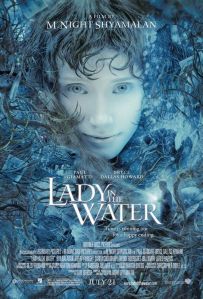
Writer/director/twist-abuser M. Night Shyamalan must have been smarting from the cool reception to his last high-concept thriller, 2004’s The Village. Shyamalan has built a reputation for smart, eerie, complex movies, as well as forced twists and endings that leave the films in shambles. He went back to basics. Lady in Water started as an ongoing story he told his kids at bedtime. His kids participated in the creation of the story. If we didn’t learn from last year’s The Adventures of Sharkboy and Lava Girl, movies where children helped shape the story should be left as bedtime stories. Lady in Water is further proof of this.
Cleveland Heep (Paul Giamatti) is the fix-it man at an apartment complex. Someone’s been swimming in the pool late at night and clogging up the filter. The unexpected culprit is Story (Bryce Dallas Howard), a waif of a girl. She says she is a “narf,” a sea nymph who’s crossed from her world, the Blue World, to ours. Her purpose is to plant the seed of change by finding a special individual. When her mission is complete a giant eagle will carry her back to her world. Cleveland accepts being her guardian and protector and assists her on her quest. He mingles with the apartment complex’s eclectic residents, trying to figure out who fits what role to help Story. There is one hairy problem. A scrunt, a wolf-like beast with twigs and long grass for fur, is after Story. An evil monkey creature is overseeing the whole weird affair.

Early on, Lady in Water was advertised as “a bedtime story by M. Night Shyamalan,” and just like your typical bedtime story, the thing feels entirely made up on the spot. The story sounds like a little kid making up a book report: “There’s this grass wolf, see, and it’s after this sea lady, and there’s these evil monkeys that oversee everything, and an eagle carries her away when she’s done, but she’s like the unknown Queen of the sea ladies, and she has helpers but can’t say who they are, and they all have special abilities, except some of them can only do stuff, and no one can see her leave.” What? Was Dio an unaccredited co-writer for this? Lady in Water feels like Shyamalan is haphazardly throwing spontaneous obstacles and rules into his story, hoping something sticks when it just muddies up the story.
Naturally, there are many unanswered questions brought about by the supernatural subject matter. Why is it an eagle that plucks Story away to safety when she?s fulfilled her mission? Wasn’t part of the schism between man and the Blue World because man moved to land? Wouldn’t something aquatic make more sense to rescue her? What about the entirely unnecessary evil monkey judge? Why is it even there? Why does it just sit there idly if the scrunt breaks the rules (and if the scrunt is a rule-breaker then why not just bust inside Cleveland’s home and eat the chick)? For that matter, if the monkey judge is so evil then why does it even respect the rules? Why don?t the evil monkey judges side with the already evil scrunts? Why do the scrunts hate the narfs so? Who established these systems of rules for narf contact and scrunt hunting? Do the monkey judges allow the narfs to get killed as long as it’s during the right time? Is it like a boxing match (“Touch gloves, to your corners, and no biting after the bell”)? And of course everyone believes this tripe. Shyamalan could fall back on the excuse that his tale is a bedtime story and not meant for extensive examination. Sure, not everything needs to be explained but that doesn’t mean Shyamalan can get away with being lazy.

There’s no finesse in the writing. Shyamalan seems to have taken his frustration with the dwindling critical reception of his works hard. The movie critic character, Mr. Farber (a droll Bob Balaban) is one of two items, either the embodiment of his ire, a figure out of touch with human emotion and the public’s trust, or Shyamalan making a preemptive strike. The critic complains there are no more original stories left in Hollywood; well, Mr. Smarty Pants, what do you think of a tale of narfs and scrunts? The problem is that the film critic is not unlikable, just cynical, and despite how dismissive Shyamalan may wish to be, the critic’s complaints and observations about the film industry are solid. In Lady in Water, characters do speak their feelings so casually. People explain back-stories and motivations like it was written on foreheads. The critic character is so inconsequential as well, so the notion that Shyamalan spends so much energy on him makes it feel like a score being settled.
What’s more irritating is how self-involved the movie comes across. The whole purpose of Story’s venture to our world is to inspire a gifted writer, a writer whose work will be seen as unchecked genius that will cause great change throughout the world. Nations will renounce war, men and women will greet each other as brother and sister, and the world will be a profoundly better place to live, all thanks to one artistic genius that changed the world. And who plays this artistic genius lying in wait? M. Night Shyamalan. In conjunction with the critic character, perhaps Shyamalan is proclaiming that his movies will stand the test of time, despite what those fuddy-duddies at their typewriters say. Lady in Water is either an intense example of artistic insecurity or an unflappable, monstrous ego.
Shyamalan is too gifted a filmmaker to make outright bad movies. However, he is prone to making very misguided choices. The addition of the monkey judge just mucks things up and more unanswerable questions. Are the monkeys like the regional overseer? Is there a tri-state office run by a giraffe with twigs on its head? Shyamalan’s plot is too formless and relies on some garish ethnic stereotypes, like the nattering Jewess and the screechy, rail-thin Korean teen. His sense of direction takes a back seat to his writing. Many moments are filmed out of focus, or the camera bounces around trying to capture whoever’s talking, always seemingly just out of reach. His visual aesthetic feels noticeably simpler. There’s a certain unapologetic yearning in Lady in Water to be a Steven Spielberg film, from the John Williams-like score, to the assembly of characters wanting to believe again, to the heaping helping of schmaltz. Lady in Water is proficiently crafted (special thanks to cinematographer Christopher Doyle) but the movie is an unmistakable artistic misfire.

Giamatti is a dependable sad sack, and he deploys an array of stutters and tics to convey how damaged Cleveland Heep is. He’s good but then he always is, no matter how stupendously awful his material may be (he did survive Big Momma’s House). Howard is one of the more beguiling and intriguing young actors in the movies right now. She bewitched me in The Village, but in Lady in Water she befuddled me. It’s hard acting as a made-up creature. Howard relies on lots of vacant, supposedly, ethereal staring. She comes across as less supernatural and more like a club kid on ecstasy.
Lady in Water is not an unmitigated disaster but it’s definitely not good by any stretch of the imagination. M. Night Shyamalan seems to fray with every new movie, and Lady in Water is by far the man’s most ridiculous and self-involved flick. He’s too great of a talent to write off, even during his misfires, but we can’t be expected to iron out his narrative kinks every time. Shyamalan’s films generally center on broken people looking for their place in the universe and finding a grander plan for their pain. Hopefully, after the birth pain of Lady in Water, Shyamalan can find his place in the artistic landscape and spare us more half-baked bedtime stories.
Nate’s Grade: C-
Share this:

The Brothers Grimm (2005)
 Director Terry Gilliam is one of the true artists working today in movies. His manic, off kilter, visually grand imagination has crafted wonderfully vivid fantasias, but it also has given Gilliam a reputation for being the captain of a sinking ship. The Adventures of Baron Munchausen is regarded as one of Hollywood’s bigger failures, unfairly I might add. A fascinating 2003 documentary called Lost in La Mancha detailed the bizarre circumstances and implosions that forced Gilliam to shut down production of his pride and joy, a film about Don Quixote. We’re talking things as out of control and unlucky as acts of God conspiring to doom this project. But then, Gilliam has always been fighting someone or something his whole film career. The studio refused Gilliam’s cut of Brazil so he sneaked out a print, showed it to the Los Angeles film community, and they dubbed it the best film of that year. Gilliam is a man governed by his idiosyncrasies. He’s blessed with a unique voice but cursed with the prospects of not having anywhere to say something (would he not make simply the most divine Harry Potter film yet?). And so Gilliam strikes his hands at something a bit more commercially minded with the action/comic fable, The Brothers Grimm.
Will (Matt Damon) and Jakob (Heath Ledger) Grimm are nineteenth century ghostbusters, so to speak. They travel from town to town ridding the villagers of evil spirits, witches, and all sorts of demonic creatures. Trouble is it’s all a lie. The Grimm brothers and their pals set up the spooks and rob the town blind. Will enjoys the fame, and especially the women, but Jakob feels apprehensive. It?s the Napoleonic wars, and the French have occupied the Germanic lands. A snooty general (Jonathan Pryce) plans to behead the two Grimm brothers unless they solve a strange case in a rural town. A slapsticky, torture-loving commander (Peter Storemare) is sent to watch over the “Grimmies.” At the village, Will and Jakob discover the town has had 10 of its daughters kidnapped with little explanation. With the help of a free-spirited woman (Lena Headey), the brothers encounter giant wolves, moving trees, lickable frogs, and the giant tower of the Mirror Queen (Monica Bellucci). The Queen was given eternal life but not eternal youth. In order to gain eternal youth, the Queen needs to take the lives of 12 hearty girls, and only the bumbling Grimm brothers stand in her way.
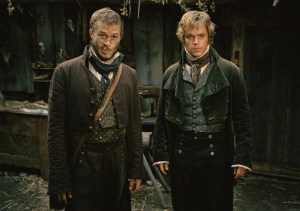 The acting is an example of the film’s messy feel. Ledger talks with marbles in his mouth. He’s putting more detail into the character than it deserves. Damon seems like he’s sleepwalking through the film, and his accent fluctuates wildly. He’s sort of a grinning straight man to Ledger’s tic-heavy daydream believer. Belluci is a ravishing beauty and proof positive for Hollywood that women over 40 don’t need to be put out to pasture. Too bad all she’s expected to do is look pretty and seductive in The Brothers Grimm. Pryce plays his role like a cartoon caricature. Stormare has already given one crazy performance this year (Constantine), and his frenzied, nearly indecipherable performance seems to be the closest to Gilliam’s whacked-out wavelength. Stormare is entertaining in every scene he’s in but can be found guilty of chewing scenery like it was a delicious candy house.
The Brothers Grimm is a gorgeous looking film. The sets are massive and greatly detailed. The location shoots in Prague seem like the perfect environment for Gilliam’s beyond-this-world landscapes. Gilliam experiments with advanced computer graphics for the first time and adds his oddball touches. A child has her eyes taken by a glob of mud, and then the mud reshapes itself into a lumbering gingerbread man. A horse spits out a spiderweb and ensnares a child. And it looks really freaking creepy. The Mirror Queen’s defeat is another standout effect as she breaks apart like shattered glass. The look of The Brothers Grimm is outstanding, but it’s what takes place inside those pretty pictures that dooms the film to mediocrity.
 The Brothers Grimm is an unfocused mess. It has disjointed subplots and several story elements that just don’t fit. The wacky French occupation feels like a leftover from a different movie. It just doesn’t work and grinds the movie to a screeching halt with every resurfacing. The Brothers Grimm will routinely work its way into a narrative corner and then use a “magic” cheat to escape (magic axe, magic mirror, magic kiss). Gilliam has always been a master maestro of chaos and visual oddities, but this time he’s tackled a film with a very weak script by Ehren Kruger (Ring Two). Kruger doesn’t bother laying the groundwork of his magical world or establish the rules. Therefore anything can happen and rarely feels satisfying. The characters are one-note, each given a single character trait to play with (skeptic, believer, idiot, etc.). The pacing is pretty sluggish. The first act takes an eternity to set up the film’s characters, plot, and yet it still feels sloppy. The twists and turns are easily telegraphed and unexpectedly boring. The plot is frustrating, shortsighted in scope, and far too conventional for Gilliam’s tastes. When The Brothers Grimm reaches its happy ending you’ll swear you can hear Gilliam gagging somewhere.
Gilliam adds a worthy macabre tone to the film. There will be touches that you know are pure Gilliam, like a woman skinning a rabbit as she talks, or a cat flying into the blades or a torture device. In fact, The Brothers Grimm has a lot of humor involving the comic demise of animals. This isn’t exactly a film appropriate for young children despite the appeal of a fairy tale background. The film wants to tweak fairy tale legends like the two Shreks, but Gilliam wants to make them disturbing nightmares, not something of irreverence. This puts the film’s tone at odds. One minute you’ll have a scene that?s morbid, darkly funny, and unconventional, and then the next minute you’ll have a scene that’s cliché, dull, and whimsically misplaced.
The Brothers Grimm feels like a Terry Gilliam film under glass. The script is weak and plodding, the characters barely leave a dent, and the tone is uneven. The plot is pulled in too many directions and lacks momentum. There are a handful of fun comic diversions but the movie feels like a loose collection of disjointed story elements. There are flashes of grim humor and visual elegance but more often than not the film is just stupendously boring. The Brothers Grimm feels the same way the Coen brothers’ Intolerable Cruelty felt: a unique vision compromised and downsized by studio conformity. You can see the indie spirit but the heart just isn’t beating. The Brothers Grimm is mediocre at best. How very grim indeed.
Nate’s Grade: C
Share this:

Shrek (2001)
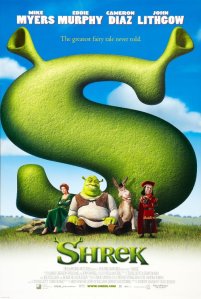 Shrek is Dreamworks’ kick in the pants to fairy tales and some of the staple creations of the Mouse house. There’s nothing a bug eating green ogre named Shrek likes more than his peaceful privacy. But this is brought to an immediate halt when all sorts of fairy tale creatures invade his swampy domain. To regain his privacy Shrek takes it up with Lord Farquad (say the name fast) who agrees to relocate the fairy tale creatures he outlawed to Shrek’s swamp in the first place if he travels to a castle and rescue a princess. Shrek agrees and along the way gets a buddy for the trip with a talking donkey, named appropriately enough, Donkey.
Shrek is amazing world of computer artistry. The characters move so life like and the detail is so magnified that it is a living and breathing world all its own. Mike Myers and Eddie Murphy are the comic duo of Shrek and Donkey and provide a good portion of laughs on their journey. With Mulan and now Shrek, Murphy seems like a natural when it comes to animation voicing. He gives it his all. Cameron Diaz is also a nice contributor as the voice of Princess Fiona, which kinda’ looks like her too creepily enough. Rounding out the cast is the always over-the-top John Lithgow as the stilted Farquad.
The humor of Shrek is enough to please kids with the fart and burp jokes, but lends its aim for more adult humor as well. There are a few jabs at the Disney Empire that are more than hilarious and the story keeps them coming. Shrek turns out to be a delightful tale of an ogre who’s a green softy at heart.
Nate’s Grade: A


 nathanzoebl
You must be logged in to post a comment.