Blog Archives
The Phoenician Scheme (2025)
 It’s so nice to connect with a Wes Anderson movie again. I’ve been mostly a fan from the beginning but his career has as many ups as downs for me, often getting lost in his distinct dollhouse style of artifice and losing the sense of wounded humanity that marks his best movies. I haven’t truly loved a Wes Anderson movie since 2014’s The Grand Budapest Hotel, which I consider one of his very best. It’s been a long ten years of feeling indifferent or distant to that signature Anderson twee whimsy. I took my wife to see 2021’s The French Dispatch in the theater, and this was her first Anderson movie, and it also happened to be his worst movie, plus with Timothee Chalamet, an actor she isn’t fond of. I feel like I ruined her impression of this indie auteur and the question over his enduring popularity. 2023’s Asteroid City had some interesting ideas and dramatic potential, but its multiple framing devices and layers of obfuscation smothered what I could have enjoyed about its drama buried underneath. It is with that accruing disappointment that I began to question whether new Wes Anderson movies just weren’t for me, and that’s why I find The Phoenician Scheme a welcomed return to form that makes me relieved. The idiosyncratic tactician that is Anderson can still make a movie that engages me on different levels, including an emotional one, which I’ve been missing for so long from his recent output.
So I’m going to do something a little different with this review. I’m going to specify and articulate why this movie works for me, namely why it resonates and succeeds where his other movies of late have not. I suppose you could argue every film critique is charged with explaining the nuts and bolts of an opinion, but I’m going to really try and crack open why The Phoenician Scheme is a better movie overall.
 1) Emotional investment. Primarily Anderson is known for his heavily mannered, expertly curated style, which is why he seems to be the go-to pastiche for A.I. film juxtaposition experiments (“What if Wes Anderson directed Star Wars?” etc.). Many of Anderson’s movies are populated with hurt people trying to reconnect, a subject that has great emotional appeal. However, if you cannot connect with the characters or their dynamic or the relationship stakes, then it can feel like an afterthought to all that fancy production design and camera placement. With The Phoenician Scheme, the movie is an adventure film but it’s really about a father (Benicio del Toro as Zsa-Zsa Korda) trying to reconnect with his estranged adult daughter (Mia Threapleton as Sister Liesel). The father is a billionaire robber baron set in a vaguely mid 19-century setting. The daughter is a newly enshrined nun who believes that her father had her mother killed. Right away, we have very different perspectives and exciting conflict between them. He’s an arms dealer and willing to have key parts of his scheme involve a famine and slave labor. Her very involvement in the convent is itself a reaction to her father, who sent her away to live there at age five. She doesn’t want to be like him, who she views as on the wrong side of morality, but she also wants to get to know this man better and get her own answers. Her convent needs her to proceed to get a significant donation from her father. He wants to hire her on a trial basis to see if she’s fit to be his sole heir. They’re stuck together on an adventure that forces them closer, and the ensuing relationship that begins to build, with old hurts melting away to new revelations and new aches of yearning, comes across as very involving and emotionally rewarding. I was actually quite taken by the father-daughter relationship and their bickering, which organically gives way to better understanding and personal growth from both parties. They make each other a little better than they could be, and they recognize that despite their differences and hurt, they do genuinely care about the other. Korda is such an unflappable dilettante and yet the very notion that his daughter thinks he might have killed her mother from rumors deeply upsets him. The rest of the movie is essentially both characters directly and indirectly trying to prove themself to the other and also acknowledge and accept the other person. The core of this movie works because the core relationship is given serious and deliberate development to be meaningful. It’s about a broken family recognizing their connection to one another and desire to be connected.
2) The vignettes do add up. The folly of The French Dispatch was that it was a collection of short films, meaning that every twenty-minutes or so it felt like having to start over again with character introductions and relationship development. It didn’t feel like it added up to much. With The Phoenician Scheme, the film is structured around the different investors that Korda has to convince to cover a higher percentage of a budget shortfall for the big plan. It might sound pretty lackluster on paper but it becomes a larger goal that each segment builds to, and each new investor and setting allows Anderson to explore a new aspect of his characters. One situation involves a literal game of basketball and another involves taking a bullet to save an investor. Each situation allows us to change things up without losing the momentum of building toward that larger goal, as well as continuing to build the progression of the character relationships. With a vignette movie, each segment is a beginning, middle, and end that starts over with the next. With this, we have those mini stories with each new investor, but the whole is still advancing. It allows Anderson to explore a variety of comedy and story options while still keeping his attention to the bigger picture, thus earning our continued investment and more payoffs.
 3) This is still a very funny movie. That droll yet whimsical tone we expect from Wes Anderson is very present, and I was smiling and laughing throughout. I particularly loved a running joke where Korda offers each new guest a hand grenade like a welcome present. Korda also has repeated assassination attempts, which is the impetus for him reaching out to his daughter because he knows he won’t outlive every assassination attempt. However, in the meantime, each new assassination attempt is presented as another predictable annoyance, and I enjoyed that with every one Korda admits, “I think that guy used to work for me.” The basketball game of horse is wonderfully absurd and dryly serious at the same time, elevated by Bryan Cranston’s considerable commitment to the bit. Another great source of comedy is Michael Cera as the third significant character to the adventure, Bjorn, an assistant to Korda and also an entomologist. He’s such a delightful nonplussed addition to the trio, providing an outsider perspective to the family drama and reminding us how not normal everything is. I heartily enjoyed how his nerdy passion for bugs keeps inserting itself in all sorts of unexpected situations. The excesses of Korba’s lifestyle, and his seeming history of amorality, allows for just about anything to be possible or referenced, opening the comedy even further into surreal asides still tethered to characterization.
4) The added religious elements provide a deeper introspection for the characters and the viewer. Every time Korba has a near-death experience from his latest assassination attempt, we have a black and white sequence of Korba interacting with the afterlife. In one sequence he’s being judged by St. Peter, then God, then his own deceased wives. Each opportunity with the afterlife is a reminder for Korba about his sins and mistakes and a motivator to do better. The stylized realm is mysterious without being overt in its directions, allowing Korba to stumble around looking for guidance, like when God is annoyed that He isn’t recognized as the Big Guy. I was amused by these little interludes but they also act like a moral intervention for our main character, and his growing interest is a sign that his daughter’s influence is affecting him. It adds a depth to the character as well as a weightier sense of celestial consequences for a life of misdeeds, and it helps to better realism the character’s arc as well as set him up for change. It allows an introspection over legacy. These are also the segments you’ll get the most blink-and-miss-them cameos, like Bill Murray, Willem Dafoe, Charlotte Gainsbourg, and F. Murray Abraham.
 5) Smaller ensemble to devote characterization. Everyone wants to work with Anderson, and he keeps an impressive list of actors who continuously reappear, even if it’s only for seconds, anything to just be back into the ornate world of a Wes Anderson fantasy. His last few films have been stuffed with characters but there wasn’t enough for everyone to do (go ahead, try and remember what Steve Carrell did in Asteroid City). The narrative gets fractured trying to provide enough moments and screen time for all these distaff characters. A larger cast is not inherently a doomed prospect, but it does mean more attention and development needs to be made, and with less time, to ensure those characters are meaningful and well developed. The French Dispatch and Asteroid City couldn’t do that for me. This time Anderson condenses his important characters down to a manageable trio. We have other supporting players but they typically come and go through the different vignettes, each getting their turn with the main players. This keeps the focus on the winning character dynamic of the father-daughter buddy comedy, and with Bjorn bumbling along and finding himself becoming more fond of Liesel. There are some fun twists and turns with the three characters but no matter the external obstacles or silliness, the emphasis remains on these three and their relationships. It all works so much better.
6) The acting by the Anderson newcomers is greatly enjoyable. It’s shocking that this is the first time Michael Cera (Scott Pilgrim Takes Off) has been in a Wes Anderson movie because his comic sensibilities are a natural fit for this universe. The direction his character goes lets Cera have even more ways to have fun, and each new turn made me love his character and the performance even more. I also love that, despite all the revelations, at his core, Bjorn really is a nerd who loves talking about insects. The real discovery is Threapleton (The Buccaneers), though maybe we shouldn’t have been so surprised considering she is the adult daughter of Kate Winslet (do you feel old now too?). She holds her own with her many scenes with del Toro and is able to hone her withering glare into a considerable weapon of disapproval. Watching her character blossom and test her boundaries, like when she says she’s only drank communion wine and is introduced to a new form of alcohol at every jaunt that she feels compelled to try. It’s a character that is slowly recognizing more about herself and the possibilities of this life.
 The Phoenician Scheme isn’t a deviation from the tried-and-true Wes Anderson formula; it’s a better calibration of what makes that style and formula continue to resonate for so many fans. I’m apparently in a small minority with my esteem for this picture, and that’s fine by me. I’ve outlined through this review the reasons why it was a much more enjoyable and worthwhile entertainment for me, and if you found yourself nodding along, then perhaps it could work its query magic on you as well. It’s nice to be charmed again by a Wes Anderson movie but to also feel something rather than distant appreciation for the carefully composed sets and photography. I actually cared about these characters and their journey. The end results mattered to me. Their plights mattered. If you’re like me and falling from the Wes Anderson bandwagon, then perhaps The Phoenician Scheme might pull you back aboard.
Nate’s Grade: A-
Share this:

How to Train Your Dragon 3: The Hidden World (2019)
 How to train your expectations for the concluding chapter in the How to Train Your Dragon franchise: step one, lower them. I was dispirited to discover what a disappointing final chapter The Hidden World comes across, especially considering the previous movies, including the 2014 sequel, are good to great. At its core it’s always been a tale of prejudice and family, dressing up a simple boy-and-his-dog story with fantasy elements. It also presents a world with danger and cost; even the fist film ended with the main character, Hiccup, losing a freaking foot. He loses his father in the second film. It’s a series that has grown naturally with heart, imagination, and a real sense of stakes. This is why I’m sad to report that the third film feels like a different creative team made it. The villain is a repeat of the second film, a dragon hunter with little to be memorable over. The plot is very redundant, stuck in an endless loop of capture, escape, capture, escape, etc. The addition of the new lady dragon is a perfunctory means to drive a wedge between Hiccup and toothless, his dragon. The lady dragon has no personality and needs rescuing too often. Her inclusion relates to a rather regressive emphasis on the need for coupling and marriage. The titular Hidden World amounts to a grand total of five minutes of screen time. The action starts off well involving the various colorful side characters but misses out on that sense of danger that defined the other movies. It feels goofy and safe and listless. How to Train Your Dragon: The Hidden World is a sizeable disappointment and coasts on the emotional investment of the first two movies. You’ll feel something by the end, sure, but it’s because of the hard work of others and not this movie.
Nate’s Grade: C
Share this:

Inside Llewyn Davis (2013)
 “There’s no success like failure. And failure’s no success at all,” Bob Dylan wrote. He could have been talking about any number of characters in the oeuvre of master filmmakers Joel and Ethan Coen. Losers and has-beens and could-have-beens fascinate the brothers, and their newest film certainly follows this model. Llewyn Davis (Oscar Isaac) is a struggling musician in the 1961 Greenwich Village, New York folk scene. He rotates crashing with various friends, unable to scrounge up enough money to ever pay his own way. His musical partner recently killed himself and Llewyn has been trying to get traction with his first solo record. His world gets even more complicated when Jean (Carey Mulligan) reveals that she’s pregnant; the baby’s father may be Llewyn or Jean’s husband and fellow performer, Jim (Justin Timberlake). Llewyn can’t catch a break.
Inside Llewyn Davis is a classic Coen creation, a character study of a misanthropic loser trying to find direction in a comical universe of indifference. I greatly look forward to every Coen picture and that’s because nobody writes characters like they do. There are no throwaway characters in a Coen universe. Even minor characters like the elevator Attendant or Manager’s Secretary are given sparks of personality, each fully formed figure creating a richer canvas. There is great pleasure in just listening to their characters speak, in natural cadences yet elevated with grace. Inside Llewyn Davis is no exception. Their storytelling is always rife with wonderful comic surprises and pit stops. The Coens are such brilliant technical craftsmen, that every shot is gorgeously composed, even without longtime cinematographer Roger Deakens (to give you an idea how old this movie was, Deakens was busy filming Skyfall). The music, supervised by O Brother maestro T. Bone Burnett, is impeccably performed and quite lovely to the ear, if you’re into folk music arrangements. If you’re not, well, it’s going to be a long movie experience.
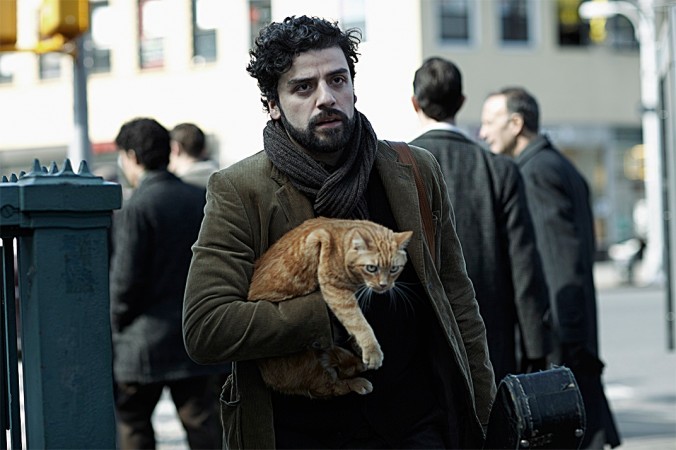 But here’s the problem with Inside Llewyn Davis: the film will likely turn off most people. It’s not a comforting movie by any means. We’re stuck following a self-destructive struggling musician bounce around couch-to-couch, chasing dreams that will never seem in reach. And Llewyn is a tough character to love. He’s surly, careless, selfish, egotistical, and also jaded. And he’s just about the only character in the movie. Most of the other famous faces are fleeting supporting players. Only Mulligan (The Great Gatsby) is given a plurality of scenes to expand her perturbed character, and even those may not be enough. Much like Llewyn’s musical direction, this is a one-man show, and he’s not cuddly. But an unlikable protagonist is not uncommon. The Coens tease so many different directions for Llewyn to go that it’s likely that audiences will feel some degree of disappointment where the film does end up. It’s a circuitous path, proving Llewyn is the architect of his own fate, but at that point audiences may not care. They may just be happy to watch Llewyn punched in the face. The plot is pretty light, running into a series of various self-contained scenes, and there isn’t much in the way of closure. I’ve watched the film twice and while I appreciate it more I’m certain that Llewyn Davis will leave a majority of people feeling cold, more so than even A Serious Man.
Unlike former Coen creations, notably in A Serious Man and Barton Fink, our titular character is the architect of his own misery. He is a musician that identifies with an older class of folk artists, something that strikes him as genuine and touching the soul. He cannot stand artistic compromise. He won’t even accept a winter coat from his music manager. He wants no handouts. He chastises Jean about her and Jim’s attitudes toward the business, calling them “careerist” and “a little bit square.” To Llewyn, to sell out is the worst crime. Jean says that they’re just doing what they can to raise up the musical ranks, and maybe the songs aren’t top-notch, like a catchy but instantly dated novelty song about the Space Race (the sure-to-be Oscar-nominated “Please Mr. Kennedy”), but they’re commercial, they’re finding an audience, they’re making inroads, partially as a husband/wife act and partially due to their own physically attractive appearances, and it frustrates Llewyn greatly. A great example is early in the film a young Army vet on leave performs a wonderfully pure song with a beautiful voice. Llewyn scoffs at the mawkish nature of the tune. “He’s a great performer,” Jim advises. Llewyn takes umbrage at the distinction; a performer is not the same as a musician. The people getting ahead are the performers, the sellouts. One of Jean and Jim’s rising hits, “500 Miles,” lyrically suggests it was an old slave song that has been repackaged and homogenized for safe consumption. Llewyn is going to stick to his guns and make it on his own terms, with expected results. Late in the movie, after Llewyn performs before a record exec (F. Murray Abraham), so aching and affecting as he puts it all into the song, the exec simply responds: “I don’t see a lot of money here.” However, the exec offers Llewyn a chance to be in a trio he’s putting together, if he cleans up and knows how to keep to the background. It’s a real opportunity. Just not for Llewyn.
It all comes down to legacy and Llewyn contemplating what his will be. His singing partner is now defined by his death, finding cruel irony in their song, “If I Had Wings.” His father is known for his long dedication to the Navy, but now he sits alone in a nursing home, a prisoner to his own infirmary and defeated mind. A road trip partner, the pompous jazz musician Roland Turner (a royally hilarious John Goodman), seems like a Ghost of Christmas Future visit from a possible future Llewyn, the artist who’s an iconoclast only in his own mind. Throughout the film, Llewyn is beset with choices, different options he could take, one in particular stemming from a revelation involving an old girlfriend. And yet, much like the thematic nature of folks songs, we’re told, Llewyn looks for something new with something old, be they routines, goals, or occupations. The folk music scene is on the cusp of change with a more commercialized pendulum swing, as evidenced by a surprise new performer at the Gaslight in the closing minutes. Llewyn is contemplating his life beyond the world of show business and where he goes next.
 And if there is a sad aspect to the Coens’ tale, it’s that Llewyn really is a talented musician. This is a breakout role for Isaac (Drive, Robin Hood) especially when you consider that he did all his own singing and guitar playing. It’s one of the most astonishing musical performances by an actor I’ve ever seen in a movie. The level of craft at command, the different slivers of passion he carefully puts into the performances, the trembling emotion, the merging of himself with the song. There’s a reason the Coens open the movie with Isaac performing the full rendition of “Hang Me, Oh Hang Me.” It crystallizes right away where the man’s talent level is, both the character and the actor. We’re left to then wonder why he hasn’t found his place in the industry, and the rest of the film is the explanation. This is the first film since perhaps 2007’s Once where full-length performances of songs really do move the story forward (I’m obviously excluding traditional musicals). Some have labeled the heavy use of song as lazy, distracting from an undercooked narrative, but I can literally go through every song in the film and justify its existence. Each tune, and the performance and performers, gives insight to character, plot, and state of mind.
Inside Llewyn Davis is an easy movie to admire but a harder one to love, unless you’re a fan of the Coen brothers or folk music in general. The protagonist is unlikable, his struggles his own doing either by hubris or integrity, the plot is rather loose with scattered supporting characters, and the film ends on a somewhat lackluster note that feels inconclusive. But then I keep going back to the richness of this world, the pop of the characters, the lyrical beauty to the unvarnished songs, and the concept of folk music as its own sense of purgatory (here me out, folk fans), the idea that we seek something new with something old, and so we follow in circles, like Llewyn’s onscreen journey. Isaac gives such a strong performance that you almost wish his character could catch a break. Almost. This is another technical marvel from the Coens, filled with their dark humor and their sense of cosmic melancholy, but Inside Llewyn Davis may ultimately find some strange sense of uplift as Llewyn continues to hold to his ambitions even as the world around him is changing, losing sight of artists like him. As long as we have the Coens, the Llewyn Davis’s of this world will get their due in one form or another.
Nate’s Grade: A-


 nathanzoebl
You must be logged in to post a comment.