Blog Archives
Haywire (2012)
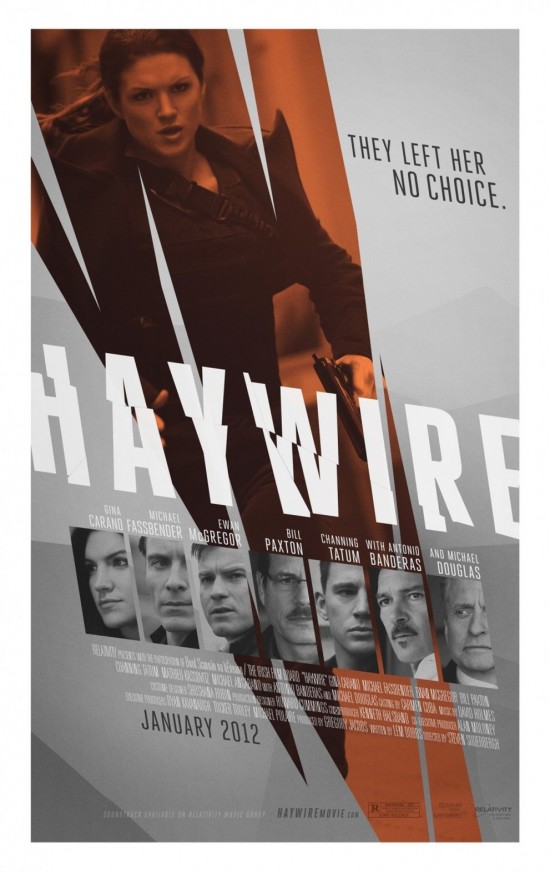 Haywire is director Steven Soderbergh’s experiment in the field of the action thriller, and it’s sparse and arty and pretty boring too. Soderbergh takes another non-actor, this time MMA fighter Gina Carano, and builds a spy thriller around the talents of this imposing fighter. Carano is no actor and her flat line delivery will routinely remind you of her limitations, but man alive does this woman just kick ass. To Soderbergh’s credit, the fight scenes occur in longer takes at a safe distance so that we the audience can watch and comprehend. Carano impresses as a physical specimen, both as a fighter and in other ways (she’s certainly got movie-star looks). I just wish this had been a more traditional action movie instead of Soderbergh’s jazzy, clinical genre experiment. There’s a handful of fights and a handful of chases, but mostly the plot is tied up in knots of who betrayed who and why. The dialogue volume is also curiously kept at a very low level, which obscures many conversations (I was forced to turn on the subtitles just to keep up). The plot itself is such a familiar rehash so why doesn’t Soderbergh pump it with more action? A bevy of stars appear in this thing (Ewan McGregor, Michael Douglas, Antonio Banderas, Michael Fassbender, Channing Tatum) but gives them precious little to do. Unless Haywire is in fight mode, it’s a rather soggy bore. The minimalism in a genre known for bombast is commendable but when that minimalism also stretches into plot and character and pacing, then you’ve entered into another Soderbergh indie experiment. For my money, Haywire is too sparse, too generic, and too dull to recommend, but I’d love to see more of Carano cracking skulls.
Nate’s Grade: C
Share this:

Beginners (2011)
 Burying a parent is one of the most gut-wrenching hardships of life, a passage I have thankfully not had to endure yet in my own life. Writer/director Mike Mills (Thumbsucker) turned his own heartbreak into a subdued, life-affirming movie called Beginners. This gentle movie is comic, poignant, and frustratingly limited thanks to a miscalculation in its structure.
Oliver (Ewan McGregor) is reeling from the loss of his elderly father, Hal (Christopher Plummer). After the death of his wife, in his seventy-fifth year, Hal came out as being gay his whole life. And he decided to have some fun in those last years too, notably with a hunky younger boyfriend (Goran Visnjic, remember him, ER fans?). We get several flashbacks with Oliver and his ailing father, who was diagnosed with stage four lung cancer soon into his gay reemergence. In the present, Oliver, as a dissatisfied graphic designer, is trying to find his bearings after burying both of his parents. Hal’s dog, a Jack Russell terrier, is mourning as well, refusing to be left alone. As a result, Oliver takes the small dog with him wherever he travels, including social events. He meets Anna (Melanie Laurent) at a friend’s costume party. He’s dressed as Sigmund Freud and she mimes having laryngitis. Anna, a young actress who spends most of her life in hotels, invites him back and the two explore the possibility of a relationship. She’ll be off to another film shoot in a month, but the two become inseparable during the time they have together. Anna learns about Oliver and his complicated relationship with the complicated man he knew as his father. Oliver, and in flashback Hal, are beginners on a road to making sense of their lives.
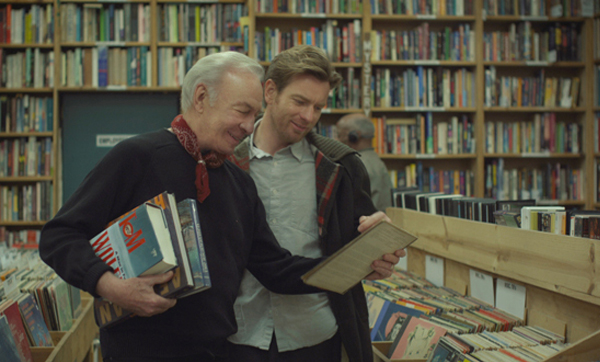 What eventually holds Beginners back is its clipped structure. The film diverges into two main storylines, father and son (60%) and son with new love (40%). The new love stuff is presented fairly linearly, however, the father/son material is not, consisting of memories that can be triggered by objects or offhand sayings. Like (500) Days of Summer, memories are presented not in a linear fashion but through a connection of theme or tone. Rarely do we recount memories in a chronological fashion, and as such Oliver is beset by deluges of images of his father ailing at various points. But it’s like Mills took that fleeting memory approach to heart because Beginners is a slave to the altar of jump cuts. The editing, and the narrative, is constantly leaping forward; scenes rarely last longer than 30-45 seconds, making the film feel like somebody had their finger mashed against a stubborn fast forward button. As a result, the film feels hurried and unsettled, and this clipped structure mollifies the emotional impact of the movie. It’s because the romance only feels like someone’s remembrance of those burgeoning happy beginnings. The film doesn’t feel like it is in its own present; we’re in 2003 and Oliver will occasionally inform us, in High Fidelity-styled notation, of life at that moment. It feels like the entire enterprise is an assembly of past memories ping-ponging off one another. Another hurdle is that Anna and Oliver’s main conflict concerns their fear of happiness. Each had parents who wed as unhappy people, had unhappy unions, and both are fearful that they too will commit to living unhappy lives. It’s not an impossible feat, to be sure, but it does make it somewhat harder to relate to your characters when the main relationship problem is that they cannot accept happiness. While psychologically interesting in larger scope, due to the structure of Beginners, this conflict for Anna and Oliver seems petty and insufficient. The antsy story structure limits the emotional resonance of the movie. What should be a nourishing meal about the human condition ends up being a tidy snack instead.
Don’t get me wrong, Beginners is still a fairly moving film in its own right. Just the very nature of the story, dealing with the last months of an ailing parent and what to do next, is destined to hit poignant pockets of drama. Plus you have gifted actors doing fine work to wring out those tears. Mills’ tale is semi-autobiographical, which allows for several personal insights that can wound, like direct shots of honesty. Oliver narrates the steps taken after a parent’s death, including the mundane yet painful trivialities needed to convince every bill collector that their client has left the Earth. When Hal is informed that he has a spot of cancer the size of a quarter in his lung, the screen flashes to black as the doctor continues her somber diagnosis. A quarter appears. Then five nickels, finally twenty-five pennies. It’s a small little visual insert, and yet it manages to seem like a believable, personally relatable moment when delivered such thundering news. Something the size of a quarter will be responsible for your father losing his life. Five nickels. Twenty-five pennies. The scenes with father and son, coming to terms with saying goodbye, reflecting on lives lived and lives deferred, is what gives Beginners its beating heart. The clipped present-day romance plays more like a post-script attempt to forge a neat resolution after all that heavy grief.
Plummer gives a performance that is equal parts weighed with the gravity of death and the electricity of life. After his wife’s death, Hal finally has an opportunity to embrace who he has been his whole life. Mills and Plummer are delicate with how they handle the relationship between Hal and his wife (Mary Page Keller in flashback). Neither hated the other, and both did express love, but they were together in a marriage of convenience, both of them hiding who they were from preying eyes (Oliver’s mother hid that she was Jewish). Plummer’s celebration of life, the twinkling realization of accepting who you truly are, is an uplifting path for his character, and thanks to both Mills and Plummer it never feels like he’s dancing on the grave of his long-suffering wife. He’s not celebrating her death; he’s embracing who he is in the twilight of his years. He’s looking for a small amount of kindness and comfort while finally being socially recognized without fear or intimidation. Plummer is delightful during Hal’s happier moments and heart wrenching during the realities of his failing body. Plummer deftly bites into one of those juicy, Oscar-bait roles.
 McGregor acts very well even if his character is kept in a very tight box of emotional expression. His character seems to sleepwalk from scene to scene; often little is said and much left to the imagination through pregnant pauses or gestures. McGregor does a fine job of balancing the different timelines of grief his character is experiencing. He’s in comic shock about his father’s newfound immersion in a gay lifestyle, he’s in mourning about the recent loss of his father, he’s in annoyance tinged with guilt about the burdens of taking care of a man that was often absent in his own life, leaving him in the care of his mother, resigned to a life of dutiful despondency, and he’s infatuated with the possibility of romantic love, a cleansing force. It’s a lot for one actor to keep straight and McGregor does an admirable job. Laurent does not fare as well. The Inglourious Basterds‘ actress is forced to rely mostly on wry smiles and her penetrating eyes. She also cocks her head to the side a lot, or a least that’s how I recall. She’s given something of a thanklessly underwritten role but she manages to be adorable from her first moment onscreen, which is her most vital acting accomplishment here. She’s supposed to be that happy ending we want Oliver to have.
Beginners is a moving, charming, and perceptive movie. If only there was more of it. The clipped, hurried jump cut-heavy structure keeps the audience at a certain distance and capping the emotional resonance. The father/son stuff is going to be easier to empathize with, both good times and bad, than two good-looking thirtysomethings afraid of being happy because their parents are screwed up. Ultimately, the film’s pretenses of a budding, quirky romance will take away from the more genuine father/son bonding late in life. You’ll get weepy at turns, maybe even swoon here and there, but the rewards are sadly too momentary, never cohesively assembling into a full-fledged narrative. Beginners has an equal number of hard truths and light moments of whimsy (the subtitled dog is a hoot), but ultimately it’s a movie that makes you wish it had left a better impression when it had the chance.
Nate’s Grade: B-
Share this:

The Ghost Writer (2010)
 Ewan McGregor (Angels & Demons, Big Fish) stars as The Ghost (no, he never earns a name even in the closing credits). He’s an expert ghost writer for best-selling autobiographies, and his services have been enlisted for his biggest client yet. Adam Lang (Pierce Brosnan) is a former British prime minister currently embroiled in a legal scandal. He’s being accused of handing over British citizens to the United States to be tortured, all in the name of the War on Terror. Lang and his wife (Olivia Williams) have holed up in a fabulous house along Cape Cod, hiding from swarms of international media. The book’s due date is soon approaching and nobody is really pleased with the first draft. Mike, the first ghost writer, can’t help with the revisions on account that his abandoned car was discovered on a Massachusetts ferry and his body washed ashore the next day. The Ghost begins to suspect that Mike somehow stumbled across some very potent and damaging information, and the secrets are hidden somewhere in that manuscript.
Consider me pleasantly surprised at how effective this small little political thriller turned out to be. It doesn’t have an overworked narrative agenda, but the few things it does it does quite well. Firstly, it’s a pleasure for a thriller to actually make the audience feel as paranoid as the main character. He treats the idea of a conspiracy as nonsense to begin with, but then he starts to second-guess that car traveling behind. What about that guy two blocks down talking to himself? The screenplay achieves a palpable sense of paranoia, nicely placing you in the emotional state of our lead. You may run questions through your head as well, wondering who can ultimately be trusted, who to turn to next, what information to divulge and to whom, whether to get into the mysterious car or not. The best “thriller” moment is the Ghost waiting in his car and driving for cover, but even that is done in a style that doesn’t feel ripped from an action blockbuster. I’ve watched so many thrillers that get by on studious attention to the routines of the genre, and while The Ghost Writer doesn’t exactly break new ground, the movie keeps the threat of danger real. Actually, on that very note, The Ghost Writer does something unexpected, which is that it begins to lull you into a false sense of security or complacency, and then it robs you of that sense of security in the end. I enjoyed the film’s climax, though even at my screening I heard dissatisfied grumbles on the way out.
 The movie is without exchanges of gunfire, explosions, or any nefarious, shadowy individual pressing a red button and laughing maniacally. The Ghost Writer exists in a world very similar to our own. It’s a conspiracy thriller in the same vein as The Constant Gardener or Michael Clayton. The menace is far more subdued; the danger getting tighter as we push forward yet the threat feels deceptively relaxed. It’s the kind of conspiracy thriller that feels like a workable conspiracy, which means that most of the dirty work is implied or done behind the scenes. This means that you have to work a little harder to engage with The Ghost Writer because it chooses not to spell out its litany of danger and those who are dangerous, but it also makes for a more effective experience of paranoia. The film even seems to follow this edict in its visual presentation. The movie has an eerie cool feel to it thanks to the downcast, icy blue-hued cinematography and sleek, sparse art direction, suggesting something is amiss but you can’t quite put your finger on what. It’s also continuously raining, a favorite, if overused, cinematic metaphor.
The Ghost Writer intelligently explores a current international imbroglio, making the political crisis relevant without reaching for a soapbox. The politics of torture is a topic that doesn’t appear to be disappearing any time soon. Torture also provides a fine, morally queasy subject matter to dive into and pick apart. Willful involvement in torture presents several ethical challenges for a character (unless you’re Jack Bauer), which can prove to be a meaty area to watch gifted actors chew over all that rueful decision-making and hand wringing. But alas, this is not a message movie like the slew of 2007 Iraq/torture films that fell flat, mostly because those lukewarm-to-awful movies felt a message supplanted entertainment. The Ghost Writer is a piece of entertainment first, an adult and a cerebral movie that has a striking sense of humor. The dialogue is surprisingly quippy, full of great one-liners amidst all the peril and uncertainty. So while the movie has some points about global politics, ownership and responsibility, the role of media and rewriting history, the movie doesn’t commit entertainment suicide trying to service a message.
Personally, I found the behind-the-scenes work of a ghost writer to be just as interesting, if not more so, than the conspiracy unraveling. The editing process can be fascinating for such a high profile political leader; deciding what moments to emphasize, what moments to forget, what narrative will be fashioned to make sure that a politician comes out on top, spiting his enemies without looking bitter. It’s a delicate balancing act and a precarious responsibility for the ghost writer, controlling a human beings life story for the annuls of mass market history. And these ghost writers get no recognition, even after mimicking the speaking/writing styles of their subject, and these are often subjects who are used to having their thoughts and opinions groomed, tested, and prepared by others, so what difference does their autobiographies make? I believe Sarah Palin could not write her own name without the aid of a ghost writer and/or a bevy of trained subordinates. While this storyline pretty much expectantly falls by the wayside once the conspiracy stuff emerges, I felt that the movie did a respectable service to honor ghost writers everywhere (Palin’s own ghost writer was Lynn Vincent).
 The cast all seemed to dig their juicy roles, judging from the performances. Brosnan and Williams are obviously playing versions of Tony and Cherie Blair, so it’s fun to watch both actors enjoy their thinly veiled roles. Brosnan (Mamma Mia) is terrific and Williams (An Education) has this disquieting calm about her that only breaks in a handful of telling moments. Many actors have these small, sometimes one-scene, parts but they make the most of them. Kim Cattrall is spunky as Lang’s loyal personal assistant (her accent isn’t flawless, but that alone is better than her work in the Sex and the City movie). Tom Wilkinson (Duplicity) also shows up as an Ivy League professor with a mysterious background, and the man knows exactly how to play a treacherous gentleman. You may be shocked to see a bald-headed, bulldog-looking Jim Belushi appear on screen, and he’s good too as a publishing exec with no patience for niceties. But the movie is McGregor’s and the actor does not disappoint. It’s pleasing to watch his character transform from observer to actor. He’s a charismatic guy that speaks his mind and a worthy hero to root for.
And it took until the final paragraph for me to mention director Roman Polanski’s current legal woes. The Ghost Writer was Polanski’s last film he directed before being obtained by Swiss authorities and set to be expedited back to California for a 30-year-old rape charge. It’s hard not to read somewhat into the premise: a man hiding from authorities with a charge hanging over his head. This may well prove to be the last film we’ll see from the 77-year-old director judging from the pending legal issues. If it does indeed serve as the last piece in the career of a talented director, it will at least be a high point. At least Polanski’s last film wasn’t the abominable Ninth Gate.
Nate’s Grade: B+
Share this:

The Men Who Stare at Goats (2009)
 This movie was a big letdown given the cast, the strange true origins of this fantastic tale, and even with the title. This odd little film feels tonally off. The material feels mishandled, mixing broad humor and with military satire and the dark realities of the war in Iraq. The premise is solid — a Pentagon program training psychic soldiers, men convinced they could run through walls or terminate goats through the power of thought. Why then does the movie feel so misguided and rudderless and, ultimately, boring? Never has such an outlandish concept, based on true events, felt so devoid of edge. The satire picks safe targets and the comedy remains farcically broad. I think the film’s downfall can ultimately be traced to the decision to turn this material into a fictional narrative. I would have preferred an actual documentary detailing the men, women, and goats involved in the real Pentagon program. If truth can be stranger than fiction, why dress it up and then dull it through fiction?
Nate’s Grade: C
Share this:

Angels & Demons (2009)
 Angels & Demons works better as a movie. It is a better movie than The Da Vinci Code, but since I found that film to be one of the worst of 2006 you should know this is not high praise.
Professor Robert Langdon (Tom Hanks, with a better haircut) is the world?s foremost expert on ancient symbols and texts, which is why the Vatican recruits him for a very important mission. The Pope has recently died and Vatican City is in the middle of the cardinals deliberating who will be the newest leader of the Roman Catholic Church. Four of the cardinals, top candidates for the Pope position, have been kidnapped. The Illuminati, a centuries-old secret society, says that a cardinal will die every hour, from 8 PM to 11 PM, and then at midnight Vatican City will be destroyed. The Illuminati was made up of followers who felt the church was rejecting science, and so we?re told that in the 16th century the Catholic Church responded reasonably by branding the Illuminati followers and executing them. 400 years is a long time to wait for revenge. To make matters worse, antimatter was stolen from the CERN facility in Switzerland and placed somewhere within Vatican City. The battery holding the antimatter is scheduled to die about, conveniently, midnight, and the antimatter will result in a huge explosion (science note: antimatter is real but it is entirely harmless and not combustible). With the help of Carmenlengo Patrick McKenna (Ewan McGreggor), acting church leader until there’s a new Pope, and particle physicist Vittoria Vetra (Ayelet Zurer), Langdon must race against time to save the Catholic Church.
 The time element gives the movie a sense of urgency that was missing before, and a kidnapping plot provides a firm structure and supplies more chances for action than unraveling a 2000-year old church conspiracy on the divinity of Jesus. The plot of Angels & Demons works out like a high-stakes scavenger hunt, shuttling Langdon across the many sights of Rome to find the next clue. However, the narrow timeline of killing a cardinal on the hour every hour makes for some tight squeezes, both for Langdon and the cardinal-killing man. I never understand why the villains give themselves such a small window to work with. I know the whole “dead cardinal every hour” thing has a nice ring to it, but is it wholly practical? There’s all that driving around Rome and the Vatican, which has got to be crowded since millions are awaiting news about a new Pope. Beyond this, why must Langdon and crew always show up to a site with like five minutes before the cardinals will be murdered? Are they stopping to get subway sandwiches in between? The timeline and plot setup provide more action sequences that make the movie fleetingly entertaining in spurts.
What doomed the Da Vinci Code movie was not the endless blather, though that certainly bored me to tears, but the fact that the film wanted to have its cake and eat it too — it wants to be a brainy thriller but get away with hokey thriller shortcomings. Angels & Demons suffers more or less the same killing blow. The flick wants you to shut your brain off and swallow these trite lapses in judgment and reality, forgiving the movie for zero character development and polluting the narrative with stupid genre stock roles, but then it also wants you to pay close attention and activate your brain to untangle the origins of symbols, conspiracies, and church doctrine. Angels & Demons introduces the idea of a ticking clock so it’s a far better paced affair than the previous film, but the movie still finds ways to get bogged down. Once again, Dan Brown’s novel has been adapted to a series of chases and sit-down chats, although this time Langdon does a lot of speed walking while he dishes out the minute history of church doctrine and architecture. To borrow from my own review of The Da Vinci Code: “You can?t be a brainy thriller and fill the story with hokey moments and lapses in thought, and likewise you can?t be an enjoyably straight forward thriller if you bookend all your action sequences with talky sit-downs to explain the minutia of your story.”
These stories are just meant to work better on the page than on screen. Puzzles and word games work when the audience can take a moment to pause but film is a medium of images and cannot simply go dead waiting for the audience to posit a guess. Movies don’t have time for you to chew things over. So then the puzzles just devolve into waiting for Langdon to explain everything, which he will do at great length. This can get tedious at a rapid rate. Langdon is less a character in this movie and more a walking, talking encyclopedia of exposition. He is robbed of anything that could be charitably described as characterization. Symbol decoding just does not work on the big screen, and Langdon is an expert whose profession is limited in application. I can’t foresee too many instances where a top-notch symbologist will be needed at a moment’s notice. Sure, it’s nice to get a history lesson and see plenty of those swell ancient churches, even if the filmmakers had to recreate them as sets because the Vatican refused them entry to film, but what point do these Dan Brown thrillers serve as movies? There is an intriguing discussion between science and the role of the church somewhere in this movie, but good luck finding much to stir your intellect. I confess never having read one of Brown’s tomes, including the super colossal mega-selling do-it-all Da Vinci Code, but surely the man deserves a better fate than to have his works die on the big screen as lamentably lame thrillers.
 There are no characters in Angels & Demons, only stock roles and suspects. Langdon’s female sidekick (Zurer,Vantage Point) serves no other purpose but to translate Latin and Italian. Really, if Langdon is a scholar on the conspiracies revolving around the Catholic Church then perhaps he should put in the time and money to learn the language. The Vatican police are there as escorts and little else. Stellen Skarsgård (Mamma Mia!) serves as the chief of the Swiss Guard, the Pope’s security team, and Armin-Mueller Stahl (Shine, Eastern Promises) is a German cardinal running the ongoing recounts for a new pontiff. Both men are presented as sly, untrustworthy suspects. Stahl’s character routinely dresses down McKenna as well, saying the young pup in the collar is not fit for church hierarchy. It?s not much to go on but the “characters” are just figures that occasionally get in the way of the film’s long-winded art history tour.
I think a lifetime of watching movies has just made my mind too analytical to be surprised by the twists in these kinds of dead weight thrillers. I?m already thinking ahead from the first minute and I don’t think I’m alone. When we are introduced to two characters, one gruff and unhelpful and one kindly and overly helpful, it is rather obvious which character will be revealed as being treacherous to provide the biggest jolt. Does anyone still suspect that Hollywood would produce a pointedly obvious evil suspect and then have it actually be that person? Not in today’s class of Hollywood thriller. You see kids, today’s Hollywood thriller is more concerned with piling on the twists than constructing a story that sticks together upon reflection, which is why many a Hollywood thriller simply falls apart as a jumbled mess by the time the end credits roll. Sometimes the endings sabotage everything logically that happened before. For an example of a textbook modern thriller, go rent the French film Tell No One and marvel at how the movie manages to be mysterious without being ludicrous. Angels & Demons doesn’t quite suffer from this screenwriting malady, but the essential evil plot by the eventually revealed evildoer is the most convoluted, ridiculously complicated scheme I have seen since that terminal 2005 thriller, Flightplan.
Director Ron Howard is able keep the film moving, almost distracting the audience away from the plot holes, but Angels & Demons is an adaptation that was doomed to fail from the start. The film plays like a lecture on tape with the fast forward button stuck. I might find more of the blitzkrieg of acts and anecdotes more intriguing if I could verify that they were all accurate. This is a thriller that wants to be seen as smart, so it empties exposition without haste, but it also wants to get away with narrative cheats common in your direct-to-DVD idiotic thrillers. You cannot simultaneously tell me to engage my brain and then a second later tell me to shut it off, sorry. Angels & Demons would have been better served without the Illuminati conspiracy and just plunged fully into the debate about bringing religion into the modern age, the friction between science and religion. Any substance the movie does present ends up being window dressing to an average potboiler mystery. This isn’t an awful movie but it never rises above “acceptable waste of time.” Hanks and Howard will probably be back in due time with the movie version of Brown’s upcoming new novel, The Lost Symbol, which will be released in September 2009. I just hope the duo, and screenwriter Akiva Goldsmith, have learned enough from their mistakes. I myself have little faith.
Nate’s Grade: C
Share this:

Deception (2008)
 Is there a more tired and pathetic genre of filmmaking than that of the erotic thriller? Deception is just about as lazy and bland as its title. The casting director got every role wrong. Ewan McGregor is an accounting nerd that befriends a swanky playboy (Hugh Jackman) and they accidentally switch phones. Of course this leads to people mistaking an accounting nerd for a swanky playboy, and McGregor is introduced to an underground web of anonymous sex (hasn’t anyone heard about Craig’s list?). I suppose the rich would rather take a chance on a stranger than have their handlers recruit some tail. Michelle Williams is completely wrong as the femme fatale who OF COURSE is in on the scheme. Deception plays out exactly as you could predict, and it even bears a somewhat strong resemblance to 2005’s Derailed, another mediocre thriller of little thrills. The chilly cinematography by Dante Spinotti is way too good for this kind of film. It seems that erotic thrillers have graduated from soft focus close-ups of copulating couples set to saxophone music to soft focus close-ups of copulating couples set to electronica beats. I suppose that’s progress for a genre defined by ridiculous plots, unrealistic characters acting like idiots, and, oh yeah, boobs.
Nate’s Grade: C
Share this:

Stay (2005)
 This is a movie that piles on the mystery and clues but once the finish does arrive I was left saying, “That’s all there is?” There’s so little to this film that, in retrospect, it’s simply blowing off the dust on An Occurrence at Owl Creek (I may have said too much). The trickery Stay throws at you is slightly intriguing but mostly confounding and, once the reveal tidies everything up, wholly unsatisfying. Part of the problem is that I didn’t care about any of the characters, so I didn’t really care about their plight. Yes I get it that there is a reason for how shallow they are, but the only thing Stay had to keep me going was my waning interest in what the hell is going on with everything. I’m not the biggest fan of Marc Forster (Finding Neverland) as a director, and he serves Stay to good and harmful effect. Forster gooses the film with all sorts of visual trickery like jump cuts, using twins and triplets as extras in backgrounds, repeating scenes, playing around with blocking, and lots and lots of spiral staircases (hello, Vertigo). And you do realize that most of these disorienting stylistic decisions have a seemingly coherent reason in retrospect, but it also effectively pushes the audience away from the story, aided by the fact that no one can get into the characters. The entire affair seems pointless and empty but it is pretty to look at. I’m sure I’d garner more from a second look, but I really just don’t want to see Stay again.
Nate’s Grade: C+
Share this:

The Island (2005)
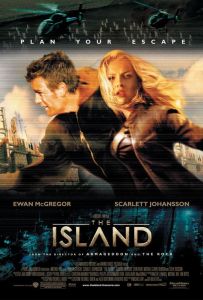 To many film critics, director Michael Bay is the devil. He’s the man behind such ADD-edited hits like Armageddon, both Bad Boys, and Pearl Harbor. Each film was more or less savaged by critics and each film was a hit. Bay has always said he makes popcorn movies for audiences and never listens to the critics. That would probably be a good thing since they don’t exactly have a lot of nice things to say about Bay and especially his editing techniques. But how would someone like Bay, who dreams about blowing stuff up with every night’s sleep, handle material a little more subtlety than, say, corpses filled with drugs being thrown at oncoming traffic (see: Bad Boys II or better yet, don’t)? The Island is Bay’s first film without uber-producer Jerry Bruckheimer and it’s also Bay’s first encounter with science fiction. Can he make The Island into another popcorn miracle or will his blockbuster tendencies get the better of him?
In the year 2020, the Earth has been contaminated by pollution. The survivors live in a series of isolated towers and are monitored, given strict diets and jobs, and even matching white jump suits. There is an upside to this life; every so often there is a lottery where the winning inhabitant gets a trip to The Island, the last uncontaminated spot on Earth. They’ll spend the rest of their days living it up in paradise, or so they think.
Lincoln Six Echo (Ewan McGregor) has been at the facility for three years. He has questions for the good doctor Merrick (Sean Bean, your go-to guy for villains when you can’t afford Al Pacino), the man in charge of the place. Lincoln questions his purpose and wonders why he keeps having recurring nightmares with images he can’t place. He’s also been having a very close friendship with Jordan Two Delta (Scarlett Johansson), though they?re not allowed intimate contact and the living quarters are separated by gender. One day Lincoln finds a butterfly on a different level of the facility and investigates the higher levels. In a few minutes time, Lincoln discovers the truth about the facility: it’s a station harvesting clones to keep rich people going when they need an organ or two. There is no Island but there is an operating room that you won’t return from. Lincoln escapes back into the facility’s population but springs into action when he learns Jordan has been selected to go to The Island. He fights the facility’s staff, grabs his girl, and the two are off to learn the truth of their world and to live.
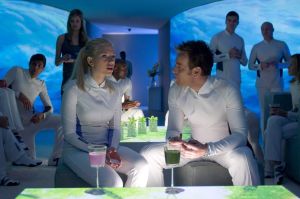 McGregor is on autopilot with this one but still manages to have some fun, especially when he’s playing two different versions of himself (“What’s with all the biting?”). Johansson looks more beautiful than ever but does little more than stare vacantly. It doesn’t help that a majority of the dialogue after the half-way mark consists of one-word shouts like, “Go!” and “Move!” and of course, “Lincoln!” The best actor by far in The Island is Michael Clarke Duncan who plays a clone who wakes up on the operating table. His mad rush of screaming, tears, confusion, horror, and betrayal may be some of the finest two minutes of acting from the year. Duncan’s cries will hit you square in the gut.
The fish out of water scenario does provide some fun moments of humor, like Lincoln being confused by the phrase “taking a dump.” The Island also asks how people who have never known sexuality deal with their expressions of sexuality (plus it doesn’t even come close to viewer discomfort of something like The Blue Lagoon). The always welcomed Steve Buscemi provides the biggest laughs in the movie as the wise-cracking outsider who helps the runaway clones.
It’s comforting to know that in the future product placement will be as large as ever. I?m normally not too offended by product placement in ads, but The Island seems like it’s contorting to show company names. In one scene, Jordan gazes at an image of herself in a perfume ad, and it’s a real ad Scarlett Johansson did. This got me thinking, what if The Island‘s villains were really today’s actual flesh-and-blood movie stars that wanted fresh parts. The real McGregor and Johansson would become the bad guys. Unfortunately, it seems a little too meta to pull off for a Bay film.
The Island is an intriguing sci-fi movie that doesn’t know what to do once it gets to the surface. As soon and our clones go on their Logan’s run, the movie devolves into a series of bloated, mediocre chase scenes. If the first half is Bay at his potential best, the second half is Bay at his lazy, expected self. The chase scenes aren’t too lively and, except for a late subplot involving McGregor playing dual roles, The Island wilts as soon as it turns into an action movie. There doesn’t seem to be enough plot for this overlong 140 minute movie. Bay’s requisite chaotic grandeur and spectacle has a ho-hum feeling and dulls the viewer right when they should be racing with excitement. Bay’s done this all before and better, and that’s why the first half is so exciting a change for him. It’s thoughtful, tense, interesting, well plotted and visually fun, and then we regrettably hit the second half and it all goes downhill from there.
 The movie limps to its over-extended climax and saps all the potential from the opening. The Island really is two disjointed movies slapped together. The first hour is a classic science fiction setup and we are given morsels of information like bread crumbs, which heighten the tension. The second half is an unimaginative, plodding thrill ride that never seems to take off. Sure, the first half may be derivative of a hundred other sci-fi films (most notably Parts: The Clonus Horror) but the second half is derivative of a thousand other action movies. I’ll take smart sci-fi over dumb action most days, even during the bombast of summer. It feels like The Island began as a scary sci-fi film and in order to make it to the big screen the studio had to piggyback a lifeless action movie on top of it. The Island‘s action sequences feel like Bay fell asleep at the wheel.
It may seem like I’m being over cruel about The Island, but the reason I lambaste the second half is because I was so thoroughly entertained by the first half. For many The Island will be enough to quench their summer thirst, but for me it only showed flashes of life in the first half. Once all the explosions, noise, and flying debris kicked in, The Island transforms into any other dumb action movie. Such promise, such vision, all quickly flushed down an embryonic feeding tube. Even if someone prefers the noisy second half they would still take issue with the first half, calling it slow and boring. Fans of Bad Boys II and Logan’s Run don’t exactly mix well. How can a movie possibly work this way?
Bay may be a master maestro of explosions and gunfire, but The Island flat lines when it transitions from thoughtful, eerie sci-fi parable to rote action flick. This feels like two very different movies slapped together, and most audiences are going to like one half stronger than the other so the film won’t work. The action sequences feel unimaginative and all of the film’s potential gets stranded by its about-face in tone. We’ve seen all of these things before, and that’s what’s most regrettable about where The Island leaves you after flashing an iota of glossy potential. Bay may not be the devil but he’s certainly losing his edge, and The Island would have been all the better for it.
Nate’s Grade: C+
Share this:

Star Wars: Revenge of the Sith (2005)
 I was in Dublin, Ireland of all places when I saw Star Wars Episode III: Revenge of the Sith. I was enticed to get off my sick bed and see George Lucas’ final Star Wars installment. As a kid I loved the original trilogy. My expectations were piqued by the promise that Revenge of the Sith would be bigger, badder, and suitably darker than any previous Star Wars installment. It did get the series’ first PG-13 rating and a stern warning to parents from Lucas for nothing. I had equal hopes for the other two prequels, 1999’s The Phantom Menace and 2002’s Attack of the Clones, but said hopes were dashed upon actually watching the movies. This was the last film and I had my fingers crossed ole George would finally get it right.
It’s now several years into the war between the Galactic Republic and the separatists led by General Grievous, leader of the droid army. Anakin (Hayden Christenson) and Obi-Wan (Ewan McGreggor) fight for the Republic and the chancellor of the Senate, Palpatine (Ian McDiarmid). Anakin is having nightmare that his secret wife Amidala (Natalie Portman) will die in childbirth. He seeks out a way to save her and is tempted by certain promises by shadowy figures that the dark side of the force can restore life. From there things are set into motion that turn the Republic into an evil Empire, the Jedi into a near extinct band of warriors, and Anakin into the iconic Darth Vader.
My friend Josh Browning brought up the idea that Star Wars would be so much cooler without George Lucas. I gave this idea some thought and have come to the same conclusion. Can anyone ever say “no” to the Jedi master in plaid? Directing flaws aside, where Lucas really needs assistance is his writing. The biggest qualms I’ve had with the new set of Star Wars, horrible acting aside, is how unforgivably boring they are and the tepid romance. The original Star Wars were about action, adventure, and things that mattered. The prequel set has been mostly about trade, taxation, Senatorial control, and separatists. The majority of the prequels have been sleep-inducing and riddled with pacing issues.
 In an Entertainment Weekly interview, Lucas said 60% of his prequel story was related to the final film. With some quick calculations, that means that there was 20% plot in The Phantom Menace and the remaining 20% in Attack of the Clones. No wonder nothing seemed to be going on! This also creates the problem of Sith having far too much plot to deal with in too short of a reasonable time frame. Things feel left out or not fully explained, like why the hell does General Grievous have a cold? I know I’m missing something but it’s lazy filmmaking to make an audience do extra homework to flesh out your storytelling.
As stated, my other main gripe was the half-baked romance Lucas had between Anakin and Amidala. In Attack of the Clones, the romance is spontaneous. He hasn’t seen her in like 10 years and now they’re instantly smitten? There is no beginning to this romance, no nurturing, no progress. The romantic troubles are worsened by Lucas’ disinterested writing. Lucas cannot write dialogue to save his life. Romantic bon mots like “Hold me like you did at the lake” and “I’ve been dying a little bit day by day, ever since you reentered my life” will not exactly stoke a fire in your loins. Plus Portman and Christenson have as absolutely no chemistry.
Now, the reason I’ve reviewed the romance from Attack of the Clones is because it serves as the linchpin for why Anakin goes bad and becomes Darth Vader. It’s a mighty big question about what turned Anakin from man into one bad mutha, and his quest to save his wife is a satisfyingly plausible answer. But the transition doesn’t have near the punch Lucas intends because of his weak romance he’s penned. Lucas’s shortcomings as a writer finally pull the rug out from Anakin’s big moment.
The acting is another weakness. True, the acting hasn’t always been the top priority with any Star Wars film, but these prequels have shown that Lucas would rather stand behind a computer than in front of an actor. Portman has generally seemed bored and lacks any interest in hiding it. In Attack of the Clones she seemed sedated. In Revenge of the Sith she gets to cry a bunch. In Lucas land, that’s seen as character development.
 I thought Anakin could not get any more annoying than Jake Lloyd’s awful “yippee”-filled run in Menace, but I’m starting to reconsider this. Anakin mopes around and when he gets upset he whines in a falsetto voice. I will say Christenson was rather good in Shattered Glass where his arrested development acting techniques expertly channeled the manipulative Stephen Glass (if you do have a choice, go rent Shattered Glass). But in the more operatic Star Wars world, Christenson routinely comes off like a kid playing dress-up. Even after he’s gone full evil and growls and screams and glares, he comes off like nothing more than a poodle trying to be a guard dog. Of course neither performer is helped any by Lucas’ absentee directing style with actors.
The only members of the Star Wars prequels that will walk away unblemished are Ewan McGreggor and Ian McDiarmid. McGreggor has got the Alec Guinness voice down and proves to be a capable and dignified leading hero. McDiarmid has a juicer role than Anakin and really relishes his villainy.
Sith is the best of the three Star Wars prequels but that isn’t saying a whole lot. Whereas Menace and Clones were boring, Sith is just kind of slow and okay. It’s an improvement but the bar wasn’t exactly set very high. The formula is about the same: the first two acts are again quite plodding and then Lucas unleashes a torrent of action to close out his film. Sith does break apart because, surprise, things actually happen and they actually matter. After about six hours of buildup, actions meet consequences, characters meet their demise, and our boy wonder becomes the dark Jedi. People have been waiting decades for these moments and when they arrive they hit like a thunder bolt. Most of the time at least.
 The special effects are uniformly fantastic, which has never been an issue for Lucas. Yoda moves and emotes fantastically, actually besting some of his flesh and blood thespians. The interaction of live elements and CGI seems improved. Planets are rendered beautifully and the lava world is simply visually stunning and just plain cool.
The action is exciting but a bit overly edited in light saber battles. As we march into Act Three, there’s a terrific sense of climax with Yoda going off to battle Palpatine and Obi-Wan knowing he must put down Anakin. At long last I felt jolts, shivers, and goose bumps at what was to come. The concluding half of Sith is great rollicking entertainment and visually luxurious to watch. See George, light saber duels and character deaths are far more entertaining than trade disputes and embargo talk. The excitement’s back in the Star Wars franchise but it’s a shame it had to only appear this close to the finish line.
The final chapter on the Star Wars universe is closed. Well, for now. The lure of mountains of cash will probably ensure we haven’t seen the last of some of these beloved characters. Revenge of the Sith is a moderately satisfying closing episode to the Star Wars saga. The film still is an exhibition of Lucas’ filmmaking flaws (writing, pacing, his handling of actors) but Sith finally reaches the excitement and grandeur the original Star Wars had. My Dublin theater was roaring, clapping, yelling and screaming throughout. And for the first time during the prequels, so was I for awhile. And you know what the absolute best part was? Not one single word from Jar-Jar Binks!
Nate’s Grade: B-
Share this:

Big Fish (2003)
 Big Fish (2003)
Premise: Estranged son Will (Billy Crudup) travels back home in an effort to know his ailing father Edward Bloom (Albert Finney; Ewan McGregor as the younger version). Will hopes to learn the truth behind a man who spent a lifetime spinning extravagant tall tales.
Results: Despite a shaky first half, Big Fish becomes a surprisingly elegant romance matched by director Tim Burtion’s visual whimsy. McGregor’s shining big-grinned optimism is charming. Not to be confused with the similar but too mawkish Forrest Gump, Burton’s father-son meditation will have you quite choked up at its moving climax. Fair warning to those with father issues, you may want to steer clear from Big Fish. You know who you are.
Nate’s Grade: B+


 nathanzoebl
You must be logged in to post a comment.