Blog Archives
The Fall Guy (2024)
 The Fall Guy, loosely based upon the 1980s TV series starring Lee Majors, is not the best action movie, nor the best dedication to the efforts of Hollywood stunt performers, but walking away, I cannot help but think it’s perhaps the most summer blockbuster-y movie I’ve ever seen, a celebration of the magic of movies, the escapism of blockbusters, and the unsung heroes of the stunt community that deserve recognition and maybe even their own Oscar category. This is the kind of movie that reawakens feelings of cinematic elation, of what blockbuster cinema can accomplish with the right creatives in alignment, leaving a smile plastered across your face and a spring in your step leaving the theater. The Fall Guy is about our love of big stars, big explosions, big feelings, and the people responsible for making those big dreams a reality.
Colt Seavers (Ryan Gosling) is a professional movie stuntman who feels invincible until one stunt goes wrong, causing him to break his back. After a year of recovery, he’s parking cars when he gets a call that his ex-girlfriend Jody (Emily Blunt) is directing her first movie, a major sci-fi blockbuster called Metalstorm (which actually exists, it’s a 1983 movie directed by Charles Band and was the shares the same bombastic tagline: “It’s High Noon at the end of the universe”). They need a replacement stuntman and perhaps he can reconnect with her and start over. Also, Colt becomes entangled in searching for the missing star of the movie, Tom Ryder (Aaron Taylor-Johnson), a famous action star that Colt worked closely with, performing his stunts. Colt has to try and find this missing moron while keeping to the movie schedule, all the while hoping to win back Jody and make sure her movie finishes its costly production with its leading man.
 First of all, this is the Ryan Gosling show. If you’re a fan of the actor, especially his cavalier charisma that almost comes across as so cocksure to be enviably casual, then The Fall Guy is going to be a dream come true. It takes the Gosling of such comically committed, goofy, un-self-conscious performances from Barbie to The Nice Guys, and it builds a big Hollywood action movie around that persona, vaulting Gosling into his Big Movie Star phase with aplomb. He’s so effortlessly engaging as our hero, even when he’s being battered and bruised and exploded all over the screen. Colt is also immediately appealing as a capable man beset by challenges rediscovering his mojo. He’s been humbled by life and fights for his dignity while at the same time fighting to win back his girl, and it all plays on a breezy, light-hearted comedy wavelength that accepts the inherent and lasting appeal of movie stars being allowed to be movie stars. There might not be much to the characters of Colt and in particular Jody, but the movie just shimmers on their winning chemistry. You’ll yearn for them to be together again with quite little prompting. It’s a movie whose romantic force is front and center. It’s so unabashedly sincere too. When Colt is jamming to Taylor Swift’s “All Too Well,” it’s not an easy point of mockery, though some may take it as such seeing our strong hero in his feelings, but a point of reliability. It’s a movie unafraid of romance, of wearing its heart on its sleeve, and being a little square.
It’s also clearly a celebration of the unheralded stunt performers of Hollywood history filling in for the more dangerous derring-do of our big screen heroes and villains. Director David Leitch (Atomic Blonde, Bullet Train) came from the stunt world and stages his action set pieces to rely heavily upon real physical stunt work, practical effects, and giving extra time for the audience to understand various dangers and know-how, to learn about this often overlooked industry of professionals risking life and limb, and sometimes giving their own, to create the illusions. The action is varied and filmed in pleasing compositions to highlight the readability of the action. It’s big and propulsive and fun. That’s the key to all of Leitch’s moves here, making the fun infectious, extending the action into unexpected yet delightful directions for more payoffs. The climax involves branching out to an armada of movie stunt performers and technicians, and it feels like a communal effort to win the day, making the ending feel celebratory and satisfying.
 This goes along with the behind-the-scenes camaraderie of the found families of filmmaking, celebrating all the many collaborators that go into building these large-scale entertainment ventures. When they’re going through the steps of how to capture a big explosion or stunt, it’s educating the audience along to better anticipate and appreciate. The Fall Guy is clear about its sincere homages, recreating moods and style from action veterans like Michael Mann, James Cameron, and Michael Bay. It’s a movie celebrating movies, and if you’re a fan of the process like me, then you’ll easily join in on the revelry. I’m sure there are famous stunt performers littered throughout, getting Leitch’s favorite colleagues the platform they deserve. The movie’s insider satire is pretty glancing, without anything too vicious or specific about Hollywood stars, especially epitomized by Taylor-Johnson’s send-up of self-absorbed actors. The concept of Metalstorm, a sci-fi Western with elements of Dune and Mad Max, is a project where the silly mash-up of “cool” elements is the unspoken punchline, the sheer stupidity of this concept, magnified by Tom Ryder channeling his most laconic Matthew McConaughey impression.
There’s a special appeal about summer blockbuster movies and The Fall Guy understands that lasting appeal. It delivers a movie whose mission is to remind us why we love these kinds of movies, big and stylish and thrilling and romantic and enchantingly entertaining. It’s a movie that’s only interested in being two hours of excellent escapism, not setting up a cinematic universe or the next sequel leading to the next sequel and spin-off. It’s only concerned with telling its lone story, which is booed by the magnetic power of its leads and their buzzy chemistry together. Gosling is chiefly in the zone and supremely charming and funny. The Fall Guy is a treat for fans of action and the professionals that make all the action so incredible.
 As a personal side note, my lovely wife is almost five months pregnant and we were informed that our little baby boy would develop his sense of hearing around this time, and during the many action scenes roaring in the surround sound theater, the kiddo was moving around in utero. Either this kid was worried about the sudden shifts in volume and noise, or he was enjoying the experience and swimming along. Either way, I’ll consider this baby’s first movie, so thank you The Fall Guy for making this a personal landmark for me and my growing family.
Nate’s Grade: A-
Share this:

Oppenheimer (2023)
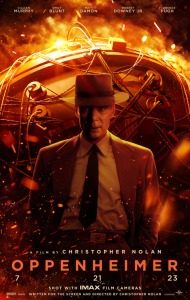 I finally did it. I watched all three hours of Christopher Nolan’s Oppenheimer, one half of the biggest movie-going event of 2023, and arguably the most smarty-pants movie to ever gross a billion dollars. It was a critical darling all year long, sailed through its awards season, and racked up seven Academy Awards including Best Picture and Best Director for Nolan, a coronation for one of Hollywood’s biggest artists whose name alone is each new project’s biggest selling point. I’ve had friends falling over themselves with rapturous praise, and I’m sure you have too, dear reader, so the danger becomes raising your expectations to a level that no movie could ever meet. As I watched all 180 lugubrious minutes of this somber contemplation of man’s hubris, I kept thinking, “All right, this is good, but is it all-time-amazing good?” I can’t fully board the Oppenheimer hype train, and while I respect the movie and its exceptional artistry, I also question some of the key creative decision-making that made this movie exactly what it is, bladder-busting length and all.
As per Nolan’s non-linear preferences, we’re bouncing back and forth between different timelines. The main story follows Robert Oppenheimer (Cillian Murphy) as an upstart theoretical physicist creating his own academic foothold and then being courted to join the Manhattan Project to beat the Nazis in the formation of a nuclear bomb. The other timeline concerns the Senate approval hearing for Lewis Strauss (Robert Downey Jr.), the former head of the Atomic Energy Commission (AEC) with a checkered history with Oppenheimer after the war. A third timeline, serving as a connecting point, involves Oppenheimer undergoing a closed-door questioning over the approval of his security clearance, which brings to light his life of choices and conundrums.
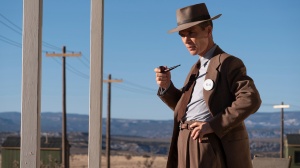 If I was going to be my most glib, I would characterize Oppenheimer in summary as, “Man creates bomb. Man is then sad.” There’s much more to it, obviously, and Nolan is at his most giddy when he’s diving into the heavy minutia of how the project came about, the many brilliant minds working in tandem, and sometimes in conflict, to usher in a new era of science and energy. Of course it also has radical implications for the world outside of academic theory. The world will never be the same because of Oppenheimer dramatically upgrading man’s self-destructive power. The accessible cautionary tale reminds me of a Patton Oswalt stand-up line: “We’re science: all about ‘coulda,’ no about ‘shoulda.’” Oh the folly of man and how it endures.
For the first two hours, the focus is the secretive Manhattan Project out in the New Mexico desert and its myriad logistical challenges, all with the urgency of being in a race with the Nazis who already have a head start (their break is Hitler’s antisemitism pushing out brilliant Jewish minds). That urgency to beat Hitler is a key motivator that allows many of the more hand-wringing members to absolve those pesky worries; Oppenheimer says their mission is to create the bomb and not to determine who or when it is used. That’s true, but it’s also convenient moral relativism, essentially saying America needs to do bad things so that the Germans don’t do worse things, a line of adversarial thinking that hasn’t gone away, only the name of the next competitor adjusts. This portion of the movie works because it adopts a similarly streamlined focus of smart people working together against a tight deadline. Looking at it as a problem needing to surmount allows for an engaging ensemble drama complete with satisfying steps toward solutions and breakthroughs. It makes you root for the all-star team and excitedly follow different elements relating to nuclear fusion and fission that you would have had no real bearing before Nolan’s intellectual epic. For those two galloping hours, the movie plays almost like a brainy heist team trying to pull together the ultimate job.
 It’s the time afterwards where Oppenheimer expands upon the lasting consequences where the movie finds its real meaning as well as loses me as a viewer. The legacy of the bomb is one that modern audiences are going to be readily familiar with 80 years after the events that precipitated their arrival, and they haven’t exactly been shelved or become the world war deterrent hoped for. As one of Oppenheimer’s physicists says, a big bomb only works until someone creates a bigger bomb, and then the arms race starts all over again fighting for incremental supremacy when it comes to whether one’s military might could destroy the world ten times or twelve times over. When Oppenheimer begins having reservations of what he has brought into this world is when his character starts becoming more dynamic, but it’s also too late. He can’t undo what he’s done, the world isn’t going back to a safer existence before nuclear arms, so his tears and fears come as short shrift. There’s a scene where Oppenheimer’s wife, Kitty (Emily Blunt), castigates him and says, “You don’t get to commit the sin and then make all of us to feel sorry for you when there are consequences.” Now this is in reference to a different personal failing of our protagonist, but the message resonates; however, I don’t know if this is Nolan’s grand takeaway. The movie in scope and ambition wants to set up this man as a tragic figure that gave birth to our modern world, but like President Truman says, it’s not about who created the bomb but who uses it. Oppenheimer is treated like a harbinger of regret, but I don’t think the story has enough to merit this examination, which is why Oppenheimer peters out after the bomb’s immediate aftermath.
It reminded me of an Oscar favorite from 2015, Adam McKay’s The Big Short, a true-ish account of real people profiting off the worldwide financial meltdown from 2008. It fools you into taking on the perspective of its main characters who present themselves as underdogs, keepers of a secret knowledge that they are trying to benefit from before an impending deadline. Likewise, the conclusion also makes you question whether you should have been rooting for this scheme all along since it was predicated on the economy crashing; these guys got their money but how many lives were irrevocably ruined to make their big score? With The Big Short, the movie-ness of its telling is part of McKay’s trickery, to ingratiate you in this clandestine financial world and to treat it like a heist or a con, and then to reckon whether you should have ever been rooting for such an adventure. Oppenheimer has a similar effect, lulling you with its admitted entertainment factor and beat-the-deadline structure. Once the mission is over, once the heroes have “won,” now the game doesn’t seem as fun or as justifiable. Except Oppenheimer could have achieved this effect with a judicious resolution rather than an entire third hour of movie shuffled throughout the other two like a mismatched deck of cards.
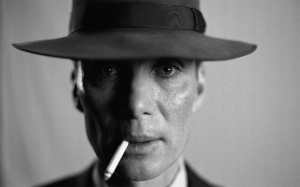 The last hour of the movie features a security clearance interrogation and a Senate confirmation hearing, neither of which have appealing stakes for an audience. After we watch the creation of a bomb, do we really care whether or not this one testy guy gets approved for a cabinet-level position or whether Oppenheimer might get his security clearance back? I understand that these stakes are meaningful for the characters, both essentially on trial for their lives and connections, but Nolan hasn’t made them as necessary for the audience. They’re really systems for exposition and re-examination, to play around with time like it was having a conversation with itself. It’s a neat effect when juggled smoothly, like when Past Oppenheimer is being interviewed by a steely and suspicious military intelligence office (Casey Affleck) while Future Oppenheimer laments to his project superior (Matt Damon) and then Even More Future Oppenheimer regrets his lack of candor to the review board. The shifty wheels-within-wheels nature of it all can be astounding when it’s all firing in alignment, but it can also feel like Nolan having a one-sided conversation with himself too often. It’s another reminder of the layers of narrative trickery and obfuscation that have become staples of a Christopher Nolan movie (I don’t think he could tell a knock-knock joke without making it at least nonlinear). The opposition to Oppenheimer is summarized by Strauss but I would argue the man didn’t need a public witch hunt to rectify what he’s done.
Lest I sound too harsh on Nolan’s latest, there are some virtuoso sequences that are spellbinding with technical artists working to their highest degree of artistry. The speech Oppenheimer gives to his Los Alamos colleagues is a horrifying lurch into a jingoistic pep rally, like he’s the big game coach trying to rally the team. The way the thundering stomps on the bleachers echo the rhythms of a locomotive in motion, driving forward at an alarming rate of acceleration, and then how Nolan drops the background sound so all we hear is Oppenheimer’s disoriented speech while the boisterous applause is muted, it’s all masterful to play with our sense of dread and remorse. This is who this man has become, and his good intentions of scientific discovery will be rendered into easily transmutable us-versus-them fear mongering politics. The ending imagery of Oppenheimer envisioning the world on fire is the exact right ending and hits with the full disquieting force of those three hours. The meeting with Harry Truman (Gary Oldman) is splendid for how undercutting it plays. Kitty’s interview at the hearing is the kind of counter-punching we’ve been waiting for and is an appreciated payoff for an otherwise underwritten character stuck in the Concerned Wife Back at Home role. The best parts are when Oppenheimer and Leslie Groves (Damon) are working in tandem to put together their team and location, as that’s when the movie feels like a well orchestrated buddy movie I didn’t know I wanted. The sterling cinematography, musical score, editing, all of the technical achievements, many of which won Oscars, are sumptuously glorious and immeasurably add to Nolan’s big screen vision.
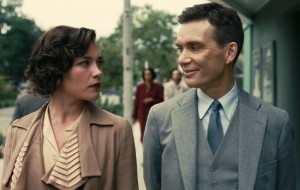 I think I may understand why the subject of sex is something Nolan has conspicuously avoided before. Much has been made about the sex scenes and nudity in Oppenheimer, which seem to be the crux of Florence Pugh’s performance as Jean Tatlock, Oppenheimer’s communist mistress through the years. The moment of Oppenheimer sitting during his hearing about his sexual tryst with an avowed communist leads to him imagining himself in the nude, exposed and vulnerable to these prying eyes and their judgment. Then Kitty imagines seeing Pugh atop her husband in his hearing seat, staring directly at her, and this sequence communicated both of their internal states well and felt justified. It’s the origin of the famous “I am become death” quote where the movie enters an unexpected level of cringe for a movie this serious. I was not prepared for this, so mild spoilers ahead if you care about such things, curious reader. We’re dropped into a sex scene between Oppenheimer and Jean where she takes a break to peruse his library shelves. She’s impressed that he has a Hindu text and pins it against her naked chest and slides atop Oppenheimer once again, requesting he read it to her rather than summarize it. “I am become death,” he utters, as he reads the Hindu Book of the Dead off Pugh’s breasts while they continue to have sex. Yikes. A big ball of yikes. If this is what’s in store, please go back to a sexless universe of men haunted by their lost women.
It’s easy to be swept away by all the ambition of Nolan’s Oppenheimer, a Great Man of History biopic that I think could have been better by being more judiciously critical of its subject. It’s a thoroughly well-acted movie where part of the fun is seeing known and lesser known name actors populate what would have been, like, Crew Member #8 roles for the sake of being part of this movie (Rami Malek as glorified clipboard-holder). Oppenheimer takes some wild swings, many of them paying off tremendously and also a few that made me scratch my head or reel back. It’s a demonstrably good movie with top-level craft, but I can’t quite shake my misgivings that enough of the movie could have been lost to history as well.
Nate’s Grade: B
Share this:

Pain Hustlers (2023)
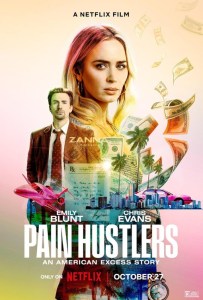
Pain Hustlers is the next attempt to dramatize the numerous stories behind the opioid crisis, a storytelling edict that is becoming its own tragic true-crime sub-genre (Dopesick, Pain Killer, Four Good Days, Recovery Boys, All the Beauty and the Bloodshed). The Netflix original has a starry cast and a topical and serious subject but it’s an un-serious movie caught up in the superficial quirks and appeal of being and making a goofy crime story of greedy sleazeballs.
Liza (Emily Blunt) is a struggling single mother trying to claw her way out of debt and, with her unfinished education and criminal record, few options are widely available. Then enters Pete Brenner (Chris Evans), a loud, gouache pharmaceutical rep for a powerful pain killer. He promises a lifestyle of luxury and power, as long as Liza is willing to ignore or bend a few ethics along the way. Together, they build a sales force of attractive women who wine and dine smaller doctors in order to get them to prescribe their special drug to anyone in need. It’s just that a drug intended for end-of-life pain wasn’t meant for common headaches. As sales boom, Liza begins to worry that her glitzy lifestyle is built upon a mountain of American corpses.
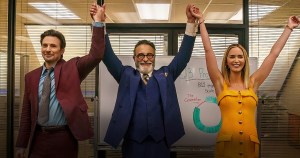
The biggest drawback of Pain Hustlers is that it fully focuses on the glitz and gives lip service to the cost of chasing that avarice. Plenty of movies illuminating bad people doing bad things are accused of glamorizing the misdeeds, from gangster movies to dark romances, though this narrow viewing often seems to conflate depiction with condoning the behavior (see: The Wolf of Wall Street). Watching stories about people stumbling their way into glamorous positions should provide some allure so as to better understand the seductive draw for the characters. The world of vice and power will be a compelling conflict, but for Pain Hustlers, it falters by just focusing on the high-powered lifestyle yet it still lacks specificity to make this story feel interesting on its own. You’ve seen variations of this kind of story before (we’ll call it Scorsese-esque) about the people struggling with less who get a ticket into a new world of access and freedom and then begin to worry At What Cost. Pain Hustlers goes through its plot beats with the most mechanical of movements. The personal details from this supposedly true story feel so generic, reminiscent of similar tales like, Love & Other Drugs and Hustlers. It feels less like an insider account of how these shady people exploited so many and more like the screenplay was cobbled together by what the filmmakers assumed this story must have pertained without reading much of the source novel by Evan Hughes. It’s absent the useful details that allow more of these accounts to prosper as we investigate moral relativism.
The other nagging shortcoming of Pain Hustlers is the consequences for all these bad people. I’m not saying that we need to see comeuppance and justice levied in order for the movie to work thematically; very often these white collar criminal types receive the faintest glance of judicial punishment. What this movie lacks is the emphasis on the consequences, and considering our main characters are pushing sleazy doctors to push highly addictive opioids, that’s a big miss. The movie is all about the climb for its heroine, the comparison of having the fancy life versus a life without. It shortchanges the extremely human cost of its bad actors in a way that does a disservice to the movie and its message. Because of its lack of specificity, this story could have been propelled by any prescription drug, from Viagra to Lipitor. The fact that we’re talking fentanyl, a drug responsible for 200 deaths every day last year according to the CDC, seems immaterial, and that is bizarre.
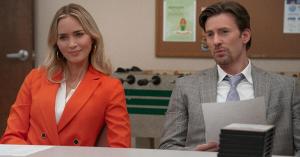
The effects of the opioid crisis begun by Purdue Pharma and the Sackler family, and then trickled down through the complicated tributaries of the American medical infrastructure, will be felt for generations. This is a major story. It would be like, say, telling the story of a struggling single mom who decides to take a career advancement in the Nazi Party in 1940s Germany. You’re not just doing a disservice to the people who really suffered, you’re doing a disservice to the audience to ignore the gravity of their moral culpability and excuse-making, of the drama of the character having to confront their part. For a movie about people profiting from opioid over-prescriptions, there is a grand total of one scene where Liza has to deal with the harsh real-world consequences of her actions (minor spoilers ahead, but I’d advise you to continue, dear reader). Early in the movie, when Liza was forced out of her home, she spent a few days living in a motel. The neighbor lady at the motel has a husband who dies from the opioid crisis, and this one man is meant to symbolize what she has wrought as a whole. It doesn’t work, and the fact that the movie presents Liza in tears trying to make amends to this widow, a character we haven’t had any thought over since Liza leaving her Act One beginnings, is a pitiful excuse for a reckoning.
Evans (The Grey Man) and Blunt (Oppenheimer) feel on autopilot here, namely because of the broad and bland characterization. Blunt resumes her Southern accent I recall from the Quiet Place movies, but her energy level feels too low, too disengaged, like she’s already at her quiet rectitude character phase when she should be at the gee-whiz giddiness of her moral slide. Evans is meant to be playing a cad prone to vulgar boasts and condescension for those he willfully steps over to reach his goals, but his “sleazeball” acting tics feel too forced, too played up, in all the ways that Blunt feels dialed down. There’s no baseline for the two of them, so the scenes they share together feel over and under-cooked, and with a generically developed rise-and-fall screenplay to boot. Andy Garcia (Father of the Bride) is the most interesting character as the head of the company, a doctor who began trying to ensure those in desperate need could have the dignity of mitigating their pain, and transforms into a megalomaniacal huckster who only wants to keep meeting the next sales projections. His rise-and-fall seems much more steep and intriguing than trying to give us Liza, a gutsy single mom (with a wacky mother of her own played by Catherine O’Hara) who we’re supposed to identify with and forgive for playing her part in a deadly chain that has wrecked untold lives across the country and world. She did it for her own kid’s medical treatment. So it’s all okay, right?

This is director David Yates’ first movie away from the familiar confines of the Harry Potter universe since the ill-fated 2016 Tarzan reboot, and only his second non-Potter movie since 2005. Given that history, I’m curious whenever this man jumps onto a non-Potter project because you would assume it has to be special in some manner. I’ll credit Yates with changing his visual preferences from the very drabby and gray palette of his Potter filmography.Pain Hustlers adopts a lot of the stylistic tics we expect in glitzy crime thrillers, from handheld camerawork to sun-bleached colors. There are other techniques to bring a documentary-like authenticity, but the constant cutting back to black-and-white interviews with the characters after the fact only serves as a narration crutch to keep things moving. The character narration lacks further insight from the distance or remorse of the onscreen events. The whole movie feels like a copy of a Scorsese imitator, something akin to 2009’s forgettable The Middle Men, a crime movie about a plunge into the underworld from a naif that doesn’t try too hard beyond empty reconfiguration of the superior style of its influences that I doubt anyone really remembers (you might as well add directorial narration, “Ever since I was young I always wanted to make a gangster movie…”). As immediate evidence to the case, there is a slow-motion house party in Pain Hustlers set to “Turn Down For What.”
Should you spend two hours watching Pain Hustlers? Not really, though if you have a fascination with the many schemers who contributed to making the opioid crisis as trenchant and terrible as it currently is, and likely will be for the near future, then maybe there’s some mild value to be had here. But even those people would be better served watching another Netflix series tackling the same subject matter, the 2023 limited series Pain Killer. For me, the Pain Hustlers story was too broad, and where it could have broken out with specificity is where it decided to wimp out and defer to genre cliches. It’s hard for me to argue that you should spend two hours watching this movie on the subject when you would be far better served, from an informative and entertainment standpoint, watching the two-part, four-hour 2021 documentary Crime of the Century by masterful filmmaker Alex Gibney. That film is damning and compelling and authentic in ways Pain Hustlers can only hope to imitate.
Nate’s Grade: C
Share this:

Jungle Cruise (2021)
 Disney turned a theme park ride that mostly involved sitting into a billion-dollar supernatural adventure franchise, so why not try another swing at reshaping its existing park properties into would-be blockbuster tentpoles? Jungle Cruise owes a lot to the Pirates of the Caribbean franchise, and actually owes a little too much for its own good. For the first half of the movie, it coasts on the charms of stars Dwayne Johnson and Emily Blunt and some light-footed visual misadventures. Then the second half turn involves a significant personal revelation, and that’s where the movie felt like it was being folded and crushed into form to closely resemble the Pirates franchise. It gets quite convoluted and littered with lackluster villains, too many and too stock to ever establish as intriguing or memorable (one of them is a man made of honey, so that’s a thing). I found myself also pulling away in the second half because of the inevitable romance. Their screwball combative banter between Johnson and Blunt gave me some smiles and entertainment and then, as they warm to one another, it sadly dissipated, as did my interest. The comedy is really labored at points. Johnson keeps referring to Blunt as “Pants” because she’s a woman and she wears pants in the twentieth century. It was not funny the first time and it’s not funny or endearing after the 80th rendition. The supernatural elements and curses feel extraneous and tacked on. With the Pirates films, at least the good ones, there are a lot of plot elements they need to keep in the air and you assume they’re be able to land them as needed. The competing character goals were so well established and developed in those movies and served as an anchor even amid the chaos of plot complications and double and triple crosses. With Jungle Cruise, it feels like a lot of effort but also a lot of dropped or mishandled story and thematic elements. This feels more creatively by committee and the heavily green screen action is harder to fully immerse with. As a wacky adventure serial, there may be enough to keep a viewer casually entertained, but Jungle Cruise feels too beholden to the Pirates formula without bringing anything exciting or fresh on its own imagination merits.
Nate’s Grade: C
Share this:

Spiral (2021) / A Quiet Place Part II (2021)
 Chris Rock seems like an odd choice to spearhead a revival of the dormant Saw franchise, but the actor was a rabid fan of the grisly horror series and came to producers with an idea for a new Saw movie, and the results are Spiral: From the Book of Saw, like it’s a Biblical chapter. A Jigsaw copycat killer is targeting corrupt police officers and those who protected them, and Rock plays a detective who dared to turn in his partner after he murdered a crime scene witness. Rock’s character is seen as a traitor by his fellow brethren in blue, and as the Jigsaw copycat continues his or her bloody rampage, the history of police abuse and cover-ups comes to light. The problem with Spiral is that it feels like an entirely different independent script that somebody attached gory Saw set pieces and said, “Reboot.” The Saw set pieces get increasingly ludicrous and gross and the drama in between, where Rock tracks clues and barks at his peers, feels like boring connective tissue the movie can’t even bother to pretend is worth the effort. Both parts feel rote, the police conspiracy thriller and the gory death traps. The movie is also entirely predictable by the nature of the economy of characters. Within 15 minutes, I was able to predict the identity of the copycat killer as well as their connection and motive. This movie desperately needed more time with Rock and Samuel L. Jackson together. Another issue is that the movie ends abruptly and with a needed extra turn missing, perhaps where Rock agrees to work with the killer and justifies the executions as righteous reform. I wanted this new Saw to be more in keeping with Saw 6, the best sequel and most topical of the franchise where health care employees were put to fiendish ironic tests to punish them for denying medical coverage. It feels like targeting bad cops would produce more social commentary, but I guess that would get in the way of watching people try and sever their own spine on a single nail. Spiral doesn’t feel any more promising than the other attempted Jigsaw reboot in 2017 even with its topical elements. It might be cheap enough to earn a sequel, but it feels like a franchise eternally going in circles.
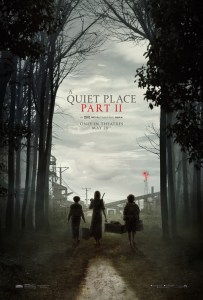 A Quiet Place Part II is the first movie I’ve seen physically in theaters since the middle of March 2020, and I genuinely missed the experience. It’s been the longest I’ve ever gone in my adult life without seeing movies in the theater, and this was one that felt like the presentation would be elevated by the big screen and superior sound system. Taking place nearly minutes after the conclusion of the 2018 hit, the surviving Abbott family ventures off their farm to find refuge and potentially find a way to protect themselves and neighboring communities from the killer monsters attracted to noise. The opening is the only flashback we get; everything else is forward-looking. I would have enjoyed getting more Day One experiences where the monsters first attacked, especially as we become open to new characters and their own harrowing journeys. The movie, written and directed by John Krasinski, isn’t quite as novel and brilliantly executed as its predecessor, but it’s still a strong sequel that gives you more while leaving you wanting more by the end. The majority of this lean 97 minutes is split between the family, one half staying put in a warehouse basement, and the other traveling out into the open to find a radio tower. The set pieces are still taut though rely more on jump scares this go-round, granted well executed jump scares that still got me to jolt in my seat and squeeze my girlfriend’s hand a little tighter. Cillian Murphy (Batman Begins) is the most significant addition as an Abbott family friend who has lost his whole family since that opening flashback. He’s a broken-down man, a parallel for Krasinski’s father figure from the first film, and at points it feels like he’s being set up to appear sinister, or at least hiding some dark secret that never really comes to fruition. The world building is expanded and introduces a very Walking Dead-familiar trope of desperate people being just as dangerous as deadly monsters, though in a world of hearing-enhanced creatures, I would think there’s more danger in larger numbers than security. The movie earns its triumphant ending even if the staging, and cross-cutting, is a little heavy-handed. A Quiet Place Part II is a successful sequel that understands the unique appeal of its franchise and how to keep an audience squirming while also remain emotionally involved and curious for more.
Nate’s Grades:
Spiral: C
A Quiet Place Part II: B+
Share this:

Mary Poppins Returns (2018)

I have no real investment in Mary Poppins as a character or the original 1964 movie, so I was expecting to walk out of Mary Poppins Returns with a shrug, likely finding it middling at worse. I was unprepared for what I endured, and endured is the accurate statement. Mary Poppins Returns is an insane movie and one of the most maddening and painful experiences in a theater I’ve had all year, and no number of spoonfuls of sugar will help this bad medicine go far enough down.
It’s the “Great Slump,” a.k.a. Depression, in London and the Banks children have grown up. Michael (Ben Whishaw) has three young children of his own and he’s struggling to maintain his job at the bank and be the father they need in the wake of his wife’s death. His sister, Jane (Emily Mortimer), has moved into help but it’s still not enough. Enter that famous nanny, Mary Poppins (Emily Blunt), who takes it upon herself to watch over the children, help them through the grieving process, and explore the outer reaches of London with some help from some friends, chiefly Jack (Lin Manuel-Miranda). The Banks family is in danger of losing their home to the head of the bank (Colin Firth) unless they can find a specific title of shares that will grant them a wealth denied their adult lives.
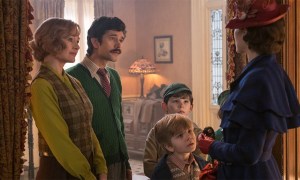
This movie felt like it was eight hours long and I had no sense of how much time was passing, mostly because of its misshaped structure and general lack of pacing. Mary Poppins Returns feels like it could have been renamed The Tony Awards: The Movie. It’s one unrelated song-and-dance number after another, rarely building from the previous one, and so it feels like an eternal televised awards show that just shuffles from one set piece to the next, never providing a sense of direction or finality. Things just happen in this movie and then different things happen but rarely do they feel consequential. This makes the film feel endless because you have no real concept of progression. It’s just another unrelated song into an unrelated magical realm that doesn’t really seem like it matters, and then we’re off to the next. I think some part of me is still trapped watching Mary Poppins Returns, never allowed to leave.
This would be mitigated if the songs were any good. There are over a dozen and not a single one is memorable. It was mere minutes after leaving the theater that I pressed myself into trying to hum any one of them, and I could not. They instantly vanish from your memory because there are no melodies or interesting production aspects that cause them to stand out. They assault you with their blandness and staid orchestration. They’re a careful recreation of an older sounding, 1950s musical, an antiquated sound that doesn’t have the same traction today. The only way you can remember one of these songs is if you have a traumatic experience forever linked to one of these mediocre, warbling collection of sounds.
There are two astoundingly peculiar songs. “Trip a Little Light Fantastic” is a big ensemble number involving the lamp lighters lead by Miranda. However, the song reference is clearly evocative of the Timothy Leary “trip the light fantastic” comment about LSD. It’s strange to think this is only a coincidence when the lamp lighters are dubbed “learies.” It’s not a good song to begin with and the performance literally involves men on BMX bicycles flying around and doing tricks. How is any of this happening in a reported Disney family film? The Meryl Streep “Turning Turtle” song may be the most excruciating five minutes I’ve sat through for all 2018. It’s just embarrassing to watch and made me honestly think of the children’s movie disaster, The Ooogieloves, where you watch once proud actors debase themselves and their legacies in depressing fashion. That’s the level of dread and mourning I had watching Streep slog through a Bela Lugosi accent and dance upside down. It has to be seen to be believed but you shouldn’t ever have to see this. I have a new appreciation for the La La Land songs.

The continual removal of stakes robs the movie of feeling like anything onscreen genuinely matters. Mary Poppins is a magical creature without clearly defined rules or limits. At any point she might simply have the solution to a problem that she wasn’t sharing. Take for instance the ending (spoilers for the duration of this paragraph, but really, who cares?) where the lamp lighters and the Banks family race to ole Big Ben to literally “turn back time” by adjusting the clock hands. The lamp lighters use their ladders to free climb the face of the clock to the very top, only to be undone by not being able to reach the minute hand at it nears twelve. Then all of a sudden Mary Poppins scoffs to herself and flies up to the clock face to adjust it. If she could do this the whole time why did these very mortal men risk their lives in this exercise? I think Mary Poppins may be a cruel god (more on this later). The concluding dash to ensure the Banks family can keep their home involves not one, not two, but three deus ex machinas, a “Turducken of ex machinas” as my pal Ben Bailey termed it. Ultimately all of their actions do not even matter because the film routinely provides an unknown escape route that invalidates their efforts. It turns out, in the end, they weren’t even going to lose their home thanks to (at my best guess) a magical bird head that is best friends with the head of a bank and who never mentioned this before, the same head of the bank who has just been off in what appears to be an adjacent room for whatever reason and that also knows that Michael Banks has accrued a hefty fortune from a childhood investment, and has never mentioned it as well except in this crucial moment. Why, why does Mary Poppins Returns do this? Why does it present stakes or the illusion of stakes only to sabotage them every time?
Is Mary Poppins really a creature of good or does her need to be loved prove her a fickle god who demands adulation, subservience, and obedience? When Mary Poppins travels from world to world, some live action, some animated, all fanciful, every inhabitant seems to know this woman and love her unconditionally despite her prevalent smarm. The bigger question is do these magical worlds exist independent of Mary Poppins? Is there a pocket universe in existence on the side of a chipped porcelain bowl, or did it only come into existence when Mary Poppins decided it would be a lovely vacation spot? If so, that means she is calling into being a throng of adoring creatures that exist to validate her impulsive whims. She is a selfish god that demands an audience of servants and sycophants, not unlike the Javier Bardem character in Darren Aronofsky’s polarizing polemic, mother!.

The actors acquit themselves fine for their roles. Blunt (A Quiet Place) and Miranda (Moana) will still be charming performers even when given substandard material. Blunt holds your attention with her prissy, schoolmarm persona, balancing the audience’s memories of Julie Andrews without going into parody. Her singing (as also evidenced from 2014’s Into the Woods) is above average and can help make some of the songs more tolerable to listen to. Miranda is a talent bursting with charisma and range, which makes it all the more frustrating to squeeze him into the narrow confines of a cockney scamp. He does get a rapping reprise in “A Cover is Not the Book” with a group of cartoon penguins. The stranger element is that it really feels like Miranda’s character wants to have sex with Mary Poppins. They slot him as a forced romantic option for Mortimer’s underwritten sister, but his eyes are clearly set for the woman who bosses people around and has magic in her fingers. He remembers her when he was a boy chimney sweep and I think he’s been fantasizing about her every day since. Plus, she hasn’t aged in 30 years.
Mary Poppins Returns is a bizarre artifact of a displaced time, taking great pains to recreate a style but without providing a purpose or sense of feeling beyond emulation. I don’t know who this movie is for besides the hardcore fans of the original. There are dancing dolphins, talking dogs, bathtub portals, an upside down house, flying balloons, union protests, Angelina Lansbury or an animatronic lookalike, and there’s lots of songs you will be unable to recall and a story that repeatedly removes any stakes or grounding from beneath itself so that the movie never feels firm or purposeful. There were several points where I just wanted to throw up my hands and ask, “What am I watching?” I still don’t know. Mary Poppins Returns is a movie musical that is nothing short of super-cali-fragil-awful.
Nate’s Grade: D+
Share this:

A Quiet Place (2018)
 I’m going to write a sentence I’ve never written in my history of writing about film: make sure you get all the gas out of your system before sitting down to watch A Quiet Place in the theater. This intense little thriller relies upon a nearly silent film experience which makes you, in the audience, hyper aware of just about every little noise permeating your surroundings. Munching popcorn, opening candy wrappers, brief coughs, you’ll become highly attuned to the faintest of noises. This is why you, dear reader, should be advised to make sure you have no bodily gasses stored in your system. Unless that’s your plan all along, to break the tension with a well-timed expelling of flatulence, going from screening to screening, finding new purpose with being that guy, eating plates of beans in preparation for the long withholding. With all that being said, A Quiet Place is an ingenious little thriller with near flawless execution.
It’s over a year into a world overrun by monsters that are trained to attack the smallest of sounds. What’s left of humanity has had to adapt to a very quiet way of life. The Abbott family has ironically be given a head start to adapt into this scary new world that prioritizes silence. Lee (John Krasinski, also co-writer and director) and Evelyn (Emily Blunt) have a daughter, Regan (Millicent Simmonds), who is deaf, so the family has learned to communicate via sign language. The family walks barefoot on paths of sand and resides in a farmhouse on the edge of a rural community. The Abbott clan is still overcoming the loss of their youngest child who, at and innocent and naïve four years old, was taken by the monsters. Now Evelyn is expecting a new child and the Abbotts must stick together if they are going to survive.
 A Quiet Place is a brilliantly simple concept that’s exceptionally well developed and executed. Using the very concept of sound itself as the monster, or the prelude to the monster, is so clever and completely relatable. It trains the audience to fear sound itself. It also serves the role of placing the audience in a hyper aware state of continuous dread. Any little sound we deeply dread, and there are so many ways to make sound in this world above a whisper. The emptiness of the aural landscape creates a template to build upon, so that any small noise feels like an alarm to the sense. The gripping sound design brings a sense of the looming dangers as we hear the thundering claps and crashes of the monsters approach. Krasinski also very cleverly communicates the world from Regan’s deaf perspective. When the camera focuses on her, the sound levels drop entirely, and then when another character is onscreen, they rise back up. It’s an extremely effective and smart way to drop the audience into her vulnerable position.
This is a movie that sets up the stakes upfront. A young child dies for doing something stupid but entirely in character for a young child (whom I’m assuming never personally encountered these creatures). A Quiet Place establishes immediately that this new world is unforgiving of mistakes. A distracted mind, a false step, a sudden impulse, and anyone can be gone forever.
Like the similarly themed Don’t Breathe, the fun is setting up the world, the playing space, and the rules, and then watching it all play out. A Quiet Place does a great job of establishing its world and surroundings and once the action hits midway through it doesn’t let up until the end credits. Fortunately, the thrills never get old too because Krasinski and the other screenwriters, Bryan Woods and Scott Beck, keep finding new and intelligent challenges to explore. The pieces all add up and the details make this world feel extremely well realized, from the marked squeaky floorboards to the routines if separated to the colored warning lights. The tension is already at a constant simmer from its very effective opening sequence that sets the mood. A simple exposed nail on a stair can be a returning point of tremendous uncertainty time and again. The very presence of a pregnancy with a looming due date feels like a bomb waiting to explode. How in the world will a baby be born in a world that punishes sound? I watched this movie with my hand covering my mouth for a far majority of it. Even the jump scares feel well distributed and earned in this movie. Mostly, it’s a film that makes you twist in that delicious sense of anxiety as you wait. It’s nerve-rattling in the best possible way.
 Another aspect of what makes the film so worthwhile that won’t get as many headlines is how well developed it is as a drama about a family overcoming grief and guilt. Each member of the Abbott family feels some level of blame for the tragedy and is punishing his or herself. In a way, the events of the film are about processing that grief and handing over the protection of the family. It’s an unspoken shroud that hangs over the entire family, you can see it on their faces, with the heaviness in their eyes, and in their day-to-day anxiety. The film does a great job through the character of Marcus (Noah Jupe), the middle child, of showcasing how this terrifying new normal would affect and fray one’s psyche. He’s petrified with fear and consumed with the scary burden of having to ascend into the role of protector and provider that his father is trying to groom him for when the inevitable comes. The happy version of “the inevitable” is Evelyn and Lee growing old and feeble. The more realistic version is the two of them at some point being felled by these murderous monsters. When Marcus is given a moment to let his guard down, to not worry about the volume of his voice, it’s a sweet father/son moment of bonding that feels entirely fulfilling as well as insightful about this new, peculiar way of life.
A central conflict is the friction between Regan and her father and their desire to understand and empathize with one another. The film’s biggest emotional moment is the conclusion of this, and it feels so fully earned and poignant that even typing it out now stirs me. It’s the culmination of a well-structured screenplay that has found its moments for character development in a nearly silent movie, so that when declarations are made, even with the monsters and its creepy gimmick, you’ll still feel something. These characters matter and their struggles are universal and emotionally appealing. The acting all around by the young children and Krasinski and Blunt is completely believable and engaging.
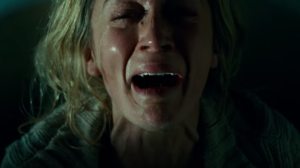 For a relatively low-budget thriller, I was surprised how much of the monsters we actually saw onscreen. Krasinski still prefers to keep his monsters on the peripheral or in the background, letting the audience’s imagination fill in the horrifying rest. That’s where I thought the movie would stay, but it does not. There are several close-ups of the creatures at work, a mass of teeth and auditory sensors. Their heads open up like blossoming flowers. I know the designs are CGI and yet they looked very realistic, as realistic as a fanciful monster can, naturally. It had the sheen of practical effects, which is the best compliment. The monsters reminded me of the Cloverfield creatures mixed with the Pitch Black aliens. It’s a spooky design and under Krasinski’s attention the menacing creatures never stop being scary.
Who knew John Krasinski had this in him? The affable actor best known for portraying Jim Halpert on the long-running American version of The Office has directed before, an adaptation of a David Foster Wallace book and an indie family dramedy. He’s never ventured into genre filmmaking before. But then again, neither had fellow funnyman Jordan Peele, who came out of nowhere in 2017 with Get Out and rode that to box-office riches, critical acclaim, and an Oscar for Best Original Screenplay. Maybe more performers we view simply through the lens of comedy have tremendous potential to be genre virtuosos. A Quiet Place is not an outright silent movie but one where silence is most keenly felt. The simple premise is beautifully realized, the characters and their plights are affecting, the details are fully thought through (though newspaper publishing is questionably late into this sound apocalypse), and the structure is smartly placed and paced. If you’re looking for a suspenseful, intense, and invigorating movie, A Quiet Place feels like a work out for the senses.
Nate’s Grade: A-
Share this:

Sherlock Gnomes (2018)
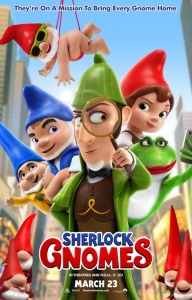 It’s been a couple of hours after watching Sherlock Gnomes and I still have alcohol working through my bloodstream (a byproduct of having to watch Sherlock Gnomes) and so I thought why not begin the review writing process and see where this goes. A little pretext first: I had no intention of watching this movie. Every time its trailer came before a movie I was watching, I cringed harder than I ever have. I cannot remember another movie trailer that I would describe as soul-killing as this one, with its emphasis on butt humor and an extended joke about a thong-wearing gnome farting in the mud. To watch this trailer was to look into the empty abyss and have it look back into you. It was this repulsed reaction that entertained my friend Ben Bailey so much that he insisted that we watch Sherlock Gnomes one fateful evening (he paid for my ticket and my suffering). I loaded up at the theater’s bar and the bartender made the easiest upsell he ever did in his life, and I took my tall adult beverage, sat in the theater, and awaited the end, like a man heading toward execution. Then a funny thing happened and Sherlock Gnomes was not the film advertised in its abysmal, life-questioning trailer. It’s still not great, though.
Following the events from the 2011 original, Gnomeo and Juliet, the garden gnomes have relocated to a new home in London. Gnomeo (voiced by James McAvoy) and Juliet (voiced by Emily Blunt) are entrusted with the gnome-specific responsibilities of the garden by gnome leadership. I guess it’s about making the place look nice. Anyway, Sherlock Gnomes (voiced by Johnny Depp) and his trusty sidekick Watson (voiced by Chiwetel Ejiofor) are looking into the disappearance of gnomes all over. One unfortunate day, while Gnomeo and Juliet are away from their garden, the rest of the gnomes have been kidnapped. Sherlock Gnomes and the others vow to find them, believing the culprit to be Sherlock’s longtime nemesis, Moriarty (voiced by Jamie Demetriou).
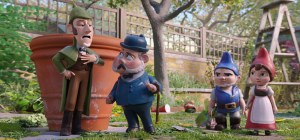 Remarkably, a solid 80 percent of the trailer for Sherlock Gnomes is not in the finished film. The fart Jacuzzi? Gone. The “no ship Sherlock” bit? Gone? The thong-wearing gnome twerking? Gone. This fascinates me. We’ve long been plagued with trailers that ultimately have moments not in the final product, but I’ve never seen a movie, let alone an animated feature, where the clear majority of its trailer does not exist. Animated films take many years in development and are generally costly. If a live-action film cuts footage in its final edit, it lost those days of work. If an animated film cuts footage in its final edit, it lost months if possible years of toil. How does this happen? Was the trailer an intentional ruse meant to advertise a far more juvenile, base, and dispiriting movie? The trailer features several jokes or references that, I assumed, were never intended for the final product because these scenes involve the other gnomes who were kidnapped. That means they were animated and either radically changed the story or these jokes were cynically constructed to produce a misleading trailer to appeal to children with farts. This truly fascinates me and befuddles me, a worthy mystery for Sherlock Gnomes (UPDATE: theory confirmed!).
The actual Sherlock Gnomes film I sat through wasn’t actively painful but it wasn’t particularly engaging or rewarding either, a mediocre children’s movie that will vanish from memory upon the ride home. There were a handful of moments where I rolled my eyes but no joke, no pun, even approached the pain of that trailer. On the flip side, there was perhaps two jokes that drew a mild chuckle and that was it. For the majority of the 86-minute running time, I just sat and took it all in, never really engaging. It was boring yet inoffensive, colorful yet unimaginative, and derivative yet silly enough to be a trifle. The look of the animation as a bit more polished than I was anticipating. The use of lighting and scale is well balanced. The voice acting was acceptable from the star-studded cast and I didn’t feel any great sadness for anyone’s involvement. The lessons and plot twists will be predictable enough for someone over the age of eight, but hey, everybody needs to learn some time. The use of the Elton John song catalogue (he is a primary producer) is the most forced element in the film, elbowing in one song or another, including “original songs” that you won’t even remember. Much like the rest, John’s contributions are mediocre and easily forgotten.
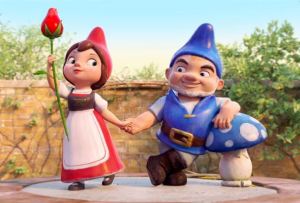 I kept wondering about the strange world building and its implications. This is a clear application of Pixar’s oft-used formula of the secret-life-of, this time with garden gnomes. Except there’s a segment where Sherlock and Juliet go to a club populated with dolls, stuffed animals, and toys of all sorts. So it’s not just garden gnomes that are secretly alive, it’s also children’s toys. Which means this is essentially the same universe as Toy Story. For whatever reason, and maybe it’s a misplaced sense of novelty, we stick with the gnomes. These creatures worry about being smashed, though can they be put back together much like Humpty Dumpty (except he couldn’t be put back together even with the help of all the king’s men and horses, no never mind this references. Also, what good are horses going to do putting together the shattered pieces of an egg-man? Do horses have thumbs to pick up the broken pieces? I feel like this entire aside might be attributable to the alcohol still in my system). If breaking is their biggest fear, why do these gnomes take such unnecessary risks with their safety and well-being? When Gnomeo is tossing Juliet in the air atop a ladder, I worried for her little gnome life. This cavalier attitude prevails amidst the larger gnome community, and my only conclusion is that these creatures are either thrill-seeking junkies or masochists. Then I began thinking of the life of other garden gnomes. I assume most gnome-owners don’t exactly have an entire menagerie of these things, and so the majority of gnome existence must seem awfully isolated and lonely. Their communities must be few and far between. Then I started thinking about transforming past Best Picture-winners into gnome format, and let’s just say that 12 Years a Garden Gnome was not a good idea for anyone.
This is a sequel and combined spin-off for the animated gnomes world, so the holdover characters often feel superfluous. This is clearly more of a Sherlock vehicle and there are even references to the Hound of Baskervilles and The Final Problem, among others. This is trying to establish a Sherlock Gnomes franchise first and foremost. The Gnomeo and Juliet subplot feels rushed and foolishly resolved. Now tasked with running the garden, Juliet feels overwhelmed with pressure and Gnomeo feels like he isn’t getting attention. Rather than support her, or see things from her perspective, he pouts and accuses her of taking him for granted. To conclude this storyline, she actually apologizes, and I shouted, “Apologize for what?” A better rendition of this storyline is realized with Sherlock Gnomes repeatedly being indifferent to Watson’s contributions. When the main theme, character arcs, and plot points involve new characters, you might as well get rid of the holdovers and go all-in on Sherlock Gnomes. Was there a picky audience that would have said, “I will only accept another gnome-related children’s film if it has the tiniest connection to the last gnome-related children’s film”? Also, there’s another garden gnome children’s film on the horizon, Gnome Alone, so stay tuned, gnome aficionados.
The victory is that Sherlock Gnomes is not the seventh-seal-breaking apocalyptic event that its reprehensible, punishing, life-sapping trailer suggested. Hooray for you, Sherlock Gnomes filmmakers. The finished product is still a mostly middling time-waster that feels like a Gnomes relaunch. I fully admit this movie was never intended for someone my age, but I attempted to see its merits for its intended audience. If you have young kids, this is a reasonable 86-minute time waster while you, presumably their parent, can do something better with that time. Go back to that novel you keep pushing off. Have some alone time with yourself or another person. Or simply close your eyes and enjoy the silence. Whatever you do, Sherlock Gnomes is an adequate comic adventure that will afford you time to think.
Nate’s Grade: C
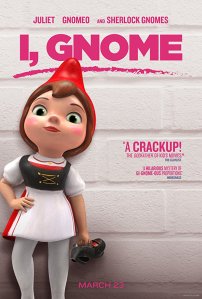
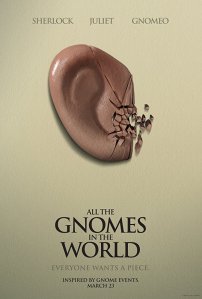
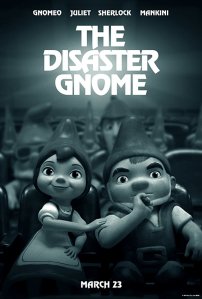
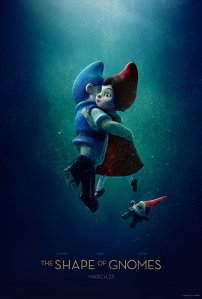
Side note: While looking up images, I came across an entirely gallery of Sherlock Gnomes poster parodies for movies like I, Tonya, The Shape of Water, Lady Bird, Darkest Hour, The Disaster Artist, The Post, and even Call Me By Your Name and All the Money in the World. Even All the Money in the World but in gnome form! This is inane!
UPDATE: Thanks to the amazing connectivity of the Internet, someone closely involved with the Sherlock Gnomes production contacted me to inform me that my theory about the trailer discrepancy was correct. Paramount’s marketing team wrote the trailer and insisted the production spend valuable time animating it. The more juvenile jokes were designed, as this source indicated, to put as many butts in the seats opening weekend, and that the marketing department said they knew best, and that was that. The production spent time creating scenes for a trailer they had no intention of ever being in the finished film with scenes that badly characterized what kind of movie it would be. This drove the production team crazy. You can blame Paramount’s marketing department for the soul-killing trailer. Thanks, Sherlock Gnomes source, for reaching out and clearing up that mystery.

Share this:

The Girl on the Train (2016)
 Consider it Gone Girl lite. The adaptation of the mega best-selling thriller The Girl on the Train seems to be on a runaway collision course with irony-free, amped-up melodrama and sundry “adult” sensuality reminiscent of the 90s boon of erotic thrillers like Jade and Sliver. The book by Paula Hawkins had three strong female lead characters each telling their own miserable worldview of trying to live up to social standards of motherhood and marriage. The movie seems to have shorn most of the focus on character and included every twist and turn, no matter how absurd. Take for instance just how insular this world is: Rachel (Emily Blunt) is the ex-wife to Tom (Justin Theroux) who left her for Anna (Rebecca Ferguson) who has a nubile nanny Megan (Haley Bennett) who is unhappy with her controlling husband Scott (Luke Evans), who happens to be the couple that Rachel voyeuristically observes and fantasizes domestic bliss. Megan goes missing and Rachel cannot account for her whereabouts because she has become a blackout drunk to kill her self-loathing and sense of internalized failure. The whodunit aspects of this movie can come across as rather hokey and overblown, but lacking the nasty nuance and subversive gender politics of the far superior Gone Girl. Every single person in the film has to come across like a suspect (Megan’s husband, Megan’s therapist, some guy in the road?) and talks in a curiously oblique style. The attempts at sexy lack heat but more than that they lack conviction. Director Tate Taylor (The Help) seems to think he’s directing a Hitchcockian thriller one minute and a tawdry art film the next. The screenplay is also unhelpfully nonlinear, frivolously jumping around in time and point of view and muddling the overall timeline. Anna and Megan are drastically underwritten; Megan is a sex kitten with a dark secret that’s trying too hard to be provocative, and Anna is an even more thankless role as the stand-in for Rachel’s swirling antipathy. The concluding moment of girl power feels unearned, and the answers to the mysteries leave a lot more lingering questions about train platform-sized plot gaps. The best thing this Girl has going for it is Emily Blunt, who delivers a better performance than the film deserves. She’s unrestrained, red-eyed, sloshing, and disturbing as a drunk. She’s wounded and lashing out ferociously at the world, at her self, and it’s fascinating and heartrending to watch. I bet it would be even better to read.
Nate’s Grade: C+
Share this:

Sicario (2015)
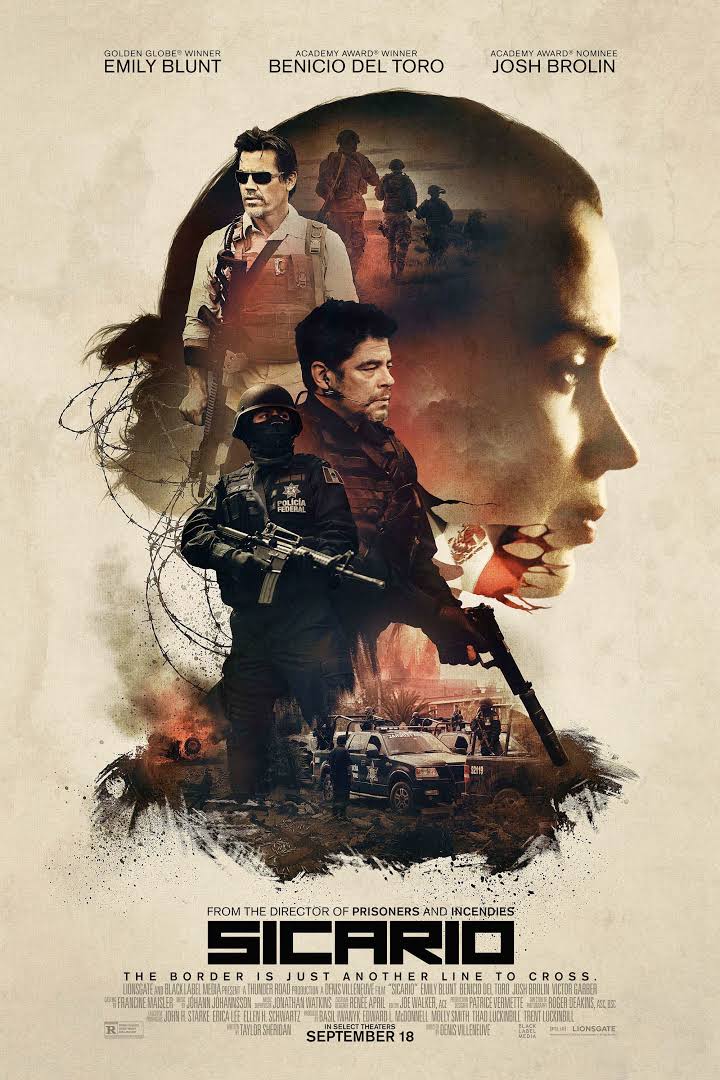 The word “sicario” is Spanish for hitman, we’re told in a helpful opening text. It’s a term that has greater meaning in the landscape of the war on drugs, a war that has ravaged Mexico and its citizens. Sicario, the film, is grim and gripping and director Denis Villeneuve doesn’t hold back from the brutality of its reality. Sicario is a flat-out tremendous film. It’s the most intense film I’ve sat through since 2012’s Zero Dark Thirty, so much so that for long stretches of the 121-minute film I was literally tearing my hair out with delicious anxiety.
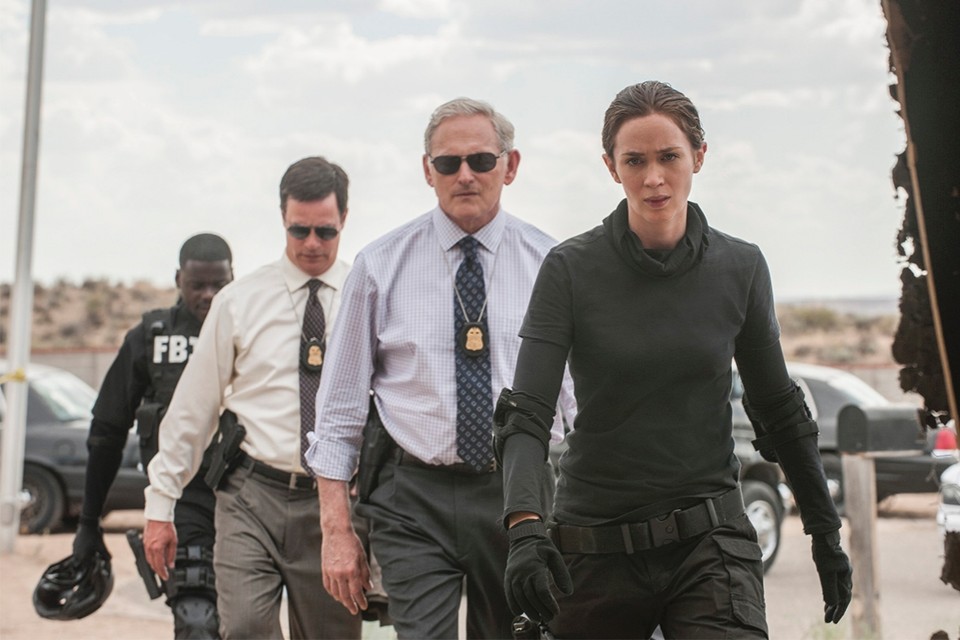
Kate Mercer (Emily Blunt) is a Phoenix FBI Agent called in by her superiors with a very special offer. Matt (Josh Brolin), a government agent whose affiliation is classified, has a task force that he would like Kate to join. She’ll be taking it to the drug cartels by destabilizing their chain of power. Kate accepts the job. Alejandro (Benicio Del Toro) is a foreign agent in alliance with Matt, and he seems to be deeply knowledgeable of the cartel and their practices. As the chaos swirls and the team gets closer to the cartel bosses, Kate has to reckon with what she is part of.
Let Sicario be a blueprint for how to brilliantly develop suspense sequences in mainstream cinema. I’ve written about it before but the key to suspense and horror is simply characters we care about and the worry of what will happen next. Sicario places our characters in the middle of an ongoing battle and serves them up as the change agent, the proverbial stick rattling the hornet’s nest of deadly cartels. There’s a wonderful sequence when Kate joins up with the team for her first mission. She’s been told she’ll be based in El Paso but in reality she and a team of Army Rangers are venturing across the Mexican border into Juarez. They’re picking up a high-level cartel informant and transporting him back to American soil. The ride into the country sets the stage as the caravan of black SUVs tears through the streets of Jaurez, bracketed by Mexican state police vehicles. We’ve previously been told at what points a likely trap might be staged, and so we wait, taking in the terrain, the distance, the exits, the personnel. We’re already sizing up the Mexican state police cars; is that one on the take? It’s at the end that the scene coalesces into an even stronger whole, as we literally have a climax in traffic. The border entrance is backed up, and so Kate and our team wait, all the while identifying some suspicious armed men in traffic lanes parallel to their vehicles. They’re told they cannot fire until deadly force is used, and so they wait and we wait. It’s a top-notch sequence where you’re nervously waiting for the boil, waiting for the explosion.
 Writer Taylor Sheridan (best known as Deputy Chief Hale on Sons of Anarchy) has taken what could have been an empty Michael Bay-styled drug war thriller and given it a soul. Sheridan’s structure is ingeniously tied into his larger message about the moral futility of the escalating war on drugs. As Kate becomes more immersed into the costs of her new role, of the mounting ethical compromises and legal loopholes, she becomes a background player and Alejandro takes center stage. Rather than simply harden up and sacrifice her ideals for the sake of her mission, Kate holds true to her principles, even if she might be the only one continuing to stick to the rules and a need for oversight. It makes her a far more interesting character and it all comes to a terrific climactic scene that hinges upon two characters at a forceful crossroads, each with diametrically opposed viewpoints. For all the action, Sheridan has found a great way for his story to have a character-based climax that hits harder than simply killing the Worst Bad Guy. As we learn more about the reasons Kate was selected, her literal marginalization in the story makes thematic sense, especially as she’s unwilling to become a “wolf” in a “country of wolves.” Alejandro is that wolf, and in the last act he becomes the film’s focus as the pieces of their destabilization plan fall into place. There’s a scene with Alejandro that is so cold-blooded yet badass that it made my audience gasp. As the bodies drop and blood is shed, Sicario doesn’t lose sight of its characters even to the very end.
Sheridan’s script tackles its subject with a propensity for acknowledging the messy reality. There are no easy solutions and perhaps the best solution is really one that is at odds with conventional legality. The United States is losing the war on drugs, and innocents are suffering in droves. Matt’s cavalier attitude is in response to the overwhelming evidence that the war on drugs has done little except to enshrine certain violent elements into power. He’s trying to clear a path for Alejandro, but for what aim afterward is ethically questionable. When you’ve got nothing but bad solutions, perhaps the best option is still one that’s a step too far. Sicario tackles the harsh realities of the war on drugs without ever dragging out a soapbox. The messages and debates are suffused in every frame, every taut sequence, even pained expression. It’s a message movie where the morality and the escalating action go hand-in-hand.
With Prisoners and now Sicario, Villeneuve has proven to be one of our finest directors when it comes to making adult movies that get your palms sweaty. The execution of these suspense sequences left me breathless. Villeneuve uses long takes of aerial photography hovering over the topography of Mexico and the American southwest. It has the effect of feeling like you’re surveying an alien planet. Added with the ominous score by Johann Johannsson (The Theory of Everything), the tension can feel overwhelming at times. The menacing and percussion-heavy score makes it feel like an army is approaching. The movie also looks absolutely beautiful thanks to the cinematography from Roger Deakens. There are several lovely shots lit with the dying rays of sunlight, which I would admire further if my heart weren’t in my throat while watching. Villeneuve also knows when to pump the brakes, letting his film breathe, and letting his actors take center stage. There are several moments of restraint that allow the actors to flourish. From top to bottom, Sicario is a technical marvel that impresses as it continues to horrify.
Blunt as a badass is nothing new after her killer turn in last year’s vastly underrated Edge of Tomorrow, but there’s way more to her than being a superhero with a gun. She’s the moral conscience of the movie and you may discover, as she does, how irrelevant such a stance may be in this underground world. She’s trying to make sense of it all, trying to go along with what she thinks is right, or at least making a difference, and swallowing her frustrations. She saves the best for last in a finale scene that pushes her character to the breaking point of her ethics, and Blunt floors you. While Blunt is our entry point into this world, and Brolin is amusing as a cavalier rogue agent, this is very much Del Toro’s movie. Alejandro could easily be the slick movie-cool hitman, a soulless killing-machine, but he’s a haunted man who knows he’s damned and goes about his business with steely resolve. Benicio Del Toro can often be confused with doing little acting because he so naturally underplays his characters, but keep watch and you’ll see a man who inherently knows his character. There are subtle shifts and small reveals that open up Alejandro, who is so hardened that this will be all you get.

There have been some complaints citing the film’s lack of perspective from the Mexican side of the border, which is fair but also overlooking Sicario’s complexity. With its fear of cartel war violence spilling over into American neighborhoods, it’s not hard to see this film becoming supposed evidence in a xenophobic political campaign. Surely Donald Trump will be talking about Sicario. There is a small degree of representation with a minor character involved in the drug trade. The movie flashes back to him and his family a few times, setting us up to expect he’ll return at a pivotal moment later. He’s a completely unremarkable character and the brief scenes we spend with him made me anxious to get back to Kate and the main story. I didn’t care, and then he did reappear and I was quite surprised to find myself actively caring for this minor character’s well being. In a scenario where it seems like there’s a lack of vulnerability, this character provides it. He’s not a bad person per se as just another cog in a corrupt machine trying to provide for his loved ones. It’s a window into the larger ramifications of Kate and Matt’s actions. The very last bittersweet image doesn’t feel like victory, more like a warning of impending consequences that will befall innocents, and they aren’t Americans.
It’s rare to get a Hollywood thriller that excels at what it does and exceeds lofty expectations, but Sicario is that movie. Here is a thriller that excites, unnerves, provokes thought as well as terrible anxiety that you sweat in buckets over. The general feeling while watching Sicario is one of disquieting dread. The challenging and disturbing reality of the war on drugs blends with the brilliantly executed suspense sequences. The characters don’t get lost midst the clatter of violence, the direction enhances the actors and allows them to better inhabit their engaging characters, and the overall orchestration of all the many moving parts is so polished, so in tune, so electric that Sicario often does more than just entertain, it forces you to react. Leaving my theater was akin to coming down off an adrenaline high and I wanted to tell everyone I knew to see this movie. That’s the power of great cinema and Villeneuve has created a compelling feature that deserves to be soaked up and studied. This is exhilarating moviemaking, folks.
Nate’s Grade: A


 nathanzoebl
You must be logged in to post a comment.