Blog Archives
Dear White People (2014)
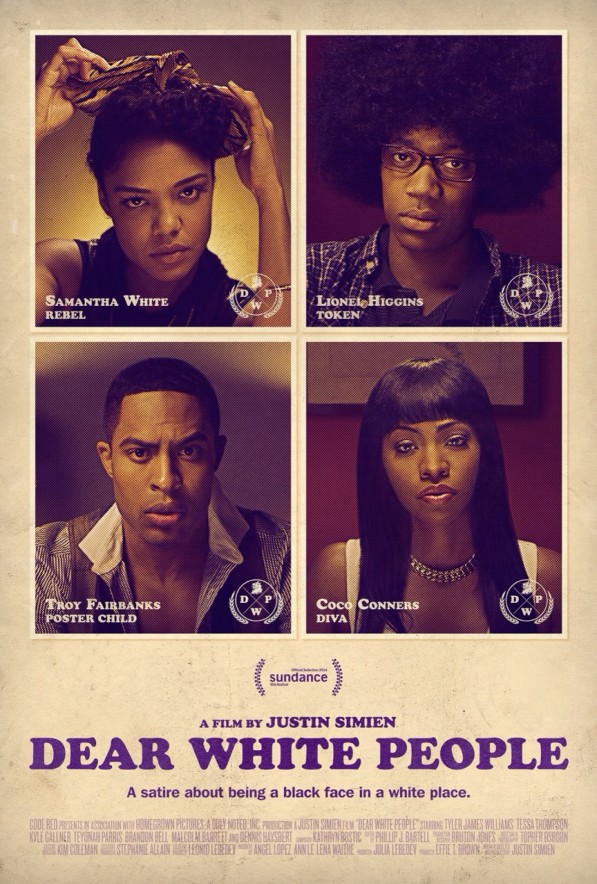 In an age where a vocal number of people believe racism died when Obama took office, or that the sins of the past are so old they have no more ramifications in today’s modern world, Dear White People is a blessed conversation-starter and a cogent argument to point to and enthusiastically say, “This!” Writer/director Justin Simien has put together a biting satire on modern race relations and the pressure to fit in where one can. This is more of a parable than a film, with some less than fully realized characters, but the commentary is rich and pointed enough that I was pinned to my seat. I wanted to hear what the characters would say next, and yes that’s also one of the film’s forgivable flaws, the fact that characters feel like they have speeches and political repartee rather than actual dialogue. In the fictional university of Winchester, every person is compromising who he or she is, pretending to be something they’re not, to fit an easily definable image. Everyone is using somebody for his or her own selfish gain. The storylines jostle around, relying on too many coincidences, but the actors are more than capable of drawing you in, especially the two leads played by Tessa Thompson (Selma, TV’s Copper) and Tyler James Williams (TV’s Everybody Hates Chris) as a gay journalist who doesn’t see himself fitting in with any of the established definitions of “black culture.” The commentary on reality TV and the media feels tacked on and undercooked, forgotten except that it lays a foundation to justify the film’s startling conclusion, a frat party where obnoxious white students dress up as grotesquely racist cartoons. Dear White People is a damning film that also plays it safe with its excoriating condemnations; it’s not as militantly ideological as some may fear or hope. This is no Bamboozled. And yet, it’s this middle approach that will make it more palatable for a mass audience. Oh, and did I mention it’s also funny? Whatever your color, take time to see this film.
Nate’s Grade: B+
Share this:

God’s Not Dead (2014)
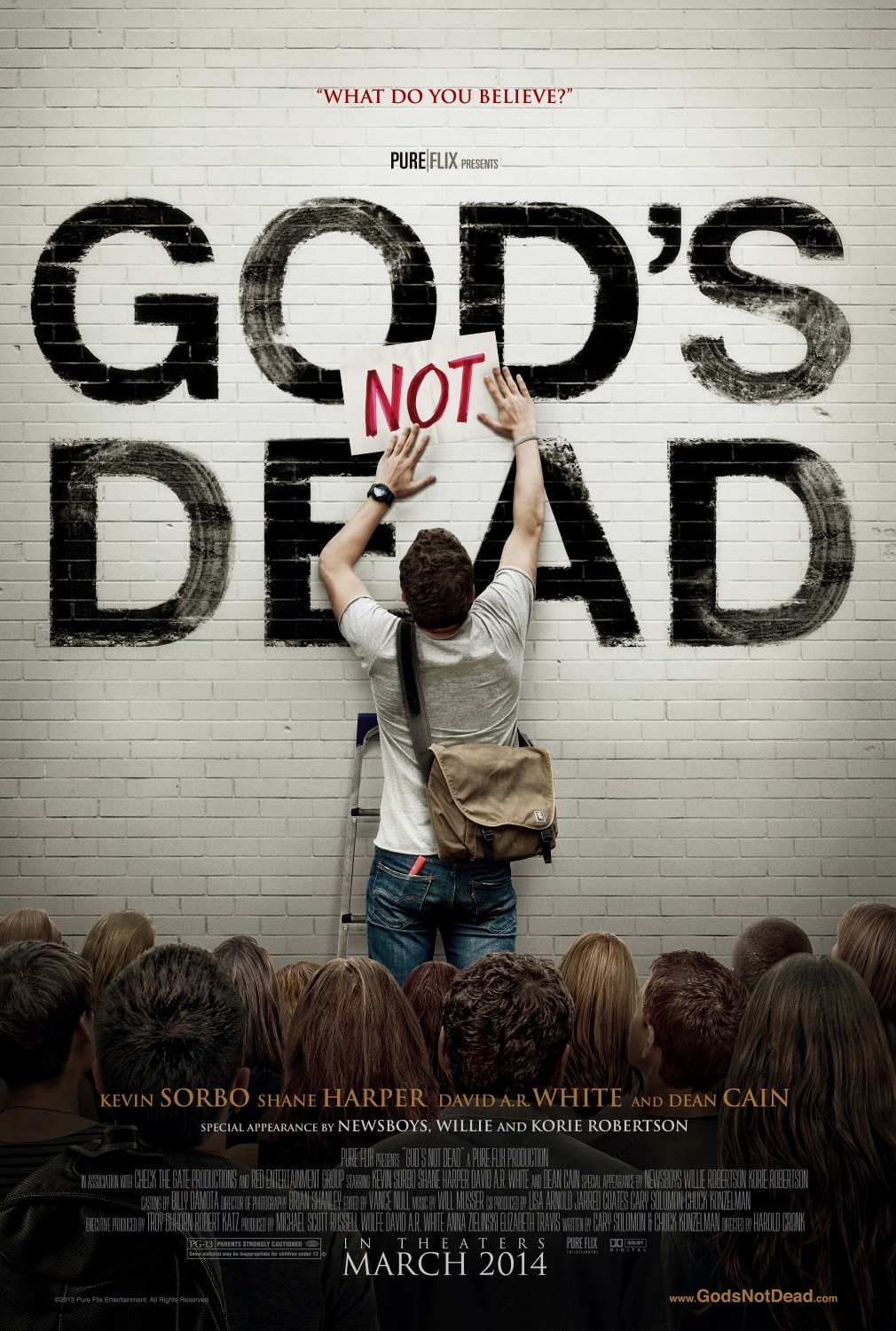 Before I dive deep into the unfortunate indie film, God’s Not Dead, allow me to disclose my own leanings. While I can objectively deconstruct and analyze a film, as I intend to with this one, allow me to state that I consider myself a Christian. I also happen to have several friends of different faiths including some who are atheists. We can civilly discuss our differences without having to demonize one another, finding merit in the different tracks people take to add value to their time on this Earth. Well somebody should have let God’s Not Dead know that the world isn’t so didactic, and the best way to reach people is not to loudly declare your own sense of superiority. This is such an angry little movie disguised with a misleading happy face.
Josh (Shane Harper) is a freshman assigned to Professor Radisson’s (Kevin Sorbo) introductory philosophy class. He’s been warned early on that the prof has a target for Christians in his class. Sure enough, on day one, Radisson offers his class a tempting offer: if they will turn in a slip admitting God is dead, then they will automatically get a good grade and the class will move on to other thinkers. Josh can’t do that, so Radisson challenges the coed to prove the existence of God over the course of three classes. Josh’s peers will serve as the jury of this theological trial.
 It should go without saying that God’s Not Dead feels like it exists in a world that doesn’t come close to resembling reality. That’s fine, movies don’t have to be a perfect reflection of our world, but when a film purports to be the reaction to the persecuted, it has to bend over backward to create its illusion of persecution. One of the big giveaways early on was the fact that all but one person in a full class would acquiesce to admitting, “God is dead” for a better grade, especially a school in the South (the film was filmed in Louisiana). The next giveaway was when Josh’s girlfriend threatens to break up with him if he goes through with challenging Radisson. Her thinking: if Josh gets a poor grade in one class his freshman year, he’ll never be able to go to law school, and their future plans will be kaput. Who thinks this way? Another giveaway was the representation of academia, namely the professors at the university, all of whom come across as snobby, self-satisfied, smug, and mean-spirited even to the point that they’re mocking their own colleague’s girlfriend to her face. People don’t behave like this. Then again this is more of a parable than a story, and more of a conversion exercise than a movie.
The genesis of this movie feels like it was spawned from a collection of e-mail forward bogeymen, in particular the notion of Christian persecution. For starters, a far majority of this country identifies as Christian, as do the politicians making and enforcing the laws. This is very much a Christian country, so why do certain people feel they are under attack? Even accepting the premise, the movie is rife with creaky subplots that don’t add weight to the film, only padding. There’s the Chinese student who wants to gravitate toward Christianity, whose father warns him to go with the flow lest they upset the Chinese government (COMMUNISM!). There’s the Muslim student forced to wear a headscarf and who secretly listens to Billy’s Graham’s son on her iPod, afraid of what her traditional father would do if he found out (MUSLIMS!). There’s a blogger that writes for “The New Left” who wants to ambush good Christian celebrities like the Newsboys and one of the bearded gents from Duck Dynasty (he looks eerily like my critical colleague, Ben Bailey) with her position of outrage (LIBERAL MEDIA!). In light of the controversy over the Duck Dynasty patriarch saying gays are on par with terrorists and black people were more cheerful in the Jim Crow days, it’s even more unusual. These additional storylines are grafted on with such witless care, belaboring the running time.
Radisson is the prime bogeyman, the smug, self-satisfied atheist intellectual (LIBERAL! COLLEGE! ATHEIST!). No college professor is EVER going to force his or her students to declare God dead in class. They would be disciplined severely and booted. Radisson can spout out a few famous names, but really the man resorts to bullying and intimidation, including physical threats against Josh. There’s no way a dean would allow this to stand. The classroom, and higher education in general, is meant to provoke discussion, especially for a philosophy class. The notion that a philosophy professor would think only in reductive right/wrong terms is idiotic. The entire idea of college as this liberal brain-washing ground that infringes upon the freedoms of Christians, a feeling cataloged in the end credits with reported legal cases, falls apart when you understand that college is about the exchanging of ideas. A Christian viewpoint is but one viewpoint, and within that group the variances are many. Simply being exposed to differing views, texts, and people is not cause for alarm, unless, of course, the person is too insecure in their own faith. The anti-intellectualism argument seems to believe that the more knowledge one is exposed to, the more choices they have, the less trustworthy they can be with making up their own mind.
 Then there’s just the overall poor nature of Josh’s debates. If you’re going to put God on trial, then devote the majority of the movie to this exercise. Cut the many subplots just floating around gunking up the narrative. Josh is in charge of presenting a compelling case for the existence of God. He opens with the notion that man cannot prove God exists but they also cannot disprove God. Huh? Josh, you’re tasked with proving the Almighty and you start with this rhetorical nonsense? Let’s apply this logic elsewhere: I can’t NOT prove that eating ice cream spares me from getting struck by lightning. An intelligent case can be made for a Creator, but that’s not what happens here. Instead, Josh relies on circular logic while blasting others for circular logic. He cites Genesis as the accurate scientific account for the Big Bang, saying science had it wrong, forgetting that science is, pardon the term, an ongoing evolution building off the previous ideas and breakthroughs. He also grossly misrepresents the theory of evolution, the timeframe of developing life, provides a ham-fisted rationalization for the existence of evil, and finally resorts to pressuring Radisson to admit he is a lapsed Christian who has never forgiven God for the death of his mother. Because, you see, an atheist can’t simply come to their beliefs logically. The final head-scratcher is when the class unanimously votes with Josh “I am Spartacus” style, not a single soul, in a philosophy class no less, quibbling over the flawed presentation (Hey, he made animated PowerPoint slides! That’s all we need). I also doubt that any modern-day college class would be filled to capacity especially a class as potentially boring and esoteric as a philosophy class for eighteen-year-olds.
Let’s focus on the really nasty core of God’s Not Dead, which states explicitly and implicitly that anybody who is not a Christian is without morals and judgment. Josh, in his concluding argument, cites Dostoevsky (though it’s really a character in his book) saying, “If God does not exist then everything is permitted.” His argument boils down to the concept that those who do not believe in God are without moral clarity. That’s generally insulting and downright hostile, presupposing that the only reason people treat other human beings with kindness and respect is because of religious faith and not, you know, an innate personal sense of right and wrong. Newsflash: no one religious group has a monopoly on moral values. Hammurabi didn’t need Christianity to come up with a system of moral laws to live by in 1700 BC. I don’t kill my neighbor merely because I fear cosmic retribution. Likewise I don’t help a person in need because I want my brownie points; I do it because I know it’s right. The entire movie exists in such a black and white terms, and to keep up with this edict every non-Christian is presented as a terrible, often mean-spirited human being. The Muslim father believes in God, but not the Christian God, and so he must beat and threaten his daughter for her clandestine conversion. The superficial businessman (Dean Cain) has riches but at what price? The liberal blogger has her career but in her time of need nobody close to comfort her. The film posits that atheists or non-Christians are without morals and cannot be truly happy in life. It’s this gnawing and unnecessary sense of superiority that infuses the film, leaving an unsettling aftertaste of smugness for a movie purporting to castigate others for their own smugness.
Let’s talk about the liberal blogger and Radisson for a moment. It’s not enough that we can’t allow intelligent people to have differing perspectives and beliefs, and respect those differences; no every person with a different view on God must be punished. The liberal blogger finds out she’s dying from cancer. Big spoilers ahead: Radisson is fatally hit by a car. Our kindly reverend character has just enough time to get Radisson to profess his love for Jesus on his deathbed before stepping off into the light. And so, our voices of dissent are unceremoniously killed off. Literally we jump from the death of a man outside to an extended Newsboys concert that asks people to text bomb their pals, a text which just happens to be the name of the movie and the Newsboys’ 2011 album. It’s a little unseemly from a dramatic standpoint but from an ethical standpoint more so.
 I’ve expended a lot of words examining the content of God’s Not Dead, so allow me to judge it as a film. For starters, there are way too many subplots that eat up valuable time, mostly people on the periphery meant to provide validation to Josh for his actions. Tonally, several of these segments clash, especially the kindly minister and his wacky misadventures trying to drive to Disney World. The time in the classroom is the hook of the film but it gives us about equal time with the liberal blogger or the Muslim daughter or any other distracting side character. Also, the filmmakers have the annoying habit of cutting to another scene and then back while their first scene continues to play out. I assume they’re forcing parallels but in reality it’s just shoddy editing that disorients an audience. Then there’s the sequence where the Muslim girl’s younger brother is entering her bedroom, going to discover what she’s listening to on her iPod, and it’s played hilariously like a horror movie with the lurking shadows. There are directing choices that take away from the potential drama of scenes. From a technical standpoint, God’s Not Dead looks slightly better than other Christian widespread releases, but the filmmakers are worse storytellers than the Kendrick brothers (Courageous).
The acting is inoffensively bland with one notable exception. Despite what you may think, Sorbo (TV’s Hercules) is actually pretty good as the raging atheist. He digs into his character’s pool of anger and arrogance and produces a performance that weirdly feels moderately grounded, even for a character that is not. I don’t really know why the Duck Dynasty cameo was necessary but I suppose the filmmakers felt they needed additional star power to lure their target audience.
God’s Not Dead is a surprisingly mean little film that hides its purpose under the auspices of evangelism. I expected a pro-Christian message and it has every right to put forward its own viewpoint, but the film isn’t so much pro-Christian as anti-everyone not already following the same limited interpretation of Scripture. This is not an inclusive film that will reach out to those lost sheep. Putting aside the poor filmmaking and plotting, the misplaced persecution complex, and the straw man arguments, the most disappointing aspect of God’s Not Dead is the illusion of intellectual rigor. The merits of Josh’s less-than-stellar arguments are not the point, though any person skilled in critical thinking should be able to poke holes in his faulty rationale. The point of the film is to feed into an unjustified sense of being wronged, that even though Christians are a clear majority in our country, that somehow they are under attack simply because others are allowed equal opportunity to share their own valid views and beliefs. In the black and white universe of God’s Not Dead, there is only one way to be happy, to be moral, and if you’re not on this team than there’s no way to achieve anything of substance in your life. Do you see the difference? It’s not that my side is good, it’s the notion that my side is better, that your side is worse. It’s a distinction that adds a decidedly sour note. This is a movie after all where the purveyors of atheism have to be struck down with death. God’s Not Dead is likewise striking ‘em dead at the box-office, but you should hold the movie to a higher standard.
Last note: the very title is a misuse of Nietzsche’s quote. The full quote is, “God is dead and man has killed him,” which implied man no longer needed religion to serve as its lone basis of moral authority.
Nate’s Grade: D
Share this:

Bad Teacher (2011)
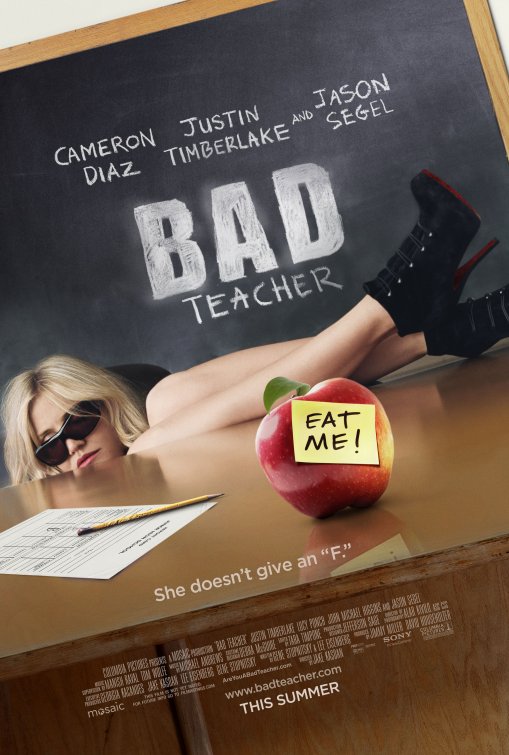 The teaching profession sure is taking its share of beatings lately. After the critical documentary Waiting for ‘Superman’, the loss of collective bargaining in several states, and the continual belief that teachers, despite having to take college courses and/or pass content tests routinely for license renewal, know nothing (full disclosure: I work in the teaching field), along comes the crude comedy, Bad Teacher. This is a comedy that wants a passing grade without showing its work.
Elizabeth Halsey (Cameron Diaz) is a figure that lives up to the promise of the film’s title. She drinks, smokes pot, sleeps, and all while in class. She looks down on her peers who actively attempt to be engaging to students, like the high-energy Miss Squirrel (Lucy Punch). The school’s gym teacher (Jason Segel) keeps trying to chip away at Elizabeth’s surly, apathetic demeanor, but she continues to shoot him down. Elizabeth’s attention is focused squarely on the handsome substitute teacher, Mr. Delecorte (Justin Timberlake). Not only is he handsome, he’s from a wealthy family. The only thing standing in her gold digging way is Miss Squirrel, who also has an interest in courting the studly sub.
Let’s analyze the bounds of having an unlikable protagonist. There’s a difference between an anti-hero and a generally disreputable lead character. An anti-hero usually has some interior good, or at least a relatable core. An anti-hero generally finds some small measure or redemption or change for the better, even if met through unorthodox means. An anti-hero doesn’t beg to be liked, but the trick is that the audience eventually does like this nontraditional lead. We do not have to agree with the values or behaviors of our lead. You do want to care and desire the character to reach some measure of happiness or wh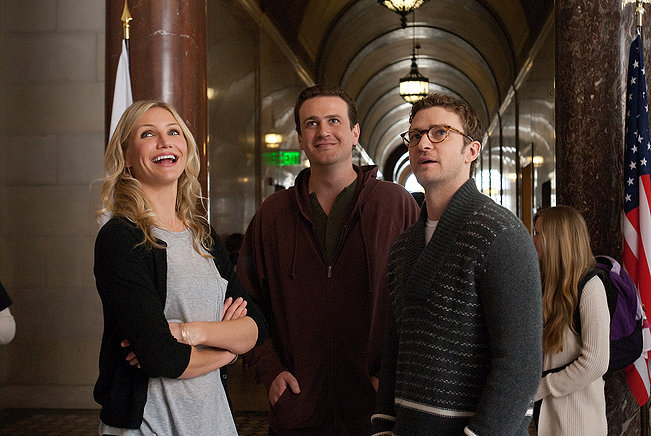 atever their goal is, perhaps an inkling of personal change. Examples include Bad Santa, Goodfellas, Jack Sparrow and Alex DeLarge, nearly every Clint Eastwood character, and take your pick from Quentin Tarantino or Robert Rodriguez’s oeuvre. A wholly unlikable protagonist is another concern. If you are so turned off by the protagonist you could not care less what befalls them. Whether they reach their goal, get away with their plot, or even risk life and limb, you do not care.
Bad Teacher suffers from having an unpleasant, obnoxious, selfish, greedy, churlish twit as its lead. Elizabeth is no dashing rogue, no charming cad, no subversive combatant against a corrupt system, nor is she is she a vulnerable individual lashing out to mask her pain or insecurity. All of those qualities would help make for a complicated but ultimately likeable hero or heroine. Instead, what Bad Teacher gives us is a woman that is so thoroughly unpleasant that you tune out early, severing all connection to a comedy. Bad move. Elizabeth’s one goal is to collect enough money through whatever means necessary to afford a boob job. And if she can bring other people down that annoy her, never mind if they are actually good people or teachers, then victory is all the sweeter. Bad Teacher‘s problem is that you don’t want Elizabeth to succeed, you want her to be punished. Elizabeth isn’t likable bad or truly nasty enough to be memorable. She’s the adult version of the popular girl that got away with everything. I never felt an ounce of pity for this person. There is no redemption for this woman, even if she starts treating a small handful of people mildly better. Acting 2% more like a human being does not qualify as progress. How did this woman get into teaching in the first place and for what purpose? There are a lot less strenuous ways to earn a paycheck.
I started feeling for Elizabeth’s rival, Miss Squirrel. Sure, she’s that hyperactive, goody-two-shoes, incredibly cheerful personality that can become grating in large doses, but she’s the only figure in the movie that displays a genuine interest in teaching. Everyone else just seems to be walking around. Elizabeth gets through months of teaching by showing inspirational teacher movies (Stand and Deliver, Dangerous Minds – no School of Rock?) and sleeping off her hangovers at her desk. Miss Squirrel is a bit obsessive about her job but she cares, and in the film’s void of having a likeable center I gravitated to the spastic, alternative foil. I began rooting for Miss Squirrel to root out her rival’s lies, expose her bad/illegal behavior, and earn some vindication. It was she that I latched onto sympathetically. I rooted for the character that was served up for ridicule by the filmmakers. What does that say about the movie? It also helps that Punch (Dinner for Schmucks, You Will Meet a Tall Dark Stranger) gives the strongest comedic performance. In the realm of Bad Teacher, the good, competent, idealistic, passionate educators are the ones unjustly punished by film’s end.
Diaz (Knight and Day, The Green Hornet) can do the salty, spunky stuff in her sleep, and often in Bad Teacher she seems to be on autopilot, dispensing with the vulgarity without a true glint of madness or enjoyment. She just seems to be irritated by everyone, including the audience. Timberlake (The Social Network) is playing aloof but could have easily been replaced by any decent-looking comic actor. Segel (Forgetting Sarah Marshall, I Love You, Man) gives the film a much-needed jolt when he appears onscreen. Too bad his screen time amounts to about 10 minutes and ends in a rather trite fashion with his gym teacher miraculously taming the shrew. Several other comedic actors are wasted in one-bit parts including John Michael Higgins, Molly Shannon, Phyllis Smith (TV’s The Office), Matt Besser (TV’s Upright Citizen’s Brigade), David “Gruber” Allen (TV’s Freaks and Geeks), and Eric Stonestreet (Emmy-winner for Modern Family).
All of this would be marginally forgivable if the film were just funnier. The jokes are stuck in the same gear, mainly Elizabeth being rude or outrageous. It’s a recipe that gets repeated too often, only altering clarifying details. The school has a car wash and Elizabeth dresses provocatively, scrubbing dirty automobiles with a nubile and sudsy devotion not seen since 1980s heavy metal music videos, the heyday of car washing imagery (there sure were a lot of filthy cars in Reagan’s America). The men are agog. It’s the same joke on repeat. She drinks. She says something inappropriate at school. She gets high. People are agog. Bad Teacher is set up from a comedic front to be 100 minutes of reaction shots. It’s like director Jake Kasdan (Orange County, Walk Hard) has to rely on a glut of reaction shots to sell the gags. Why are the kids so meaningless in the comedy? Surely you would think the screenwriters would want to have some students as main characters as well, if nothing else than as a gauge for their lead. Elizabeth does give some advice to a lovesick dorky kid, but her advice is more of a tough love. When Elizabeth discovers there’s a bonus for whoever’s class has the highest state testing scores, you’d think this would be a rally the troops moment. She actually starts teaching and utilizing her skills to get her class to learn, albeit for a personal financial incentive. You would assume then that this might be a changing point for the character, where she actually discovers that she may like teaching or that she does in fact have some aptitude for the profession. Nope. She just resorts to cheating and blackmailing the maker of the state test (Thomas Lennon). I would applaud this narrative pivot, avoiding the expected, if it led to a funnier series of jokes.
The teaching profession is ripe for an astute, mordant satire exploding the politics of the position. Bad Teacher is not that movie. It’s not even close to that movie. It is, however, a comedy that is weighed down by an abhorrent lead character. Diaz’s heroine is unlikable to the point that she turns you off from the whole movie. I suppose there’s a certain measure of bravery having a mainstream studio movie with such an unpleasant main character that doesn’t give a damn about redemption. In the end, watching an appalling egotist get theirs in the end can lead to some sliver of satisfaction, but when that same detestable character gets away with their dastardly deeds? You feel robbed. That’s Bad Teacher in a nutshell. It robs you of laughs, money, and time.
Nate’s Grade: C
Share this:

Expelled: No Intelligence Allowed (2008)
 Ben Stein is best known as the monotone teacher in Ferris Bueller’s Day Off, but the man has also been a speechwriter for Nixon, a game show host, and popular figure of deadpanned irony. Expelled: No Intelligence Allowed follows Stein as he travels across the world interviewing scientists, authors, professors, and others about what he sees as a disservice to science and America. “Big Science,” as he refers, is so heavily entrenched in the theory of evolution and the teachings of Charles Darwin that they are unwilling to even broach alternative approaches. Intelligent Design believes that life is far too complicated to occur randomly, and thus must have been created by some powerful supernatural designer. The teaching of evolution is still seen as a controversial subject and I.D. proponents want their theory to be given equal time.
Stein tries to skew his argument into one about freedom. The Constitution calls for the freedom of speech and our nation is built upon the bedrock of being a marketplace of ideas. Stein compares the resistance in the scientific community to Intelligence Design to the Berlin Wall, and he argues that I.D. proponents just want to open up the dialogue. Detractors warn that I.D. is just Creationism in sheep’s clothing, and indeed the U.S. courts have ruled the same way. The problem with Intelligent Design is that it can’t really apply to science. Science can only test what exists in the natural world, and religion by definition deals with the supernatural and thus can’t be tested. It’s one thing to say, “The sky is blue because God made it so,” but what else do you do with that as a scientist? Where do you go from there as a teacher? Science textbooks would be awfully thin, since you would just need one sentence to sum up all of existence. Evolution begins with the start of life and no one has a strong feel for how life began, but I.D. runs into the same wall if you think about it. Saying, “God created life” leads to the question, “How was God created?” and now we’re back where we started. Personally, I don’t see why evolution and religion have to be seen as forces that cancel each other out.
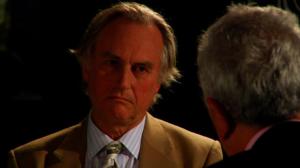
 Ignoring the subject matter, Expelled just doesn’t even work effectively as an expose documentary. The movie continuously jumps to old newsreel footage as a visual resource even for mundane conversations. It happens again and again. Either the filmmakers thought their audience had ADD or was too stupid to sit through an interview without several jump cuts to visual reference points. Some of the clips are fun in a goofy retro way but the whole decision comes across like a narrative crutch and it makes Expelled feel erratic. Stein doesn’t try very hard to disguise his interview style, which includes him leading his interview subjects and lobbing softball questions like, “Intelligent Design is just Creationism, right,” and the audacious, “What was the purpose of the concentration camps?” I think it is telling that the interview subjects are not given lengthy reactions and are not pressed into actually presenting what Intelligent Design proof that exists. In contrast, the evolutionary scientists interviewed are intercut with clips of Nazis and Communists soldiers. I don’t even think Michael Moore would have chosen to go that obvious.
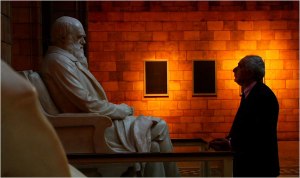
While I’m on the subject of Moore, Stein follows some similar ambush tactics and they are obvious and obnoxious. Stein tries to walk into the Smithsonian Center to get a statement as to why a prominent scientist was released and ends up getting kicked out. Did he expect anything different? Portions of Expelled come across as transparently staged, and upon some research I have learned that some were indeed staged. The film opens and closes with Stein addressing a full crowd of college students. They erupt in rapturous applause by the end of his speech and give the man a standing ovation. That crowd was nothing more than paid extras and Stein has never traveled the college circuit to speak on Intelligent Design. The scientists that were interviewed were also misinformed and told that they were being filmed for a documentary called Crossroads about the “intersection of science and religion.” The evolution scientists interviewed were then barred from free public screenings. That should tell you something.
Scientists being blacklisted by their peers seems rather unfair, but the movie takes their subjects strictly at face value. I am convinced there is more to the story than Expelled lets on. One woman off-handedly mentioned the phrase, and that was all, and was let go. I want to know more, but the film apparently doesn’t. Stein even cuts her interview off and dubs his own voice over as she continues her story. I would have appreciated some interviews with scientists who believe in evolution and God. Given that approximately 99.97 percent of life scientists believe in the theory of evolution, so statistically there must be a healthy slew of scientists who happen to be Christians that believe in the existence of evolution.
 The film is heavy-handed propaganda, sure, but man oh man does it just take an ugly turn in its last third. Ben Stein eventually makes the leap from evolution to… wait for it… Nazism and the extermination of those less desirable. Stein and some of his interview subjects are making the case that Hitler was directly influenced by the tenets of evolution and that he used Darwin’s template to snuff out Jews, Gypsies, gays, the handicapped, and all those holding back the human race with their inferior genetics. There are many steps removed from Darwin to Hitler, but Stein is laying the blame of the Holocaust at the feet of Darwin’s ideas. Arguably, exterminating an inferior race could be applied to the idea of natural selection (though forcibly killing millions doesn’t seem very natural to me) but people were killing each other long before Darwin was ever born. Before Darwin, there was still genocide in the name of eliminating those deemed inferior, and mostly it was performed with the justification of religion. Surely historically religion has been the motivator for more death than Darwin (count the Crusades and the Inquisition). Even specifically Jews have been persecuted and put to mass death centuries before Darwin. And what about all the countries in the world that have embraced evolution as science and not gassed millions of people? But Stein persists in trying to attach the Holocaust and Nazism to evolution. To me, this is like blaming The Catcher in the Rye for shooting John Lennon in the head. Darwin posited ideas and cannot be blamed for others perverting those ideas for their own gain. The film also glosses over the fact that it was Herbert Spencer who introduced the phrase “survival of the fittest,”
And yet after spending a good deal of time linking Darwin and the Holocaust, Stein throws out this caveat: “But I know that Darwinism doesn’t automatically lead to Nazism.” Expelled is filled with other such contradictions. It argues that science and, specifically, evolution does not disqualify the existence of God, and to this I agree whole-heartedly. Science provides the “how” in life and religion can provide the “why” for people. Science does not disqualify God and vice versa; however, Expelled then trumps interview after interview of scientists that explain how evolution turned them into atheists. Huh? The film presses the irritating and confusing point that evolution will turn everyone into a bunch of atheists, but this conflicts with one of the film’s central points on the roles of religion and science. Stein never goes into great detail in this area and ignores the fact that a majority of the American public is both religious and believes in evolution.
 Expelled starts to become an ideological dartboard by the end of its experience. Stein says evolution is responsible for eugenics, which lead to the idea of population control, which lead to Margaret Sanger founding Planned Parenthood. My reaction is: so? Planned Parenthood promotes safe sex and performs legal abortions, yes, but they have nothing to do with eugenics and religion. Henry Ford and Walt Disney were also believers in eugenics. But the interview subjects all seem to repeat the phrase “euthanasia and abortion” like it was a talking point they were handed. The exact phrasing is so precise for several interview subjects that it seems deceptive. Why does this matter at all in a movie reportedly about Intelligence Design?
I cannot honestly see anyone being converted by Expelled. Skeptics and believers in evolution will fail to be swayed, and for the large Christian community the film is courting, well it will be preaching to the choir. I just discovered that there’s a website called expelledexposed.com intent to hold Stein’s film to review. I’m a firm believer in evolution and that Intelligent Design is religion; yeah they don’t specify “who” but how many I.D. proponents were the same ones pushing Creationism in schools earlier? If they stick to the tenets of Intelligent Design then I’d like them to accept the Raelians in their camp (Raelians believe that aliens seeded our planet). Expelled never makes the case for why Intelligent Design should be taught, merely that it is unfair to exclude it from the classroom. The movie presents contradictions, logic fallacies, and some disconcerting guilt-by-association arguments that border on exploitation. Even though I disagree with its ideology, from a filmmaking standpoint it falls apart. The topic of evolution’s relationship to religion deserves a thoughtful and intelligent movie. This is not it.
Nate’s Grade: F


 nathanzoebl
You must be logged in to post a comment.