Blog Archives
Concussion (2015)
 Concussion wants to be a hard-hitting drama exposing the dangers of repetitive head trauma in football and the lengths of the cover-ups and collusion within the NFL, except that movie already exists and is the Frontline documentary League of Denial that was too controversial to air on ESPN. Concussion, in comparison, is an adequate but hopelessly underwhelming film on the Nigerian-born Dr. Omalu (Will Smith) who discovered chronic traumatic encephalopathy (CTE) in the brains of deceased NFL players. The resistance and denials are soft-pedaled, though the movie treats them with heightened dramatic stakes that are unearned. There’s one threatening anonymous phone call but for the most part it feels like Dr. Omalu is just being ignored, and “being ignored” is a hard thing to turn into outstanding dramatic stakes at the movies. The movie doesn’t let the NFL completely off the hook but its critiques have been softened by studio interference (as revealed through the Sony email hack). As a straightforward drama, Concussion is easy to watch and Smith gives an authentic performance that doesn’t have to go to histrionic lengths to communicate his internal struggle. There’s a nice subplot with Omalu courting his eventual wife played by Gugu Mbatha-Raw. Albert Brooks and Alec Baldwin are strong supporting players. David Morse gets a show-stopping part to show off his acting skills. By the end, it all feels just a little too nice, a little too polished, and a little too easy, both in how it presents a complicated medical discovery and its implications but also the NFL’s response. For an awards-season drama that’s meant to shock and inform, being “easy” is the wrong call.
Nate’s Grade: B-
Note: “League of Denial” is currently available on Netflix streaming and I encourage people to check it out.
Share this:

The World’s End (2013)
 The third in the Cornetto trilogy, the series of loving homages to genre films that end up transforming into those films, written by star Simon Pegg and director Edgar Wright (Scott Pilgrim vs. the World), is so self-assured, so witty, and so stylish, but it’s also the best film Wright has done. While my heart will always bleed for 2004’s Shaun of the Dead, it’s something of a revelation how everything comes together so magically in The World’s End. Every joke, every sight gag, every offhand reference, it somehow is all tied up together or has some greater narrative connection, like the names of the 12 pubs on a pub crawl reunion that discovers an alien invasion. The dialogue is packed with layered humor, with choice bon mots like, “That’s why I drink out of a crazy straw. Not so crazy now, huh?” and, “Or selective memory like that one guy… who? Oh yeah. Me.” Given the previous films, Shaun and 2007’s Hot Fuzz, I knew this would be a funny movie, but I was unprepared for how emotionally adept it is. The characters are given surprising depth and pain and anger, mostly stemming from Pegg’s screw-up alcoholic character desperately trying to relive the good times. The writing is so textured that the characters come across like actual people, and the twists and turns, while entertaining, are far more emotionally grounded than in any previous Wright movie. There is real pain and atonement for these fallible characters, which makes us root for them even more against the robot invaders. Pegg and Nick Frost are terrific again. The action is frenetic and inventive, the laughs are frequent, and the characters are so fully realized that The World’s End isn’t just the best film in a stellar, pop-culture savvy trilogy, it’s also one of the best movies you’ll see this year.
Nate’s Grade: A
Share this:

Sherlock Holmes: A Game of Shadows (2011)
 Delivering pretty much more of the same, Sherlock Holmes: A Game of Shadows isn’t exactly an improvement over the classic detective’s first foray into out-and-out Hollywood action cinema. The real treat of the budding franchise is the comic interplay between Holmes (Robert Downey Jr.) and Watson (Jude Law). Their harried banter makes for the best moments. Once again the plot is overwrought, the side characters underdeveloped (poor original dragon tattooed girl, Noomi Rapace, given absolutely nothing to do but run in a gypsy skirt), mysteries that you give up and just wait for Holmes to explain, and a villain that proves to be lackluster. For Moriarty (Mad Men’s Jared Harris) to be the nemesis, the intellectual equal of Holmes I’m going to need to see much more than this. There is a fine sequence at the very end where Holmes mentally envisions the steps of his attack and then Moriarty joins in: “You think you’re the only one who can do that?” They hold an entire duel fought step-by-step in the imagination. I wanted more experiences like this, but director Guy Ritchie (Snatch) falls back on his signature stylized action sequences of fast whooshing and quick spinning. The action is a step up from the first Holmes, and that will be enough for most ticket-buyers. I’ll admit there is a certain meta-literary charm at watching Arthur Conan Doyle’s signature detective fighting his way through an armed body of baddies. Whatever your feelings were for the 2009 Sherlock Holmes, I’m fairly certain you’ll revisit them in their entirety with Game of Shadows. I know I did.
Nate’s Grade: C+
Share this:

Sherlock Holmes (2009)
 Sherlock Holmes as a gritty pub-brawler? Before you dismiss the big-budget Hollywood retooling of the literary detective, look back at author Arthur Conan Doyle’s source material. Appearing in over 50 stories, Holmes was a bit of a rude rapscallion who would get into brawls and recreationally use cocaine. It was only until Dr. Watson stepped into his life that Holmes cleaned up and became a proper, respectable gentleman and the figure we know. With stylish director Guy Ritchie (RocknRolla) attached, it appears that this Holmes for a new generation is actually a throwback to his roots.
Famous detective Sherlock Holmes (Robert Downey Jr.) and his assistant, Dr. Watson (Jude Law), are at an impasse. Watson wishes to leave Holmes establishment and start a new life with a woman he loves. Holmes is also threatened by Lord Blackwood (Mark Strong), an aristocrat in prison for killing women in ritualistic manners of the dark arts. He’s about to be executed when Lord Blackwood promises he will return from the dead, and his murders will continue. Sure enough, after Blackwood is hung by the neck and pronounced dead by Watson, the murders resume and the dead man himself is seen walking among the living. Holmes is on the trail of his resurrected foe when he meets Adler (Rachel McAdams), the woman who broke his heart. She’s employed by a mysterious stranger and becomes mixed up in the deadly hunt to stop Lord Blackwood.
 As is quickly becoming commonplace, Downey is the best part of the movie. His combative relationship with Law makes the movie worthwhile. They have a feisty, squabbling chemistry that generates a lot of humor, and they interact like a 1980s buddy cop movie. Their verbal jousting practically saves the movie from collapsing due to the overwrought plot. At its best moments, Sherlock Holmes feels like a buddy cop movie transplanted to Victorian England. Downey is having a hoot as the character and brings a vibrant energy to his role, turning Holmes into an eccentric who gets buggy if he cannot obsess over a case, taking several cues from the Monk playbook of eccentric detective genius. Downey is cocksure and a charming cad, enjoying every moment he can outsmart the competition. Law is more equal than sidekick and plays the straight man to Downey’s neurotic detective. I’m not usually one to bemoan foreign accents, but this is one movie that would benefit from subtitles. The actors don’t necessarily talk in thick accents but they speak so fast that it begins to sound like an unintelligible mumble.
The romantic subplot is a non-starter as Holmes reunites with both The One That Got Away and his Crafty Equal. McAdams is a fine actress with a luminescent smile, but her involvement is really an afterthought. She’s the old flame that always re-enters in those 1980s buddy cop movies. She stays long enough to rekindle some old feelings and provide a figure in need of rescuing. Her storyline is one of several that could have been completely eliminated. The same could be said for Watson’s girlfriend, the steamboat accomplice, the put-upon maid, and many of the conspirators.
The plot for Sherlock Holmes feels like three screenplays were crudely sewn together. There are so many junky side stories and characters that need to be eliminated. It’s just far too busy without anything making real traction. The story is weighed down with expository dialogue and mounting subplots. There are a few sequences that jump forward in time but don’t inform the audience, so we’re left a tad discombobulated. The film jumps immediately into the fray without any pertinent flashbacks or setup, daring the audience to pay attention. At some point in the middle I gave up, having disengaged from the plot and determined to simply wait it out for Holmes to explain what I was missing. I think at one point I was even starting to nod off to sleep, which is a deadly sign for an action movie. The central occult conspiracy has a lot of men in cloaks but no discernible outcome. The movie is littered with conspirators and locations and details that all seem meaningless until Holmes can tie all the jangled pieces together. The script is overloaded and half-cocked and bides its time waiting for Holmes to provide relative clarity. It gets old after a while when only Holmes knows the clues and he won’t share.
 You don’t usually think of the intellectual detective in the deerstalker cap as a man of action, but this brash reinterpretation would be acceptable if Holmes found himself in some action sequences that would befit his legendary stature. Ritchie?s hyperbolic shooting style makes for a lot of fast whooshing and quick spinning but it doesn’t add up to many satisfying sequences; the best is probably a battle with Holmes and a giant that destroys a shipyard plank by plank. Ritchie introduces an intriguing action device for this beefed-up Holmes; he mentally envisions the steps of his attack, going from punch to counter punch. This technique is a fun peek into the mind of Holmes and it makes the action easier to follow for the audience. The fact that this narrative action device is used twice in the 30 minutes made me alert. Surely this cool little stylish flourish would come into play during a climactic moment. Nope. This visual quirk is done twice and then curiously never resurfaces. Instead, the movie ends in a climax dotted with the tired routine of atop high places. The showdown is rather weak. Watching Holmes and Watson beat their way through thugs has its meta-literary appeal but Ritchie and his screenwriters fail to summon entertainment amidst the cluttered chaos.
I am a self-described Ritchie fan, though he hasn’t made a good movie since 2001’s Snatch. He lathers on the style right from the opening studio titles being integrated into the cobblestone streets of London. The production design is impressive and the actors seem to be having a game go with the literary legend, but it all comes back to the murky story. Sherlock Holmes could have succeeded on a crackerjack story or on being an entertaining thrill-ride, but it fails in both areas. The nonsensical conspiracy plot feels like a leftover from a bad Dan Brown novel (redundant?) with secret societies and mystic orders and blah blah blah. The characters feel less than real because they aren’t given time to be fleshed out, so they resort to being stock archetypes locked into well-defined place by the fact that the plot gallops from the start. The action is uninspired and occasionally incoherent. Sherlock Holmes as a man of action is an acceptable premise but he needs to be placed in strongly constructed, inventive action sequences. I like Downey and Law, and I especially like their time together, but the movie lets them down. Maybe I was just holding out hope that Holmes would come back and explain the whole movie, providing compelling evidence for mass entertainment that I had been missing. It was never to be.
Nate’s Grade: C+
Share this:

Happy-Go-Lucky (2008)
 I wanted to turn this movie off for the first 30 minutes or so and that’s because of Poppy (Sally Hawkins), the deranged optimist that the movie follows. Writer/director Mike Leigh’s latest semi-improvised tale following the English working class centers on a primary school teacher who makes the conscious choice to be happy in life, no matter what life throws her way. Her presence is somewhat exhausting, like a customer who doesn’t know when making jokes has gone from fun to downright annoying. But you know what? Poppy eventually won me over, and I’m all but positive it was the scenes of her and her raging, pessimistic, tightly wound driving instructor (Eddie Marsan) that did it. Before their first driving lesson, I felt like the movie was giving me a slice-of-life that I was hesitant about; Poppy, like anyone who is insanely happy, can be grating. The humor is extremely dry and most of the clever dialogue exchanges will likely go by unnoticed because the actors aren’t delivering big punch lines. Hawkins goes all-out as the unflappable Poppy and she will make you smile through sheer force of will. This was a film I liked more by the time it was winding down, perhaps because Poppy might be easier to take knowing that time is coming to a close much like spending time with a distant relative during the holidays.
Nate’s Grade: B
Share this:

Hancock (2008)
 Hancock is perhaps the first movie that looks at the consequences of being a super-powered do-gooder. I’m not talking the self-doubt or placing your loved ones in danger. I’m talking about money. A super hero can rack up super amounts of damage to a city, and the titular character often causes millions of dollars in destruction as he sloppily combats crime. In some ways, the super hero is more costly than the criminals. As you can imagine, the public at large isn’t too taken with Hancock (the film misses the opportunity to have neighbors worry their property values will plummet if Hancock moves into town). It’s too bad that Hancock, the film, doesn’t stay as original.
John Hancock (Will Smith) is a disgruntled man. He likes to drink, sleep, and keep to himself. Unfortunately, people keep bugging him for help. This may have something to do with the fact that Hancock is a man with the abilities of a super hero. He can fly, has incredible strength, and appears to be physically impervious, but that doesn’t stop criminals from emptying their guns at him. One gang learns firsthand the anger of Hancock when they destroy his whisky bottle. The city doesn’t know what to do with the world’s lone super being because he causes so much destruction. Ray (Jason Bateman) is a PR man fighting a losing battle to convince major corporations to donate supplies to needy countries for free. Hancock saves his life one afternoon and Ray decides to use his skills to give the irritable super hero an image makeover. He’s going to use Hancock to help change the world for the better. The plan to reform Hancock involves sending him to prison and waiting until the city begs for his assistance with rising crime. Ray’s wife, Mary (Charlize Theron), is wary of her husband’s super hero project. She just wants to live a quiet life with regular meatball madness dinners with her family.
 I think I’m already starting to get sick of super heroes and there’s still more to come this summer. There are several good ideas rolling around inside Hancock, but at a scant 92 minutes there’s little time to develop them. The movie takes off in a mildly satisfying manner but then botches the landing.
Smith’s considerable charms at put at odds with a character that resembles an ornery bastard. It’s a bit of a wink to the audience because no Hollywood studio would let the most popular international movie star release a super expensive summer movie where he begins and ends as a total jackass. The film seems to be tailor-made to Smith’s strengths, which still include his ability to naturally command attention and likeability. The idea of a lone super hero who drinks heavily, destroys personal property, and whom the public vocally dislikes is a sound idea and allows Smith and the filmmakers to explore certain realities not seen in other super hero flicks. The public griping over the methods Hancock chooses to save the day seems rather believable, especially when those methods usually involve heavy-duty collateral damage consequences. I like the idea that every time Hancock lands from flying he takes chunks of concrete or tar with him. There are several interesting ideas that come from the conflict between society and a super hero who would rather sleep off a hangover. I think the idea of paring a disgruntled super hero with an idealistic PR man is a great concept, benefited by Bateman’s sterling comic abilities fine-tuned from Arrested Development (where he also romanced Theron). I really enjoyed the interaction between Hancock and Ray. For a decent 60 minutes, Hancock is a passable super hero excursion lifted by Smith and Bateman’s chemistry.
Hancock starts with some promise but then goes in a completely different direction for its third act (let me just say this: there’s a reason they’ve been hiding Theron from any advertisement). The film also overplays its hand early. When Hancock and Mary first meet they hang on to each other, then she looks at him suspiciously and continues to, then she says some very leading dialogue that is a bit on-the-nose. All an audience needs is one award, penetrating look to understand that something is up. Hancock ends up feeling pulled in too many directions. It begins as a sly satire on super heroes and is mostly confined to jaunty comedy, but then the movie gets dramatic and grim and a bit hard to follow. The film begins as a jokey riff and then gets gritty, finding room to fit in mythology, religious questions, age-old racism about interracial dating, and a terribly clunky villain (Eddie Marsan) who breaks out of jail so that he can seek improbable vengeance against an immortal. Hancock’s origin is muddled and as preposterous as most other super heroes. The third act shift seems to drain all the fun out of the movie and it gets too serious, too confusing, and too convoluted (what’s the distance rule here between super people?). Hancock ultimately has too many chefs in the kitchen and becomes a mess.
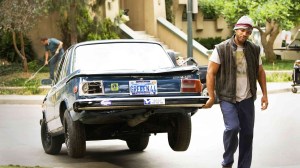 I’m sad to say but director Peter Berg really whiffs with this movie. His visual style is a hindrance to the film. I recently re-watched his first action film, 2003’s The Rundown, and Berg was able to craft stylish, highly playful action sequences without shaking the camera all over the place. A tripod served the film’s best interest and Berg tailored his visual style to the material. I expressed worry with his previous film, 2007’s The Kingdom, that Berg has become locked in to his handheld docu-drama style that bobs and weaves around his actors and employs numerous quick cuts and odd angles. His erratic style can improve and assist narratives but it can also hamper the storytelling. Nothing is really gained by Berg filming his tender moments at obtuse angles, extreme asymmetrical close-ups, and a hovering camera. It feels like a style completely unsuited for the material. I would have liked to fully watch the action sequences and enjoy the clever tweaks on the genre. Berg is an imaginative and underrated director, but his jittery docu-drama style he has embraced can also make his films seem cobbled together and overly rushed and, potentially, half-assed.
Hancock is much like the title character. It means well and wants to help but an audience can’t help but grumble about its methods. The concept of a super hero that is rejected by the people he saves is a subject ripe with subtext that could explore meaningful and insightful glimpses about guilt, the weight of expectation, the desire for human affection and acceptance, the frustration to be understood, the questions of personal responsibility and loyalty, and rejecting or heeding the call to do better. Hancock does not delve into any of these potent psychological areas. That’s fine, as long as the film delivers top-notch popcorn thrills and makes me forget about its wasted potential. Sadly, Hancock fails to deliver. The special effects are generally sub-par, the story misfires, and the whole film begins with promise but ends up turning into a mundane mess. Berg’s aesthetic doesn’t square with the material. Smith is still as charming as ever and will always be a genial presence onscreen, but Hancock turns into a movie that feels like a super hero hangover itself.
Nate’s Grade: C+
Share this:

Gangs of New York (2002)
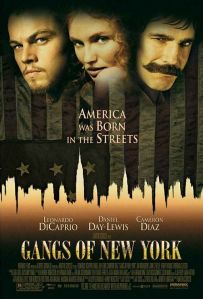 Watching Martin Scorsese’s long-in-the-making Gangs of New York is like watching a 12-round bout between two weary and staggering prize fighters. You witness the onslaught of blows, see the momentum change several times, and in the end cant really tell which fighter is victorious. This is the experience of watching Gangs of New York, and the two fighters are called Ambitions and Flaws.
The film begins in the Five Points district of 1840s New York among a vivid gang war over turf. Amsterdam (Leonardo DiCaprio) witnesses the slaying of his father, Priest Vallon (Liam Neeson), at the blade of William Bill the Butcher Cutting (Daniel Day-Lewis) and his Native Americans gang. So what does this son of a dead preacher-man do? Well he grows up, plots revenge by making a name under the wing of the Butcher becoming like a surrogate son. But will vengeance consume him?
 Watch Leo DiCaprio assemble toughs, rake heels, and ne’er do wells to his Irish gang of rapscallions with facial hair that looks to be tweezed! Witness a one-dimensional Leo suck the life out of the film like a black hole! See Leo become the least frightening gangster since Fredo. Watch the horribly miscast Cameron Diaz play pin-the-tail-on-an-accent! Witness as she tries to play a pickpocket with a heart of gold that falls hopelessly and illogically in love with Leo! Marvel how someone looking like Diaz would exist in a mangy slum! See the brilliant Daniel Day-Lewis upstage our stupid hero and steal every scene he inhabits! Witness one of the greatest villains in the last decade of movies! Watch Day-Lewis almost single-handedly compensate for the films flaws with his virtuoso performance! Admire his stove-top hat and handlebar mustache!
Witness a wonderful supporting cast including John C. Reilly, Jim Broadbent and Brendan Gleeson! Wish that they had more screen time to work with! Wonder to yourself why in all good graces this film took nearly two years of delays to get out! Speculate away!
Gangs has the sharp aroma of a film heavily interfered with by its producers. The whole exercise feels like Scorsese being compromised. Gangs is a meticulous recreation of 1860s New York that often evokes an epic sense of awe. The story has more resonance when it flashes to small yet tasty historical asides, like the dueling fire houses and the Draft Riots. But all of these interesting tidbits get pushed aside for our pedantic revenge storyline with Leo front and center. You know the producers wanted a more commercial storyline, which probably explains why Diaz has anything to do with this.
 The script is credited to longtime Scorsese collaborator Jay Cocks, Steven Zallian (Academy Award winner for Schindler’s List) and Kenneth Lonergan (Academy award nominee for You Can Count on Me). So with all these writing credentials, dont you think one of them would realize all of the dumb things going on with the story? The ending is also very anticlimactic and ham-fisted. Just watch as we segue from a graveyard to present day New York, all thanks to the Irish rockers of U2!
I know this much, Day-Lewis needs to stop cobbling shoes and act more often. Gangs is his first visit to the big screen since 1997’s The Boxer. He spent part of this hiatus in Italy actually making shoes. I don’t know about everyone else but this man has too much talent to only be acting once every five years. Somebody buy his shoes and get him a script, post haste!
Scorsese’s Gangs of New York is at times sprawling with entertainment in its historic vision and at other times is infuriating, always dragging behind it a ball and chain called stupid revenge story/love story. I’m sure the film will get plenty of awards and Oscar nods in prominent categories, and this seems like the Academy’s familiar plan: ignore a brilliant artist for the majority of their career and then finally reward them late for one of their lesser films. So here’s hoping Scorsese wins the Oscar he deserved for Raging Bull and Goodfellas.
Nate’s Grade: C+


 nathanzoebl
You must be logged in to post a comment.