Blog Archives
Megalopolis (2024)

Trying to make sense of Megalopolis is something of a fool’s errand. It clearly means something significant to its creator, legendary director Francis Ford Coppola. He’s been wanting to make this movie for decades and finally the urge just became too strong to ignore, so he sold his successful Zoetrope winery and put over $100 million of his own fortune into this movie to ensure his vision would be unclouded by meddling studio execs and moneymen. It’s the kind of bracing act of artistic hubris and ambition that is worth celebrating. It’s a big swing from a legendary filmmaker who has quite often gone overboard only to return from the brink with cinematic classics, like Apocalypse Now and Bram Stoker’s Dracula. Given his filmography, you would think that Coppola has more than earned the benefit of the doubt. Except… the Coppola of today isn’t exactly in his prime. He hasn’t had a great movie since 1992’s Dracula, and in those ensuing 30 years, he’s made inexplicable movies like Jack, where Robin Williams plays a kid who ages rapidly, and Twixt, a bizarre misfire with Edgar Allan Poe and vampires that was reportedly inspired by a dream he had. I would expect any new Coppola project to lean more towards these kinds of artistic follies than his generation-defining classics. The man is 85 years old and put all his remaining artistic cache and wealth into guaranteeing that we live in a world with Megalopolis. After seeing his long-gestating opus, I cannot say we are better for the trouble.
It’s hard to condense the plot of Megalopolis because so much is happening while nothing seems that important. For example, brilliant architect Caesar Catilina (Adam Driver) wants to build a new wondrous city he calls Megalopolis, a utopia for the masses. The power brokers of New Rome, including Mayor Cicero (Giancarlo Esposito) and CEO of the largest bank Hamilton Crassu III (Jon Voight), are against such radical changes and see Caesar as an upstart. It also so happens that Caesar can stop time at will, until he cannot. He also has discovered a miracle material to build his futuristic city, but nobody seems to care. The masses of New Rome are more interested in whether or not a pop star is still really a virgin. Julia (Nathalie Emmanuel), the mayor’s party girl daughter, witnesses Caesar stopping time, which is a big deal, or maybe it’s not, but she’s intrigued by the mercurial artist seeking to bring to life his unique vision. But Caesar only likes people interested in art and philosophy and books. Could he fall for her, and will it possibly cost his artistic vision from becoming a shimmering reality of hope?

This is a $100-million-dollar movie created entirely for one person, and if you happen to be Francis Ford Corolla, then congratulations, you will understand and properly appreciate the artistic messages and bravado of Megalopolis. For the rest of us poor souls, we’ll be struggling for meaning and insight. The movie almost exists on a purely allegorical level, or at least it must considering that so much of the scene-to-scene plotting is haphazard and underdeveloped.
Let’s start with the central conflict: why are these forces so immovably against one another? If you were the mayor of a city with a raft of problems, it would sure seem like a great move for a utopian addition. I suppose he and the other men in power are afraid of ceding some of their influence and status to this newcomer, and that is something that could have been explored stronger through generational conflict, the old having a stranglehold on power and losing sight of relevance but still clinging to their storied perches. Caesar should be a threat, an appeal to the people that they no longer truly serve. However, in this story, Caesar is so brilliant and any person standing in his way is meant to look foolish or evil. It reminded me a lot of Ayn Rand’s terrible book Atlas Shrugged that was turned into a terrible trilogy of ideologically rotten movies where the brilliant billionaires are tired of their genius being wasted by government regulation. Obviously Caesar is meant to represent The Artist who is being doubted or interfered with, which is how Coppola views himself, or at least filmmakers in general. Therefore this character can have no flaws and must always be right because the message is to give the great artists their space to be great, to challenge our preconceptions of what art can be. He must be vindicated, so it makes him a rather boring and simplistic character who wants a glorious future for the people.
But what exactly is Megalopolis as a utopia? All we know is that it has moving sidewalks and gyroscope orbs for traveling and it’s very glowy. Visually it reminds me of another Adam Driver movie, 2016’s Midnight Special, when the alien world began co-existing with our world. This magic future city is made of a magic future element that also has the magic ability to heal Caesar after he gets critically injured. All of those details beg for more clarity or development, along with Caesar’s ability to stop time, which I guess is hereditary. These elements should be more impactful, but like the utopian city of Megalopolis, they’re just convenient devices, to simply provide the protagonist with a means of solution whatever his dilemma may be. There’s another conflict in the middle where Caesar is framed with an altered video of him having sex with that virginal pop star, but this too is resolved ludicrously fast. Even this scandal cannot last longer than a few minutes before once again dear Caesar is proven virtuous and unassailable. When he has a magic solution for every problem, including reconstructing a hole in his face, and he can never be wrong, and he has no complexity except for his supposed genius, but his genius is also vaguely defined as far as the actual outcome of his supposed utopia, it makes for an extremely uninteresting main character that gets tiresome as we never flesh out his important attributes.

Likewise, the satire of Megalopolis is fleeting and broad and hard to really engage with. There’s the rich and powerful living in excess and with a sense of depraved callousness toward those they feel are lesser. This is best epitomized by Aubrey Plaza’s tabloid journalist character with the exceptionally bad name of Wow Platinum. She’s a gold digger and flippantly shallow as well as super horny, starting as a fling with Caesar before moving onto Clodio (Shia LeBeouf), the grandson to the CEO of the big bank. This woman has no guile to her and is transparently voracious for all she covets, whether it be sexual or material. With Plaza giving a delightfully campy performance, really digging into the scenery-chewing villainy of her character, it makes her the most entertaining person on screen, and a welcomed respite from all the other actors being so self-serious and stodgy and haughty. This tempers the satiric effect because now I’m looking at Wow Platinum as a godsend. Obviously New Rome is meant to represent the United States, so all of its foreboding narration about the death of empires is meant to make the audience compare the end of Rome to the internal fissures of America. Like everything else in the movie, the comparison is only skin deep, and it’s merely asking you to juxtapose rather than critically compare modern-day to the collapse of Rome. By the end, there’s some definite unsubtle swipes at topical political culture, like when Clodio adopts himself as a humble man of the people to “Make New Rome Great Again” and foments an army of red-hatted rabble. But what exactly is Coppola saying with this? That the people in power will pose as populists to manipulate the lower classes into action that benefits them? Not exactly breaking news, nor is it explored on a deeper or more complex or at least more interesting development. Much like the plotting of Megalopolis, the satirical elements are a cacophonous mess of dispirit ideas and directions.
It’s staggering to believe that the man who wrote Patton and The Godfather is the same man who wrote such lines like, “You’re anal as hell whereas I am oral as hell,” as Plaza looks face-first at Driver’s crotch. The dialogue in this movie is tortured and feels like it was written by A.I., or by aliens who were trying to recreate human social interactions but whose only archive of study was the amazing catalogue of movies by Neil Breen and Tommy Wiseau. The “Entitles me?” conversation that repeats itself four times, the “riches of my Emersonian mind,” to “when we ask questions, that’s basically a utopia,” to what might be the most eye-rolling line of 2024, where a vindictive Voight hides a tiny bow and arrow under a sheet by his waist and literally says, “What do you think of this boner I’ve got here?” Yes, the man who gave us The Godfather has also now given us, “What do you think of this boner I’ve got here?” The movie is so preoccupied with the fall of empires and yet a line of dialogue like that is a sign of the decline of an empire.

Ultimately, Megalopolis reminded me of Richard Kelly’s 2007 flop, Southland Tales, a connection I also felt while watching 2023’s Beau is Afraid as well. I wrote, “It’s because both movies are stuffed to the brim with their director’s assorted odd ideas and concepts, as if either man was afraid they were never going to make another movie again and had to awkwardly squeeze in everything they ever wanted into one overburdened project.” It’s an ungainly mess, a protracted and self-indulgent litany of Coppola’s foibles and follies, and it’s practically impenetrable for an audience. I challenge anyone to seriously engage with this movie beyond rubbernecking. I cannot believe this movie cost $100 million dollars and for a passion project there’s so little that makes me wonder how someone would be so passionate about this. It’s not a good movie but it has its own ongoing fascination for cinephiles morbidly curious what Coppola had to make. These are the kinds of bold artistic swings we should cherish, where filmmakers with storied careers are willing to burn it all down for one more project that must be just so, like Kevin Costner’s four-part Horizon Western that we’ll probably never see completed. I wanted artists to test the waters, to chase their visions, to be ambitious. But that doesn’t mean the art is always worth it.
Nate’s Grade: D
Share this:

Last Chance Harvey (2009)
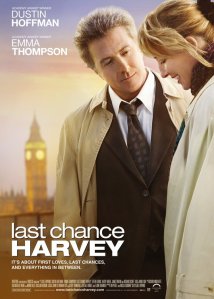 There aren’t too many movies that feature a middle-aged romance. That’s really the sole draw here. Harvey follows the titular dad (Dustin Hoffman) as he travels overseas to his daughter’s wedding. His life is in shambles and he strikes up a friendship with a downtrodden woman (Emma Thompson) that eventually percolates into romance. The interaction between Hoffman and Thompson is relaxed and charming but the storyline is too slight and predictable. This whirlwind courtship spans one single day, so the movie feels too brief. We’re just getting to know these characters and enjoying their chemistry when the movie just limps to a close. Last Chance Harvey feels less like a movie and more like the first act of a movie. The plot is predictable and hits all the resolution points it needs to, which means get ready for tear-jerking wedding toasts from men who’ve changed and grown wiser over the course of 24 hours. Last Chance Harvey is a mildly pleasant diversion with two talented actors making the most of a shopworn and abbreviated story.
Nate’s Grade: B-
Share this:

Stranger than Fiction (2006)
 Ever think your life would make for a good story? Be careful what you wish for. Harold Crick (Will Ferrell) is hearing voices. They aren’t telling him to kill or do anything subversive. In fact it’s just one voice, an English woman, and she isn’t instructing Crick to do anything. No, she’s more so just… narrating. She comes in and out and expresses the doldrums of Crick?s life. He’s an IRS agent whose life revolves around order, repetition, and numbers. We can even see his inner tabulations thanks to some snazzy onscreen visual effects. Crick is sent to audit Anna (Maggie Gyllenhaal), a baker with a disdain for civil servants and authority. Crick is stricken by this shrewd beauty and finds himself wanting her, something the Narrator affirms for him. Crick’s life takes a dour turn when the Narrator lets on that Harold Crick had set in motion his “imminent death.” Crick is confused and seeks advice from Professor Hilbert (Dustin Hoffman) an expert on literature. Then they figure out the Narrator is Kay Eiffel (Emma Thompson), a famous writer who has the unfortunate habit of bumping off every one of her main characters.
Make no mistake, Stranger than Fiction is funny, but it’s a different kind of funny than most people are accustomed to with Ferrell. In my theater, I kept an eye on a gaggle of teenagers sitting several rows in front of me. I just wanted to observe their body language and what I saw was a lot of fidgeting, getting up for trips to bathrooms and popcorn, and lots of whispery talk. I can only imagine the disappointment of those teenagers expecting Ferrell to rip his clothes off and run around like a buffoon. They were likely busily thumbing away at their ever-present cell phones, text messaging their friends. People that are looking for a wild, sidesplitting, slapstick comedy are going to shaking their head. Stranger than Fiction is funny, but it’s in a very dry, witty way, much like British humor; it’s a humor you can admire for being clever but might not make you roll in any aisle.
 The biggest fans of Stranger than Fiction will be bookworms. This is a very literate movie that works better for those with an appreciation or outright love of literature and storytelling. Professor Hilbert doesn’t initially believe Crick until he learns that Crick’s narrator said, “Little did he know.” That, ladies and gents, is all a professor of literature needs. He has to rule out what kind of story Crick may be apart of, so he subjects Crick to a series of hilarious questions along the lines of treasure-inheriting, nemesis-making, and magical-creature befriending. Crick keeps a notebook to tally examples in his life that may point to whether he is part of a Comedy or a Tragedy. Professor Hilton even explains the difference: in grand Shakespearean tradition, a comedy ends with people getting hitched and a tragedy ends with people getting snuffed. This is all fabulously witty and extremely fun, but I can think you’ll see why hard-core fans of Old School and Talladega Nights might be heading for the exits.
Writer Zach Helm has created a wonderfully whimsical tale that’s trippy but manages to still have warmth and a firm heart. It’s far more embraceable a movie than, say, Adaptation, and less smug. He has a smart sense of humor and loves deconstructing literature, like the Jasper Fforde (The Thursday Next books) of screenwriting. We are really sucked into the movie from the moment we can hear Thompson. The story has an innocence to it and this existential comedy feels out there but still grounded; it’s surprisingly poignant and full of dramatic revelations. Even better, Helm has done something that few have achieved: he wrote a story-within-a-story that works. Kay’s narrative voice is highly droll in her observations on Harold Crick’s life. It sounds like a genuine novel, and on top of that, a novel I would enjoy reading. Stranger than Fiction is all the proof I need that Helm is a talent to keep track of.
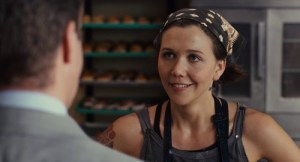 The performers all seem to have the same affection for the material. Ferrell is making that leap from funnyman into leading man, the same dramatic territory Robin Williams first tiptoed in Good Morning Vietnam and, likewise, Jim Carrey approached in The Truman Show. Ferrell won’t turn any heads but he underplays his performance maturely, playing a sad but sweet drone of a human being finally taking charge of his life under very insane circumstances. There’s a quiet moment toward the end where Ferrell is told he must accept his fate and he sits, shell-shocked, tearing up, his voice getting softer with every word. It’s only a moment but it piques my interest in what Ferrell may have in the tank. The comedy he can do in spades, including a desperate moment when he tries narrating his own life to coax his Narrator out of hiding.
Who will turn heads, however, is Gyllenhaal. I can already see a nation of teen boys falling in love with her tattooed, punky baker. To them I say, get in line pals, Gyllenhaal has made me dot my I’s with hearts ever since her star-making performance in 2002’s kinky romantic comedy, Secretary. She’s easy to fall in love with and expresses a fragile compassion to her role. The romance between Anna and Crick is unexpected but these two people need each other, and you feel that need as you watch their eyes light up as their relationship blossoms. Late moments between them add to the tenderness of the film and you will be on your knees pleading Crick is spared so he can return to loving Anna. I think Wreckless Eric’s “Whole Wide World” will become a potential staple on romantic teenage mix CDs sent to their sweethearts from now on.
Thompson and Hoffman have appealing supporting performances. Thompson has marvelous fun thinking of different grisly outcomes in store for Crick. Her interaction with the hospital staff to see the “not gonna make it people” is a howl. But Thompson is too good of an actress to play it straight. Once she discovers the life-altering implications of her writing she is crushed by guilt, obsessed over killing good people cruelly. Frankly, if I had anyone narrating my life, Thompson’s voice would definitely rank high. Hoffman plays a dedicated literary professor like a straight man, and everything seems on the level for him, even the fantastic. It’s a nice touch for a film that doesn’t require broad strokes.
 The movie doesn’t have the depth of feeling or dark turnarounds that I know Charlie Kaufman would have done. Stranger than Fiction has a lot of fun with a very ripe premise, and is very intellectually stimulating, but you do feel like it could have gone further, exploring the reaches and implications of its metaphysical setup. What if someone who read Kay’s manuscript thought it was such a masterpiece, a shining light of literature that could move mountains, that they knew Crick must die, and that they must kill him to make certain of it. Or what about the relationship between author and character, and the role each has over the other and perhaps a battle over the future, a typewriter, and a happy ending at the end of a tunnel. However, while all of these options would further explore the novel premise, it would betray the movie’s whimsical tone. This isn’t a very dark movie. It has an authentic sweetness to it, and Crick is a gentle and kind man, and to do anything too heavy would work against the film’s tone. The movie explores existential queries and the topics can be grim, but ultimately Stranger than Fiction is life affirming.
Stranger than fiction also has a buoyant, unexpectedly pleasing romance to it. Again, it doesn’t show the depth of love and human feeling that Kaufman’s Eternal Sunshine could, but this is an unfair comparison. This romance is more a subplot that carries increasing weight thanks to heartwarming performances and the winsomely adorable Gyllenhaal. The romance in Eternal Sunshine was the story, and everything else was outside variable coming into contact. It might sound dismissive to call Stranger than Fiction as decaf Charlie Kaufman, but it really is a compliment. Kaufman is the most exciting, brilliant, creative, insightful, and whacked out screenwriter working today. I would give one of my kidneys to write even one story that could be described as decaf Kaufman. Stranger than Fiction may not examine as many themes, conflicts, or relationships as Kaufman might with the material, but this movie is a sweet fable that floats by like a fluffy cloud on a sunny day. It’s just so damn pleasant you sort of soak it in and fall in love, not wanting to leave.
Stranger than Fiction is strange, all right, but gloriously so. Scribe Zach Helm has concocted an existential fairy tale aimed for bookworms and outsiders. The premise is clever but the film doesn’t stop there, and Helm explores the implications of his premise with whimsy, charm, and a sweetness that is hard to rebuke. The wacky story seems reminiscent of Kaufman’s works, but it has a more heartwarming and embraceable appeal. Great performances from a game cast help to push the material even further into excellence. It has a small handful of flaws, perhaps a too limited scope, but that doesn’t stop Stranger than Fiction from being one of the best stories of 2006 and one of the best movies too.
Nate?s Grade: A-
Share this:

Finding Neverland (2004)
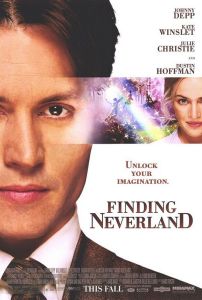 My friend George Bailey and I came to a similar conclusion during a recent conversation. There are a handful of movies, usually released around this time of year, that are packed to the gills with awards hype and general goodwill. Then I see them and feel underwhelmed for whatever reason and I walk out and feel that I should like the movie more than I do (if I do at all). I don’t know what to call it, societal guilt, elitism, but this is exactly what I felt when I left Finding Neverland.
J.M. Barrie (Johnny Depp) is in search of his next play. It?s 1903 London, and the financier (Dustin Hoffman) of his last play has taken a financial bath. Barrie’s also emotionally closed off from his wife (Radha Mitchell). One day in the park, Barrie stumbles across Sylvia (Kate Winslet), a widow managing four boys by her lonesome. Barrie takes a shining to her children and delights in spending long days with Sylvia and her boys. From his encounters with Sylvia and the boys, Barrie works up the inspiration to write a new story, called Peter Pan. Of course the public has its own gossip about a married man gallivanting about with a widow and her boys (think recent Michael Jackson scandals). Then there?s Sylvia?s mother (Julie Christie), who is set to put her house back in order starting with removing Barrie from their lives.
 The message of the movie is about the need for adults to slow down, open their imagination, and become bewitched by the power of believing. Because it’s not like there aren’t any other Hollywood movies out there that teach us to loosen up and enjoy life. Thank you Finding Neverland, I never would have found this out by myself. The message of belief overpowering all is also a bit naive, but then it works into the whole cross-stitching of sap the movie is generating.
Not even Depp can save the film. Long established as one of the most versatile and exciting actors, Depp finds ways to disappear into his oddball characters. In Finding Neverland, Depp sports an impressive Scottish brogue, but, sadly, this is the most impressive aspect about his performance. There had been much talk about Finding Neverland being Depp’s next opportunity at finding Oscar, but it would be a shame if Depp won for such a lackluster, artificial performance especially when he’s been brilliant so consistently in other movies. J.M. Barrie was somewhat eccentric, but in Finding Neverland he comes off as mostly vacant. The film tries to show that Barrie didn’t really fit in, but instead of becoming a showcase for Depp’s acting it becomes a showcase for Depp’s silence. The performance is so subtle that it doesn’t even come off as a performance. If Depp stood in the background of a movie, it would be akin to this performance.
Winslet has also been a very versatile actor. Her role in Finding Neverland never really deepens beyond Disadvantaged Woman. She’s been hit by adversity, she’s beset by four rambunctious kids and an icy mother, but that’s about all the film does for her characterization. Winslet is a tremendously talented actor, as evidenced by her Oscar-worthy performance in this year’s Eternal Sunshine of the Spotless Mind. So why strand her in a role where her character’s greatest acting moment is coughing fits?
Director Marc Forster (Monster’s Ball) has the frustrating habit of having two shot styles he shoots in. He decides between medium shots which usually involve two or three people, or large close-ups. While I was watching Finding Neverland I never once thought to myself that something was filmed in a visually interesting way. Some of Forster’s decisions seem unnecessary, like when he has to visually show us scenes of imagination instead of allowing the audience to, gasp, use their own imagination (hey, isn’t that the message of the movie?).
Finding Neverland tries so hard to be a three-hanky movie (and truth be told I heard a lot of sniffling in my theater during the last half hour), but what stops the film short is how unbelievably transparent everything is. Finding Neverland could have explored the rich complexity of an enigmatic figure like J.M. Barrie, but instead it settles for goopy sentimentality at every opportunity. Barrie becomes sugar-coated into an earnest father figure, and in the process key facts are sugar-coated as well. What do you mean? Well, Sylvia’s husband didn’t die until several years after Barrie wrote Peter Pan. Barrie’s wife didn’t have her affair until long after Peter Pan. Also, the original Peter threw himself in front of a train because of how upset he was about his connection to the famous character. I guess that’s why this is a biographical movie merely “inspired” by true events, much like Hidalgo.
The filmmakers rely on cloying tricks to make an audience care about its characters. The movie paints in very stark black and white tones, mainly “adults = shortsighted” and “children = special.” This is a film that is proud to take the easy road and makes little effort to cover its pride. It plays toward audience expectation and thus loses any long lasting magic.
Finding Neverland takes the easy road for audience-friendly sappiness. Barrie insists that 25 orphans be strategically placed around the theater on opening night of Peter Pan. Sure enough, the theater is full of old white men with monocles, and apparently they just don’t get the spirit of theater. The orphans laugh and squeal from the stage antics, and somehow this triggers all those old curmudgeons to learn to laugh once again. You see, all it takes is strategically placed orphans to make us laugh at life again.

When Sylvia is hanging laundry she starts to gently cough. If you’re smart, you’ll instantly figure out what trajectory is in store for her, but even if you miss this single cough don’t worry, because Sylvia will be doubled over with coughing later to spell it out for everyone. You can all but see the strings being pulled (the audience will cry… now!). All can be overcome in the end, those who didn’t understand will, and we’ll all be happier and live life to the fullest, in theory of course.
Finding Neverland wants to be Shakespeare in Love, another whimsical movie that shows how a writer utilized the people and events around them to pen a masterwork. Except in Shakespeare in Love there was a romance to fall back on, as well as some ripe comedy, but with Finding Neverland there isn’t anything to fall back on. It’s a Hallmark card mass-marketed to the largest possible audience.
Everything about Finding Neverland is disappointingly under whelming. The direction is shabby, the actors are marooned by their weak roles, and nothing is sacred in the film’s pursuit of that tearjerker ending. This is a movie for people that ask little of their movies, and yet I can reasonably see Finding Neverland becoming an audience favorite and riding good word of mouth all the way to awards season. Finding Neverland is a film that never takes flight because it’s too content to stay grounded by going the easy route.
[Nate’s Grade: C


 nathanzoebl
You must be logged in to post a comment.