Blog Archives
Noirvember: Double Indemnity (1944)
 Billy Wilder’s Double Indemnity is a classic film noir and a classic crime drama about bad people doing bad things and doing them badly. It’s a rich narrative environment that has been explored in droves before and after. Double Indemnity was a box-office sensation, critical hit that was nominated for seven Oscars, and solidified Wilder as one of the most creative and daring writing and directing voices in cinema. This was only his third directing effort and it provided the freedom to make his own way through Hollywood. There’s a certain danger in going back to cinematic classics. It’s easy to see their influence in a sea of imitators and sometimes the accomplishments can be taken for granted just because the viewer is too removed from the initial splash the film made. Double Indemnity is a sharp, surefooted, and highly influential film that still resonates with suspense and intrigue. The formula was refined with Wilder at the helm and his genius can be readily recognized.
Walter Neff (Fred MacMurray) is a mid 30s insurance salesman in Los Angeles. He gets into some big trouble when a prospective client, Phyllis Dietrichson (Barbara Stanwyck), intimates that she would like to bump off her husband and profit from the act. Walter is appalled but also intrigued, drawn to the charms of the sexy Mrs. Dietrichson. He agrees and says they’re going to do it right. She takes out a hefty insurance policy on her husband that pays double for rare accidents, which spurs Neff to stage a phony accident where the injured Mr. Dietrichson (Tom Powers) fell to his death off a train. The scheme is elaborate, with alibis, swapped identities, hiding places, and a minimal of public interactions. It seems perfectly executed that is until Neff’s boss, Barton Keyes (Edward G. Robinson), starts inspecting closer feeling something is amiss. Neff must outwit his boss and co-workers and keep the scheme from getting further out of control.
“I killed him for money – and a woman – and I didn’t get the money and I didn’t get the woman.”
 Thanks to the morally and creatively restrictive Hays Code, it’s easy to see all the roadblocks that could have sabotaged the movie from getting made, let alone becoming a great film. It’s a movie not just about adulterers but they’re also murderers, and the script places you in their perspective, clinging to hope they might succeed in their scheme. Admittedly, the characters are punished for their misdeeds by the film’s end as the Hays Code would demand, but the film experience was different, and Wilder made it so early on. Within minutes, as Walter Neff dictates his confession in his boss’ empty office, he admits to being a killer, to killing Mr. Dietrichson, and in doing so out of a desire for Mrs. Dietrichson. By the very fact that he’s slumped over, panting heavily, and confessing in sordid detail, we can rightfully assume that he did not get away with it. What’s left for the audience to discover? Wilder has already established the major turns of his story for his audience and seemingly robbed us of any notion of surprise. But that’s where Wilder’s storytelling prowess emerges, because it’s not so much a story of whether something was done or would be done, it’s a story of how and how to elude capture.
We’re locked into Neff’s perspective, and with it as an experienced insurance salesman, he knows the proper way to stage a murder, make it look like an accident, and not get caught. It’s in the details that Wilder hooks us, and as we watch the trap unravel, the movie becomes an exercise in nervous tension wondering what will trip up our lovers. An audience generally gravitates to smart characters trying to outwit others, appreciating the wiles but also, perhaps, wanting to see if the scheme can be accomplished. It pushes the audience into an interesting position of rooting for our murderer. There’s a wonderful scene right after Neff and Phyllis have deposited the body of her dead husband. They’ve hopped in her car and are ready to flee the scene of the crime, and that’s when her car won’t start. Wilder simmers in the moment, luxuriating in the encroaching panic as key turn after key turn only results in the sounds of a stalled engine. Finally, it starts, but during the sequence you empathize with the killers and their panic. Wilder and company have done their job and at least some part of the audience is pushing for them to escape. What happens later tests audience loyalty, but we’re still firmly in the perspective and in the shoes of the film’s killer, the only killer in the picture at that. He’s our man.
“I think you’re rotten.”
“I think you’re swell – so long as I’m not your husband.”
 The staples of noir cinema really came alive with Wilder’s excellent crime drama. The visual signifiers we associate with the genre are all here in accordance, like the chiaroscuro lighting that bathed the actors in swaths of invading darkness. The lighting does a great job of reflecting the sordid schemes of our lovers. As soon as Walter accepts, the lighting changes drastically and the layers of dark creep in on the actors’ faces. The dialogue by Wilder and Raymond Chandler (his first screenwriting gig in Hollywood) has that robust rat-a-tat rhythms of hardboiled genre fiction that we love. The twists and turns keep an audience glued even though we have already been told the major plot particulars. The inclusion of Mr. Dietrich’s twenty-something daughter Lola (Jean Heather) from his previous marriage presents an intriguing complication. She suspects her wicked stepmother might have something to do with her father’s death as well as her mother’s death. Walter Neff keeps tabs on her as a means of trying to dissuade whom she tells her suspicions to, as a means of manipulating her, but then when Lola reveals that her ex-boyfriend has been seeing Phyllis on a nightly basis, we don’t know what to think. Is Phyllis setting up her own scheme to kill Neff? Is Lola knowingly manipulating Neff to enact vengeance against her hated stepmother? Is there anyone a guy can trust? It’s a fine character and played sincerely by Heather (Going My Way) almost to the point of ache. She stopped acting altogether in 1949, to the detriment of us all.
But the ultimate femme fatale is Stanwyck (The Lady Eve). I think what makes her work is the fact that she doesn’t immediately leap to mind as a femme fatale. She’s not the most gorgeous actress in Hollywood, though clearly still an attractive woman. The stiff blonde wig they saddled her with doesn’t help on that front. She’s a temptress that doesn’t sizzle off the screen so much as step from the mind because she feels more realistic. Working within the repressive confines of the Hays Code, Stanwyck still knows how to provide a sexy smirk to things left unsaid with her character. There are a few looks she employs that could make you melt. A standout scene focuses entirely on her face. Her husband is being murdered just off screen. That violent act is left to our morbid imaginations while we watch Stanwyck’s subtle expression of satisfaction cross her face only to dissolve when she knows better. I wish MacMurray (The Absentminded Professor) was a better scene partner with her. He seems overly stiff like he’s trying harder to get out the stylized dialogue in the tone the director wants. Wilder finds ways to subvert the actor’s tendencies but I feel like he’s at best a likable but limited dolt of an actor.
“You’re not smarter, Walter… you’re just a little taller.”
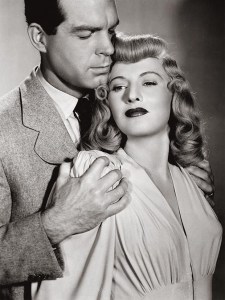 Phyllis is a classic femme fatale figure and Stanwyck plays her with a beautifully controlled sense of menace, but I want to offer a different theory as to what kind of twisted love story inhabits Double Indemnity. I think Walter Neff was never in love with Phyllis, though he acknowledged her beauty and general seductive effect. This much is clear from his first meeting with her where the insurance veteran can’t help himself with how forward and transparent his flirting is. He’s interested, though he’s also interested in getting a sale, and then when she floats the idea of life insurance, his tone immediately changes. The flirting stops cold and he promptly sees himself out. But he can’t stop thinking it over. I propose he isn’t drawn to Phyllis so much as he’s drawn to the intellectual challenge of pulling off the “perfect crime.” He considers himself a clever man and this would put all his skills to the test. He knows what agents look for to suss out foul play. He knows what the police ask about. Now he gets to see if he can fool them all. In this interpretation of mine it’s not Neff’s love for the dame that gets him but his love of his ego. There’s a cold manner in how often he calls Phyllis “baby,” lacking apparent affection and instead seemingly turning the pet name into something dutiful. Oh, but you’ll argue, his voice over goes into great detail about the magnetic and sexual appeal of Mrs. Dietrichson, and that’s the point to remember, that it’s his voice over. Neff is retelling this story, knowingly dictating his confession, and perhaps he’s playing into a narrative that removes some of the emphasis from his true intentions. I propose Neff is an unreliable narrator. Since it’s from his perspective, his words are all we know about Phyllis and her assumed seductress ways. Having the final word on his story would provide a perfect opportunity for Walter to alter the story as best he sees fit, shifting some blame onto the woman who done him wrong. I believe that in the end it was Walter Neff’s desire to prove he could outsmart the world of law enforcement and get away with murder that drove him onto this wayward path and not a woman as fetching as Stanwyck and her anklet may have been.
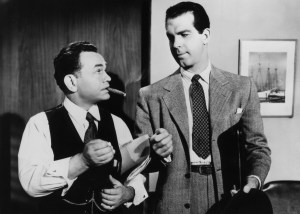 There’s a very unexpected emotional current that surfaces fully by the conclusion of Double Indemnity. Edward G. Robinson was at a transitional point in his career, having been the lead in a slew of older crime pictures. An audience was prepped from association to consider Robinson a disreputable character, just as they had prepped to consider MacMurray’s character a likeable fellow from his previous comedic roles. Wilder’s film flips audience expectations to great effect. MacMurray is the cunning murderer and Robinson is the moral center. Keyes is exceptionally skilled at insurance fraud and it naturally should be him that unknowingly tightens the noose around his beloved employee as he gets closer and closer to the truth. He just can’t see it; Walter Neff is so close he inhabits a blind spot. When Keyes does discover the truth, his crushing sense of disappointment he tries to hold back is an emotional moment that hits hard. It’s the professional and loving relationship between these men that helps to add something more to Double Indemnity; it’s got the noir staples we come to expect nowadays but it also has a surprisingly sweet and affecting father/son relationship between mentor and student. Robinson is terrific in the bravado moments like when he unleashes a torrent of statistical categories on suicide types and methods and he also sells the quiet hurt of a proud man who must admit he placed his trust in the wrong recipient.
“I couldn’t hear my own footsteps. It was the walk of a dead man.”
Double Indemnity is a film classic that holds up thanks to deft plotting that puts the audience in the place of the killers, solid twists and turns, and a clear understanding of the strengths of the genre. It’s a standout film noir that still stands rather tall. It’s always reassuring when the great pieces of art can still transport, still excite, and still resonate with the same feeling that communicates why they deserve their decades of plaudits and acclaim. Wilder was one of Hollywood’s greatest storytellers who could hop genres like few others. His foray into noir cinema left a long lasting legacy for the genre and its fans to follow, and Double Indemnity is still the crackling crime thriller it was under the Hays Code. Perhaps the scrutiny of censorship forced Wilder and Chandler to get more creative, and the finished product is a taut and stylish imprint that others eagerly copied. There’s just something inherently interesting about bad people doing bad things badly no matter the best intentions of the moral crusaders of its day.
Nate’s Grade: A
Share this:

Elle (2016)
 It’s been a long time since director Paul Verhoeven (Robocop, Starship Troopers) has directed a movie, a whopping nine years since Black Book (my favorite title is the original Dutch – Zwartboek). In fact Elle is only the second movie of Verhoeven’s since 2000’s Hollow Man. Cinema needs more movies from men like Verhoeven. He’s famous for his penchant for camp and over-the-top violence and sex, but it’s his subversive streak, dark satire, and willingness to push an audience into squirmy situations that are missed most. Elle is a hard movie to describe and a hard movie to sell. It’s an uncomfortable viewing and that’s much of the point that Verhoeven wants to push the viewer into an uncomfortable world of a woman who makes others uncomfortable.
Michele (Isabelle Huppert) is a middle-aged professional woman who, in the opening scene, is raped on the floor of her home by a masked intruder. She tries to brush off the attack, refusing to report it and go to the police. She returns to her normal routine, which involves berating the employees at the video game company she runs, having an affair with her best friend’s husband, and asserting barely passive-aggressive control over her ex-husband and her adult son. Once Michele starts receiving taunting messages from her assumed attacker, she assess who in her life’s orbit may have been her rapist and how best to unmask their identity. There’s also the matter of vengeance.
 Elle starts as a sneaky who-dunnit mystery and then blossoms into an engaging character study. Our first image of Michele is lying on the floor and being sexually violated by her attacker. It’s harrowing and upsetting and your sympathy instantly allies with the victim. However, the rest of the movie does not portray Michele with even the faintest glow of a halo. She’s a venom-spewing bully who sabotages the happiness of others around her and is having an indifferent affair with the husband of her best friend. Michele also runs a video game company that profits from the exaggerated sexual violence of the video game industry. She even lectures a programmer that the distressed cries of a rape victim should be louder and more orgasmic. Everything after the initial rape scene makes us question whether this character is worthy of our sympathies, and then that makes us question whether we should be ashamed to deny a rape victim sympathy at even a basic human level of empathy. There’s a happy moment where everything appears relatively settled, and she just can’t help herself and has to sabotage it with real ramifications with someone she genuinely cares for. It’s just her nature. It’s a complex crucible of self-reflection and it makes the movie an intriguing a unique experience to sit through.
About the half-hour mark, Michele becomes even more absorbing, and that’s when it’s revealed she’s the daughter of a notorious serial killer. As a young girl, she “assisted” her maniac father dispose of bodies into a large fire, and a picture of her looking dead-eyed and covered in ash is famous in French culture. There’s a lingering question of what her culpability was. As soon as this connection was revealed, my interest in Elle increased two-fold. It explains why she felt she couldn’t go to the police because she didn’t want the exposure, and certainly there would be a bitter few saying she got some sort of cosmic justice. Her relationship with her elderly and ailing father becomes its own mystery, and I started looking for parallels between Michele’s relationship with her father and her relationship with her screw-up adult son. Was she manipulating him like her father had done to her? Is her son’s penchant for not fitting in the adult workforce a sign of something more troubling? Is his temper and possibility for violence a hidden bomb thanks to grandpa’s DNA? I was even more observant and looking for connections.
The problem Verhoeven’s movie is that its story engine only takes you about two acts forward. From early on, the two things hanging over Michele are the prospect of finally coming face-to-face with her father one last time and discovering the identity of her rapist. Verheoven plays into the mystery thriller elements by populating Michele’s world with suspects that could secretly be her attacker. There’s the guy at her job that seems to loathe her and find her unworthy of her position. There’s the guy at work that has a little too close of an affection for her. There’s her friend’s husband, angered by being rebuffed when Michele ends their unfulfilling affair. There’s her neighbor’s husband who Michele covets and fantasizes over, who seems aware of Michele’s feelings. As the plot progresses and her attacker sends more messages, we get clues to the identity and who among our band of suspects is eliminated from contention. Then we find out and the movie has like a solid half hour left. That’s because the movie goes in an unexpected direction but one that makes enough sense knowing Michele as a character. Not all of the storylines hold the same level of interest, like Vincent’s one-note baby mama (Alice Isaaz), though you do understand why he might be attracted to abrasive women. The same with Michele’s mother (Judtih Magre) who seems too comically wacky as a sugar momma. Not all of the characters in the story’s sphere are worthy of the attention they receive, however, how Michele responds to them is worth our attention. The other storyline, a sense of closure with her father, is resolved around the same time in another unexpected manner. It’s a bit deflating and after both mysteries are resolved the movie feels like it’s abandoned its sense of direction. You’re waiting for the film to wrap up any moment but it keeps going, a tad too long at 130 minutes. It’s a small grievance but I definitely started feeling a sense of impatience during the final twenty minutes.
There’s a surprising amount of dark humor to be had with Michelle’s caustic view of other people and her genial manipulation of others. There’s an award and dark comedy that comes from the interactions, which seems counterproductive or downright tonally unforgivable given the above admission of how rape-y the film comes across. It’s a squirming comedy, the kind that makes you laugh under your breath to break the tension of people behaving badly. Even the prospect of laughing given the serious subject matter somehow makes the film even more uncomfortable. The older ladies behind me in my theater were already chattering about how Elle was not one of the better movies they’ve come to see. To be fair this was after like the fourth rape scene.
Huppert (Amour, The Piano Teacher) is in every scene of the movie and she unleashes a performance destined to leave you talking. She’s 63 playing 50, which is usually the opposite of how Hollywood movies operate (if the women are even allowed to get to 50). Michele is a beautifully flawed and complicated canvas and Huppert seems to relish in her brusquely dismissive demeanor. She’s constantly testing the people in her world, mostly men, and sizing up the women. There’s a reason that she seems to revel in stomping out the happiness of the men around her whether it be an ex-husband, her oafish son, the husband of her best friend she’s having an affair with. Michele refuses to be defined by her trauma but she is still processing that, and Huppert is agile at showing the cracks in Michele’s armor to provide clues as to what is most important. She doesn’t care what we think of her and that adds a thrilling quality to an already bracing performance.
 Does the movie cross a line into being tawdry exploitation? Because of the nature of its storyline and the past films of its director, it would be easy to slap the title of high-dross exploitation film onto Elle, but I don’t know if it applies fully. I cannot think of a more rape-y movie that I have ever seen. Full trigger warning to those out there, there are like six different rape scenes in the movie, though some of them are fantasy and some of them are violent role-playing, but all of them are disturbing. At its core, Elle is about power and even though our opening impression of Michele is one of victim it’s a title she does not want. She is seeking to punish her rapist, and when the identity is revealed, she transforms the power dynamic and reclaims a sense of her sexual autonomy. Does consenting to abuse and enjoying it undercut the abuser’s power or reconfirm it? I can’t say whether this is any less exploitative than say 1974’s The Night Porter, another movie about trauma where the victim and victimizer indulge in an unhealthy sexual relationship that blurs the lines between sadomasochistic role-playing and fetishizing personal abuse. I feel like there’s enough substance in the characterization and the wide berths that Verhoeven allows free of judgment to classify Elle as more than exploitation, or to classify it as a reclamation of the exploitation film, an exercise akin to what it feels like Michael Haneeke (The White Ribbon, Funny Games) does that I inevitably can’t stand.
I can’t quite grasp what about Elle spurred Verhoeven out of a nine-year absence from filmmaking (he experimented with a 53-minute farce in 2012 whose script was crowdsourced, so I’m discounting that). On the surface, I would make the connections to the film’s extreme sex and violence, staples of Verhoeven’s Hollywood career. But that’s too easy, and there’s no shortage of extreme sex and violence in other stories. What was it about Elle that drew the Dutch filmmaker out of seclusion? I think it was another opportunity to be subversive, this time in the realm of art-house French cinema. Verhoeven has always enjoyed proving people wrong, exploring our baser instincts, and telling damn fine entertaining movies for adults. His subversive streak is renewed with a rape thriller that also happens to be an incisive character study of a very nasty woman who had something very nasty done to her. Audience loyalties and sympathies are consistently in tumult, shifting and being tested by new information and the mounting evidence of Michele’s treatment of others. Huppert gives a calculated, fierce performance right down to the end, pushing the audience into more uncomfortable reflection and uncomfortable laughter in the face of despair. I think this is why Verhoeven hopped back into the director’s chair and even re-learned French so he could communicate with a French film crew. He wanted to push an audience, upending their expectations about power, sex, and subjugation. Elle is downright elegant as it goes about its business, the business of forcing viewers to think critically and question their personal discomfort. It’s not exactly an easy movie to watch at times but it is a hard movie to forget.
Nate’s Grade: B


 nathanzoebl
You must be logged in to post a comment.