Blog Archives
Unbroken (2014)
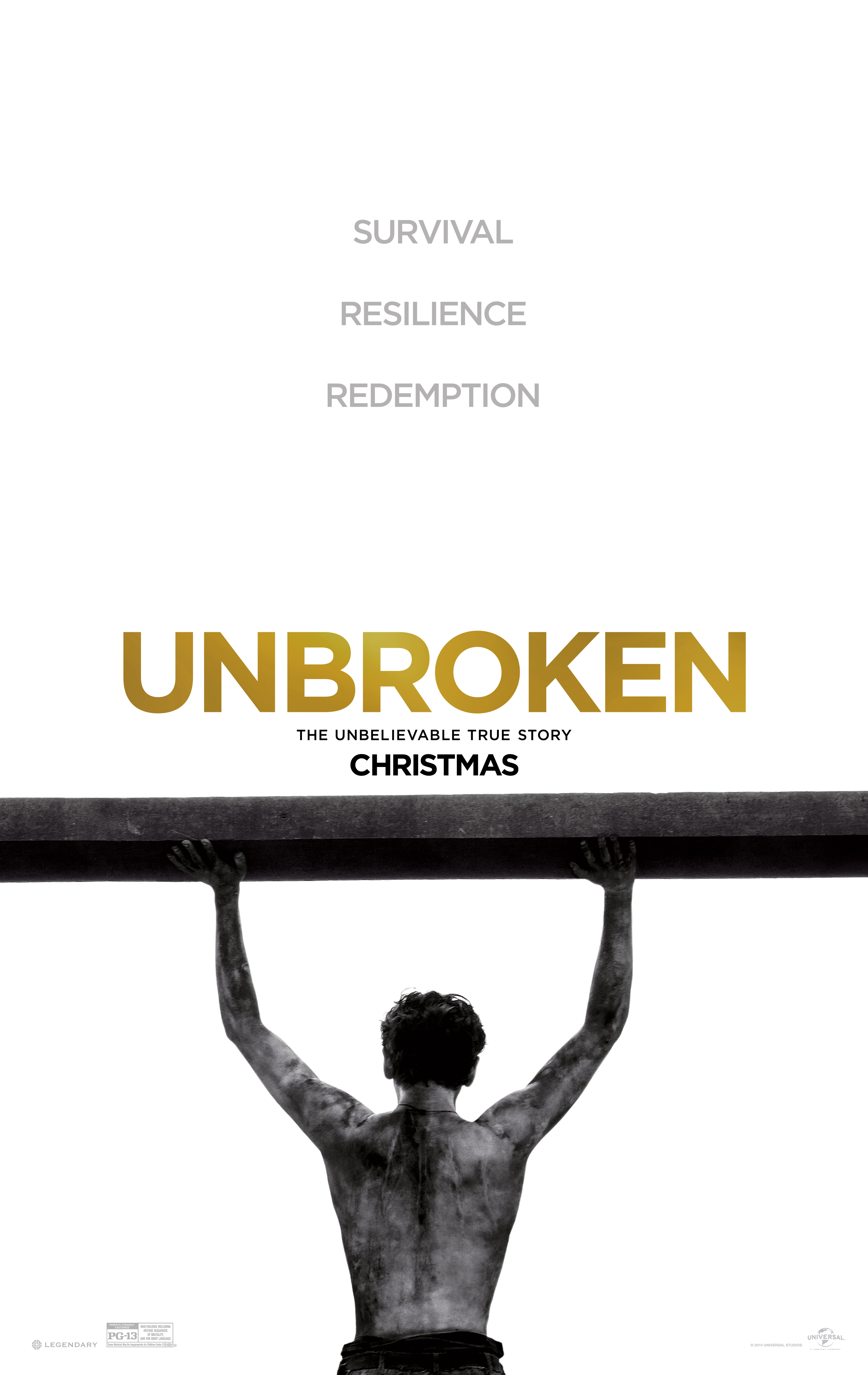 Angelina Jolie is one of the biggest stars on the planet but as a director she’s still a mystery. Jolie was so enamored with Lauren Hillenbrand’s best-selling novel Unbroken that she felt like she was the only person who could translate this story to the big screen. Somehow that passion got lost in translation.
Louis Zamperini (Jack O’Connell) is a man who ran for his country in the Olympics. He fought on a bomber plane over the Pacific. He was shot down and survived in a raft for over 40 days at sea. He was taken to a Japanese P.O.W. camp and endured harsh and cruel treatment, and he still persevered and returned home a hero.
It’s hard not to feel a general calculation about the entire film. I’m not trying to say that Jolie or her crew had any sort of nefarious ulterior motives, but the entire product seems like it was made in an Oscar Bait factory. This is the kind of movie that the Academy typically salivates for, and it’s based on a true story, and it’s set during World War II! There’s a reason that, sight unseen, Unbroken was often at the top of the prediction lists for Oscar pundits. It is those same Oscar-friendly elements, though, that act as a detriment to the story, because the thematic elements stand in for the story and sense of commentary. The movie is so caught up with Louis’ dilemma that it forgets that it needs to make you care about him as a person rather than a martyr. The biggest hindrance for Unbroken is just how little it develops its protagonist. The only emotion he seems to exhibit in the two-plus hours is suffering. The guy ends up being a human punching bag with the movie clobbering the audience with the same message again and again as well, the will to survive. Unlike other war stories or concentration camp survival tales, Louis doesn’t survive through any great networking of allies, skill, scheming, or prescient decision-making. We do not see him adapt and outsmart his adversaries. He merely outlasts them as he wastes away. Like what I wrote in my review of last year’s Best Picture winner 12 Years a Slave, I need more characterization than suffering. It’s a frustrating experience because you know there has to be more to this character.
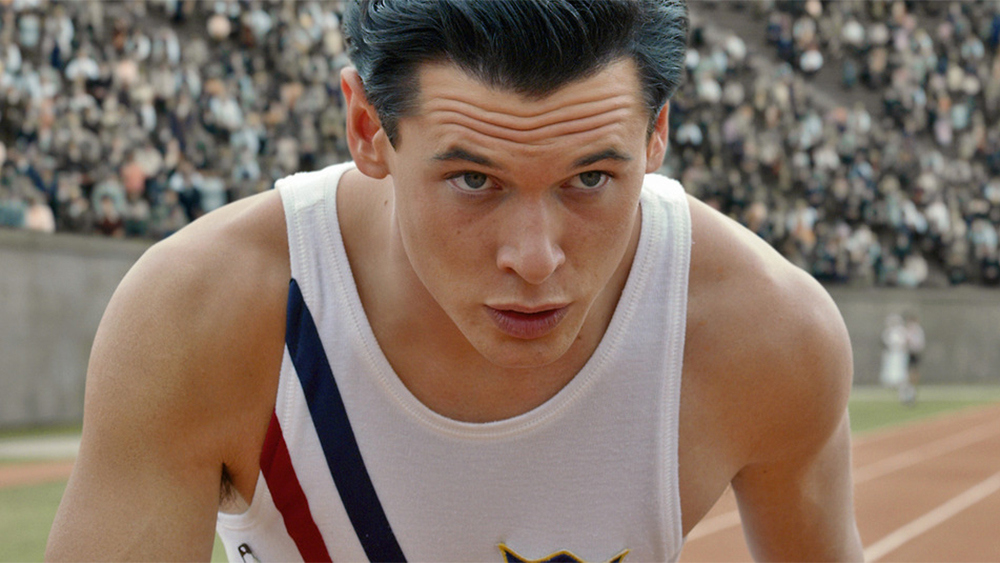 The danger with any film that purports to tell a true story of a hero is making sure the audience doesn’t lose sense of the person beneath the hero. We glorify their positive qualities and what we admire but when placed upon a pedestal, our heroes can start to become otherworldly, separate from the rest of us mortals. A biography that idealizes its subject is called a hagiography, and that is where Unbroken falls. Louis Zamperini is lost in this story, instead replaced with Louis the Survivor or, occasionally, Louis the Runner. Amidst the swelling music, the pretty cinematography, and the supporting characters channeling the audience with their encouraging mutterings of, “Come on,” and the like, Louis is painted more saint than man, which is a shame. Considering all of the peril he survived, it would make sense for him to struggle with his own doubts and fears. The most we get a sense of him and his internal struggle is when he prays aloud to God during a thunderstorm at sea and Louis promises to serve Him somehow if he survives. The movie forgets about this moment until the end credits text. If Louis Zamperini is going to be the focal point for a true story of heroism, then the movie needs to do better to make him human rather than resorting to having him only bleed.
The entire first act flashbacks could likely have been jettisoned. Watching Louis as a young man learn to run and then eventually compete in Berlin’s Olympics (way to take all of his luster away, Jesse Owens), we expect these moments to have relevance again, pointing toward some kind of grit or training regiment or lesson learned that will become useful or comforting solace during his internment. It all boils down to one skill, endurance, and that’s all we keep coming back to. We don’t need to see the Olympics or his younger life to establish as back-story in the P.O.W. camp, just as we didn’t get back-story for the prisoner who was revealed in the moment to be a concert musician. The flashbacks do little to flesh out Louis as a character. He was a troubled son of immigrants and found popularity and purpose with running, which he did to the Olympics, and then… the war. Too bad running doesn’t really come into play during his torment in Japan. I understand that we’re working with a true story but what has been added by including 20-30 minutes of flashbacks, particularly when they fail to illuminate our main character? Skipping right to the war, with perhaps a smattering of brief memories during physically and mentally fraught times, would have been preferable and more useful.
The other aspect that makes Unbroken frustrating is the potential it does flash in sparse moments. For the majority of its running time, the film is a perfectly decent war drama with an extra glossy sheen to it provided by expert cinematographer Roger Deakens (Skyfall). When adrift at sea, there’s an inherently interesting survival story there. Louis and his comrades are still in an active war zone. In one scene, a plane approaches and the guys realize late it’s no rescue but a Japanese fighter plane. They leap into the ocean as the plane fires bullets after them. This scene is made all the worse by the fact that sharks are swimming below. There’s an extra kick of dread worrying what will happen next if anyone gets wounded or killed by that gunfire. It’s a great sequence, but then it’s over and the film goes back to autopilot glorifying the resolute nature of Louis. Likewise the opening with Louis crawling along and having to manually close the bomber plane’s doors during a dogfight is great. Unbroken does get a lift when it introduces its main antagonist, Watanabe (played by rock star Takamasa Ishihara), nicknamed “The Bird.” The film now has a sense of direction and a renewed sense of danger with “The Bird” eager to break down his Olympic prize runner. The story feels more personal and interesting and it feels like this fresh antagonism will allow us to develop Louis more as a character. Sadly, he remains the same film martyr.
 This is Jolie’s second film as a director and she’s revealing some pretty old-fashioned tastes and instincts. Actors are judged at a somewhat harsher standard when they turn to directing, but the audience must simply ask if this person elevated the performances of their actors and whether they found an incisive and insightful way of telling a story. The jury’s still out on Jolie as a directing talent. The direction is more than adequate and quite fine, especially aided by having a team of gifted technicians. If you had taken Jolie’s name off the film I wouldn’t be any more or less effusive. Perhaps a more experienced director would have insisted on fixing the screenplay’s development, but then again, perhaps that director wasn’t going to get the gig of a major Oscar bait film for a studio.
I’ve spent the majority of this review criticizing Unbroken and may have given the impression that it’s a bad movie. It isn’t. It is a perfectly fine film by all accounts and a movie that will likely find a welcoming audience this holiday season. It’s got emotions and survival and danger and all set to a rousing score. It looks the part of an Oscar contender and that will be enough for many ticket-buyers. Unbroken is a perfectly good-looking tale of survival that unravels upon reflection. The necessary work of building up strong, complex, interesting characters takes a backseat to setting up a series of punishing obstacles for our protagonist. It’s like the filmmakers wanted to make an inspirational tale but didn’t want to complicate that with ambiguity and nuance and doubts. Louis is canonized in the movie’s flattering glow, and his suffering is shrugged off as “character-building.” Cogent or potent commentary on war, man’s capability for evil and good, or the nature of forgiveness, are absent, which means the film can only go as far as the immediate impact of its plot beats. Supposedly the whole movie was about forgiveness but I got no sense of that until the end credits. Unbroken is a by-the-book rendition on how to make a movie that looks good and about Important Things. It just lacks the deft storytelling, characterization, and subtext to make it important on its own.
Nate’s Grade: B-
Share this:

About Time (2013)
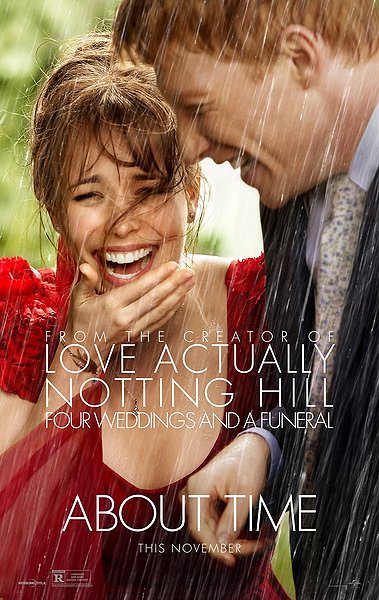 Richard Curtis is something equivalent to royalty in romantic comedy circles. The man wrote Four Weddings and a Funeral, Notting Hill, the screenplay for Bridget Jones’ Diary, and he wrote and directed Love, Actually. If you are a fan of those movies, then About Time is already at the top of your to-do list. Reportedly Curtis’ last movie he will direct (he’s only done three), this time-travel romance looks to be a break from a genre burdened by convention. If you like your British rom-coms to be mildly cheeky, hopelessly dewy-eyed romantic, filled with beautiful people, and loaded with hugs, then About Time with suffice. If you were expecting something grander from the premise you’ll walk away shaking your head at all the squandered potential.
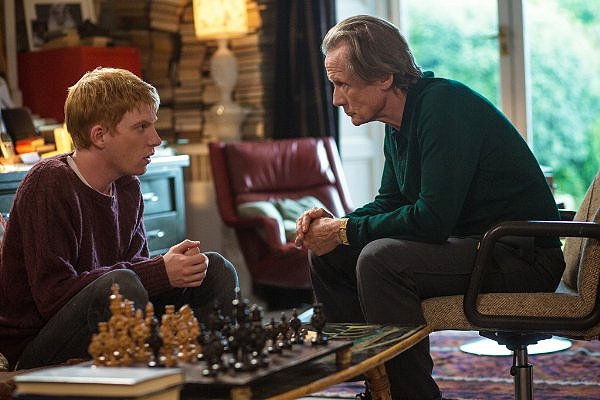
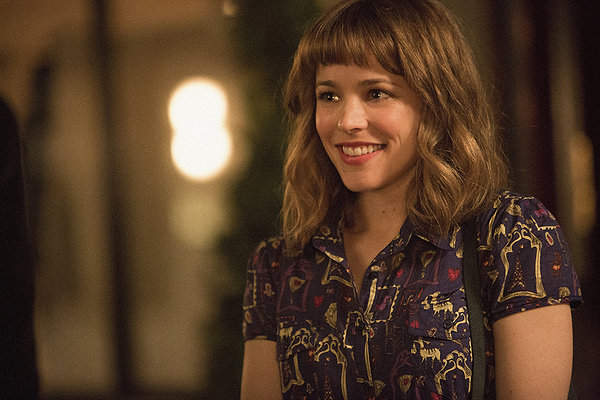
Tim (Domhnall Gleeson, son of Brendan) is a normal upper class British student when his father (Bill Nighy) sits him down to have… The Talk. This one isn’t about birds and bees so much as it is the space-time continuum. It seems that the men in their family have the unique ability to travel through time, though only during their lifetimes. All Tim need do is find a somewhat secluded, dark corner, clench his fists, and think his way back to a particular memory. Tim is able to blink out embarrassing incidents and use his foreknowledge. He meets Mary (Rachel McAdams) and sets his sights on making her fall in love with him. He corrects their courtship until he gets everything “right.”
 While eminently pleasant and suitably funny and emotional, About Time is a tale of wasted potential. I’m unsure why Curtis even brought in such an unconventional element like time travel if he was just going to play it safe. The standard, feel-good rom-com route feels the safe way through, and while it’s well done in that regard, I almost wish the film had pushed further with its concept. To begin with, the time travel restrictions are arbitrarily applied and will later be broken altogether as the film continues. When time travel is used it’s played out like Groundhog Day, with Tim immediately going back to fine-tune his actions, particularly his courting of Mary. That works, as we get used to the inertia of the edits, but that seems to be the lone focus. Once he gets the girl, Tim rarely uses his amazing gift. He’s content and so time travel is an afterthought when, as I suspect for any of us, it would be all we could think about. Tim lacks suitable ambition. I think the film would have been weightier had its lead been less idealistic. He’s a nice guy but imagine a Lothario having the power to travel back in time. He could physically cheat on his wife, go back and make sure it never happened, and live his life, having his cake and eating it too, except for the guilt. Is it cheating if it happened in an alternate timeline? Or what if he was a stockbroker committing insider trading with his past self. In fact, what if he just interacted with his older, more morally wanton self? There’s also the fact that Mary never finds out about any of this. At no point does Tim reveal his family’s incredible ability and have to atone for his actions. I’m fairly certain Mary would feel like her marital bliss could be the end product to manipulation. Alas, we’re stuck with our cute, acceptable, but mostly square rom-com.
While likeable, I didn’t think the characters themselves were sketched out well; I like McAdams and Gleeson, but I couldn’t really say much about them as people. He’s a lawyer. She works as a reader for a publisher. His family is kind of rich. And that’s about it. Even through their interactions we don’t learn much about Tim or Mary. They fall in love, and it’s nice, but the lack of characterization, besides the fact that they are cute together, kept me from fully investing in their love story. I doubt the target audience will have this same issue. I found them cute and their scenes are cute together but I need more about my main characters than a collection of cute scenes. Another nagging aspect of their courtship is that it seems too easy. Tim has the amazing power of time travel so he can fix any problem presented, but that shouldn’t stop the appearance of problems. Tim and Mary are nice people that seem to have no discernible differences, besides Tim’s leftover feelings for a first love. An audience may say they want a couple to be sweet together always. They don’t. It’s boring. We need conflict. With About Time, there just isn’t enough of it and Tim and Mary are too underdeveloped for me to pine for them.
There are loads of dangling storylines that feel like they are leftovers from past drafts. You would think wrapping up a peachy marriage early would lead to some sort of personal crossroads and sacrifice. Everything was coming far too easily for Tim, so I kept waiting for another shoe to drop late in the film, to give him the chance to undo his own personal happiness and marriage to, say, save a beloved family member. I kept waiting for some kind of greater personal stakes, but it never came. Then the movie has all sorts of dangling storylines that do not seem conceptualized. The doddy uncle who seems to be experiencing the ravaged effects of too much time travel? Not much there. They never explain him and so he is just the standard Brit com-com kooky family member to say weird things offhand. Seems like a waste of greater pathos. Tim’s troubled sister? She’s fixed in a pinch and of course it all has to do with the men she’s dating.
 Then there are the rules, which in time travel need to be adhered to closely or else the butterfly effect ripples cascade. We’re told at first that Tim can only go backwards in time. This gives the impression that he has to live out all that extra time. So, say, if Tim traveled back two years, he’d have to live out all two years to get back to the presumed moment he began his journey backwards (writing about time travel does wonderful things with sentence tenses). So every jump back requires reliving your life. But then all of a sudden Tim can jump forward in time as well. No one comments about this. If the men in the family are reliving days and possibly years of time, then shouldn’t they be preternaturally aging, looking 70 at 50 and so on? Then there’s the fact that Tim introduces the ability to travel back in time WITH another person. This is never dealt with again, sadly, and it’s a big deal. You can bring other people with you through time. This is an amazing opportunity but it’s wasted like so many others.
However, with all that said, the movie won me over more as it transitioned into a greater emphasis on the father/son relationship, enough so that it feels like Curtis trying to get the sense of closure we so rarely get in life. I though a late trip backwards, as a young son skipping stones with his dad before he may never see him again, was quite beautiful. It got me wishing the film had given more time to explore the dynamics of father/son time travelers, a rich dramatic possibility that only reminds you how much more interesting About Time could have been.
About Time will be catnip to its target audience, namely female rom-com fans. I found it a fairly pleasant movie and its stars wholly likeable. I laughed at spots and even got teary-eyed a bit toward the end as the film’s emphasis shifted from a guy-gets-girl narrative to more of a father-son examination. The funny Brit characters do their thing, the lovely scenery remains lovely, and the declarations of love get a spit-shine. It is an effective romantic comedy that will charm and please and get its audience to swoon, but I was left feeling that its potential went untapped as it settled on a safer, more conventional story despite all the unconventional possibility. Why introduce time travel if you’re just going to take the safest route possible with your storytelling, never pitting Tim in a difficult decision he has to make, or jeopardizing his carefully manipulated happiness? There are so many possibilities Curtis had with a premise that opens up alternative histories, but it seems like he settled for another dash of more-of-the-same.
Nate’s Grade: B-
Share this:

Anna Karenina (2012)
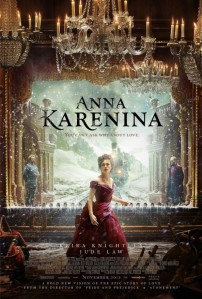 I’ve never read a Russian novel before, mostly because I don’t need to read 900 pages of bleakness and repressed happiness. With that said, I knew very little going into Anna Karenina (the very title sounds too heavy in syllables, like you’re stuttering). What didn’t help matters was director Joe Wright’s edict to set the story as if it was being performed on a living stage. This bizarre visual concept is interesting for a little while until you realize that it never goes further than the obvious note that the lives of the elites were played out in public for cruel judgment. The staging also gave me many periods of confusion where it felt like a character fantasy was taking place. The peculiar staging seems superfluous and the real draw for the film, not the relatively fine performances or Tom Stoppard’s (Shakespeare in Love) adaptation. I don’t think it works as a movie because, much like Wright’s Atonement, it feels too self-satisfied in its own mannered artifice. It’s an overload on style and the film neglects to give me a reason to care about the story and the characters. Keira Knightley as the titular heroine is hard to embrace, Aaron Taylor-Johnson (Savages) seems miscast as her dashing lover, and Jude Law (Hugo) comes across as unreasonably tolerable of his wife’s flights of fancy, so much so it makes it hard to sympathize with her downward spiral. It’s a pretty movie and I applaud its attempt to do something different, but Wright’s Anna Karenina feels too fanciful to come across as tragic.
Nate’s Grade: B-


 nathanzoebl
You must be logged in to post a comment.