Blog Archives
Babies (2010)
 This tiny documentary might easily win the award for cutest movie of the year, but at best it’s only perfectly suited to have on in the background of your home. Nearly wordless, this French documentary chronicles four newborn babies on four different countries growing up in vastly different cultures, from San Francisco to Namibia to Tokyo and Mongolia. The babies are adorable and the sequences rarely last more than a minute with each baby, making this perhaps the fastest paced home movie you’ll ever likely see. At the same time, just because the different babies are juxtaposed does not mean that a greater sense of meaning arises from the film. We watch them walk, talk, and discover the various stimuli of their environment in beautiful photography. Babies may be the best looking documentary that conveys the least substance. This may be the cutest waste of time you’ll have all year at the movies.
Nate’s Grade: C+
Share this:

Catfish (2010)
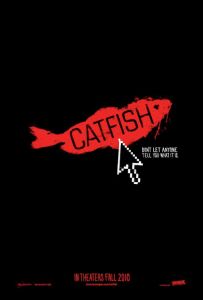 Catfish is a slippery pseudo-documentary that seeks to explore the idea of human connection in the digital age. What does it mean when people’s friends originate from a glowing box?
The film chronicles the online relationship of Yaniv “Nev” Schulman. He’s a twenty-something New York City photographer who gets a painting in the mail one day. It’s a painting based upon one of his pictures published in a New York magazine. A 12-year-old girl saw the photo and was inspired to paint. She keeps sending more and more paintings to Nev in New York. He researches the 12-year-old, her family, and eyes pictures of Megan, her older sister. Megan is a strikingly good-looking model who also dances, plays the cello, writes songs, and raises horses. Nev and Megan have several conversations via phone, texting, online chatting, e-mail, and Facebook postings. It’s a relationship completely dependent on thumbs. Then Nev, along with his filmmaking friends Henry Joost and Nev’s brother, Ariel Schulman, start noticing peculiarities. Why does Megan pass off other people’s songs as her own? Why does she never seem to be around when other family members are? Is Megan really Megan? The guys start investigating and deconstructing this online romantic fable. Nev’s friends prod him into making an unexpected road trip to Megan’s family home in Ishpeming, Michigan. They’re excited and morbidly curious about what awaits them.
 I suppose your ultimate feelings about this movie will depend upon whether you view Catfish as a work of fiction or non-fiction. In either case, there’s a lot of manipulation and exploitation. Even if you do some half-hearted Internet research, you can find real-life events mentioned in the film that actually happened. A real-life special needs child died in the town of Ishpeming, as described in the closing text of the film. That means that a character we see late in the film is either the genuine special needs child or was a stand-in for one and the filmmakers took advantage of a community’s loss for “authenticity.” Which is more manipulative? Nev and his pals want to expose this scheming family, broadcasting private messages and intruding upon their lives with cameras to document their foibles. From my assessment, the film felt staged from start to finish. What luck they had cameras rolling for all these important moments of inquiry. But does that mean that the film is any less believable? The movie examines how easy it is not just to create a different persona, or new friends via the Internet; it showcases how the Internet allows people to create their own world. People lose themselves in alternate online realities, not just social-networking sites like Facebook but The Sims, Second Life, World of Warcraft, and all sorts of other avatar-based sites. The Internet allows us to fashion our own worlds, our own escape door from reality. Our grasp on reality has become subjective, which is further evidence that the truthfulness of the film is a moot point (a fictional non-fiction film about people posing as fictional versions of who they want to be online?). What does identity mean in an age of ever-increasing fiction?
As a film, Catfish is a mess of digital images. We see Facebook posts and text messages, scrutinize images posted Online, scroll through Google and YouTube for damming evidence of a con, and the guys make extensive use of Google Earth to showcase their cross-country travels. The visual do-it-yourself aesthetic contributes to the stab at authenticity as well as amateur journalism. The framing of the shots, however, is another point that tips Catfish into being a likely work of fiction. Whatever the case may be, the filmmakers and the subjects aren’t speaking one way or another.
 Those snookered by Catfish’s sensational trailer (there will be many) are likely in for a crushing disappointment. Catfish begins as a slightly intriguing mystery as Nev and his buddies uncover the irregularities and discrepancies of Megan. Then when the trio actually arrives in Ishpeming in the dead of night, there’s about a ten-minute stretch of “don’t go in there!” cinema. Nev’s filmmaking pals egg it on with self-aware comments about how scared they are or how creepy the situation is becoming. Then again, who exactly peaks into an abandoned horse farm in the dead of night? At this point, goaded by the trailer, you’re expecting Catfish to go down the grisly horror path. You expect they will discover some terrifying secret like that Megan is apart of a family of grifters that lure unsuspecting men from the Internet to be butchered and have their organs sold. Catfish does not go down that path. It actually pretty much goes the way you’d expect in real life. It actually turns out to be a fairly normal, mundane story, something that would have made an interesting one-hour TV special (“To Catch an Internet Poser”? It would run for decades). Catfish begins as a warning about how well we can truly know someone in the digital age, but then it concludes as a thoughtful character-piece about the steps people take to alleviate the disappointments and hardships of life.
Catfish has some moments of intrigue and tension, but at most the film is a mildly interesting experiment. It straddles many creative lines. It’s both fiction and non-fiction, humane and exploitative, probing and lethargic, a fitting contradistinction about a world that full of them. It’s a mostly well-crafted movie but what do you do with it after you know all its secrets? Nev and his crew are on a crusade for the truth, but whose truth? If you’re looking for a true stimulating experience exploring life in the Internet age, check out The Social Network again. Talking and analyzing Catfish is more intriguing than actually viewing the film.
Nate’s Grade: B-
Share this:

This Is It (2009)
 More like a DVD behind-the-scenes feature that never materialized, This Is It is a documentary following Michel Jackson’s rehearsal for his comeback concerts that never were to be. The entire film feels more like a memorial service than an actual movie. It feels like a supplement. In between teary interviews where performers express how Jackson inspired others, we do experience some key moments where Jackson reminds us about his brilliance as a performer. The man is relentlessly dedicated to perfecting his vision, and he isn’t afraid to push others. But overall, This Is It is mostly a boring enterprise that ultimately alternates between feeling like a reverent memorial and a crass cash-grab. Unless you’re a Jackson fanatic, there really is no reason to watch this film. It provides no insights into Jackson’s final days, his state of mind, or even the events that lead to his death. I was morbidly searching for any little clues but the movie seems to skip over anything that doesn’t portray the King of Pop as a saint. There will be many documentaries and TV specials in the future that examine the life and impact of Jackson, as well as his bizarre and damages personality, but this isn’t it.
Nate’s Grade: C
Share this:

49 Up (2006)
 In 1964, filmmaker Michael Apted (Coal Miner’s Daughter, Gorillas in the Mist) interviewed 14 seven-year-old kids from different British backgrounds asking them about their futures. The half-hour TV special by Granada was called 7 Up and it aimed to show the world where the future politicians and doctors and trash collectors would begin. Every seven years since, Apted has returned to those same kids and peaked in on their lives, chronicling their lives. It’s one of the most famous documentary series in history. Thanks to the virtues of Netflix’s streaming service, I was able to watch six of the seven movies in the Up anthology (sorry 35 Up, the lone film not available for streaming). I spent the next twelve hours watching the lives of 14 complete strangers from childhood to middle age, and by the end they didn’t feel like strangers any more. They felt, weirdly, like family. And that’s the true appeal of the ongoing series: you are watching the evolution of human beings. It’s not everybody that gets a visual scrapbook of their life that’s viewed by millions worldwide.
 Finally, after many hours, 49 Up is the first in the anthology to address the ideas of selective editing and building storylines to suit the “characters.” Long before reality television smoothed away life’s edges to make everybody fit into archetypes, Apted positioned the Up series as his thesis on class struggle. He purposely selected a cross-section of English schoolchildren from private schools and public schools and even two from a boy’s school for orphans. You can see it at 14, 21, and 28 how Apted sticks to his same line of questioning about class advantages and disadvantages, peppering his subjects with questions about what they didn’t have and then showing their current situations in a specific manner to make the audience feel a specific emotion. It’s not deliberately diabolical or partisan but the class warfare ideology certainly can chafe. Do the kids at the top still get all the perks? Are the kids at the bottom suffering with limited opportunities? Has anybody transcended class? Apted starts attributing achievements by the upper class boys as part of their upper class advantages and not due to their hard work, dedication, or talent, which they have every right to complain about. John complains at 21 that when, at seven, they declare their education ambitions, and Apted follows it up with narration, “John did attend such and such,” that it creates the illusion that everything has been handed to them. The hard work and long hours are not shown, and fair point. A few of his subjects actually begin to challenge Apted over his perceptions. Suzy takes aim at his line of questioning, hinting at her life’s disappointments, and fights back, accusing Apted of trapping her into a small narrative box. She even brings up another heated conversation in the history of the series, when Apted questioned whether Suzy, at 21, had experienced enough of life to settle down (she eventually divorced years later). You witness her youthful indignation and she remarks, with some resignation, that Apted is free to edit this outburst as he will and she is helpless (obviously Apted kept this in). It’s the first time I’ve seen the stars of Up contest their onscreen portrayals.
It is also with 49 Up that the film series starts to finally reflect. Part of that comes with living half a century, and many of the 12 on camera subjects are now at an age where they have grandchildren and are setting up retirement (I wonder what the economic meltdown of 2008 did for those plans). They can reflect about the accomplishments of their lives, the past dreams captured on camera that never came true, the marriages that dissolved, the joys and struggles of rearing children, the pains of burying parents, etc. They seem to be at that stopping point where they can take stock of a life lived. On top of that, the participants now begin to reflect on what being apart of the Up series has meant to them. It certainly shapes public opinion about who they are as people, and Apted gropes for any new info to connect with the prior material in the earlier movies.
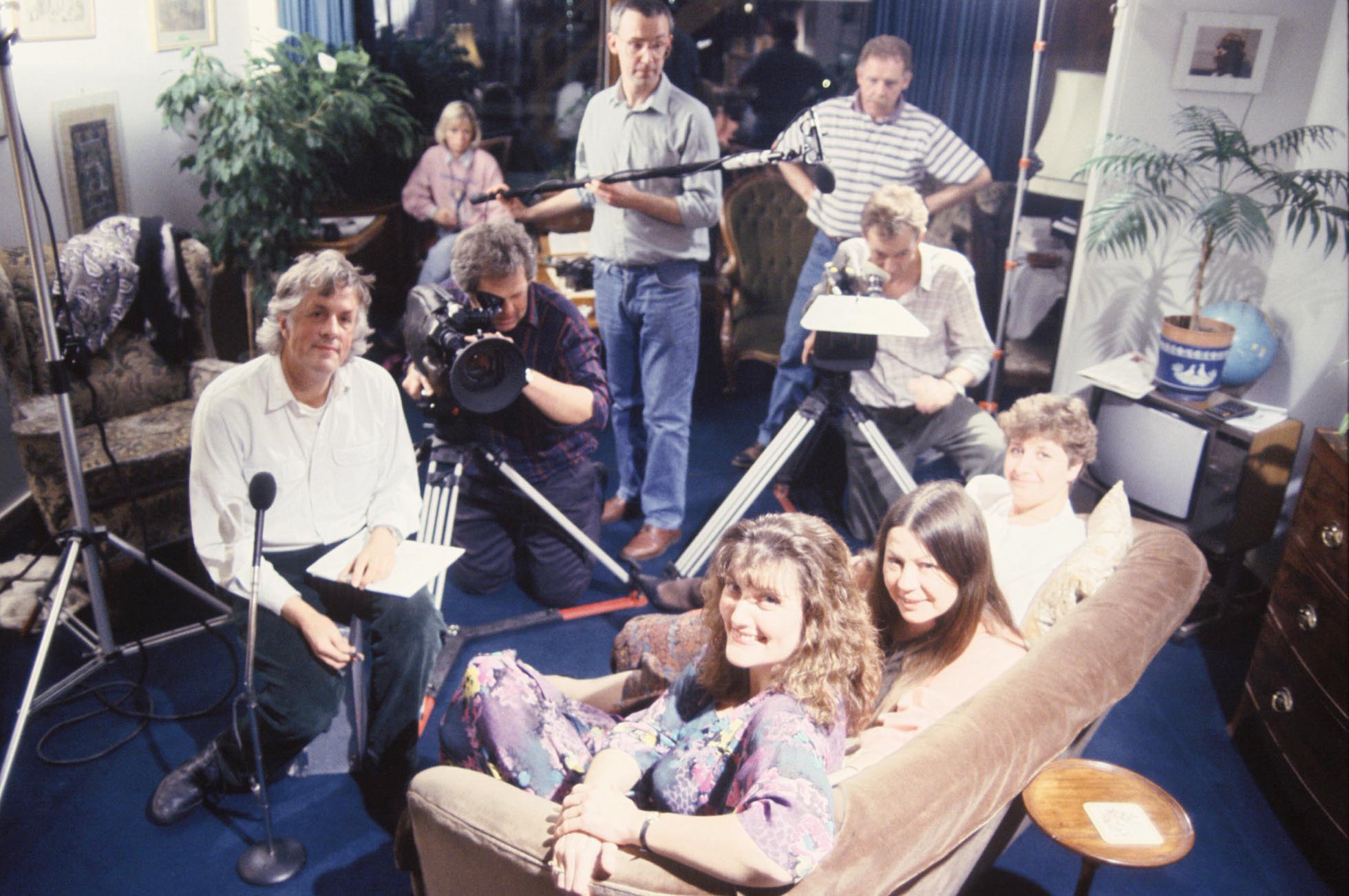 Perhaps Apted feels like he has to keep flogging his class thesis because most of his subjects are pretty regular, i.e. boring, people. They’ve lived lives of modesty and hardship and persevered, but they’re at heart no more interesting than your neighbors. The problem with selecting a bunch of seven-year-olds you plan to follow for the rest of their lives is that you have no clue what will happen. The narrative is completely up in the air. This is why Apted, early on in the series, sticks doggedly to his class thesis to provide some sort of framework he can revisit every seven years. That’s why the series starts to become something of an echo chamber. The exact same sound bytes get used over and over again, trying to find new relevancy. The adults get forever defined, and continuously redefined, by something they said at seven years old, like Neil’s worry that a wife would force him to eat greens and he “don’t like greens” (I’m in the same boat, kid). The echo chamber effect is even more obvious if you watch the Up series in a row. You will start to memorize the childhood catch phrase of everybody and then watch the same clips recycled from 7 to 42. Each is like a little stepping-stone to the present. When viewed as a whole, the series can almost come across as facile. Apted doesn’t probe very deep into his subjects and their lives, mainly sticking to the Life’s Checklist of Accomplishments of Being an Adult: school, job, spouse, family. Personally, I hate how we become defined by a profession. That seems to be the second question that rolls off our tongues when we meet a stranger: “Who are you and what do you do?” What do we do? That’s a loaded question and I object to the idea that our job is the only relevant thing that we “do.” But that’s just my hang-up, I suppose. Apted also lets his subjects reveal the biggest changes in their lives, meaning that if somebody doesn’t want to broach a topic then it gets left unanswered. It can get frustrating and makes for some opaque follow-up visits.
Not every participant is thankful for the Up series. In fact, many of them are wary and somewhat disdainful of participating. Every seven years these people have to rehash their life’s highs and lows, boil them down into a package, and then have it picked over by Apted and his leaning questions, stirring drama anew. It’s easy to see why this becomes a difficult and challenging experience for most, something akin to a cross-examination about your life. So why do most of the 14 return every seven years? Is it the secret hunger for fame? John Brisby ducked out of the Up series after the third installment, upset that he had been made into the series villain through editing. He came across pompous and like a prototypical “old money” sort who lived in a small privileged world (fox hunting!) and reinforced Apted’s thesis on class advantages. Of course his interviews didn’t help him, but I’ll give the guy the benefit of the doubt. I’d hate for everything I said when I was 14 and 21 to follow me for the rest of my life. Well, in 35 Up, John returned, though begrudgingly. He had a reason. His wife and he had begun a charity to raise funds to help the beleaguered educational state of Belarus, a country where John’s family once resided. In 49 Up, he travels once again to that ancestral country and he remarks, somewhat graciously, that it was directly because of exposure on the Up series that donations increased and the kids in Belarus today have books and school buildings and dedicated educators. John made the most of his fame and directed it to a worthy cause. Plus, it doesn’t hurt that John’s passionate desire to help Belarus (his wife is the daughter of an ambassador to the country) feels like the “character” of John has matured.
 Is there any sense of privacy when you know that cameras will be regularly scheduled to appear? There’s this enormous pressure to continue with the Up series, I imagine. But whom do these lives belong to? They were chosen by school officials and Granada at age seven, so they never really had much of a say in what has turned into a lifelong commitment. It seems that the world has a sense of ownership over these 14 individuals’ lives, an ownership that they never granted permission. They must feel an enormous obligation to keep informing the public about their lives, much like a nagging relative. We are a nosy, intrusive lot, human beings are. And I must say that I personally feel weirdly paternal about them. I feel happiness when they too reach happiness through whatever means. I was smiling from ear to ear when Nick, who at 14 was so shy and awkward, became a wonderfully charismatic, articulate, thoughtful, and rather handsome 21-year-old man (he looked strikingly similar to Andy Samberg). I feel despair as well when marriages don’t work out or once secure jobs vanish. Watching the Up series is like watching the evolution of a human being through time-lapse photography; it’s voyeuristic but at the same time it’s like having an extended surrogate family that requires no commitment. We can watch people grow up, mature, gain wisdom, and without anything more than the click of a button. We can watch hairlines get thinner, faces get larger, bodies get saggy, wrinkles multiply, all while playing the visual game of connecting the current iteration of participants with their past selves. We have these 14 people’s lives at our disposal for entertainment.
The Up series aren’t individually great documentaries. In fact, they’re pretty plain and not fairly insightful. As a whole, they present a fascinating document of the human experience and make for a great way to spend a rainy day. You can’t help but reflect on your own life after watching several of the Up movies, and curiously wonder what you have done with your own life at various intervals. As of this writing, all 14 original participants are still alive, which is somewhat amazing in itself. It will be morbidly interesting to see how the film series carries on after one or more of the participants pass away. Millions around the world will mourn what otherwise would have been a normal stranger passing. It’s probably selfish to keep hoping for future installments, and for the participants to keep updating me about their personal lives, but after a 45-plus year investment for some, it’s hard not to feel a sense of attachment to these people.
Nate’s Grade: B
Series Grade: A-
Share this:

The Cove (2009)
 I never really wanted to watch the documentary, The Cove, and judging by its anemic box-office gross, I wasn’t the only one. A movie about dolphin slaughter felt like it was going to be a hard chunk of medicine, and I can’t really blame anybody who read about this acclaimed Sundance doc and said, “You know, I don’t feel like spending eight bucks to watch dolphins get harpooned to death.” I can’t argue with that and it was with great trepidation that I put the DVD into my player, hiding behind a blanket, dreading the animal cruelty and self-righteousness that would soon wait. And then a funny thing happened. In the first five minutes I really got into the movie, my nervous tension disappeared, and I was captivated by one of the best-edited and most thrilling movies of the year. For the squeamish, rest assured, the dolphin death footage isn’t graphic and used rather sparingly and tastefully. This is not just a PETA snuff film.
The Cove has two storylines at play that converge with a unified goal. The first explores the life of Ric O’Barry, the world’s premier dolphin trainer responsible for all those playful porpoises on TV’s Flipper (he even lived in the TV family’s house by the dock). It’s because of that popular TV show that the dolphin craze began where people wanted to see them do tricks and people wanted to swim with the cute dolphins. Sea parks sprouted up around the world and many dolphins were sold into captivity. O’Barry then drastically changed his mind about dolphins living in captivity after the death of one of the Flippers. Dolphins need to consciously breath, so they can actually hold their breath and die, which is what happened. The Flipper dolphin committed “suicide” in O’Barry’s arms, or so he says (he may be projecting a bit of his own guilt). He has been fighting ever since for dolphins to be freed and often O’Barry gets arrested for his activism efforts.
O’Barry’s biggest target is Taiji, Japan. It is this small coastal town that supplies dolphins to most of the world. Researchers and entertainment trainers will take their pick of the litter and the rest aren’t so lucky. The remaining dolphins get transferred to a small inlet where coastline bystanders cannot see and where large “Keep Out” signs are met with barbed wire. Then the waters run red. Tens of thousands of dolphins are slaughtered every fall and O’Barry has been trying to get the word out for years but has been stymied by the local fishermen, the meat corporations, and the Japanese government. Director Louie Psihoyos, a critical member of the Ocean Preservation Society, intended to make a film about depleting ocean reefs and intended to have O’Barry be one part of an overall bigger picture. Then, while traveling in Taiji, he became convinced that the real story was exposing the secret dolphin killings and why what goes on in that deadly cove matters to the rest of Japan and the world.
 What hooked me was that The Cove is structured like a real-life espionage thriller. Psihoyos and his technical crew wanted to go the legal route but were blocked by opposing forces. So he assembles a team of experts to infiltrate the Taiji cove and document what exactly is going on there. He recruits the best deep diver who can plunge to record-breaking depths on a single breath of air. He recruits a model maker at special effects studio ILM to make convincing rocks that will house hidden cameras. They recruit a man who knows all about cameras and body imaging technology. They even get an expert on flying toy helicopters so they can plant a camera on one. The director says it himself on camera, that he was gathering a real-life Ocean’s Eleven team. The tone of the movie follows suit, making for some great suspense. As soon as O’Barry enters Taiji, he’s tailed by several police officers and they even interrogate him in his hotel lobby to ascertain the purpose of his visit (caught on hidden camera). The billion-dollar dolphin entertainment/meat industry hires people to do nothing else but to film O’Barry himself, keeping track of his movements and trying to provoke an emotional reaction to disparage his cause and boot him from town. We then chart how far the connections go, all the way through to Japanese government officials bribing other Pacific island nations to join their fight to overturn whaling laws. It’s fascinating and frustrating as hell to watch.
Psihoyos is a rather accomplished filmmaker in his own right, spicing up an intriguing tale with some visual pizzazz and a great sense of pacing. This thing just flies by. It’s strange to say that a documentary about killing dolphins is one of the most gripping thrillers of the year, but there it is. This is an impeccably crafted opinion piece with a dash of espionage excitement. The movie is indignant, yes, but refrains from being self-righteous or condescending. At no point did I feel beaten over the head with some activist propaganda, though the film is clearly one-sided. Psihoyos manages to weave in a lot of useful information. I was dreading the actual dolphin slaughter footage even though, from a structural standpoint, that was the climax of the movie people have been waiting for. The footage is mostly at long angles, though you do see Japanese fishermen repeatedly jabbing harpoons into dolphin shapes. The most disturbing moments are earlier when a mortally wounded dolphin spaces past the nets and tries to swim for freedom. It’s spitting blood and wildly trying to break free but it eventually drowns. The final image of the hard-won footage is the blood-soaked shores of the cove, which are a deep, unsettling red that reminds you of a full-on Biblical plague. An easy plea to emotional appeals, perhaps, but effective nonetheless. I have no shame in admitting that The Cove put me to tears on three separate occasions.
 So is there really a difference here between killing and eating dolphins and the West’s industry of killing and eating cows? Is this all just a matter of cultural insensitivity? That’s a harder question. Which animals do we draw the line at eating? Is there a moral disparity between eating a hamburger and eating a dolphin, or eating a cat or a dog? I don’t know. Personally, given my Western biases and everything, I become repulsed when it comes to inhumane treatment to animals and when self-aware creatures are used for food. I am a content meat-eater but that doesn’t mean I want to snack on a dog sandwich. Certain animals are just more self-aware than others, which muddy the moral waters. When an animal reaches that sense of awareness then it becomes an even stronger ethical dilemma when it comes to killing them, because they are more cognizant of what is happening and the life being taken from them. It may all sound like semantics to some, but that’s my personal stance. To literally quote George Orwell’s famous novel: “All animals are equal but some animals are more equal than others.” That may seem hypocritical to people but I’d argue it’s a reigning opinion among a majority of Americans. The counter argument is that Westerners know that cows are being led to the slaughter, whereas the Japanese are purposely kept in the dark about the nature of the dolphin massacres. To make matters worse, dolphin meat is incredibly high in levels of mercury and the meat is labeled as other fish. The majority of the Japanese do not know that they are consuming poisoned dolphin meat. Americans at least know what they’re biting into (the jury’s still out with hot dogs).
The Cove only gives you the Western perspective on the subject because that’s what fits its agenda. It does take a few swipes at the arguments for dolphin hunting. The Japanese government views them as pests needed to be dealt with and blames the porpoises for declining fish levels, which to any rational thinking person would sound absurd. Which seems like the more likely scenario: pollution and over fishing lead to declining levels, or the sea creatures that have lived on the planet for millions of years are now to blame? The other token argument is that whale and dolphin killing is a part of traditional Japanese historical culture. This might hold true for some people; however, upon some minor research you find that the whaling tradition goes back only a couple centuries, no further than it did for European countries that have given up the practice.
But what the movie really fails to explore is why. Why do the Japanese fishermen, when offered the same money NOT to kill dolphins, decide to keep killing them? What is the psychology at foot in Taiji that links the town with annual slaughters? It’s a shame that Psihoyos devoted the entire bulk of the film to getting the footage. The focus of The Cove is a bit limited but I understand why. There needed to be an attainable goal: get the secret footage and spread the word. The movie is too entertaining and harrowing to really knock its limited scope, but The Cove could have been a much fuller depiction of this bloody reality.
The Cove builds a compelling, if one-sided, case condemning the ongoing actions of Taiji, Japan and the greater government. The conspiracy unfolds layer by layer and the movie ends up rallying others to action (O’Barry says you’re either an activist or an “inactivist”). I don’t know if anything will actually change now that the footage is out there, but at least people can be more aware of the annual dolphin slaughter. And after a year of wrangling, it appears that The Cove will be released in Japan this spring. Let’s see what kind of response comes out then and whether the Japanese are willing to pay the yen equivalent of eight bucks to watch dolphins die.
Nate’s Grade: A
Share this:

Food Inc. (2009)
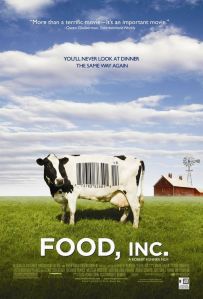 Food Inc. is informative and occasionally jarring, but unless you have no common sense and/or political acumen, nothing here should seem like much of a surprise. The food industry, like most, is about finding faster, cheaper ways to turn higher profits, so it seems natural that the fast-food style system would be integrated into industrial factories. Our current eating lifestyle as a nation is unhealthy and heading toward disaster. But this is old news. Food Inc. makes a mostly compelling case except when it comes to organics. An organic farmer addresses the argument that worldwide organic farming cold never feed enough people, and tosses it aside as “specious.” I’m sorry, global hunger is not a specious argument, and Food Inc. glosses over the facts that organic farming requires a massive amount more land to produce crops, it only uses natural fertilizer which means its more prone to breaks of E. Coli, and, most damning, is more prone to infection because they only use natural pesticides, ignoring decades of scientific improvement, which naturally makes their crops more prone to being wiped out by insects. Which billion people get to be told their hunger doesn’t matter? The film’s most interesting section is when giant food companies control a market and squeeze the legal system to keep it that way, like Monsanto’s near 90 percent hold on soy beans. They hire former military men to spy on farmers and scare them. They engage in frivolous lawsuits because they can afford the legal fees, but a poor farmer can’t, so they admit guilt and settle. The Monsanto dismantling of family farms is scary, way scarier than the hidden camera footage of animals at a slaughterhouse (it’s sad, I’m not a monster, but as long as it’s humane, does a cow really care how it dies?). Food Inc. is an interesting, galvanizing little documentary that makes several good, albeit familiar, points.
Nate’s Grade: B
Share this:

The Box (2009)/ Capitalism: A Love Story (2009)
 Both films on the surface seem so radically different and yet I found lots of common ground between a sci-fi conspiracy and a muckraking documentary about the biggest financial meltdown of the modern era. Both are centered around the concept of greed and whether humanity can forgo selfishness for empathy of their fellow man. Would you kill a stranger for a million bucks? Would you rig a financial system so that the richest one percent can gamble the life of a nation? Both movies also bite off more than they can chew and both movies exist as interesting yet dispirit elements that could use more cohesion and resolution.
You have been given a box with a button. If you press the button tow things happen: somebody you do not know will die and you will receive a million dollars. Do you press it? That’s the hook of writer/director Richard Kelly’s sci-fi morality tale based upon a short story by Richard Matheson. The Box is a messy and outlandish conspiracy sandwiched between two moral tests, the second a consequence of the first and a means to wipe the slate clean. There’s plenty of weird unsettling moments, including the horrendous wallpaper of the 1970s, but not everything really hangs together. Kelly’s intergalactic conspiracy can get readily outlandish with all the variables and needed participants, but like in Donnie Darko, he lays out enough tantalizing info to keep your attention and then keeps the narrative vague enough for personal interpretation. However, unlike Darko, this movie needed to cleanup its loose storylines. It just sort of ends in perplexing rush, and I sat in silence through the end credits waiting for some kind of scene to help tie together dangling storylines that were left to dangle for an eternity. The Box has a nicely tuned foreboding atmosphere, and it certainly keeps you guessing, but it will also keep you scratching your head to try and make sense of everything from button boxes to teleportation pools to Mars probes to sudden nosebleeds to Satre’s No Exit. Kelly, as he has done with his previous movies, packs a lot in two hours. Whether or not it all formulates is up to the viewer’s wearying patience. I’d rather have more movies like The Box than more thoughtless drivel from the Hollywood assembly line.
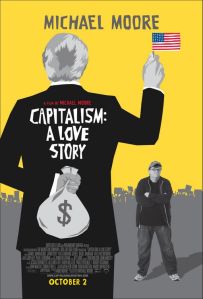 After 20 years, you pretty much know at this point what you’re going to get from a Michael Moore documentary. There’s the anecdotal evidence, emotional interviews of the downtrodden, the one-sided arguments, the nods to the depressive state of Flint, Michigan, and Moore trying to bully his way to see the powers that be that have no interest seeing him. In a way, Capitalism: A Love Story is like a greatest hits collection for Moore that reminds you of his better moments and better films. Despite all the outrage, Moore wants to throw the baby out with the bath water. He cites capitalism as an evil that needs to be eradicated. His thesis isn’t very cohesive and consists of a series of related and unrelated anecdotes, some of them grossly offensive like companies profiting from the death of employees thanks to “Dead Peasant” life insurance policies. But at no point do you walk away thinking, “Let’s start from scratch. What has capitalism gotten us?” Several of his points are easy to agree with. There is a flagrant disregard for the well being of others on Wall Street, who carelessly gambled the nation’s fortunes and then got the taxpayers to cover the loss. The bailout is a crime of pure capitalism and in a true capitalistic society there is no such thing as “too big to fail,” there is only fail. It’s not following an ideology built upon greed that has hurt the U.S., it’s unchecked greed, capitalism run amok without any oversight or regulation that has endangered the nation’s livelihood, and I’m surprised Moore didn’t emphasize the process of deregulation from Reagan to Bush more. The story of our financial meltdown is too large for a confined two-hour narrative window, and it’s too important a lesson for a man like Moore to use it as fire to ignite a people’s revolution.
Both movies: C+
Share this:

Waltz with Bashir (2008)
 A mix between animation, documentary, and war drama, this Israeli film is something uniquely different and remarkable. Filmmaker Ari Folman interviews fellow veteran servicemen from Israel’s 1982 invasion of Lebanon in hopes of jogging his memory. He has blocked out the painful memories of war but his mind is reawakened as he reexamines the truth about the conflict and eventual massacre of Lebanese Arabs. Folman utilizes a rotoscope style of animation, which gives it a heightened reality and an intoxicating painterly beauty. He also takes advantage of the fact that atrocities can be easier to stomach when presented through the barrier of tasteful animation. However, it will be hard to keep from being affected (a scene of dying horses got to me bad). The realms of reality, fantasy, nightmare, and memory can crash together in fascinating ways, and eventually the movie transforms outright into a full-fledged documentary that melts away any last obstacle of empathy, ending with real disturbing footage of the massacre’s aftermath. Waltz with Bashir does not come with an agenda in tow, which allows the movie to explore the ambiguities of being young, nationalistic, confused, and armed in a hostile land. Folman is trying to peel away at the unbiased truth of the matter and cleanse his curiosity and, perhaps, his conscience. His filmic journey to that elusive and painful truth is a movie that crosses cultures and redefines what a documentary can be.
Nate’s Grade: A
Share this:

Anvil! The Story of Anvil (2009)
 Imagine a real-life This is Spinal Tap! and you’ll have a fertile starting ground to tackle the rock documentary, Anvil! The Story of Anvil. There are so many unintentional references to that landmark mockumentary that you’ll be forgiven for suspecting that Anvil is fake. They even have music knobs that go to eleven! You see, Anvil played with other rock and roll headliners like The Scorpions, White Snake, and Bon Jovi in 1984. They were on the cusp of fame and stardom and then… it just didn’t happen. Flash forward, and the Anvil band members are still playing together and fighting for the fame that has eluded them for over 25 years. Singer/lead guitarist Steve “Lips” Kudlow lives in his native Canada and delivers lunches to school cafeterias. Drummer Rob Reiner (absolutely no relation to the director of Spinal Tap) works meager construction jobs. They both have wives and children, but they haven?t put their dreams on hold and know the fame they deserve is just one more opportunity away.
The band is not without its fans, and one of them is Tiziana Arrigoni, a Swedish woman who loves heavy metal and books Anvil an ill-fated tour of gigs throughout Eastern Europe. And just like Spinal Tap, everything that can go wrong generally does go wrong. The band misses several trains. The clubs they play are small, mostly attracting a handful of die-hard fans and drunks. They get lost in Prague and arrive two hours late to their gig. The club owner refuses to pay the band, instead offering them plates of goulash for their payment. The deepest cut is when the band is booked for the “Monsters of Transylvania” show in Romania at a venue that can seat 10,000. Lips even marvels that, “The mayor of Transylvania is gonna be there!” Only 175 attend the event (it is unclear whether or not the mayor was in attendance). The hapless Tiziana breaks down and cries, “I try,” and you honestly believe her; what kind of European venues should a Canadian metal band 25 years past their prime be playing? I can’t imagine anyone else with no managing experience could do better given the circumstances. Lips seems to see the same silver lining: “Everything on the tour went drastically wrong. But at least there was a tour for it to go wrong on.”
 This section of the movie ends at about the half-hour mark and I was left wondering what would be next. Then I understood the smarts of director Sacha Gervasi as a filmmaker because by watching Anvil endure the inequities of failure and humiliation early on, the audience will quickly sympathize with these rock dinosaurs. They fight for their dreams and surely they deserve better, and you will be on their side. This isn’t a spoof or a self-conscious skewering of a bunch of over-the-hill hasbeens. You feel for these guys, and the film offers several moments of surprising poignancy as they struggle to make ends meet, labor in dead-end jobs, and spend time with their loving families doing simple things like eating a pizza. Both Lips and Reiner are described as great family men, though one wonders what kinds of life moments they have missed out chasing fame. Don’t feel too bad for Tiziana either; she ends up marrying the band’s bassist. Their wedding reception is the greatest comic moment in the movie. Anvil rocks out at the reception and the disinterested audience looks like they are being held captive.
It’s the relationship between Lips and Reiner that gives the movie its heart. These aren’t the most self-aware subjects and are given to outlandish statements, but they’re just so overwhelmingly positive in the face of relentless adversity. He walks into various record company offices and hand delivers the newest Anvil album, hoping to get his calls returned eventually. In Canada, Lips and Reiner meet with an A&R man for EMI, and it is painful to watch. The A&R guy takes notes like a secretive psychiatrist and then he shuts off the music after no more than seconds. He tells the Anvil guys that if EMI doesn’t feel like it can give the band what they deserve then they won’t go forward with any album release. He’s brushing them off and making it sound like he’s doing them a favor. And yet Lips keeps chugging along like the little engine that could because he has to. The band mates look to him for inspiration. Often a band’s relationship is compared to a marriage, and this seems appropriate for Lips and Reiner. They’ve been friends since high school, stuck together through thick and thin, and their brotherhood is undeniably touching. Lips talks about the intense pressure he endures and how he feels like leaping off a cliff sometimes. Reiner, right there by Lips’ side, adds, “Well, you won’t jump off the cliff because I’ll stop you,” and then he just beams with pride in their friendship. Lips looks over and he too gets choked up. It’s a genuinely heartfelt moment and encapsulates the emotion mined in the film.
The family members seem to politely go along with the boys? wishes, especially the wives who say in revealing interviews that they too have put their lives on hold for their husband’s ambitions. In one scene, Lips’ sister agrees to loan her baby brother the money to record another Anvil album. She starts to cry on camera and we’re left with the quiet contemplation over what she may be so tearful about. Does she feel joy helping her brother continue on his quest, giving him another jolt of life and a reason to live for, or does she feel guilt and resignation knowing that she is enabling a comeback that is never going to happen, only delaying her brother’s cruel return back to reality. The Anvil boys do have patient and mostly supportive family members, though Reiner’s sister likes to get in easy digs here and there, calling Anvil a “joke.” At one point, Reiner’s wife rebuts the oft-repeated claim that these middle-aged headbangers need to “give up and get a real job” by being candidly self-reflective, talking about her own desire to touch fame through her husband’s achievements, and that she too dreams as much as her husband. It’s a nice moment and an insightful peak into the family lives of rock musicians.
 If Anvil has one obvious flaw it’s that Gervasi turns the film into a valentine to his favorite band from his youth. The movie ends on a 1985 picture of Gervasi with Lips, and apparently the director also served as a roadie on one of the band’s mid 80s Canadian tours, so I understand his enthusiasm for a subject near and dear to his heart, but his movie also forgoes any real criticism of the band. There is conflict that goes unexplored. Why didn’t the band actually make it? The movie seems to excuse the band from any blame, although perhaps writing rock songs without a hook might have doomed their radio play. They were skilled musically but can their decline into obscurity all be chalked up to fate and bad management? When the band records their thirteenth album, the “comeback” album, why do they even bother going after major labels? Why do they not go to a niche label, a label that specifically markets to heavy metal fans, the only people who may still acknowledge the demand for another Anvil album? Why, in today’s technologically evolving music market, are these guys not selling the album themselves and online, like what Radiohead did in 2007 for their album, In Rainbows? We see in interviews that notable rock musicians from Metallica and Anthrax admired Anvil, so why didn’t any of them help out when the band was falling apart? What is at the heart of the pain between Lips and Reiner? I’m pleased that Gervasi didn’t lambaste his teenage idols but his movie also could have benefited from further inquiry. He may be too close to the topic to make Anvil a seminal music industry documentary, but Gervasi does keep the movie engaging and, like Lips himself, keeps the darkness at bay no matter the situation.
Anvil! The Story of Anvil is an entertaining documentary that manages to be funny, sad, touching, and inspirational. It doesn’t dig too deep but then again you?re kind of pleased just to be along for the ride and explore these aging musicians? family lives. I don’t consider it a spoiler to say that the men of Anvil get some well-earned recognition by the end of the movie, coming full circle from that 1984 Japanese rock festival. You don?t have to be a fan of metal music whatsoever to enjoy this movie; in fact, the film curiously never plays a full song from the band. Anvil is an enjoyable labor of love for Gervasi, and it’s hard not to fall under the same nostalgic spell.
Nate’s Grade: B
Share this:

Every Little Step (2009)
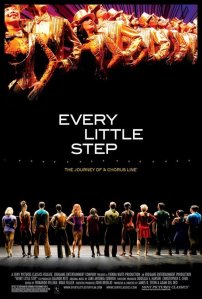 Being that A Chorus Line is a famous Broadway musical all about auditioning for a Broadway musical, Every Little Step, an agile documentary following every heel-toe-kick, takes place almost entirely in the world of high-stress auditions. The documentary traces the origins of the meta-theatrical show all the way to a taped conversation director Michael Bennet had with a handful of New York City dancers in 1974. That night they opened up about their lives and then it became character backstories. I would have liked more of an exploration about the nature of art transposing someone’s life story, but this is not that movie. Every Little Step examines the elation, disappointment, and sheer exhaustion of getting a part in a show. We watch scores of actors try out for the 2006 revival and we also listen to interviews from key participants in the original 1975 production. The movie does have some issues and one of them is that it doesn’t become personally involving to a Broadway naïf until after an hour in. I understand that the casting crew was weeding out hundreds of talent, but the movie doesn’t give enough time to specific hopefuls to follow, build a connection with, and eventually root for. Every Little Step only begins to flesh out its finalists at the final round of callbacks, which makes the stakes less emotionally involving. Still, it’s hard not to feel the rush of joy when some dancers achieve their dreams.
Nate’s Grade: B


 nathanzoebl
You must be logged in to post a comment.