Blog Archives
The Tillman Story (2010)
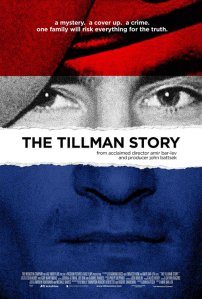 Perhaps better than any movie I’ve ever seen, the searing documentary The Tillman Story explores the nature of shared grief and whether a family is even entitled to privacy when the world feels like it has a shared pain in their loss. This documentary focuses on former NFL star Pat Tillman who enlisted in the Army Rangers in 2002 and was killed in 2004 in the mountains of Afghanistan. He was hailed as a hero of battle, saving his men from enemy ambush, but the truth was really far less sensational but just as damaging. Tillman was killed by friendly fire, a fact the Army admitted only with their backs against the wall. Tillman was their most famous soldier and became a recruiting poster for the post-9/11 armed forces. The doc recounts Tillman’s family struggling to get a straight answer from Army officials and government goons who felt the truth could not compare to a good story. While recreating the events that lead to Tillman’s death in a mostly commanding manner, the doc’s real draw is exploring the idea of a family who has had their private mourning torn away, who are trotted around the nation to events memorializing their son, turning him into whatever symbol best serves personal agendas (conservative pundits are seen in stubborn disbelief when it comes to processing the news that Tillman read Noam Chomsky, thought the Iraq War was illegal, and was going to vote for John Kerry in 2004). What gets lost in all that patriotic maneuvering is a complicated man who didn’t want to become a myth.
Nate’s Grade: B
Share this:

Client 9: The Rise and Fall of Eliot Spitzer (2010)
 Alex Gibney, the Oscar-winning documentary filmmaker behind Enron and Taxi to the Dark Side, rolls out his third 2010 entry in what must have been a rather exhausting year for the man. The focus is on former New York attorney general and governor Eliot Spitzer and his fall from grace after being linked to a high-end prostitution ring. Gibney charts the man’s rise and fall in a fairly straightforward and engaging manner, though you start to wonder if there’s really enough material to fill out a two-hour feature. Spitzer speaks candidly and will not humbly vanish as some may wish; the man is an intriguing mixture of righteousness, ego, and humility. What’s most fascinating about Client 9 (named after Spitzer’s name in the FBI sting) is that Spitzer gained a wealth of enemies when he went after Wall Street largesse and greedy shenanigans, and they all want to be on camera. No one with a serious grudge against Spitzer, including men who have since been convicted of crimes and ethics violations, refuses an interview. Gibney draws together a fairly convincing thesis on the take-down of Spitzer, a cabal of powerful execs, politically motivated prosecutors in the Bush administration, and government officials who reject accountability. It’s all circumstantial evidence, to be sure, but there’s a mountain of it. There is a definite conservative-backed coordinated effort to sully and embarrass the man. But ultimately, Spitzer admits that he is responsible for his sins. You will never get full satisfying clarity as to why he sought out the comfort of prostitutes in the first place. I don’t think even Spitzer knows for sure. But that’s an age-old mystery that can’t be tied up in two hours.
Nate’s Grade: B
Share this:

Waiting for Superman (2010)
 Award-winning documentary filmmaker Davis Guggenheim (An Inconvenient Truth) tackles an even more alarming subject – the state of the nation’s education. Guggenheim, who admits to enrolling his own kids in costly private schools, felt bad about all those “other kids” resigned to public schooling. His film addresses a myriad of issues related to the disparity in education. The deluge of data and statistics is broken up by the heart-wrenching story of five children ranging in age from five to fourteen. These children are hoping to land a chance to enroll in neighborhood charter schools. These charter schools perform higher than their public competition, so there are more applicants than seats open. Far more. By charter guidelines, the applicants are given a number and a lottery is taken to determine who earns a place in the school. To these five students and their families, the random drop of a numbered ping-pong ball can determine the fate of all.
You’d have to have a heart of stone not to feel such powerful pangs of emotion by the film’s devastating conclusion. Guggenheim frames the overall demise of public education by telling the small story of five hopeful students who must look to the simple luck of the draw to get a quality education in their neighborhood; the bigger issue now has a face to empathize with. And you will. Obviously the odds are stacked against all five kids Guggenheim selected to follow. I think the best charter school lottery odds had 20 seats available and only 65 applicants. It should therefore be no surprise that there are many dashed hopes and crushed dreams, and you too will feel tears rolling down your cheeks as you watch shell-shocked parents try to compose themselves as their child’s number is never called. It’s flat-out devastating to witness. It is a profound embarrassment that these families are forced into a lottery system just to earn a quality education. The anguish and bone-shaking disappointment will long linger, which is exactly what Guggenheim wants. The concluding portion of the movie drops all stats and cogent rhetoric and just opens up completely to unashamed, yet highly effective, emotional appeals. Guggenheim clearly knew that the odds were against these kids being selected, which upon reflection, gives the montage of sorrow a slightly unpleasant exploitative aftertaste.
 I wasn’t expecting a detailed manual on how to fix the nation’s educational woes, but at the same time I think Guggenheim is laying the blame a little too explicitly at the feet of intractable teacher unions. Now, full disclosure to my adoring readership: I work for a public school system and belong to a prominent teacher’s union, the National Education Association. I’m trying to be as impartial as possible in my analysis of a documentary that hits fairly close to home. It’s pretty impossible to not walk away affected from Waiting for Superman. You’ll be left shaken, red-eyed, and clamoring for reform, but what reform? Guggenheim tends to keep whacking at his target, the teachers unions, but a grave omission is that he never interviews a SINGLE teacher. He interviews retired teachers and numerous teachers that have become administrators, but a documentary about the concerns of a modern classroom might want to include the views of those teachers who are expected to get consistent results with inconsistent materials. There is enormous pressure on teachers, often the first to be blamed for circumstances beyond their control. Are teachers responsible for poverty and absent parenting? Are teachers responsible to fix all society’s ills? The modern educational environment has changed so much in recent years (I cannot even think of a life teaching before the distraction of texting and cell phones), and yet so much of our system is geared toward an outdated model. Tracking systems do more to segregate students into an educational caste system that tells a portion of students that nobody truly has high expectations for them. The summer recess was so that the kids could return to work on the farm in time for harvests. Hey, guess what, we stopped being an agrarian society for over 100 years.
Educational reforms like No Child Left Behind (NCLB) are mentioned, but the aftereffects are shockingly soft-pedaled by Guggenheim. The NCLB act was meant to make educators accountable, and in a way it does, but only to a single high-stakes test. The curriculum of many school environments is now entirely shaped to passing this test, which isn’t a surprise considering school funds are determined almost entirely by this single measuring device. There’s little room for enrichment when the test dictates all. I have spoken with several teachers and administrator, and I’ve heard horror stories where lower-performing students are tossed around in devious manners to keep the school’s percentage higher. The shame of NCLB is that its legacy may be that even more children are left behind. I’m flabbergasted that Guggenheim neglects to include any of the detrimental consequences of NCLB in his film. Now I’m by no means saying that teachers should not be held accountable and that unions can lead to abuses of power. Guggenheim references the infamous “rubber rooms” where disciplined teachers sit and collect full paychecks while reading the newspaper or playing cards. On the surface, naturally this excess is appalling and a waste of taxpayer dollars. But then if you stop and think, looking through the indignant broad strokes, you realize several of these rubber room inhabitants are simply getting the full measure of due process. Excess may be needed to ensure the rights of every citizen. Or do we start selectively choosing who is denied due process?
 At the risk of sounding too ideologically defensive, allow me to lastly take aim with Guggenheim’s thesis that he carefully shapes. Charter schools become Guggenheim’s shining beacon of hope for his handful of student subjects. The film itself evasively admits that only 1 in 5 charter schools succeeds and that most perform at levels below public schools. I’m not knocking the success of charter schools and the dedicated professionals who operate them. It’s just another choice, and I suppose that’s what Guggenheim really boils it down to – choice. He shows us that lower income Americans are denied educational choices, which leads to a limited array of choices of opportunities in a lifetime. Charter schools are free from the Byzantine bureaucracy of the public school system, which I think is why Guggenheim lionizes them despite the 20% success rate. Waiting for Superman shows that the status quo is anything but for too many.
With all of my rebuttals, it may sound like I strongly disliked this muckraking documentary. On the contrary. Waiting for Superman is supremely engrossing, stirring, moving, devastating, illuminating, occasionally frustrating, but easily one of the best films of 2010. Most of the ills of the United States can be traced back to the epicenter of educational failure. The state of America’s education is in crisis. Just like Guggenheim’s Oscar-winning Inconvenient Truth, this is meant to sound the alarm of an impending disaster. If the educational system keeps failing students en mass, you can expect there will be far-flung generational ramifications. How can the richest country in the world fall behind so far in education? Guggenheim is passionate about a problem with no clear-cut solution. Nobody knows what makes a good teacher. There is no secret formula. And just as each child is a unique and different, so are the educational situations nationwide. Every school is going to have a different solution than another. Guggenheim has a handful of ideas on how to patch up our schools (take away the excessive power of unions, make it easier to fire poor teachers, better access to alternative schools), but the ugly truth is that there is no magic solution. Simplistic at times and perhaps a little too evasive, Waiting for Superman is nonetheless a powerful document that challenges a nation to do better.
Nate’s Grade: A-
Share this:

Countdown to Zero (2010)
 This documentary on the history and ultimate danger of nuclear arms (not nuc-u-lar, sorry President Bush) is alternating informative and terrifying. Director Lucy Walker utilizes a wealth of interview subjects from high-ranking positions to offer tremendous insight into the shocking ease of acquiring a nuclear weapon and the danger this poses. As a brush-up on history, several talking heads reveal terrifying anecdotes about how close the world came to being one big mushroom cloud. One weapon silo operator reveals that the Pentagon brass bristled at having a safety code imposed by then Secretary of Defense Robert McNamara. So they made the launch code all zeroes, a fact that every person sitting in a silo knew. At any point, somebody could have started nuclear Armageddon at will. Walker lays out a fairly tight case for the reduction of nuclear arms and the need for far better safety protocols to go with a stiff dose of diplomacy. Perhaps enough Congressmen were watching, because during the 2010 lame duck session, Congress passed the START Treaty, which is an agreement with Russia to reduce arms on both sides. Countdown to Zero is an effective little documentary that states a convincing case that occasionally seems more professorial than necessary.
Nate’s Grade: B
Share this:

Joan Rivers: A Piece of Work (2010)
 There’s a moment late in Joan River’s somewhat biographical doc where she’s telling a random offensive joke at a comedy club, this time about Helen Keller. An irate audience member pipes up, “I have a deaf son,” and chastises the 75-year-old comic of legend for the offense. She goes into a defensive position and argues that it is the point of comedy to make life bearable, even the horrors and pains that we know no other means to suffer through. This awkward moment of clarity sums up Rivers’ life fairly well: tenacious, volatile, and genuine. She turns pain into inspiration. She’s fought long and hard to get where she is in the comedy world and she will have to be dragged away kicking and screaming. When fans compliment her on being influential, Rivers tiffs that she’s still influential and isn’t ceding her spotlight for any young female comics. The documentary follows Rivers on a upswing in her career, notably winning a 2009 edition of Celebrity Apprentice. But this woman will work any gig no matter how small. She fears that if she stops she’ll be forgotten. Part determination and part desperation, this standard documentary showcases the abrasive and dynamic personality of Joan Rivers (you even get to see that famously refined face without makeup).
Nate’s Grade: B
Share this:

Exit Through the Gift Shop (2010)
 This twisty documentary begins as a chronicle of guerilla street art and then flips the script. Its star subject, mysterious British artist Bansky, becomes the director, cutting down Thierry Guetta’s massive amount of footage into a workable frame. The subject becomes the filmmaker and the filmmaker becomes the subject. Exit Through the Gift Shop is a canny film that questions the nature of art, good and bad, the documentary format, and even our perspectives on reality (what is real when seen through a lens?), all with prankish humor and an anarchist’s eye. The film starts as an introduction to street art and famous underground street artists. Initially wary, they come to trust Guetta’s ever-present camera and then wish they hadn’t. At the end, when Guetta becomes a multi-million dollar street artist under the guise Mr. Brainwash, you’re not quite certain whether everything you’ve just witnessed is one elaborate put-on, a master practical joke on the commercialization of art and style. This is far more than a look at ordinary graffiti artists. These cultural satirists question the very idea of what constitutes art, who owns it or deserves to, and the overwhelming power of self-manufactured hype to hoodwink. You get to watch the birth of an underground art form and then watch its commercialization. We’re probably only minutes away from knock-off Bansky-like tote purses. See Exit Through the Gift Shop and watch the stylistic birth and near death of an art form you never knew existed.
Nate’s Grade: B+
Share this:

I’m Still Here (2010)
 Joaquin Phoenix may not be the most stable of actors, but anyone could have successfully guessed that his public meltdown and entry into rap, complete with a scraggly mountain man beard, was a hoax. Phoenix and his brother-in-law Casey Affleck worked out a two-year piece of performance art, with Phoenix completely committing to his egotistical, self-destructive send-up of actors. Affleck directed the exploits, which is another clue that everything is a hoax. Do you think his brother-in-law, and a respected actor, would film Phoenix going overboard, snorting coke, lying with hookers, having an assistant literally defecate on his face, and then try and turn a buck? I’m Still Here is like a Saturday Night Live sketch, or an improv game, that stretches on forever. Whatever points Phoenix and Affleck may have had in mind get utterly lost at a plodding 108 minutes. Phoenix’s Andy Kaufman-esque practical joke is admirable but that doesn’t mean anybody needs to see this ramshackle, artless mess. It all comes across like a self-indulgent jape between friends, a personal project that loses all meaning outside a limited circle of friends.
Nate’s Grade: C
Share this:

Best Worst Movie (2010)
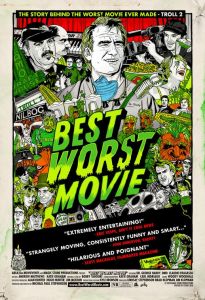 Being an ardent fan of crappy cinema, I wanted to like this documentary a lot more than I did. Best Worst Movie is a documentary exploring the cult following of Troll 2, a bizarre 1990 horror sequel (that had nothing to do with the original) universally regarded as one of the worst films of all time. It’s all about killer vegetarian goblins that turn people into plants, among other things. Michael Stephenson, a child actor who starred in Troll 2 and got a hard life lesson, directs the documentary. He tracks down other cast members and reminisces about the strange shoot in Utah and their strange Italian director. I expected more colorful anecdotes and analysis, but Best Worst Movie is too navel-gazing. It focuses on the cult movement that has embraced the film and how the actors have found some merit of appreciative fans. Clearly Stephenson is trying to fashion validation for himself and his cast mates. The main figure of focus is George Hardy, a gregarious Alabama dentist who got his first, and only, acting job with Troll 2. He clearly hungers for the spotlight but at the same time dismisses the cult fans as being too “weird.” The best moments of Best Worst Movie are when we peel away the ironic veneer and catch the glimpses of personal joy people find from Troll 2. Whether it’s the audiences in bafflement, or the actors finding a modicum of relief and appreciation, an indescribably bad movie can link people into a loving community. For my money, The Room is the better trashy midnight movie experience.
Nate’s Grade: B
Share this:

Inside Job (2010)
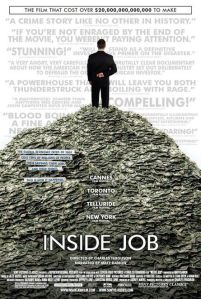
Charles Ferguson is a man I’d love to sit down and have a conversation with. The former political scientist first waded into the waters of documentary film with his brilliant Iraq War doc, 2007’s Oscar-nominated No End in Sight. He’s a filmmaker that absorbs himself in the comfort of clear logic and facts. Now he takes that same rigorous and analytical eye to the story of our generation, the worldwide financial meltdown from the fall of 2008. The global event eliminated trillions in money, millions in jobs, and still confounds thousands of us. If you don’t leave Inside Job absolutely infuriated, then you weren’t paying close enough attention.
Just like he did with No End in Sight, Ferguson lays out his case with clear-eyed precision. He doesn’t rely on ad hominem attacks, a la Michael Moore’s myopic Capitalism: A Love Story; he lets the facts do the talking, and as presented they are damning. Inside Job sounds like the title of a heist movie and that’s exactly what was propagated on the world stage. This is a wholesale plundering brought about by unchecked avarice, greed, and hubris. I’ve been waiting since the financial collapse for a filmmaker to produce an authoritative step-by-step document that could meet out deserved blame and scorn, while presenting complex mathematical calculations in layman’s terms. This is that movie. Ferguson has crafted a definitive synopsis of the 2008 global meltdown that is scarier than any horror movie Hollywood could churn out.

When you learn about the forces that led this country into economic disaster, you begin to realize that it all centers on the old Gordon Gekko pronouncement that “greed is good.” I’ve never fully understood how capitalism is somehow absolved of any sin or that free markets are the same thing as democracy. Somehow the screwy idea that business would behave if nobody were watching became an intractable ideology. The Reagan revolution of the 1980s brought with it deregulated markets and lax oversight, which has brought waves of financial scandals that have only led to bigger consequences (Savings and Loan to Enron to the 2008 collapse). With the dense derivatives market, the financial industry found new tools to manufacture money at alarming rates. Rather than betting on simple stocks, investors could now bet on anything. Derivatives helped turn the entire world into one large casino. Short-term profits became the total goal and risk became just another four-letter word. Just like the insightful 2005 doc Enron: The Smartest Guys in the Room, these events are not stories about math, they’re stories about people. You don’t have to know a CDO from a CFO. It’s the unchecked hubris of men and women, but mostly men, and the slippery slope of business when the only protectors for the consumer is getting paid by Wall Street profits.
But all those greedy bankers and CEOs were not alone. Days before the several lending firms went bust, their ratings were stuck in the AAA to AA range, the same rating as a U.S. bond, meaning non-existent risk. The ratings industry got used to big paychecks dependent upon the number of high-quality ratings they passed out. As one interview puts it, if a New York Times journalist was offered $5000 to write a positive story and zero to pen a negative one, what do you believe the outcome would be? Insurance companies, notably AIG, were gambling with all that collateralized debt, betting that it wouldn’t get paid off. This allowed companies to sell loans they knew were poor and bet against them. The systems of regulation, like the Fed and the SEC, were ridiculously negligent at best and criminally complicit at worst. Rather than investigate and prosecute, regulation officers sat on their hands, relying on an ironclad belief that the industry knew best. Congress passed a law in 2000 that prohibited government from regulating the derivatives market. Then in 2004 the regulatory bodies decided to relax requirements for capital reserves. This meant that banks could take on even more borrowed assets, leveraging greater debt (ratios of capital to borrowed capital went from 3:1 to as high as 30:1). Both of these regulatory omissions allowed Wall Street to gamble even bigger. Don’t forget that many of those high-ranking officials meant to operate as referees had been former employees of large financial firms. It all became an incestuous boys club that looked out for its own interests. Why haven’t there been any prosecutions even concerning the drugs and hookers? It seems that the only people who get prosecuted for their vices are the ones fighting for reform, like former New York governor Eliot Spitzer (he gets his own doc this fall too). The collusion among the financial sector, regulators, and legislators is staggering.

To Ferguson’s credit, he lays out a sober and exacting analysis of the mess. This cannot be dismissed as some sort of partisan hatchet job like a Michael Moore production. Like it or not, Moore has become a caricature of himself and his dubious sleight-of-hand practices hurt the merits of his message. Ferguson, on the other hand, is a reasonable fella who assembles a crack team of experts and officials, the people directly involved with the financial meltdown. Several big names like Alan Greenspan and Larry Summers declined to be interviewed, lest they have to atone for their actual culpability (Summers is getting slammed twice this fall, after his irritable appearance in The Social Network as the dean of Harvard). Ferguson serves as an intelligent inquisitor, ready and willing to challenge his subjects when they try and hide between weak rationalizations or inaccurate facts. Inside Job plays a serious subject fairly seriously. There are no easy gags or frivolous attempts at comedic relief, despite some ironic usage of pop songs. Ferguson makes use of several unsophisticated charts and graphs to help grasp the explosive rise in profits and debt. They aren’t fancy graphics, in fact most are red bar graphs you’d find in a junior high report. But Ferguson’s great asset is his collection of key participants. Inside Job isn’t much more than a talking heads piece with a smattering of visual aids and narrative elucidation. But when your subject is no less than the financial state of the world, you’ll be forgiven for keeping a professorial approach.
Ferguson is one of the first I’ve seen to shed due attention to the area of academia and its cozy relationship with the financial institutions. Many of the same names involved in the accumulated financial disaster are teaching economics at prestigious Ivy League universities. These men, the devoted disciples of deregulation, are teaching the next generation of capitalist sharks. Ferguson even examines the non-disclosure of who is paying all these business profs. A professor can have a lucrative side business when it comes to consulting, so the companies that benefit the most from deregulation are paying the men championing the ideology of free markets. Professor will write scholarly articles about the merits of various financial firms, failing to note that the firms paid them. It’s another in an endless series of maddening conflicts of interest that go unimpeded.

Inside Job ends on a somber note of resignation. As we’re informed, not one body has been brought to justice over the worldwide financial collapse or the crimes and outright fraud that got us there. In the wake of the doom and gloom, banks gobbled each other up and now Too Big to Fail has gotten even bigger. In a world where companies book potential earnings as current earnings, bet against their own stocks, and employ a phalanx of high-priced lawyers and lobbyists to resist any minute reform, whom is the American public supposed to trust? Who isn’t on the payroll? Ferguson’s lacerating documentary is the best starting point for novices to history, but even Inside Job is far from definitive. This is because the complete scope of the 2008 crises cannot be contained to a two-hour movie, even with the talents of Ferguson. As the movie comes to a close, and the audience is generally feeling numb to all this high-stakes larceny, it looks like things are depressingly settling back to the way they were. President Obama has appointed several people involved in the financial collapse to cabinet and regulatory positions. I’m sorry Mr. President, but that doesn’t count as change by the most generous definitions. The coterie of Wall Street elites feel that they are indispensable, that what they do is just too complicated for the rest of us plebeians to fathom. I don’t know about other folks, but I’m tired of the top 0.1 percent holding the rest of the nation hostage and expecting everybody else to foot the bill for their gambling losses. The narration ends with a righteous fury, declaring that some things are worth fighting no matter how hard. Inside Job is required viewing for every man, woman, child, and dog in this country. The future of the world depends upon people seeing movies like this. An informed public is the best defense against Wall Street firms and bought-and-paid-for politicians getting away with murder — again.
Nate’s Grade: A
Share this:

Casino Jack and the United States of Money (2010)
 Alex Gibney is a masterful documentary filmmaker, having crafted Enron: The Smartest Guys in the Room and the Oscar-winning Taxi to the Dark Side. His latest doc chronicling the rise and fall of corrupt lobbyist Jack Abramoff is insightful, clear-eyed, and entertaining like his other work, but something’s missing here and it’s hard to put my finger on it. Gibney’s doc lacks the fire and outrage of his previous exposes, so Casino Jack doesn’t hold your attention as strong. It focuses closely on Abramoff’s scandals and his influence peddling and gives shrift coverage to bigger issues about our government being for sale to the highest bidder. The lack of attention to a bigger picture hurts the movie’s power. But ultimately I think what makes Casino Jack lacking is that it is missing one very key participant — Abramoff. Gibney interviewed the man several times in prison but Abramoff declined to be involved after pressure from federal prosecutors. By all accounts, Abramoff is a charismatic, larger-than-life figure, whose Reagan era College Republican idealism transforms into greed and out-of-control hubris (Abramoff foolishly wrote every single thought down in e-mail). His absence is noticeable and blunts the storytelling angles the film can take. With Abramoff’s side, there could be much more insight and dirt. Casino Jack is a solid viewing but not up to snuff for Gibney. Wait for the Kevin Spacey film later this year.
Nate’s Grade: B


 nathanzoebl
You must be logged in to post a comment.