Blog Archives
Life Itself (2014)
 I would not be a film critic or even as ardent a lover of movies if it weren’t for Roger Ebert and his towering influence on generations of curious cinephiles. Every film review is likely going to touch upon their own personal relationship with Siskel and Ebert and this one will be no different (full disclosure: I contributed online to make sure this documentary would reach completion. You can find my name last in the end credits “thanks” section. The perks of being a Z-kid). When I was young, I would sneak into my parents’ room and wake them up, eager to watch not cartoons but the latest episode of Siskel and Ebert’s take on new releases. For me, Roger and Gene opened an entire new world for me, and hearing their spirited discussions over the latest Hollywood blockbuster or indie experiment would stimulate my imagination. Therefore, Life Itself, a documentary chronicling the life and death of Roger, including those difficult final months of his fight against cancer, is a tremendously emotional and personal experience for me. Even now it’s hard for me to write this review as I have a wealth of feelings churning. It’s like watching one of your heroes ride off into the sunset; eternally grateful for those years they had on Earth to inspire. It’s fitting that Roger become a part of the movies himself with a documentary that’s one of the year’s best and most poignant films.
This was never meant to be a film about Roger’s death. It was intended to be an adaptation of his 2011 memoir, the titular Life Itself. Filmmaker Steve James, best known as the director of Hoop Dreams (Roger’s #1 film for 1994), tackles the essential biography bits we’d expect tracing the cradle-to-grave approach. What makes this film more interesting is that it too follows Ebert’s own perspective he utilized in his memoir. Rather than writing from the point of view of being in the moment, Ebert acknowledges his age and looks back on the past not as it’s happening but as an older man reflecting upon his life. The thoughts are not so linear, the consideration more meditative, thoughtful, and overall thankful. This is a man looking back and taking stock of his life, grateful for the people that have elevated his experiences. The framing device of the movie happens to be Roger’s last five months of life, going in and out of the hospital and adjusting to the ever-mounting hurdles of his deteriorating health. It can be downright shocking and horrifying to watch this Ebert, his jaw hanging loose like an ill-fitting Halloween mask. Never has the man looked more vulnerable and so mortal. It’s not how you wish to remember him, and Roger is without vanity as he wants the cameras to have access to his day-to-day reality no matter the hardships. As the months pass and Roger’s communication starts fading, everyone has to come to terms with the inevitable, and the viewer is right there too, bidding goodbye with Roger’s grieving family.
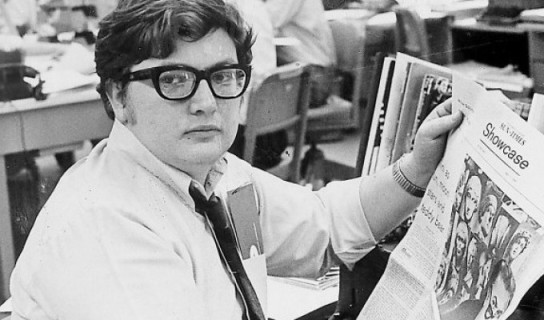 While tears will be shed, do not think of the movie as an elegiac tribute meant to fill your heart with dread for the demise of a great writer and a great man. As the title indicates, it’s a celebration of the man’s life, illuminating a figure that was much larger than his prolific publications (note: not a fat joke). Can you picture Ebert as a skirt-chasing Chicago Sun-Times reporter? How about as a guy who would get drunk and hang from the rafters, causing scenes? Many likely don’t know that Ebert has one screenwriting credit for Russ Meyer’s 1970 camp-tastic Beyond the Valley of the Dolls, a job Ebert likely took on so he could, in his words, “get laid.” There’s even a lengthy bit over their populist film critiques and whether the famous “Thumbs Up/Thumbs Down” model was helpful or harmful to film criticism. Life Itself does a fitting job tracing the roots of the man, with each chapter of his life given due development and consideration. I could have watched a four-hour documentary on the man’s life, but I’m not the general public.
The film is defined by two central relationships: Roger and Gene and Roger and his wife, Chaz. The first is the most famous. We track their initial growing pains taking the leap adapting their styles to the realm of TV. Gene was a natural, Roger less so, which only made Ebert more furious (photos of Gene “ladies man” Siskel gallivanting with Hugh Hefner are a hoot). The impact of their advocacy cannot be overstated. There are plenty of filmmakers that got their big break thanks to special consideration and publicity from these two. No matter the medium, these were the most famous critics of the twentieth century, opening up the world of movies to a new and hungry and appreciative audience. As enjoyable as it is to watch Siskel and Ebert in agreement, there was a special pleasure in watching them disagree because of the unleashed intensity. They really felt like they could convert the other person through sheer force of will. Their egos were both massive and Siskel knew exactly which buttons to push to set his cohort into aggravation. We see TV clips and unused rehearsal video and you feel like they might start a fistfight at any moment. And then that ire and ego forged into a deep admiration and love for one another, a love that Ebert reflects more tenderly of in the years since Siskel’s death in 1999. Gene didn’t want his loved ones to watch the clock, waiting for him to expire, and so he told nobody of his terminal brain tumor until the end. Roger was always wounded by this and vowed to be as open as possible if he suffered severe health setbacks.
The other relationship we get to witness come to a close right before our tear-stricken eyes. Roger met Chaz in AA, a fact she says she’s never publicly admitted before. He was over 50 when he married. He accepted her children as his own, whisking the family on faraway vacations and sharing his love of cinema with his stepchildren and grandchildren. Ebert credits Chaz with nothing less than saving his life, asserting he’d have drank himself to death without her. It’s a love story that forces us to watch the heartbreaking finale, namely Chaz coming to grips with the reality of losing her husband, of letting the love of her life go, something so profound. We’re right with her, wanting to fight on, try the next surgery, always hopeful, though in our circumstances we have the dread of foreknowledge. Then again perhaps Chaz and those close to the Eberts suspected as much as well, especially as his health faded so quickly in the spring of 2013. Just watching her talk about Roger in the past tense, you watch the ripples of pain reverberate through this woman. She’s the unexpected heart of the movie and one of many torchbearers when it comes to the legacy of Roger.
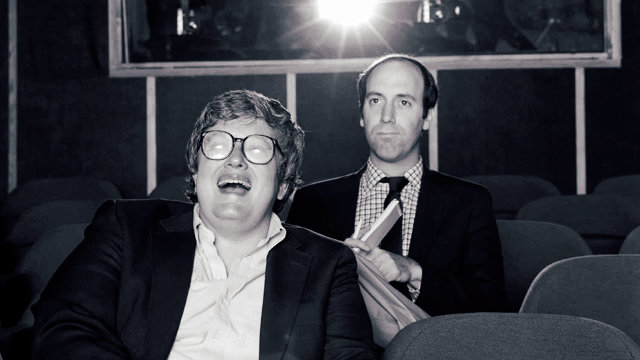 Ultimately, Life Itself is a love story. It’s a love story about two men who go from rivals to close friends. It’s a love story between a man and a woman. It’s also the love story of a man with the movies, a love that he felt eager to share with millions of his readers and television viewers, because in the end (danger: sentimentality approaching) it’s our love and passion that will ultimately outlast us all, and the people we touch are the living embodiment of our legacies. And Roger’s passing has touched many. As fans, those who grew up with him, I think we all felt like he was partly ours. Life Itself is a touching, engrossing, invigorating, and fitting tribute to a man larger than the movies.
Nate’s Grade: A
Share this:

America: Imagine the World Without Her (2014)
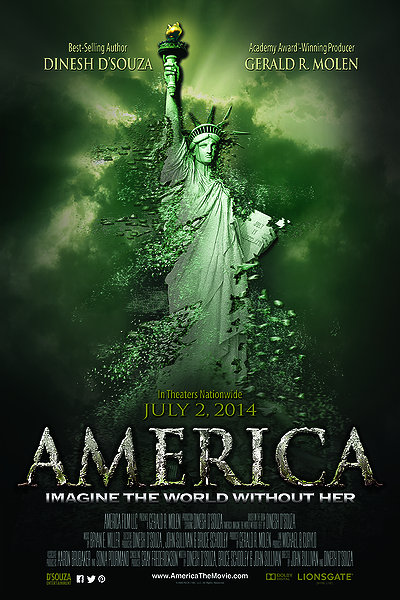 Conservative author and political speaker Dinesh D’Souza struck gold with his last documentary, 2016: Obama’s America. The 2012 film struck a chord with enough moviegoers to earn over $33 million at the box-office, and it earned my own hallowed award for Worst Film of 2012, a puerile character hit-piece that only served as agitprop. My in depth review even got picked up by other outlets and message boards and became something of an e-mail forward itself. So when D’Souza announced his follow-up, America: Imagine a World Without Her, I knew I would have plenty to write about. It’s not as overtly risible as 2016 but its true intent is possibly even more sinister. Let me assure you, dear reader, that I go into every movie to objectively critique what works, what doesn’t and why. I would welcome a conservative counterpart to Michael Moore, but Dinesh D’Souza is not that filmmaker, not by a long shot.
The film begins with an interesting “what if” scenario questioning what might have happened in history if George Washington had fallen on the battlefield and America had lost its revolution for independence. American monuments are turned to dust and ominous music pervades. However, instead of following through on this slice of alternative history, D’Souza switches gears immediately and points toward a new goal. He wants to change what he sees as a “shame America” narrative, fostered by the likes of Howard Zinn and Noam Chomsky and the “blame America first” crowd of liberal and academic nogoodniks. To do so, D’Souza seeks out to reclaim America’s past, which amounts to defending or mitigating the famous sins of America’s past. D’Souza’s demonstrably shaky logic disputing America’s past ills only takes a modicum of critical thinking skills to see it for the intellectually facile, dishonest, disingenuous, morally bankrupt rhetoric of a charlatan. Allow me to examine D’Souza’s rebuttal of the five reported thefts he examines in the film.
 1) “Theft of land from Native Americans.” This one seems pretty obvious. They were here first. American settlers, as well as other nations, came, conquered, and Manifest Destinied the continent. D’Souza tries to argue that the Native Americans themselves would engage in war and take over other tribes’ territories; therefore their original claim to the land is nil. Also, the land is only valuable because of what the new owners built on that land. I guess America’s national parks have no inherent value then. It almost ends up transforming into a rhetorical line that the Native Americans didn’t know how best to use their own land, so they didn’t deserve it. The worst part of this segment, besides breezing over the Trail of Tears and countless broken treaties, is that D’Souza has the temerity to dispute the semantics of “genocide.” See, D’Souza opines that with genocide there has to be intent to do harm, and Europeans simply bringing along deadly infections the natives had no immunity for cannot count. Never mind the whole smallpox blankets episode, America’s earliest form of biological warfare, which was intentional. D’Souza then compares the decimation of the Native Americans via disease to the Black Plague. “We don’t call that genocide,” he smugly asserts. Let me provide a more fitting analogy: if Turkey had invaded the European continent, bringing with it the Bubonic Plague, and then purposely spread it to the natives to eliminate them, while claiming the land as Turkey’s own, establishing settlements, and forcing the weakened Europeans into small unobtrusive clusters, well maybe we would accurately call that by all accounts genocide.
2) “Theft of labor of Africans.” First, re-read that sentence and really let D’Souza’s slimy word choice sink in. “Theft of labor” is what we’re calling slavery now? How about theft of life, theft of rights, theft of future, theft of family, theft of dignity, theft of their basic humanity? This rebuttal is curious because at the outset D’Souza admits, “Yes, slavery was theft.” Everything referenced after this point cannot alter this declaration, meaning the rest of this segment is all about mitigating the terror of slavery. D’Souza says the United States didn’t invent slavery, and that even Africans would enslave one another. He literally uses the “everybody else was doing it too” argument children use to get away with misdeeds. He even tries to turn it around as a positive, enthusiastically informing us that America is the only country to fight a war to end slavery and that makes us a special place. Well, that’s one way of looking at it. Another way would be to celebrate other countries that didn’t require bloody wars to come to a consensus that owning other people as property was morally repugnant. Then D’Souza flouts anomalous examples to try and muddy the disgraceful practice of slavery. There were black slave owners, yes, because these people still exist in a crooked system. What does the existence of black slave owners prove? D’Souza’s unsourced claim that there were as many black slave owners as white slave owners is so obviously dishonest that it takes your breath away. But even if it were true, which it is most assuredly not, what does it prove? Is D’Souza trying to say blacks are just as complicit in slavery? Then he adds that white indentured servants worked alongside many slaves and they had it rough too. Indentured servants were still seen as people with human rights. There is no comparison to slavery. The end.
3) “Theft of land from Mexico.” This one is given even shorter shrift, mostly boiling down to a simplistic analysis of how lousy life is in Mexico. The United States gained much of the western states after annexing them from Mexico. D’Souza reasons that after the war we had all of Mexico and we only took half, so that should be acceptable. “I wonder how many of those in Mexico wish we had kept all of their country,” he intones.
4) “Theft of independence with foreign policy.” I forget the exact wording on this one, but really it just amounts to the American wars and conflicts in the last 50 years. Tackling Vietnam, D’Souza offers a straw man that has never existed in mainstream thought: that we went to war in Vietnam to take over their land as imperialists. The war in Vietnam was a result of the domino theory in thwarting the spread of communism, not to take over Asia. On top of this, let’s ignore the Gulf of Tonkin incident that was manufactured as a rationale to escalate a war in South Vietnam. All D’Souza does is interview one P.O.W. veteran who says he went to war to spread democracy. That’s fine, but one man’s experience is anecdotal and not indicative of the whole, let alone of the military command. D’Souza then says we gave back Iraq to the Iraqis and didn’t ask for anything in return, except, you know, permanent military bases that they objected to. Wars aren’t just fought for territory, they can be fought for profit by powerful interests; just look at the military industrial complex run amok. And yet, weirdly, D’Souza never combats Noam Chomsky’s listing of all the American-assisted coups across the globe, from Iran (1953) to Chile (1973) to Brazil (1964) to Guatemala (1954) and others. In 2011, documents over the Iran coup were declassified and admitted CIA involvement as “an act of U.S. foreign policy conceived and approved by the highest levels of government.”
 5) “Theft of wealth by capitalism.” D’Souza actually comes to the defense of Wall Street, lamenting that America’s wealthy are under unfair attack from the unwashed masses. First, D’Souza conflates a critique of unregulated, Laissez-faire capitalism with capitalism itself. There are socialists and communists and others of similar ideology out there, but the mainstream left is not arguing for the wholesale destruction of the economic system of this country. A lack of oversight and unchecked greed and fraternal collusion lead to the financial meltdown of 2008, bringing the world to the brink of economic ruin because of the bad bets of Wall Street. Instead, D’Souza stages a silly example of himself running a fast food restaurant, complete with himself playing all of the workers and with a comical (?) Indian accent. He flatly contends that it costs the consumer more money to make a hamburger at home than to buy one from his restaurant, ipso facto “the American people are not being ripped off.” This is D’Souza’s insufficient summary of capitalism, ignoring the 2008 financial crises, ignoring the robber barons, ignoring strike-busting, ignoring the reasons the unions had to be formed in the first place because of dangerous, unfit working conditions that would still exist without intervention. Thomas Piketty wrote a 700-page book on the history of capitalism that has become an unexpected runaway bestseller. He studied hundreds of years of documents of all sorts and concluded that return on capital is higher than the growth rate of the economy, meaning the rich get a bigger part of the pie as time goes on. Economic inequality is hitting record rates not seen since the Great Depression, but somehow for D’Souza this is Obama’s failings and not those of the enshrined 1%, a.k.a. the “job creators.”
Each of these segments runs less than 10 minutes and D’Souza seems to brush through them with little effort as if the man can’t be bothered to knock down his own poorly reasoned straw men. Every claim that D’Souza makes is lacking in substantive facts. He has little evidence to support his slanted and mischaracterized claims. I only recall him ever once citing a source as he worked through his rebuttal of America’s past transgressions. That’s because D’Souza’s assertions don’t hold up under any trace amount of intellectual scrutiny, which is why he often defers to emotional appeals and anomalous anecdotes (Hey, a black woman became the first female millionaire selling hair products, therefore all ex-slaves could have prospered in this country if they only worked hard, never mind Jim Crow and all that). We watch re-enactments of the P.O.W. being tortured in Vietnam, and obviously our empathy goes out to this man, but that doesn’t erase a million dead Vietnamese and 55,000 fallen Americans. There is an absurd amount of historical re-enactments in America, to pad out its running time given the paucity of its argument, but mostly to fall back upon unfettered emotional appeals. D’Souza relies on the symbols of patriotism and actors portraying great figures from history, notably Abe Lincoln, to persuade his audience about the unimpeachable history of America rather than the integrity of his unsubstantiated and spurious claims.
D’Souza doesn’t even bother to cover his obvious biases with his interview subjects. He asks Michael Eric Dyson why the re-election of Obama doesn’t mean “the end of racism” (forgetting that half of the country did not vote for the man, and no, this does not mean every non-Obama vote was a racist). He props extremist Ward Churchill as the face of modern liberalism, referencing his comparison of 9/11 victims to Eichmann, and prompting him to justify dropping an atomic bomb on American soil as retribution. D’Souza then spends the duration of an interview with a Mexican-American student by asking him what the American Dream means to him. His interview subjects are also rarely identified onscreen, nor does D’Souza disclose such pertinent facts like the talking heads belonging to prominent conservative think tanks, ones that have lined his own pockets. There’s also a noticeable lack of follow-up questions. D’Souza’s interview style is also haltingly slow and modulated, as if speaking slower is the same as being reflective. But my favorite interview by far begins with these magical words: “Senator Ted Cruz, why did the Mexican-American War take place?” Oh my.
 America lacks a general workable thesis to hold its claims and counter-claims together, which is something at least 2016 had going for it. This may be because the film’s possible real intent is only revealed in the closing twenty minutes, and it amounts to a plea not elect Hilary Clinton to the White House. D’Souza’s last effort to stop Obama’s re-election didn’t work out, even though he claims his ridiculous assertions have come true (the debt hasn’t doubled since 2012 and Israel has yet to become the “United States of Islam” as well). D’Souza enjoys reasserting conservative bogeymen, which is why we get more references to Bill Ayers, Reverend Wright, and especially Saul Alinsky. Until a few years ago, I doubt anyone even knew who this man was but now D’Souza, and others, have pinned him as the ultimate political bogeyman, contorting America from beyond the grave. That’s because his disciples are living out Alinsky’s anti-capitalist dogma, chief among them Obama and Hilary Clinton. There is a goofy re-enactment where a young Clinton is introduced to Alinsky in a high school cafeteria, and the scene is played with such ominous music and lighting that it’s meant to convey a sit-down with none other than the devil (Alinksy is quoted as taking organizational tips from Lucifer, so you make the connection, audience). Hilary wrote her college thesis on the guy even. However, when she graduated she turned down working for the guy and instead became a lawyer, so… I don’t know what. Hilariously, the Alinsky re-enactments are bursting with overwrought menace including one incomprehensible scene of Alinsky sitting in his car and scoping out school children for likely nefarious purposes. “Alinksy would love Obamacare,” D’Souza notes, which makes little sense considering the ACA is all about providing new clients to private industry. As a socialist, I imagine Alsinky would have preferred the public option found in every other Western nation.
It’s these kind of broad generalizations, armchair psychological projection, and guilt-by-association pleas that typify D’Souza’s documentaries. Last time he said Obama’s “anti-colonialist” views were all because he wanted to appeal to an absent father he saw a couple of times in his life. Now D’Souza is warning us that Hilary Clinton is doing the same but trying to appease the ghost of Alinsky, a man she turned down working for way back when.
The real question is WHY would anyone even pose arguments to mitigate the horrors of slavery and genocide? What morally charitable rationale can even be created to try and argue that these horrors were not as bad as history has thoroughly documented? D’Souza says he wants to take control of the “shame America” narrative, but in doing so he’s whitewashing and mitigating this country’s mistakes just to make, what, his core audience of conservatives feel better about themselves? In this, I must quote my critical colleague Ben Bailey, himself paraphrasing a quote from Al Franken: “Franken once observed that, while liberals and conservatives both love America, they love it in different ways. Liberals love America like an adult loves their parents, seeing them not just as mom and dad but as complex individuals with strengths and flaws. Conservatives love America like a baby loves his mommy, who in the child’s eyes can do no wrong, and anyone who says so is a lying bastard.” Patriotism does not mean turning a blind eye toward your country’s mistakes, past and current, nor does it make the ignorant more patriotic than the educated that accept their country’s past, warts and all, and pledge to ensure that those same mistakes are never repeated. Now, slavery isn’t exactly likely to return any time soon to this country, but the core tenets that enshrined slavery were looking at others as subhuman, as undeserving of equality, rigging a system to deny people fair opportunities, a true lack of empathy for the hardships of others. These traits still exist today and can still be found in modern domestic and foreign legislation.
 As a movie, America: Imagine a World Without Her is also a failure. It’s a political polemic that preaches to the faithful, assuaging any feelings of guilt they may have had over the past sins of our country, and yet D’Souza doesn’t even offer a vigorous or even competent attempt to do just that. Unless you are already converted to D’Souza’s worldview, you are unlikely to be persuaded by this crackpot expose. The film lacks corroborating evidence for its outrageous claims and rebuttals, conveniently ignoring a larger context in many cases because it would disprove D’Souza’s disingenuous claims, that is, when D’Souza isn’t inadvertently disproving his own claims. History is written by the winners and Zinn wanted to show history from the point of view of the oppressed, the disadvantaged, and the lower classes that typically get lost amidst the resuscitation of kings, generals, and Great Men of Industry. D’Souza’s view seems to be, yeah history is written by the winners, so stop whining minorities and suck it up. After all, the Native Americans get to open casinos, so how bad off can they be? Here’s the thing: most people, liberals and conservative and everyone else, don’t feel guilt per se about Native American genocide or slavery, mostly because we were not alive and responsible. I feel no more guilt over these issues than I do over the other numerous acts of genocide, slavery, and general horror that populate the far-away past. But civilization is a constant work in progress and the responsibility of every citizen is to try and make this world better than it was before. The past informs our actions and our understanding of the world and us. Nobody except the fringe thinks America is a pit of unrepentant evil that has done the world nothing but harm. It has been a force for good but it’s also made mistakes, but to quote Stannis Baratheon, “The bad does not wash out the good, nor does the good wash out the bad.” We all love our country but just because some recognize certain inconvenient historical facts don’t make them any less patriotic.
With all of this exhaustively analyzed, allow me one more moment of examination, borrowing some of the armchair psychological speculation that D’Souza likes to primarily trade in. It appears that D’Souza has a healthy opinion of himself bordering on obsessive narcissism. He cheerily lets us know his past film ranks as the number two highest-grossing political documentary of all time, omitting who owns the number one spot and by a large margin. His name is listed SIX times in the opening credits, including credits for having written the source book, writing the screenplay, and “creating and narrating” the film. Much of the film involves D’Souza in his turtlenecks strolling along national monuments and looking forlorn. He is the star of the film. But there’s also the problem that D’Souza pleaded guilty to federal campaign finance fraud, posing as third parties to continue making campaign donations in 2012. D’Souza admits, “I made a mistake. No man is above the law,” but he frames his guilt as martyrdom. D’Souza makes himself seem like the “latest victim to be targeted by the White House,” instead of, you know, a man who broke the law and got caught. He argues the White House, using the NSA and the (debunked) IRS scandal, are out to silence dissent, abusing whatever measures they have at their disposal (never mind that Bush began the wiretap surveillance program). I propose that America is nothing more than a cover for D’Souza’s conviction and to save face amidst impending jail time. It’s a 90-minute excuse not for America’s misdeeds but for D’Souza’s.
Nate’s Grade: F
Share this:

West of Memphis (2012)
 The West Memphis Three murder case gained substantial notoriety thanks to an HBO documentary team, Joe Berlinger and Bruce Sinofsky, who were on hand in 1993 to document the trial in their film, Paradise Lost. Three eight-year-old boys (Michael Moore, Christopher Byers, Steven Branch) went missing one day in May in West Memphis, Arkansas. Their bodies were found the next day in a nearby creek. The boys had been hogtied and bore plenty of vicious marks, one of them having a severed penis. The horror shocked the small town and the blame landed on a trio of local teens (Jessie Miskelley, Jason Baldwin, Damien Echols). Miskelley had confessed under police interrogation and so was tried separately, but all three were found guilty. Miskelley and Baldwin were given life in jail and Echols, the supposed ringleader, a teen who disliked authority and read about magic and demons, was given the death penalty.
In the years that followed, thanks to the exposure of the Paradise Lost films (a second was released in 2000 and a third in 2011), advocates flocked to the cause, belied by the overwhelming belief that the three convicted had been unfairly railroaded. Celebrities spoke out and got involved, chief among them Lord of the Rings filmmakers Peter Jackson and Fran Walsh. They began communicating with Echols and his wife, Lori, and personally bankrolled a new team of forensic experts to amass new evidence that could allow for a potential appeal. Jackson even hired Oscar-nominated filmmaker Amy Berg (Deliver Us from Evil) to helm her own documentary, West of Memphis.
 Denied at most turns by the same flat-footed officials, the West Memphis Three struck a deal with the Arkansas attorney general in August 2011. The three would be granted freedom if they agreed to an Alford Plea, a rare legal circumstance where a defendant can plead guilty while still maintain their innocence. Eighteen years later the West Memphis Three are free but there are still many questions that need to be answered, mostly involving the conduct of officials involved in the case and the identity of the real killer.
As an ardent follower of the case, as well as the three previous documentaries by Berlinger and Sinofsky, I was concerned that West of Memphis would be more or less a rehash of what has already been covered in earlier, better movies, and to some degree it is. When you’re the fourth documentary to the table, there’s going to be some repetition. Berg’s film serves as a nice introduction to the case for newcomers and provides a diligent overview of the main facets of the murder case. There are a few finer points that Berg’s film spends more time illuminating that I think are worth mentioning. The first is extensively laying out why Miskelley’s confession was coerced. The teen, whose mental faculties are low, was locked away in police custody, without a parent or lawyer, for most of a day, with only a scant portion recorded. On these recordings, Berg clearly points out, with the assistance from some expert talking heads, how police officials guided Miskelley into the statement they wanted to hear. It’s pretty damming stuff to hear and a clear-cut case of a coerced confession.
What West of Memphis does best is narrow its focus to police and prosecutorial misconduct, picking apart the evidence that put two men away for life and one on death row. The fact that the prosecution used Damien’s own teenage poetry against him, evidence that might simultaneously doom and embarrass us all, should speak volumes. This was a case where the only thing tying the defendants to the crime scene was Miskelley’s false confession and the flimsy idea that the crime scene was a satanic ritual. Berg finds several of the prosecution witnesses who testified on the stand about how the three were involved in satanic practices, and in those new interviews each witness comes clean, admitting they were pressured by police or offered attractive deals to link the defendants to the satanic motive. Their recantations are satisfying to hear and, in journalistic lingo, a true get for Berg and her crew.
We expect our law enforcement officials to be just but mistakes will happen; however, in the event of those mistakes, we expect officials to try and correct them, to make things right. What West of Memphis shows is that the West Memphis officials dug down deeper in the face of compelling evidence, refusing to admit when they were so clearly wrong. In the years after the case and following the Berlinger and Sinofsky films, there have been renewed efforts to revisit the physical evidence of the case. To a fault, every professional profiler, including one guy who was there at the founding of the FBI, concluded that the crime had nothing to do with Satanism or the occult. They also concluded that most of the wounds, argued by prosecutors to be responsible by a serrated knife found in a lake behind Baldwin’s family mobile home (a knife the prosecution expressly knew Baldwin’s mother admitted to hurling in that lake a year prior to the case), were in fact made post-mortem by local scavenging animals, mainly large turtles with snapping jaws. There’s a reason that the wounds aren’t bloodier. It’s because the victims were already dead.
 But the most enlightening piece of evidence is what was found thanks to DNA, namely nothing. On not one single piece of evidence or anything relating to the victims was one scrap of DNA linked to Baldwin, Misskelley, or Echols. Seems rather open and shut, doesn’t it? Except Judge David Burnett, the same judge who presided over the original case, dismissed the reams of new physical evidence and rejected the motion for an appeal. It got to the point where, at the Arkansas Supreme Court, the state was arguing that the only new evidence that should be considered when granting appeals is evidence that points to guilt. The state argued, to the disbelief of the court justices, that new evidence that could overturn (wrongful) convictions should be disallowed. Fortunately, the Arkansas Supreme Court rejected this motion unanimously. It’s quite clear that law enforcement officials sought to save face rather than enact justice.
Another aspect that Berg’s film does better is illuminating another suspect the police have ignored for 18 years, Terry Hobbs, stepfather to Steven Branch. The movie devotes a solid 45 minutes on the subject, painting a convincing portrait of a suspect with long ties to abuse, anger, lies, and manipulation. A hair of Hobbs, matching his DNA exactly, was found tied into the knot of one of the bound boys. Weirdly enough, Terry Hobbs sued Dixie Chicks lead singer Natalie Maines for defamation, which fortuitously provided an opportunity to question Hobbs with the full penalty of the law behind them. Under oath, his story crumbles and his alibi at the time proves to have a sizable a gap, a period where the boys were killed according to medical reports.
Clearly Terry Hobbs is a compelling suspect though I wish the movie didn’t feel the need to resort to superficial assertions concerning how he “behaves guilty,” like his lack of emotion concerned the case. Questioning why he waited over two hours to tell his wife that their son was missing is a fair line of inquiry. Questioning his history of spousal abuse and violent run-ins is fair. Questioning why he isn’t more outwardly bereaved is not. It’s the same prejudicial judgments made against Damien when he was being tried, the idea that he just wasn’t acting like an innocent man (to be fair, Damien was also a moody teen at the time). Berlinger and Sinofsky are guilty of this as well, devoting a disproportionate amount of Paradise Lost 2 to pointing a suspicious eye toward John Mark Byers, stepfather of Christopher Byers, and a theatrical, larger-than-life figure. At least with Paradise Lost 3, the filmmakers make amends, and there’s a nice scene where Byers apologizes to Echols. This guilt-by-superficial-judgment is a dubious line of accusation that Berg and her film should rise above (just the facts, ma’am).
From there, though, I started feeling like West of Memphis is best served as a complimentary film to be paired with the altogether superior Paradise Lost documentaries. There is something to be said for Berlinger and Sinofsky being on the ground from the get-go, having unprecedented access to the victims’ families, the families of the accused, the attorneys on both sides, and the accused themselves. Naturally over three films you get a much stronger sense of the nuances of the case, but Berlinger and Sinofsky also gave you a much stronger sense of the community and the full context of the crimes. I was bothered at how often Berg’s film eschews direct on-camera interviews with Miskelley and Baldwin. Late in the film, as the movie explores Baldwin’s hesitancy to admit guilt for a chance at freedom, a friend recounts her phone conversations with Baldwin on the tricky subject. Why isn’t Baldwin himself on camera talking about this rather than a friend relaying her conversations with the man? Throughout the film, when it concerns the accused, the movie feels oddly removed from the source (Damien and his wife are credited as producers for the doc). It’s got plenty of talking heads and famous celebrities on camera but I’d rather hear from those directly involved. It’s just another reminder of the access and relationships that were formed through the Paradise Lost films. You’ll get a good overview of the fascinating and horrifying case with this movie, but to get a better understanding of the people involved, reference the meatier Berlinger and Sinofsky films.
 By the end, even after 18 years in prison, it’s remarkable and inspiring how free of bitterness the three men are. They still have to live with the guilty verdicts but they are free, and rather than dwell on what was taken from them, the men are thankful for their freedoms and thankful for the diligence of the people who believed in their innocence, who fought long and hard so the day would come when they three of them would be set free. Berg’s film even dedicates its last moments to those advocates and their efforts, saying that their involvement made all the difference. This is an example where a movie literally saved somebody’s life. Without the exposure of the Paradise Lost, it’s very likely Echols would have remained on death row and been executed. On a personal note, this was the final moment that got me to cry (there were a couple others that made me teary). It’s because of the shared happiness and accomplishments of helping, in whatever small way, three innocent men get their long overdue freedom. I won’t overstate my involvement, but I was there, writing letters, sending in donations, advocating, since 1999. I have never been happier to retire a T-shirt than with my “Free the West Memphis Three” shirt (I wore it one last time to watch this movie). The forward-thinking, gracious attitudes of Baldwin, Miskelley, and Echols are inspiring, and it even inspired me to seize the moment myself rather than remain passive in a personal relationship.
Coming in after a trilogy of other extensive documentaries, West of Memphis can’t help but feel a little late to the party. Its strengths lie in deconstructing the prosecution’s case and assembling new interviews where key witnesses have an opportunity to come clean and recant. Otherwise, it’s like listening to another singer perform a song you’re already familiar with. The case is so deeply troubling and morbidly fascinating that there’s definitely room for four movies on the topic and then some; Atom Egoyan has filmed a movie based upon journalist Mara Leveritt’s book on the case, Devil’s Knot (starring Reese Witherspoon and Colin Firth too). It’s easy to become immersed in this case; I know I have over the years. It all came down to a police force pressured to find a killer and three teens that were different in a small town. There are many tragedies tied to this case. The three boys who were gruesomely murdered. The three men who were wrongly convicted and lost 18 years of their lives. And since the West Memphis Three plead guilty, it means that the police can officially close the case, allowing the real killer to continue to walk free and unpunished. That should trouble every single person. West of Memphis is a gripping and thought-provoking documentary, though I think it’s best viewed as a supplement or introduction to the superior Berlinger and Sinofsky films.
Nate’s Grade: B+
Share this:

2016: Obama’s America (2012)
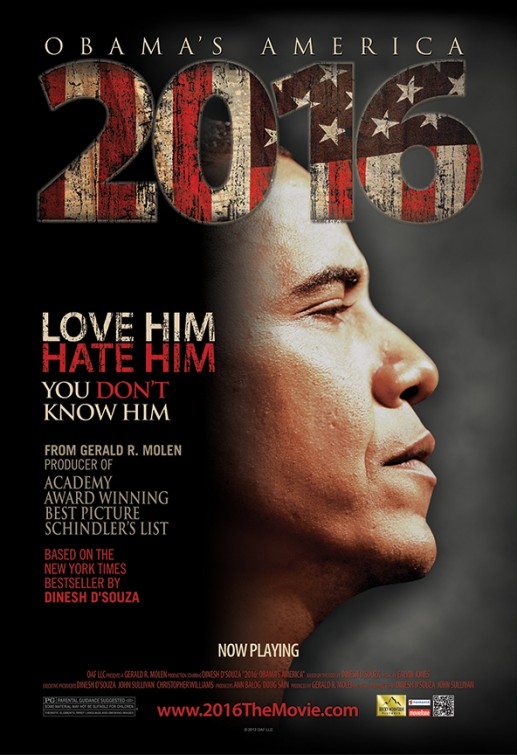 Dinesh D’Souza, noted conservative pundit and author, has risen to mainstream attention thanks to his documentary 2016: Obama’s America, a little movie making some big noise at the box-office. Co-written and directed by John Sullivan (Ben Stein’s Expelled), the film rationalizes that the American people don’t really know the true Barack Obama. D’Souza uses Obama’s own words from his best-selling memoir Dreams From My Father to try and decipher who the president is deep down, and D’Souza theorizes that the most powerful man in the world is really just trying to appeal to an absentee father. D’Souza visits the globe and promises to shed light on the “real” Obama, or, at least, the “real” Obama that fits into the narrative of a narrow political polemic.
After viewing 2016: Obama’s America, I am at a loss for words. This won’t last long, trust me.
This pseudo-documentary is such an intellectually dishonest, disingenuous, feeble-minded character attack, relying on heavy amounts of guilt-by-association, armchair psychology, factual whitewashing, leaps in logic, and ugly race-baited visual associations to remind its public that Obama is an “other.” I tried to be as objective as possible assessing D’Souza’s takedown on America’s first black president. I tried to analyze his rhetoric, his process of laying the case for his outlandish, paranoid claims. I tried to remove all personal politics from my assessment, and I still will attempt to keep them at bay, to simply review this as a “film.” What Obama’s America truly aspires to be is the evidence that your crackpot uncle cites as proof that his dismissive opinion of the president, that he’s not to be trusted, that he’s trying to destroy the country from the inside out, is correct. In this fashion, D’Souza is trying to give cover for the crackpots.
Let’s start with D’Souza’s fundamental thesis that supposes that Obama’s entire motivation is to live out the ideals of his father. He’s trying to impress his absent father. I cannot buy this broad generalization, and D’Souza keeps returning to it like he’s the only one who can see this obvious conclusion. I find it hard to believe that the father Obama saw once in his life is really the guiding force of his worldviews. Therefore, the more information D’Souza spills about Obama’s father the more he’s repeating the same conjecture without making any concrete connection. He interviews friends of Barack Sr. in Kenya and asks for their views of President Obama, a man they’ve never known. There is a litany of interview subjects with tenuous connection to Obama, most are always a step or two or more removed from the man himself. We get his mother’s college professor and Obama’s half-brother living in Kenya. That’s about as close as the movie gets. Often the interview subjects will disintegrate into weak hearsay (“I interviewed a guy who knew his father, so I guess I have some credibility.”). I also found it odd how when his interview subjects refer to his radical father, they keep repeating the name “Barack,” and not specifying senior or father. It happens so often that the intended association is quite transparent. Here’s a clue you’re dealing with a crank: D’Souza tries to make hay out of the fact that Obama’s book is titled “Dreams FROM My Father” and not “Dreams OF My Father.” Rarely has one preposition been given such (half-assed) psychological insight. The fact that the movie purports to get at the “real Obama,” and this is the scraps it offers, robs the movie of any desperately desired insight or credibility.
 The movie, especially the first 20 minutes, is also the story of D’Souza and his personal journey of why he feels America is the greatest land of them all. Just because the man was born the same year as Obama, got married the same year, and comes from a foreign country (though Obama is an American citizen who only spent four years abroad, but I digress), doesn’t mean somehow D’Souza has been given such psychic insight into the mind of Obama. Like Michael Moore, D’Souza inserts himself and his life story into his narrative when it’s not essential.
This would also work as an excellent case study in psychological projection. Since we don’t get people close to Obama, we get lots and lots of conjecture and people offering their “esteemed” analysis of the man. These so-called experts do what the man’s worst critics do, which is ignore the reality of Obama and project their radical interpretation of the man. An even-keeled centrist is a boring narrative, so now he becomes a Marxist, a socialist, a leftist radical, an enemy of the American way of life. This just doesn’t jibe with a pesky thing known as the facts. If Obama is really the socialist he’s labeled, then he’s a horrible socialist. No public option? Recycling the Republican health care plan from the 1990s, including the mandate? Relaxing more gun control laws than Bush did in his entire presidency? Stepping up record numbers of drone attacks in Afghanistan and Pakistan? Does that sound like a guy who’s “weirdly sympathetic to jihadists”?
D’Souza and his interview subjects even take the step of saying that Obama’s even-keeled style is really just a front, that deep down he’s a raging black man just like failed presidential candidates Jesse Jackson and Al Sharpton. The reason we don’t see this font of anger is because, and here’s the ingenious part, Obama knows how to manipulate us all! He’s secretly hiding his surplus of radical anger through emotional pragmatism. Not only that, Obama is manipulating race relations to lull us into complacency, because he knows white America wants to be assuaged of feeling racist, so we’ll appreciate and advance an African-American man of merit. Excuse me? Does that make sense to anyone, that instead of just being, you know, a pragmatist, Obama is secretly exploiting white guilt to advance, because otherwise how would this man become president unless we were all duped? None of that holds together. D’Souza’s 2010 book was called The Roots of Obama’s Rage (he also penned the 1995 book The End of Racism, so I guess he was just a little early on that one). The fact that two years, or less, into his presidency, D’Souza is ready to lambaste the man as “rageful” makes me think that D’Souza just cannot perceive objective reality like the rest of us.
D’Souza and company also take any opportunity to de-legitimize the man’s accomplishments. Obama didn’t win the presidency because he was an eloquent, charismatic, intelligent, and compelling political figure, not to mention that he got ten million more votes than John McCain. Could Obama have achieved the historic because of his accomplishments? According to this movie, Obama won the 2008 presidential election because of one thing: he was black. You see foolish reader, America as a nation wanted to assuage any collective white guilt over the transgressions of our ancestors, so we all (myself included) voted for the man as a declarative statement once and for all that we are not racist. Maybe a handful of people were motivated by such a ludicrous notion, but all 69.5 million Obama voters? This is not the film’s only simplistic generalization. We also have a psychological expert on what an absentee father does to a child. This is not a unique situation in our culture, nor is it one that prescribes a catchall response. Just because one person grows up without a father does not mean they will rigidly follow the same path in life; there are too many variables to prescribe one fate.
 The most telling moment occurs when D’Souza visits Kenya to trace Obama’s father’s life. He interviews the president’s half-brother and tries to needle him that his distant, famous relative is callous. “Why hasn’t he helped you out here?” D’Souza presses. “He has a family of his own. I can take care of myself,” the half-brother reasons, adding, “He’s got other issues to take care of.” This is the only member of Obama’s actual extended family that D’Souza manages to snag an interview with, and he shuts down his line of inquiry pretty succinctly. Later, the man gives some rather hostile views of Israel, which is meant to signal that any possible points he made should be invalidated.
Then there’s just the disingenuous and petty digs that omit key clarifying facts. D’Souza keeps railing against Obama as an anti-colonialist. First off, who in this day and age is going to champion colonialism, a system where the strong take from the weak? And why is colonialism even a relevant prism for the twenty-first century? Again, D’Souza offers little evidence to tie his theories to the man he’s critiquing. One of his key pieces of evidence is that Obama returned a bust of Winston Churchill back to England. For D’Souza, this is a sign of his distaste for Churchill as a colonialist. However, the facts are that the bust was on loan and scheduled to return to England anyway, before Obama took office, and there’s another bust of Churchill that remains in the president’s private offices. What an inconvenience the actual facts make. I’d like to share my friend and PSP colleague Ben Bailey’s thoughts on this specific matter:
“Little known fact I just learn from the Obama 2016 documentary: The bust of Winston Churchill that used to be kept in the White House was actually a magical artifact that protected this country from socialism as long as it was in America. Naturally, the Anti-Colonialist Obama’s first action upon taking office was to send that shit back. The other bust of Churchill that still resides in the White House does not have any magical powers, so it was kept.”
D’Souza also hammers home the notion that Obama opposes the British rule of the Falkland Islands, a tiny group of islands off Argentina’s coast. Another casual fact-checking venture proves this is false. The U.S. refused to endorse a declaration of Argentina’s claim of ownership. And these are just the petty examples of D’Souza’s argument approaching snide, dickish territory.
There are also the demonstrably false assertions, like Obama’s desire to destroy America’s superpower standing. D’Souza likes to obfuscate the eight years of Bush, speeding over him quickly in a timeline, lumping the national debt explosion under “Bush and Obama.” Conservative pundits like to lambaste the president for the dour economy, which has improved over the past four years, but they also conveniently forget the mess the man inherited. To ignore eight years of policies that helped lead to near financial ruin, two wars that Bush also left off budgets and Obama did not, among other things, is to remove all context. It’s like setting your house on fire and then blaming the next guy for trying to put it out: “Why haven’t you fixed everything yet, pal?” Record debt and financial ruination did not suddenly appear one day in January 2009 when a Democrat took office, despite what some choose to believe. Forgetting the eight tumultuous years of Bush, and their far-reaching complications, is a disservice to history and an ignorant understanding of how we got where we are now.
 Then there’s D’Souza’s dangerous assertion that Obama wants to weaken this country by cutting defense spending and our number of nuclear warheads. Anyone that talks about seriously reducing debt and the deficit and doesn’t offer slashing defense spending, a huge part of the pie, is simply not committed to their goal. Like not one dollar of defense spending is wasteful, and any cuts would endanger the security of American life? We’re drawing down two wars; do we need to keep spending like they’re still active? Also, Obama wants to reduce the world’s nuclear arms, and what’s so wrong with that? How many warheads do you need? Are 1,500 warheads not enough to blow up the world ten times over? The notion that any reduction in arms or spending accompanies “weakness” is fanciful. Obama doesn’t want to weaken this country by reducing America’s nuclear stockpile while the world continues to wield these weapons. He wants to reduce all the world’s nuclear arms to zero, an ambition D’Souza callously dismisses as fantasy. You know who also wanted to reduce nuclear weapons to zero? Ronald Reagan, D’Souza’s hero. As per his 1984 speech: “My dream is to see the day when nuclear weapons will be banished from the face of the Earth.” Even Superman was for limiting nuclear arms!
Now, as a piece of pure agitprop, Obama’s America suffers as well. D’Souza is no conservative alternative to Michael Moore, an expert at crafting a cohesive message with needlessly duplicitous measures. There is no subtext here; it’s all text. There are literally slasher movie violin shrieks on the soundtrack when D’Souza and an interview subject discuss the debt under Obama. There’s the image of thorn-covered vines covering the Middle East, threatening Israel to become the “United States of Islam.” There is no connecting of the dots, there’s only wide conjecture and baseless fear mongering. What this movie becomes is one long string of codes and buzzwords and dog whistles, meant to elicit a certain response from its likely audience. How many times does the phrase “Third World” need to be repeated? D’Souza even tries to turn Hawaii as a stalwart of radicalism with ONE interview from a guy who makes unsubstantiated claims. D’Souza also reminds the audience, as a wink to the birthers out there, that Obama’s birth was reported in two Hawaiian newspapers. What other purpose is there to mention this ordinary fact other than to appeal to the birthers in a coded manner? There’s a lot of juxtaposition between foreign cultures, Kenya, Indonesia, but what about the fact that Obama spent a far majority of his life in the United States? The man spent four years in Indonesia, and D’Souza makes it sound like this was the central formation of the man’s worldviews, not as he grew into maturity, went to college, and practiced law. Surely Obama became the man he was when he was seven years old, just like the rest of us.
D’Souza collects a conservative rogue’s gallery of people who must have had tantamount influence on Obama, including old targets like Bill Ayers and Rev. Wright. This is a continuation of guilt by association, a common tactic in 2008. Obama’s half-brother in Kenya talks about the West’s need to “tame Israel,” so D’Souza relies on us to make the connection just like with his father. If Obama’s family thinks this way, surely the son they have seen so rarely must be in lockstep? Because nobody ever differed in political views from his or her family.
 2016: Obama’s America, which hilariously predicts the end of the American empire circa 2016 (I guess a Republican president won’t be able to fix things), is a documentary that will convert no one. It’s constructed entirely to reinforce the alarmist notions of the president’s most fringe detractors. D’Souza doesn’t deal with facts because they get in the way of his exaggerated narrative of a fictional Obama, a man who is destroying our country in a quest to prove himself to his absentee ghost of a father. There’s plenty of logical inconsistencies, conjecture, and psychological projection and little evidence besides the expert opinions of people who knew a guy who knew a guy who knew Obama Sr. There’s plenty of unintentional comedy to be had, however, like a ludicrous racism-is-dead visual reenactment where a black man is upset because people at a bar are purposely giving him the cold shoulder (racists!). A minute later, they come out with a birthday cake and everyone in the bar, including the tattooed biker dude, erupts in applause for the heralded black man (see how wrong you were, world?). The basic assertion that Obama’s presidency is his attempt to live out his father’s ideals doesn’t stand up to scrutiny. It marginalizes a complex, educated man, saying he’s just a daddy’s boy, just like the film marginalizes the president’s historic election by saying it was simply an outpouring of white guilt (what about non-white people?).
I repeat: this pseudo-documentary is such an intellectually dishonest, disingenuous, feeble-minded character attack. It’s slimy, snide, petty, and wallows in conjecture and fear mongering. When the denizens in my theater applauded by film’s end, I felt a great sadness wash over me. If these people thought this appalling film was effective, was compelling, was informative, and was accurate, then I fear what prism these people choose to view the world through. Because 2016: Obama’s America isn’t just a horrid example of propaganda, it’s also the worst movie of the year, bar none.
Nate’s Grade: F
Share this:

The Invisible War (2012)
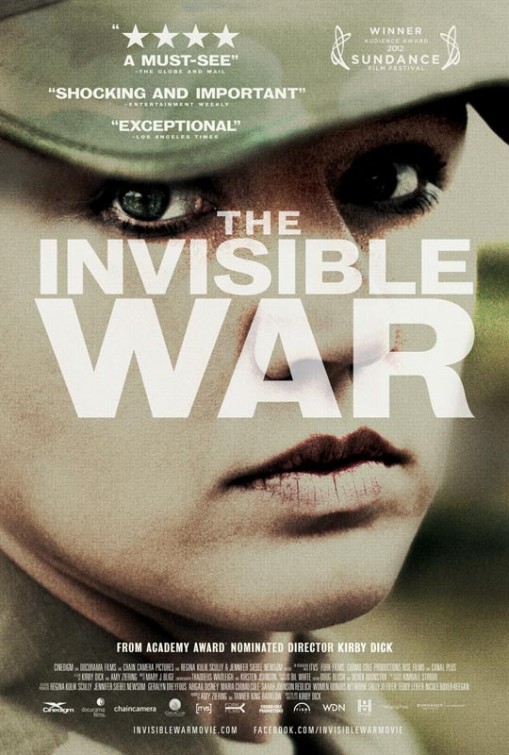 Kirby Dick is a documentary filmmaker known for picking fights with powerful institutions that operate in secrecy. In the Oscar-nominated Twist of Faith, he scrutinized the abuses of the Catholic Church covering up for sexual predators. In 2006’s This Film is Not Yet Rated, he hunted down the then-unknown members of the MPAA ratings board and delivered an overwhelming critique of their ratings hypocrisies. With The Invisible War, Dick has taken on a subject that’s even more powerful. The Invisible War, which won some awards at the Sundance film festival, examines the rampant numbers of sexual assaults and rape within the military. Through extensive, emotionally draining interviews and enraging statistics, Dick shows that most of the victims, when courageous enough to report their abuse, are met with skepticism, contempt, and injustice. One interview subject says that being raped isn’t what makes her angry the most: “It’s the commanders that were complicit in covering up everything that happened.” This is a shocking, sobering, and eye-opening documentary that deserves to be seen by every American. You owe it to the brave men and women who serve this country, to see this movie. The ugly truth needs to come out and be finally dealt with.
The upsetting statistics of sexual abuse within the military come from the Department of Defense, not an advocacy group, but our own government. Here are some of the most devastating stats:
-20 percent of all women in the military have been sexually assaulted and/or raped while serving.
-Women are twice as likely to be raped in the military rather than outside it.
-Military sexual assault/rape victims have a higher rate of PTSD than soldiers who have fought in combat.
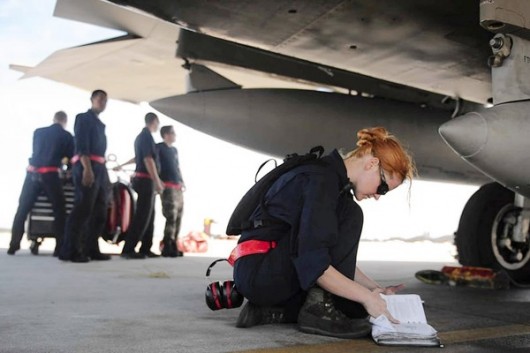 This is a profoundly revolting, morally repugnant, and infuriating story presented with damning testimonials clear-eyed logic. When I left the theater, I was radiating unquenchable fury. You could have harnessed my rage as an alternative resource. A lot of people blithely say they support the troops but we as a nation are letting these brave men and women down. The system is letting these people down, protecting rapists, training them to be better rapists, and then setting them loose upon the civilian population to continue their heinous crimes (it’s estimated the average sexual predator commits 300 acts in his or her lifetime). Listening to these heartbreaking stories can be grueling, but it is vital to listen. The women speak with such candor and bravery, befitting those ready to lay down their lives out of service for this country. But lest you believe this is merely a “women’s issue,” the film has a few interviews with male victims as well. With men outnumbering women six to one in the military, men are the majority of the victims of sexual abuse, a fact I doubt many would have known. As the experts attest, for an organization that rewards machismo, the shame for men can be compounded by the rampant homophobia within the American military culture.
It’s sadly understandable that so many of the interview subjects contemplated or attempted suicide. “Suicide or AWOL, those are your only two real options,” a military investigator laments. According to TIME’s investigative report, one Iraq and/or Afghanistan veteran commits suicide every day in America. Now remember that stat above concerning PTSD, and think about what the suicide rate must be like for victims of sexual abuse. One military man, husband to a rape victim, breaks down in sobs recounting his phone call for help while he tried to stop his wife from taking her own life. Watching proud, grown men break down into tears when they try and make sense of their institution harming their wives or daughters, it’s heartbreaking all its own. These veterans would not advise any woman to consider a career in the military, not when this is the sorry state of justice.
These victims were often handled with apathetic, callous, or downright hostile behavior, often being blamed for being attacked. These victims risked their careers to report their abuses, expecting some semblance of justice, and many times they were simply ignored or punished for “making waves.” One interview subject talks about how her commanding officer related that he had heard about three rape accusations that week and incredulously asked if the women were all in cahoots. One woman was raped and then charged with adultery; she wasn’t married but her rapist was, though he was never brought up on charges. Dick’s documentary lays a clear argument that giving the commanding officers, people often without any legal training whatsoever, the power to prosecute cases leads to plenty of ignored abuses. In 2010, the military reported 3,158 reports of sexual abuse (remember that 80 percent of cases generally go unreported), but only one-sixth of those cases lead to a court martial and only 175 of the assailants served jail time. And when they do serve jail time, it’s often knocked down to mere weeks. That way, the convicted serviceman doesn’t get charged with a felony. This also means when they leave the military, the convicted sexual offender does not have to register with a national sex offender database. When investigations do arise, they are routinely stonewalled.
 What emerges from this inflammatory documentary is that the command’s response wasn’t to protect the victims but to protect the accused, time and again. These commanders are supposed to be objective and impartial arbitrators, but this is hardly the case. It’s all about saving face, and a commander looks bad when he has a rapist in his unit, so rather than expel and punish the rapist, the military often drops the case and punishes the victim. Sometimes the commanding officer the victims are supposed to report the abuse to was in fact the perpetrator. In those instances, the victims have no possible path to justice. Major General Mary Kay Kellogg, Director of the Sexual Assault Prevention and Response Office (DOSAPRO), said victims could appeal to the Defense Department’s Attorney General, hence going over their commander’s head. Except that of the almost 3,000 cases sent to the DOD AG, not a single case was ever prosecuted. Kellogg also absurdly suggests that victims petition their Congressman. Just imagine a civilian being raped and told, “Better ask your Congressman if you want justice.”
The response to the systemic abuses has been ineffectual. The military response was to raise awareness, not sift out rapists from the ranks and protect their own soldiers from sexual predators. The ad campaign to raise awareness is jaw-dropping, with slogans like, “Wait til she’s sober,” and a horrendously ear-splitting rap song about sexual assault prevention. It’s so bad you can almost feel the seething resentment of the military. There’s also an informative video with a dramatization of a woman, fleeing helplessly after a man tries to touch her (the fact that this dramatization makes the woman look silly is intentional, me thinks). This woman runs into another serviceman who admonishes her, “Where’s your buddy?” The implication is that women should know that they can be raped at any time unless accompanied by a buddy. Does this not imply that every man in the military is capable of rape at the drop of a hat? And what if that buddy ends up being your rapist? The military builds a greater sense of camaraderie, and the men and women in uniform feel like a family. As one interview subject notes, when one soldier rapes another, it is akin to a crime of incest, a betrayal of that family. One victim was told she brought on the sexual harassment because of what she was wearing… which just happened to be her military uniform.
Dick’s film is obviously advocating a very specific side, but who cares about the idea of presenting balance given the subject? The Department of Defense spokespersons and their rote, officious responses are edited for some major points of baffled, incredulous laughter, as we contrast their company line with the testimonials of the men and women they failed to protect. Again, I return to the notion that not every story has two sides. What exactly is the other side in this epidemic of abuses? What possibly could the merits of the other side be, the status quo? This is not just some anti-military screed. In fact, many of the participants speak so highly of the ideals of the military, the duty to serve, and their genuine feelings of belonging to these hallowed institutions. This makes their disillusionment all the more distressing. Almost every interview subject has a military background, some discharged and some retired, and the movie presents its claims with clear, level evidence. The testimonials are so damming, the abuses so clearly documented, the obfuscation from justice so repeatedly maintained, that I cannot even fathom a second side to this story. When it comes to sexual assault, there is only one side to this issue.
 Dick also doesn’t overplay the obvious emotional appeals in the film. There is plenty, but he doesn’t sensationalize the drama or amplify the emotions in a self-serving manner. Instead, the film looks to clearly examine a systematic problem. Rather than deal only with potent outrage, Dick’s film is also a call to action with some strong ideas on how to better protect the victims of sexual abuses. Set up an independent system of justice outside of the commanders’ control, and work on preventing rapists from joining the military rather than cutting down the possibilities of how women can be raped. How about we punish the guilty party?
Last year, a group of veterans who had been sexually abused, initiated a class-action lawsuit against the military. This suit was dismissed by the court because, in their words, rape was an “occupational hazard of military service.” Reread that sentence again. Let it sink in. Now ask yourself is that at all acceptable given the values we profess for our country? The culture within the military is simply that rape and sexual abuses are just not that big of a deal (a Congresswoman admits that the Defense AG told her they have “other, higher priorities” to worry about), and so it all continues. The implication is that for the military to function, you’re going to have to excuse some excess, that excess being an estimated 30,000 sexual assaults a year. I’d like the military brass to explain to me what number would be unacceptable. How prevalent do these abuses need to be before proper action is taken, and not some facile PR, face-saving empty gesture, but something real? To me, one rape is one too many.
Dick’s excoriating advocacy documentary is powerful, furious, but sensitive to the victims and their horrifying ordeals. It declares that we can and should do better. In April, Secretary of Defense Leon Panetta watched The Invisible War and two days later made some changes. He took the decision to prosecute away from the commanders. It’s a start, but there’s a long way to go to fixing the military’s patronizing view of women. The movie opens with a series of advertisements targeted at women through the years, and the treatment is astoundingly patronizing and the film’s only spot of bleak humor. At one point, one of the victims asks if she and her fellow victims hypothetically deserve purple hearts for being wounded in battle too. “We’re never going to get anything,” another replies. These victims deserve recognition and justice, which has long been denied them. You won’t see a more challenging, infuriating, and compelling documentary of this year. It’s hard to watch at many points, and I cried at five separate occasions, but this is a movie that needs to be watched. I invite all readers to visit the Not Invisible site and consider joining the advocacy of this noble cause. You say you support the troops? Prove it.
Nate’s Grade: A
Share this:

The Queen of Versailles (2012)
 Meet the Siegels, the subjects of a Sundance-winning documentary, The Queen of Versailles. David is a real estate magnate in his 60s. Jackie is his 40-something wife, a former model, and together they have eight children. It would be an understatement to call the Siegels rich. These people are stupid rich. These are people that have so much money they don’t know what to do with it, which is why David and Jackie set out to build the biggest home in the nation. After the subprime mortgage flameout of 2008, the Siegels took a major hit in their resources. But not everyone sees worldwide economic disaster as a wake-up call. Some just keep on shopping.
The Queen of Versailles is one captivating clinical study in overreaching. In the wake of the financial collapse, politicians were eager to lambaste the poor who bought mortgages they couldn’t afford (the better to shield blame from their friends in the banking cabal). Let this film show you that even the super rich can have trouble living within their (enormous) means. I won’t lie; part of the appeal of this documentary is the continual shock of the wasteful extravagance the Siegel clan called normal. How opulent was their lifestyle? Well their 26,000-square foot home only had 17 bathrooms, so you can see why the Siegels would feel the need to build the biggest home in the nation. This 90,000-square foot fortress was modeled after the actual French palace in Versailles, so you know, it’s going to be modest. It was designed to have 30 bathrooms, 10 kitchens, a bowling alley, an ice-skating rink, and two movie theaters (for counter programming?). The large stain glass window itself cost $250,000. The total cost of the project: more or less $100 million. I repeatedly laughed to myself in disbelief at the untamed lavishness on display. I confess it’s hard for me to put myself into this vapid mindset. I just see all hat money and think of all the better things it could have been spent on. How many children could be vaccinated with $100 million? How many people could have been bought out of slavery with that money? How many low-income students could have afforded college? The kicker, what really gets my ire, is that is was all unnecessary. The Siegel family already lived in a giant mansion. Did they have to live in a giant-er mansion? When is enough just enough?
 By the end of the movie you won’t know whether to scorn the Siegels or feel sorry for them. I’m at a loss myself. There’s a certain level of schadenfreude watching a riches-to-rags story, watching the wealthiest among us find their world of easy money come crumbling down. But then you start thinking what these people are going to do now without the luxury of wealth. The Siegel children are horrified when at one point dad declares they will likely have to go to college and, gasp, earn their own living. And if these kids have to fend for themselves, it doesn’t take a genius to get a sense of what the future holds. At one point, the adopted niece discovers her pet lizard is dead. Jackie harangues her about not taking care of it. “No one takes me to the pet store!” the niece declares. “But why didn’t you at least give him water?” Jackie reasonably asks. The niece responds dead-serious: “That wouldn’t have made a difference.” And these people are going to have to fend for themselves! The horror that waits. The entire family has been wrapped up in a cocoon of wealth, insulated from the real world, and now has no real sense of how to navigate this new, blunt reality.
Adding to the sadness is the dawning realization that David Siegel cannot stand his wife. Jackie is wife number three, and a former pageant winner/model, so we all know what stood out to the older businessman. Even his kids know. Late in the film, when the weight of creditors bears down on him, David sequesters himself in his private room, shows no interest in his wife or his children, and confides to his dog that the two of them could just run away together. With the comforts of wealth stripped away, and Jackie reaching, gasp, middle age, it becomes readily apparent that David’s waning affection is not going to reverse.
But the movie belongs to Jackie, the titular queen, and she is easily the most fascinating figure in the film. It’s easy to dismiss the bleach-blonde woman with huge fake breasts and a shiny, fake life of glamor. Is she a ditz? She got a degree in computer engineering. Impressive. Is she a gold digger? She cannot help herself when it comes to buying, whether it’s at Southerby’s or Wal-Mart. Is she even a good mother? She does admit that she would not have had nearly as many children if it weren’t for the ever-present nannies. What I saw was a woman who knew she could taste the good life and then became afraid of being kicked to the curb. David is happy to fund her personal projects and let her splurge on posh buys, but for how long? Her body, impressive though top-heavy, is aging, and her model looks are naturally fading into a comfortable middle age. Such is life. However, you can tell that Jackie is terrified. Mountains of money acted like a buffer between her and her husband. That’s gone now. He keeps joking that when Jackie gets old he’s going to dump her for two twenty-year-olds. Even when the family is downsizing, Jackie makes sure to fit in her beauty stops (botox, tanning, etc.). Some might charge the woman with being toxically narcissistic, but I think that’s too simple. Her looks are her meal ticket and now they are betraying her. She knows the type of man she married, and they both seem to be failing to live up to expectations. Now that the shiny distractions are removed, they have to live with one another as-is, and as-is doesn’t really work for men of wealth and ego.
 Director Lauren Greenfield (Thin) spent three years documenting the Siegel clan. She must have done something right with her finished product since David Siegel filed a lawsuit against the movie and Greenfield. The suit argues the film damages David Siegel’s credibility by positing that his company is on the verge of financial ruin. His company, Westgate Resorts, sold timeshares in the same kind of high-pressure sales tactics that lead to people buying things they cannot afford. After the 2008 meltdown, guess what? People couldn’t afford their own homes let alone a vacation timeshare. When the bankers freeze the easy money, Siegel and his company cannot pay their bills and have to downsize, sell offices, and foreclose major properties, including their signature Vegas resort. It’s hard to imagine that Greenfield went out of her way to portray a gloomy outlook on Siegel’s company when the facts are pretty black and white. He lost his access to money and lost assets he couldn’t afford any longer. The litigation just seems like desperate spin against the obvious and insurmountable.
From a documentary standpoint, not all of the storylines and messages stick together. You can tell Greenfield wants to use the Siegel clan as an allegory for the American consumerist culture. See, the movie says, even the rich overreached too. But beyond the audience feeling superior to such careless individuals, I don’t think this works. The movie never fails to be fascinating but practically in a car-crash sort of manner, as we vicariously lavish in the pornography of riches. Certainly Greenfield never condones the lifestyles of her subjects, not like the insipid, soul-deadening, vain Real Housewives reality franchise on Bravo (in a surprise to nobody, Bravo has snapped up the broadcast TV rights to Versailles). There’s plenty of derisive laughter to be had throughout, but you do wish that Greenfield had pushed further. Comparing the Siegel’s lives to their live-in nannies seems to be given superficial significance. These immigrant women bust their asses raising the Siegel brood and one of them literally lives in one of the kid’s super sized dollhouses. She literally lives in a former dollhouse. Choke on that metaphor. Then there’s a limo driver who’s had to cut back to make ends meet, but really the stars of the film are Jackie and David. Too often the film seems caught up in the “look how disgustingly rich they are” direction. This is a compelling documentary, to be sure, but it can lapse into an extended Lifestyles of the Super Rich and Famous.
David Siegel makes a very apt observation in the film. “Everyone wants to be rich,” he says. “If they can’t be rich, they want to feel rich.” Of course David Siegel’s company made a hefty profit from making people feel rich at their resorts. Everyone wanted to partake in the same illusion, the same false belief that the good times were never going to end. The Queen of Versailles is alarming, fascinating, and beyond belief at several points (why do these people keep getting more pets they won’t care for?). You’ll feel a general sense of moral superiority but that’s the movie’s weakness as well. The super rich are characterized as extravagantly wasteful, and while this is a notion that will not break any headlines, the movie too often dips into schadenfreude that doesn’t elevate the material. We’re left with the sinking impression that this clan is stuck in their ways and ultimately doomed. Since the film’s release, David Siegel has reclaimed his foreclosed super mansion, and now he’s brought the asking price down to a more reasonable $65 million. It seems that you can lose millions and still not gain a lick of sense and perspective.
Nate’s Grade: B
Share this:

Senna (2011)
 I have never been a fan of racing of any sorts, be it horse or NASCAR or Formula One, the subject of the biographical documentary, Senna. So naturally I never felt like I’d been interested in a documentary about Ayrto Senna, the brilliant Brazilian driver who was the head of the pack. I was wrong. Even non-fans like myself can get enjoy Senna, a lean doc that doesn’t waste a second. In fact, never do talking heads, interviews, or reenactments enter the frame. The movie is completely made up of archival footage, some of it astonishing like Senna’s dashboard recordings that immerse you into his world of speed. The vintage race footage is thrilling. The film ably portrays the driver’s life, his passion, his controversies with league officials who disliked the young man’s style, his competition with rivals, and his impact on the sport. Here’s an instance where being completely ignorant of the subject and its sport will come in handy, since you don’t know what befalls Senna, though most will be able to pick up the ominous tones and markings of tragedy. This is a doc that just flies by with skill, precision, and enthusiasm, much like its charismatic and confounding subject.
Nate’s Grade: B+
Share this:

Conan O’Brien Can’t Stop (2011)
 You’d think that a behind-the-scenes documentary in the immediate aftermath of Conan O’Brien being paid $30 million to walk away from his dream job hosting The Tonight Show would have plenty of drama and revelations. It doesn’t. This thin documentary mostly just tags along on O’Brien’s multi-city comedy tour during the time he was contractually obligated to not appear on TV. O’Brien doesn’t go into much detail about the Tonight Show brouhaha, making only vague references to his ouster in conversations about confronting his anger. Fans of the gawky comedian will be put off by O’Brien’s often hurtful, prickly behavior toward his subordinates and co-workers. He has a biting wit but often that wit has a discernible edge, making everyone feel uncomfortable, and now you too at home. His bitterness always seems to be bubbling. He’s a conflicted man, bemoaning meeting and greeting fans, citing the exhaustive nature of always being “on,” but then in the next moment he’ll charge into a crowd to feel alive again. Conan O’Brien Can’t Stop is a lackluster documentary that has a few laughs since it does chronicle a road show about funny people, but it’s not too long before even O’Brien fans might wish that he’d just stop.
Nate’s Grade: C
Share this:

Tabloid (2011)
 Legendary documentary filmmaker Errol Morris (The Thin Blue Line, The Fog of War) has always had a knack for telling quirky stories involving quirky real-life interview subjects. From people who taxidermy their dead pets to a capital punishment engineer/Holocaust denier, Morris has a gift for making his subjects comfortably candid, and then the man gets out of the way of a good story. And if nothing else, Tabloid is a juicy story that seems too good to be true. As one journalist says, “It had everything.” In 1977, Joyce McKinney, former Miss Wyoming beauty queen, was charged with kidnapping a Mormon man, who she claimed was her boyfriend and had been brainwashed by church leaders. This kidnapping included handcuffing the man to a bed and “three days of food, fun, and sex.” Taking place in Britain, the sensational “Case of the Manicaled Mormon” fascinated the U.K. and turned McKinney into a prized media figure. When she escaped back to the U.S. posing as a deaf mute with a suitcase full of wigs and disguises, it made her even more famous. British tabloids were in a McKinney arms race, trying to out-scoop the other, unearthing secret lusty bondage pictures. Amazingly, McKinney agreed to appear on camera and tell her story, and boy does this woman speak her mind. Morris does not present McKinney up for easy ridicule. She presents a perky version of events, and it’s easy to feel the pull of this woman who is a natural storyteller. Whether her version of the “truth” is real is another matter. I wish Tabloid had dug a little deeper and had more ambition to it. The nature of tabloid journalism, sensationalism, and the ambiguous nature of truth gets ultimately swept aside by the bizarre twists and turns of the story and the outsized personality of McKinney. Tabloid certainly isn’t close to the best documentaries Morris has fashioned, but it’s a fascinating story that sells itself.
Nate’s Grade: B
Share this:

Cave of Forgotten Dreams (2011)
 Only Werner Herzog (Rescue Dawn, Grizzly Man) would make a feature-length documentary about doodles on a cave wall. But hold on, those aren’t just any doodles. In the recently discovered Chauvet caves in southern France, explorers discovered cave paintings from humankind’s prehistoric ancestors. The pristine paintings are 30,000 years old, shockingly twice as old as the next oldest cave painting. That means these remarkable displays are the oldest artwork in human history and a great insight into mankind’s beginning; Herzog dubs the cave “the place where the human soul was born.” Herzog was given special permission to film inside the cramped cave, and to share the experience he shot with 3-D cameras. The theatrical experience comes alive with the 3-D, watching the rippling contours of the cave walls, finding that our prehistoric artists actually used the topography of the cave intentionally (abstract thought from long ago). The movie itself is a bit dry and Herzog is prone to ramble on melodramatic pontification, but the real star is the art. It reopens our ideas of life 30,000 years prior. The artwork is also far more sophisticated than you may be assuming. Due to the limitations of shooting, Herzog relies on several talking heads to fill us in on historical/archeological contexts, but it’s never enough. You hunger for more information that the movie ultimately never dishes. But Herzog has given the world a cultural treat, an artifact to remind us about our shared history and the significance of art to humanity.
Nate’s Grade: B


 nathanzoebl
You must be logged in to post a comment.