Blog Archives
The Little Mermaid (2023)

With every new Disney live-action remake, and we’re not slowing down any time soon folks, I feel like I need to stipulate two reservations I have, so, dear reader, here is my boilerplate. First, I believe that simply because a film is animated does not mean it is missing something or somehow inferior to a live-action movie. Animation is a showcase of imagination and ingenuity and visual decadence, and often the live-action interpretations of this only serve to dilute and downgrade the quality of those presentations. I can’t believe the recently announced live-action Moana will add anything more magical or visually beautiful than the 2016 animated original. Second, the closer these original animated movies are to the present, the less likely that Disney will be to change things up. The core audience will be demanding fidelity to the source material, and thus we usually just get an inferior version of the same story with minimal alterations. Occasionally, Disney can really surprise with some of these live-action remakes; I adored Pete’s Dragon, was charmed by Cinderella, and will defend Tim Burton’s unfairly maligned Dumbo.
Now we reach The Little Mermaid, whose 1989 release began the much-heralded resurgence of Disney animation through the 1990s. I re-watched the original a couple years ago and found it still quite ebullient and compelling, but I was shocked at how short it was (only 80 minutes long) and how brisk much of its third act felt. With a few more old-fashioned wrinkles to iron out like gender roles and the prominence of securing a man, I felt there was actual room where a modern remake could actually improve upon the original. Having seen the live-action Little Mermaid, I can say that it falls into a middle zone where it can’t quite escape the shadow of its predecessor but it exhibits plenty of its own winning qualities to cheer audiences and fans of the original.

Ariel (Halle Bailey, not to be confused with Halle Berry) is a teenage mermaid and the youngest daughter of King Triton (Javier Bardem), the ruler of the seas. She longs to be part of the surface world, the world of man, and she’s willing to sacrifice her voice to her malevolent Aunt Ursula (Melissa McCarthy) for a pair of legs. She has three days to secure true love’s kiss, likely from Prince Eric (Jonah Hauer-King), but she can’t recall what she needs to do as part of Ursula’s spell. Her friends Sebastian (Daveed Diggs) the crab, Scuttle (Awkwafina) the gannet, and Flounder (Jacob Temblay) the fish must help protect and guide the new Ariel-with-legs.
Let’s start with the positive attributes that separate this Little Mermaid, and chief among them is the fantastic lead performance from Bailey (one half of the singing sisters Chloe x Halle). This is a star-making turn from this young woman who completely makes the role her own. She has a natural grace, curiosity, and charm to her Ariel, and when she gets her chance to belt the big musical numbers, she delivers a stirring rendition. I got tingles during different parts of “Part of Your World.” A good half of the movie takes place after her Faustian bargain, so Bailey is acting without her voice and she still is able to communicate so much through her physical performance as well as her facial expressions. The filmmakers decide to give Ariel several new songs through the guise of internal monologues where she can express all that she is feeling and thinking during her fish-out-of-water adjustments. I think it’s a smart move and while none of these new songs are particularly memorable, giving Bailey more opportunity to flex her own voice, both literally and thematically to express her character’s perspective, is a good creative choice.

I also was pleased that much of the added time, which amounts to almost a full hour of material, is devoted to fleshing out Eric and the development of the romance with Ariel. Rather than simply being a handsome himbo, this Eric is an adopted son of his island nation, and he feels more at home aboard a ship than in any royal ceremony. There’s a direct parallel with Ariel and Eric rejecting their predetermined roles under the pressure of royal expectations. This Eric even gets his own version of a “Part of Your World” ditty about dreaming for something more, especially after his chance encounter with a mermaid set his world afire. It’s not a particularly great song, as none of the new additions are on par with the Oscar-winning originals, and some of the lyrics made my wife physically cringe next to me in the theater (“Strange as a dream/ Real as the sea/ If you can hear me now/ Come set me free”). There is added time where the romance feels much more organic as we witness Ariel and Eric get to know one another and watch one another come alive and share their interests. The added curse of Ariel forgetting her end goal of true love’s kiss is an intelligent way to make the romantic feelings between them feel more believable and less the byproduct of her urgency and the manipulation of her friends. The added rom-com moments give more credence to their romance and it better reflects on both members.
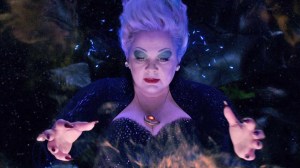
McCarthy (Thunder Force) acquits herself very well as the villainous sea witch. She puts her own spin on Pat Carrol’s famous vocal performance from the original, making her Ursula the seething also-ran waiting on the sidelines and nursing old grudges. The added back-story makes Ursula Ariel’s aunt now, which adds an extra degree of menace to their transactional bargain. I was also reminded how little Ursula is in this movie until it counts, so to justify her continuing presence, we have a few check-ins where she basically monologues her thoughts on the action. It feels like padding but I didn’t mind because I got to spend more time with McCarthy.
And now, dear reader, let’s go through some of the adaptation changes that aren’t quite as charming or beneficial. The colorful realm of the sea feels rather limited in this rendition. The vastness of the ocean and its mermaid kingdom feels strangely contained, and that’s a result of the reality of filming on a large empty set as well as the cost of extensive special effects. This is another case where the beauty and imagination of animation proves incomparable. The differing versions of “Under the Sea” really magnify this. Along those lines, making Ariel’s aquatic friends photo realistic robs them of the personality and expression they exuded in the animated movie, and it also drags them into an uncomfortable uncanny valley. Stop robbing characters of expression for the sake of added biological “realism.” It’s a bad trade. Stop it, Disney. Watching a photo realistic Flounder flop around on dry land while he tries to cheer Ariel on with his expressionless might-as-well-be-dead fish eye is not as whimsical as it should be. The original voice of Sebastian, Samuel E. Wright, has a small cameo as a fisherman, and it’s nice to hear his familiar voice again, especially knowing the actor sadly passed away in May 2021.
I’ve already discussed the new songs by Lin-Manuel Miranda being mostly agreeable but unremarkable, but there is one new track that stands out for all the wrong reasons. Being a Miranda musical, it’s not unexpected for the inclusion of a new hip-hop-infused song, especially with his Tony-winning Hamilton co-star in the movie. What is surprising is that Daveed Diggs doesn’t get the bulk of the new rap song but instead it’s Awkwafina, and her voice at these levels of gravely intensity feels like an aural assault. I was wincing throughout the song “Scuttlebutt” and kept wondering why Diggs wasn’t the star considering he handled the most linguistically complex flows in Hamilton. I even enjoy Awkwafina as a vocal artist but this song is painful to endure.
The 2023 live-action Little Mermaid has enough positive additions that fans of the 1989 original will likely enjoy while still checking the boxes of their own nostalgia requirements. Bailey is sensational and the added time for the romance to be more organic and believable, with some extra fleshing out supporting characters like the Queen and Grimsby also allowing the world to feel more textured and less archetypal. The visuals aren’t as murky as I feared but the magical world of this hidden undersea realm definitely feels lacking. The pacing is a bit sluggish too, as we don’t even get our deal with Ursula until an hour into the movie, and the added songs fail to compete with the classics even with the artistic prowess of Miranda. I don’t know if it needed to be this long, and I certainly don’t care for the photo realism approach, but I was smiling throughout the movie and found it charming. Consider this mid-tier Disney live-action scale, a remake with enough of its own to swim with the weight of expectations.
Nate’s Grade: B
Share this:

Hamilton (2020)

Multi-hyphenate sensation Lin-Manuel Miranda’s Hamilton sounds like a bizarre misfire, a hip-hop-infused musical about one of the lesser known Founding Fathers, and yet not only does it succeed so magnificently, so transcendentally, it’s one of those rare artistic pinnacles that lives up to its own momentous hype. This is one of the crowning artistic achievements of the twenty-first century. I’m exceedingly grateful for a filmed version of the vaulted stage experience, with the original cast, that allows me that front-row view my bank account never would afford. This is going to be a film review of what is, essentially, a live theatrical performance, but really this written review is going to be a celebration of Hamilton and what I consider to be so phenomenal.
In 1776, Alexander Hamilton (Miranda) is an immigrant looking to make his name in the American colonies and the looming war with Britain for independence from King George III (Jonathan Groff). He meets and befriends Aaron Burr (Leslie Odom Jr.), an ambitious upstart who seems fatefully linked with Hamilton through the decades. Hamilton falls in love and marries Eliza Schuyler (Phillipa Soo) but also has a close relationship with her older sister, Angelica (Renee Elise Goldsberry), who keeps her real feelings at bay to protect her sister. Eager to get into the action, Hamilton accepts a position as George Washington’s (Chris Jackson) right-hand man as the battle comes to New York and the colonists do the unthinkable and defeat England as we conclude the musical’s first act. “You’ll be back,” King George retorts.
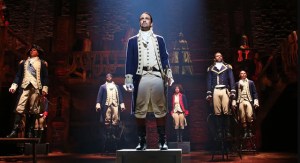
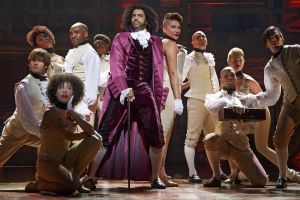
Next comes the tricky part of building a functioning country in the aftermath. Hamilton is appointed to be Secretary of the Treasury by newly elected President Washington, but his federalist principles are fought against by some pretty big names in the cabinet, like James Madison (Okieriete Onaodowan) and Secretary of State, Thomas Jefferson (Daveed Diggs). Both are wary of a centralized government and prefer more power to be held by the states. The Founding Fathers jostle for ideological supremacy and Hamilton gifts his opponents with the burgeoning nation’s first political sex scandal with Maria Reynolds (Jasmine Cephas Jones). Aaron Burr rises in local and national politics but sees Hamilton as a constant thorn in his side. With the presidential election so close in 1800, Hamilton’s endorsement of Jefferson over Burr is the final straw, and Burr demands satisfaction in a duel against Hamilton that will prove tragic.
For fans of musical theater, Hamilton is a two-hour-and-forty-minute joyously exuberant celebration of a bold artistic vision, the electricity of live theater, and broadening American history in a manner that makes it far more accessible, relevant, and humane for a modern audience. The very nature of having minority actors portraying the Founding Fathers and their famous wives is part of Miranda’s appeal that he wanted to tell the story of America with the America of today. Ordinarily, African-Americans would never get an opportunity to play Washington or Jefferson, or a Chinese-American woman playing the role of Eliza Hamilton, and there is definite power in representation, in seeing these different faces playing these historical figures. The deliberate color-blind casting makes America’s history feel more inclusive. It’s such a simple act, opening the ethnicity of historical roles, but it produces a beautiful result and provides even more cross-textual commentary, like slave-owning presidents played by black thespians.

Another miraculous effort by Miranda is his ability to generously humanize many of the characters, including the man who eventually murders Hamilton himself. Very often when we talk about the Founding Fathers and other Great Figures of History from oh so long ago, they take on a mythic quality and seem less human, less flawed, and less relatable. They seem practically superhuman, absent our doubts and desires. Miranda’s portrayal of the men and women of America’s founding does the opposite and makes these people feel relatable, flawed, and human yet again.
This includes Hamilton as well. He’s obsessed with his sense of legacy, has a pretty healthy ego that gets him into trouble, and might have been having an emotional affair with his sister-in-law, never mind an actual affair with Maria Reynolds. He’s so concerned about his “good name” and rumor of impropriety (he was accused of embezzling government money to pay for Ms. Reynolds’ husband’s extortion) that he literally confessed to his marital misdeeds and published it. Hamilton is consumed with writing his ideas (“Why do you write like you’re running out of time?”) and an impending early death, something he amazingly escaped during a hurricane in the Caribbean that destroyed his village as well as his mother’s fatal illness. He was so eager to get into the heat of war that Washington had to sit him down to persuade him that dying as a martyr isn’t as glamorous as living and seeing through your ideals. Hamilton’s death at the hands of Burr is likely the most widely known fact about both duelists, but the musical brings each to glorious and troubled life with unerring compassion without excusing their real failings.
Burr serves as the narrator of our near three hours, setting the stage for Hamilton’s story with his own regrets and jealousies framing his recounting. He’s a complex character worthy of his own biopic, an orphan who finished college in two years, had an affair with the wife or a British officer, lost her at sea, and championed retail politics centuries before it was the norm. His personal philosophy was one of caution, diametrically opposed to Hamilton jumping after whatever he wanted no matter the consequences. Burr longs for being near the real center of power, and his showstopping number “The Room Where It Happens” is an ode to his desire. He begins as a friend and ally of Hamilton, then political rival, and finally as a mortal enemy. He’s too calculated with his personal beliefs, never wanting to be too challenging and at risk, which is an embodiment of his social-climbing ambition as well as his callow decision-making. To Burr, avoiding risk and not accruing enemies is simply smart business. The musical does an excellent job of humanizing Burr (“Now I’m the villain in your history book”) and offering a perspective in opposition to Hamilton but not without its own measurable merits.
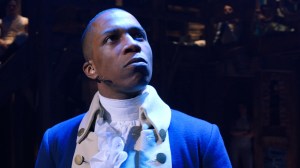
The domestic side of Hamilton could be its own movie to itself. The relationship between Alexander, Eliza, and Angelica is complicated to say the least. Angelica was the elder sister and in her stellar song “Satisfied” she details the social pressures of being in that position, being expected to marry into a desirable match that will see the family name and fortune to prosper. Feeling initially unsure about Hamilton’s intentions, she introduces him to her sister Eliza instead, and it’s a choice that she feels conflicted about ever since. Angelica dearly loves her sister (“I love my sister more than anything in this life/ I will choose her happiness over mine every time”) but cannot help but still feel a yearning for her brother-in-law. However, when the Reynolds scandal comes to light, she will defend her sister to her dying breath. That sisterly deference makes Angelica such a fascinating figure, and it certainly makes the Hamilton marriage more intriguing and roiling with pent-up desires. Eliza sings about removing herself from the narrative in “Burn” and how her husband has “forfeited the rights to my heart.” She’s been trying to impress upon her husband to be happy in the moment (“Look around, look around/ How lucky we are to be alive right now”) and enjoy his accomplishments rather than looking ahead. Her eventual forgiveness of Hamilton is one of the most emotional moments of the show that causes me to tear up. And she serves as a final testament to Hamilton’s legacy during the final number, after his death, and fills in the gaps of history by asserting her own agency back into the observed “narrative.”
I’ve gone over 1300 words, dear reader, and I haven’t even talked in depth about the music, so allow me to say that Hamilton as a musical is just about music perfection. Hip-hop is such a densely wordy platform that allows so much information to be imparted at lightning speed, which means that lyrically these songs are jam-packed with clever asides, allusions, and rhyming recitations of history. The songs are instantly quotable and filled with deep consideration from witticisms to also important dramatic themes and perspectives. I was amazed at Miranda’s composition skills in particular how he’s able to weave and build off character leitmotifs. It’s brilliant how something like Hamilton’s declarative early song “Not throwing away my shot” about his ambitions can come back during his duel with Burr where he raises his pistol in the air, away from Burr, and literally throws away his shot. Or how the beat of a song can imitate a failing heartbeat in a fractious moment of tragedy. Or how King George’s self-involved songs are fashioned to be like 1960s British invasion pop ditties. Or how cabinet arguments become riotous battle raps between Jefferson and Hamilton. Or how the same actors who played Hamilton’s wartime buddies in Act 1 are playing his political rivals in Act 2 (“Have you forgotten Lafayette?” he asks of Jefferson, the same man who portrayed Lafayette). There are layers and layers to the compositions here and the music is remarkably assured; almost every song is a certified earworm, and it’s an entirely sung musical. Every person will have their favorites, and for me they include “Satisfied,” “The Room Where It Happens,” “History Has Its Eyes on You,” “Dear Theodosia,” “One Last Time,” and the moving finisher, “Who Lives, Who Dies, Who Tells Your Story.” Even if you don’t like rap music, Miranda’s offerings are so catchy, so accomplished, and so bursting with excitement, that it’s near impossible to resist.

This movie was filmed in 2016 from the original Broadway cast, many of whom earned Tony awards for their sensational work (Diggs, Goldsberry, and Odom Jr.). Everyone is truly excellent but my favorite performer, by far, is Diggs (Blindspotting). He gets to spit lightning-fast rhymes in a French accent as Lafayette, and his portrayal of Jefferson as a dandy in the style of Andre 3000 from Outkast is enormously entertaining. His “What Did I Miss?” introductory number is a perfect impression for Jefferson’s arrival onto the stage. Diggs’ is so charming even when he’s being a scoundrel trying to plot the doom of Hamilton. His battle raps with Miranda are a highlight and Diggs also seems to get the most tricky lyrical arrangements because of his peerless skills at maintaining flow and diction (“I’m in the cabinet, I am complicit in/ Watching him grabbin’ at power and kiss it/ If Washington isn’t gon’ listen/ To disciplined dissidents, this is the difference./ This kid is out!”). There’s a reason Diggs has become the other breakout star of the show.
Soo (The Code) breaks my heart with her Act 2 solo numbers and then mends it back as she reasserts herself on “Who Live, Who Dies, Who Tells Your Story.” Goldsberry (Altered Carbon) has such a fire to her. Groff (Mindhunter) is hilarious as King George, though his singing involves a lot of literal spitting. Miranda (Mary Poppins Returns) is exceptional as the titular character who comes from nothing and through the power of his ideas creates America’s financial institutions that are still standing to this day. But it’s his personal relationships that better define him in the play. The fatherly relationship he has with Washington is affectionate (“One Last Time” has an extra poignancy knowing Washington died shortly after leaving office) and his hopes for his newborn son (“You’ll Blow Us All Away”) speak to a larger truth about parenting that also links up with the foundation of a nation in infancy. There’s also his complicated love divided between Eliza and her sister. Miranda has such a natural charm and swagger and earnestness that seeps into his performance and every performer.
So is there anything about this movie-wise to separate it from a bootleg of the show? Director Thomas Kail (also the director of the musical) does make smart use of when to go tighter on his actors, to zero in on the emotions and expressiveness, and when to go wider for best impact. The stage is designed like a bullseye with a rotating circle, which can play up the dramatic confrontations between foes, especially the duels. I was impressed at points where the movement of the stage would be perfectly timed with camera focus and edits, allowing other characters to loom over the shoulder, or pop into focus, giving the production a greater sense of filmed visuals. However, this is really a filmed version of the stage show, so as a movie, it’s only going to do so much with those trappings. The unreality of theater has to be accepted but the movie version does a great job of maintaining the intimacy of the shared theatrical experience. It’s even nice to hear the applause after the musical numbers or some of the laugh lines hit home.
By this time, you’ve likely heard about the Broadway-smashing Hamilton success story of Miranda and his crew but do yourself a real favor and watch the movie with the OG cast. Yes, there are historical shortcuts taken for dramatic license and not everything you see on stage will be one hundred percent accurate with the long record of history, but it all clicks for the greater storytelling aims. Some might be uncomfortable with the re-visioning of the Founding Fathers, either by the open-ethnicity casting or glossing over their slave-owning faults, but Miranda’s larger goal of making history reflective of the people who currently live today is admirable. In short, unless you have the kind of money to blow on a front-row ticket, enjoy the Hamilton movie experience until Miranda eventually wrangles his artistic milestone into a more movie-movie version.
Movie Grade: A
Show Grade: A+


 nathanzoebl
You must be logged in to post a comment.