Blog Archives
The Ice Harvest (2005)
 Imagine my surprise when I found out that a small crime novel I read years ago was getting the big Hollywood treatment. I read Scott Phillips’ The Ice Storm in one sitting back in 2003 during a plane trip from Ohio to San Diego. It was deliciously dark down to the very last page and I loved it, but then I am a sucker for a good crime story (check out Jason Starr’s Tough Luck and Hard Feelings if you are the same). The movie looked to be on the right track with names like John Cusack to star and Harold Ramis to direct. Ramis is responsible for starring, writing, or acting in or directing some of the most beloved comedies of the last 25 years including Ghostbusters, Groundhog Day, Stripes, and National Lampoon’s Vacation. That’s one illustrious comedic pedigree. So how could the movie go wrong?
It’s Christmas Eve and Charlie Arglist (John Cusack) is a self-loathing attorney that works for some of the shadiest folks in Wichita, Kansas. One of those bad customers is mob boss Bill Guerrard (Randy Quaid) whom Charlie and his partner Vic (Billy Bob Thornton) have just swindled over $2 million from. Unfortunately for them, Wichita is hit by an ice storm that makes the roads haphazard to travel. The two will wait until the morning thaw and then hit the road with their booty. Vic reassures Charlie to just, “act normal.” This means many ventures to some of Wichita’s finest strip clubs with alluring names like Sweet Cage and Tease-O-Rama. Charlie has a sweet spot for Renatta (Connie Nielsen), a bombshell and the operator of the Sweet Cage. He’ll also have to drive his plastered friend Phil (Oliver Platt) around, who is regretting having married Charlie’s cold ex-wife. Charlie would love to sail off into the sunset with Renatta by his side but first he’ll have to survive the night and a mob enforcer (Mike Starr) is already on his trail.
 The Ice Harvest feels like an episodic collection of ideas, too many of which have too little significance. The titular ice storm seems all but forgotten, only serving as a cheap plot device to keep our characters bottled up in the city. It has no bearing elsewhere on the plot. The reoccurring “As Wichita falls” passage has no payoff. The nosy police officer plotline looks like it might be building to something important but then is quickly disposed of. The Christmas setting has little impact except for giving the strippers something to complain about. The Ice Harvest wants to benefit from the juxtaposition of Christmas cheer with all these tawdry, violent asides and it just seems small and shallow. The movie also shifts the story’s time from 1979 to modern day one suspects just for the cheap out of cell phones.
Credit goes to Cusack for making his character as likable as he is. His character is a mob lawyer, a deadbeat dad, an increasingly drunk driver, and a man with his nose in whole lot of sleazy ventures, and yet you still pull for him to somehow succeed. Cusack, forever youthful, seems overly numb to all the horror around him and downplays the danger to a negative degree. Charlie seems like he’s in the wrong movie. Thornton plays yet another hedonistic louse and is quite good though not at his Bad Santa apex. He seems the most at ease with the physical comedy. Nielsen plays your typical femme fatale with a Veronica Lake haircut and breezy voice, which should both be instant red flags for students of film noir. The two men that steal the show are Platt and Quaid. Platt gives a brilliant uninhibited performance as quite possibly the drunkest man in movie history. Quaid is an honest surprise as a menacing mobster ruing the day he chose a criminal enterprise in Kansas. He chomps scenery with a violent exasperation that truly seems larger than life. This is a bad guy to fear and Quaid makes the most of his very limited screen time.
Ramis is out of his league here. The man cannot competently direct tension or action. Ramis doesn’t let the audience build suspicion because he’d much rather have characters just point-blank say, “Don’t trust this person” instead. He doesn’t give us time to piece clues of betrayal together so instead characters just keep running forward until they get smacked in the face by something made obvious. Ramis’ mishandling of tone really sinks the movie. The Ice Harvest doesn’t know whether it wants to be a thriller of a dark comedy and therefore just really sputters at both. The comedic elements and the thriller elements butt heads; because of the comedy the character never feel in danger, and because of the thriller/noir elements the characters and their situations never really seem funny. The Ice Harvest turns into some kind of two-headed beast that snaps at itself. I think maybe Ramis was watching Blood Simple and taking notes and then he accidentally taped over it with a Charles in Charge marathon and was at a loss.
P art of this problem is that the screenwriters don’t fully commit to the nastiness. Phillips’ novel is unrelentingly dark, cynical, and unsentimental and doesn’t give a damn if you like its characters. The movie, on the other hand, wants to get its hands dirty but is more interested in playing it safe. The film seriously reminded me of last year’s Surviving Christmas, another movie that wanted to be sweet and nasty and wound up just being really bad. You can feel The Ice Harvest reeling back several times to set up Charlie as a likable lad in over his head, going so far as a slightly contrived yet predictable finale. At least Bad Santa had the gusto to approach a happy ending on its own crude, unsentimental terms. Ramis needs to stick to broad comedies and leave the bleak neo-noir humor to the Coen brothers.
There are some plot elements from the book that just don?t work with this half-hearted adaptation. (Spoilers to follow for paragraph) At the very end of the movie Charlie has left the city with all the money and stops along the road to help a stalled camper. In the book, the camper backs up over him and kills him, thus ending with the ringing endorsement that crime doesn’t pay. It made sense, especially for a book that was dark to the very end. In the movie, the camper backs up and knocks him to the ground but doesn’t run him over. Charlie dusts himself off and that’s that. The scene feels pointless without fulfilling the end of the book. It doesn’t provide any last-second tension. Charlie just hops back in his car, dear hung over Phil pops up, and the two are set for one most excellent adventure. Unearned and misplaced happy ending? No thank you.
The Ice Harvest is only a mere 88 minutes long and yet the film still feels padded and draggy. The drunken Oliver Platt-heavy middle is a generously paced muddle, and though it’s rather funny it’s also rather extraneous. The Ice Harvest is really a handful of great moments that don?t add up to a satisfying whole. The movie is really episodic and too many of those episodes have little bearing on the plot. Character betrayals are spelled out to us and Ramis seems to lose interest in his own film as it slides further and further into dangerous territory. The Ice Harvest can’t commit to whatever it wants to be and the audience is the one to suffer. Read the book instead. It’s only 224 pages.
Nate’s Grade: C
Share this:

Mr. and Mrs. Smith (2005)
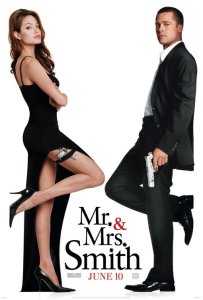 The new action comedy Mr. and Mrs. Smith sure seems to be in the headlines a lot. Most from tabloids trying to connect Angelina Jolie as the catalyst for why Brad Pitt and Jennifer Aniston have filed for divorce. You can’t walk past a checkout counter without being screamed at by 15 magazine covers. Too bad the actual movie seems to be forgotten in the process. That’s a shame because Mr. and Mrs. Smith is one terrifically fun summer ride that you don’t want to get off of (kind of like Jolie and/or Pitt, depending upon which way you swing).
Things aren’t so peachy for the Smiths (Jolie and Pitt). They met and married in Columbia amid a flurry of action but now it seems like their lives have become quite mundane as husband and wife. Life at work, though, is quite the opposite. Mr. and Mrs. Smith are hiding a whopper of a secret — that they’re hired assassins. They’ve both been hired to take out the same mark (Adam Brody) and accidentally discover each other’s true identity. Of course both spies are now compromised so they’re assigned to bump off their spouse. And you thought your marriage was murder. Mr. and Mrs. Smith combat their real feelings and put the spark back into their marriage by trying to kill each other, the little taught alternative in marriage counseling courses.
Mr. and Mrs. Smith has a vibrant sex appeal to it. Pitt and Jolie are extraordinarily beautiful people, no question, but they also have sizzling chemistry. The looks they give could ignite the screen. Even when they’re at each other’s throats you like them and hope for the best. The stars’ sex appeal and the film’s off kilter tone collides in fun ways. A knockout, drag-out fight between husband and wife turns into foreplay that literally brings the house down. The most unbelievable aspect of the movie is the idea that these gorgeous people would grow sexually tired with one another.
 The leads are terrific and terrific together. Jolie has finally found the right role for her. She’s the perfect balance between tough and sexy. She could very easily kick my ass and look good doing it. Originally Nicole Kidman was going to play Mrs. Smith before scheduling conflicts put the kibosh on that. I can not see Kidman working. I’m not afraid of Kidman, but with Jolie I’d do whatever she says. Jolie has a real kick in Mr. and Mrs. Smith and the audience can feel it too. It also helps that she looks absolutely magnificent. Finally, her beauty and wildness are put to excellent use. I’ve always thought Pitt got a bad rap as an actor for being pretty. Sure, he’s built like a Greek God (and played one in Troy) but this man can act. People seem to forget he was nominated for an Oscar for Twelve Monkeys. Pitt exudes a natural calm and always seems a smirk away from getting out of anything. These traits serve him well as a smooth criminal. Even when he’s whacking people with a golf club he seems easygoing.
The tone needs to be very specific for Mr. and Mrs. Smith to work. I mean, one false step and husband and wife revitalizing their marriage by trying to kill each other turns from funny to horrifying. Mrs. and Mrs. Smith walks that delicate line but nails the jaunty, tongue-in-cheek tone needed to make this movie soar. When you boil it down, Mr. and Mrs. Smith is essentially a modern day screwball romance. Instead of sparring with witticisms they spar with heavy-duty weaponry (I can only imagine what Spencer Tracy and Katherine Hepburn could have done with knives and bazookas).
After Mr. and Mrs. Smith find out the true identities of their spouses, they both know it’s kill-or-be-killed. Both tread very carefully and are highly suspicious that any little thing, like a glass of wine, a trip to the bathroom, could be the trigger to their demise. Now, if the tone weren’t exactly perfect, this sequence would seem overly silly or overly cruel. Instead, the sequence comes across as being very funny. Pitt and Jolie nail the casual awkwardness as they test one another. Even the ending of Mr. and Mrs. Smith is laugh-out-loud perfect with the film’s vibe. I will go so far to say it’s the greatest ending line for a film since 1959’s Some Like it Hot.
 It seems that if you want your action done right, you call Doug Liman to be director. Liman, as he did with 2002’s stellar The Bourne Identity, can craft highly imaginative, stylish, and playful action sequences that are low on pesky CGI and high on thrills. He makes sure the audience can witness every balletic move of his orchestration. He’s likes his fireballs big, though not Michael Bay the-sun-is-exploding big. If you want an inventive use of ordinary objects, Liman’s your man. There’s a fabulous car chase that utilizes a mini-van in surprising and gleeful ways. While dodging bullets and bad guys, Mr. Smith slides the vehicle’s doors open on both sides. When a bad guy jumps into the car, he grabs the baddie and swings him out the other side in one continuous motion.
This isn’t a movie to take too seriously. Yes, the plot is pretty goofy at turns and the Smiths seem nigh invincible. Yes, the bad guys are all terrible shots. Yes, it would be unlikely for the Smiths to take out 100 or so armed men surrounding them. Yes, it seems like the resolution would be cloudy because they’d still be wanted as husband and wife assassins. Yes, Brody is wearing a Fight Club T-shirt. None of this matters. Of course a world of super spies and gadgets is going to be goofy, but Mr. and Mrs. Smith never winks at the camera. This is one romantic comedy with a macabre edge and a devilish sense of humor. I was thoroughly entertained from start to finish.
Mr. and Mrs. Smith is the big blast of fun I’ve been waiting Hollywood to deliver all year. The action sequences are inventive, exciting, and quite sexy. Seeing the two hottest people on the planet (Thora Birch excluded, obviously) kiss, fight, shoot each other, and blow stuff up is entertainment in itself, but the chemistry between Jolie and Pitt is in the five-alarm area. This will not be a movie for everyone. Mr. and Mrs. Smith is about married assassins who do kill people and get off on trying to kill each other. But for people who like their summer ventures to have a little malevolent glee, Mr. and Mrs. Smith will hit the right note. I can only hope for the eventual sequel – Mr. and Mrs. Smith Go to Washington. Imagine that potential filibuster sequence and try not to smile. You can’t!
Nate’s Grade: A-
Share this:

Intolerable Cruelty (2003)
 Miles Massey (George Clooney) is the preeminent divorce attorney in Los Angeles. But after years of bankrupting homes after people have broken them (this allusion may be too tricky), hes grown tired of the same old same old. Enter Marilyn Roxroth (Catherine Zeta-Jones), a conniving gold digger who has been ruined by Massey defending her dimwitted hubby (Edward Herrmann). Now shes out for revenge, which could be in the form of romancing Massey while bringing him down.
Intolerable Cruelty is something of a strange breed. It’s the Coens most striving foray into mainstream success, with the weight of the world on Clooney and Zeta-Jones exchanging sparks and verbal repartee. For the most part, things work: the leads do have a winning chemistry; Zeta-Jones is positively glowing in Roger Deakins’ beautifully milky cinematography (she found out she pregnant late in the shoot, which could explain the glow).
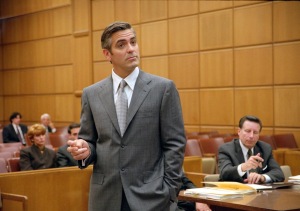 The stumbling block for Intolerable Cruelty and its central romance is that neither of the leads, though at times charming, isn’t exactly likable or able to root for. An integral part of any romantic comedy is empathy for the leads so much that we want them to get together, possibly with swirling crescendos. But in Intolerable Cruelty, both leads make a living off deceiving and taking advantage of others. So while their War of the Roses-esque pursuit to out-scam the other can provide some entertaining twists (and some forced and out of place), the whole duplicitous one-upsmanship doesn’t blossom credible love between the leads or the audience.
I have a strong feeling that Intolerable Cruelty was a story the Coens hopped on late, did some rewrites and invited old Coen friends to join in the jubilee. This is the first time the Coens have worked with other writers (the people who brought us such duds as (Big Trouble and Life), and certain storylines or subplots that glaringly feel disjointed from the screwball-comedy tone of the film. An asthmatic hit man named Wheezy Joe (who got the biggest laugh with his demise) is funny but in the wrong Coen film. When Clooney and Zeta-Jones both hire the services of Wheezy Joe to off the other, you know the story took a fantastical wrong turn. A creepy decrepit owner of Clooney’s law firm also feels like a leftover from a different film. This movie also has the most ripping up of legal documents I’ve ever seen in a movie.
Clooney is quite funny as a chattering legal eagle with a Cary Grant edge. Hes ready and willing to play against his movie star image, which works wonders for comedy, though the running gag where he must look at his teeth in any reflective surface never takes off. It took me until Intolerable Cruelty to realize how much of a beautiful woman Zeta-Jones is. Her warm smile could light up an auditorium. The supporting characters are all underused but very memorable. The opening with Geoffrey Rush’s TV exec walking in on his canoodling wife is very funny, and he plays the long-haired arrogant type well. Cedric the Entertainer is hilarious as a private eye determined to ”nail yo ass” that I started privately wishing the film would spin to follow his life and not Clooney’s.
Intolerable Cruelty is a nice diversion for the Coens, with some good laughs here and there (my favorite being the courtroom scene where Clooney and Zeta-Jones go head-to-head for the first time), but one would hope that the Coens will get back to doing hat they do best, which is quirky yet beautiful independent films. In the end, it seems that the Coens have created an oddity for themselves — a normal movie. We expect more Joel and Ethan.
Nate’s Grade: B-
Share this:

Cabin Fever (2003)
 Throw out all your foolhardy preconceived notions of what you believe to be mans greatest endeavor. Fire, the wheel, antiseptics, flight? Toss them all in a big garbage can, because Cabin Fever is the greatest single thing human beings have ever and will ever create. I hear a select few countering, What about the Renaissance? Oh yeah, did the Renaissance have gratuitous nudity? Wait, scratch that. Did the Renaissance have indulgent nude scenes involving the former Yellow Power Ranger? I think not. Did your fancy-smantzy Renaissance have dogs ripping people apart, backwater yokels who perform kung fu and hobos being set on fire? Thats what I thought. Now who looks like the fool? If I had to live in a Cabin Fever-less world, I would hope it would collapse upon itself, because humanity shouldn’t have to continue without this movie.
 Cabin Fever is a delirious new horror film tweaking all the clichés and expectations of horror. Five friends who have just graduated from college rent a secluded cabin for a weekend. Then their numbers start dwindling through horrific killings. The brutal murderer? A flesh eating bacteria infecting their numbers, ravaging inside them and making flesh fall off like loose cheese on a pizza.
Once the group discovers that one of their friends has become infected they without hesitation quarantine her in a shed. They make failed attempts at getting outside assistance but are pushed back into the hot zone. Their fears and distrust manifest, and what was intended to be a sexual romp in he woods (we all know how that goes in horror flicks) has turned into a microcosm of Lord of the Flies meets Evil Dead II, with a dash of Night of the Living Dead.
What elevates Cabin Fever from similar brainless exercises in mutilating sexually active teens is its self-awareness and constant humor. It plays upon horror staples, particularly the notion of a nation of creepy backwoods folk waiting to take advantage of lost teens. Cabin Fever proudly wears its horror influences on its sleeve. The film is also relentlessly hilarious in its tongue-in-cheek self-awareness. I was laughing all the way through. The film even ends in an inter-racial ho-down with banjos!
The film isn’t so much scary, though it does have a few shares of scares. The film also isn’t as gory as youd believe, but when it shows the gory goods Cabin Fever swings for the fences. Interesting enough, someone on the Cabin Fever crew actually suffered an attack by flesh-eating bacteria in their life and claims the gruesome makeup to be 100 percent authentic.
 Writer/director Eli Roth’s Cabin Fever is a scream. He has an amazing sense of visuals and creates a vivid picture of doom. He displays a sickly entertaining sense of humor, much like Sam Raimi and Peter Jackson did before they went Hollywood. The photography is great, the disgusting makeup is skin-crawling (perhaps a more appropriate term than intended) and the performances are dead-on camp. Each of the characters fits into a horror archetype from innocent girl next-door (who gets infected first), sexy brunette vamp, loudmouth drunkard and nice guy who lacks confidence (Rider Strong of Boy Meets World).
Now some will take umbrage to the fact I’m giving a goo-filled horror flick such a high rating. Cabin Fever is the most fun I’ve had at the movies in some time, and is perfect for getting a group of your friends together to experience. I couldn’t ask for more breezy entertainment from a movie. You know what else your fancy Renaissance didn’t have? People swallowing their harmonicas. I’m pretty sure they didn’t have that. Take that harmonica-less Michelangelo, you hack!
Nate’s Grade: A
Share this:

Once Upon a Time in Mexico (2003)
 Robert Rodriguez (From Dusk Till Dawn, The Faculty) wrote, directed, produced, photographed, edited, and scored Once Upon a Time in Mexico. I’m sure if you look further this jack-of-all-trades also provided coffee and donuts. Coming off his third Spy Kids feature, Rodriguez seems like the hardest working man in showbiz. Mexico, a sequel to 1995’s Desperado, is one tasty burrito of stylish action, vigorous energy and the immensely appealing Johnny Depp.
Depp stars as Sands, an amoral CIA agent who calls Mexico his beat. Through the help of a one-eyed flunky (Cheech Marin), he recruits a mysterious gunman, El Mariachi (Antonio Banderas), to thwart a coup being lead by Marquez, a military general, and paid for by a drug cartel run by Barillo (Willem Dafoe, a.k.a. the Creepiest Man Alive). Then theres also a retired FBI Agent (Ruben Blades) looking to settle a personal score with Barillo, a Federale (Eva Mendes) looking for some action, a nasty hired gun (Danny Trejo) itching to off a certain Mariachi, Mickey Rourke with a Chihuahua, Enrique Iglesias with a mole, and also the fact that Marquez, who Banderas has been assigned to kill, murdered Banderas wife (Salma Hayek) and daughter. Ill stop so you can catch your breath. Ready? Okay.
 You better think ahead and bring a second pair of pants because Depp will charm them right off as he plays yet another oddball. We are delighted with Sands and his multitude of fake mustaches, tacky T-shirts (one actually says CIA) and method of paying people through cash-filled nostalgic lunch boxes. Despite plotting near a Machiavellian level and shooting innocent chefs, the character settles into a lovable anti-hero that transforms into a blind reaper of vengeance. Depp is one of the best, if not the best, actors on the planet. Once again as he did in Pirates of the Caribbean, Depp gives life to a character and nourishes the film every time hes onscreen. This is Depp’s show. Mexico does have a noticeable lull whenever Depp is absent. I don’t know anyone else that could actually become cooler AFTER what he goes through. Possession is nine-tenths of the law, and Depp totally owns this movie and the 2003 year.
Banderas is smooth and has never looked better than playing the role of the silent-but-deadly musician. Hayeks role amounts to little more than a cameo. Shes witnessed through flashbacks, but she still has a healthy smolder to her. Blades has the most integrity of all the characters. Most of the actors have fun with their roles, especially the ones that are bad (which accounts for most everyone), but you can’t help but get the feeling that theyre being wasted for the most part.
Rodriguez’s overstuffed film is so delightfully over-the top and loopy that it crackles with an infectious kind of energy. Once Upon a Time in Mexico is a wild and lively cartoon of an action movie with a very healthy sense of humor. Its action relies low on CGI and high on inventive, if slightly self-aware, camera angles and furious gun fights. A sequence involving Banderas and Hayek chained to the wrist and swinging one-by-one down the levels of a building is breathtaking.
 What this spaghetti western below the border could have used is a little less of its myriad of twists, double-crosses, triple-crosses, and character subplots. By the time the Day of the Dead rolls on, you might need note cards to keep everything straight. Rodriguez’s earlier Mariachi films were lean on plots which allowed for fun and grandiose action sequences. Perhaps Mexico could have shaved some of these needless characters (cough, Eva Mendes, cough) from its convoluted plot and drawn out its sometimes too quick bursts of stellar action.
Once Upon a Time in Mexico is a bloody good time. Depp amazes yet again in this bombastically silly yet undeniably fun south o the border shoot-em-up. If Rodriguez has any plans for an additional sequel (and he might given his insane work ethic) I’d recommend following Depp’s Sands character wherever the sands take him. To witness this incredibly cool, whip-smart character cut up in any land would certainly be music to my ears.
Nate’s Grade: B
Share this:

Confessions of a Dangerous Mind (2002)
 The premise is undeniably amusing: game show host and creator Chuck Barris (Sam Rockwell) in between escorting Dating Game couples and introducing Gong Show losers, was a hired killer for the CIA. The directorial debut by George Clooney is impressive on a technical level. Clooney is inventive with scene changes, camera angles, lighting, editing, color palettes … I don’t know whether to champion him or credit his excellent cinematographer, but hats off to whomever designed the look of this movie. Rockwell is great and carries the film well, though I think he lacks the proper ability for self-loathing that the character needs. The brilliant weirdness of the story is tempered by famed scribe Charlie Kaufman’s astute sense of the intricately bizarre. Kaufman is a master of the offbeat, but he does more with his story structures and the ability to keep surprising than any other screenwriter. Confessions of a Dangerous Mind is a cheeky diversion into the unauthorized autobiography written by Barris himself. The movie itself is one big joke and Clooney tells it like a pro.
Nate’s Grade: B+
Share this:

The Man Who Wasn’t There (2001)
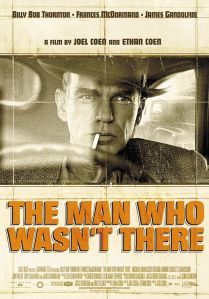 The Coen brothers dark, twisty entry to the world of film noir looks mind-blowing with its black and white lensing. And the story is great too. Billy Bob Thronton plays a barber who gives new definition to the word passive. One day a customer lets him in on an up-and-coming financial project and if Thronton were to provide some dough then surely he would rake it in. As with most film noir, the normal man is thus pulled into the web of intrigue and crime. The ball gets rolling after Thornton blackmails his wife’s tryst (James Gandolfini), who also happens to be her boss and his friend. Things get far more complicated from there and nothing seems to go right as Thornton makes one bad decision after another. The Man Who Wasn’t There is an engaging and smart drama with game bits of comedy strewn at key moments. The Coen brothers are a pair not very easily topped when it comes to excellence in films, and this latest entry is a wonderful addition to their resume.
Nate’s Grade: A-
Share this:

Snatch (2001)
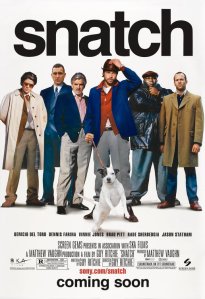 Snatch is really more of the same for writer/director Guy Richie as he retreats back to his magical land of London gangsters with Dick Tracy-esque names and thick cockney accents intermixing in comically violent and ironic ways. He’s like a more stylized version of Tarantino, if Tarantino ever got to have sex with Madonna. So if you like the niche Richie has trapped himself in for the moment (like myself) then you’ll like Snatch. The film is coursing with energy to spare and never loses its sense of fun, which carries over into audience smiles (at least for me and my gal it did). Brad Pitt is a riot as the hardly intelligible Irish gypsy and part time boxer.
Nate’s Grade: B+
Share this:

Nurse Betty (2000)
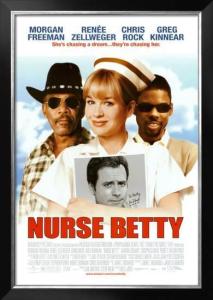 Can a fairy tale have a dark undertone below all the bubbly whimsy? Hell, the Grimm tales were barbaric before they became homogenized, sanitized, and finally Disneytized. Nurse Betty presents a modern day fairy tale with the strike of reality always below it — the strike of darkness and disappointment. Fairy tales are an escape from this, but what if one creates her own fairy tale and chooses to believe in it over the drab reality she presides in?
Neil LaBute, the director of the incessantly dark In the Company of Men and Your Friends and Neighbors, collects together a whimsical modern day fable with a top-notch cast. Yes, to those fans of earlier LaBute offeriengs his name doesn’t seem synonymous with whimsical comedy – but in this flick LaBute cuts his teeth in the mainstream and earns his stripes if ever.
Baby-voiced and rosy-cheeked Renee Zellweger plays our heroine in diner worker and soap opera fanatic Betty. Betty finds solace from her life featuring a sleazy spouse, played with marvelous flair by Aaron Eckhart, in her favorite soap opera. When her louche of a hubby isn’t wiping his hands on the kitchen curtains or banging his secretary he tries proposing drug deals for shady characters. A recent drug peddling snafu sets him up to an ominous encounter with hitmen team Morgan Freeman and Chris Rock. Through a jarring scene of violence Betty’s husband is left brutally murdered and the only witness is Betty herself. The event causes Betty to slip into a fractured psychological state where she believes the world of her soap opera is alive and real with herself a vital character. She hops in one of her dead hubby’s used cars and drives off toward California to meet the doctor/soap star of her dreams in Greg Kinnear.
 Morgan Freeman and Chris Rock mistake Betty for a criminal mastermind and believe her to have taken the drugs and run. They embark on their own mad dash to capture her and finish the job they were paid to complete. Along the way Betty encounters many people that are at first confused but ultimately charmed by this delusional dame. Through a series of events she meets up with the eternally smarmy Kinnear and begins to learn what happens when a fantasy is corrupted by the disappointment of reality. Allison Janey has a small part as a network executive that shines strong, and Crispin “McFly” Glovin is just nice to see in a film again. He doesn’t seem to age though. Maybe he has that Dick Clark disease.
The flow of Betty is well paced and a smart mix between drama, whimsy, and dark humor. Overlooking some sudden bursts of violence bookend the film it comes across as a sweet yet intelligent satire and fable. Betty is looking for her Prince Charming but will later learn that she doesn’t need one, that she is the fairy tale happy ending inside her.
The acting of Nurse Betty is never in danger of flat-lining. Zelwegger is a lovable and good-natured heroine. Freeman is a strong and deceptively hilarious actor along side a caustic yet down-to-earth Rock. And I make an outgoing question if there is an actor alive out there that can do smarm better than Kinnear — I think not.
Nurse Betty is a wonderful surprise. Check into your local theater, take one showing, and call me in the morning. You’ll be glad you did.
Nate’s Grade: A-
Reviewed 20 years later as part of the “Reviews Re-View: 2000” article.
Share this:

Cecil B. Demented (2000)
 John Waters’ latest excuse to venture outside of the home is a full out assault on the commercialism and corporate sap proliferating the film industry today. Cecil B. Demented is as much a commentary, or a ferocious editorial, than a comedy. Waters’ opinion is easily known as a militant group of “film terrorists” attack cinema and any Patch Adams that dare get in their way. Stephen Dorff leads the pack as they kidnap a famous movie starlette (Melanie Griffith) and brainwash her Patty Hearst style. The end result is a band of misfits trying to seize the world from bad movies – a noble cause I’d say. The movie is short but feels long at times. Cecil B. Demented is at its caustic best when the film terrorists are in action battling the ills of society and cinema. What’s surprising is the amount of action in a John Waters’ film – consider this his Die Hard. Some of the jokes are off kilter but gut-bursting (“Porno fans, your queen needs your help!”), while just a few are tiresome (Forest Gump 2? *sigh*). John Waters’ social commentary/comedy is sadistic joy and who doesn’t enjoy seeing a bad movie tortured?
Nate’s Grade: B


 nathanzoebl
You must be logged in to post a comment.