Blog Archives
If I Had Legs I’d Kick You (2025)

I have been told by numerous friends and other critics that If I Had Legs I’d Kick You falls in that dreaded entertainment zone of the “difficult watch.” These are usually made up of admired movies tackling challenging subjects in unflinching ways, movies that are easier to admire than love. I was girding myself to finally watch If I Had Legs (this will be the reference for the title from here out because, frankly, I’m too lazy to type out an extra three words every reference), I found it pretty despairing, especially for women, especially for parents of young children, and especially for those suffering or who have suffered through some degree of post-partum depression. This movie is a sensory immersion into the frazzled, anxious, and punishing existence of our heroine, just trying to catch her breath or get a break in a universe that seems cruelly engineered to only provide stressors. It’s a truly phenomenal movie giving bristling life to the perspective of writer/director Mary Bronstein (Yeast), with stylistic and surreal touches that reminded me of Charlie Kaufman or even Franz Kafka. The tragi-comic absurdity, as well as the unrelenting existential anxiety, is meant to provoke a primal, wince-inducing response, eliciting sympathy for the countless mothers coasting hour-to-hour looking for a little oasis of relief. If I Had Legs is one of those rare feel-bad experiences that I not only admire but I think I actually love.
Rose Byrne plays Linda, a forty-something woman being pulled in every direction. Her young daughter is suffering from a physical malady that requires her to have a feeding tube, and she needs to gain weight in order to have the tube removed, but the child can’t gain weight because she doesn’t want to eat, and this obstacle is compounded by the hospital telling Linda if the child doesn’t meet her goal weight, then it’s a reflection of neglect, and Linda herself will have to attend parenting classes. The child is also, let’s put this nicely, very high-maintenance and attention-demanding. There’s also Linda’s husband who is away at sea and generally unhelpful and curt whenever caught on the phone. Linda also has a therapist (Conan O’Brien) who is likewise generally unhelpful and seems disdainful even talking to her. Then the roof of her apartment explodes with a torrent of water, and now Linda and her daughter have to live out of a local motel, further exacerbating all of their personal problems. It’s forty minutes in when the movie reveals Linda’s profession and I genuinely gasped: she’s a psychiatrist with her own very demanding clients to counsel. It’s not easy being Linda, but then again, there are plenty of Lindas in the world just waiting to catch a break.
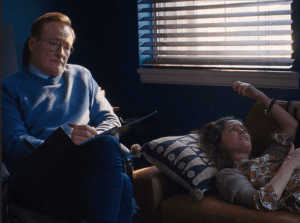
This movie is a lot. It’s a lot to process, and it’s very deliberately using disorienting creative decisions to test your limits. The sound design is an especially effective dynamic that raises anxiety. Bronstein never shows you the face of Linda’s daughter, at least not until the very end of the movie, and there’s a stark reason for this. Our identity is Linda, and this voice that keeps coming in, frequently interrupting, occasionally screaming, and often compounding the stress of her mom, is designed to be viewed as a primary source of agitation. We don’t see the daughter because in this vision she doesn’t exist as a character but more as a burden. We view the child as Linda perceives her. There’s a trying sequence where Linda’s client leaves her baby behind and vanishes, forcing Linda to cart around a crying baby while frantically looking for the mother. The soundtrack of a crying baby is like a direct line to your nervous system that something is wrong and all you want is for the child to be soothed, but it keeps going for nearly five minutes straight, with that screechy wailing eating away at you one cry at a time. I can readily imagine my wife watching this movie and just turning it off after ten minutes.
The movie is packed with these creative decisions, all designed to make Linda’s perspective that much more empathetic and exhausting. For those tut-tuting Linda viewing her daughter as a burden, I’d ask for some grace, but also the movie doesn’t withhold criticism from its protagonist. She can be selfish as she’s spiraling, even seeking comfort in bad places. It would be harder to endure if the perspective was purely Job-like, wherein Linda relentlessly suffers because the universe is indifferent, or God is unhappy and spitefully targeting this poor woman. It does feel like everything is going wrong, but that’s also because we’re anchored in Linda’s perspective. Seeing things from her daughter’s perspective would make for a fairly different movie, but that’s not what this movie aspires to be. It’s not meant to be balanced, it’s meant to convey a very specific viewpoint, and that perspective feels like everything is stacked against you. In one key moment, what my pal Eric Muller dubbed Byrne’s “Oscar clip moment,” she unloads on her therapist and desperately pleads for someone to just tell her exactly what to do, to have responsibility and uncertainty stripped from her life. She wants a clear direction and the relief of knowing what to do, something that is rarely so clear in the adult world. It’s hard not to feel for Linda in the movie unless you’re actively trying to reject the vision of the director. If I Had Legs is a movie deliberately designed to be overstimulating and upsetting, so it’s going to be a select audience willing to wallow in the discomfort for the insight offered. I can see plenty saying, “Yeah, I live this, so no thanks.” I get it. After becoming a parent myself, my tolerance for emotionally-draining media certainly lowered. However, I think there’s ample artistic accomplishment to be savored with If I Had Legs that is worth treading the discomfort.
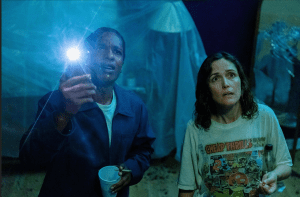
Byrne has been playing around the world of comedies since 2010’s Get Him to the Greek (a peak candidate for “most canceled cast” of the modern era, Byrne excluded) that I forgot how great she can also be in dramas. This is my favorite female performance of 2025. She is astounding. It’s smart to hire an actress of Byrne’s caliber, someone capable of finding the dark humor and exasperated guffaws of a life that feels like an assembly line of slaps to the face. The camera also rarely leaves her orbit, tacitly tying our sympathies, and it takes a lot to command the screen knowing your face is often going to be the measured focal point of every reaction to every slight and surprise and shock. She is the face of beleaguered motherhood, and it’s hard not to relate to at least a dozen moments of this nuanced and transcendent performance.
I don’t believe that If I Had Legs is unforgivably bleak; it’s certainly intense and agitating, but in order to make my finer point I need to spoil the end of the movie. However, dear reader, I truly don’t believe this is a movie that can be ruined through spoilers. So much of its appeal is the execution of such a specific vision, and to give one’s self over to that voice and its effect cannot be diminished through prior knowledge. It’s about the experience. Consider yourself warned, folks. Throughout the movie, the hole in Linda’s apartment ceiling becomes a sort of metaphor for her experience, an empty void. She dreams about losing herself inside the void, giving herself to the emptiness, and it’s easy to make a connection to darker impulses of self-destruction. This comes to a head at the very end, when Linda literally tries to run into the ocean to escape the troubles of her life, and the sea won’t have it, repeatedly throwing her back onto the shore. Even her attempt to escape ends up in tragic-comic slapstick. But it’s here where the movie switches gears, and we now see Linda’s daughter for the first time just as Linda is promising to be better for her. This changing of perspective effectively communicates Linda seeing her daughter, actually seeing her as a person rather than a nuisance, a peripheral voice of need and stress. The movie ends not on the harried breathing of Linda trying to calm down but on the hopeful smile of her daughter, and it might be misplaced optimism after a movie that feels plenty pessimistic, but I viewed this as a meaningful change. Even after all her struggles, even after her mistakes, there’s still the desire to do right for your loved ones, to improve.
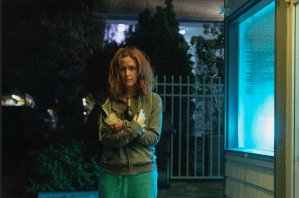
I originally wanted to do a double review, pairing If I Had Legs with Die My Love, the newest Lynn Ramsey movie that explores the inexplicable loneliness of post-partum depression with Jennifer Lawrence trying to reconnect with her body, her sense of self, and the world as it was and is. I felt beforehand that the movies would have the connecting themes of the difficulties of motherhood, and they do, but I feel both movies are so tonally different in approach and execution that they deserve to be judged separately. If I Had Legs I’d Kick You might just be that hard-to-stomach film-experience so many have warned about (don’t expect the hamster to last long), but it’s such a transporting, exhilarating, and deeply humane vision executed to a remarkable degree of vibrant life. It’s personal and yet easily empathetic. It’s an unflinching and unsentimental portrayal not just of motherhood but of the difficulties of maintaining sanity in a world that often feels indifferent to your needs. It’s a difficult movie to watch, yes, but that doesn’t mean it lacks value and impact. If you’re brave and willing to wade through the deliberate discomfort, If I Had Legs is a remarkably good bad time at the movies.
Nate’s Grade: A
Share this:

Hell of a Summer (2025)
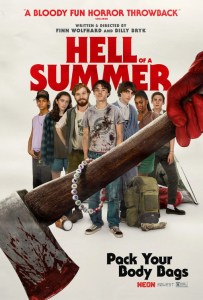 You’ve likely seen this kind of movie before, and co-stars/co-writers/co-directors Billy Bryk and Finn Wolfhard (yes, the Stranger Things actor has directed a movie by age 19) are counting on that. Hell of a Summer is a summer camp slasher movie with horny camp counselors trying to score before they get murdered by a masked assailant. The tone, however, is decidedly more heightened and goofy, aiming for more of an unassailable offbeat comedy like Wet Hot American Summer. It works because the horror/thriller elements, and the general mystery of who is the real killer, are never really that compelling, clear pastiche but no more than that. The real entertainment value comes from the silly characters navigating familiar teen troubles like relationships, growing independence, and the scary uncertainty of being an adult, with a heightened seriousness amidst the ridiculous, approaching camp-levels but without being obnoxiously self-aware. That’s why I credit Wet Hot American Summer as its primary influence. There’s a loosely experimental yet admirably confident air to the presentation. Even when the jokes aren’t landing or the pastiche is getting old, I held out with hope that another strange moment might catch my fancy in short order, like Wolfhard being obsessed with the hydration of his peers, or Bryk having a crisis of self-doubt when people suggest the killer is targeting the “hottest counselors” and he’s not been targeted yet. It makes for a silly, inoffensive bauble of a movie with clear affection for its genre influences. If you can’t get on the movie’s comic wavelength, it will make for a slog of 90 minutes. Hell of a Summer might make you smile enough to warrant one pleasant viewing, and who knows, this might just be the beginning of Finn Wolfhard, directing titan.
Nate’s Grade: C+
Share this:

He’s Coming to Get You! (2025)
 Kyle Rayburn might just be one of the nicest human beings you’ll ever meet, and he’s admirably unafraid of pursuing his dreams, whether it’s starting a chicken wing food truck or making micro-budget horror comedies in central Ohio. The man has gusto, and it shines through the seams of his hardscrabble yet charming earlier cinematic efforts, Night Work and Satanic Soccer Mom from Ohio. Each of Rayburn’s movies is filmed for under $5000 and shot on an iPhone. He’s in a production groove, promising the next adventure during the credits of his latest completed movie (coming up next: Slam Hounds), and his latest cinematic salvo is the evocatively-titled He’s Coming to Get You!, a title that William Castle surely would have nodded in solemn approval. It’s more or less The Crow by way of Sam Raimi, who even gets name-checked in the movie, a supernatural-fueled revenge thriller with goofy slapstick and self-aware references. It’s a fairly entertaining beginning and ending to a movie that, unfortunately, at just an emaciated 51 minutes in length before end credits, lacks the development for a satisfying exploration between start and finish.
George Russo (Scott Baker, Sulphur for Leviathan) is turning thirty-three and looking forward to a night of cavorting with his long-time girlfriend, Aja (Alyss Winkler, Space Babes From Outer Space). A team of sex traffickers (Jason Crowe, Seth McGuffin – yes, that is his real last name) is determined to capture Aja for their boss. They mug the happy couple and shoot George in his face, killing him and kidnapping Aja. An occult bookstore owner (Grace Plazolles-Hayes) resurrects George through the power of voodoo. He’ll be alive for the remainder of the night, enough time to track and rescue Aja. He’s also a “pain sponge,” meaning that he can take lots of physical punishment and keeps on going, the Energizer Bunny of vengeance, if you will. Can he rescue his beloved before it’s time once again to shuffle from the mortal coil? Will he be able to inflict maximum justice while also trying out some long-sought kung-fu moves?
 From that description, you can see how the premise would suffice as a movie for He’s Coming to Get You! (it’s never going to be normal in my brain to type a period after the punctuation in the title). There’s something inherently appealing about revenge stories, and you add a supernatural element that doesn’t just level the playing field for our undead underdog but gives them a key advantage, and we’re hooked. It really is The Crow with a better sense of humor, or, well, any sense of humor. Along those lines, giving our avenging crusader a sense of humor that would fit into Army of Darkness is a great boon. The heavier aspects of the movie like murder, assault, and trafficking are mitigated by having a main character who has definite Bugs Bunny by way of Bruce Campbell energy. It’s the filmmakers way of saying to the audience not to get too worried because the results will be more like an amiable, goofy hangout.
After three movies, I can say that Rayburn and his co-writer/producer Ben Reger love making movies that are, first and foremost, concerned with imparting good times no matter the twisted material. I laughed out loud a few times, like when a thug, seconds before his imminent death, replies forlornly, “I never saw Pari.” I laughed at George attempting a kung-fu move and then berating himself, “Nope, felt wrong the second I tried.” There’s a pair of bumbling cops (played by Rayburn and Reger) that you can tell they have such affection over, even if they seem like the most incompetent cops on the beat. It all encapsulates a certain teenage boy ethos of rock and roll, scatological humor, babes, and cartoonish violence. The infectious vibes of the movie are back and appealing, a feature that can elevate low-budget movies with obvious limitations. It’s the same with the mumblecore movies of the 2010s, low-budget slice-of-life movies buoyed by strong characters and sense of place. There is no budget on engaging storytelling. It’s the same with Rayburn and Reger’s collaborations. Whatever the premise, theirs is a universe you’ll want to make pit stops for the irreverent good times and weirdness.
 And that brings me to my biggest hesitation with He’s Coming to Get You!, mainly that in its final form it comes across more of a proof of concept for a bigger movie than feeling like a complete feature. This is primarily because of its length and the rushed development skipped over for an abbreviated Act Two. The total running time before end credits is 51 minutes, but if you subtract the opening credits that play over the montage of George getting up for the morning, that’s an additional three and a half minutes, taking the running time to a paltry 48 minutes or so, fitting an hour of network TV rather than a feature-length film. From a structural standpoint, George is killed at the 21-minute mark, resurrected and sent on his mission at the 31-minute mark, foils the bad guys by the 46-minute mark, and then the movie ends at minute 51. That’s it. It’s hard not to feel a little cheated; the “coming to get you” part of the title is only 15 minutes. Imagine The House on Haunted Hill but you’re only on Haunted Hill for all of ten minutes.
The movie is sprinting through potential plot and further world-building that would help to make its storytelling feel more original and engrossing. Once George is resurrected, he is given great powers but there aren’t any notable rules on the powers besides the fact that they, and he, will expire upon morning. The villains never really have a chance to even process their new adversary as he just shows up, kills them, and then wins the day on his first attempt. The absent struggle and creative development hampers some of the fun, like the movie was in a rush to call it quits over practical considerations. After George is resurrected, there’s one other group he gets to test his new powers on before it’s already time to eliminate the people who killed him. In The Crow, the main character targeted the gang of killers one-by-one, with them learning about this new threat gradually and planning counter-moves. The way it plays out in this movie is all too easy. It’s like an acknowledgement that an audience won’t want to watch a full movie of a supernatural hero getting everything he wants too easily, but the answer isn’t to just shorten the movie, it’s to better develop the premise and ensuing conflicts and challenges and unique world-building. I’d rather watch a version of this movie where George has to figure out his powers and has certain rules and limits than a speed-run to the finish without any interesting challenges, organic complications, or surprises.
 There is one moment toward the very end of He’s Coming to Get You! that I feel is emblematic of the positives and drawbacks of the development, but it involves some mild spoilers since it concerns the conclusion, so be advised, dear reader. Aja and George are reunited and finally get some privacy in the bedroom. Aja has been promising quite a bevy of sexual activity for George’s birthday. They’re finally alone, she performs a strip tease, then she crawls into bed and the movie cuts to them just talking and laughing. I thought that was a nice subversion. They have one final night together, so why spend it on physical copulation when you could wile away the hours talking to your favorite person, hearing their laugh, reminding yourself why you love them before they’re gone for good? Besides, having sex with a resurrected dead body, who has been stabbed and beaten throughout the movie, might make for an extremely upsetting final memory of your lover. Plus there’s the whole possible joke of being unable to control blood flow since, you know, blood doesn’t flow anymore anyway. I thought this was clever and sweet. Then it’s revealed that George and Aja did indeed have their sex off-screen and this is just post-coital pillow talk rather than a subversive replacement. Oh? Oh well then.
After three movies, I can start to catalogue the Kyle Rayburn film experience: silly comedy cul-de-sacs, low stakes regardless of circumstance, celebration of schlock, amiable vibes, actors having fun regardless of experience, lo-fi visuals, minimal if any coverage beyond shot-reverse shot edits, and underdeveloped stories. This has been my chief criticism with each of Rayburn’s previous movies, that they benefit from fun ensembles and intriguing premises but that more work could have been done to better realize the potential of each. I often walk away from these movies thinking we got the first draft onscreen. He’s Coming to Get You! is the most real world setting in a Rayburn vehicle, so there aren’t as many interesting characters or details to the world to cover some of those plotting shortcomings, so the vacancy becomes more notable and damaging to the entertainment. It’s easy to graft onto the relaxed, schlocky wavelength of the movie but by the end I felt a little shortchanged in creativity and execution, missing a movie middle. I’m happy Rayburn is following his dreams and has built a staple of returning players. He’s Coming to Get You! has enough going for it that I wish the team had dug in more. I only wish that whatever the next three or four projects prove to be, that Rayburn and his team take more time to really work through their particular story conventions to make them the best version they can be, not just completed.
Nate’s Grade: C+
Share this:

Havoc (2025)/ Novocaine (2025)

Action cinema has long been one of the most satisfying experiences for the always-insatiable moviegoer, being presented with the thrum of kinetic editing, expert choreography, and visceral photography to produce a sensory thrill. Watching a well-developed action sequence is akin to watching a stupendously choreographed dance, where the movement and struggle are part of the storytelling momentum. Two recent action movies show what can be achieved, one through intensity of the familiar and the other through elevating its concept. Both are fairly enjoyable escapes and reminders that, with the right hook or sense of passion, action cinema can be some of the most gleefully transporting sensory experiences.
One of the best genre filmmakers is Gareth Evans, a man who blew the industry away with his intense Indonesian martial arts epics, The Raid and its even better sequel. After watching those movies, and taking time to catch your breath, you have to wonder why Evans isn’t directing every Hollywood action movie, or at least been tapped to try his hand at juicing some studio franchise with his visionary feel for action. It’s still a mystery to me that Evans has only helmed two movies since 2014. Both of them happen to be from Netflix, and while I don’t pretend to understand the creative machinations behind this streaming giant, if I were them I would give Evans a $20-million budget every three years and tell him to do whatever he wants as long as it involves people getting hurt. At first glance, Havoc looks fairly conventional, a crime drama about corrupt cops and hoodlums fighting over who can get to a target first. You have to keep reminding yourself that Havoc is not The Raid and not aspiring to be, so the fact that it cannot rise to that extreme level of action excellence does not mean it is a failure. It’s not in that upper echelon of action cinema, like your John Wicks, but Havoc is most definitely a step above many of Netflix’s junky action-thrillers with A-listers that inevitably disappoint in their flailing execution.

Tom Hardy plays Walker, a veteran cop who works as an enforcer when the money’s right. He’s tired of being a tool to the rich and powerful and looking to get out and be a better family man. You know, the stuff of formulaic action boilerplate. He gets involved in a job gone wrong that leads to a gang war spreading and plenty of hired guns looking to find the son of the mayor (Forest Whitaker). That’s about it as far as the plot. It’s about different groups racing to get what they want first at whatever bloody cost.
Whereas The Raid was a martial arts action extravaganza with professionals at the top of their game getting the platform and material to showcase their amazing skills, Havoc is not that kind of movie; in fact there’s very few moments where the action consists of fisticuffs. This is an action movie built on car chases and mainly gunfights. It’s a cops and robbers kind of action movie, which puts less emphasis on hand-to-hand and more on room clearing. While the accumulated thrills might not be as gratifying as watching professional athletes launch exciting routines, there is still plenty to enjoy when watching finely developed gunfight sequences. The boring approach is simply to convey a shot-reverse shot dynamic: Character A fires a gun, then cuts to Character B being shot or dodging, repeat. Good directors will think about how to better stage a sequence so that each one has its own purpose, its own set of mini-goals, a set of organic complications that keep the conflict roiling, and ways to connect to character. Action sequences should not just be excuses to blow something up. With Havoc, it takes quite a bit to get going, but there are two standout action sequences that make it worthwhile and will satisfy most action aficionados.

The first sequence is a fight in a club that kicks off the movie’s shift to constant scrambling action. It’s about 50 minutes into the movie and all the respective characters have been slotted into their conflicting positions. We know who the good guys are, the bad guys, the goals in opposition, and what the stakes are, and from there the movie just takes off in a sprint until its final blast. The club involves different levels and different factions fighting and mixing, providing a series of changing complications that makes the sequence feel more lively and engaging. There are several inventive moves to avoid gunfire or reach guns, and the cinematography keeps the action centered and easy to comprehend. The best action sequences are planned like moving puzzles, and the more work that is put into the preparation, the more enjoyable the action can become. This club shootout scene finds numerous ways to keep the stakes upended and to place the characters in new forms of danger they have to quickly adapt to survive.
The second sequence is a climactic confrontation at a cabin in the middle of a snowy forest. It’s a prolonged siege sequence where the bad guys are attempting to break through into this secure location and take out our heroes. From this claustrophobic setting, Evans presents the antagonistic intrusions as unrelenting and coming from all four walls and even below as well. The characters have to constantly be moving and reacting to an assembly of threats while their protective walls begin to literally crumble. It is a literal onslaught. I’m shocked the cabin is still standing by the end. It’s an immensely engaging sequence that communicates the frenzy and anxiety of being under constant attack. The gunplay can be brutal and there are satisfying kills and battles between side characters throughout this sequence to avoid the sequence from feeling too repetitive. It feels in many ways like the whole movie has been leading up to this sequence, not just in a traditional linear-plotting fashion but also the viewer has been waiting for the director to fully go off with a celebration of action mayhem. This is Evans unleashing his best, and he’s adapted his creativity to the setting and the action sub-genre, so there’s different moments meant to present immediate gunfire problems and fast-paced responses. In this world, people aren’t all gifted as expert fighters, and thus even our heroes can falter under the harried circumstances.

Short of these sequences, the rest of Havoc has difficulty breaking free from the gravitational pull of its own genre cliches. Evans wrote the screenplay by himself and I’m surprised how flimsy so much of the story and characters come across. With 2011’s Raid, there wasn’t much of a story once the action stopped, but with 2014’s Raid 2, Evans was able to compose an undercover cop story that was just as compelling even when people weren’t getting kicked in the face. He can write colorful side characters that feel like they stepped out of a Tarantino-favorite grindhouse movie. He can write tense sequences that don’t have to rely upon action. He can do so much more than what Havoc provides, so it’s hard not to feel like this wasn’t exactly a passion project. It feels more like a serviceable vehicle to achieve the kind of action that Evans was looking to achieve. Now, if you’ve underwritten a genre movie because your real interest is staging the action, then you would expect there to be more action, correct? Strangely, Evans spends most of those first fifty minutes setting up his story, the same story that is awash in genre stock roles and cliches without much intrigue beyond a one-sentence description. Simply put, if you’re going to stick us with underdeveloped characters, don’t keep us waiting for the action. There’s so many characters in this movie that I think Evans gets overwhelmed trying to set them all up and involve them in the larger story. If they’re only going to be stock roles, why do we need 30 when 10 can do? I think Evans keeps his cast so big so he can unceremoniously bump off so many of them, which can be surprising, but I would have preferred doing more with the space their absence might have provided the narrative. There’s also an odd stylistic choice where any exterior shots are much more stylized, looking more like video game cut-scenes or something out of the realm of Sin City. It’s at odds with the rest of the film’s stripped-down look.
Havoc is a gritty and bloody action movie that can overwhelm at moments and underwhelm at others. The genre grist is pretty familiar, from our troubled antihero lead trying to atone for his past sins, to the dumb kids in the middle of a gang war they don’t understand, to the good-natured partner who has to grow up, so to speak, by getting their hands dirty. You’ve seen variations of these stories before, but the real draw is once Evans works up enough space to really unleash his invigorating action best. It’s a movie I wish was better but it’s functional enough for Evans to do his extraordinary thing. I just want more of his specialty.
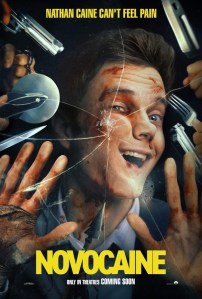
In comparison, Novocaine isn’t going to be defined by stylish choreography or exceptional style. It’s a high-concept action comedy driven by flipping the genre script. Instead of our hero inflicting great pain on his foes, this movie is about a hero enduring amazing amounts of pain. It’s an underdog story where a novice is thrust into an unfamiliar situation and has to utilize his unique disorder, a blessing and a curse, in order to rescue the girl and save the day. It’s a great premise that lends itself to plenty of fun scenarios to fully capitalize on its bizarre potential, and that’s where Novocaine hits a sweet spot of entertainment.
Nate (Jack Quaid) is a shy assistant manager at a small bank in San Diego. He suffers from a unique medical condition where he doesn’t feel the burdens of physical pain. You might think this a luxury but it’s actually a great worry for Nate. Without his body’s alarm system he can stumble into grave danger without even knowing it, so he’s been living an overly cautious life as a result. That all changes when he meets Sherry (Amber Midthunder), a new coworker who takes an interest in him. They go out on a date and really hit it off. Things are looking up for Nate until bank robbers storm his work, kill his boss, and take Sherry hostage. Nate hijacks a cop car and goes chasing after the bandits to rescue Sherry. He’ll undergo lots of trials of pain to win back the girl who makes him feel things.

How do you make a person invulnerable to pain an exciting character? It’s the lingering Superman question, except nobody is going to confuse the character of Nate with Krypton’s orphaned son; if a character cannot feel pain how can we worry over their well-being? Now there’s a reason writers have been able to tell Superman stories for decades, even if the movies often struggle with representing the figure, and that’s because it just forces you to have to think harder. It can be done. With Novocaine, Nate is a hapless naif thrown into an action movie and trying his best to fit in. He lacks physical prowess, weapons training, and tactical planning. However, the only thing he has going for him is his inability to feel physical pain, and the filmmakers routinely find funny and entertaining methods to test how far one could go with this pain threshold. While his body isn’t registering pain he is still taking all the punishment. Nate is nowhere near indestructible, and a running gag becomes how utterly mangled and deformed his hand becomes from event after event (I thought it was just going to be a stump by the end). He takes quite a beating but because of the whole “mind over matter” matter, he’s surprisingly able to persevere where others could not. This allows Nate to become an unexpected hero where the rest of us would pass out from shock. The appeal of the movie isn’t so much the action itself but the ongoing response to all of said action.
The set pieces are what makes this movie so much fun, pushing Naate into action hero mode when he’s clearly awkward and not ready for the promotion. I loved his dry responses to every new injury, from mild annoyance to feigned surprise. There’s a scene where one of the villains is torturing Nate and he has to go along with the charade in order to appease his tormentor and get valuable information out of him. It’s a reverse interrogation where the target is actually trying to manipulate the guy with the pliers. I loved how quickly he could bounce back from whatever trauma, from catching a knife blade first and quickly yanking it out of his hand, to casually writing an address on his hand with a tattoo gun. There is a crafty ingenuity to how the filmmakers can make the best use of this superpower. There are some impressive kills that also made me wince in response, like reaching for a gun at the bottom of a deep fryer, or literally stabbing a person in the face with an exposed arm bone. Novocaine has a delightfully demented sense of humor that keeps everything grounded with mordant laughs even when it’s dishing out the punishment.

Even more surprising, there’s a buoyant love story that genuinely feels sweet that could have benefited from a little more development and attention. Sherry is the one who activates our protagonist and pushes him outside of his comfort zone. He lacks confidence in himself and has been living an overly cautious existence from fear of not being able to respond to his body’s emergencies. The man has been eating his food as liquefied goop out of a fear of choking. She introduces him to the simple joys of eating one’s food before it’s been vigorously blended, like the wonders of pie. Their first date was genuinely charming and I liked the chemistry between both actors. Midthunder has been a favorite of mine since Prey and I want to see her in more varied roles. When the bank robbery commences, I actually had an emotional response to these two being in danger and watching the other being put in danger. Once she becomes a hostage, Sherry is placed as the damsel to be saved, which is disappointing because I liked her contributions to the story and especially what she brought out of Nate. There is a revelation with her later that reorients our understanding of her but I don’t think it was fully necessary. Their budding romance is quite enjoyable and so I wish the story could also continue to develop this connection over its wild series of mishaps.
Novocaine is a great example of a movie that maximizes its unique premise to stand out. It’s structured like a traditional action-thriller but it never takes itself seriously, pushing forward a stumbling protagonist whose real gift is that he’s the human equivalent of a punching bag. This dynamic is ingeniously developed and showcased, and just when I was worrying the premise might get old or become repetitive, the filmmakers find new ways to twist their story into even better twisted results. I wish the female supporting role was more tied into the action and fun, and the villains are a bland blend of overly confident paramilitary goons. Still, the fun comes from Quaid and his light-footed screwball performance anchoring the bloody hi-jinks and demented humor. Novocaine is a fresh reworking of action movie tropes with a twist that allows the audience to heartily laugh at our hero’s pain and pratfalls. It’s the kind of humor and energy that reminds me of the Crank filmmakers. If you’re looking for a winning dark comedy bouncing against the formulas of action movies of old, settle in for some Novocaine and enjoy the pain.
Nate’s Grades:
Havoc: B-
Novocaine: B+


 nathanzoebl
You must be logged in to post a comment.