Blog Archives
Duplicity (2009)
 This is the kind of slick, breezy fun that Hollywood seems to have forgotten how to make, or at least forgotten to make well. Writer/director Tony Gilroy has concocted an entertaining movie headlined by movie stars clearly having a blast. Gilroy’s narrative routinely folds back on itself with plot reversals, supplying new perspectives to the ongoing con/heist involving Clive Owen and Julia Roberts as ex-spies and current lovers. The movie itself is one long, pleasing con that manages to stay a step ahead of the audience without coming across as too confusing or dull. The tricky, twisty plot means that the audience must constantly reevaluate the movie, meaning that watching Duplicity can be described as less involving and more like an assignment. Gilroy is a sophisticated wordsmith and he has been knocking out crafty, intelligent adult movies, from the Bourne franchise to 2007’s Michael Clayton. The man probably spent too much effort trying to keep an audience on its toes. The audience becomes keenly aware of the plot structure, and we know it’s only a matter of time (usually 10-15 minutes) before another flashback reveals something else that will change the rules of the game. Still, the movie benefits from fantastic character interplay between Owen and Roberts and a superb supporting cast lead by Tom Wilkinson and Paul Giamatti as scheming corporate scoundrels (the opening credits slow-mo fight between the two men is delightful). Duplicity is an enjoyable romp with snappy dialogue, sizzling stars, and little re-watchability once all the plot machinations play out.
Nate’s Grade: B+
Share this:

RocknRolla (2008)
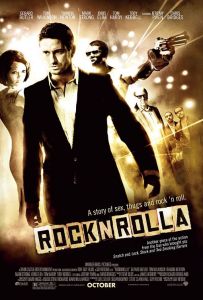 I’m a fan of Guy Ritchie’s convoluted cockney comedic crime capers (wow, check out that alliteration), but this movie is just plodding and dull. The trouble is that Ritchie works best when he has one foot in the fantastic, with comically over-the-top and menacing underworld personalities. A Ritchie movie usually involves a lot of crisscrossing characters, but this is his first film where I couldn’t keep the folks straight, I couldn’t understand much of the personal connections, I couldn’t understand the purpose of the various characters and their various interplay, and frankly, I never bothered to care. RocknRolla has maybe two colorful characters (all hail Tom Wilkinson as a sleazy real estate gangster), but the rest of the movie is overstuffed with bland and forgettable toughs. What the hell are Ludacris and Jeremy Piven doing here? You could eliminate half of the cast and the movie would barely be affected. This movie is just way too straight and square for its own good. Ritchie is still a top-notch visual stylist, and the movie has a terrific deep focus digital video cinematography, but there are very few moments or visual flourishes in this flick that prove to be remotely memorable. I hope Ritchie does not make good on his promise to continue telling more stories with these characters and in this style because this many needs to get back to what he does so well, and that is telling the darkly comic escapades of larger than life Dick Tracy-esque villains and scoundrels.
Nate’s Grade: C
Share this:

Slumdog Millionaire (2008)
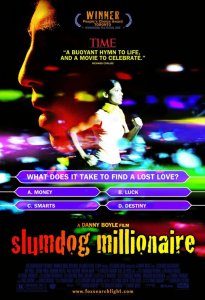 If there is one independent movie that seems to be picking up momentum this awards season, it’s Slumdog Millionaire. The film seems destined to break out into the mainstream, especially in a time where audiences could use a happy story given the ongoing news of economic downturns. Slumdog Millionaire is a highly spirited rags-to-riches tale that marries Hollywood and Bollywood into one fantastic product.
Jamal (Dev Patel) is an 18-year-old kid who grew up impoverished in India’s favellas. He’s also on the verge of winning 20 million rupees on the Indian version of the Who Wants to Be a Millionaire? Game show. The TV host reminds Jamal that lawyers and doctors have never gotten as far as he, a lowly “slumdog” from such humble origins. As each question emerges we discover more about Jamal’s life, from escaping a riot, touring India as a stowaway on a train, conning American tourists at the Taj Mahal, to his assistant work at a call center. Throughout Jamal’s life are two constants: Salim (Madhur Mittal) and Latika (Frieda Pinto). Salim is Jamal’s scheming older brother who has a loose sense of morals. He finds a life of crime as a suitable escape from poverty. Latika is a young orphan girl that Jamal befriended as a child. He declared that she was the “third Musketeer” in their group and has always sworn to love her. This is complicated because Salim’s crime boss wants Latika for a prize, and Salim keeps his younger brother away from Latika. Ultimately, as an entire nation watches with baited breath, Jamal explains that he is appearing on TV because he knew that Latika, his love, would be watching somewhere.
 It’s like City of God and Forrest Gump had a baby that was raised by Oliver Twist. The film is given a dynamic energy thanks to director Danny Boyle’s exuberant camerawork and skillful style. Boyle is a director that knows how to make images jump and Slumdog feels like it is coursing with life. The feel-good fantasy nature of the rags-to-riches plot is offset by some pretty harrowing violence, and Boyle makes great pains to show the realities of living in squalor. At one point a very Fagin-esque local crime lord collects young orphans to be beggars and he has a foolproof scenario to make these kids sympathetic and thus big earners — he blinds them with hot liquid. Despite the fantastical elements, Slumdog is rated R for a reason and that’s because it does show the cruel reality of a life in the slums, granted it’s nowhere near as bleak and formidable as something like City of God. After all, the kid gets to win on a game show, though the movie does open with Jamal being tortured by the police. Boyle has a tremendously natural eye for crafting visuals that delight the senses; he can make his shot compositions feel interesting without ever truly calling attention to being flashy. The views of India are beautiful and fascinating. Plus, having a majority of the movie in a foreign dialect was appreciated (Boyle provides different color background for different character’s subtitles, a nice touch). There’s a magic feeling to the film that definitely takes hold of the audience, an uplift that channels smiles and gasps of joy. While I’ll still credit Millions as Boyle’s best film since Trainspotting, his work on Slumdog is deserving of praise. I don’t know if another director could have made a film with so many contradictory elements (feel-good flick with child prostitutes?) run so smoothly.
The movie is also given a brilliant story structure by screenwriter Simon Beaufoy (The Full Monty). The movie is built around a steady stream of flashbacks linked to the questions Jamal tackles on the game show. So the host will pose a question and then we’ll be treated to a 10-15-minute flashback to Jamal’s life to discover how he knows the answer. The approach is fresh and it reinforces the magical notion that Jamal’s life has all been leading up to this moment of glory. Beaufoy’s script smartly weaves many storylines together to give us an emerging sense of who Jamal truly is. He manages to write an uplifting and hopeful tale that stays clear from easy sentiment. Indeed, Slumdog is an accomplished feat of writing as well as direction. Working from the Indian novel Q&A, Beaufoy has written a modern-day fairy tale in the same fashion as the Brothers Grimm, which means he didn’t skimp on the unpleasantness and hardship. Yet Slumdog is able to find great human spirit amidst the squalor. I doubt I’ll see a climax more rousing and crowd-pleasing all year. Seriously, you’d have to have a pretty hard heart not to feel some excitement and jubilation in the closing moments.
 This unlikely fantasy is aided by sharp performances by a collection of actors. Jamal is an unassuming yet plucky underdog, and Patel nicely handles these elements. He’s a stringy kid but he carries himself with charm and fortitude. As he grows confident he spars with the combative TV host, and it’s fun to watch. Pinto is a swell looking beauty with a great smile but I wish the story had given her more to do as an actress. The young actors who play Jamal, Salim, and Latika as young children actually give the best performances.
And now after all my effusive talk comes the time where I must voice my minor reservations. First off, the structure is ingenious but having Jamal interrogated by the police after the fact seems unnecessary, plus it also tips off the audience from the beginning that this kid has already won it all, which sucks some of the tension out of the game show format. I really think the movie would have been better served just playing out the game show in real time instead. Also, it’s a bit too convenient that every one of the quiz questions triggers a memory in a linear fashion. Jamal can tell his life’s story from beginning to end, but the movie would have been more challenging and interesting if the quiz questions forced Jamal to bounce around in his own memory. That way the script would provide more mysteries that could lead to even more satisfying answers. The Millionaire game show also goes on a commercial break and Jamal is astoundingly allowed to leave and go to the bathroom after he knows one of the high-money questions. In the age of wireless Internet, no game show would ever allow the contestant to leave its sight. Finally, the movie is presented like a Dickensian fable told in chunks, which means I found it hard to fully embrace the central romance that drives Jamal. I will readily follow the romantic notion of locating your true love, however, I will feel more involved in that search if the combined time Jamal and Latika spent together was longer then like a week. Seriously, they see each other every few years for a moment and then are broken apart, only to find each other again for a few moments to be broken apart. She’s more a symbol than a fully translated character, though this did not stop me from rooting for a happy ending.
 Slumdog Millionaire is a thrilling, funny, and triumphant story that courses with lively electricity, thanks to the deft direction of Danny Boyle. This movie is enormously entertaining while still baring a social conscious about the plight of those impoverished, though I hope people don’t get the mistaken idea that all that character-building impoverished life styles will lead to future fortunes like Jamal. The movie is hopeful and uplifting while also balancing tense violence and improbable circumstances. While I’m not on board with the critics calling this the best film of 2008, it has some minor flaws in approach to storytelling and character, Slumdog Millionaire has all the right markings to be a crowd-pleasing sensation. After all, it is destiny. And that’s my final answer.
Nate’s Grade: A-
Share this:

Dear Zachary: A Letter to a Son About His Father (2008)
 Dear Zachary: A Letter to a Son About His Father is an extremely personal movie, but it’s also a gut-wrenching, emotionally devastating film that will completely empty out your tear ducts. As an ardent fan of film, I cannot fully advise doing some research on the real-life case before seeing the movie, but those with less strong sensibilities may be better off knowing what they are going to be in for. This film is emotionally draining and infuriating, but it is also unquestionably one of the best films of the year, bar none. Just thinking back on it makes me have to fight back tears.
In 2001, Dr. Andrew Bagby died at age 28. The squat man had a chubby face, a large personality, and an innate ability to make friends wherever he went. Here was a case where one man made a difference simply by living out his life (several grooms had pegged him to be their Best Man in weddings). Filmmaker Kurt Kuenne decided to make a movie that would serve as a living testimony to the life of his departed friend. He traveled the nation, interviewing scads of friends and relatives about what Andrew meant to them. For Kuenne, Andrew was his childhood best friend and the star of numerous home videos, which are a treasure trove of footage that reveal a charismatic star.
 But, you see, Andrew didn’t simply die, he was murdered. He was enrolled at med school in St. John’s, Newfoundland. There he met a woman who became instantly smitten and very emotionally needy. Dr. Shirley Turner was 40, twice divorced, and controlling. Friends lament that Andrew’s fragile sense of self-esteem when it came to girls probably made it easy for him to relish the lavish attention that Turner gave him. He found a family practice in Pennsylvania for his medical internship, and he didn’t invite Turner to come along. After being dumped, she drove 1000 miles to talk to Andrew. The next morning he was dead, lying face down in a park and having been shot five times. The circumstantial evidence was pretty damning for Turner, so she fled the country back to St. John’s in Canada. Andrew’s family thought the extradition process would be over quickly, but the wheels of justice in Canada spin even slower, and Tuner, a likely premeditated first degree murderer, was allowed to be free on bail even though she didn’t have to put a single cent down, nor did anyone else.
But this is where the story gets even more tragic. Turner revealed to the world that she was four months pregnant, and a DNA paternity test revealed that Andrew was the father. Andrew’s parents, David and Kate Bagby, moved to St. John’s to gain custody of the last link they had to Andrew. Kuenne’s film had a new purpose: to educate a child about the father that they will reluctantly never know. Turner gave birth while in prison and named the child Zachary Andrew Turner. Amazingly, the Canadian courts gave Turner custody while the extradition process dragged on for nearly two years. One ruling by appeals Judge Gale Welsh will make your head explode. While Turner was in jail and going to be extradited, Welsh granted Turner bail, again, without requiring Turner to put any money down, again (are numbers just meaningless?). Welsh ruled that Turner did not pose a threat to the community because the alleged crime of murder was “not directed at the public at large but was specific in nature.” Ergo, because Turner only sought to kill one man and succeeded, surely she poses no risk to others. Excuse me? And you’re a freaking judge? It does actually get worse from there.
 You will likely not see a more chilling antagonist in a movie this year than that of Dr. Shirley Turner. I do not say this lightly, but this woman is evil. You never see a glimmer of remorse in her eyes, only cunning manipulation and a deep psychosis. She readily knows the power she has and punishes Andrew’s parents over and over, putting them through an emotional wringer to be near their grandson, and all the while Turner pretends like nothing of consequence happened. It’s like a normal play-date between her and her in-laws. I am amazed that Andrew’s parents were able to swallow so much injustice to be involved with Zachary, the last living connection to their lost son. When David Bagby says how much he hated Turner, you too will feel every bit of seething anguish. To be fair, Kuenne’s film is wholly biased when it comes to his depiction of Turner, but you know what? I don’t care. Let’s objectively compare Andrew and Turner and see what each left in their wake. Andrew has a glut of friends and family that mourn him. Turner does not. This woman is evil and she had a long history of dangerously unstable behavior that Canadian justice officials ignored. The lengths that Turner will go to hurt others is terrifying. This woman makes Joan Crawford look like a responsible parent.
But while it’s the horror and tragedy and near unbearable sadness that will long stay with you, Kuenne’s movie also is a showcase for the capacity of human goodness. Andrew’s parents should be fast-tracked for sainthood after having to obey the whims of their son’s emotionally disturbed killer, who astoundingly was given the upper hand in the custody battle in Canada. David and Kate are exceptional people, both hardscrabble and resourceful but also funny and enormously good-hearted. When they move to St. John’s they immerse themselves in the community and quickly collect new friends. Many of Andrew’s friends feel like they were practically adopted by his parents; they will readily credit David and Kate for expertly raising such a beloved person. Dear Zachary is a terrific example of people who excel at parenting, who instinctively know how to tackle the greatest challenge in life, shaping a human being. Kate is so naturally loving with little Zachary that it eventually causes friction with Turner when she realizes that the baby doesn’t want to leave grandma’s arms. By the conclusion, you will feel better about the state of humanity that there are people like David and Kate out there to make a difference in a thousand subtle ways in a thousand different lives.
 As a filmmaker, Kuenne doesn’t overwhelm his true-life tragedy with spiffy visual artifice. That doesn’t mean Dear Zachary feels like a glorified home movie. It’s somewhat morbidly fascinating to watch one man work through his grief, and the film serves ultimately as a means of catharsis for the filmmaker. In that regard, Keunne can be forgiven for overdoing it a tad with some music cues trying to amp up emotion that’s already present. He also displays his understandable anger at certain points that mock Canadian authorities and Turner. The imperfections seem to make it feel more authentic. The documentary is only 90-some minutes but Kuenne packs lots of information and interviews into a small space of time. In fact, Kuenne serves as director, writer, narrator (he occasionally even gets choked up), composer, but his work as editor is the most accomplished. Through teams of interviews and home movies, Kuenne is able to bring Andrew to life in a manner where an ordinary audience member feels like they know the guy. The editing can be spastic, sometimes interviews bleed over into one another and Kuenne uses elliptical sound bites for poignancy. The editing keeps viewers alert and intrigued. I never found the editing to be problematic, but I welcomed Kuenne trying to pack as much life into his film about recreating a life.
Dear Zachary is a documentary that needs to be seen to be believed, and it desperately and deservedly needs to be seen. This potent doc is emotionally wrenching and will stir up great anger, which might just point lynch mobs toward our bewildered neighbors to the North. But Kuenne’s film isn’t just a sad movie that requires a few boxes of tissue at hand. No, Dear Zachary is also inherently a very life-affirming tale about the long reach of human goodness, as evidenced by Andrew and his parents. While the Academy has already left Dear Zachary off its shortlist for the Best Documentaries of 2008, I doubt you’ll find a more stirring and heart-breaking story in documentary form.
Nate’s Grade: A
Share this:

88 Minutes (2008)
 Typically you can smell something wrong when a movie is continually delayed or held from release for well over a year. The serial killer thriller 88 Minutes actually began filming during the fall of 2005 (!). It was released in the United States well after it had been available on DVD in Europe for over a year. After watching all 108 minutes of 88 Minutes, it’s easy to see why the studio and the film’s astounding 20 producers (!!) were trying to hide this from public eyes.
Dr. Jack Gramm (Al Pacino) is the top forensic psychiatrist in Seattle. His testimony is responsible for convicting Jon Forster (Neal McDonough) of a death sentence. Many years later, Jon is now hours away from execution and still professing his innocence, claiming the real “Seattle Slayer” is still out there. Gramm works as a college professor and he can still woo the young ladies and beds them regularly. His assistant (Amy Brenneman) informs Gramm that a woman in his class has been murdered and her murder is patterned after the “Seattle Slayer” killings. Gramm believes that Forster is collaborating with someone on the outside to cast doubt on his conviction. Then as Gramm walks to class he gets an anonymous phone call that tells him he has 88 minutes to live. Gramm scrambles to try and use the time to figure out who is targeting him, framing him, and why. Could it be his assistant, his T.A. (Alicia Witt), his skeptical students (Benjamin McKenzie, Leelee Sobieski), the skeezy campus cop, or maybe the starting second baseman for the Seattle Mariners?
 First off, the time frame doesn’t work at all. 88 minutes is too short a time frame to do crack investigation, and Gramm runs all over the city of Seattle at least three times without getting caught in any gridlock. The movie establishes a real-time ticking clock but then decides to follow a different set of time. Occasionally the movie will be faster than real life, meaning that it says 10 minutes have passed when only say 6 have, and occasionally the movie will be slower than real life, like when the third act probably takes all of 10 minutes in the film’s universe. It’s not consistent and points out the flaw of the structure. The 88-minute countdown was supposed to add a feeling of suspense but what it does is add an extra level of incredulity. There is no way that 88 minutes would be a sufficient time for the killer to stage murder and mayhem around a large metropolitan city known for inclement weather. Seriously, is the killer trying to set unreasonable personal goals? Why not a three-hour window of time? That way the killer could have a healthy planning period without worrying that everything would collapse if they got stuck in traffic. Also, the 88-minute time frame allows glimpses into the anal retentive nature of our killer. Gramm is harassed by phone calls updating him on his declining time, but what’s truly special is when the killer defaces Gramm’s car saying how long he has to live to the minute. The killer must have known to the second when Gramm would come by his car because had the doc taken a different route, gotten a coffee, gone to the bathroom, or performed whatever other million actions then the death threat would be inaccurate.
Next, all the women are helpless sycophants. They think the world of Gramm and several of these twenty-something college girls have big time crushes on the aged Pacino. It’s hard to take seriously the idea that Gramm, in this context, is still a Lothario that he can bed any coed he sets his sleepy eyes upon. The fact that the movie opens with him waking up from his latest and naked conquest already gives the film a squeamish start, but when multiple characters all confess to having crushes on Gramm then the whole idea transforms into an uncomfortable stroking of Pacino’s vanity and virility. I suppose I shouldn’t expect too much from the plethora of female characters because they’re all in need of comfort and every one of them winds up a pitiful damsel in distress. We’re supposed to believe these are strong and capable women, all of them working alongside a criminal expert so perhaps they know a thing or two about self-defense. They fawn over the man and then inexplicably wind up in danger. Occasionally the women will experience dramatic setbacks and they all take a backseat toward getting a hug from Gramm. These women react to the sight of death in puzzling ways and then will just as easily move on to another topic.
 This is the kind of wretched movie where a flashback tragedy is defined by a memory so inane that it becomes insulting. Gramm keeps flashing back to a simple memory of his long deceased younger sister; she is running along the bank of a rather filthy looking river with a kite trailing inches behind her. Now, 88 Minutes is the type of movie where she has to giggle innocently and say something ridiculously non-descript, which in this case is, “[Giggle], dad look at the kite.” Of course Gramm is not her father (or is he?) and her call to look at the kite makes little sense because 1) its string is about three feet so it cannot go very high at all, and 2) it’s usually flying lower than the girl. I just find this image, this idea, this whole flashback construct to be emblematic of how truly awful and derivative and excruciating 88 Minutes can be.
I must confess there is one scene in 88 Minutes that I will remember for the rest of my life specifically because of how ridiculously appalling it is. Few scenes cause me to simultaneously stare in wide-eyed amazement and resist the urge to vomit. Here goes. Gramm is confronted by his FBI agent pal (William Forsythe) who has some bad news for Gramm. It turns out Gramm’s semen was found inside the “vaginal cavity” of the victim. We know Gramm wasn’t sexually involved with her because he was sexually involved with our opening naked escort lady, Sara Pollard (Leah Caims). Gramm then argues that someone out there framed him by killing Sara Pollard (oh don’t act surprised), retrieving Gramm’s semen from inside her, and then injecting it into the “vaginal cavity” of the victim. Hearing an actor of Pacino’s credit verbalize this theory is akin to having the “sex talk” with your parents, nay, grandparents — it’s just so intensely uncomfortable to watch. I just picture a lab tech with a long syringe that has to run around Seattle to make his semen import/export deadlines. This one icky moment stands out as the most ridiculously awful in a movie that is nothing but collective scenes of awful.
88 Minutes has no characters, only red herrings. Each of the numerous supporting characters is given the chance to act suspiciously and for no real good reason. Gramm takes his turn going through accusing nearly every supporting character he comes across as being in league with Forster. The screenplay even establishes characters like the painfully named Guy LaForge (Stephen Moyer, True Blood‘s Bill the Vampire) who serves no purpose other than to wear a leather jacket and squint in backgrounds.
 Forget anything approaching characterization because writer Gary Scott Thompson (The Fast and the Furious) has created a script that is woeful in every department, including thrills. The reveal of the killer is mishandled, as is most every plot point, and I’m at a total loss at the rationale of attempting to commit murder in a building the killer called in a bomb threat. Yeah there may not be students but there will be plenty of police sniffing around. More than half of the scenes involve people talking on cell phones. The dialogue is unintentionally hilarious more often than not, with lines like “Someone has penetrated my most secret place” and, “If I can’t forgive you I don’t deserve you,” and the killer taunting, “You see Jacko, I’m a true believer.” Need I remind you of the “vaginal cavity” conversation? This is a complete laughable mess that would have been just another half-rate direct-to-TV movies airing late nights on cable channels were it not for Pacino’s involvement.
Pacino doesn’t even try to hide his disillusionment with the movie. He comes across as sleepy-eyed to the point of being a zombie with a permanent case of bedhead (seriously, Pacino’s crazy hair steals the show). The man is going through the motions to collect a paycheck, and he even gets a couple scenes to work up the frothy barking Pacino voice that he has settled into for the past 15 years of acting. He never seems to be worried that he only has so many minutes to live, so why should we bother sweating? The rest of the cast is awful and they were likely lured to this doomed project because of the chance to work alongside Pacino. Leelee Sobieski must be singled out for being particularly atrocious, especially when she tries to play a tough girl. This has got to be her worst performance since she started speaking. Then again, she has worked with Uwe Boll (Fun fact: one of 88 Minutes‘ many producers is Boll’s longtime producer).
88 Minutes is bad in every possible manner of filmmaking. This is an embarrassment for everyone whose name’s is attached to this film. From the overly anxious musical score, to the choppy editing, to the lackluster cinematography, to the abysmal story and outlandish acting and the lazy direction, 88 Minutes is a cinematic catastrophe. It should only be watched at a safe distance and only with the intention of derisive enjoyment. Because while this movie fails at every level it may just end up becoming the funniest comedy of the year.
Nate’s Grade: D
Share this:

Street Kings (2008)
 This is a wildly overwrought and sleazy drama is hoping to come across as edgy but everything is so overdone. It fulfills all the requisite elements of the modern crime picture; double crosses, forlorn anti-heroes, bloody violence, but Street Kings misses the mark big time when it comes to any nuance. Every beat of this murky, convoluted dirty cops mystery is plain and obvious. If you cannot guess within minutes who the eventual culprits will be then you haven’t seen enough movies. Every character is a cliché of a cliché, every unrestrained actor is constantly speaking in nothing but exclamation marks, and the dialogue is some of the worst I’ve heard all year. Keanu Reeves is a listless leading man who is blank and lifeless, unable to wrestle the dark and complicated emotions needed for a “cop on the edge” role. I can practically feel Forest Whitaker’s spittle every time he speaks. Street Kings feels like a route retread of rogue cop pictures, which are director David Ayer’s specialty. It wants to shine a light on the seedy underbelly of the law but it can’t stop from feeling like a lobotomized version of L.A. Confidential (Note to Ayer: Jay Mohr + mustache = an arrangement that benefits neither party).
Nate’s Grade: D
Share this:

The Dark Knight (2008)
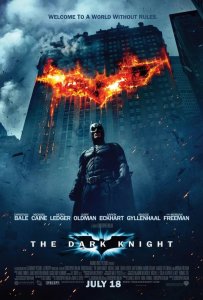 In 2005, Christopher Nolan’s reboot of the Batman series was a critical and commercial success. Gone were the campy and opulent sequences of old and the nipples on the Batsuit felt simply like a bad dream. Nolan served as director and screenwriter and brought serious psychological depth to his story and characters. As a life-long Batman fan, I loved it and wanted a sequel immediately with the exact same people responsible. The Dark Knight has been overshadowed by the passing of actor Heath Ledger, a gifted young actor nominated for a Best Actor Oscar for 2005’s Brokeback Mountain. He’s gone from gay cowboy to the criminally insane, and it’s all anyone can talk about. The buzz on Ledger and The Dark Knight is deafening and I am about to join that joyous chorus. This is a movie for grown-ups and makes lesser super hero adventures look downright stupid.
Bruce Wayne (Christian Bale) is dealing with the repercussions of his choice to assume the masked identity of Batman. He’s cracked down on Gotham City’s mobsters, and in their desperation they have turned to a crazed anarchist that likes to wear strange makeup. The Joker (Ledger) promises to return Gotham back to its old ways but even he knows this isn’t possible. “You’ve changed things,” he tells Batman. “There’s no going back.” The Joker wants to break the will of Batman and Gotham City and sets up elaborate and disturbing moral dilemmas that push many to the edge. His purpose is chaos, which isn’t exactly what the Mob had in mind when they subcontracted his services. Bruce must rely on his trusted butler Alfred (Michael Caine) and company tech guru Lucius Fox (Morgan Freeman) to help him combat a man that “just wants to watch the world burn.” Gotham also has a new district attorney, Harvey Dent (Aaron Eckhart), who is willing to put his name on the line to clean up the city. He’s butting heads with Lt. Gordon (Gary Oldman) because of Gordon’s secrecy and his reliance on Batman to do the things the law won’t allow. Dent wants to prosecute mobsters and is willing to put himself in jeopardy. He believes Batman is waiting for men like him to take the baton. Bruce’s old squeeze Rachel Dawes (Maggie Gyllenhaal replacing Katie Holmes — upgrade) has fallen for Dent. He’s an emotionally available man who wants to do good. Naturally, Dent and Rachel will becomes targets of the Joker.
 First off, believe the hype because everything you’ve read and heard about Ledger’s performance is the gospel truth. The actor vanishes completely underneath the gnarly latex scars, stringy hair, and smeared makeup. He transforms into this menacing figure and he makes Jack Nicholson look like a circus clown in comparison. He’s creepy and funny in a totally demented and spooky way, but he almost comes across like a feral creature that enjoys toying with his prey. Ledger fully inhabits his character and brings a snarling ferocity to the role. The Joker is given no back-story and he takes a macabre delight in crafting differing versions of his sordid past depending upon the audience. Ledger’s Joker is like a mixture of sadist and intellectual, of Alex from A Clockwork Orange and Hannibal Lector; he finds a way to get inside your mind and unleashes torment. There’s a great scene where he’s left alone in a holding cell with a police officer. The Joker taunts the man, getting little reaction from the trained lawman, but then he hits a nerve. The Joker asks how many of his friends, his fellow officers has he murdered. He then rhapsodizes the finer points of using knives instead of guns because guns are too quick. With knives he can see who people truly are in the final moments of existence. “So in a way, I know your friends better than you ever did,” he tells the officer. “Would you like to know which of them are cowards?” This triggers the officer to break his protocol and play into the Joker’s scheme. I’m not ready to say Ledger’s performance overtakes Javier Bardem’s Anton Chigurh (No Country for Old Men) as the most menacing villain of late, but Ledger certainly will make your skin do more than crawl.
Ledger gives a performance worthy of posthumous Oscar consideration. Toward the end of the film I found myself lingering on sadness that, well, this was it. This is all we are ever going to get of the Joker, such a fabulous character, but even more, this was the last full performance we are ever going to get from Ledger. His unnerving performance will stand the test of time when it comes to haunting screen villains, and I’m sure the actor had many more incredibly performances left in him before he passed away.
 The Dark Knight has less in common with other superhero series and should be considered a modern crime drama. It has more in common with Heat than with Spider-Man. Even compared to Nolan’s excellent Batman Begins, this is the first Batman film that feels like it occurs in a real city in our own reality. In Batman Begins, we had the CGI ghetto that happened to be conveniently where all the city’s scum lived, an ancient league of ninjas that wanted to wipe an entire modern city off the map, and then a super microwave that zapped water molecules in the air. Even though it was the most realistic Batman yet, it still had some fantastic elements that kept it from feeling fully believable. This newest Batman adventure feels more like a real city and a city that is being torn apart. You get to see a lot of Gotham City’s moving parts and different social circles and then see the Joker tear them apart. The knotty screenplay by Christopher Nolan and his brother Jonathon is dense and packed with subtext and ambiguity not seen in the likes of other spandex-clad super hero movies. This isn’t a super hero movie so much as an enthralling crime thriller with better gadgets.
Whereas Batman Begins focused on the psychology of a man that dresses up in a costume and fights crime, now the attention turns into examining the impact of Batman. There has been escalation, just as Gordon hinted at the close of the last film. Batman has stepped up law enforcement and now Gotham’s criminal element has placed their trust in a psychopath that promises results. This is a movie about symbols and ideals and about the tenets of civilization. The movie presents an arsenal of mature questions and rarely gives absolute answers. Batman I supposed to be a hero but does he play by the law? Can he make decisions that no one else can? Batman believes in the goodness of others and serves as a symbol for the city to stand up against corruption, but can Batman be corruptible? Does he have a breaking point? Is implanting hidden surveillance and spying on 30 million people in the name of security overstepping? Is it acceptable to cross a line if your enemy crossed it first? The Joker lives at the other ideological end and believes that human beings are selfish and will eat each other when the chips are down. He devises disturbing social experiments that test the limits of ordinary citizens and how far they are willing to go out of self-interest. The Joker is an anarchic force that seeks to tear down civilization itself, and that is a far more interesting and devastating plot than vaporizing water molecules with ninjas. When the movie covers the tired “we’re one in the same” territory that most super hero flicks hit (the Joker responds to Batman with, “I don’t want to kill you. What would I do without you? You complete me.”), it even makes sense given the psychological and philosophical complexity at root.
And oh boy, is The Dark Knight dark. This flick racks up a body count that could compete with movies usually involving some cataclysmic act of nature. The Joker’s unpredictable nature, and the dark twists the film plumbs, creates an atmosphere where you dread anything happening at any time, and mostly bad things happen. Batman must come face to face with his limitations and the realization that his actions, no matter how altruistic, will have negative consequences. This is not a movie for young children. If any parent buys their child a Joker doll and takes them to see this movie then expect years of therapy bills down the line. Much of the violence is implied but the overall effect is still chilling. It’s difficult to call The Dark Knight a “fun” movie. Batman Begins was fun as we followed Bruce Wayne tinker and become his crime-fighting avenger. This movie watches much of what he built get taken away. The movie makes gutsy decisions and for a super hero movie, let alone a summer blockbuster, and this is one decidedly dour flick where no character ends in a particularly pleasant place, especially poor Harvey Dent.
 Speaking of Mr. Dent, while Ledger is deservedly getting all the buzz and plaudits, Eckhart’s excellent performance is going unnoticed. Dent gets just as much screen time as Batman and is the white knight of Gotham, the man unwilling to break the boundaries of the law to merit out justice. Like Batman, he serves as a symbol for Gotham City and its resurrection from the stranglehold of crime. Batman fights in the shadows and serves as an anonymous vigilante but Dent is the face that can inspire the city. That’s what makes his transformation into Two-Face all the more tragic. You really do care about the characters in this movie, so when Dent turns on his principles and seeks out vengeance you feel a weighted sense of sorrow for the demise of a truly decent man. Eckhart and his lantern jaw easily sell Dent’s idealism and courage. After his horrific transformation, Eckhart burrows deep enough to show the intense hatred and mistrust he has even in fate. He gives a terrific performance that plays a variety of emotions and does justice to them all.
The rest of the cast, just to be mentioned, is excellent yet again.
Nolan has also stepped up his directing skills and delivered some high-intensity action. His first foray with Batman had some dicey action sequences that suffered from choppy editing, but he pulls back his camera lens and lets the audience see the action in The Dark Knight. The explosive high point is a long car chase where the Joker tries to attack an armored police car via an 18-wheeler truck. The police look for safe detours to escape the Joker’s line of fire, and when Batman surfaces with the sleek Batpod motorcycle thing get even cooler. What makes the sequence even better is that all of the peripheral characters behave in semi-logical ways, meaning that your secondary cop characters are respectable decision makers. Nolan also shot several sections of the film in IMAX, which boasts the highest resolution possible for film stock. The panoramic views of Batman atop buildings are breathtaking and may strike vertigo in some moviegoers. The movie looks great and it delivers the action goods but it’s really more of a tense thriller with more tiny moments of unease than an out-and-out action flick with gargantuan explosions and blanket gunfire.
Despite the undeniable brilliance of The Dark Knight, the movie is rather exhausting. After a decent 45 minutes of establishing the characters and setting up the stakes, the movie is essentially two hours of climax after climax, and you will be perched on the edge of your seat and tense until the end credits crash onto the screen. It’s exciting and overwhelming but you will feel wiped out by the end of the movie. There are a lot of characters and a lot of subplots and while I’m thrilled the movie has so much intricacy it also makes it hard for the film to come to a stop. The climax with Two-Face and Gordon’s family also feels misplaced. At a tremendous 2 hours and 30 minute running time, The Dark Knight will test your endurance skills in the best way.
 I honestly have no idea where Nolan and crew can take the story now. The Dark Knight seems unlikely to be topped. This is an intense, epic crime thriller with a labyrinthine plot that is packed with emotion, subtext, philosophy, penetrating open-ended questions, and genuine nerve-racking tension. It’s hard for me even to think of this movie as a super hero flick despite that fact that it’s about a billionaire in a rubber suit. This is an engrossing modern crime drama that just so happens to have people in weird costumes. Nolan and his brother have crafted a stirring addition to, not just the Batman canon, but to cinema as a whole. Ledger’s character is the driving force behind the film, the man that makes everyone else react, and his incredibly daring and haunting performance will stand as a last reminder of what talent was lost to the world when he passed away. I for one will be amongst the throng crying out for Oscar recognition but not just for Ledger, for The Dark Knight in general. And I may not be alone. The Dark Knight is currently breaking every box-office record imaginable and seems destined to finish as the number two highest grossing movie of all time, steadily behind James Cameron’s Titanic. If the Academy is looking for a way to shore in better ratings for the Oscars, it might seriously consider nominating The Dark Knight in some key races. It certainly deserves recognition.
Nate’s Grade: A
Share this:

Gone Baby Gone (2007)
 Ben Affleck doesn’t necessarily establish any gifted visual style with his directing debut, however, Affleck the Screenwriter and Affleck the Actor ensure that the movie succeeds swimmingly as a murky morality play. The film is an actor’s showcase and they get plenty of room to maneuver, with standout performances by Ed Harris as an embittered cop and Amy Ryan as the living embodiment of the worst white trash would-be mother on the planet. Where Affleck earns his artistic stripes is by asking hard questions with moral ambiguity and not dishing out easy answers. This is an above average crime thriller that uses its lower class Boston setting as an additional character. There are only a handful of relevant flaws, like Michelle Mongahan’s character being pointless except to cry, and a mystery that clever moviegoers will have figured it out early thanks to the economy of characters and some shifty glances. The missing child mystery allows Affleck to explore some very dark places and non darker than the human soul. Affleck may not dazzle with visual prowess, but the man sure knows how to tell a damn good story and direct actors to award-winning levels. Give this man another movie.
Nate’s Grade: A-
Share this:

Michael Clayton (2007)
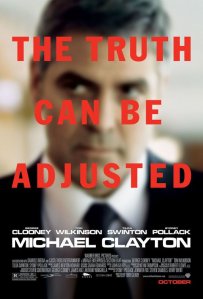 A smart, suspenseful, terrifically acted corporate thriller, this movie hums along with great precision thanks to a deeply articulate screenplay by writer/director Tony Gilroy. The acting trio (George Clooney, Tom Wilkinson, Tilda Swinton) delivers sensational performances muddled with doubt and weary, nervy complexity; each comes across a full human being in what could have come across as a dull Law and Order episode. I don’t understand why Gilroy plays around with the film’s timeframe, because he spends nearly ten minutes at the end in a suspenseful car chase where we already know the outcome. There is a murder that is played against Hollywood convention; it’s quick, grimly efficient, and scary in how soon it’s all over. Michael Clayton is a first-class movie that respects the intelligence of an audience.
Nate’s Grade: A
Share this:

Before the Devil Knows You’re Dead (2007)
 Sidney Lumet is 83 years old and still directing movies, God love him. The man is behind cinematic milestones and classics like The Pawnbroker, Serpico, Dog Day Afternoon, Network, and 12 Angry Men, which goes back all the way to 1957 – 50 freaking years ago! The longevity of this man is admirable. He hasn’t pulled together a compelling film in some time, but Before the Devil Knows You’re Dead is a stirring, character-driven crime drama that reveals itself to be a first-rate melodrama.
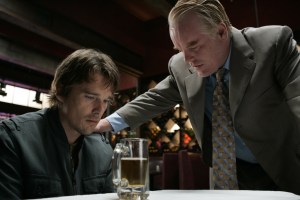
The film is anchored by two huge performances by Philip Seymour Hoffman and Ethan Hawke, playing a pair of brothers both on hard times. Hoffman’s character, Andy, has been living well outside his means to keep up appearances and to sate his taste for a local heroin den. He’s in charge of company payroll and an internal review just discovered a pair of terminated employees still drawing checks, the source of Andy’s cash to pay for his lavish lifestyle. Hawke’s character, Hank, is behind on child support and belittled by his ex-wife. He’s having a hard time even finding the dough to pay the 100 bucks for his daughter to go see The Lion King in New York City. Andy hatches a scheme to solve both their money woes: they’re going to knock over a mom-and-pop jewelry store. It just so happens that the store belongs to Andy and Hank’s mom (Rosemary Harris) and pop (Albert Finney). The plan goes hopelessly awry and both brothers feel intense pressure in the aftermath.
 Lumet and debut screenwriter Kelly Masterson really know how to ratchet up the suspense. The nonlinear timeframe keeps the audience on its toes and continuously rewriting what we think we know. Unlike movies like Babel and 21 Grams, the plot is actually assisted by skipping around time and telling the story out of order. We get the basics and then the details begin to take shape, but because of the prior knowledge the film packs an increasing sense of dread that builds in intensity. As the brothers sink lower trying to cover their misdeeds, Lumet and Masterson crank up the tension to a peak. The knotted and twisty narrative exposes the fragile dynamic of this family and keeps the audience alert and hungry for more.
Hoffman is at his sleazy, duplicitous best with this performance. His character is a man accustomed to getting what he wants and he knows all the manipulative tricks to get there, be it bullying or cajoling. He’s a pusher with so much anger and desperation just below the surface. Andy never feels respected or loved by his father, and he has a great scene where he breaks down in a fit of rage and tears in response to his father apologizing for the bad upbringing. Hoffman imbues great emotional complexity to a man whose world is crashing down. It is enthralling to watch.
Not to be outdone, Hawke puts forth his finest effort of his career. He’s the baby of one very corrosive family; he misplaces trust and admiration in his big brother. Hank isn’t the sharpest tool in the shed but he has a distinct weariness to his worries, living day-to-day with the knowledge that the world sees him as a loser or a screw-up, losing the respect of his own daughter. When things go bad he unravels rapidly while still holding to his secrets. It’s a performance brimming with nervous anxiety, mounting regret, and self-effacement.
 The secondary characters don’t get nearly the attention and consideration. Marisa Tomei is more a plot device than a character; she’s Andy’s wife but has been having an ongoing affair with the more nurturing Hank. She spends most of her scenes in some form of undress and feels more like another notch in the complicated relationship between the brothers.
Finney is fine with a rather small role that merely requires him to be aghast or incredulous with the slow police work. I don’t know if a suitable Finney performance can compensate for a staggering leap of character late in the movie, but I suppose I’d rather have any Albert Finney performance in a movie than none at all. Before the Devil places Finney’s character on a perch and just doesn’t give him much outside of his own dawning realization of who was responsible for the botched robbery.
Before the Devil Knows You’re Dead is a gripping family tragedy that takes on a Shakespearean quality as it comes to a somber, chilling close. The wordy titles comes from an Irish drinking toast that states, “May you have food and raiment, a soft pillow for your head; may you be 40 years in heaven, before the devil knows you’re dead.” The message declares the inescapable consequences of our actions. This is a film about the disfiguration of one family; it’s bleak, tragic, but whole-heartedly entertaining and extremely focused in its aims. Lumet has returned to smashing form and reminds an audience that there’s still plenty of vigor left in this 83-year-old director.
Nate’s Grade: B+


 nathanzoebl
You must be logged in to post a comment.