Blog Archives
Scary Movie 4 (2006)
 David Zucker was apart of the team that gave the world Airplane!, The Kentucky Fried Movie, Top Secret, the Naked Gun flicks, Ruthless People, and even Ghost. When the Wayans brothers left the Scary Movie franchise for greener pastures (greener meaning richer), it was Zucker and his stable of writers that came in and gave Scary Movie 3 a fresh kick. Now less than three years later we have Scary Movie 4 poking at the same material, and once again this franchise is starting to feel like a bore.
Cindy Campbell (Anna Farris) is in the home health care business looking after a supposedly haunted house. Inside the house resides those pale, wide-eyed, meowing ghosts from The Grudge. Next door resides Tom Ryan (Craig Bierko), a crappy father watching after his two crappy kids for the weekend. Things get a tad hectic when giant Tr-ipod robots rise from the ground and start zapping everyone. A war of some worlds looks to be in progress. Cindy and Tom go their separate ways, each trying to stay alive and return to each other. Cindy meets her old pal Brenda (Regina Hall) and they journey into the heart of a secluded village, one surrounded by monsters. Somehow they’ll find a way to stop the aliens from destroying the planet. Meanwhile, President Harris (Leslie Nielson), briefed that the country is under attack, is very interested to know what happens to a duck in a children’s story. The only thing missing is a Passion of the Christ parody (talk about a horror movie).
 This is a franchise of diminished returns. Zucker and company feel like they’re badly grasping for something. Scary Movie 4 relies far too heavily on juvenile scatological behavior (a urine sponge bath is simply gross, not a gross-out) and very repetitious slapstick. Your level of enjoyment with Scary Movie 4 will rest solely on the question of how many times you can laugh at someone getting hit in the junk. Zucker’s gone practically overboard on the physical comedy, making this the filmic equivalent of “Football in the Groin.” The sad thing about this franchise is how safe it all feels now. It seems to have its demo sights set squarely on teen males, less discerning folk who will pee their pants with groin kick #86 and roll in the aisles uncontrollably with groin kick #113. I’m no prude when it comes to slapstick mind you; a well-timed kick to the groin can be downright Shakespearean, but when an entire film is stuffed with people knocking the stuffing out of themselves, then the joke loses its original flavor. No one wants to keep chewing on something once its flavor has long vanished.
I seriously think there should be a one-term limit when it comes to the comedy teams working with the Scary Movie films. Scary Movie 2 felt like a bad Xerox copy of Scary Movie, heavily smudged and lacking definition. Seriously, how many times can you go back to the giant semen geyser well? So too does Scary Movie 4, Zucker’s second in the series, resonate with the same hackneyed feeling. Zucker’s first movie dialed down the raunch and upped the PG-13 slapstick, and now his second film feels like a less executed duplicate. In Scary Movie 3, the joke was that the creepy psychic kid could never foresee his own clobbering. Therefore, there was an extra comedic layer to watching a kid accurately predict when a woman would start her period but not when a car back into him. In Scary Movie 4, it’s simply been reduced to watched a kid get beaten a lot. Jokes rarely connect when you rob them of context or set-up or just repeat them ad nasuem. Scary Movie 4 feels a bit overly content just to be a copy of a copy. That’s simply depressing.
 Even the jokes feel out of touch, smacking of a minimal effort. The Scary Movie franchise was never a place for biting satire, but everything seems so curiously outdated. Viagra jokes in 2006? I guess so. When the film does reference modern items (Myspace, Yahoo maps, Michael Jackson) it still feels awkward. The Brokeback Mountain parody, while shocking in how comparatively restrained it is, comes across dead in the water because our market is over-saturated with gay cowboy jokes. It’s like in 1999 when even your invalid grandmother was doing a Blair Witch Project parody (turns out the witch was just the nurse trying to get her to take her pills). I do realize that the plot parodies are mostly a jumble, bits blended together to house the film’s rapid-fire gags. The Million Dollar Baby parody is probably the best sequence in the film and even that spoofs a cultural event 10 years old. If Scary Movie 4 is targeting teens, to the detriment of the film’s funny, then why even bother referencing pop-culture outside their cognizance? I wonder if the inevitable Scary Movie 5 will have a pointed satire on the Iran-Contra scandal.
Zucker just feels too pleased with himself. His movie parodies are spot-on when it comes to technical execution, replicating even the camera angles from his source material. It’s a pity he has little to add with his tweaking. Any form of comedy gets old with repetition but slapstick especially. I would think a man like Zucker would know this.
Farris is the best thing that Scary Movie could have ever hoped for. She’s one of the most gifted comedic actresses working today. She’s at home whether it’s the physical, whether it’s delivering a silly line with pitch-perfect dumb blonde finesse, or whether it’s just making exaggerated facial contortions. There’s a music montage of Farris making funny faces that works so well because of how much Farris throws herself entirely into the joke. Too bad the movie lets her down.
Nate’s Grade: C-
Share this:

Cinderella Man (2005)
 Let’s talk a little about screenwriter Akiva Goldsman. This is the man responsible for travesties like Lost in Space and the franchise killing, pun-crazy Batman and Robin. There’s plenty of junk writers in Hollywood and plenty of good writers just saddled by junk to make a living, and either might apply to Goldsman. How in the world did he become a Hollywood go-to guy?It probably has something to do with Ron Howard. Goldsman adapted the screenplay for Howard’s film A Beautiful Mind and both walked away with Oscars. Suddenly the man who wrote Mr. Freeze saying, “You’re not sending MEEE to the COOLER,” had an Oscar on his mantle. Goldsman and Howard, in retrospect, seem like a match made in heaven. They both enjoy big Hollywood event movies that spoon-feed an audience and shave off the gray areas. Cinderella Man serves as the duo’s second collaboration and it’s exactly what you would expect a big Hollywood event movie to be from them.
Jim Braddock (Russell Crowe) is an up-and-coming New Jersey boxer who’s on a warpath to the heavyweight title. His wife Mae (Renee Zellweger) loves him dearly and he dotes on his three kids. Life seems so perfect in 1929 America. And then the Depression hits. Braddock breaks his hand in a fight and his skills slip tremendously. The boxing commission revokes his license and Braddock is forced to take a dock job to provide for his family. Times are tough and there doesn’t appear to be a way out, until Braddock’s old boxing manager (Paul Giamatti) offers him a one time only bout in the ring. Braddock is seen as a has-been but he knocks his opponent flat out. More fights come and so do more victories, and Jim Braddock seems destined for a remarkable storybook comeback. But then there’s the reigning champ Max Baer (Craig Bierko), an arrogant playboy. Baer also is a ferocious fighter and has actually killed two men in the ring. The championship leads through him and Braddock is unafraid. Mae is terrified she’ll become a widow and pleads with her husband not to fight. But now that he’s been through the gutter, Braddock knows what he?s fighting for: the survival of his family. To do that, he?s headed for a title match with Baer.
 What elevates Cinderella Man from an “okay” film into a “mostly good” film is the singular brilliance of Russell Crowe. This man is simply one of the most amazing actors we’ve ever seen, and he’s been on an incredible hot streak since 1999’s The Insider (forget 2000’s Proof of Life, please). Yet again mastering another accent, Crowe excels at playing a noble man with guarded emotions and honest intentions. He’s an actor that can display such an intense wealth of emotions in the same moment. When he visits his old boxing bosses, hat in hand, begging for enough money to turn the electricity back on, Crowe has laid a sucker punch to your emotions. It’s getting to the point where I will go out and see any movie Russell Crowe stars in just to soak up his brilliant performance. He can throw a phone at my head anytime. Crowe’s stellar and resonant acting will hopefully be noticed come Oscar time; however, I doubt much else of Cinderella Man will be remembered.
Crowe’s sparring partner doesn’t fare as well. I’ve liked Zellweger in a lot of her roles (even the sappy One True Thing), but she’s entirely miscast as Braddock’s underwritten stand-by-your-man wife. She scrunches her face too much and squints for most of the movie.
Two great actors make the most of their meager roles. Giamatti serves as Braddock’s growling pit dog of a corner man and works up a good froth. Bierko almost transcends the film’s one-note villain caste and becomes a figure of showboating sensuality. He struts in the ring with a gallant pride that’s fun to watch, even though you know Howard?s whispering in your ear, “Booooo. Don’t like him. He’s the mean man. Booooo.”
The production design on Cinderella Man is great and really recreates the look and feel of the 1930s in all walks of life. The cinematography, on the other hand, seems washed out and overly dark in spots, though it may have just been my theater?s projection. I miss Roger Deakins, DP on A Beautiful Mind. Deakins knew how to beautifully light a scene and capture the audience with a precise, eye-pleasing angle. In contrast, Cinderella Man seems to think that sepia tones defined the time period of the 1930s.
Howard still has little to no trust in his audience. He can’t rely on the performances of his actors to express their motivation. We know why Braddock is fighting during the Depression, Howard. We don’t need split-second cuts of his family for reminders. It’s almost like Howard wants to point to the screen and tell the audience what to feel. It should be obvious by now but ambiguity doesn’t work here. That’s why Braddock is seen as almost saintly (never mind the connections to organized crime). That’s why Baer is seen as dastardly (never mind that in 1933 Baer heroically wore a Jewish star and knocked out Hitler’s favorite prize fighter, Max Schmeling). It seems that the details just get in the way when Howard wants to turn true-life stories into calculating crowd-pleasers.
At the docks, just in case we don’t get how tragic the Great Depression is (you know, in case you forgot what either the words “great” or “depression” meant), Howard has to bend over backwards to show someone stepping over a newspaper declaring how high unemployment is. When Braddock finds a friend in Hoovertown (Central Park turned into a neighborhood of shanties) we see him run over by a horse and buggy as another man crushed by the system or a runaway metaphor. When Baer fights in the ring Howard makes sure to get that sneering close-up of our villain. And surely anyone who’s a womanizing playboy must go down for the good of the nation. Howard is aggressive in his pandering.
Thanks to Goldsman and Hollingsworth’s mawkish script, Cinderella Man has the myth of complexity to it when it’s really content to go the easy route. It plays this story too close to the rules: embittered hero with humanity intact, stalwart wife, cocky villain, the grumbling manager. Cinderella Man is stripped of complexity and Goldsman and Hollingsworth want to lead the audience by the nose. When Braddock promises his son in a heart-to-heart that he’ll never split up the family, we know it’s only a matter of time before it happens. Their script is also full of workmanlike dialogue that does enough to just push the story forward but give little shading to its people (Zellweger’s, “You are the champion of my heart, Jim Braddock” is particularly not great.
 Cinderella Man really is a film more about the Depression than boxing, except for its pummeling and gritty final act of non-stop boxing. The script paints an almost insulting idea that the Depression was good for people to learn important life lessons, like family comes first, hard work will be rewarded, and one man can heal a nation. Seabiscuit fell into this same trap with its depiction of the Depression but at least Gary Ross’ film dealt with characters that weren’t tired genre archetypes. Cinderella Man could be described as “Seabiscuit in a boxing ring,” as yet again the triumph of an underdog pulls the country back together and gives the common man something to believe in. What I’d like to see is Braddock vs. Seabiscuit in a ring or even on the horse’s turf. Then we can finally decide once and for all who is responsible for getting America out of the Depression (somewhere FDR is spinning in his wheelchair-accessible grave).
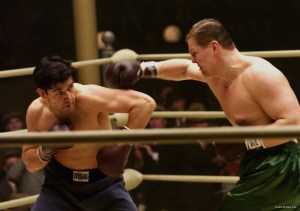
The film does come alive when Braddock steps into the ring. The boxing matches are finely choreographed and pack a real wallop. You can practically feel the bruises and taste the sweat during the 15-round bout between Braddock and Baer. These scenes give you a good understanding of the progression of a boxing match and the real strategy that can turn a loser into a winner. Howard also has a smart visual cue during these lively moments. Whenever a bone gets broken, like Braddock’s hand, we cut to an X-ray shot of that scene and see the bone snap. It might seem old in a CSI-drenched landscape of entertainment but it’s effective and neat.
Cinderella Man is a rousing, heartstring-tugging crowd-pleaser that will inspire hope and redemption. Until you look at it more objectively. It?s easy to get sucked into Howard’s underdog tale and that’s because it’s been tailored to satisfy your emotions. Crowe rises above this heavy-handed yesteryear yarn with a riveting performance. I’m positive most people will walk away from Cinderella Man feeling uplifted and touched and would view me as being overly cynical. But with a maudlin story by Goldsman that simplifies the details, Cinderella Man feels like a feel-good-movie that’s been rigged. These people have no trust in their audience, so why should you put your trust in them?
Nate’s Grade: C+


 nathanzoebl
You must be logged in to post a comment.