Blog Archives
Cadia: The World Within (2019)
 Cadia: The World Within (pronounced Kuh-Dee-uh) is a fantasy film that was made in my hometown of Columbus, Ohio and directed by an alumnus of my own college. 24-year-old Cedric Gegel (The Coroner’s Assistant) wrote and directed Cadia, which was inspired by a story he was making up to entertain 12-year-old triplets backstage during a theater show. He spent years revising and elaborating that tale and elected to make it a big screen adventure, and starring those same triplets in starring roles. He even attracted known actors like Corbin Bernson and one of the two Harry Potter twins. I attended the special Capital University screening before Cadia begins hitting festivals and seeking distribution. As I have in the past, I happen to know several people that were involved in this production, primarily behind the camera, and I promise to try and be as objective as possible in this review.
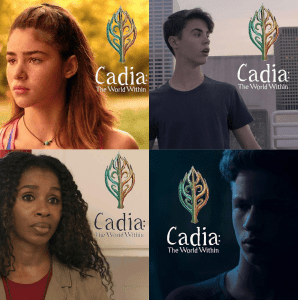
Three teenagers are dealing with the recent loss of their mother. Renee (Carly Sells), David (Keegan Sells), and Matthew (Tanner Sells) are now living with their Aunt Alice (Nicky Buggs) and their Grandpa George (Bernson). One day, a magic set of stones takes the kids to another world, Cadia, where they meet Elza (John Wells) shortly after escaping a monster. They learn there are dueling factions in this realm, and Tannion (James Phelps) wants one of the siblings to tap into an elemental power supply to rewrite the cosmos for the better.
 I’m going to caution that this review will likely sound more negative than I intend. I want to be supportive of local filmmakers and encourage their efforts, and any movie by itself is something of a miracle considering the countless people who work in tandem to bring together a vision. The people behind Cadia seem like genuinely sweet and thoughtful individuals who cared about the movie they were making. I wish them all well. However, it does nobody good to avoid constructive criticism where it’s warranted, because ignoring problems is unhelpful. The characters of Cadia might even agree with that sentiment. So, dear reader, let’s dive into what doesn’t quite work here and keeps Cadia from being more than the sum total of its many influences and good intentions. Much of the faults chiefly come down to the writing.
Fantasy stories are tricky because they need to be transporting but also accessible, otherwise they will feel like they’re being made up on the spot or like a private story that wasn’t intended for a wider audience (Lady in the Water, anyone?). With Cadia, the influences are easy to pick up on (Narnia, Harry Potter, Peter Pan, the Bible) but the rules and understanding of this new world feel too murky and unclear. It’s a magic world with… warring factions that are at war because… power? I never understood who just about anyone was and what their purpose served beyond allegiances. It’s too vague and the world feels too small and undeveloped, making it feel less a new world and more like a weekend excursion. What is the relationship between this family and the history of Cadia exactly as it comes to Grandpa George? Did this world come into existence with George telling the story and thus linking it to this particular family and giving them larger importance, or did it exist on its own? Why do some people have powers and what are the extents of those powers, the limitations, the costs of those powers? Is dead mom alive in this world or simply a ghost? Are there more potential ghosts? What started the factions? There are teleporting stones but are they direct portals or can they be manipulated? It feels like this should be of greater importance just from a novelty of how they can be clever (and cheap to execute). There’s one malevolent monster witnessed but otherwise it’s just a bunch of people hanging out in the woods. Too many of the too many characters are just sitting around, seemingly like they’re waiting for something to do. Cadia operates on a level that assumes you know what is happening or find this new world intriguing, but as a viewer it feels like you’re missing vital critical info to make that happen.
Fantasy world building is essential because the new world has to be teeming with interesting life and details, the stuff a viewer could immerse themselves within. Barring that, the fantasy details can be shaped and pruned to serve the thematic journey of a character, externalizing the internal. I thought Cadia was going here. It kind of does and kind of doesn’t. The central trio are dealing with their grief over their late mother, except when the movie doesn’t need them to. I thought the world of Cadia would present itself as symbol for the grief and anger of a character, luring him or her as temptation to reverse course and save dear dead mom, and therefore we would learn a lesson about healing and about facing loss. This element is present, yes, but “element” is the proper term; it’s not a theme or anything larger in plotting, it’s merely there as needed like any other sudden magic power that goes without explanation or question. Overall, the fantasy world just felt under developed in detail and scope.
 I was hoping for the thematic personalization because there’s a general lack of urgency when it comes to any looming sense of danger. For being transported to a new world, these kids take it all in amazing stride. Even after a long-clawed monster chases after them, the kids are so casual and nonplussed the next scene even as they have just barely eluded this monster. Nobody seems in a hurry to return home. We’re constantly told of warring factions but the only outward danger felt is from this one monster, and even when the kids are close their fear seems fleeting. The characters they encounter don’t present (immediate) danger, which makes the film feel rather loping and without conflict and danger. It’s lacking potent stakes. What’s stopping these kids from returning? What’s stopping anyone from anything? The world of Cadia is too plain and safe, which coupled with its undeveloped nature, only makes things less interesting. If the world doesn’t present interest, it can at least present a palpable threat, and Cadia does not.
Another miscue that hampers the stakes is that the film keeps cutting back and forth between the kids in Cadia and the adults on Earth. Why? Do we really need to see Aunt Alice having coffee with her friend while the kids are lost in a new realm? Do we really need two check-ins with Grandpa George to literally watch him put together a puzzle? Cutting away from the discovery of the magic world to watch characters do mundane things back home is detrimental to pacing and establishing a growing threat. Can it be much of a threat if the kids seem chill and we cut back to puzzle formation? Without a threat, without an interesting setting, and without a personalization toward one of the main characters, Cadia feels like a less-than-magical retreat.
The characters also suffer from both being underwritten and simply having far too many of them. The main trio of real-life triplets are left as archetypes; there’s the more introverted one (The Nerd), the more rebellious, aggressive one (The Jock), and the… girl (The Girl). Seriously, that’s her characterization. The other brothers get starting points on a scale to grow from but her characterization is simply not being the things her brothers are, and also being a girl. It’s not like the characters are running away from confronting the hard truth of death and Cadia will allow them to better process their grief, like A Monster Calls and I Kill Giants. Other characters talk more about their mother than the actual children of that mother mourning that mother. It’s difficult for me to go much further in describing the characters because once they travel to the fantasy realm their characterization gets put on hold as they encounter a slew of dull new people.
 There are several scenes where we introduce a group of new, personality-free characters. That’s the other necessity with fantasy, writing larger, expressive, and memorable characters. There’s a Lost Boys-esque group of centuries-old Cadia dwellers, but this group could have been one person, could have been twelve, because there aren’t differentiated characters within, only actors fulfilling space in the frame. This isn’t the fault of the actors. They just weren’t given material to work with. A way to establish a memorable character is through a memorable entrance or at least with significant contrasts. Cadia has trouble with this even as it presents characters on opposite sides of its vague conflict that is eventually resolved through platitudes about love that could have been reached at any time prior to the characters’ fortuitous arrivals. The narrative feels polluted with extraneous characters that exist for no other reason than to squeeze another actor onscreen. Characters should have a purpose for their inclusion and the narrative shouldn’t be more or less the same without their involvement. With Cadia, you could eliminate 80% of the characters and still tell this story. Do we need a lady in the river? Do we need two untrustworthy schemers to tempt the kids? Is the cousin needed? When the big fight arrives, with side-versus-side, your guess is as good as mine who they are, why they are important, and what they’re even doing here.
The dialogue is also heavily expository, where characters are tasked with asking questions or making statements so that the audience will know critical points of information. Characters talk in inauthentic manners, the kind of stuff that seems like they know an audience is watching. “I know you’re having a hard time dealing with mom’s death,” sort of thing. Or you’ll have characters talk so point-of-fact, like this exchange: “Who’s good and bad?” and then, “Well that depends on who ‘you’ is. Good and bad depends.” It’s pretty on-the-nose, but even ignoring that, the two sentences in response are redundant, conveying the same idea. Naturally exposition is going to be needed when establishing an alternate, living world, but when it feels like characters are going from person to person to only digest info because the plot demands it, then it feels less like a film narrative and more of a museum display guiding you to the next exhibit.
The acting is a high-point for the movie. The triplets all handle their first big screen acting job reasonably well and demonstrate future promise. My favorite was probably Carly Sells as Renee, which is even more impressive considering she has the least amount of material to work with of the three. She has a particular sense of poise that lends to better imbuing life to her character. Keegan Sells is at his best in the beginning as he’s internalizing his grief and frustrations. Tanner Sells has a nonchalance to much of the world, which can be funny. Bernson is a lovable grump that doesn’t feel too off from his father figure in TV’s Psych. He doesn’t have much to do in the film but he’s a welcome presence who feels glad to be there. Phelps (Harry Potter) and Wells (Piranha Sharks) do a fine job as the resident schemers, concealing their intentions. Brittany Picard (Alan and the Fullness of Time) had a nice ethereal charm even in brief moments as the departed mother Maggie. Why wasn’t she in more? If mom is potentially alive, or at least corporeal in Cadia, why isn’t that a narrative resource to be tapped for further drama especially as it pertains to acknowledging loss? I was most impressed by Buggs (Powers) who was the one immediately processing the emotions of grief. She sells her scenes with subtlety and grace. Another pleasant standout was Grace Kelly (Kill Mamba Kill!) as Jade, the school guidance counselor. She has a presence that grabs you, and the fact that she’s a Marine athlete makes me yearn for her to have a starring action vehicle that can show off a full range of her capabilities. She’s a breakout star waiting to happen, so somebody make it happen.
 The technical merits are pretty agreeable for being a low-budget feature, but there are a couple aspects that I think take away from the overall achievement. The cinematography is very limited in how it presents the scenes, which follows the pattern of master and then shot-reverse shot. There are very long running takes with a swooping Steadicam that centers the action. It can be impressive at points but at other points, as the scene carries on without variation, I began to wonder if this was continuing because, frankly, that was all they had to work with. The editing can also be curious with certain choices. There’s a scene where Aunt Alice runs out of the coffee shop, having learned of the children’s disappearance. Instead of the scene ending there, the moment holds for another four or five seconds on Jade’s reaction, which is fine considering later revelations. But even after that we hold on the scene and a waitress comes to ask about taking away the coffee cups, and Jade says, “Yes, you can take them.” Why was any of that necessary? The scene just carries on awkwardly after its import has literally left the building. During the family dinner, the camera circles around the table for a full minute while they gab and reach for the food. Did we need a full minute of them vamping while eating? Is this included simply because they wanted to maximize the amount of Bernson screen time they could? The costumes are pretty standard fantasy garb except when they’re not. During the big showdown, there are characters dressed in flowing robes and tunics, and then there are others just in ordinary clothes. There’s one woman in like a polka-dot skirt and it just directly draws your eye. This incongruity almost made me chuckle, and then polka-dot skirt lady is given prominence in the fight too. It’s unfair to be too critical on any technical limitations of a low-budget film as long as they don’t impede the vision and intent of the filmmakers, but these decisions occasionally took me out of the movie.
I honestly feel conflicted about writing this review because I knew it was going to have some significant criticisms. It’s genuinely impressive that a film like Cadia: The World Within got made, attracted known actors, and pulled it all off on a low budget with many artists who were eager to sink their teeth into a bigger project. I definitely think there is an audience for Cadia and that there will be plenty of people that genuinely enjoy the movie on its own terms. Afterwards, at the screening, one such fan asked about the possibility of a sequel (Gegel respectfully demurred). For me, the fantasy world felt diminished, opaque, and too often as ordinary as the “normal world.” The characters are kept at an archetypal level, or are superfluous additions, and the plot seems to lack urgency, propulsion, or needed steps to tap into larger emotions and themes or intrigue. It felt like watching a bunch of people having fun with make believe and putting on a show, and they just happened to have larger names involved in the fun. Cadia is a family fantasy that might play well for its intended audience but unfortunately is a fantasy that feels less than magical.
Nate’s Grade: C
Share this:

Kiss Kiss, Bang Bang (2005)
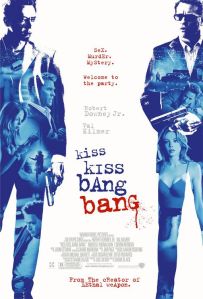 Shane Black was a Hollywood icon by the time he was in his early 20s. In 1987 he sold a script called Lethal Weapon to producer Joel Silver that put a jolt back into action flicks and gave the template for all buddy-cop comedies to come. He earned a then-record $1.7 million for his script, The Last Boy Scout, topped later by the $2 million paycheck he got for The Long Kiss Goodnight. It’s a shame both scripts were marginalized by their film directors. Black went underground for a long time, nursing his wounds over what had happened to his screenplays. Then in 2004, Black began his comeback vehicle, a modern day detective story that also lampooned Hollywood, and this time he’d direct his own material. The final product is called Kiss Kiss, Bang Bang, and Black’s comeback film is nothing short of a cinematic knockout and the most refreshingly entertaining movie of all 2005.
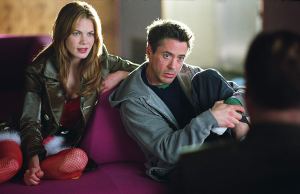
Harry Lockhart (Robert Downey Jr.) is a small-time crook on the run from the cops when he stumbles into an acting audition. They hand him a script, tell him his partner’s dead, and are so impressed with his “acting” that he’s immediately flown to Hollywood. Harry is teamed up with Gay Perry (Val Kilmer), a cop who does advisory work and just happens to be gay. During a house party, Harry reunites with a childhood friend, Harmony Faith Lane (Michelle Monaghan). They reminisce about their childhoods in Indiana and their fascination with the Johnny Gossamer detective novels, but she has much more on her mind: her sister’s gone missing and she needs Harry to find her. Trouble is Harry hasn’t told her he’s not a real detective. He’s gone from crook to pretend actor to pretend detective, and before Christmas is over he’ll be up to his neck in bodies, intrigue, double-crosses and all the stuff that would make for a rip-roaring Johnny Gossamer book.
 First and foremost, Kiss Kiss, Bang Bang is one deliriously fun party. The film moves at breakneck speed through its smart, cheeky gags. Black’s dialogue is hilarious and feels so effortlessly natural coming from Downey Jr. and Kilmer, like he’s got their speech patterns tattooed in his brain. In fact, the dialogue feels so robust and natural, never glib and self-conscious, that it almost comes across as feeling like a heavy improv session between two immensely talented actors. Kiss Kiss, Bang Bang, Black’s opus to the hard-boiled detective genre, has more twists and turns than a seizure patient doing the Hokey Pokey. You never know where this movie will head next or what joke will topple you over with unexpected laughter, and that’s what makes Kiss Kiss, Bang Bang so unabashedly thrilling to watch. Even when the movie does start to veer into more conventional material, Downey Jr. is there as our narrator to point out what we’re all thinking and to make fun of the expected. Kiss Kiss, Bang Bang can get jubilantly perverse at parts (a corpse getting a golden shower), but the macabre touches never deflect from the film’s boundless, inconsumable energy. Everyone is having the time of their lives in Black’s comic caper, and it shows.
Seriously, this movie is the definition of a laugh riot. It’s like a carnival ride through a gag factory (that sounds kind of spooky, actually), and Black has such an assured confidence to his writing, evidenced in his set-ups, reversals, and the insightful tweaking of Hollywood that could only come from one of its own (Harry laments that the nation turned over and shook and all the normal girls hung on while the crazies landed in L.A.). Here’s a conversation between Harmony and Harry about a promiscuous actress:
Harmony: Well, for starters, she’s been f***ed more times than she’s had a hot meal.
Harry: Yeah, I heard about that. It was neck-and-neck and then she skipped lunch.
Just re-reading it makes me laugh. How many comedies make you laugh just thinking about them in retrospect? Kiss Kiss, Bang Bang is one of those oh so rare delights. It even has a talking bear in it!
 The lone detraction for Kiss Kiss, Bang Bang is the movie’s overall lack of substance. It doesn’t reach for anything more than bold entertainment, and to that end it succeeds in spades. Some may argue the movie is spinning so fast to try and distract you from its empty center, but I say enjoy the ride while it lasts. I only wish this movie was longer, like Lord of the Rings-long. I did not want to leave this world and these characters. My claw marks might still be visible on the armrests where they had to throw me out.
Black also proves to be a very slick director with a natural eye for camera placement. His photography is very pleasing, relying on different light placements to add surreal touches that accentuate the narrative. Black keeps his movie at a breathless pace and knows how to handle his actors. His narrative side-steps enliven the film and grab our attention, and Harry’s voice over is never overused to explain the minutia the script cannot. The only drawback for Black might be that his film could be too smart for its own good. I mean, most of the movie going public will be stooped by a joke about adverbs. Black has an obvious love for detective yarns and film noir, that’s evident with the film’s style and the fact that chapter titles are Raymond Chandler novels, but some familiarity with this world will sharpen your experience. Kiss Kiss, Bang Bang never panders to its audience, and that may hurt Black as far as making a movie that will reach out to Middle America (Perry apologizes to the Midwest for using the “f-bomb” as often as they do).
The chemistry between Downey Jr. and Kilmer is incredible, positioning them as one of the finest comic pairings in recent cinema history. Their indelible camaraderie is the true heart of Kiss Kiss, Bang Bang. They bat insults and injuries with comic aplomb. Both characters are unapologetic, Harry as a nattering criminal screw-up way in over his head, and Perry as gay man who’s fine with that and will rip your testicles off just the same if you cross him. He’s not stereotypical swishy or flamboyant, but he’s very enjoyably dry and sarcastic. Both actors have a history of being troublesome to work with, but Downey Jr. and Kilmer have been two of our most amazingly talented actors … when they want to be. Kilmer is the coolest customer in the film, being nonchalantly badass even when he’s about to blow his top (this is NOT a gay joke, by the way). Downey Jr. is his usual charming, amiable, fast-talking self, but even his tiniest details speak comedic volumes, like his reactions and general awkward physicality. I cannot imagine anyone else doing as excellent a job in these roles, especially Harrison Ford who was sought by producers for the Gay Perry part (feel free to shudder at what might have been Hollywood Homicide 2.
 Monaghan is a break-out actress that could have been even more break-out-er by this time. She’s mostly had small unmemorable roles in films like Unfaithful and The Bourne Supremacy, but 2005 was set to be her year. She had roles in Constantine, Mr. and Mrs. Smith, and Syriana. Unfortunately, her scenes were cut from Syriana and Constantine, and her role was drastically pared down in Mr. and Mrs. Smith. The only thing Monaghan has to show for 2005 is Kiss Kiss, Bang Bang, and that’s all she’ll need. She’s bright and pretty, but she also gives Harmony a great sense of being run down, another girl getting off the bus to Hollywood with stars in her eyes only to find out the harsh reality. Her combative relationship with Harry as they reconnect and try and wonder how they went astray is another film high point. She’s a comedic asset and should be on Hollywood’s speed dial if they need a charming, funny, capable actress.
Kiss Kiss, Bang Bang is a wicked good time. It’s complex, twisting, riveting, unique, hilarious, and just about every synonym you can think for the word “awesome.” Black’s comeback may be too smart for its own good, and having a general understanding of film noir will enhance your experience, but this is one comic caper that’s so much fun, so stylish, so damned entertaining, who cares if it lacks substance? Kiss Kiss, Bang Bang is a refreshing blast of fresh air and should please anyone looking for a smart Hollywood film mixed with doses of their familiar sex and violence. But that’s what makes Kiss Kiss, Bang Bang so exhilarating, nothing about it could be classified as familiar. Seeing this flick is like being invited to the party of the year. Just make sure to head to your theater before your invitation gets lost in the mail.
Nate’s Grade: A


 nathanzoebl
You must be logged in to post a comment.