Blog Archives
A Christmas Carol (2009)
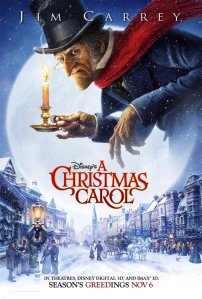 I still am at a loss over the appeal of the motion-capture system that director Robert Zemeckis fancies as of late. The creative mind that gave us classics Back to the Future and Who Framed Roger Rabbit? has embraced a technology that straddles the middle between live-action and outright animation. Motion-capture attaches electronic nodes to actors and digitizes their movements and facial features to later be conceptualized by computer wizards. And to this I say… so what? It seems like a whole slew of unnecessary work that adds little else than a vague starting point. Why not let the animators start from scratch? Why hamstrung creative professionals because Cary Elwes was feeling like making a certain gesture as “Portly Gentlemen #1?” I just don’t get it. To me, the motion-capture system is stranded in some artistic netherworld where it isn’t live-action and it isn’t animation. Zemeckis has cranked out his third mo-cap baby this decade, a retelling of Charles Dickens’ famous Christmas Carol. Why Zemeckis thought an old holiday chestnut would work best in this format, I’ll never know.
Cold-hearted Scrooge (Jim Carrey) is set to be visited by three spirits on a very magical Christmas Eve. The old man goes through Christmas past, present, and future to reevaluate his life and the true meaning of “peace on earth and good will toward men.” You know the drill, folks.
I like A Christmas Carol. I do. So do plenty of nice people. There’s a reason this oft-told tale still manages to resonate with generation after generation and that?s because it’s a good story. Of course it’s also an extremely familiar story to just about anyone outside of a womb at the moment. I expected Zemeckis and his crew to use their technology to jazz up the old story and give it a fresh new life on the big screen. Despite a handful of excursions flying through ye olde London, the extra slathering of special effects doesn’t enliven this holiday tale. I remember having great fun with Zemeckis’ previous motion-capture movie, 2007’s Beowulf (which does not play nearly as well in 2-D). That movie played around with the 3-D environment to great effect and made you feel apart of the experience. In contrast, A Christmas Carol does shockingly little with its depth of field, rarely placing distance between the foreground and the background. It’s a fairly lackluster 3-D experience. Maybe I wasn’t relaxing my eyes the right way, though I did notice how conscious I was of trying to elevate the 3-D experience myself. My disappointment is magnified by the fact that Zemeckis has been a pioneer for the 3-D playbook that Hollywood has now dubbed as the savior of the theater going experience.
 I wonder if Disney execs imposed limitations on the use of the 3-D immersion, not wanting to scare children by making them feel like they’re in the middle of a ghost story (there are some spooky moments already). The whole draw of motion-capture, and animation, is to transport an audience untethered by the limits of traditional practical filmmaking. This newest incarnation of A Christmas Carol fails to justify its existence. Why should I pay to see the most familiar story of modern day if there isn’t any new offering? At least The Muppet Christmas Carol gave me something different. And it had Muppets.
When I was younger in the mid 90s I was a huge fan of Carrey’s rubber-faced antics. I quoted Ace Ventura verbatim with my fellow seventh graders in 1995. So I understand the attraction of having him play multiple parts, but why exactly in a Dickens story? It’s not a comedy unless it’s adapted into one, and Zemeckis hews very close to Dickens and mostly recites the tale word-for-word. Scrooge isn’t funny, the ghosts aren’t funny, so why hire a renowned comedian to portray them all? This is a straight-laced adaptation and as such not the best use for Carrey’s talents. Is the move any better because Carey played all three ghosts? Is the movie any better because Gary Oldman gets to play Bob Cratchett and voice Tiny Tim? Is the movie any better because Elwes is credited for five inconsequential roles? Celebrity vocal casting is rarely effective in animation and so it seems the same in motion-capture.
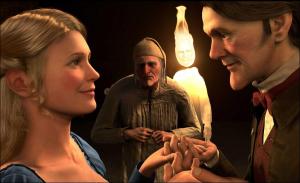 The technology has improved from the dead-eyed zombie children days of Polar Express, but it still seems like little more than less refined animation to my eyes. The movements are more fluid but the color palate is subdued into amber hues and candlelit locales. It doesn’t exactly use all the technological tools in the toolbox. It’s like a five-star chef toasting a Pop Tart: a waste of potential. I didn’t care for the skewed proportions on people either. Scrooge has a wiry frame with long spidery limbs and a triangular torso, and his character design kept reminding me of Jack Skellington. It’s too otherworldly considering nobody else comes across as a garish caricature in design form. The character designs for the three spirits are also fairly underwhelming. The Ghost of Christmas Past is a wispy flame. The Ghost of Christmas Future is nothing but a shadow. Is there a connection here? Otherwise, a shadow is pretty lame for the one ghost that can get really inventive and scary. Really, a shadow? I can do that myself without the aid of computers. And was it Carrey’s shadow to make it officially motion-capture? Because God forbid no other shadow could do or give the same performance of being draped over shapes.
I actually had to vehemently fight the urge to nap during A Christmas Carol. Maybe it was my poor sleep from the night before, maybe it was the fact that the 3-D glasses make everything darker (they still manage to hurt my eyes after prolonged use), but it was likely due to the fact that Zemeckis added a coat of polish to a holiday classic but declined to find purpose for doing so. Does this story get better with zooms through London, or Scrooge being shrunk and chased by demonic horses? It all seems like folly to me, like somebody’s idea to goose literary classics. Can you imagine Jane Eyre being shrunk and climbing through the walls of her Victorian era home? It all seems like an annoying distraction. Zemeckis? A Christmas Carol is exactly what you’d expect, which means you’d be just as well to flip through the TV channels and find any number of Christmas Carol versions. The Muppet Christmas Carol might even be on. Give that one a try instead. It even has some nice songs. And it’s got Muppets.
Nate’s Grade: C
Share this:

Then She Found Me (2008)
 Actress Helen Hunt’s directorial debut is an altogether pleasant film experience without achieving anything memorable or truly accomplished. It’s a simple story of a 40-something grade school teacher (Hunt) torn between her man-boy husband (Matthew Broderick) and a student’s hot father (Colin Firth, who seems to be a middle-aged woman’s dream come true). The extra plotline where Hunt discovers the identity of her biological mother (Bette Midler) never truly seems to coalesce with the romantic foibles. Then She Found Me has a noticeably wry tone, like that of a world-weary adult that’s been-there-done-that. That specific and welcomed tone helps keep the viewer alert and mostly satisfied from beginning to end. It isn’t a warm or sappy movie despite some sitcom-level plot complications. The acting is fairly amusing, though somewhat one-note (the foursome of actors rarely break from the one-sentence descriptions of their characters). The most shocking aspect of the flick is how weathered and gaunt Hunt looks, which is a refreshing and realistic turn for the actress. Hunt is competent behind the camera but doesn’t prove much else when it comes to directorial skills. Then She Found Me is a mildly affecting movie that passes the time well. Stick around to catch acclaimed author Salman Rushdie as Hunt’s OB-GYN.
Nate’s Grade: B
Share this:

Mamma Mia! (2008)
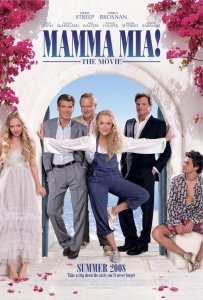 Mamma mia here we go again. This movie is going to be a middle-aged woman’s dream come true. It boasts a cast whose median age is in the mid 50s, one former yet still dashing James Bond, lots of good vibration getaway vibes, songs by a pop group whose heyday was over 30 years ago, and a heaping helping of girl power. In short, Mamma Mia will entertain the same mixture that made Sex and the City a monster hit, notably middle-aged women, teen girls, and gay males. I’ve seen the stage show and enjoyed it, as have millions of others around the world, but the movie fails to capitalize on reaching a broader audience. Mamma Mia is content to serve the faithful and delivers a less than satisfactory product. The world of cinema is not the best place for this material.
Raised all her life on a Greek island in a Mediterranean paradise, Sophie (Big Love‘s Amanda Seyfried) is getting married. Her disapproving mother, Donna (Meryl Streep), runs a hotel and has raised her daughter by herself. Then one day Sophie goes through her mother’s diary and discovers she has three possible fathers, Harry (Colin Firth), Bill (Stellan Skarsgård), or Sam (Pierce Brosnan). She invites all three to the island to vet her real father. In agitated response, Sophie invites her old gal pals Rosie (Julie Walters) and Tanya (Christine Baranski) to help her during this paternity crisis. Over time old loves will be rekindled, new love will bloom, and there will be a lot of singing.
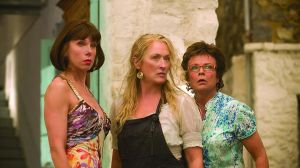 Let Mamma Mia stand as a future testament as to why you do not generally let someone helm a film when they have no film experience whatsoever. The creative talent behind the hit Broadway musical refused to grant anyone in Hollywood the rights to their worldwide sensation. So the stage director, Phyllinda Lloyd, is now also the film’s director, and oh my goodness was not the right choice. Her film inexperience shows with every second. The movie just doesn’t look right from beginning to end. There’s a noticeable “off” sensation due to Lloyd poorly shooting her scenes, editing her scenes, and directing her actors. I kept wanting, through sheer force of will, to nudge the camera angles, to change the composition a tad to make them more visually appealing, because Lloyd shoots the movie in bland static angles with minimal coverage. Mamma Mia looks so amateurish and fussily so, like Lloyd is purposefully thumbing her nose at the art of cinema. Lloyd also doesn’t bother to place any choreography in her scenes, and her actors just sort of spin and sway to the music like they were dancing in front of a bedroom mirror. It’s remarkable that a movie with so much riding on it looks so shoddy.
Presented in the reality of a stage, Mamma Mia is a shallow but fairly fun time. The movie version transports the musical into an actual Greek locale, which, to knock Lloyd yet again, she makes no real use out of (she mostly shoots her actors against rock faces and under harsh, glaring sunlight). What works on stage, when presented under the pretenses of the real world, comes across as incredibly cheesy and goofy beyond all relief (get a load of the high-stepping snorkerlers). The song and dance numbers, the character interactions, the sitcom generic plot (ripped off from 1968’s Buona Sera, Mrs. Campbell), they all start to transform into camp and beg for mockery. All of a sudden the entire island turns into a Greek chorus and provides backup during the impromptu singing. It’s strange and comes so late that it never feels properly established. The characterization is pretty slim, and once the movie establishes its characters it pushes the petal to the floor. The plot whizzes by in a whirlwind of one Abba song after another, with minimal breaks in between just to change setting and barely elbow the characters forward. I don’t think the actors had any chance to breathe in between the song numbers because I know I could barely exhale before another song assaulted my senses with forced giddiness.
But here’s the odd thing. The film is so silly and played to constant high-energy capacity that after a while Mamma Mia begins to wear you down. You may begin to smile, you may begin to clap, but you’ll be guaranteed to start humming the incredibly infectious tunes. Mamma Mia is essentially an Abba jukebox with a third-rate story strung along for the ride. As a story, it leaves much to be desired, but as a musical experience it makes you realize how glorious those Abba songs are. They’re like perfect pop bundles that somehow make you feel better even if the lyrics are more bittersweet than you realize at the time. The 18 Abba songs showcased, along with a few others during a weird curtain call sing-a-long, will certainly lift your spirits just as long as you concentrate more on the music than on the often-forced context.
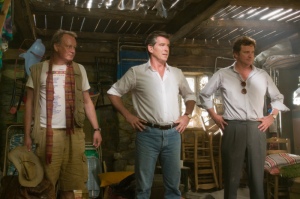 The actors are better than the material, clearly. Streep is her generation’s finest actress but she tries too hard to convince you of the great girl-power fun she’s having. The singing, on the other hand, is all over the map. Streep and Seyfried have the strongest voices of the bunch, which is good considering they also have the most musical numbers to sing and twirl to. Neither has a particularly sensational voice but then again they certainly distance themselves from their pitiful peers. Most of the other actors just have droning vocals but Brosnan, oh boy, I have to congratulate the man for having the courage he does. You feel embarrassed for the guy; I mean this is James Bond here. I found myself turning away whenever he opened his mouth, not wanting to look the man in the eye. Every time he started singing my theater crowd of Mamma Mia faithful began snickering and giggling. I almost feel so bad that I should send the guy a card saying, “Sorry about the singing, but hey, you’ll always have the paycheck.”
The real audience for a Mamma Mia movie is the fans of the Mamma Mia theatrical show, and the movie is tailored to their interests. The big screen version isn’t interested in converting new fans, hence the amateurish direction and disregard for reaching out for broader appeal. Mamma Mia the movie is pretty much a less zippy and ten times goofier version of the stage show except with bad singing. If that sounds like a fun evening out, then by all means enjoy. This is a mess of a movie and not a terribly good movie at that, and yet the power of those Abba songs will inject enough goodwill that you will forgive some of the movie’s transgressions. Some. Pierce Brosnan’s singing is something that cannot be forgiven nor forgotten.
Nate’s Grade: C+
Share this:

Bridget Jones: The Edge of Reason (2004)
 You don’t see too many sequels to romantic comedies, and that?s practically by design. Most romantic comedies consist of keeping the leads apart as long as possible, and then in that final climactic moment they connect, embrace, kiss, usually while a camera pans around them and some up-tempo Top 40 songs swells on the soundtrack. Then we end, our story finished. You see, romantic comedies are essentially modern fairy tales, and they end on the “happily ever after” moment, the most joyous moment. We don?t think about what their lives could be afterwards. I doubt few in the audience are biting their nails to know who does the dishes or if their sex life diminishes.
So for all of these stated reasons, sequels to romantic comedies are rare, unless, of course, they’re based on a book series that’s a cash cow of chick lit. Thus, America, we are given Bridget Jones: The Edge of Reason, the sequel to the smash 2001 film Bridget Jones’s Diary.
 The movie takes place four weeks after Bridget (Renee Zellweger) and Mark Darcy (Colin Firth) cuddling in the falling snow. Their relationship is all lovey-dovey, until Bridget starts reconsidering if she made the right choice of men. Her former boss, Daniel (Hugh Grant) has gone on to fame as a travel correspondent for TV news. He’s a bad boy, for sure, but sparks flew with him. Bridget also suspects Mark of cheating on her with a leggy colleague (whose final plot revelation is quite dumb). Bridget tries her best to fit in with Mark’s upper crust society, but is starting to feel unaccepted. Then she becomes a partner to Daniel on his travel reports, and the two visit exotic locales and sparks begin once more.
Edge of Reason feels like a poor slapdash grab at money. The film lifts entire scenes from the first Bridget Jones movie and tries reworking them for similar effect. Watching Firth and Grant sissy fight each other is amusing … the first time I saw it in 2001. For the most part, it seems like the filmmakers behind Edge of Reason were straining to come up with things after that “happily ever after” moment. What other reason can there be for some of the disastrous plot turns in Edge of Reason? The revolving door of writers (including author Helen Fielding herself) manufacture petty and foolish nitpicks for Bridget that she treats as life or death. It’s hard to feel concern for her. When you strand your main character -in a romantic comedy, no less- in a Thailand prison because she was caught smuggling drugs -in a romantic comedy, remember- then you have some giant plot issues.
The wit and biting commentary from Bridget seem to be stripped away. She only makes two journal entries, which open and close the film, and they were responsible for some of the greatest comedy bits in the original movie. She no longer comes across as a snappy, ordinary girl with a big heart and some big neuroses (did I mention the Thailand prison?). The Bridget of Edge of Reason seems a bit obnoxious at times. The comedy of Edge of Reason doesn’t generally rise above slapstick. Watch Bridget parachute into a dung field (Ha!), watch Bridget ski backwards down a slalom (Hilarious!), watch Bridget get stoned from magic mushrooms (You’re killing me!), and don?t forget to watch her fall down, like, a lot (R.I.P. Nate; cause of death: laughing too hard). The makers of Edge of Reason are just trying too damn hard.
It’s a wonder that Edge of Reason does work at times, and that reason is because of the acting of our romantic trio. Zellweger is still incredibly charming despite some of the things she’s forced to do. She’s never looked better than when she has her Bridget Jones physique; she’s practically glowing. Grant is at his best when he’s a cad, and once again he gets the best lines, especially when he’s undressing Bridget during a work trip. The movie comes alive when he and Zellweger start their flirtatious battle. Firth adds shades of humanity and adoration to his fuddy-duddy role. He’s got a great everyman appeal even when he’s being a twit.
Edge of Reason also seems to flog whatever it feels is funny. If Bridget saying something inappropriate in front of a group of dignitaries and ambassadors is funny, then expect it to happen again five or six times. And it does, sadly. Edge of Reason is almost a wall-to-wall torture chamber of public embarrassment for Bridget, and if the filmmakers thought that would endear her to audiences they were wrong. We were endeared already by her wit and charm, but I guess the people behind Edge of Reason thought we didn’t want more of that. I miss you old Bridget Jones, wherever you are.
 The first Bridget Jones movie was directed by Sharon Maguire, a personal friend of Fielding. Maguire was close enough to know how to adapt the story and retain the elements that made Bridget Jones entertaining. Edge of Reason‘s director Beeban Kidron seems to be assembling a Bridget Jones movie for a focus group. We lose the personality of Bridget and get an accident-prone buffoon. All that’s missing are the banana peels.
Everything about Edge of Reason screams laziness. A great example of this is the film’s choice for music. The songs are so obvious, from “All By Myself” to “I’m Not in Love” to songs that simply have “love” in their title, like “I Believe in a Thing Called Love” to Beyonce’s “Crazy in Love.” Chances are, if your band ever released a song with “love” in the title, the music director of Edge of Reason considered using it.
Bridget Jones: The Edge of Reason will likely entertain its core audience (there were very few men unaccompanied by women in my theater). The cast makes this stilted sequel worth watching. If you really liked Bridget Jones’s Diary, you’ll probably be intermittently amused with Edge of Reason, because it’s the same meal, only reheated with a bit of a chill. Let this be an example of why Hollywood doesn’t make sequels to romantic comedies. We’re happy enough with “happily ever after.”
Nate’s Grade: C+


 nathanzoebl
You must be logged in to post a comment.