Blog Archives
Grace is Gone (2008)
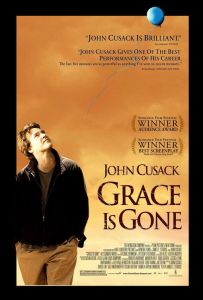 This Iraq War drama means well but it comes across as manipulative and morally questionable. John Cusack stars as a former military man who just found out his wife, on active duty in Iraq, has been killed. The bulk of the film’s conflict deals with how Cusack will tell his two daughters that mommy is not coming home again. Instead of being upfront with his children, he takes them out of school and whisks them away on a family trip to an amusement park. His reasoning is that he wants to squeeze in a few more happy memories before the kids hear the news. To me, this is irresponsible and psychologically damaging; those kids will resent their father holding onto such important information while he encouraged his kids to shop in ignorance. The film is about 80 minutes of watching a guillotine hang over someone’s head, just waiting for the moment to hit. It can get rather uncomfortable. Somewhere in this misguided drama is a poignant look at the domestic cost of the Iraq War from the family’s perspective, a perspective yet to be fully articulated by the movies. Instead, Grace is Gone is a well-acted but contrived drama that favors delaying the pains of reality to the point of incredulity.
Nate’s Grade: C+
Share this:

Flags of Our Fathers (2006)
 Clint Eastwood’s WWII epic is all about scaling down legend, deconstructing myths, and illustrating how truth can become hazy in the name of the greater good. It’s very well made, noble, reverent, intelligently written but somewhat empty at its center, feeling far too mechanical to become one of the great war movies of modern times. The structure is needlessly scattered into three interconnected storylines: 1) the ongoing battle of Iwo Jima between Japan and the United States, 2) the stateside bond tour by three of the six men responsible for raising the flag in the iconic photograph, and 3) a son in present day writing a book about his father’s war experiences in the Pacific. I really don’t feel that splintering the narrative added anything to the story; in fact, there’s a late segment that’s a barrage of character deaths that would have been far more powerful had it not been assembled into an afterthought of a montage. The battle moments are tense and bloody, with just a tinge of Saving Private Ryan familiarity (shaky cam POV, washed out colors, chaotic editing, graphic gore). I would have actually preferred more battle action but oh well.
Most of the film focuses on our three soldiers (Ryan Phillippe, Jesse Bradford, Adam Beach) dealing with the pressure of a spotlight they feel is undeserved. You see, the raising-the-flag picture, perhaps the most famous war photograph of all time, was a group of men replacing a flag. There were no bullets buzzing over heads, no bombs blasting; it isn’t even the first flag. The men wince at being called heroes. They’re made to become U.S. military shills, encouraging the nation to keep buying those war bonds. This segment provides lots of moments of interest by illuminating a chapter few know — the story behind the story. These moments of insider info have some juice to them, led by a suave SOB performance by John Slattery as the man in charge of drumming up dollar signs.
Phillippe is an actor I’ve been keeping tabs on ever since 2000’s Way of the Gun, and he is the moral center of the movie, showing grit and humility. It’s mostly a performance of stoic silence, but he has a very strong scene when he confronts a war widow wanting the truth and he lies between his teeth to comfort her. Beach (Wind Talkers) gets the best role as a solider of Native American blood that is still seen as a second citizen in his own nation. There are plenty of revealing moments of casual racism (people call him “chief” more than his actual name) that explain why he took to the bottle with such ferocity. Beach is an emotional wreck and deeply haunted by the disturbing memories of war. He has to be practically pried off of a widow he is clinging to and crying uncontrollably. The cast is full of young Hollywood actors and it might due some good to become acquainted with their faces before stepping into a theater. It can get confusing. Yet another reason a disjointed narrative is a bad idea.
Where Flags of our Fathers cannot make the leap from good to great is in the area of character. After two hours, you don’t really feel like you know anyone better. There’s a distance that stops the audience from fully investing. I think Eastwood and the film have such noble aims that the movie becomes more of a statement than entertainment. There isn’t any conclusive climax; the film seems to directly go right into a voice-over heavy resolution. On a technical front, Flags is very impressive and Eastwood has created his most visually lush film to date. From a human standpoint, it falters and flags. It’s admirable and attractive but I doubt come Oscar time that this war-weary ode to heroism will have many followers.
Nate’s Grade: B
Share this:

Million Dollar Baby (2004)
 Million Dollar Baby, much like its fledgling female boxing character, has come out of nowhere and made a considerable deal of noise. This little homespun film directed by Clint Eastwood didn’t have the glitz and sheen of other awards friendly movies, but now it seems that Eastwood?s own baby may clean up come Oscar time. Can Million Dollar Baby tackle the enormous hype surrounding it? Yes and no.
]Frankie (Eastwood) is a hardened boxing trainer too concerned for his fighters’ welfare to allow them to fight in championship bouts. He’s the kind of cynical old man that enjoys pestering a priest and causing him to unleash an F-bomb. Frankie and his longtime friend Scrap (Morgan Freeman) run a rundown gym and talk un-sentimentally about their older days as prize fighters. Then along comes Maggie (Hilary Swank), a 32-year old waitress who’s got nothing to believe in except her possibility as a boxer. She wants Frank to train her into the champ she knows she can be. He refuses saying he doesn’t train girls. She’s so determined she won’t take no for an answer. Frank finally agrees, especially after some help from Scrap, and starts to teach Maggie everything she needs to know to be a star pugilist. The two begin to open up to each other emotionally and Maggie seems destined to become a force in the ring.
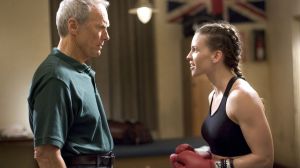 Million Dollar Baby‘s greasiest attribute is its trio of knockout performances. Swank owns every second of this movie. She’s unremittingly perky, conscientious but also dogged, stubborn, and irresistibly lovable. Swank embodies the role with a startling muscular physique and a million dollar smile. Her performance is equal parts charming and heartbreaking. Maggie’s the heart of Million Dollar Baby and Swank doesn’t let you forget it for a millisecond. Come Oscar time, I’m sure she will be walking onstage to grab her second Best Actress Oscar in five years.
No one does grizzled better than Eastwood, and maybe no other actor has made as much of an acting mark by squinting a lot. Million Dollar Baby is probably his best performance to date, though for a good while it sounds like Frank has something lodged in his throat (pride?). Frank has the greatest transformation, and Eastwood brilliantly understates each stop on the journey until landing in a vulnerable, emotionally needy place.
Freeman once again serves as a film’s gentle narrator. There isn’t a movie that can’t be made better by a Morgan Freeman performance. His give-and-take with Frank feels natural and casual to the point that it seems improvised on the spot. Freeman unloads some great monologues like he’s relishing every syllable, chief among them about how he lost his eye. It’s wonderful to watch such a great actor sink his teeth into ripe material and deliver a performance that may net him a long-awaited Oscar (I think he’s due, and likely so will the Academy).
For whatever reason, Eastwood is hitting a directing groove in his twilight years. First came Mystic River, an ordinary police whodunnit made exceptional by incredible acting. Now Eastwood follows up with Baby, an ordinary sports film made extraordinary by incredible acting. Hmmm, a pattern is forming. The cinematography is crisp and makes great use of light and shadow to convey emotion. Eastwood’s score is also appropriately delicate and somber. The boxing sequences are brief but efficient.
Million Dollar Baby is a very traditional story that is at times surprisingly ordinary. Maggie’s the scrappy underdog that just needs a chance, Frank’s the old timer that needs to find personal redemption, and Scrap?s the wise old black man. Once again, an old curmudgeon takes on a rookie and in the process has their tough facade melt away as the inevitable victories pile up. Million Dollar Baby is a very familiar story but then again most boxing tales are fairly the same in scope.
What eventually separates Million Dollar Baby from the pack is its third act twist. You think you know where Eastwood’s film is headed, especially given the well-worn terrain, but you have no clue where this story will wind up. The plot turn deepens the characters and their relationships to each other in very surprising ways. You may be flat-out shocked how much you’ve found yourself caring for the people onscreen. It almost seems like Eastwood and company have used the familiar rags-to-riches underdog drama to sucker punch an audience into Million Dollar Baby‘s final 30 minutes. We’re transported into an uncomfortable and challenging position, and Eastwood won’t let an audience turn away.
 Million Dollar Baby is not the colossal masterpiece that critics have been drooling over. For one thing, the group of antagonists is not nearly as textured as our trio of leads. They’re actually more stock roles that further enforce the ordinary story of Million Dollar Baby. Maggie’s trailer trash family is lazy unsupportive batch of stereotypes. The evil female boxing champ just happens to be a German who doesn’t mind playing dirty. One of the boxers at Frank’s gym is an arrogant showboat just waiting to be nasty while the teacher’s back is turned. Million Dollar Baby excels at showing depth and humanity with its lead trio, yet it seems if you aren’t in that circle you’re doomed to wade in the shallow end.
Eastwood shows that great acting and great characters you love can elevate a common framework. The package may be similar to a lot of films before about scrappy underdogs, but Million Dollar Baby lacks comparison in its genre when it comes to its enthralling acting and characters. The father-daughter bond between Frank and Maggie is heartwarming. The final reveal of what her Gaelic boxing name means may just bring tears to your eyes. The results are a very fulfilling movie going experience, albeit one that regrettably may not live up to such hype.
Million Dollar Baby has been showered with heapings of praise and become a formidable Oscar contender. The story treads familiar waters but its outstanding acting and deep and humane characters elevate the material. The film can’t match the hyperbole of critics but Million Dollar Baby is an ordinary but greatly satisfying ride led by compelling acting. The film hums with professionalism and seems to just glide when everything comes together magnificently, particularly in that last 30 minutes. Eastwood is hitting an artistic stride and it’s actually exciting to see what Clint will do next. Million Dollar Baby may not be a first round knockout but it definitely wins by decision.
Nate’s Grade: B+
Share this:

Mystic River (2003)
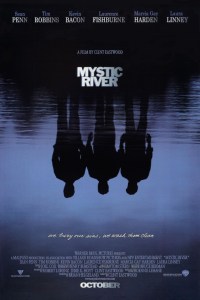 The acting is phenomenal. The story is twisting and layered with incredible amounts of depth. The direction is calm and focused. This is a great Greek tragedy and a great crime story and human drama. Eastwood scores again.
Nate’s Grade: A
Share this:

Space Cowboys (2000)
 Geezers in space? Consider it the John Glenn biopic. Clint Eastwood teams up with veteran actors James Garner, Donald Sutherland, and Tommy Lee Jones to save the world with the combined aid of Ensure and adult diapers. But these old-timers show some of the “youngins” what movie entertainment is really all about.
Back in the day when the Air Force was in charge of space related programs Clint and his team were the cream of their crop and scheduled to be the first men to enter the dark void of space. Unfortunately NASA was formulated and the boys got the boot for a cosmo chimp. Now 50 years later the earth is threatened by a falling Russian satellite with technology too ancient that only a select group of experienced men still know to this day. So NASA enlists the help of the very men it backhanded so many moons ago to be drafted into a space operation to halt the plummeting satellite.
For a good while Space Cowboys is a breath of fresh air from a veteran team of actors. The rivalry between Jones and Eastwood as well as the young healthy astronauts versus the elderly-shake-your-hand-at-Wal-Mart astronauts makes for great comedy. The entire core group of actors sparkle with terrific chemistry and on screen presence. They create a jovial fun atmosphere that makes the movie humorous and surprisingly engrossing.
Space Cowboys is not liver-spot free. The direction by Eastwood is often flat and very un-engaging. The entire Russian Cold War spy subplot borders on the absurd, and the romances with women that can be their daughters makes vomit rise into my throat whenever I see their leathery faces suck the life out of those young and nubile girls. When the gentlemen get launched into space the entire movie loses focus and forgets what made it before. The typical space rescue themes abound and you know before they get up there that one of them won’t make it back, and probably do something heroic in the first place.
For the most part Space Cowboys is a reminder that the elderly still know how to put on a good show, even if the last fourth is very lackluster. These cowboys can ride off into the sunset content for a job well done.
Nate’s Grade: B-


 nathanzoebl
You must be logged in to post a comment.