Blog Archives
Kick-Ass 2 (2013)
 It’s hard for me to discuss Kick-Ass 2 without sounding like a hypocrite. I enjoyed the first film’s visceral thrills, style, and satire of superhero tropes. The sequel gives me more of the same except not nearly as well polished, and in typical sequel mentality, it goes bigger, expanding the world and the height of the sick puppy violence. Kick-Ass (Aaron Taylor-Johnson) and Hit Girl (Chloe Grace-Moritz) are trying to live ordinary lives but keep feeling the need to don their suits and fight crime. Kick-Ass joins a ragtag team of other costumed vigilantes to battle a super villain team, lead by the former Red Mist (Christopher Mintz-Plasse). For long stretches, the movie seems like an unwanted Heathers knockoff as Hit Girl attempts to fit in at high school. She has some particularly nasty vengeance against a popular bully, and if there is a line, it may have been crossed here. I don’t know what it says about me, but I guess I’m fine with a pint-sized kid slicing up bad guys and cursing like a sailor, but making a woman simultaneously vomit and defecate herself, watching both projectile streams spray out her ends, is too much for me. This is a darker, cruel, and mean-spirited feel with the material, and writer/director Jeff Wadlow fails to compensate for the lack of creativity this go-round (I miss you Matthew Vaughn). The humor is still lively, but the plot is predictable at every step, the characters behave in ways that don’t make sense, and the action sequences are poorly filmed, leading to an anticlimactic ending that simply peters out. Kick-Ass 2 won’t be knocking anyone out.
Nate’s Grade: C+
Share this:

Kick-Ass (2010)
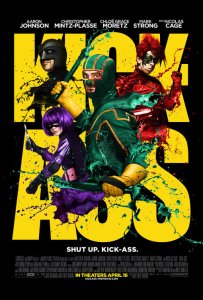 Based on Mark Millar and John Romita Jr.’s popular eight-issue comic, Kick-Ass takes the world of superheroes and makes it one step closer to reality. Granted, it’s still a heightened reality with flexible rules erratically administered, but it’s almost recognizable. Nobody in Hollywood wanted to touch this movie, so it was produced entirely outside the studio system. That hesitation may be because Kick-Ass begins as a goofy teen comedy and morphs into a bloody action caper with off-the-wall violence. But it’s also preposterously entertaining.
Dave Lizewski (Aaron Johnson) is just a typical kid who reads comics and wonders what else could be out there for him. He’s pretty much a nobody at school who routinely gets beat up. His life’s biggest tragedy is the loss of his mother, but she was not taken by some dastardly villain but by an aneurysm. Dave questions why nobody ever tried to be a real super hero. Tired of being a nonentity, Dave orders a wet suit and fashions a costume for a superhero alter ego, Kick-Ass. His first few encounters don’t go so well, landing Dave in the hospital, but in short time his exploits become a YouTube sensation. His MySpace page becomes full of admirers all seeking super hero help. He inspires others to don cape and cowl, like Damon “Big Daddy” Macready (Nicolas Cage) and his daughter, Mindy “Hit Girl” Macready (Chloe Grace Moretz). But they have their own reasons for cleaning up the streets. Big Daddy worked as a cop but was wrongly imprisoned when he went against mob kingpin Frank D’Amico (Mark Strong). Damon has been plotting his vengeance and training Mindy to be an efficient killing machine. Unfortunately, their mob hits are being blamed on the hapless Kick-Ass. Frank D’Amico enlists his wannabe gangster son, Chris (Christopher Mintz-Plasse), to pose as a superhero and lure Kick-Ass out into the open. It’s like The Departed but with more eyeliner.
 Kick-Ass is a fairly subversive work, notably in the relationship between Hit Girl and Big Daddy. He has been training her (or brainwashing) to become a tool of vengeance, but he’s also making sure that his little girl will be tough enough to handle the evil the world may throw at her. A father/daughter outing includes dad firing live ammunition into his daughter’s bulletproof wearing chest. He’s doing this so that she won’t be afraid when, not if, she gets shot. She will know what it feels like. He then promises that they’ll go out for ice cream later. This demented sense of parenting, as presented, actually becomes strangely endearing. They become the heart of the movie, and I was surprised that during some major scenes how emotionally involved I was. We have a beguiling sense of protection for Hit Girl, much like her father who even in moments of great agony screams helpful tactical suggestions to his little girl (to answer any concerns, Moretz and the character are not sexualized even with a Catholic schoolgirl outfit). Unlike Kick-Ass, they have something very concrete to fight for, which is why we feel for them and hope for their success.
The tone of this movie, as you might be able to tell, is wildly uneven. Kick-Ass exists in a reality closer to our own, and Hit Girl and Big Daddy exist in a different fantastic reality where they can perform Matrix style maneuvers at a moment’s notice. But I actually believe that these two different tones and approaches compliment one another. Kick-Ass is a realistic portrayal of what would happen if somebody with no training and nothing but complete naivety would don a costume to fight crime for the greater good. In Kick-Ass’s first confrontation with the criminal element ends with him getting stabbed. His superhero wish fulfillment is brought back to a stinging reality thanks to that blade in his side reminding him that violence is real and painful. His first successful encounter with criminals is not because suddenly he has developed super martial arts skills or any sort of power, it’s simply because he has a stronger will power to continue fighting, even as he staggers back and forth likely to pass out from exhaustion. He wins through sheer will power and little else. He’s got heart but not the ability, thus we watch him receive many pummelings throughout the film. And throughout the movie, Kick-Ass keeps to this edict. He doesn’t succeed through any sort of cunning; his only “special ability” is his above-average tolerance for pain. On the flip side, Hit Girl is the ultra stylized fantasy version of a superhero that we’re more familiar with. She has an amazing talent for death and deception, and even her back story feels ripped from the comic pages — raised to avenge the death of her mother by the hands of gangsters. She is much more in line with our anticipated pop culture sensibility of what makes a super hero. So she and Big Daddy exist as the contrast, an exaggeration that heightens the vast difference between the fantasy super hero and the harsh reality of the ordinary (Dave). It’s a satire that indulges in its targets. While the movie toggles back and forth between the two tones, I never felt chaffed by the alternating styles.
 And while we’re on the subject, while the film may be called Kick-Ass but he’s the least interesting aspect of it, perhaps because he is a mirror to the audience. He’s weak, wimpy, and is delusional as far as where his lack of abilities can take him. Which sets the stage for the film to be completely stolen by Hit Girl, played to foul-mouthed, steely perfection by breakout star Moretz. She is a one-woman wrecking crew and dispatches bad guys with stylish, wall-flipping ease. The incongruity of watching an 11-year-old child turn into a killing machine both serves as commentary on the preposterous nature of the comic book world, and it also makes for some seriously wicked fun. Who wouldn’t enjoy a pint-sized little crime fighter with a profane vocabulary? Parental activist groups, I suppose, who have complained about the movie’s portrayal of young Moretz, going so far as to argue that any child should not be made to say the off-color language that she does in Kick-Ass (have they listened to school yards this century?). But here’s the point: it’s supposed to be shocking exactly because she’s a child and that battery of behavior is not expected. She lures opponents into a false sense of security because, after all, she’s “just a little kid.” But Hit Girl is anything but. She’s one tough chick and Moretz gives a performance full of swagger. Film fans, get ready for her lead role in the Let the Right One In remake this fall. It should prove to be another launching pad for Moretz.
Director Matthew Vaughn started as a producer for Guy Ritchie’s films, but with every new film under his belt it looks like Ritchie might become an asterisk for the mighty career of Vaughn. After the tense gangster thriller Layer Cake, the whimsical fantasy Stardust, it seems like Vaughn is getting to be a better director whereas Ritchie appears to be getting worse from film to film. But I am here to praise Vaughn and not bury Ritchie. The movie has splashy visuals and some grand action, especially during an all-out assault on D’Amico’s lair as finale. Pretty much like Hot Fuzz, in the last act the movie degenerates into what it was parodying earlier. But by this time I’m already hooked. Let the fireworks commence and I’ll keep munching my popcorn. It’s a rousing, action-packed finish that manages to acknowledge the irreverent ludicrousness of the whole film while still being, well, kick-ass. Vaughn makes excellent use of music, nicely pairing muscular pieces of epic instrumental rock like “In the House — In A Heartbeat” by John Murphy from 28 Days Later. There are some smart additions like having Joan Jett’s “Bad Reputation” play at a fiery moment of anger, and a kitschy kid song playing during our first introduction to Hit Girl, magnifying the absurdity.
Vaughn also coaxes a good performance from Cage, meaning the actor has strung two good performances in a row (please see Bad Lieutenant: Port of Call New Orleans). Cage has an eerie sense of determination but he plays his character in an “aw, shucks” Mr. Rogers style, even borrowing the speech patterns of Adam West when he dons his costume.
 The movie does have some issues. It’s stuffed with too many subplots that go into more detail than they have to. The gangster goons have way too much screen time and are, at best, bad caricatures. The subplot with Dave’s love interest, cute girl Katie (Lyndsy Fonseca), thinking Dave is gay goes on for too long just to offer some third-rate Three’s Company misunderstanding gags. The plot is also completely self-referential without stooping to explanation. As stated earlier, the tonality shifts will not play out the same for everyone, and the plot pretty much switches protagonists halfway through, becoming the Hit Girl show. Then again some might argue that the film would be better off without Kick-Ass.
Kick-Ass plays like a juvenile romp, nothing to be taken seriously. This is not The Dark Knight by any account. I was not feeling the same sense of moral unease that I felt during the depraved, consequences-free killing-as-personal-self-actualization film Wanted, also based on a Millar comic book series. Kick-Ass is never really mean-spirited or cruel or casual with human life, despite the central themes of vigilantism and vengeance. In fact, the movie posits that more people need to make a difference and stand up to injustice, granted he movie ignores the justice system in lieu of fisticuffs. The movie doesn’t deconstruct the world of superheroes like Watchmen, but at the same time it holds it all up for ridicule, saying, “Isn’t this all ridiculous?” and offering escapist thrills. Kick-Ass is a visceral, absurd satire of the realm of superheroes that also manages to mine that same realm for polished genre thrills. Vaughn keeps the movie from feeling disjointed, even as it swaps tones from comic to dramatic, from (moderately) realistic to geek fantasy wish fulfillment. It won’t be for everybody, but consider me apart of the throng that cheered when an 11-year-old managed to make a guy shoot himself in the head with his own gun. There’s probably something wrong with me.
Nate’s Grade: B+
Share this:

Hot Tub Time Machine (2010)
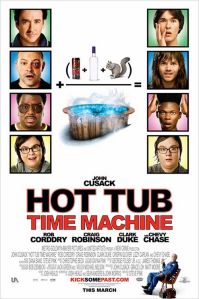 Not nearly as clever as the brilliant title may suggest, Hot Tub Time Machine is a fairly silly yet sloppy comedic enterprise. The purposely moronic nature of it leads to some raunchy enjoyment, and the premise involving a time-traveling Jacuzzi allows for some fun comedic situations. The trouble is that the movie shadows our foursome of dudes (John Cusack, Rob Corddry, Craig Robinson, and Clark Duke) too closely. The movie presents intriguing comedic setups but spends inordinate amounts of time dealing with the fractious falling out between the dudes. We spend more time talking about old friendships than we do the sheer possibilities brought about through time travel. The pacing has some turgid moments; it takes too long to reach the magic hot tub. There’s some good humor at first when the guys believe they must follow the exact path they tread before, lest the butterfly effect destroy the future. Then they decide to walk a different path, taking advantage of their knowledge of the future. The movie doesn’t fully take advantage of its own comedic possibilities and settles for lame payoffs, like an end credits sequence inserting Corddry into a Motley Crue video (it’s not funny). There are a few Farrelly Brother-level gross-out gags, but most of the comedy happens around these guys, not because of their characters. They themselves are not exasperatingly funny, so it’s disappointing when Hot Tub Time Machine flirts with fun comic scenarios (an outlandish bet on a sporting game, performing a modern song, the mystery of how the bellhop loses his arm, Duke making sure he will be conceived in the past) only to give up and spend more time with the guys hashing out their years-old squabbles. Enough with the personal growth and reflection. Get back to messing around with the space-time continuum.
Nate’s Grade: B-


 nathanzoebl
You must be logged in to post a comment.