Blog Archives
There Will Be Blood (2007)
 Paul Thomas Anderson is one of the most gifted filmmakers working today, bar none. There Will Be Blood is only his fifth film and marks a radical departure from his intimate, inter-laced character dramas. Blood is an epic in size and scope and has been blessed with numerous awards and vehement praise. Critics say this film is one for the ages. My anticipation was fed to unhealthy proportions thanks to the hyperbolic praise and Anderson’s track record of audacious visionary cinema. There Will Be Blood is certainly audacious, and not just with its bladder-testing running length. This lethargic throwback to 1970 filmmaking exists for the purpose of a single performance and neglects other important tenets of storytelling. At 158 minutes, I can safely assume for many that there will be boredom with There Will Be Blood.
Our first glimpse of Daniel Plainview (Daniel Day-Lewis) is in the pit of a hole. It’s 1898 and Plainview is chipping away at the earth looking for scraps of silver. His meager beginnings set the stage for other mining prospects when, on the hunt for silver, he discovers even bigger riches – oil. Thanks to the advancing automobile age, the world has a thirst for oil that knows no bounds and makes Plainview a wealthy man. He’s an unscrupulous business figure that trots around his “son” HW (Dillion Freasier) as one more angle to fleece gullible townsfolk out of their property rights. HW’s father died in a drilling accident when he was a baby and Plainview has looked after him since.
One day Paul Sunday (Paul Dano) enters Plainview’s office and is willing to name a prime piece of land that oozes oil. Plainview agrees to pay Paul his sum and heads out with crew to Little Boston, California. The small town is easily enamored by Plainview’s promises of riches and prosperity. He purchases as much tracts of land as he can and begins drilling for that valuable black liquid. Eli Sunday (also Dano) is Paul’s twin brother; he wishes to build a church and become a prominent religious figure for his town. He sees the oil as his ticket to a throng of adoring congregants that will do his bidding. Oil is struck and several parties vie for dominance.
 I fear that Blood may be too languid for its own good. I’m all about allowing a film to take its time to establish a world and the people that inhabit it, and to its credit Blood spectacularly recreates turn-of-the-century America and the craze for oil. The cinematography and production design are stunning in gorgeously recreating a bygone era with such dusty detail. The film is packed with evocative imagery that will linger in your memory, like a burning oil derrick that feels like someone just drilled down to hell. The mixture of smoke, fire, and oil set amidst the hazy twilight is a remarkable sight. Visually speaking, this movie is close to flawless.
The nascent plot is what hampers Anderson’s Blood from reaching masterwork territory. The focus is on a misanthropic man who despises people and wants only to seclude himself, and yet he has genuine affection for his son until Daniel feels betrayed by his ambitions. I understand that the movie is a far-reaching character study, and Daniel Plainview is a fascinating and ferocious character, a perfect yet perplexing combination of greed and ambition, but I feel like Anderson has spent so much thought on his characters and forgotten to write a story around them. The silent, early portion of Blood gives us a quick summation of how Plainview rose to fortune and power and it’s rather compelling how much story comes across with no words of dialogue. This wordless pattern seeps into [i]Blood[/i] and there are stretches here and there where you may not hear a wisp of dialogue for, oh, 15 minutes, but by this point the movie is beyond setting up its storytelling universe. Again, I have no issues with the use of silence to convey meaning and metaphor, but it feels downright neglectful for Anderson to have concocted such intense, lively portraits of people and then to encase them in a void of speech.
Significant human interaction is kept to a minimum and I couldn’t help but feel that the movie was uncomfortably coasting without conflict for too long. Blood sets up Eli Sunday and Daniel Plainview as rivals, two men intent on grabbing power and the upper hand. The film takes a winding path to set these players in motion but I was encouraged that now, finally with two adversaries pitted together, the film would kick into another level and showcase a violent struggle worthy of a titan like Plainview. I recall every summary I read of There Will Be Blood noting that Eli is the thorn in Plainview’s side for many years and that their feud took up the bulk of the labored running time. This does not happen at all. Eli drops out for long stretches of plot and is forgotten unless Anderson feels that the character needs to be shoehorned back into the central drama at arbitrary points. This is no battle either, it’s all one-sided; Plainview handles Eli without breaking a sweat. With this in mind, I’m puzzled at how the conflict between Eli and Plainview was supposed to take center stage. Anderson had such wonderful potential to paint a doomed rivalry that eclipsed both men, but instead the external conflict only appears whenever Anderson desires some new sounding board for Plainview. That means that Blood can go for what feel like entire acts before it appears that conflict will be introduced or elaborated upon. There is a vacuum of story here and Eli Sunday, as written and performed, is far too submissive and easily beaten to present any formidable challenge.
 Why present characters at odds if you’re not going to push them further? Why write such vivid and amoral characters if you’re going to have them sit out or stay still? Plainview is the star of the show, I get that, but that isn’t an excuse for underwriting every single other character in an entire 158-minute movie. There are no intriguing character dynamics in this movie. Eli Sunday is forgotten. HW presents the closest insight into the humanity (what’s left) of Plainview, but the character is treated like a mute doll and when HW unexpectedly leaves the story so too does the only significantly interesting emotional relationship. Anderson establishes that greed comes in all shapes and sizes, be it an oil tycoon or a false prophet feasting on the coffers of his congregation. There is great thematic tension between the spiritual and the material but it never comes to a head. I kept waiting for confrontation but what Blood kept dishing out time and again was willful stagnation.
The extended ending forces a marginally contrived final reunion between Eli and Plainview but it doesn’t feel like any sort of payoff. The brutish and abrupt finale will cause many to scratch their heads and say, “That’s it?” until their scalps bleed. It’s a rather unsatisfying end for a film that boasted such grand ambitions.
The musical score by Radiohead guitarist Jonny Greenwood certainly wasn’t bad but it definitely did not mesh with the movie. Greenwood’s score consists mostly of a cacophony of violin strings buzzing about like a swarm of angry bees. The score seems to have a life of its own, intruding upon the scene at whim and upstaging character dialogue at times. The mixture of shrieking violins and some heavy percussion makes the movie feel less like a costume drama and more like a horror movie. The score seems to percolate and signify approaching danger. The score is also overly redundant and feels unnaturally paired to There Will Be Blood. It’s a marriage that doesn’t ever match.
 Day-Lewis doesn’t act often in movies and when he does it’s usually something special. His performance in Blood is outstanding, and it better be, because the film is built exclusively around his performance. He is an angry man bent on crushing opponents and making sure no one else gets sight of success. Day-Lewis is an immense talent and can dabble with multiple emotions with sheer, sightless subtlety. His distinct manner of speaking is finely attuned, though sometimes I felt like I was watching the world’s longest, and best, Jack Palence impersonation.
The other actors fall victim to the one-man show nature of the narrative. Dano comes across as miscast. He seems too youthful and ineffectual for the role. When he’s beaten and bullied his voice goes into a high-pitch squeal that is not becoming for the character. Dano’s acting takes the empty characterization one step further and removes any audience empathy.
Going by the repeated slam that Anderson is less a visionary and more a regurgitation of homage, if Boogie Nights was his Scorsese movie, Magnolia his Altman movie, Punch-Drunk Love his French New Wave movie, then There Will Be Blood is his Kubrick movie. It’s a plodding, challenging, and idiosyncratic movie that hits universal themes like family, greed, desire, and vengeance but does so in a small-scale story that feels intimate and epic simultaneously. The movie is dripping with artistic integrity and breathtaking filmmaking ability; however, it’s also a crushing disappointment. Anderson is a gifted writer/director with few contemporary peers, but he strands such vivid characters in a dessert of storytelling. There is little external conflict and the characters feel neglected or too easily forgotten. The focus is one misanthropic man but the film shortchanges him by not supplying additional substantial characters or conflict. Perhaps There Will Be Blood will stand the test of time and be the classic or landmark that critics are wetting themselves to declare it. It’s just simple economics in my mind: a character study cannot fully resonate without a strong network of supporting characters and/or lasting conflict. I have never been let down by a Paul Thomas Anderson film yet but I suppose there’s a first for everything.
Nate’s Grade: B-
Share this:

Munich (2005)
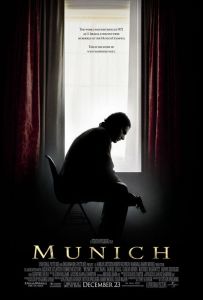 If 2005’s War of the Worlds was Steven Spielberg’s look at 9/11, then Munich should be considered his examination of the aftermath. What could be more relevant today than a film about combating terrorism, violent reprisals, and where a government leader says, “Every civilization finds it necessary to negotiate compromises with its own values?” Anyone seen the news lately? Spy eavesdropping, prison abuses, hemming and hawing on what the definition of torture is, it’s all compromised values in the name of security. This is our world and Spielberg analyzes the costs of war. Munich is visceral, haunting, thoughtful, and compelling as both an idea piece and as a mainstream thriller. It’s Spielberg’s most mature work in a decade.
In 1972, a group of Palestinian terrorists known as Black September took 11 Israeli athletes hostage during the Munich Olympics. The world watched as the standoff stretched for hours, finally ending in a firefight at the airport and the terrorists throwing grenades into helicopters housing their hostages. Every Israeli athlete and Black September member had been killed. “They’re all gone.”
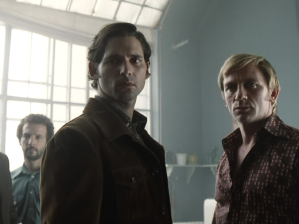
But it doesn’t stop there. Israel Prime Minister Golda Meir (Lynne Cohen) recruits Mossad agent Avner (Eric Bana) to run a secretive counter strike. Avner is to assemble a team, track down the architects of the Munich massacre, and assassinate each one. Their mission is only known by a select few, and their only contact is via a handler (Geoffrey Rush) and a safety deposit box that fills up with money. Joining Avner are Steve (Daniel Craig), the South African with a hot-head, Robert (Mathieu Kassovitch), the toymaker turned bomb maker, Hans (Hanns Zischler), the document forger, and Carl (Ciarán Hinds), the clean-up man. The men crisscross the globe hunting down their targets, and with each successful kill there is escalating retaliation by Black September. Soon Avner’s group becomes a target themselves and he questions if the men they are snuffing out have any connection to Munich.
 When I first heard about Munich I thought it would be a dramatization of the hostage situation, and Spielberg does revisit the sequence in horrifying and bloody flashbacks. The film’s focus is on the aftermath of Munich, though it does not pretend to be fact. This is a made up story based on rumors. As new evidence clears, it looks like the Munich retaliatory slayings were unrelated Palestinian men.
For events that began in 1972, Spielberg punctuates his drama with a gnawing sense of timeliness, closing his film with the very image of the World Trade Center in the New York skyline, connecting an invisible line from Munich to our world today. This is a mature, meditative examination on the retaliatory response to terror. Munich is even-handed in its views and dives into challenging territory where an easy answer is an insult. This isn’t a pro-Israeli movie or an anti-Palestine movie (though it’s already earned condemnation from fundamentalists on both sides), and every side gets a moment in the spotlight to effectively argue their case. The result is a movie that thoughtfully and reflectively looks at the cost of vengeance and compromising our values. Munich, even with its glut of important messages and mouth pieces, never forgets to be entertaining. The cameras are often handheld and Speilberg’s winding shot compositions give a visceral feeling to the events.
Bana (Troy) is the moral anchor of the film and gives a staggering performance. He begins proud and humbled, living in the shadow of his father’s name, an Israeli war hero. As the assassinations play out, each changes Avner and Bana expertly expresses his character’s turmoil, finally succumbing to paranoia and fear. The final act has relatives telling Avner he has done right, that his dead family is smiling with approval, and Bana’s sad, haunting eyes tell the full story of what he truly believes. He looks like he’s aged ten years in such a short time span. Each member of the hit squad fills out their role nicely, with Craig (Layer Cake) imparting tough, hip savvy, Kassovitch (the director of Gothika, oddly enough) is nebbish and the first to morally crack, Zischler is stoic button-lipped,and then there’s the fantastic Hinds (Julius Caesar on HBO’s Rome), an experienced man that?s so calm and knowing and wryly warm-hearted. He’s such a delightful onscreen presence. Rush is only onscreen in spurts but is brash, humorous, and unsentimental to the very end. He’s an actor that rarely misfires, if ever.
Too often we bandy about the term “evil;” our enemies are “evil,” atrocities are brought about by “evildoers,” but by painting in such broad, simplistic strokes, demonizing the enemy as “evil” (and conversely implying you are the side of good) you strip away the reality of the situation. The worst thing you could do in this war on terror is simplify the situation. These are not evildoers; these are people deciding to commit atrocious acts. If they are dubbed monsters or simply evil then we’ve reduced the argument to a kindergarten lesson. Munich doesn’t show the Palestinian targets as mustache-twirling evil doers (no one is spotted tying a damsel to railroad tracks). These are men with convictions, family, and humanity. “Evil” is too tidy a term, and Spielberg understands this. Are evil acts necessary to combat evil? Do we become our enemies when we resort to their ruthless tactics? Robert, shaken from a recent kill, pleads that Jews are supposed to be righteous, that’s what separates them from their persecutors. Assassination is not a righteous act, despite what Pat Robertson may spout off on TV. In the end, the only trustworthy people in the film may be a strange French family that sells information to the highest bidder, regardless of politics.
 There’s one moment in the middle of Munich that will stick with me forever. There’s only one pure vengeance murder in the movie and it involves a female killer (Marie-Josée Croze). It’s a kill the audience is thirsting for and demanding; the other assassinations were murky, men unknown to have any involvement in terror other than being a name on a sheet. This is an instance where the audience wants revenge and then Spielberg gives exactly what we want and disgusts us. The kill is so sharp, so uncompromising that the violence is startling and, more importantly, it hurts. The reality of it is painful to watch. Spielberg has masterfully turned our quench for violence and shown the ugly reality.
Munich also succeeds as a thriller, pulsing with immediate danger and drawing the viewer in. There were key moments that I was chewing on my knuckles because of how taut the suspense was. As a thriller, Munich briefs us on these men’s mission like all good spy movies, brings us into their fraternal order, and then we watch each assassination play out, many never going according to plan. What elevates Munich is how real everything feels and how dangerous every moment comes across. This is a thriller that it makes the heart pound but also courses with subtext, and exquisite dialogue by Tony Kushner (Angles in America), who magnificently frames his characters with the tiniest details, who crafts deft symbolism in moments of doubt and paranoia, and who, channeled with the film’s masterful acting all around, creates a stirring study of the cost of violence and the broken bodies it leaves behind, even those that live to ponder another day. Kushner’s writing is a perfect match for Spielberg’s effortless artistry.
This is Spielberg maturing as a filmmaker, despite some missteps here and there, mostly with the length and a late sequence where he juxtaposes the final Munich hostage flashback with Avner climaxing in coitus with his wife. The characters are sharp, the acting is resonant, and the thrills are palpably engrossing, giving the film a refined sense of danger where anything could happen. Munich is more than a thriller and more than a think-piece. It’s a close examination of the cyclical nature of retaliation and reprisal, dooming both parties into an endless bloodbath. Don’t be frightened by all this heady talk because it’s also a very entertaining movie. Munich isn’t the best film of the year; it’s pretty good but it’s definitely one of the more important movies of the year and worth seeing.
Nate’s Grade: B


 nathanzoebl
You must be logged in to post a comment.