Blog Archives
Son of God (2014)
 Safe to the point of unyielding boredom, Son of God is a film that is too fearful to be anything but bland. It’s a resuscitation of the life and times of Jesus Christ, but it’s so static because it’s a collection of the Jesus Greatest Hits checklist. This is more a jumble of scenes than a movie, with little room given to flesh out the man who asked others to eat of his flesh. If anything, the one takeaway it presents is a more rounded and surprisingly empathetic perspective on why the leaders of the time felt threatened by Jesus. There is nothing here that stands out, that separates it from the glut of Biblical dramas of the past, beyond a penchant for reaction shots of an anguished Mary (Roma Downey, a producer as well). Son of God is shot and acted with the limited vision of a TV movie, and it’s easy to see why. The movie is actually partially culled from footage of The Bible miniseries that aired on the History Channel in record numbers. With that context, it’s easy to see the movie as a crass brand extension. I almost fell asleep at several points chiefly because I knew exactly what was coming and had little engagement with those onscreen. Just because you got Jesus up there doesn’t mean to get to slack when it comes to characterization. Even Mel Gibson’s Passion of the Christ brought the cinematic spectacle. This is just a bland movie that only preaches to the converted.
Nate’s Grade: C
Share this:

October Baby (2012)
 Abortion and the rights of choice are topics that inspire intense feelings on all sides. October Baby is the latest evangelical movie to be funded by Provident Films, who gave us Courageous and Fireproof. The directing tandem of Andrew and Jon Erwin take a more melodramatic approach, focusing on the aftereffects of not just abortion but also the aborted.
Hannah (Rachel Hendrix) is a 19-year-old college student who collapses during the opening night of her big play. She learns from her family doc that her parents (Jennifer Price, John Schneider) have been keeping some pretty major secrets from her. She was adopted. She was the survivor of a failed late-term abortion. Also, she had a twin brother who did not survive the abortion. Suddenly Hannah’s physical and mental maladies make sense, and she’s determined to seek out her biological mother and find out more about whom she is. Her lifelong best friend, Jason (Jason Burkey), invites her on a road trip to New Orleans, and the two of them veer off to Mobile, Alabama to look for her mother. Over the course of Hannah’s journey, she will come face-to-face with the mother that tried to abort her.
 Like other heavily funded Christian productions, this is more of a message than a movie, which is a shame because it had the potential to rise above. I guess there are no spoonfuls of sugar accountable when you’re dealing with a subject as painful and raw as abortion. I’ll give October Baby credit for being less interested in sermonizing. Oh sure, you’ll never doubt where the movie stands on the issue and where it wants its audience to go. The fact that a former clinic nurse can recall, in graphic detail, a procedure that was done over 20 years ago seems a tad suspicious, but credit actress Jasmine Guy (TV’s A Different World) for nailing this scene. The movie makes a more sincere, modest approach and sidesteps the overt proselytizing of the Kendrick brothers’ pictures like Fireproof and Courageous. It’s a fervent melodrama, yes, but it doesn’t push its message in your face. The issues of faith are seemingly kept to a minimum. Though soft-pedaling the admittedly traumatic story of abortion into a dewy coming-of-age movie seems like a disservice to the drama at play. This is more than one girl just finding out where she came from. This is more than just a routine road trip. This is more than tropes and clichés. This is about the pain of making agonizing decisions and living with them. What about Hannah’s biological mother? There’s a wealth of dramatic potential there as mother comes face-to-face with the teenage daughter she decided to abort. Just having her reject Hannah all over again to later cry against a doorway seems like a lousy use of screen time. Clearly this woman did not come to this decision impulsively. And yet, October Baby is less interested in exploring the realities of abortion than ascribing psychological torment to all parties (the mother, the baby, the nurse, etc.) and providing a clear, and somewhat contrived, road to redemption and forgiveness.
If we’re going to feel for these people, they need to feel like recognizable people and not as mouthpieces for message points. We’re told via Hannah’s journal that she’s deeply depressed and contemplating suicide. However, this mental misery does not match the Hannah we have seen on screen at all. I also find it really hard to believe some of her ailments. I’ll buy that she has long-lasting physical problems from the failed abortion, including asthma, seizures, and hip issues that require surgery. What I don’t buy is that somehow the act of abortion left a psychic scar on this girl and she has gone her entire life feeling unwanted, which is more than a little specious considering her adoptive parents have been unwavering in support and paid for all those costly operations. It’s not too long before we realize that Hannah is really just the formless mass of producer ideology. She makes weird decisions, like forcing her platonic friend to sleep on the floor when they have to share a hotel room, and then after blurting out, for no reason, that she is a virgin, she leaves the room that she paid for to sleep on a couch in the lobby. And her platonic friend joins her, so it’s acceptable for them to sleep side-by-side on a couch rather than a bed? That makes no sense. Hannah doesn’t feel like a person, more like a series of plot points in human form, and her ridiculously happy ending seems a tad disingenuous given the dramatic reveals this woman has endured. Her anger would feel more justifiable if she were more represented as a character.
Let me deal with the romantic relationship with Hannah and Jason. They’re life-long best friends and the movie even opens with them as smiling children, holding hands and racing to jump into a lake. You can only imagine where the two of them are destined to end up. He even has a standoffish girlfriend (Colleen Trusler) that doesn’t like the amount of time Jason spends with his “friend” Hannah. I believe that her resentment is well deserved considering how Jason dances around the truth of spending time with Hannah, often falling back on the shady vague rationalizations, “hanging with… a friend… doing… nothing.” As much as Hannah lacks proper characterization, besides being victimized, Jason is also every sweet, nice, good guy trope rolled into a human being. He’s less a person than a human-sized version of a loyal puppy ready to lap at her face. He never seems to have any interests or desires or goals other than being there for his dearest platonic pal, and even when she’s behaving like a mad woman, he sticks by her. Their eventual coupling is so chaste and passionless that, while inevitable from the opening image, makes little in the way of payoff. Both of these people are rather bland and nice, so why not be bland and nice together and have bland and nice children who will marry their spouses before they sleep in the same bed together (couches are another story). For a story about teenagers ignoring their parents’ wishes and getting into trouble with the law twice, including breaking and entering (because really abandoned hospitals leave behind all their patient info), there’s nary a hint of danger or excitement.
 October Baby looks a lot more professional than the other notable Christian releases that have found themselves in the mainstream marketplace. The photography is actually quite good, bathing Hannah’s journey in an amber, honeyed glow, and the Erwin brothers have a knack for visually pleasing compositions. Their background in music videos really shows, especially during the movie’s montage sequences. The music, on the other hand, is horribly redundant; lots of twinkling pianos and soft acoustic guitar. Former 2007 American Idol contestant Chris Sligh contributes several low-key tunes to the soundtrack and actually plays the overweight driver for the road trip. He’s fat, so you know he’s going to be a source of comedy, though you’ll be hard-pressed to realize it.
Acting-wise, October Baby is also a step up from what we’ve seen recently. Hendrix (Alumni), despite a somewhat surly characterization, is quite able to handle the many, many crying moments she’s run through. She’s got a fresh face and hopefully she’ll find her footing in the film world. She at least deserves to have as big a career as Kirk Cameron. Burkey (For the Glory) does earnest well and that’s about the only note he gets to play. Schneider (TV’s Dukes of Hazard) provides a calming presence, even though his beach bum haircut felt off-putting for a surgeon. I kept staring at Schneider onscreen and thinking how strangely he resembled Beau Bridges (The Descendants). The best actor in the movie is Hannah’s biological mother played by Shari Rigby (Easy Rider: The Ride Back). Sure she gets a crying jag all her own, but the actress underplays the mixed emotions upon the confrontation with her past. I wish the movie had concentrated more on this storyline, and more with this actress. The closing credits include a touching interview with Rigby where she confesses relating to her character and the abortion she had in her youth. Those brief couple minutes come across as more honest, engaging, and moving than any of the fictional drama that preceded it.
When the topic concerns abortion, it’s always going to be a controversial movie no matter the stance. October Baby is not exactly nuanced but it’s a lot gentler than I ever would have imagined. The entire movie takes a cue from its bland but pleasant leads and produces an overwhelmingly bland but pleasant enough experience. There’s no demonization of pro-choice people and few scenes of absolute sermonizing. Clearly the movie has an agenda but it doesn’t feel so overwhelmingly dogmatic. It’s not exactly going to make people rethink their political stances on a hot-button issue, but then again a rather humdrum story with characters that don’t feel recognizably human is only going to affect the audience members who are there for the message, not the movie.
Nate’s Grade: C
Share this:

Courageous (2011)
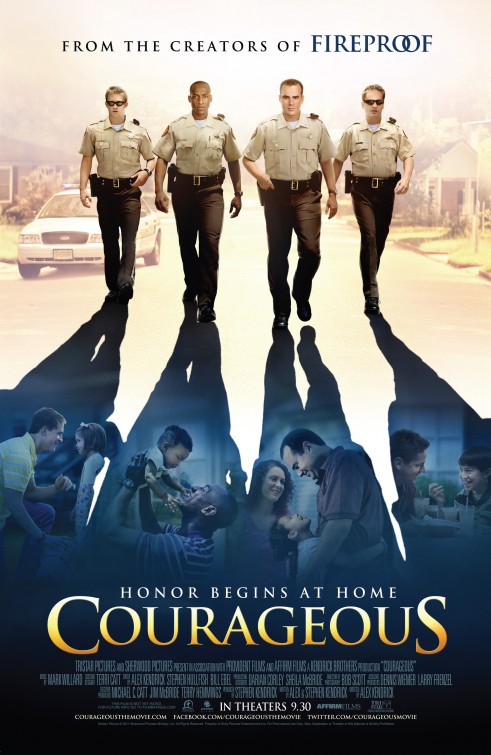 Last fall, Courageous opened to sellout crowds, but unless you or your family is plugged in to Christian media, you probably missed it (you know a movie’s got to be good when it has a quote from former football coach Tony Dungy). This is the latest film from the Kendrick brothers, a pair of pastors that started their own production company and have been making low-budget Christian-themed dramas that score big profits. What they really create, in my estimation, are two-hour film components to go along with a ready-made Bible study/lesson package (and you bet you can purchase your own Courageous companion book). As you’d expect, from an objective standpoint, these films, intended for a select audience of the converted, aren’t paragons of film artistry. And the Kendrick brothers’ last movie, 2008’s Kirk Cameron vehicle Fireproof, was awful on just about every level of filmmaking. Courageous is a better film on every front, but “better” and “good” are not interchangeable descriptions.
In the small town of Albany, Georgia, a group of police officers have al come to a personal crossroads concerning fatherhood. Adam (Alex Kendrick, director and co-writer) has recently lost his 11-year-old daughter in a tragic car accident. Nathan (Ken Bevel) is trying to come to terms to forgive the absent father he never knew. He also has to protect his teen daughter from going out with a young boy who happens to be part of a gang. David (Ben Davies) is the rookie in the group with a shameful secret of his own, namely that he has a small daughter he abandoned with her mother. Javier (Robert Amaya) is struggling to find a stable job to support his wife and children. His wife fears they’ll have no choice but to go back to their home country. Shane (Kevin Downes) is feeling the pressures of the job as well and making bad decisions that will catch up with him. The five gentlemen decide to make a public pledge and sign a written contract promising to be involved, loving, and responsible fathers for their families. But saying it and doing it is another matter.
 As with most of the Christian-funded film efforts, the movie is secondary to the message. Unlike Fireproof, the filmmakers package their wholesome message in a far more easily digestible package. There are moments in the movie that work really well and ring true, mostly the struggle of overcoming grief at the loss of a child. Adam is told that losing a child has been compared to losing a limb (look out if you lose a limb and a child). It’s not going to give Rabbit Hole a run for its money as far as psychological implications, but there are glimpses that feel like genuine and powerful drama. Whether Adam performing a dance with the memory of his deceased daughter is corny or emotional is up to you. Unfortunately, given the scatter-shot nature of the story, these moments only stay as moments, fleeting in their impact. But I was wholly surprised to even have anything genuine after the ridiculousness of Fireproof. Kendrick has improved as a filmmaker and his grasp on characterization is sharper; there are some nice moments of wry humor like when Adam keeps accidentally telling his chief he “loves him” (those declarations were intended for his wife on the other phone line). There’s an amusing bit akin to a “who’s on first?” routine as Adam mistakenly thinks Javier is another Javier he hired for some construction work. The struggle of an immigrant family hovering above the poverty line is a welcome storyline to a pretty middle-class point of view that dominates the story. I don’t know if the Javier character completely works in the context of this story, but he’s an amiable presence as he becomes an adopted member into the boys’ club. The opening even has a rather exciting flash of action with Nathan holding onto his carjacker from outside the speeding vehicle. There’s a foot chase that is crisply edited and filmed with a bit more flair than is normally accustomed to with these movies. It’s something of a small miracle that Courageous seems to exist in a modestly recognizable universe.
While being easily the best movie yet to bear the Kendrick name, Courageous still has enough faults to limit its execution, likely only reaching those already converted to its Christian values. Subtlety is rarely a tactic employed in Kendrick’s wheelhouse. As a result, everything can become rather ham-handed and message-laden. There are far too many different elements that just don’t jibe together to form a cohesive whole; the movie feels like a series of anecdotes that occasionally collide together. The narrative is stuffed with the death of a child, the struggle of immigrant workers to find a foothold, parental abandonment and reconciliation, gang recruitment, and police corruption (if you’re going to steal drugs from the evidence room, at least replace the weight value). They could have easily lost one of these guys from the plot, particularly the corrupt cop. There’s too much going on for real narrative momentum to get going. Structurally, most of the movies conflicts are resolved before we even get into the meat of Act Three, leaving the movie to finish with a hasty shootout with gang members that feels arbitrary. I suppose the Kendrick brothers might argue that the gang members represent the tragic results of boys raised without strong paternal role models, but that’s a rather simplified implication. And why does no one indignantly reject the idea that the death of a little girl was meant to prosper greater goodness in the world? I would imagine a grieving parent, no matter their closeness with God, would feel some modicum of anger at the idea that their daughter needed to die for them to be a better person. Kendrick is not nearly a strong enough actor to sell the various ups and down his lead character endures.
But the biggest problem I have with the movie is that it posits that “Christian values” and “ethics” are synonymous. I have no beef with any religious belief that people rely upon to choose to be better, more caring, conscientious, and active people. However, I bristle with the notion that ONLY religion can give people the tools to achieve these ethical realizations. The group of characters sits around a barbeque and talk about religion, parenting, their own negligent fathers, but they present religion, and specifically Christianity, as the only solution to being a better person. I would argue that mankind can realize moral good and hold to a code ethics without the direct tutelage of Christianity. If this was the case, would this logical argument not suggest that portions of the world that favor other religions are wayward in any sense of moral reasoning and value? What about before Christianity came into being, all that B.C. part of the timeline? Surely Jews would kvetch that they didn’t need Christianity to adhere to a moral order.
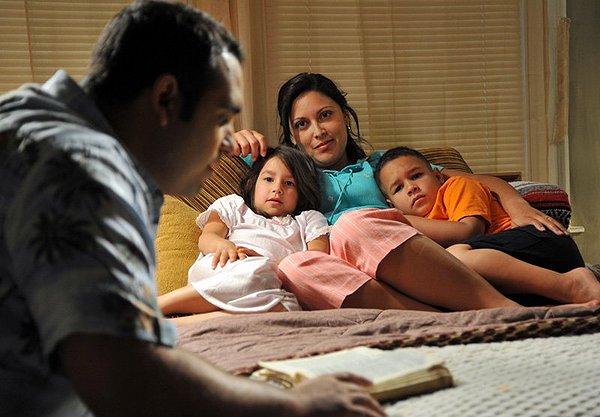 The movie’s patriarchal insistence that men are the only guardians of their family seems ignorant. The women presented in Courageous are pretty much the doting types who wrap their arms around their husbands and remind them what good Godly men that are. The movie puts all the pressure onto the men, somehow missing the point that women can and should be a contributing force when it comes to rearing a family. While the Kendricks have plenty of statistics at hand about the significance of a father, the movie tacitly paints a portrait that a family is doomed when it falls under the complete stewardship of a mother. I’m not going to rip open a feminist rant because I don’t find anything in Courageous to be insidious or malicious, though its depiction of black gang members seems a bit sketchy. I just think the overemphasis on spurring men into taking responsibility doesn’t need to be at the expense of women giving up something. Parenting should be a shared responsibility and not something tagged to whomever holds the title of head of household. And as presented, the movie gives the fathers questionable levels of control. Nathan takes his teen daughter out to a fancy restaurant where he presents her with a fancy ring as a gift in exchange for dad being granted veto-power when it comes to potential boyfriends with no expiration date. I understand it’s meant as a father caring for his daughter, but buying her a ring to celebrate her chastity seems incredibly creepy.
Courageous is an improved effort from the Kendrick brothers and their Sherwood Pictures production house. The movies may improve but they still remain subservient to a message, and the ticket-buyers who look forward to a positive affirmation of that message have fewer demands when it comes to characters, plot, direction, etc. The core audience has a high demand when it comes to spirituality, but I wish they had just as high demands for artistic quality. Why can’t the faithful find inspiration from a movie that isn’t so on-the-nose? Are my only choices when it comes to depictions of spirituality the bludgeoning type (Fireproof, Left Behind, anything with Kirk Cameron really) or the esoteric (The Tree of Life)? Good intentions can only get you so far, and while its core message that men need to be responsible and step it up when it comes to parenting is valid, the rest of the movie jangles with some questionable representations and moral simplification. If people feel truly inspired by these movies to better themselves, then that’s a commendable effect but it doesn’t make the movie any better. At one point a character says that his father was “good enough.” Adam responds, “Well, I don’t want to be just a ‘good enough’ father.” Well, to many Courageous will be a “good enough” Christian drama. To me, mediocrity knows no one faith.
Nate’s Grade: C+
Share this:

Fireproof (2008)
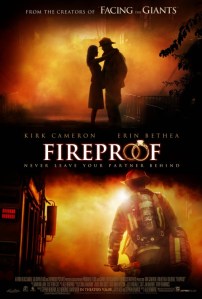 Earlier this fall, a small flick financed by evangelical Christians broke into the top of the box office. It was written by the Kendrick brothers, Alex and Stephen, both associate pastors, and directed by Alex. They previously wrote and directed 2006’s small hit Facing the Giants, a Christian-based sports movie. Fireproof is a story about Caleb (Kirk Cameron, the Russell Crowe of direct-to-video Christian produced movies) and his strained marriage to his wife Catherine (Erin Bethea). She works as a public relations rep in a hospital and feels that it may be time to divorce her irritable, selfish, and overall jerk of a husband. Caleb’s born again father convinces him to hold off on any divorce proceedings and passes along a book called The Love Dare, which challenges couples to 40 days of guided help.
This movie is bad. You probably already knew that. I am somewhat alarmed that there appears to be a whole lot of eager Christian filmgoers that will plop down plenty of dollars to see anything, no matter how horrible, if it conveys a Christian message. Just because you can agree with a message doesn’t mean the product is worthwhile. Here are some things to think about if someone ever asks you if you’ve seen the movie Fireproof.
1) Fireproof exists in a world not our own. The characters behave in odd ways that do not appear to resemble observable human behavior. Some leeway is given because, yes, they are fictional characters, but they say dialogue that sounds forced and clichés, and they do actions that are contrived because the movie requires them for the plot. Here are some minor examples that play to this theme:
 a) The town of Albany, Georgia is designed like a small town even though it has a metropolitan population of about 160,000. And yet the town only has one crew of firefighters consisting of five guys, and three of those guys are clearly not in a physical condition that would be deemed passing. Seriously, these guys are too overweight to be firefighters. Because of the film’s small town presentation and the fact that the county clearly doesn’t care about physical fitness for its emergency responders, Fireproof thus gives us a fire crew that has a whole lot of time on their hands. This complicates things because it makes it seem like Caleb would have more time to be nice to his wife.
b) The women are presented in completely unflattering ways. There are two main female characters, Catherine and Caleb’s mother, and a gaggle of female nurses that simply cannot help themselves when it comes to gossiping and clucking like hens. Every black woman in this movie at some point must say the utterance, “Mmmhmmmm,” and of course bob their head as they talk. The dialogue feels forcibly “black” for these characters when it just could have been anything. Caleb’s mother is briefly presented as a concerned figure but Caleb just tells her to shut it and asks for alone time with dad, you know, the man of the house. She never stands up for herself and her husband, Caleb’s father, does a lousy job of telling his idiot son to respect his mother. Now Catherine is given plenty more time and she has some serious grievances with her lunkhead mate, but when he tries doing helpful and nice things she still decides to be cold to him. Why? Maybe Catherine is just a cold person, after all. One of the very first moments we see her character is when she’s talking to her mother, who has recently had a stroke. Catherine is venting about her troubled marriage and then begins to break down to her mother and says, unbelievably, “I miss the real you.” Excuse me? Just because your mother had a stroke doesn’t mean she’s any different mentally, and she can still hear and understand you, dear.
 c) Internet pornography is played with more drama than the Holt’s marriage. When it comes to dramas that center around marital discord, it shouldn’t take much effort to create a compelling conflict. But I just didn’t buy the conflict between Caleb and Catherine from the start. The conflicts in their marriage are rather mundane, which is likely very realistic for many couples but it makes for poor drama. He wants the respect he feels he’s entitled to. She wants her husband to spend time with her and be nicer to her. He wants to buy a boat with his money. She wants new shelves. How expensive can shelves be? Catherine does feel temptation at work from a doctor that takes time out to listen and make her feel special. That’s a real dilemma. On Caleb’s side? His big moment comes when he battles his addiction to Internet pornography, which was an issue the filmmakers also addressed in their previous flick, Facing the Giants. Caleb is looking at boats online when a pop-up appears that asks if he “Wanna see?” a sexy lady. Oh, the horror. Caleb lingers. Then he paces, all the while staring at the tempting pop-up ad a mere click away. He paces more. Dramatic music starts to build. “Why is this so hard?” he angrily asks to no one in particular. This goes on for like a minute solid. Then he resists the temptation and is determined to be a better man for his wife, sans pornography. Great. Except that’s not exactly what he decides to do. He decides to take the computer outside and literally smash it to pieces. There is likely plenty of personal information, credit card numbers, family photos, personal documents, and more on that computer, but alas Caleb decides to get smash happy with a baseball bat. I understand that Internet pornography is a realistic addiction for many people but, again, it makes for terrible drama in a PG-rated movie. His wife is nonplussed when she finds out about the computer being smashed. Human beings do not behave like this! At the very least, she should have been angry that he just wasted money. You know, you can get Adult Web site blocking software for much cheaper than a new computer.
d) Caleb totally got hosed when it came to hospital supplies. This is a lesser charge but it still sticks in my memory. Caleb has saved up $24,000 for a boat but ultimately spends all of it to pay for a wheelchair and a hospital bed for Catherine’s mother. Catherine is so thickheaded that it takes her weeks to figure out her husband spent the dough and not the nice doctor she talks with at the hospital. There is no way that a hospital bed and one electric wheelchair cost that much money. Caleb got taken for a sucker. Catherine’s mother had a stroke, and you’re telling me that in her situation she doesn’t qualify for Medicare? The government probably should have covered the whole thing, if not most of the expenses. But then this incident is just a cheap conflict that makes Catherine look stupid and Caleb look naïve.
 2) The metaphors are leaden and inane. Given the title and the nature of Caleb’s profession, you can bet your bottom dollar you’re going to be inundated with “fire” metaphors: “You never leave your partner behind, especially in a fire.” Or how about: “Fireproof doesn’t mean the fire will never come. It means when the fire comes that you will be able to withstand it.” You get the idea. What’s even worse is that the movie offers metaphors that are intended to be profound but are astoundingly shallow. One character says, “You know a woman is like a rose. If you treat her right she’ll bloom, if you don’t she’ll wither.” That is quite possible the worst simile I’ve ever heard in my life. Read it again, please. It is essentially saying, “A woman is like a [thing]. If you are [good] to her then [good will happen to thing]. If you are [bad] to her then [bad will happen to thing].” This is basic attribution, people. I can come up with equally profound comparisons using this model. How about this one: “A woman is like a ’62 Chevy. If you treat her right she’ll keep running, if you don’t she’ll need to be put up on blocks.”
3) This Love Dare book is tripe. This book actually exists now, by popular demand from the many people that watched Fireproof and asked for this guidebook. I’m supportive for anyone out there that actually tries to save their marriage rather than give up, but let’s face it, sometimes some marriages were meant to be dissolved. Just ask Britney Spears. Caleb’s mentoring firefighter buddy reveals, shocker, he was previously married at one point, and he confesses, “I got married for the wrong reasons and then divorced for the wrong reasons.” Well, if you were married for the wrong reasons and not truly compatible then perhaps you got divorced for the right reasons. Ignoring this, the book that Caleb’s father presents has some tepid advice. Day One: Don’t say anything negative to your spouse. Day Two: Do a small act of kindness. Day Three: Check in on your spouse. Yawn. This is common sense marketed as life-changing behavior recipes. You really needed a book to tell you that a successful marriage is aided by holding your tongue? What really makes the book questionable is what happens on Day 23 or so: remove parasites from your marriage, a.k.a. addictions like gambling, drugs, and pornography. Why is such a monumental step placed at the halfway point? Will saying nice things and buying flowers really matter if you still have a heroin habit?
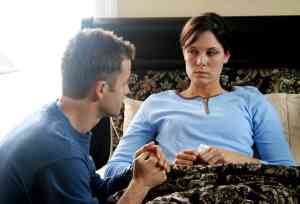 4) Little to this movie feels authentic or genuine. I’ve already gone into plenty of detail about why the movie feels unrealistic, but the $500,000 budget doesn’t help matters when it comes to authenticity. Visually, the Kendrick brothers know the language of film but are clueless when it comes to making a visually appealing picture. Fireproof does the term “bland” a disservice. I counted exactly five shots that I thought were visually interesting, and I might have been generous. The editing is also poor and frequently shots will not match up well. Yes, shortcuts are going to have to be made but monetary shortcuts don’t interfere with writing good characters and realistic interplay. Not one single character feels like you would ever find them existing outside of this movie. Even the Christian characters come across unflattering and not genuine. My favorite part in the entire film was when an old nurse at the hospital spotted Catherine and the hunky doctor flirting in the hall. The camera fixed on her disapproving stink-eyed glare and it held for so long, and the woman put so much distaste in her expression that I instantly wanted her face as a Halloween mask. When she appears again to eat with Catherine she takes great pains to excuse herself so she can call attention to her praying before her meal. I cannot fathom a random moviegoer warming up to this woman via her portrayal. Even Caleb gets to threaten the hunky doc with a not so subtle call to a brawl.
I’ve already espoused more words on this movie than it deserves. Fireproof isn’t so much a movie as it is an accessory to a Bible study guide, or a marketing tool for selling the Love Dare book. It cannot stand on its own merits as a worthy film. It’s predictable, unabashedly cheesy, poorly written, poorly directed, and poorly acted. I know Kirk Cameron isn’t a terribly good actor, but man he blows every other actor away in this. There is some fairly pedestrian acting, especially from Bethea. I’m happy if people can walk away from any movie and want to be better people, even if it’s because of dumb movies like Fireproof. I think the most annoying aspect of the film is how insistent it is that a faltering marriage must turn to God in order to be saved. Look, if you need God to tell you to clean the house or be nice to your wife, then you have bigger issues.
Nate’s Grade: C-
Share this:

Expelled: No Intelligence Allowed (2008)
 Ben Stein is best known as the monotone teacher in Ferris Bueller’s Day Off, but the man has also been a speechwriter for Nixon, a game show host, and popular figure of deadpanned irony. Expelled: No Intelligence Allowed follows Stein as he travels across the world interviewing scientists, authors, professors, and others about what he sees as a disservice to science and America. “Big Science,” as he refers, is so heavily entrenched in the theory of evolution and the teachings of Charles Darwin that they are unwilling to even broach alternative approaches. Intelligent Design believes that life is far too complicated to occur randomly, and thus must have been created by some powerful supernatural designer. The teaching of evolution is still seen as a controversial subject and I.D. proponents want their theory to be given equal time.
Stein tries to skew his argument into one about freedom. The Constitution calls for the freedom of speech and our nation is built upon the bedrock of being a marketplace of ideas. Stein compares the resistance in the scientific community to Intelligence Design to the Berlin Wall, and he argues that I.D. proponents just want to open up the dialogue. Detractors warn that I.D. is just Creationism in sheep’s clothing, and indeed the U.S. courts have ruled the same way. The problem with Intelligent Design is that it can’t really apply to science. Science can only test what exists in the natural world, and religion by definition deals with the supernatural and thus can’t be tested. It’s one thing to say, “The sky is blue because God made it so,” but what else do you do with that as a scientist? Where do you go from there as a teacher? Science textbooks would be awfully thin, since you would just need one sentence to sum up all of existence. Evolution begins with the start of life and no one has a strong feel for how life began, but I.D. runs into the same wall if you think about it. Saying, “God created life” leads to the question, “How was God created?” and now we’re back where we started. Personally, I don’t see why evolution and religion have to be seen as forces that cancel each other out.
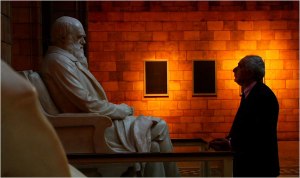 Ignoring the subject matter, Expelled just doesn’t even work effectively as an expose documentary. The movie continuously jumps to old newsreel footage as a visual resource even for mundane conversations. It happens again and again. Either the filmmakers thought their audience had ADD or was too stupid to sit through an interview without several jump cuts to visual reference points. Some of the clips are fun in a goofy retro way but the whole decision comes across like a narrative crutch and it makes Expelled feel erratic. Stein doesn’t try very hard to disguise his interview style, which includes him leading his interview subjects and lobbing softball questions like, “Intelligent Design is just Creationism, right,” and the audacious, “What was the purpose of the concentration camps?” I think it is telling that the interview subjects are not given lengthy reactions and are not pressed into actually presenting what Intelligent Design proof that exists. In contrast, the evolutionary scientists interviewed are intercut with clips of Nazis and Communists soldiers. I don’t even think Michael Moore would have chosen to go that obvious.
While I’m on the subject of Moore, Stein follows some similar ambush tactics and they are obvious and obnoxious. Stein tries to walk into the Smithsonian Center to get a statement as to why a prominent scientist was released and ends up getting kicked out. Did he expect anything different? Portions of Expelled come across as transparently staged, and upon some research I have learned that some were indeed staged. The film opens and closes with Stein addressing a full crowd of college students. They erupt in rapturous applause by the end of his speech and give the man a standing ovation. That crowd was nothing more than paid extras and Stein has never traveled the college circuit to speak on Intelligent Design. The scientists that were interviewed were also misinformed and told that they were being filmed for a documentary called Crossroads about the “intersection of science and religion.” The evolution scientists interviewed were then barred from free public screenings. That should tell you something.
Scientists being blacklisted by their peers seems rather unfair, but the movie takes their subjects strictly at face value. I am convinced there is more to the story than Expelled lets on. One woman off-handedly mentioned the phrase, and that was all, and was let go. I want to know more, but the film apparently doesn’t. Stein even cuts her interview off and dubs his own voice over as she continues her story. I would have appreciated some interviews with scientists who believe in evolution and God. Given that approximately 99.97 percent of life scientists believe in the theory of evolution, so statistically there must be a healthy slew of scientists who happen to be Christians that believe in the existence of evolution.
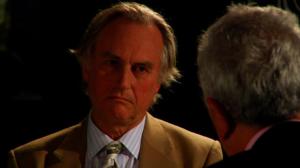 The film is heavy-handed propaganda, sure, but man oh man does it just take an ugly turn in its last third. Ben Stein eventually makes the leap from evolution to… wait for it… Nazism and the extermination of those less desirable. Stein and some of his interview subjects are making the case that Hitler was directly influenced by the tenets of evolution and that he used Darwin’s template to snuff out Jews, Gypsies, gays, the handicapped, and all those holding back the human race with their inferior genetics. There are many steps removed from Darwin to Hitler, but Stein is laying the blame of the Holocaust at the feet of Darwin’s ideas. Arguably, exterminating an inferior race could be applied to the idea of natural selection (though forcibly killing millions doesn’t seem very natural to me) but people were killing each other long before Darwin was ever born. Before Darwin, there was still genocide in the name of eliminating those deemed inferior, and mostly it was performed with the justification of religion. Surely historically religion has been the motivator for more death than Darwin (count the Crusades and the Inquisition). Even specifically Jews have been persecuted and put to mass death centuries before Darwin. And what about all the countries in the world that have embraced evolution as science and not gassed millions of people? But Stein persists in trying to attach the Holocaust and Nazism to evolution. To me, this is like blaming The Catcher in the Rye for shooting John Lennon in the head. Darwin posited ideas and cannot be blamed for others perverting those ideas for their own gain. The film also glosses over the fact that it was Herbert Spencer who introduced the phrase “survival of the fittest,”
And yet after spending a good deal of time linking Darwin and the Holocaust, Stein throws out this caveat: “But I know that Darwinism doesn’t automatically lead to Nazism.” Expelled is filled with other such contradictions. It argues that science and, specifically, evolution does not disqualify the existence of God, and to this I agree whole-heartedly. Science provides the “how” in life and religion can provide the “why” for people. Science does not disqualify God and vice versa; however, Expelled then trumps interview after interview of scientists that explain how evolution turned them into atheists. Huh? The film presses the irritating and confusing point that evolution will turn everyone into a bunch of atheists, but this conflicts with one of the film’s central points on the roles of religion and science. Stein never goes into great detail in this area and ignores the fact that a majority of the American public is both religious and believes in evolution.
 Expelled starts to become an ideological dartboard by the end of its experience. Stein says evolution is responsible for eugenics, which lead to the idea of population control, which lead to Margaret Sanger founding Planned Parenthood. My reaction is: so? Planned Parenthood promotes safe sex and performs legal abortions, yes, but they have nothing to do with eugenics and religion. Henry Ford and Walt Disney were also believers in eugenics. But the interview subjects all seem to repeat the phrase “euthanasia and abortion” like it was a talking point they were handed. The exact phrasing is so precise for several interview subjects that it seems deceptive. Why does this matter at all in a movie reportedly about Intelligence Design?
I cannot honestly see anyone being converted by Expelled. Skeptics and believers in evolution will fail to be swayed, and for the large Christian community the film is courting, well it will be preaching to the choir. I just discovered that there’s a website called expelledexposed.com intent to hold Stein’s film to review. I’m a firm believer in evolution and that Intelligent Design is religion; yeah they don’t specify “who” but how many I.D. proponents were the same ones pushing Creationism in schools earlier? If they stick to the tenets of Intelligent Design then I’d like them to accept the Raelians in their camp (Raelians believe that aliens seeded our planet). Expelled never makes the case for why Intelligent Design should be taught, merely that it is unfair to exclude it from the classroom. The movie presents contradictions, logic fallacies, and some disconcerting guilt-by-association arguments that border on exploitation. Even though I disagree with its ideology, from a filmmaking standpoint it falls apart. The topic of evolution’s relationship to religion deserves a thoughtful and intelligent movie. This is not it.
Nate’s Grade: F


 nathanzoebl
You must be logged in to post a comment.