Blog Archives
Hugo (2011)
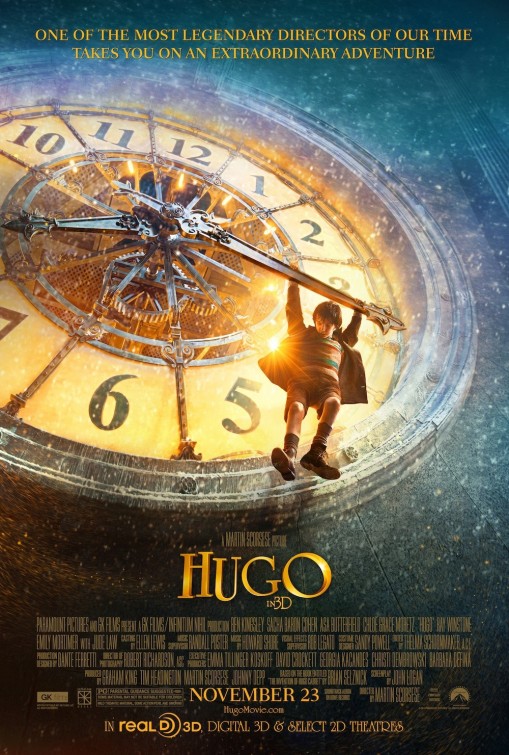 Martin Scorsese tackling a children’s film feels like an odd fit for the man responsible for classic gangster epics and symphonies of violence. But if David Lynch, Kevin Smith, Tim Burton, and Danny Boyle can all make family films that don’t make your brain rot, then why not the greatest living director? Maybe notorious sadist Lars von Trier will be next. Adapted from the award-winning children’s book, Hugo is, as my pal Eric Muller put it, a family film for film historians.
Hugo (Asa Butterfield) is an orphan boy living beneath the walls of the Paris train station. He’s secretly the one responsible for winding up all the clocks and keeping time. He has to stay one step ahead of the Station Inspector (Sacha Baron Cohen), who snatches wayward boys and sends them off to an orphanage. Hugo has been swiping clock pieces from the booth of a mysterious toy collector, George (Ben Kingsley). He needs the tiny pieces to fix a metallic man that Hugo and his late father (Jude Law) had been working on together. Hugo is convinced that if he fixes the metal man the automaton will write out one last message from his father. Hugo befriends George’s niece, Isabelle (Chloe Grace Moretz), and the two of them explore the various shops and shopkeepers of the station. As they uncover more clues, the kids realize that George is actually George Méliès, the filmmaking pioneer best known for the 1902 fantasy, A Trip to the Moon (the one where the moon gets a bullet in its eye).
 Scorsese’s first foray into 3D filmmaking is a rousing sensation for the eyes. The images pop without superfluous objects flying at the camera. The depth of field is nicely and creatively toyed with by Scorsese. Best of all, the 3D enhances the story rather than distracting you. Hugo is a celebration of the advances in moviemaking, and 3D is the latest advancement meant to make the theatergoing experience special. Of course the theatergoing experience has always been special, as the movie indicates. Where else but a theater can we collectively bond with a group of strangers, laughing collectively, feeling the pangs of emotion in unison? There’s a thematic rationale for Scorsese’s use of the third dimension. He masterfully fills the screen with wonderful images, like the massive inner working of clock towers. Scorsese’s signature tracking shots zoom in through the wintry 1930s Paris landscape and train station. A visual highlight is when a trunk of sketches busts open, the papers scattered all over the screen, some moving like flip books, creating the illusion of animation. I can honestly advise people to seek out a 3D showing of Hugo if given the option. For once, it’s worth the extra dough. I only anticipate making this same recommendation for the upcoming Piranha 3DD.
It’s the second half where the movie shows its true intentions, becoming a love letter to the power of cinema and the early pioneers of the art form. Scrosese has long been a historian of the movies, and Hugo is his celebration of the early cinematic dream makers, notably Méliès and his surreal theatrical landscapes. Arthur C. Clark famously said that “any sufficiently advanced technology is indistinguishable from magic.” That’s what early cinema was to a populace that had never seen the likes of moving pictures (we see an early audience fearing for their lives watching a film of a train arriving). It was like a new magic. The turn-of-the century filmmakers like Méliès were charting new terrain as visual storytellers, opening the public to new wonders of the imagination. Simple tricks of editing substitution, dissolves, and visual arrangement could help foster the ongoing illusion. It may be low-rent, like hand painting individual film frames, but it was the special effects of their day. D.W. Griffith once said of Méliès, “I owe him everything.” Scorsese is sharing his passion for the history of the movies and it’s hard not to feel the power of the movies.
But when Hugo gets swallowed whole by Scorsese’s nostalgia, the rest of the plot becomes incidental. The characters, which were not strong to begin with, are given pat resolutions that make you realize how flimsy the characterization is. The movie takes a sub-Amelie route, letting Hugo bring together disparate couples, but you don’t really know anything about these people. Emily Mortimer’s female florist has maybe two lines in the movie, so why should I root for her to get with the Station Inspector? There’s an older couple whose romance is sabotaged by an aggressive pooch. You can imagine the scintillating resolution that awaits. The film history section is honestly the best part of the movie, but it means that everything leading up to that point was just in service to prop up the academic nostalgia. It means that the characters and their mysteries were really unimportant, and they feel that way by film’s end. The movie just grinds to a halt. The mystery of the metal man is that he’s a MacGuffin, a means to discover Méliès’ past. The whole clockwork symbolism can be clumsy, instructing us time and again that people are broken and Hugo feels the need to fix things. Too bad he couldn’t fix the disjointed story.
 The actors manage to make favorable impressions when they can fight free of the movie’s educational pull. Butterfield (The Boy in the Striped Pajamas) is a strong lead actor who rises above the sniveling preface of his character. He makes you root for the kid even when we don’t really know much about him beyond his Dickensian conditions. The kid has some pretty piercing Paul Newman-esque blue eyes too. Moretz (Let Me In, Kick-Ass) is showing the poise and grace to make it long term in this business. Kinglsey (Shutter Island) is effectively curt with his poorly veiled pain and regret. Cohen (Borat) expands his dramatic range noticeably, adding touches of empathy for a character that could mostly have been arch and cartoonish. He’s still the film’s best source for comedy. Michael Stuhlbarg (A Serious Man) makes a welcomed appearance as an expert on early filmmaking, Méliès especially. He serves as the mouthpiece for Scorsese’s passion.
Hugo is a family film that ultimately gets swallowed whole by the filmmakers’ passion. It makes for an entertaining and informative essay on the skill and vision of turn-of-the-century filmmakers, but if people are anticipating a fun story about a scrappy kid and his mischievous adventures, then this is not that movie. Hugo benefits from terrific visuals, strong acting, and Scorsese’s blend of whimsy and innocence without stooping to anything crass or lowbrow. Hugo aspires for the rich, romantic experience of a Jean-Pierre Jeunet film (Amelie, A Very Long Engagement) but comes up short. Hugo is at turns charming and magical but as a narrative it is too often flimsy, a wispy thing meant to lead to Scorsese’s love letter. It’s a fine and fitting tribute but even the best and most powerful love letter can only go so far, never mind the hassle of special 3D glasses.
Nate’s Grade: B
Share this:

Let Me In (2010)
 Essentially a faithful remake of the Swedish pre-teen vampire romance, Let the Right One In, this American reinterpretation loses points in originality and freshness but makes up for it with a bigger budget and better acting. Even fans of the original, and count me as one, must admit that Chloe Grace Moretz (Kick-Ass) as a pint-sized vampire stuck forever in pre-pubescence, and Richard Jenkins (The Visitor) as her aging caretaker, are upgrades. The true surprise is the eerie assuredness of the entire production from director Matt Reeves, he of shaky-cam Cloverfield fame. The entire film just feels so placidly precise, even as it draws tension and sets up for one vicious poolside climax. Some of the audience unfriendly moments from the original have been exorcised (say goodbye to lingering gender identity questions), but Let Me In still happily dwells in an unsettling place, forcing its characters to do questionable things in the name of companionship and forcing the audience to decide how they fell about that. Also, the film still retains its ambiguity for interpretation; whether you view it as a depressing saga of use and abuse, or an disaffected teen romance is entirely up to you. Let Me In won’t grab peoples’ attention in the same way its Scandinavian predecessor did, but it doesn’t screw it up either. And these days, that’s got to count for a lot.
Nate’s Grade: B+
Share this:

Kick-Ass (2010)
 Based on Mark Millar and John Romita Jr.’s popular eight-issue comic, Kick-Ass takes the world of superheroes and makes it one step closer to reality. Granted, it’s still a heightened reality with flexible rules erratically administered, but it’s almost recognizable. Nobody in Hollywood wanted to touch this movie, so it was produced entirely outside the studio system. That hesitation may be because Kick-Ass begins as a goofy teen comedy and morphs into a bloody action caper with off-the-wall violence. But it’s also preposterously entertaining.
Dave Lizewski (Aaron Johnson) is just a typical kid who reads comics and wonders what else could be out there for him. He’s pretty much a nobody at school who routinely gets beat up. His life’s biggest tragedy is the loss of his mother, but she was not taken by some dastardly villain but by an aneurysm. Dave questions why nobody ever tried to be a real super hero. Tired of being a nonentity, Dave orders a wet suit and fashions a costume for a superhero alter ego, Kick-Ass. His first few encounters don’t go so well, landing Dave in the hospital, but in short time his exploits become a YouTube sensation. His MySpace page becomes full of admirers all seeking super hero help. He inspires others to don cape and cowl, like Damon “Big Daddy” Macready (Nicolas Cage) and his daughter, Mindy “Hit Girl” Macready (Chloe Grace Moretz). But they have their own reasons for cleaning up the streets. Big Daddy worked as a cop but was wrongly imprisoned when he went against mob kingpin Frank D’Amico (Mark Strong). Damon has been plotting his vengeance and training Mindy to be an efficient killing machine. Unfortunately, their mob hits are being blamed on the hapless Kick-Ass. Frank D’Amico enlists his wannabe gangster son, Chris (Christopher Mintz-Plasse), to pose as a superhero and lure Kick-Ass out into the open. It’s like The Departed but with more eyeliner.
 Kick-Ass is a fairly subversive work, notably in the relationship between Hit Girl and Big Daddy. He has been training her (or brainwashing) to become a tool of vengeance, but he’s also making sure that his little girl will be tough enough to handle the evil the world may throw at her. A father/daughter outing includes dad firing live ammunition into his daughter’s bulletproof wearing chest. He’s doing this so that she won’t be afraid when, not if, she gets shot. She will know what it feels like. He then promises that they’ll go out for ice cream later. This demented sense of parenting, as presented, actually becomes strangely endearing. They become the heart of the movie, and I was surprised that during some major scenes how emotionally involved I was. We have a beguiling sense of protection for Hit Girl, much like her father who even in moments of great agony screams helpful tactical suggestions to his little girl (to answer any concerns, Moretz and the character are not sexualized even with a Catholic schoolgirl outfit). Unlike Kick-Ass, they have something very concrete to fight for, which is why we feel for them and hope for their success.
The tone of this movie, as you might be able to tell, is wildly uneven. Kick-Ass exists in a reality closer to our own, and Hit Girl and Big Daddy exist in a different fantastic reality where they can perform Matrix style maneuvers at a moment’s notice. But I actually believe that these two different tones and approaches compliment one another. Kick-Ass is a realistic portrayal of what would happen if somebody with no training and nothing but complete naivety would don a costume to fight crime for the greater good. In Kick-Ass’s first confrontation with the criminal element ends with him getting stabbed. His superhero wish fulfillment is brought back to a stinging reality thanks to that blade in his side reminding him that violence is real and painful. His first successful encounter with criminals is not because suddenly he has developed super martial arts skills or any sort of power, it’s simply because he has a stronger will power to continue fighting, even as he staggers back and forth likely to pass out from exhaustion. He wins through sheer will power and little else. He’s got heart but not the ability, thus we watch him receive many pummelings throughout the film. And throughout the movie, Kick-Ass keeps to this edict. He doesn’t succeed through any sort of cunning; his only “special ability” is his above-average tolerance for pain. On the flip side, Hit Girl is the ultra stylized fantasy version of a superhero that we’re more familiar with. She has an amazing talent for death and deception, and even her back story feels ripped from the comic pages — raised to avenge the death of her mother by the hands of gangsters. She is much more in line with our anticipated pop culture sensibility of what makes a super hero. So she and Big Daddy exist as the contrast, an exaggeration that heightens the vast difference between the fantasy super hero and the harsh reality of the ordinary (Dave). It’s a satire that indulges in its targets. While the movie toggles back and forth between the two tones, I never felt chaffed by the alternating styles.
 And while we’re on the subject, while the film may be called Kick-Ass but he’s the least interesting aspect of it, perhaps because he is a mirror to the audience. He’s weak, wimpy, and is delusional as far as where his lack of abilities can take him. Which sets the stage for the film to be completely stolen by Hit Girl, played to foul-mouthed, steely perfection by breakout star Moretz. She is a one-woman wrecking crew and dispatches bad guys with stylish, wall-flipping ease. The incongruity of watching an 11-year-old child turn into a killing machine both serves as commentary on the preposterous nature of the comic book world, and it also makes for some seriously wicked fun. Who wouldn’t enjoy a pint-sized little crime fighter with a profane vocabulary? Parental activist groups, I suppose, who have complained about the movie’s portrayal of young Moretz, going so far as to argue that any child should not be made to say the off-color language that she does in Kick-Ass (have they listened to school yards this century?). But here’s the point: it’s supposed to be shocking exactly because she’s a child and that battery of behavior is not expected. She lures opponents into a false sense of security because, after all, she’s “just a little kid.” But Hit Girl is anything but. She’s one tough chick and Moretz gives a performance full of swagger. Film fans, get ready for her lead role in the Let the Right One In remake this fall. It should prove to be another launching pad for Moretz.
Director Matthew Vaughn started as a producer for Guy Ritchie’s films, but with every new film under his belt it looks like Ritchie might become an asterisk for the mighty career of Vaughn. After the tense gangster thriller Layer Cake, the whimsical fantasy Stardust, it seems like Vaughn is getting to be a better director whereas Ritchie appears to be getting worse from film to film. But I am here to praise Vaughn and not bury Ritchie. The movie has splashy visuals and some grand action, especially during an all-out assault on D’Amico’s lair as finale. Pretty much like Hot Fuzz, in the last act the movie degenerates into what it was parodying earlier. But by this time I’m already hooked. Let the fireworks commence and I’ll keep munching my popcorn. It’s a rousing, action-packed finish that manages to acknowledge the irreverent ludicrousness of the whole film while still being, well, kick-ass. Vaughn makes excellent use of music, nicely pairing muscular pieces of epic instrumental rock like “In the House — In A Heartbeat” by John Murphy from 28 Days Later. There are some smart additions like having Joan Jett’s “Bad Reputation” play at a fiery moment of anger, and a kitschy kid song playing during our first introduction to Hit Girl, magnifying the absurdity.
Vaughn also coaxes a good performance from Cage, meaning the actor has strung two good performances in a row (please see Bad Lieutenant: Port of Call New Orleans). Cage has an eerie sense of determination but he plays his character in an “aw, shucks” Mr. Rogers style, even borrowing the speech patterns of Adam West when he dons his costume.
 The movie does have some issues. It’s stuffed with too many subplots that go into more detail than they have to. The gangster goons have way too much screen time and are, at best, bad caricatures. The subplot with Dave’s love interest, cute girl Katie (Lyndsy Fonseca), thinking Dave is gay goes on for too long just to offer some third-rate Three’s Company misunderstanding gags. The plot is also completely self-referential without stooping to explanation. As stated earlier, the tonality shifts will not play out the same for everyone, and the plot pretty much switches protagonists halfway through, becoming the Hit Girl show. Then again some might argue that the film would be better off without Kick-Ass.
Kick-Ass plays like a juvenile romp, nothing to be taken seriously. This is not The Dark Knight by any account. I was not feeling the same sense of moral unease that I felt during the depraved, consequences-free killing-as-personal-self-actualization film Wanted, also based on a Millar comic book series. Kick-Ass is never really mean-spirited or cruel or casual with human life, despite the central themes of vigilantism and vengeance. In fact, the movie posits that more people need to make a difference and stand up to injustice, granted he movie ignores the justice system in lieu of fisticuffs. The movie doesn’t deconstruct the world of superheroes like Watchmen, but at the same time it holds it all up for ridicule, saying, “Isn’t this all ridiculous?” and offering escapist thrills. Kick-Ass is a visceral, absurd satire of the realm of superheroes that also manages to mine that same realm for polished genre thrills. Vaughn keeps the movie from feeling disjointed, even as it swaps tones from comic to dramatic, from (moderately) realistic to geek fantasy wish fulfillment. It won’t be for everybody, but consider me apart of the throng that cheered when an 11-year-old managed to make a guy shoot himself in the head with his own gun. There’s probably something wrong with me.
Nate’s Grade: B+
Share this:

(500) Days of Summer (2009)
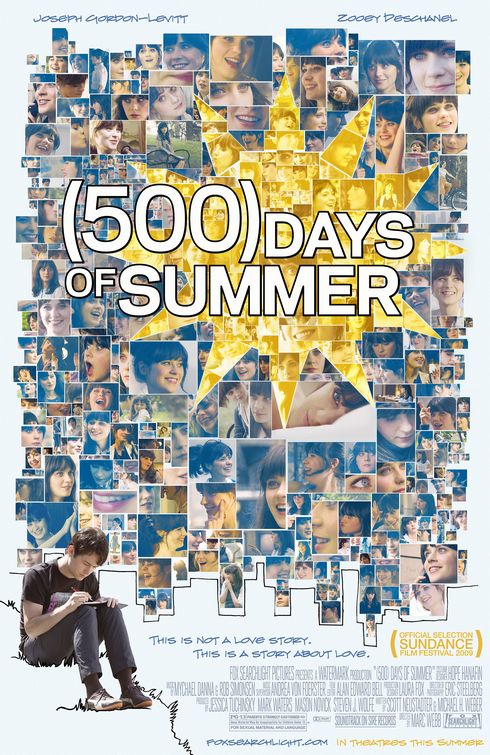
It doesn’t take long before you realize that (500) Days of Summer is a different kind of romantic comedy. In fact, to slap that genre title onto it does a disservice. I’ve watched plenty of romantic comedies (a notable rise in viewership since getting married in 2006), and the traditional Hollywood romantic comedy exists in a world not our own. It is a sitcom world where people blurt out their feelings, interact in bizarre manners, and get into wacky hijinks and contrived misunderstandings. These tales also exist in “movie world”; (500) Days of Summer, on the other hand, is refreshingly recognizable. Granted the characters still have fantastic if slightly off kilter jobs (writer of greeting cards), and the characters live in fabulous and gigantic apartments. Excusing those contextual quirks, the movie is upfront about its intention. “This is a story of boy meets girl,” a narrator intones, “but it is not a love story.”
Tom (Joeseph Gordon-Levitt) recounts the 500 days he has spent with his ex-girlfriend, Summer (Zooey Deschanel), the girl he aches over because he feels her to be his “one.”
This is a movie about love and relationships but it has such a wider scope. It’s perceptive and insightful in the way that human beings engage in coupling. Tom ping-pongs between memories, tying together happy moments and the failed recapturing of those exact happy moments later. I enjoyed how reflexive the film can be with romance. When Tom is infatuated with Summer he lists her attributes: “I love her smile. I love her hair. I love her knees. I love how she licks her lips before she talks. I love her heart-shaped birthmark on her neck.” And then when he is frustrated with Summer, he lists her faults: “I hate her crooked teeth. I hate the way she smacks her lips. I hate her knobby knees. I hate that cockroach shape splotch on her neck.” I appreciate a movie that tries to tackle the complexities of love in a manner that doesn’t seem trite or sensational. A movie doesn’t have to say anything new about romance (is it even possible to scoop the Romantic poets?), but it can still say something true and revealing. It is a story about love, but not a love story.
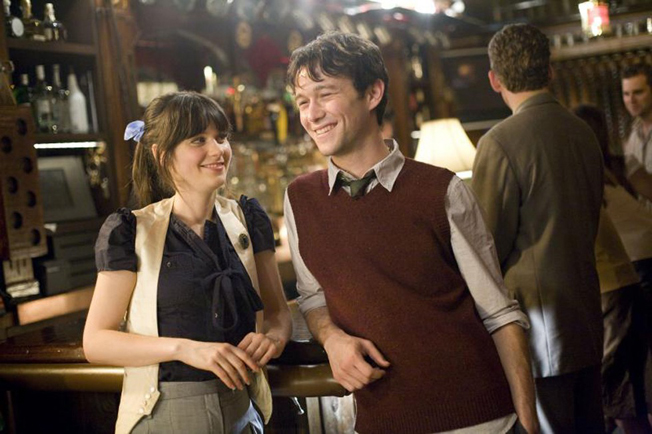
 It also helps that the characters are meaty and are played by capable actors. Tom is a smart enough guy, though a bit of a foolish romantic. He buys into the love that is talked about in pop songs and greeting cards; he’s not naïve per se but plenty vulnerable enough to get his heart broken in the real world. Summer is an independent woman who says at the start that she is not looking for a boyfriend. She doesn’t wish to be constrained by a relationship and wants to enjoy the carefree days of youth. Yet Tom persists thinking he can wear her down or win her over, waiting for Summer to cave and find solace in Tom’s embrace. He fancies Summer as the “girl of his dreams,” though everyone else isn’t so sure. His little sister argues, “Just because she likes the same bizzaro crap you do doesn’t mean she’s your soul mate.” One of Tom’s friends has a really nice monologue describing his “perfect girl,” and these descriptions noticeably differ from that of his long-term high school sweetheart. But then he stops, reflects, and says that’s what his “perfect girl” would be like, but his current girlfriend, well, she’s better than his imaginary version of a perfect girl. But Summer isn’t a fantasy of romantic perfection, she’s a person. She has her own desires, her own insecurities, her own ambitions, and her own life to lead. These two feel like actual human beings and not stock players, though (500) Days of Summer does carry its own share of stock parts like the square boss (Clark Gregg) and the goofy, horny friend (Geoffrey Arend).
The saying “the camera loves” somebody seems outdated, old fashioned, and liberally applied. But when it comes to actress Zooey Deschanel, well, the camera just loves her. It’s hard not to fall in love with this blue-eyed beauty. She’s adorable, but not in an overly quirky way, and she’s smart, but still approachable, and altogether lovely. She is the face of unrequited love. She can be cold and aloof and jubilant. Deschanel plays the complications and complexities of an enigmatic woman who refuses to abide by labels. Her last conversation with Tom manages to be both crushing and inspirational. Her chemistry with Gordon-Levitt feels entirely naturalistic and pleasant. Gordon-Levitt has been cranking out strong performances in indie films like Brick, Mysterious Skin, and The Lookout. He’s quite possibly becoming one of the premier young actors working today. He has an everyman capability but he also can turn on the charm in a way that doesn’t seem forced, like Shia LaBeouf. Gordon-Levitt is the anchor of this movie and we see the world and Summer through his eyes. He brings great vulnerability to his role and we feel each step of his emotional journey. Both actors deliver terrific performances that don’t stoop to playing by the conventions of the romantic comedy.
 The nonlinear story structure seems like a gimmick until you realize that the writers, Scott Neustadter and Michael H. Weber, have cleverly freed themselves from the contrivances of movie romance time. MRT, for those who prefer their nomenclature in the shorthand, is that unbelievable breadth of time where the characters fall head over in heels in love with each other. It always feels so fast and far too fleeting, so that when complications have to arise late in the second act they too feel rushed. You could apply a healthy dose of montages to signify massive time passages, but those get old unless you’re Sylvester Stallone training to fight another boxing match. (500) Days of Summer tells you right away that this story takes place over a year and a half, and Day One isn’t when boy got girl but when boy met girl. By skipping around to specific dates, Neustadter and Weber are hitting only the highpoints, the memorable moments, and leaving out the unforeseen groundwork. All those mundane yet essential moments of pulling together a successful relationship are there, they are just now implicit. They are implied in the time jumps. The relationship between Tom and Summer, therefore, exists in an expanse of time that feels believable. The nonlinear structure also belies the way our memories work. Human beings don’t remember everything in a straight line, especially in matters of the heart.
There’s a lot of drama to be mined here with the breakup territory, but the movie is also playful and funny. Director Marc Webb, he of the video music world, pokes fun at other filmic expressions of love. At one point, Tom struts down the street and becomes the center of a lively choreographed dance sequence complete with animated blue birds. At another point, during Tom’s heartbreak, the movie descends through Bergman and Fellini visual tropes. It simultaneously communicates Tom’s emotional highs and lows and satirizes the histrionic nature of his feelings. Truly, when one’s in love you couldn’t feel better, or worse, but upon retrospect you can see how silly such in-the-heat-of-the-moment proclamations can be. There’s also a scene later in the film where Tom attends a party that Summer invited him to. The screen cuts in half, and on one side we see Tom’s expectations of what will happen that night and on the other side we see what actually occurs. The visual symmetry is interesting and a great glimpse inside the mind of a hopeful romantic.
 (500) Days of Summer manages to be breezy, moving, delightful, perceptive, charming, and just a great time at the movies. It’s a story about falling in love for the right reasons with the wrong girl. Summer isn’t the villain of the piece but her own woman, and she can be fickle and frustrating but she is not cruel or indifferent. Tom is desperately in search for his “one true love” but he’s playing by a checklist he’s drawn up from movies, TV, and love songs. All of this could have been sticky and formulaic (in fact, the dynamic vaguely resembles the characters from the abysmal Ugly Truth), but the filmmakers and the talented actors make the movie feel honest and relatable. The nonlinear narrative allows the movie to simultaneously be more playful, believable, and actually easier to understand, linking selective memories. No matter your current romantic situation, (500) Days of Summer is a slick antidote to Hollywood’s rom-com factory line.
Nate’s Grade: A


 nathanzoebl
You must be logged in to post a comment.