Blog Archives
Inside Job (2010)
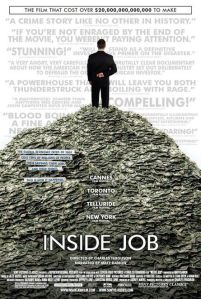
Charles Ferguson is a man I’d love to sit down and have a conversation with. The former political scientist first waded into the waters of documentary film with his brilliant Iraq War doc, 2007’s Oscar-nominated No End in Sight. He’s a filmmaker that absorbs himself in the comfort of clear logic and facts. Now he takes that same rigorous and analytical eye to the story of our generation, the worldwide financial meltdown from the fall of 2008. The global event eliminated trillions in money, millions in jobs, and still confounds thousands of us. If you don’t leave Inside Job absolutely infuriated, then you weren’t paying close enough attention.
Just like he did with No End in Sight, Ferguson lays out his case with clear-eyed precision. He doesn’t rely on ad hominem attacks, a la Michael Moore’s myopic Capitalism: A Love Story; he lets the facts do the talking, and as presented they are damning. Inside Job sounds like the title of a heist movie and that’s exactly what was propagated on the world stage. This is a wholesale plundering brought about by unchecked avarice, greed, and hubris. I’ve been waiting since the financial collapse for a filmmaker to produce an authoritative step-by-step document that could meet out deserved blame and scorn, while presenting complex mathematical calculations in layman’s terms. This is that movie. Ferguson has crafted a definitive synopsis of the 2008 global meltdown that is scarier than any horror movie Hollywood could churn out.

When you learn about the forces that led this country into economic disaster, you begin to realize that it all centers on the old Gordon Gekko pronouncement that “greed is good.” I’ve never fully understood how capitalism is somehow absolved of any sin or that free markets are the same thing as democracy. Somehow the screwy idea that business would behave if nobody were watching became an intractable ideology. The Reagan revolution of the 1980s brought with it deregulated markets and lax oversight, which has brought waves of financial scandals that have only led to bigger consequences (Savings and Loan to Enron to the 2008 collapse). With the dense derivatives market, the financial industry found new tools to manufacture money at alarming rates. Rather than betting on simple stocks, investors could now bet on anything. Derivatives helped turn the entire world into one large casino. Short-term profits became the total goal and risk became just another four-letter word. Just like the insightful 2005 doc Enron: The Smartest Guys in the Room, these events are not stories about math, they’re stories about people. You don’t have to know a CDO from a CFO. It’s the unchecked hubris of men and women, but mostly men, and the slippery slope of business when the only protectors for the consumer is getting paid by Wall Street profits.
But all those greedy bankers and CEOs were not alone. Days before the several lending firms went bust, their ratings were stuck in the AAA to AA range, the same rating as a U.S. bond, meaning non-existent risk. The ratings industry got used to big paychecks dependent upon the number of high-quality ratings they passed out. As one interview puts it, if a New York Times journalist was offered $5000 to write a positive story and zero to pen a negative one, what do you believe the outcome would be? Insurance companies, notably AIG, were gambling with all that collateralized debt, betting that it wouldn’t get paid off. This allowed companies to sell loans they knew were poor and bet against them. The systems of regulation, like the Fed and the SEC, were ridiculously negligent at best and criminally complicit at worst. Rather than investigate and prosecute, regulation officers sat on their hands, relying on an ironclad belief that the industry knew best. Congress passed a law in 2000 that prohibited government from regulating the derivatives market. Then in 2004 the regulatory bodies decided to relax requirements for capital reserves. This meant that banks could take on even more borrowed assets, leveraging greater debt (ratios of capital to borrowed capital went from 3:1 to as high as 30:1). Both of these regulatory omissions allowed Wall Street to gamble even bigger. Don’t forget that many of those high-ranking officials meant to operate as referees had been former employees of large financial firms. It all became an incestuous boys club that looked out for its own interests. Why haven’t there been any prosecutions even concerning the drugs and hookers? It seems that the only people who get prosecuted for their vices are the ones fighting for reform, like former New York governor Eliot Spitzer (he gets his own doc this fall too). The collusion among the financial sector, regulators, and legislators is staggering.

To Ferguson’s credit, he lays out a sober and exacting analysis of the mess. This cannot be dismissed as some sort of partisan hatchet job like a Michael Moore production. Like it or not, Moore has become a caricature of himself and his dubious sleight-of-hand practices hurt the merits of his message. Ferguson, on the other hand, is a reasonable fella who assembles a crack team of experts and officials, the people directly involved with the financial meltdown. Several big names like Alan Greenspan and Larry Summers declined to be interviewed, lest they have to atone for their actual culpability (Summers is getting slammed twice this fall, after his irritable appearance in The Social Network as the dean of Harvard). Ferguson serves as an intelligent inquisitor, ready and willing to challenge his subjects when they try and hide between weak rationalizations or inaccurate facts. Inside Job plays a serious subject fairly seriously. There are no easy gags or frivolous attempts at comedic relief, despite some ironic usage of pop songs. Ferguson makes use of several unsophisticated charts and graphs to help grasp the explosive rise in profits and debt. They aren’t fancy graphics, in fact most are red bar graphs you’d find in a junior high report. But Ferguson’s great asset is his collection of key participants. Inside Job isn’t much more than a talking heads piece with a smattering of visual aids and narrative elucidation. But when your subject is no less than the financial state of the world, you’ll be forgiven for keeping a professorial approach.
Ferguson is one of the first I’ve seen to shed due attention to the area of academia and its cozy relationship with the financial institutions. Many of the same names involved in the accumulated financial disaster are teaching economics at prestigious Ivy League universities. These men, the devoted disciples of deregulation, are teaching the next generation of capitalist sharks. Ferguson even examines the non-disclosure of who is paying all these business profs. A professor can have a lucrative side business when it comes to consulting, so the companies that benefit the most from deregulation are paying the men championing the ideology of free markets. Professor will write scholarly articles about the merits of various financial firms, failing to note that the firms paid them. It’s another in an endless series of maddening conflicts of interest that go unimpeded.

Inside Job ends on a somber note of resignation. As we’re informed, not one body has been brought to justice over the worldwide financial collapse or the crimes and outright fraud that got us there. In the wake of the doom and gloom, banks gobbled each other up and now Too Big to Fail has gotten even bigger. In a world where companies book potential earnings as current earnings, bet against their own stocks, and employ a phalanx of high-priced lawyers and lobbyists to resist any minute reform, whom is the American public supposed to trust? Who isn’t on the payroll? Ferguson’s lacerating documentary is the best starting point for novices to history, but even Inside Job is far from definitive. This is because the complete scope of the 2008 crises cannot be contained to a two-hour movie, even with the talents of Ferguson. As the movie comes to a close, and the audience is generally feeling numb to all this high-stakes larceny, it looks like things are depressingly settling back to the way they were. President Obama has appointed several people involved in the financial collapse to cabinet and regulatory positions. I’m sorry Mr. President, but that doesn’t count as change by the most generous definitions. The coterie of Wall Street elites feel that they are indispensable, that what they do is just too complicated for the rest of us plebeians to fathom. I don’t know about other folks, but I’m tired of the top 0.1 percent holding the rest of the nation hostage and expecting everybody else to foot the bill for their gambling losses. The narration ends with a righteous fury, declaring that some things are worth fighting no matter how hard. Inside Job is required viewing for every man, woman, child, and dog in this country. The future of the world depends upon people seeing movies like this. An informed public is the best defense against Wall Street firms and bought-and-paid-for politicians getting away with murder — again.
Nate’s Grade: A
Share this:

No End in Sight (2007)
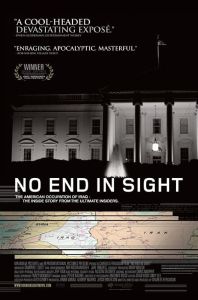 Director Charles Ferguson lived his life as a PhD political scientist, and then he felt compelled to make a movie. No End in Sight doesn’t focus much on the origins of the current Iraq War, which have been well documented and discussed in many other realms, instead the movie takes an exacting look into where the U.S. government fouled up the occupation after toppling Saddam Hussein. Because of this approach, Ferguson’s expose cannot be dismissed under false propaganda claims, and because his interviews mostly consist of the people on the ground who were responsible to stabilize the country, No End in Sight is blessed with plenty of hard-hitting first-hand accounts by the people given the hurried, thankless job of rebuilding a conquered nation.
General Jay Garner and his team, including Colonel Paul Hughes and Ambassador Barbara Bodine, were given 60 days to plan for a post-war Iraq. In contrast, FDR spent years planning ahead for an occupation of Germany. Planning was difficult because when they arrived in Baghdad the post-war looting made setting up a government a formidable task. They not only had to find means to contact people but they had to figure out ways simply to operate in an environment where looting had destroyed buildings and proper tools for communication. They were in charge of ORHA, the Office of Reconstruction and Humanitarian Assistance, which was not run through the State department, as would be normal, but run by the Defense department.
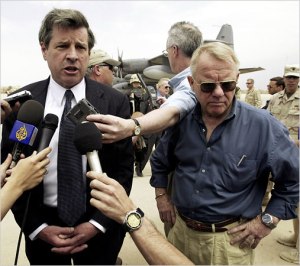 The film holds its harshest criticism for L. Paul Bremer, the man appointed to run the Coalition Provisional Authority, formerly ORHA. Bremer, like many who planned the post-war occupation and were placed in key positions within the occupation, had no military experience, no foreign policy experience with the Middle East, a notoriously tricky region, and he didn’t speak a lick of Arabic. In any other scenario, he would be judged unqualified for his heavy duty ahead. No End in Sight lays out three grievous errors that Bremer made in the summer of 2003 that gave birth to the ongoing insurgency and sent Iraq spinning out of control. The first was absolving any previous work to reach out and include Iraqis in helping to form a working provisional government. Bremer was more a my-way-or-the-highway kind of guy, which may be why he was esteemed in a presidential administration filled with these types. This alienated the Iraqi people and began Bremer’s calamitous habit of bridge burning. His second error was his decision to eliminate the Ba’ath party, Saddam Hussein’s ruling party, and bar members from any future government service. This stripped teachers, engineers, intellectuals, the very people integral to build the infrastructure of a nation, and made them permanently unemployed in Iraq. Many members had merely joined the Ba’ath party because it was the only way to secure a steady job.
But by far the most baffling and incompetent decision Bremer made was to disband Iraq’s army. This boneheaded move went against the recommendations of U.S. military figures, and in the blink of an eye, the 500,000-strong Iraqi army were without a job and an income. There were overtures from military leaders to ORHA; Paul Hughes recounts that one officer promised him 12,000 men in a week if asked. So, in a situation where the U.S. military did not have enough soldiers on the ground to even halt looting, Bremer disbanded Iraq’s best solution for restoring law and order. Half a million angry, disenfranchised, combat-trained, well-armed men were now left to fend for themselves, and if the U.S. didn’t care for their expertise then death militias would. It should come as no surprise that shortly after this colossal miscue is when Improvised Explosive Device (IED) attacks on the U.S. troops surged along with U.S. casualties. It seems like at that point the verdict had come against the U.S. occupation.
 Bremer’s decisions alienated, humiliated, and inflamed the people of Iraq, and they went against the recommendations by people that knew what they were talking about. The greatest tragedy that comes to mind is that, despite morally questionable, downright repugnant reasons for entering this conflict, the U.S. could have done this right. Saddam was indeed a bad man and the people of Iraq were initially receptive to see what the U.S. occupation would bring about. They weren’t expecting rampant unemployment, no tangible security force, being excluded from decision-making, having American private contractors bleed them dry, and an utter lack of basic human services like power and clean water. Add a long-standing religious feud into the mix and it’s no wonder the country has descended into a quagmire. No End in Sight makes the dots easy to follow and connect the cause-effect relationships into where we are today.
It’s hard to watch the film and not feel your blood boil. While No End in Sight is presented soberly and with clear-headed precision, watching the absurd miscalculations and naiveté prevail over the opinions of experts is infuriating. General Shinseki recommended to Congress that several hundred thousand troops would be required after toppling Saddam. Paul Wolfowitz, deputy Secretary of Defense, swiftly countered this assertion by claiming that it was unimaginable that it would require more troops to secure the peace rather than engage in war. “Unimaginable” is the key word here; Wolfowitz just couldn’t potentially fathom a reality that was known by most high-ranking military officials. Stabilizing a country is far more taxing than simply taking out an opposing force. Shinseki, who guided occupation forces in Bosnia and Kosovo, was ignored and pushed into “early retirement,” and Wolfowitz’s plan was followed (Wolfowitz also famously stated that the war would pay for itself thanks to Iraq’s oil revenues).
 No End in Sight does have a figure of amusement and it just so happens to be Secretary of Defense Donald Rumsfeld. The film opens with his farewell address after the 2006 midterm elections where Republicans lost control of Congress and Rumsfeld was shortly ousted from his job days later. He calls the Iraq War little understood and declares that Bush and his team’s accomplishments will one day get the full historical notation they deserve. Of course, the irony is that the designers of the Iraq War had little understanding of what they were getting into and ignored the warnings and advice of those whose opinions conflicted with the Administration line. Many clips of Rumsfeld news conferences are shown and the man comes across as flippant and disingenuous. He dismisses the looting as “stuff happens” and argues TV news is re-running the same image of a man absconding with a vase (“And you have to wonder, are there that many vases in the whole country?” he adds). The Iraq looting destroyed a museum that had artifacts dating back 7,000 years to the dawn of civilization and a library with hundreds of ancient manuscripts was burned to the ground; an entire country’s deep culture and history went up in smoke and Rumsfeld was using it as a setup to a vase joke. The clips further remind the audience that Rumsfeld, one of the chief architects of the war along with Vice President Dick Cheney and Wolfowitz, simply disregards information he doesn’t agree with, whether it may actually be right. The leaders of the Bush Administration demonstrate time and again a supreme disconnect from reality.
No End in Sight is one of the best documentaries yet on the Iraq War and a definitive indictment on the lack of substantial care given to post-war planning. No one can accuse this film of slander or pushing an agenda; this is an exacting autopsy on the current chaos in Iraq, and it has cold facts and hard truths to back up its convictions. Even if you feel that you know all the blunders tied to Iraq, this sensational film is not merely a repackaging of dogma. It’s eye-opening and intensely fascinating and one of the better films of the year; it’s an argument made on the merits of evidence and testimony, and it is damning. One soldier reflects upon the current conditions and flatly asks, “This is the best America can do? Don’t tell me that.” Then after a small pause he adds, “That makes me angry.” You are not alone, brother.
Nate’s Grade: A


 nathanzoebl
You must be logged in to post a comment.