Blog Archives
Argo (2012)
 The reinvention of Ben Affleck as movie director took a big step forward with the critical and commercial success of the 2010 Boston cops-and-robbers thriller, The Town. While I’d argue Affleck’s first outing as a director, 2007’s Gone Baby Gone, is still his best, The Town won over plenty of doubters. Here was an actor-turned-director who could deliver smart drama, intense suspense, and coax Oscar-caliber performances from his brilliantly assembled casts. Have you seen Blake Lively half as good in anything as she was as a tragic junkie single mom in The Town? She’ll be able to get work for years just from the demo reels of that performance. But with two sturdy, complex, taut genre movies under his belt, Affleck still had doubters. The political thriller Argo takes Affleck far out of his Bostonian comfort zone. The creative stretching proves fruitful because Argo is a stirring, fascinating, and engrossing true-life story that should at last silence the remainng doubters concerning Affleck’s talents behind the camera.
In 1979, The U.S. embassy in Tehran was overtaken by a storm of Iranian protestors. Fifty-two Americans were held hostage for an exasperating 444 days. During the takeover, six Americans escapes through a back alley and found asylum with the Canadian ambassador (Victor Garber). There they waited for months, trying to work out a plan to escape. If caught by the mob, it’s very likely they would be deemed spies and executed. Enter CIA agent Tony Mendez (Ben Affleck) and his scheme. His idea is to pretend the six American hostages are part of a Canadian film crew scouting locations in Iran for their sci-fi movie. His superiors seem dubious but Mendez gets the green light. He heads to Hollywood and puts together his team, a veteran makeup artist (John Goodman) and an established producer (Alan Arkin) on the outs with the industry. They settle on the screenplay “Argo” and have to build a credible cover story. From there, Mendez travels into Iran to meet with the hidden hostages to sell them his scheme. They were all coming out together or nobody was getting back home.
 Argo is a fascinating story that seems like it could only exist in the movies, and yet it’s a true story and one hell of a story. It’s a mission movie, so we know the familiar flow of the film even as the details seem fresh (unless you’re Canadian). The very idea is one of those “so crazy it might work” plans; one State department official asks, “You don’t have any better bad ideas than this?” Even though we know it was a success, that doesn’t stop the movie from being engrossing. Argo flies by like a caper film as the CIA gathers the resources and experts to try and put together a ramshackle rescue mission. There’s feeling out the Hollywood angle, gathering the pieces to create the illusion of an actual film production, and the urgency of the façade. Even though it’s a bit outlandish, the fake movie plot seems worlds better than the other possible plans being pitched by the government agencies (smuggling in bicycles and maps?). I thought it was genuinely interesting just to be granted access to a room where people where debating rescue options and picking them apart. The film is consistently intriguing watching smart people come up with smart solutions to challenging problems.
Argo really is three movies expertly rolled together into one; a Middle East thriller, a Hollywood satire, and a D.C. procedural. It’s a bonus that every one of these segments works but it’s even more surprising, and rewarding, that the different segments all snap together without breaking tone. Credit Affleck the director for making sure his movie parts don’t overpower one another. We can go from a tense Middle East sequence where the hostages might have just risked exposure, and then we’ll cut to Hollywood and laugh at the cantankerous Lester. It’s a delicate balancing act that Affleck superbly handles. The humor of Hollywood doesn’t detract or minimize the seriousness of the Middle East chapters; it allows room to breathe, to let off steam. The D.C. segments are the biggest expository moments but they give scope and meaning to the danger. Each of these segments is compelling and each one could have been a captivating movie all its own. We’re fortunate that Argo gives us all three.
Audience ignorance aside, we may know how this story ends but that doesn’t stop the film from being completely nerve-wracking. Affleck showed remarkable skill in The Town when it came to building exciting sequences that felt like they would explode with tension. When it came to Argo, there were moments that literally kept me on the edge of my seat, a rarity with action films. The beginning sequence of the American embassy is rapt with suspense, as the security system deteriorates and the people inside realize the inevitable. They start destroying classified state evidence but really they just have to sit and wait, hearing the footsteps, knowing what is near. The sharp screenplay from Chris Terrio (Heights) does a tremendous job of developing clear suspense sequences. There’s the tension of the precarious subterfuge, of the hostages hiding behind enemy lines, so to speak. If one wrong person were to discover their identity, it could quickly unravel. There’s a whole team of children being paid to piece together shredded documents and photos like they were jigsaw puzzles. Knowing this, it makes the scenes where the group ventures out of the embassy thrilling. The group has to visit a marketplace as part of their cover and it’s terrifying. We know the steps of escape, and each one could easily blow up and get everyone killed. Just when you think you can breathe a sigh of relief we’ve moved onto the next challenge and the tension washes over you again. The climax is so tense that your audience will likely erupt in applause when the hostages eventually escape, relieved and proud of the accomplishment.
The maturation of Affleck as a bonafide directing talent continues. There’s a growing confidence in his direction. The man doesn’t have to rely on flashy visual artifice nor does he seem to be hewing to one notable style. He’s directing each movie as its own beast, be it crime thrillers or true-life suspense story. The man knows where to put his camera in the thick of the action. Affleck also eschews the popular shakycam docu-drama approach that too many filmmakers automatically does all the work of establishing realism. Docu-drama visuals can work when properly utilized, but too often I find it to be self-consciously arty and an annoying distraction. Affleck’s camera remains steady but holds on his actors, giving them space to emote. Three movies into his directing career, Affleck has established himself as one of the best men to direct actors. He’s already lead two actors to Oscar nominations and might just earn a third for Arkin. Plus there’s the fact that Argo, top to bottom, is cast with great character actors. You have people the likes of Michael Parks (Red State) who are there for one line. It also helps Affleck the actor to have Affleck the director.
 The only nagging problem with Argo is that it’s rather light when it comes to character development. The caper is the star of the movie and sucks up most of the screen time. The film does an excellent job of recreating the anxiety that the hostages felt. I can’t say we get to know any of them well as people. I can’t say we get to know much about Tony Mendez either, beside the de rigueur parts of being a CIA agent like divorce, child custody, and long nights of loneliness. The best-developed character in the movie is Lester Siegel, and while he’s terrifically entertaining, it’s something of a misstep for the cranky Hollywood producer to win that title. He’s a man who knows his value in the ever-changing currency of Hollywood; bitter, crabby, but hopeful of making a difference. Arkin (Little Miss Sunshine) is a natural fit for the character and brings more dimensions to the role. I wish the same care were given for the other people in the story, particularly those in harm’s way. The nuanced approach to character with Gone Baby Gone and The Town is just absent. Thankfully, the story is so engrossing that it’s not a mortal wound, but you do wish there was a greater emotional involvement in the film rather than a generic empathy of rescuing those in danger. Also, the Canadian involvement seems curiously downplayed even though their ambassador was the one hiding them for months. His role in the movie plays like he’s Guy #8. I know we tackle the CIA’s involvement but Canada could use more recognition for their integral contributions.
Argo establishes Ben Affleck as a dependable, versatile, actor’s director; someone along the likes of a Sidney Lumet or Sydney Pollack (I swear I don’t have a “Sydney” key lock in my brain). Affleck has proven to be a director who immerses himself into his stories, and his fingerprints are on every frame, every performance. He just nails it. The pacing is tight, the suspense builds to near unsustainable levels, and the tones are expertly juggled to prove complimentary rather than distractions. Best of all, Affleck lets Terrio’s terrific script take center stage. The incredible true-story of Argo is the biggest selling point for the movie, and Affleck doesn’t try to gussy up a whopper of a tale. The film has even more unexpected resonance given the recent spur of violent protests in the Middle East, notably the deadly attack on the U.S. embassy in Benghazi. Argo doesn’t sensationalize the hostage crises for cheap popcorn entertainment. Nor does it glorify or denigrate the Iranian’s outrage over the U.S. giving sanctuary to the deposed Shah. For a very political subject, the movie takes a very muted political stance, relying on the facts of the situation. The movie finds a rare poignancy in its appeal to the power of international cooperation. By the end of the movie, you might even tear up when you hear the actual hostages and government officials recount their struggle and ultimate triumph. Argo is that rare breed of a movie that seems to have everything. While it’s not perfect, it’s clear that Affleck is here to stay as a top-level director.
Nate’s Grade: A-
Share this:

Total Recall (2012)
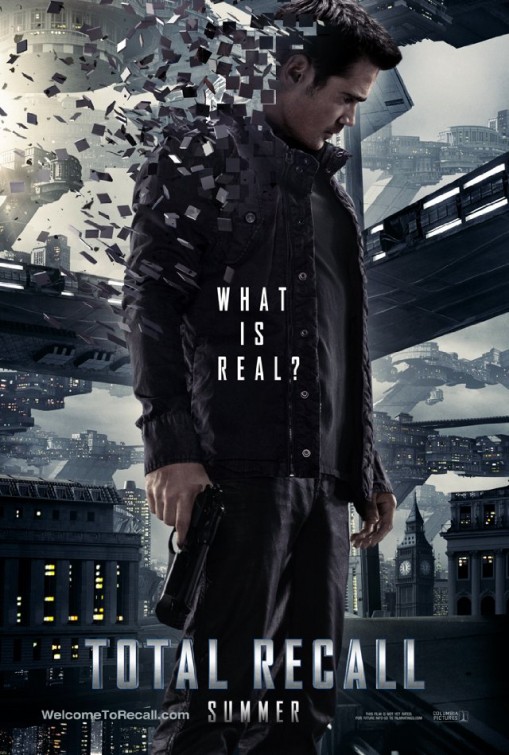 The latest needless remake takes the basic elements of 1990’s Total Recall and streamlines them into one very long chase sequence. And for those concerned males, the three-boobed lady makes a triumphant reappearance, because surely the movie wouldn’t be the same without her. Though in the age of the Internet, the sight of a three-boobed woman seems less indelible to impressionable male minds. But I digress. I was ready to dismiss this as another soulless Hollywood remake. Then I found myself enjoying Total Recall, and even the stuff that was dumb I had to also admit was cool. Take for instance a commute that goes through the center of the Earth. How exactly could such a thing be built? What does one do for maintenance? How does this not affect the Earth’s rotation? But then I forgot all about it because, in pure movie terms, it was cool. The zero gravity change-up as the transport changes directions at the core – cool. The fact that we get a zero gravity action sequence in this environment – cool. The fact that this transport system becomes a conduit for an invasion – cool. The plot mechanics are all familiar, notably the memory wipes and the super spy histories, but I didn’t care because the movie rarely lets its foot off the gas. When this thing starts, it doesn’t let up. The chase sequences are well executed amidst an imaginative array of locations, from a flying highway to a series of hanging housing developments. It’s not terribly smart but Total Recall is an entertaining escapist thriller that delivers some robust action and enough imagination in its future settings. Plus, there’s a woman with three boobs in it.
Nate’s Grade: B
Share this:

John Carter (2012)
 John Carter has been in the longest development hell of any movie project in the history of cinema. If nothing else, that’s at least an accomplishment. Author Edgar Rice Burroughs first published his tale of interplanetary adventure in “A Princess of Mars” way back in 1912. It was his first published work, even before the phenomenon that would make him a star, Tarzan. Ever since 1931, filmmakers have been trying to realize Burroughs’ grandiose sci-fi vision but have never been able to finish. In the last decade, the movie has gone through different stages of development, with Robert Rodriguez, Kerry Conran (Sky Captain and the World of Tomorrow), and Jon Favreau attached as director at different points. Then Disney snatched up the rights and hired one of its own, Pixar director Andrew Stanton, to do what nobody has been able to do for 80 years –bring Burroughs’ vision to the big screen. It doesn’t hurt when Disney gives you a reported $250 million to spend.
John Carter (Taylor Kitsch) is a Civil War veteran haunted by his past. He’s chased by a group of bandits and stumbles into a cave that transports him to Mars, known as Barsoom to the natives. Carter discovers that he’s found himself in the middle of another civil war, this time between the cities of Zodanga and Helium. The Tharks are a race of 10-foot tall four-armed warrior creatures, and their leader, Tars Tarkus (Willem Dafoe), sees Carter as the turning point in getting his people’s lands back. Carter will also help solidify Tars Tarkus’ place as leader to his people. John Carter is a coveted free agent on the red planet. Princess Dejah Thoris (Lynn Collins) wants John to help her people survive against the Zodangans, lead by Sab Than (Dominic West). Dejah’s father (Cirian Hinds) has brokered a shaky peace on the promise that she and Sab Than will marry. The mysterious Therns, lead by Matai Shang (Mark Strong), are the real power players on Mars. They have offered a powerful new weapon known as the “ninth ray” to give Sab Than the upper hand. All John really wants to do is return home, but first he has to find a way back.
 John Carter is an amusing, entertaining throwback to old-fashioned B-movies. Even the depiction of life on Mars is charmingly retro, what a future would look like to a man from the early twentieth century perspective. As a result, the aliens fight with Bronze era weapons and guns that behave like trinkets from a Western. Even the minimalist alien design, the Roman-esque costumes, the fact that everyone can breathe air, and low-grade technology of these advanced species (flying machines that look like Da Vinci designed them) come across as nostalgic, vestiges of the past more so than insights into the future. It’s like watching those old sci-fi TV shows from the 1950s and how they predicted man would have colonized the solar system by now and already have a working lunar colony (Newt Gingrich is trying his best). The movie channels the spirit of old adventure serials and captures a certain gee-whiz, childlike sense of fun. There are moments where Stanton has a playful sense of storytelling, like a near montage of Carter’s determined escapes from officer Powell (Bryan Cranston? Why not?). While being PG-13, there is still a feeling of the Disney-fication of the tale, complete with tamer outfits for Dejah Thoris (do a Google image search) and an adorable alien “dog” sidekick that befriends John.
The best moments are easily the scenes where John integrates into the indigenous Thark tribes, finding a sense of community and a bonding with Tars Tarkas. If the movie had only featured this alien race instead of all those warring people-who-have-red-henna-tattoos-on-so-they-must-be-aliens-right, I think the movie would have succeeded better. One alien race focuses the narrative but instead we get four (three?). When our climax does come into view, the pieces have all fallen into place and the action is suitably thrilling. Stanton’s live-action debut isn’t the homerun that Brad Bird’s Mission: Impossible 4 was, but the large-scale action is satisfying and imaginative enough. The payoffs work and Stanton has nicely intertwined his storylines so that everything comes to a head. The Earthbound framing device, with Edgar Rice Burroughs (Daryl Sabara) reading the diary of his rich departed Uncle John, enriches the narrative once the full context is revealed, gearing up the audience for a long-awaited reunion to end the movie on a perfect high note.
What John Carter also has going against it is the pull of time. It’s hard not to see how derivative the story and characters are; Burroughs’ original novels were hugely influential to science fiction writers, and you can see similarities in Star Wars, Avatar, and other works. Scenes in this movie will feel like rip-offs from other movies, like an arena battle with giant alien hordes from Attack of the Clones, riling up a native alien species against its imperial antagonists in Avatar, Deja Thoris clearly has her DNA all over Princess Leia, and the dynamics of jumping through space travel via gateways made me think of how excellent a movie Stargate was (watch it again; it’s terrifically executed). Carter can easily be credited as the predecessor to superheroes. Now it’s unfair to say that John Carter rips off these other sci-fi movies when every one of them was released long after Burroughs’s novels had been widely published. It’s unfair, but you can’t help but feel the way you feel, and I was feeling a fairly resounding sense that I had seen much of this tale before and better. The actual terrain of Mars is a little less than inspiring. Its rocky vistas don’t make it feel too noticeably alien. We don’t ever really get a good view of alien culture outside of the Tharks. John Carter’s one big addition is that the character, given his physiological makeup and Mars’ gravity, can leap to impressive heights that were only previously known by Italian plumbers in video games. This means we get a lot of John Carter jumping up, jumping around, jumping like a Martian jumping bean. But just because you can jump really high, doesn’t that mean you’d be plummeting at a high rate of force? Wouldn’t John seriously break his legs leaping 500 feet in the air and then landing?
 The script, credited to Stanton, Mark Andrews (co-director of Pixar’s upcoming Brave), and Pulitzer Prize-winner Michael Chabon, is weighed down with expositional slog that it cannot break until the third act. I was expecting a better and more graceful story given Stanton’s previous film, WALL-E, which could be taught in film classes as a textbook example of elegant visual storytelling. With John Carter, it feels like we’ve been hit with the Martian phone book. We’re inundated with unfamiliar names and given scant time to adjust. While a gamble that the audience intelligence will catch up, it also makes for a confusing half of a movie. It’s hard to keep track of all the different names; Tharks this, Hellium that, Zodanga this, Jeddak that, Therns here, Barsoom there, etc. The movie doesn’t gradually expand its Martian history, it just plops us, along with Carter, right into the middle. The opening structure is also a bit confusing, as we’re jumping around time without any proper setup. Still, the movie cannot be accused of being stupid; hokey and convoluted, yes, but not stupid.
And boy do we get a lot of talking for an action movie set on Mars. The middle section is quite heavy with yapping. Kids who came thank to their trust of the Disney name will probably be bored as the movie explains to us things we already know and things we don’t care about knowing. For a two-hour plus film that has a lot of political infighting, I’m surprised that the movie is pretty pedestrian when it comes to its politics. It all really comes down to an arranged marriage to broker peace. That’s not very complicated. The main villains, the ghostly Therns, are completely incomprehensible when it comes to motivation. I have no idea what they stood to gain. If they have a gateway that can take them to Earth, or they have their own copies on Earth, why aren’t they using this to their advantage? Why aren’t they grabbing more Earthmen to form an army of jumping Jacks? Why the significance of the “ninth element” when we all know the fifth element is love? But more importantly, as last year’s Green Lantern proved, it hurts your movie when your hero can’t be bothered to be heroic. It takes far too long for John Carter to seem like he gives a damn about anything. I understand he’s a war-weary vet, but the movie feels like 90 minutes of him shrugging while everyone on Mars desperately pleads with him to save them.
Kitsch (X-Men Origins: Wolverine) is going to be having a fairly big breakout year given his mug appearing in several high-profile, high-budgeted movies. The guy has already proven with steady work on TV’s Friday Night Lights that he can act, though the results are not so convincing with John Carter. I think he was going for some sort of gruff, Clint Eastwood-esque loner but he just comes across as wooden. Add his character’s reluctant nature, and it makes for a pretty uninvolving hero. Fortunately for Kitsch (what an unfortunate last name), the supporting cast is there to pick up the slack. Collins (TV’s True Blood) is the real breakout star of the movie. She’s feisty and strong and passionate and altogether easy on the eyes she could give Leia a run for her money in a metal bikini competition. Collins’ performance is filled with urgency, like she’s compensating for our taciturn lead actor. When she’s on screen you feel engaged in the story. Dafoe (Spider-Man) finds the right mixture of humor and pathos as the leader of the Tharks. West (300) has such a slimy sneer to him, it’s magnificent to watch. I’m starting to think that Strong needs to take a break from playing villains (I count eight bad guy roles sine his breakout in 2008’s RocknRolla) except that he’s so good at playing them. I think if Mark Strong ever plays himself in a movie about his own life, he’ll inevitably be the bad guy.
John Carter is an entertaining throwback to the adventure serials of old, a retro sci-fi action film that falters somewhat from a talky, uneven, exposition-laden script. When this movie works, it works quite well. There’s just too much stuff in this movie, too many alien races, too much exposition, and too many other movies that make John Carter feel derivative. What was once amazing and imaginative in 1912 will not have the same effect on audiences in 2012, especially those who have grown up on pop culture inspired by John Carter. I don’t think anyone can say the final product was worth the wait, but John Carter is a modestly fun adventure. I wouldn’t mind taking another trip to Mars, just as long as it doesn’t take 80 years.
Nate’s Grade: B-
Share this:

Contagion (2011)
 For the germophobes amongst us, you probably want to skip seeing the new thriller, Contagion. Like for life. Never see this film if you’re the type that needs a paper toilet seat cover before sitting down to do their business. Contagion is a movie that makes you reevaluate basic human interaction. You may not leave the house again without covering yourself in plastic and a year’s worth of Purel. Director Stephen Soderbergh (Che, Ocean’s Thirteen) has assembled an all-star cast to drop like flies like only Hollywood’s most talented can do. Contagion is an intelligent, unnerving, technically authentic thriller that will make you cringe just watching people cough.
Contagion’s main character is a virus that begins its origin in a Hong Kong casino and quickly spreads from there. A British model takes it to the UK, a Chinese waiter goes home infected, a Japanese businessman keels over dead on a return trip home, and Beth Emhoff (Gwyneth Paltrow) comes home from her business tripe back to Minneapolis and goes into seizures. The next day, she’s dead and soon after having her brain dug out for an autopsy. The spooked docs alert the Centers for Disease Control immediately; something is definitely wrong with Paltrow’s brain (insert Coldplay joke here). The head of the CDC, Dr. Ellis Cheever (Laurence Fishburne), and his specialists track the expansion of the virus. He dispatches Dr. Erin Mears (Kate Winslet), to Minnesota to coordinate inter-agency action and interview Beth’s husband (Matt Damon), who appears to be immune to the virus. He’s in shock and isolated from his remaining daughter. He’s still trying to make sense of how quickly everything fell apart for his family. Capitalizing on fear, anti-establishment medical blogger Alan Krumweid (Jude Law) steers a panicked public toward a homeopathic medical alternative that he just so happens to have a financial stake with. The World Health Organization sends Dr. Leonora Orantes (Marion Cotillard) to investigate the Hong Kong casino and overview hours of security footage to glean the origins of the virus. But she, like others, soon find themselves in ever-increasing danger as the world races against time to beat this new threat.
For those expecting an action-thriller with plenty of doctors barking moral quandaries and racing against time to escape government agents… you will be sorely disappointed. Contagion is much more cerebral, cool, like a scientific procedural that plays the premise out in a realistic fashion, which means it’s often short the fireworks that mainstream audiences have come to expect from disaster movies. The CDC is really the main setting as they try and determine the origin of the virus, breaking down the virus, and projecting its rate on infection and contamination. Soderbergh has onscreen titles indicating how large the population centers are for the plot settings, reminding us simply with text how vulnerable to danger all those people are. The real pleasure of the film is watching A-level Oscar actors puzzle out how to solve this multi-faceted crisis. The movie does a minimal amount of explanation and expects an audience to be able to keep up with its scientific analysis. Soderbergh’s film is much more in keeping with The Andromeda Strain than Outbreak (find that monkey and all will be happy again!). You witness smart people doing smart things and still making little traction. This isn’t necessarily Irwin Allen territory of disaster. It’s a disaster that seems all too reasonably possible rather than being trapped in the belly of a ship that has turned upside down. Getting sick is a lot harder to avoid especially in our modern world. Globalization has done many wonders for the world, but by making the world a smaller place it also means that we’re all much more susceptible to the spreads of pandemics. No longer can geography be held as a total defense. We’re all one flight away from the spread of the next great illness (as the end credits to Rise of the Planet of the Apes also remind).
Soderbergh and screenwriter Scott Z. Burns (The Informant!) cast a wide net all over the world to see the ramifications of crisis. Things go rather quickly. By the end of the first week, the CDC is coordinating its resources and media strategy to not inflame panic. Easier said than done when ignorance and fear are in large quantities. The reaction to the news, the intra-government squabbles over resources and money, the exploitation of fear by opportune business types, the rising resentment of those left out of the loop, and even the kidnapping schemes for those known to have access to medicine. Contagion works because it gets the details right without losing track of the big picture. The film feels eerily plausible at every beat. Nurses are on strike refusing to be near the sick until uniform safety protocols are established. Funeral homes refuse to handle infected bodies out of health concerns. These are absorbing details that feel completely authentic yet would easily have been overlooked in other disaster pictures. The movie even addresses recent pandemic fears related to H1N1, SARS, and the perceived “overreaction” when these potential worldwide disasters turned out to be milder bugs. A government agent asks the head of the CDC if some terror organization could have weaponized the bird flu. “They don’t have to. The birds are already doing it,” the CDC head replies.
While Burns lies out a host of characters and scenarios with increasing tension as stakes mount and the death toll rises, Contagion just kind of drifts into an ending for the last 20 minutes. I was expecting another big wallop, some kind of sudden plot turn that reestablished an ongoing threat, but it wasn’t to be. The tension just sorts of lets out slowly like a balloon, playing against movie laws. That means that Contagion, wile tense, eschews a dramatic buildup for a climax. Burns and Soderbergh instead to play out their realistic “what if” experiment to its conclusion, which makes for a realistic if somewhat inert final act. There’s no chasing monkeys or butting with government agents willing to sacrifice infected town for “the good of mankind”; it’s just government employees doing good work and trying to minimize damages. It’s exciting to watch smart characters break down a nasty new virus and try to understand it and get ahead of it, but once they succeed, it’s not as exciting to watch the aftereffects of people getting better and returning to a normal existence (minus 30 million people on the planet – the solution to fixing unemployment?).
 Because the emphasis is on the cross-sections of plot and scientific breakdown, the emotional connection to the characters is limited. There are a lot of famous faces that appear in this movie; even bit parts are taken up by the likes of Bryan Cranston (TV’s Breaking Bad), John Hawkes (Winter’s Bone), Demetri Martin (Taking Woodstock), Enrico Colatoni (TV’s Veronica Mars). Damon (The Adjustment Bureau) is probably the closest thing the film has to an emotional center. He’s immune to the virus but he has to watch his family fall apart with the knowledge that his wife was Patient Zero. On top of that, he has to deal with the fact that she was cheating on him. That’s a healthy brew of emotions to confront in such a heightened situation, and Damon does a nice job of putting a human face to the mass tragedy. Winslet (The Reader) is superb as a CDC investigator, so duty-bound that even when she awakes to discover she has become infected she goes through protocol trying to investigate who serviced her room so that others will not share her fate. Law (Sherlock Holmes) is suitably sleazy as a moral relativist trying that uses his army of Internet followers to discredit the government’s response. Fishburne (Predators) has terrific poise as the man in charge of scrambling the response forces, keeping his cool, and being the public face of the government response until an all too human scandal tarnishes him. But perhaps the best performer is Jennifer Ehle (Pride and Glory, The King’s Speech). She plays one of the chief CDC scientists studying the virus and takes some extreme measures to test a potential vaccine. She has a scene with her sick father that is likely the most emotionally affecting moment in the film. Her sturdy determination even when most vulnerable is selfless.
Contagion is a smart by-the-book procedural thriller that may not be dramatic enough for audiences fed by Hollywood disaster films. The film is far more analytical and detail-oriented to its benefit and sometimes detraction. It’s got stars galore and some plenty of rising tension, but the film also follows a realistic blueprint toward a rapid world response to a new pandemic, which means that well-developed characterization is spared amidst all that fraught scientific lingo. As a result, Contagion feels more like a docu-drama than an amped-up Hollywood thriller with its finger firmly pressed upon American anxieties. Contagion is a bit overextended and data-heavy. It’s a stripped down indie in studio clothing. Soderbergh’s movie is a bit too lean and clinical to be fully satisfying and emotionally engaging, especially with its somewhat inert ending. It’ll sure make you look at free bowls of peanuts differently. And Gwyneth Paltrow’s skull.
Nate’s Grade: B


 nathanzoebl
You must be logged in to post a comment.