Blog Archives
Rampart (2012)
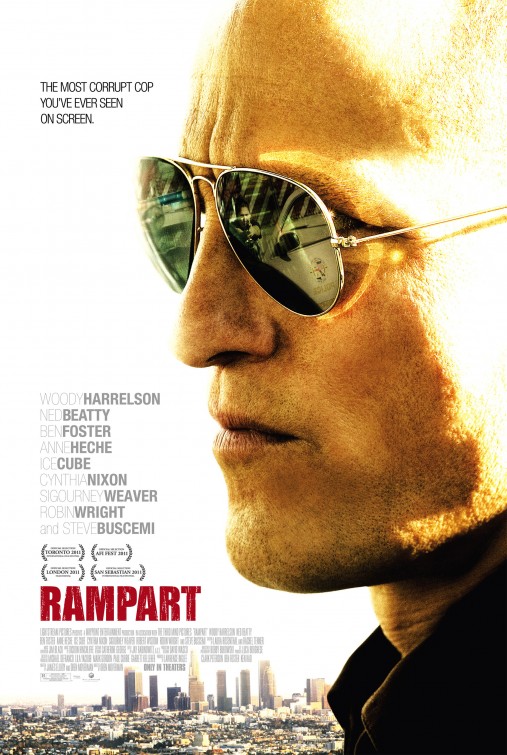 Stop me if you’ve heard this one before. A corrupt L.A. cop (Woody Harrelson) makes bad choices, alienated and frightens his family, and looks to be on the way out as a career of taking the law into his own hands is at long last catching up with him. Yeah, you probably stopped me after the third word in that sentence. This dour character-study showcases Harrelson nicely as a cocksure cop who’s so self-destructive and paranoid that he pushes everyone away. Co-written and directed by Oren Moverman, who made the terrific and searing drama The Messenger, this movie just about turns into high-gloss navel-gazing. The plot is quite loose and there’s very little traction. We get to see scene after scene of Harrelson behaving badly or violent, but what does it all add up to? We already know he’s a bad cop tortured by his own sins and the demands of the job. In a way, there’s an intriguing connection between law enforcement and soldiers who are often called to bear incredible burdens and just deal with it, forgotten by a public complacent with being safe. But really this movie is just one long trip with an angry man who keeps everyone, including the audience, pushed away. He’s complex but I can’t say we ever got to know him better. The film is well acted with plenty of recognizable stars, but why should I care? The central message about the prevailing influence of corruption is a bit heavy-handed as well; at one point Harreslon’s wife says, “You made us dirty.” Rampart is a disappointing venture for Moverman despite Harrelson’s best efforts. In the end, when you’re stuck with a dirty cop he better be worth the time.
Nate’s Grade: C
Share this:

21 Jump Street (2012)
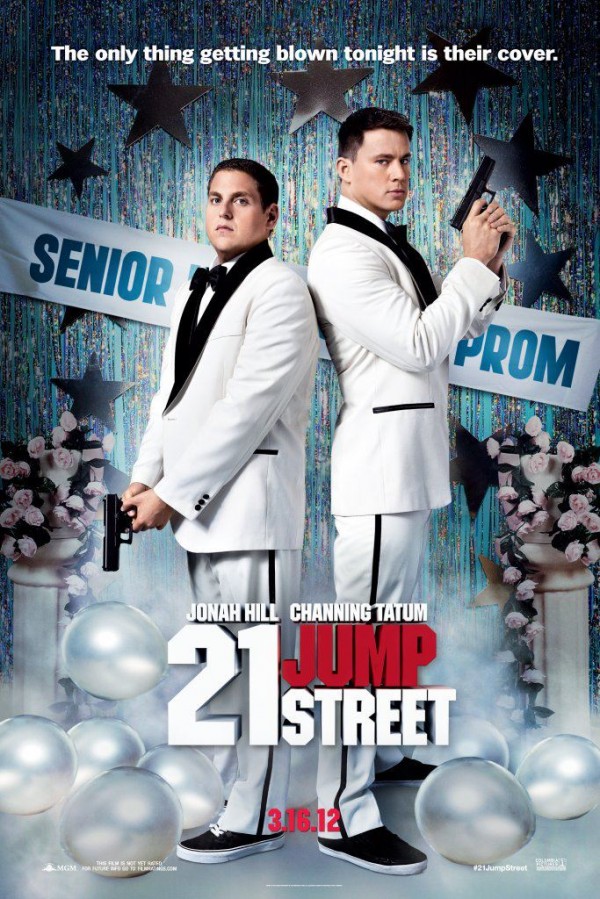 21 Jump Street ran on TV from 1987-1991 and is mainly known as serving as a launching pad for eventual mega movie star Johnny Depp… and Richard Greico too. Youthful looking police officers infiltrated high schools and tackled topical issues of the day (what snap bracelet goes best with my high-waisted jeans?). Why would anyone want to make this movie, let alone comic actor Jonah Hill? Surprising in just about every way, especially when it comes to overall quality, the 21 Jump Street movie is not just a great comedy but also a great movie. How the hell did this happen, Movie Gods?
Officer Schmidt (Hill) is smart but shrimpy (which is saying something considering how dangerous Hill’s weight has been before). Officer Jenko (Channing Tatum) is a stud but pretty dimwitted when it comes to tests. The two form a partnership and get assigned as bicycle cops, not exactly the position of command and authority they were expecting. After a few screw-ups, including failing to read a suspect his Miranda rights (“You… have the right… to be an attorney”), the duo gets bounced to an old undercover program at, you guessed it, 21 Jump Street. The pair is supposed to pose as high school students and find out who’s supplying teenagers a dangerous new club drug. Much has changed since Schmidt and Jenko were in high school together, and both of their profiles were accidentally swapped, meaning Jenko is given AP chemistry and the higher level classes, and Schmidt is given gym and acting courses, where he’s supposed to work his way into the popular circles. Molly (Brie Larson) is a gal in that popular inner circle and Schmidt struggles to accept that a pretty, smart, popular girl might actually “like like” him.
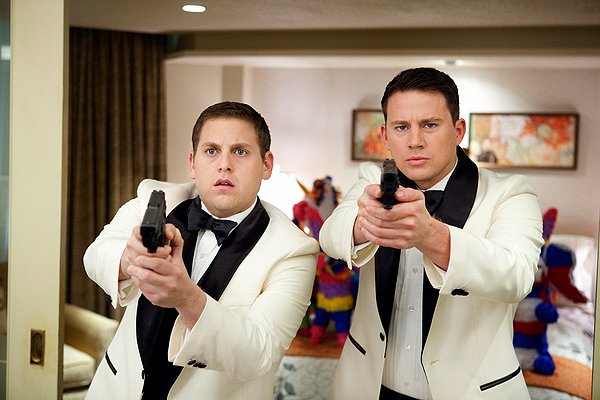 I knew I was in for something special when the movie itself lambastes the very idea of a 21 Jump Street movie, with the police chief (Parks and Recreation’s Nick Offerman) ridiculing the idea of unoriginal nitwits recycling something old that has name recognition and hoping the public will be too dumb to care. The movie beats the audience to the punch every time, mocking the absurdity of its own premise and plot points (many characters note how old Jenko appears). I should have expected more from screenwriter Michael Bacall (co-writer of the Scott Pilgrim movie adaptation) and especially from directors Phil Lord and Chris Hill, the same pair whose rambunctious comedic verve radiated from every frame of Cloudy with a Chance of Meatballs and their brilliant short-lived animated MTV show, Clone High. This movie had me laughing a lot and had me laughing hard, doubling over, with-tears-in-my-eyes laughter at points. Dickson spouts, “Some kid overdoses on drugs. And because he’s white, people actually give a shit,” showing that a movie with a mind-blowing number of male genitalia jokes can provide a few shrewd jabs of social commentary. There’s a great bit where on their first day back in school, Jenko points out the various school cliques. Then he gets to a group of students in skinny jeans, thrift store clothes, and floppy hats, and he looks puzzled. “I don’t know what those kids are?” Ha, because hipsters didn’t exist back in his (my) day.
21 Jump Street is cheeky, rowdy, quick-witted and playful in the best sense of an action comedy. It’s got fish-out-of-water moments as the duo struggle to fit in with a different high school setting. The one-liners and riffs can be gut-busters, but the film does an even better job layering oddball gags (Korean Jesus), loony slapstick, fun but telling character moments (Schmidt not knowing how to end a prayer: “The end, right? ‘The end’?”), strong setups that have stronger payoffs (using the reading of Miranda rights as a genuine emotional climax), and an overall raucous, anarchic spirit.
Here’s one sequence in particular that shows off the film’s clever comedic chops. The film finds a way to satirize the tropes of action movies, particularly buddy cop movies, with such nimble precision. Schmidt and Jenko are on the run but their car chase keeps butting heads with the fabricated reality of Hollywood movie chases. For one, they keep finding themselves getting stuck in traffic on the highway. This forces them to have to keep abandoning cars and finding a new set of wheels ahead of the gridlock. Then, as the bad guys chase them down on motorcycles, the chase causes all sorts of chaotic collateral damage, including oil trucks riddled with bullet holes and dripping the flammable substance all over the road. Then one of the motorcycles skids into the flammable muck, and our heroes wince in preparation of the expected explosion, and then nothing happens. “Huh. I really thought that was going to explode,” one of them remarks casually. And this setup is repeated again, denying us the explosive equation that action movies have pummeled into our brains (car + any tap of force = humungous fireball), and there is a payoff to this comedic tweak on the cliché, and it is silly and terrifically funny. Plus, I haven’t even mentioned that both Schmidt and Jenko are dressed in silly outfits and begin their car chase in a driver’s ed car. This sequence is just one example of the anarchic, robust, and self-aware comedic attitude that the movie flaunts.
 But more than being a hysterical action picture, 21 Jump Street works even better because at its core is a level of sweetness, a satisfying mixture of lewd and heart like the best Judd Apatow ventures. It’s a bromance of epic proportions even by buddy cop standards, the old school bromance vehicle of its day. The guys go back to high school and the movie’s bright switcheroo puts the characters in opposite social spheres, with Schmidt with the cool kids and Jenko struggling with the social misfits and bottom-dwellers, a.k.a. nerds. Of course the whole class assignment also shows the façade of being cool in high school. The movie could have mined this well-worn stereotypical class conflict with ease, but instead it decides to use its contrived scenario as a jumpstart for the guy’s emotional growth. The lessons may be simplistic (perils of ego, believe in yourself, teamwork, personal responsibility) but that doesn’t make them bad lessons, and the fact that the flick seriously uses covalent bonds as a metaphor, and does so in an almost poignant fashion, is worth applauding. The relationship between Schmidt and Jenko engages the audience, and we root for them even when they’re behaving like jerks. They’re misfits who are doubted and reprimanded, which make us hope for their eventual success even more. Refreshingly, the movie doesn’t put them in opposing camps in high school. Schmidt was a dweeb and Jenko was a dumb jock, but that doesn’t mean they needed to be adversarial. When they regroup in the police academy, they form a genuine partnership, realizing they can assist one another. They form an actual friendship and they’re both better cops, and better characters, together.
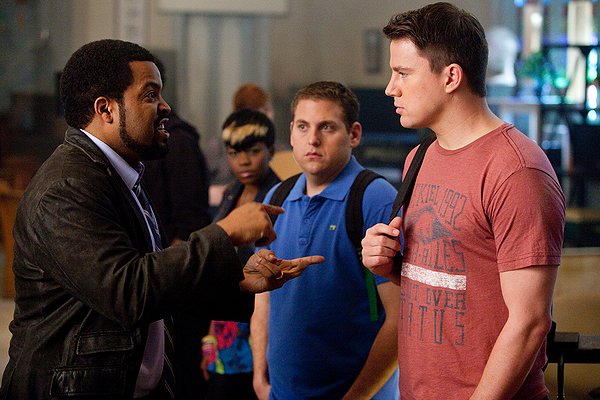
Hill and Tatum have preposterously good chemistry together as a comic duo. Hill, a co-writer himself, reportedly had to remain steadfast to convince Tatum to join forces, and thank god he stuck it out. Hill’s (Moneyball) already a comic pro at this point, though this role tones down his comical rancor and ups the spaz awkwardness. Tatum (The Vow) is the true revelation. Man does this guy have really great comedic skills; a sharp, instinctive sense of timing, a pliable physicality, and a genial charisma that doesn’t demand solo attention. He’s good at playing dumb without going overboard. He’s not just good, he’s flat-out terrific. Larson (Scott Pilgrim vs. the World) is an adorable and plucky love interest, sure of herself, down to earth, and accessibly quirky. The supporting cast shines in their small roles, notable Ice Cube (Lottery Ticket) as the typical brash and loud police captain, Ellie Kemper (Bridesmaids), in her randiest roll yet, as a chemistry teacher awkwardly flirting with the hunky Jenko, Dave Franco (Fright Night) as an eco-friendly drug dealer, Rob Riggle (The Other Guys) as an aggressive gym teacher, and a special cameo that’s worth leaving unspoiled.
21 Jump Street has some weaker points, namely when the action ramps up it’s pretty mundane when it’s not being funny, but the faults are minor. This is a silly, shrewd, salacious, and outright thrill of giddy entertainment, a comic blast. Hill and Tatum have a wonderful comedic dynamic and the clever screenplay gives them plenty to do with their talents. I didn’t think it was possible to adapt the cheesy TV show into a worthwhile studio comedy, but Hill and company have exceeded every expectation. 21 Jump Street isn’t the most nuanced or subtle comedy, though I will argue spiritedly that it has plenty of smarts in all the right places, but it’s an affectionate, witty, and rambunctious night out at the movies that will be hard to beat this spring.
Nate’s Grade: A-
Share this:

Scott Pilgrim vs. the World (2010)
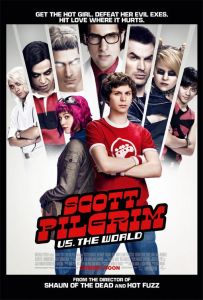 What happens when the millennial generation gets its own (attempted) seminal movie? It stays home and plays video games, letting the film, Scott Pilgrim vs. the World, languish at the box-office. I guess that’s what happens when you finance a movie whose target demographic will just as readily download the movie for free off the Internet.
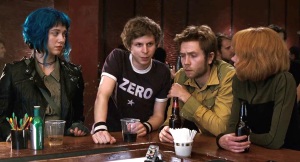
Scott Pilgrim (Michael Cera) is a 22-year-old Toronto slacker. He?s the bass player for the band Sex Bob-Omb, along with lead singer Stephen Stills (Mark Webber) and acerbic drummer Kim (Alison Pill), a former ex-girlfriend of Scott’s from high school. The band’s biggest fan is 17-year-old Knives Chau (Ellen Wong), who also happens to be Scott?s new girlfriend. The world of Scott Pilgrim is abuzz with this scandal, especially Scott’s gay roommate Wallace (Kieran Culkin) and Scott?s younger sister (Anna Kendrick). Scott insists it’s all on the level and he has no ulterior motives for dating a high schooler. Then he sees the mysterious and alluring Ramona Flowers (Mary Elizabeth Winstead) who?s new to the area and American. Scott rabidly pursues her in what could best be described as stalking, eventually getting her to agree to date him. Trouble is, he hasn’t broken up with Knives just yet before starting this new venture. Scott is then confronted at the Battle of the Bands concert by a man who comes bursting out from the ceiling. He is the first of Ramona’s seven evil exes and Scott must defeat them all in order to earn the right to the violet-haired beauty. “Everybody has baggage,” Ramona says. “Yeah, but my baggage doesn’t try and kill me,” Scott wearily replies.
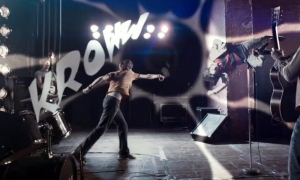
 Visually, this movie showcases director Edgar Wright (Hot Fuzz, Shaun of the Dead) using every crayon in the Crayola box. This is a visually resplendent film where every scene seems crammed with details to delight the eyes and light up the senses. It’s a rush to watch the kaleidoscope of colors and motions. The Scott Pilgrim universe clearly differs from our own. This is a realm that borrows heavily from old school video games, where people burst into coins when vanquished, where life-decisions are met with “leveling up,” where people have onscreen pee bars that will deplete after a trip to a urinal. Sound effects will routinely be verbalized on screen, everything from a “RIIIIIIIIIIING” of a telephone to the “Ding Dong” of a door. It’s amusing, though also easily overused. Jobs and stuff like that are for the real world, hence too square to be depicted. It’s this entire idiosyncratic comic book world treated like everyday reality.
The enormous display of style is impossible to ignore. Scott Pilgrim is a slick, flashy piece of entertainment that is riddled with nostalgic references for a select crowd. I appreciated how a nice walk was accompanied by the theme song from The Legend of Zelda, or that sound effects and onscreen graphics echoed the fights from Street Fighter II (don’t ask me which of the 800 versions). Scott Pilgrim is an excellent pop pastiche of a specific culture, namely a slacker, hipster, amiable, comics and gamer group. I myself was an avid Nintendo gamer back in my day, but I admit to waning interest when the games got too complicated and grisly (“Back in my day we had two buttons to push, one to jump and the other to shoot, and that’s how we liked it!”). The movie is an explosion of color, light, and (lo-fi garage rock) sound, which also might sound like the description of a seizure or a stroke to some. Like those ailments, Scott Pilgrim will be seen by some as an infliction. It’s hyperactivity and eagerness to please via nostalgic reference points will be what drives people to this film and what drives them away in equal measure.
The Scott Pilgrim graphic novels total six volumes and approximately 1200 pages, which means it?s not the easiest fit for a two-hour window. It also hurts that the Pilgrim books have a wide supporting cast of characters to tussle with, plus there?s the whole seven deadly exes thing which means the movie has to provide about a solid 20 minutes of set-up before finding enough time for seven antagonists (or boss battles, following gamer parlance) and a reasonable amount of resolution. Add on top of this the fact that Wright keeps the movie moving at an outrageous, ADD-addled pace, like the plot conveyor belt lever got broken and the scenes speed one after another. Everything about this movie feels fast and over caffeinated. The editing in particular has characters holding conversations where every line is in a new location, implying an added sense of movement. So you shouldn’t be too surprised when the Scott Pilgrim film feels like a whole lot of a little; it’s moving at the speed of light to entertain.
 Because of the plot mechanics and oversized cast of characters, Pilgrim can give off the impression of shallowness. It seems like all style and little substance and that’s because the movie attempts to cram an entire series of stories, back-stories, and conflict into two hours. The film version only has enough time to attempt to give Scott and Ramona characterization, though both come across as weak-willed, tentative, and less than charismatic, wondering if either party is worth the trouble. The movie tries to paint over these differences through distraction and force of will. The large cast of supporting players all elbows each other just to be mouthpieces for one-liners. Knives actually comes across as the most complete character, consumed by her infatuation, heartbreak, and then quest for misguided vengeance. She’s somewhat dismissed and yet she is the most developed person on screen thanks to Wong’s endearing and relatable performance. The entire experience of Scott Pilgrim vs. the World can be somewhat fatiguing when there’s little evidence presented for emotional investment. The books supplied the reasons for caring besides the whole underdog angle.
The movie aims to be a battle over love, but it’s not entirely convincing. Scott appreciates Knives because she’s simple, a relationship he doesn’t have to invest much within, something casual and enjoyable while it lasts or until it becomes too taxing. Then he goes ga-ga for Ramona and stalks her, wearing down her defenses. He’s purely smitten with her and willing to do whatever it takes to earn her affections, though he can?t explain why he feels this way. Here’s a note to screenwriters: when characters are asked why they love somebody, do not have them say, “I don’t know.” But for Ramona, Scott is her Knives. He’s something easy that won?t break her heart, an escape from the jerks she’s been dating before. He?s low maintenance. He’s something to pass the time. There’s an interesting dynamic here, made even more complicated by the fact that Scott’s time with Knives blended with his time with Ramona. There was not a clear end point. The movie takes a literal approach to the idea of love being a destructive force of nature. Scott is punished throughout because of his infatuation with Ramona, but he persists despite the bruises. And he doesn’t even really know much about her. There’s an interesting statement somewhere there about the punishment we endure, sometimes foolishly, over the affections of people we may love, or convince ourselves of, but not even like.
 It may sound peculiar but I’m paying Michael Cera a compliment by saying his performance in Scott Pilgrim is the least Michael Cera the actor has ever been on screen. Gone is his gawky, awkward, ironic shtick that has fast become the Cera persona in films like Superbad and Year One. Scott is unjustifiably confident in his life’s pursuits, and Cera gets to act cocky and quippy, even if it?s done with a wink. He?s an unlikely kung-fu star but then again he?s also an unlikely leading man. Winstead (Live Free or Die Hard) is cute but plays her part a bit too toned down, like Ramona’s still searching for the right medication combination. Culkin and Pill are both scene-stealers of the first order, doing so with unabashed and flippant sarcasm. Every scene is made better by their presence. Among the evil exes, Brandon Routh (Superman Returns) has plenty of fun as a dim-witted super-powered Vegan bassist (“Vegans are just better than other people”), and Jason Schwartzman epitomizes hipster snark with such relish. The film is exceedingly well cast from top to bottom.
I’ve read some reviews positing that Scott Pilgrim vs. the World is an elaborate fantasy taking place in the mind of its titular hero, that he blends his knowledge of comics and video games to help make sense of the troubled waters of relationships and lingering hurt from the demise of love. I think that’s a nice explanation but perhaps trying too hard to frame this film as some form of psychoanalytical commentary on modern youth’s interpersonal relationships and the value of love. Scott Pilgrim vs. the World is really just a spastic, hip, clever wank that, as presented, gives little room or emotional investment. It?s a blurry, messy, prankish good time at the cinema that doesn’t translate into much more than the equivalent of sensory button mashing (video game reference). It’s fun while it lasts but it doesn’t have much beyond those astounding visuals to make it feel lasting, and I say this as a genuine fan of the graphic novels by Bryan Lee O’Malley. Alas, heavier discussions about the thorny, maddening issues of love are better left to more dramatic, and romantic, movies like Brokeback Mountain, Eternal Sunshine of the Spotless Mind, and even WALL-E. This movie is more preoccupied with spinning as fast as it can and then vomiting.
Nate’s Grade: B


 nathanzoebl
You must be logged in to post a comment.