Blog Archives
Wolfs (2024)
 George Clooney and Brad Pitt star as rival fixers, unscrupulous men the rich and powerful call upon to clean up the messes of the rich and powerful, as Clooney portrayed in 2007’s Michael Clayton. It’s clearly playing upon the movie world depiction of these kinds of characters, whose titular name comes from the famous Pulp Fiction fixer played by Harvey Keitel. I don’t know what writer/director Jon Watts (Cop Car, Spider-Man: No Way Home) wanted to say or even achieve once he brings these two bickering and aging alphas together on-screen. The first ten minutes is played completely straight, as the drama of a high-powered woman in peril (Amy Ryan) leads to dueling fixers with different bosses being put in charge of disposing of a body and returning stacks of ill-gotten goods. You might assume with this premise that the movie will be a cantankerous buddy movie, with the professionals trying to measure their competition over the course of one long hectic night. It plays with this professional rivalry for a while, but then Wolfs gets bogged down by mafia wars, double crosses, and convoluted conspiracies the fixers are trying to untangle while bringing on an unexpected third wheel to the night of shenanigans. The plot gets easily lost, and the comedy feels lacking and underwritten, relying upon the star power of its leads to serve some kind of ironic undercurrent of energy. I kept thinking to myself that this premise, with these actors, should be a lot more fun. By the end, it feels almost like a setup for a wacky TV series for further adventures, but if this is the level of entertainment we’re getting from this pairing, let the old men die off-screen, thank you.
Nate’s Grade: C+
Share this:

Babylon (2022)
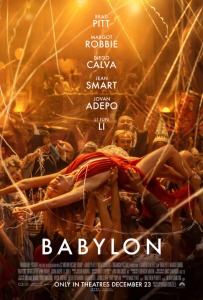 I completely understand how Babylon is such a divisive movie, and this seems entirely the point of writer/director Damien Chazelle (Whiplash, La La Land). It’s over three hours long, it’s got a budget of around $100 million dollars, and the entire enterprise just shouts artistic hubris, at best, and petulantly self-indulgent miasma at worst. Any movie that literally opens with a sequence that includes shots of an elephant defecating and a prostitute urinating on her giggling john is clearly trying to provoke a very strong response, and Chazelle’s expose on the early romanticized days of Old Hollywood is, chiefly, intended to revile and disgust. Chazelle’s mission is to rip apart the cozy nostalgia and hazy romance of the dawning of the film industry, to proclaim that Hollywood has always been a cesspool of exploitation and misogyny and racism and greed. The movie wallows in giddy exploitation but also hijacks the illusion of achieving stardom and asks whether or not the lasting art is worth all of the horror and ugliness of the systems that produce it. Babylon is a wild party of a movie with multiple sequences brimming with pure brilliant filmmaking bravura, and it also ends in a way that just might collapse Chazelle’s righteous fury and contempt.
Within the first half-hour, we are introduced to the three main characters we’ll be charting over many years. Nellie LaRoy (Margot Robbie) crashes a big house party that would make Gatsby jealous. She’s come to California to follow her acting dreams, which her family and small-town peers would sneer at, and she is faking it until she makes it with her boisterous personality. Manny Torres (Diego Calva) is a Mexican-American just trying to get his big break in Hollywood and willing to do whatever it takes to pal around with those in the movies (he is one of our primary elephant wranglers). Jack Conrad (Brad Pitt) is the highest-paid silent movie star famous for his sweeping epics as well as his drinking and multiple broken marriages. Over the next few years, as the industry transitions into the precarious era of sound, each of these three will experience their own rise and fall as they struggle to hold onto their dreams despite the many personal compromises and risks they have to endure to cling to that glitz and glamor.
 If Baz Luhrrman’s Great Gatsby and The Wolf of Wall Street had an illicit baby, and then it was raised by Boogie Nights-era Paul Thomas Anderson, you might get Babylon. It is a big movie founded on the principle of grandiose excess in all capacities. First off, it’s three hours long though this might be some of the fastest-paced three hours, albeit twenty minutes could have been trimmed here and there. I was never bored once, partly because the structure of the movie is episodic in nature, boasting varied sequences that run the gamut from brilliant to ridiculous to brilliantly ridiculous. From an overall thematic standpoint, there isn’t really any subtlety or nuance. The movie is like having the director screaming in your face. Chazelle’s depiction of Old Hollywood is one of direct shame and wanton hedonism, and beyond the obvious “It was always this bad” moralizing there isn’t much more that Chazelle has to articulate, except for a strangely misguided and arguably antithetical coda (more on this later). For almost three hours, Chazelle holds the industry accountable on their buzzy, boozy wavelength of high energy and thrills.
Babylon is presented as a big raucous party where you’re happy to be a guest but also glad you can go home to your own bed. This isn’t a movie that excuses the misdeeds of its degenerates and hangers-on and the systems of power that enshrined the horrible to be even more horrible. Babylon pushes its many characters into uncomfortable questions of what they’re willing to compromise for fame. It’s a process of assimilation and people cutting free their identity, which can be liberating for some and lacerating for others. A significant supporting character is a black jazz musician who begins to find success in the pictures. Then the producers want the man to blacken his face even further, and the ensuing anguish and rage is so palpable that it’s hard to think Chazelle has anything but seething contempt for the sordid history of his own industry. Babylon yearns to be shocking, to be provocative, and it does so easily, sometimes too easily. It’s exceptionally gratuitous to a fault, cavorting with topless women, drug binges, abrupt and callous violence, and all sorts of lewd bacchanalia. Chazelle is demystifying Hollywood’s self-serious fable, and he’s doing so by boldly leaving no bodily fluid untapped and un-splattered.
 This movie is a lot, and it’s also offering very little on a thematic level, so I can understand why plenty of people would hold their repulsed noses and say, “Not for me.” I get it. Not everyone is going to want to watch Nellie projectile vomit onto a hoity-toity snob during a party where she’s trying to re-frame her coarse, lower class identity to be accepted by the brain-dead social elites. Hollywood is presented as a vehicle for self-actualization, but the system is relentless and unforgiving, and even those who achieve success are never afforded a secure perch. The careless regard for safety in Old Hollywood is highlighted by memorable moments, like when a Medieval war epic is halted as a dead extra has a spear sticking straight up in his gut. The crew argue that the man was known as a drinker and therefore it must have been an accident of his own doing. And then the movie skips back to filming, this man’s passing given no more passing thought. And yet there are thousands arriving every year to work themselves senselessly to be the next awaiting sacrifice for this town. It’s an industry built upon human suffering and I can see how many viewers would view the many examples as wallowing in the muck for titillation. The difference for me is that I don’t feel like Chazelle is glorifying any of these antics…
…With the exception of the ending, of which I will discuss more in depth because I find it to be wholly curious and in conflict with every fiber of the movie up until this very final point. I don’t think much of this would spoil the movie for you, but if you wish to avoid my discussion of the conclusion, then skip to the next paragraph, dear reader. The film has a very definitive perspective on the movie industry’s sadistic history and yet in the last five minutes, Manny is subjected to a montage of cinematic high points, zooming ahead into history to include such movies as Terminator 2, Titanic, The Matrix, and Avatar, and he weeps. For 170 minutes, Chazelle has taken us along the road of perdition of Hollywood exploitation and degradation, complete with a skin-crawling trip through hell with Tobey Maguire. And then in the final ten minutes, Chazelle says, yeah, but maybe all of that exploitation and death and disaster was all worth it because we now have movies like… Avatar. It’s the conclusion where Chazelle, as my pal Ben Bailey would say, reveals himself as an art maximalist, that only the art remains and only the art shall matter, arguing that all the vile behavior we’ve endured has meant nothing. It’s the opposite of what the rest of the movie has been purporting, and it’s strangely sentimental for an unsentimental film. It feels like a misguided misstep that concludes with excuse-making and moral relativism, which is far queasier than any of the gratuitous sequences of nudity, drugs, vomit, piss, and rat-eating.
 The technical qualities of Babylon are outstanding, and when working in such symbiotic symphony, they can be absolutely thrilling to exhibit. The sterling production design, extravagant costuming, and swinging cinematography work with the fevered editing and pumping score, and expertly recreate this era with amazing scope and lived-in period detail. I’m still humming the score’s memorable, jazzy, percussive leitmotifs days later. There are sequences that are simply stunning, such as the first day on a movie set for Nelly and Manny, both of them making names for themselves through problem-solving and scene-stealing, and the revelations and race-against-time brinkmanship are electric. The introduction of sound also creates many complications, brilliantly encapsulated in a comedic sequence where Nellie is trying to adjust to this new reality on a soundstage. It’s a comedy of errors cracked up to a hallucinatory madness by the end. Chazelle also delivers one of the best fart jokes in film history, where Conrad is in a bathroom questioning the appeal of sound and why audiences would want to hear, and as punchline, a giant fart erupts from one of the bathroom stalls. The parties are ribald, with the opening making use of an elephant as a literal distraction stomping through a mansion, and a latter one that ends in a frenzied man-to-snake fight. The entire sequence with Maguire is best left as a stupefying surprise, a sequence that reminded me of the dread-fueled Wonderland scene in Boogie Nights. In my view, even if you found the movie was thematically shallow, the individual sequences are so entertaining and so technically executed that the movie demands to be seen.
I’ve noticed some complaints that Chazelle’s messy opus could have pulled from actual Hollywood scandals, that he didn’t need to make up characters and fictional scenarios. That’s fair, but Chazelle wants to impart an impression rather than a case-by-case history of literal bad men. There are characters meant to resemble clear inspirations, like Fatty Arbuckle (who was innocent, by the way) and the affair of Greta Garbo and Marlene Dietrich or Errol Fylnn’s penchant for underage girls, but I don’t think the movie loses its spirit or bite because it’s not strictly recreating existing historical scandals. It’s still an expose on Old Hollywood without the names.
 Babylon is a rip-roaring experience that condemns the history of cinema through the expansive art of cinema, and it’s a wild party populated by sleazy provocateurs and capitalists. Even some of the criticisms of Babylon I can find artistic explanations for, from its gratuitous nature to even the sidelining of its minority and queer stories, perspectives themselves cruelly sidelined and erased from the studio system of Hollywood. Even its overwhelming explicit nature is partly the point, as characters spin round and round, indulging in every debauchery to avoid the march of mortality. Robbie’s high-energy performance is like if a bag of cocaine became a sentient human being. It’s all about sensation and distraction and the many willing to give everything to be part of that, and for almost three hours, Chazelle makes the manic chaos absorbing and horrifying before going soft in the end and arguing that maybe it’s all worth it. Babylon is dazzling filmmaking that will exhaust and nauseate as many as it potentially thrills. I’m glad Chazelle decided to use much of his carefully built artistic cache to make something this extravagantly divisive and ambitious.
Nate’s Grade: A
Share this:

Bullet Train (2022)/ The Princess (2022)
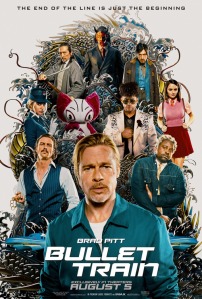
Bullet Train and The Princess are two recent releases that could serve as a double feature for all they have in common. Both movies prioritize fun above all else, both of them feature stylized violence and bloodshed, both of them have a perverse sense of humor, and both of them feature young actress Joey King (The Kissing Booth, Wish Upon), coincidentally playing the listed roles of Prince and The Princess. What more do you need for this combo? If you are a fan of Bullet Train, you’ll likely be a fan of The Princess, and vice versa, because both of them are exactly as advertised. They’re wild, whimsically violent, but succeed with nimble action construction, bizarre and engaging characters, and high energy that sparks fun escapist entertainment.
Bullet Train is set almost entirely on a speeding bullet train in Tokyo, and we follow a group of hired killers, mercenaries, and generally nasty people all sharing one very fast locomotive. “Ladybug” (Brad Pitt) is a reformed hitman who only takes snatch-and-grab gigs as he’s trying to better himself with therapy and meditation. He’s meant to grab a briefcase of money and get off the train. Naturally, things don’t go as smoothly as planned. Onboard the train are “Lemon” (Brian Tyree Hill) and “Tangerine” (Aaron Taylor-Johnson), who have the briefcase in their possession along with the prodigal son (Logan Lerman) of a scary Yakuza boss known as “The White Death.” Also on board is Kimura (Andrew Koji) seeking to find the person responsible for pushing his child off a rooftop, Prince (Joey King) using her diminutive stature to trick unsuspecting men, the Wolf (Bad Bunny) seeking out the person responsible for the death of his bride, and several other masked killers looking to up the ante. Characters will clash, many will die, and “The White Death” will be appeased by the end, coming to collect a blood debt from all. 
Bullet Train was, blissfully, everything I was needing it to be. It’s a universe familiar to fans of Quentin Tarantino and especially Guy Ritchie, with colorful and threatening characters with large personalities and quirks colliding in unexpected and violent ways. I’ve seen so many Tarantino knock-offs, and Tarantino knock-off knock-offs, so I appreciate when someone is able to understand what it takes to succeed on this unique playing field. Screenwriter Zak Olkewicz (Fear Street: 1978) knows how to sharpen the kind of off-the-cuff banter that makes these movies excel, with space given for the characters to make a sizable impression. There needs to be time to get to know them, their quirks and faults, and then send them all running at one another at cross-purposes, interacting in fun ways that lend to one character screwing something up for another. There’s about a dozen characters dropped upon us, and just about everyone gets a flashback or introduction set piece, sometimes more, sometimes extensions of previous flashbacks, sometimes extensions from alternate perspectives. Part of the fun is just seeing how the different characters relate to one another, so there is a period of time where the mask has to eventually drop, and the reveal needs to be worthwhile. It’s a lot, and Bullet Train gleefully trades in excess upon excess all in the name of chasing after a good time, and if you connect on its zany and breezy wavelength of reckless violence and dark humor, then you shall be happy for the ride.
The movie is constantly reshuffling and transforming, allowing it to hyperextend into whatever shape it necessitates before contorting back to its next phase. This malleability makes the movie far more responsive, sometimes overlapping, and it provides an extra level of energy. It’s reminiscent of Snatch, my favorite of the Ricthie cockney crime capers, where the story zigged and zagged through linear time, providing answers to different stacked questions. I won’t say the characters are as distinct as Snatch, but Olkewicz takes his time to introduce each with relish. Pitt may be the marketable star of the movie, at least as far as advertising is concerned, but it’s really much more of an ensemble, and one anchored by Lemon and Tangerine. Their droll, snappy banter really cements their long-term relationship almost like a screwball romance. They end up becoming, strangely, the heart of the movie, if one were to suggest a movie with an entire wedding party vomiting their guts to death had a beating heart. Their exact connection and genuine affection for one another, even when they’re driving one another mad, is one of the film’s many surprises as it zooms ahead. There are fun cameos, and some unexpected abrupt deaths, but Bullet Train works because of the entertainment of the kooky killer characters. I enjoyed that one character’s obsession, namely likening people to Thomas the Tank Engine avatars, has a personal connection but actually leads to some ironic turns. Not every set-up has the best payoff (Chekov’s toilet snake comes to shockingly little) or resolution (why wasn’t the snooping conductor thrown back in or given a revelation?) but with so many characters criss-crossing, so many goofy asides and cul-de-sacs, and so much bloody mayhem, there’s a steady stream of fun, satisfying payoffs and retribution until the mid-credits sequence. 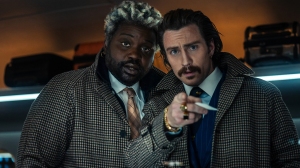
To me, the water bottle symbolizes Bullet Train at its best and worst. After two hours of multiple characters and their out-of-order flashbacks shuffling for dominance, we get an inanimate object with its own flashback. It’s a goofy and superfluous addition, as the water bottle has served as a plot device but has served its ultimate plot purpose already, so seeing its entire history offers no new information that the audience didn’t already have. However, what it does is show the movie from the perspective of this bottle, and many sequences are reframed from the bottle’s rigid point of view. It made me think about how after they got their shot setups, someone on staff would then call out, “Okay, we need the water bottle POV shot now,” and they would film that. I appreciate the effort for something this fleeting and silly. They didn’t need to put in this flashback or this level of attention to an object that ultimately just gets thrown at a guy’s head. However, it’s the misdirect, the ridiculous inclusion on top of the others, and the ramping of energy that made me smile, even as little else came out of it. I appreciated the showmanship. For me, this is emblematic of the movie as a whole, an overload of style and energy just for the fleeting hell of it.
Under the direction of David Leitch (Atomic Blonde, Deadpool 2), the action is as fun and energetic as the colorful characters. Leitch has become one of the best modern directors of action movies. The hand-to-hand combat is refreshing and makes use of close quarter combat demands. I enjoyed that the two participants in a fight are trying to sneak in quick moves without getting caught by an older lady who demands quiet in the quiet train car. I enjoyed the zany flashback where Tangerine and Lemon recount to the camera and dispute the number of men killed on a previous job. With a character cursed with bad luck, it provides opportunities to have fun with accidents and bad timing, which Leitch works into different action set-ups and setbacks. Even when the movie literally goes off the rails and becomes a big cartoon, Leitch finds ways to marry the big tone in such a manner that the ridiculous doesn’t prove off-putting. When characters are swinging samurai swords in slow-mo, while a Japanese version of “Holding Out For a Hero” is pumping on the soundtrack, I just sat back and soaked up the deliciously disposable fun times. 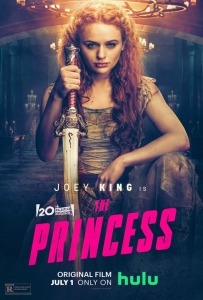
The plot of The Princess is as straightforward as Bullet Train is knotty. The Princess (Joey King) of a fantasy kingdom is chained at the very top of a castle tower. Her captor, Julius (Dominic Cooper), has imprisoned her family and plans to wed the princess and become king. The princess, however, has other plans. Thanks to her martial arts and weapon training, she breaks free and becomes a one-woman wrecking crew as she descends the tower floors to freedom.
I was genuinely surprised at how well developed and exciting the action sequences were. The Princess shares more in common with The Raid than anything by the Grimms. The script by Ben Lustig and Jake Thornton follows the model of a video game; every new floor is a literal new level with a new boss or new objective to be achieved to advance to the next level. The simplicity of the premise is refreshing, and the movie doesn’t waste any time ramping things up. Blood is shed within the first few minutes and it doesn’t let up. What I really appreciated was how well constructed each new action set piece was. There’s variety and specification that challenges our heroine, who is powerful but still not all-powerful and bereft of vulnerability. Each new encounter forces our protagonist to think through a different application of skills. There’s a situation that involves overpowering a larger and stronger man, a situation trying to wound a fully armored man, a situation battling two men, then even more, a situation with men charging into the battle and having to escape to a safer environment, a situation where she has to swing along the outside of the castle to enter a different room, a situation involving stealth, and many others, but each requires something different and thus each proves to flesh out our main character and her capabilities and problem-solving acumen. It’s always a pleasure to watch smart people overcome challenges in fun and smart ways, and The Princess has this formula down. I was worried the movie might get repetitive with its video game level design, but each new challenge is an opportunity to dazzle and enlighten us about our John Wick-esque fighter.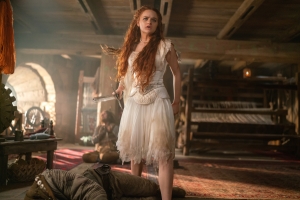
That’s probably the best comparison, the John Wick franchise, because it’s a series of movies that is defined by the thrills of its fight choreography and action set pieces. That’s it. The world has some interesting flourishes but the draw is the fight scenes and the pleasure of watching professionals operating at such a high level and with demonstrations that allow us to better immerse and appreciate the artistry of the fighting. And it’s good here. The impressive choreography has a really nice A-to-B propulsion, with each move connecting to the next to tell its own story of countermoves and adjustment. I really appreciated how the specific geography of each location is incorporated into the action, whether that be as a hindrance or an assistance to the fighting. It makes the sequences more meaningful and better developed. It’s also a movie that understands that if you give your villains specialized weapons, they better use them in fun or nasty ways. If all you’re looking for is imaginative, bloody, and brutal fighting, The Princess delivers it all. Credit also to King for throwing herself completely into the role. She effortlessly executes complicated fight moves and swordplay during long takes. You can tell she’s having a blast being a badass. Think of The Princess like a feminist version of The Raid or an upside-down version of Dredd (“Instead of fighting up, this character fights her way… down.”).
The Princess could have made more social statements but its very conceit is a feminist reworking of outdated fantasy tropes, so I don’t mind that it’s a streamlined action movie with a blunt yet obvious point. The familiar story tells us that these damsels in distress are the maidens in need of rescuing (“Sorry, our princess is in another castle” and the like), so just having the princess be her own champion is a simple yet satisfying subversion. This is an action movie and less one on politics; however, it’s a movie that cannot help from being political because it’s upsetting the expected social norms, that women are docile and weaker and at the whims of men. The Princess isn’t breaking new ground here. There have been plenty of movies that re-contextualized the feminine roles of old legends and folk tales and made them more capable and strong and fierce. That doesn’t mean there’s any less enjoyment watching our princess take down one leering man after another. It’s the appeal of the underdog who makes men pay dearly for underestimating her. These repeated interactions and bloody comeuppance speak about as well as necessary for this kind of movie. I doubt things would have radically improved if one of the characters broke into a treatise on the misapplication of gender roles. It’s a woman beating the stuffing out of creepy and lascivious misogynists. For this movie, that’s more than enough to keep me watching. 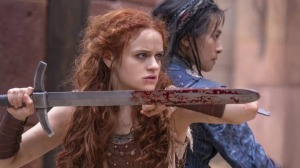
Where The Princess starts to lose itself is once it shifts into its final act and abandons its formula. I can understand wanting to shake things up so the viewer doesn’t get lulled into complacency, but because the sequences were, beforehand, varied, my interest was not lagging. During this final stretch, the titular princess leads a squad to take down the baddies, and the movie becomes any other number of similar fantasy action movies. The enjoyable fight choreography is still present, but it feels like a rush to clear everything in comparison to the methodical floor-by-floor clearing from before. I wish the filmmakers had merely held steady with their plot rather than throwing things out and relying upon a grand team-up revolutionary raid. There’s also a sudden shift that throws out the rationale for keeping the princess alive. The bad guy just shrugs and says, “Forget it, I’ll find a replacement,” and it feels too arbitrary of an escalation. If he could do this, why was he so insistent for the first hour that she not be killed? It’s not a bad ending or one that ruins the movie but it’s definitely a downshift from the action excitement highs from before.
The Princess and Bullet Train are both frantic, over-the-top, cartoonishly violent, while still understanding how to effectively sell their escapist mayhem. We need to be dazzled by the action sequences and have them be meaningful (check), we need weird and interesting characters that we want to root for or watch bumble onscreen (check), we need payoffs that feel rewarding (check), we need an onslaught of style and attitude (check), and we need, above all else, fun and surprises (check). Neither of these movies is going to qualify as one of the best movies of the year. That’s just not the kind of experience either is shooting for. However, they may be some of the best fun you have with movies for 2022, and in a world in short order of fun, that’s plenty.
Nate’s Grade’s:
Bullet Train: B
The Princess: B
Share this:

The Lost City (2022)
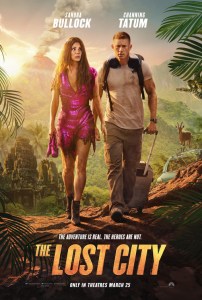 It’s a new spin on Romancing the Stone and as long as the leads are charming and the movie is fun, I have no problem with rehashing this formula. The Lost City mostly succeeds thanks to the winning chemistry between Sandra Bullock and Channing Tatum. She plays a self-loathing romance author and he’s her hunky and clueless cover model, and they both get into a treasure-hunting escapade and chased by scary men with guns thanks to a crazed rich kid (Daniel Radcliffe) looking for a titular lost city of yore to bolster his own rep. The movie stays on a consistently light wavelength even when death and sudden violence occurs. That jokey mentality assures the audience that the movie will not take things too seriously, and that relaxed-yet-antic attitude translates into fairly amusing banter with our leads. The movie does a good job of spacing out its comic set pieces and keeping things moving for its short 90 minutes. Not everything works as well as the leads though. Some storylines feel underplayed or forgotten until called upon for moments that don’t feel earned. Radcliffe feels wasted as a petulant baddie without any fun or memorable angle. One of the best aspects is what happens to the movie’s surprise cameo (spoiled via the movie’s own trailer) but the ending resolution of this feels entirely pointless and undercuts its nerve. It’s a movie that delivers exactly the kind of experience it advertises, and it’s nice to still be able to see a comedy in theaters lifted by the appeal of two stars having a ball together. The Lost City is a formula rom-com with enough good-natured screwball comedy and enjoyable zaniness to coasts on charm and star power.
Nate’s Grade: B
Share this:

Ad Astra (2019)
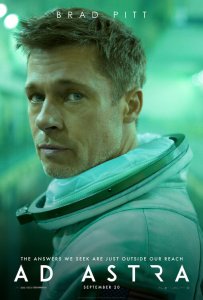 I knew early on when I was watching the advertisement for writer/director James Grey’s Ad Astra (Latin for “to the stars”) that this was going to be more a quiet, slower, contemplative movie than the ads were making it seem. Hey, I like quiet, slower, contemplative movies, but I like the ones where they give me an entry point, a reason to care, and a story with characters that make me feel compelled to watch what happens next. Ad Astra does not quite rise to that level.
Roy McBride (Brad Pitt) is an astronaut in a near future with a special mission: to find his father (Tommy Lee Jones). The father left Earth decades ago to search for intelligent life and develop an alternative energy source. His discovery has unleashed a series of destabilizing power surges across Earth. Roy is ordered to travel to the outer reaches of Neptune and discover what has happened to his father and his crew who have stopped communicating. If necessary, he is to use all options to correct the problem, including taking his dear deadbeat dad’s life.
 Ad Astra is probably the most realistic portrayal of what space travel cold be like in the near future. It’s a grounded approach that feels very detail-oriented without necessarily losing the audience in the schematic output of all those details. It reminded me a bit of a companion piece with last year’s First Man, where the audience saw all the ingenuity, as well as makeshift dangers, of early space flight. The interiors of these space ships and bases are far closer to resembling the plain days of early NASA than anything fancy and gleaming when it comes to futuristic science fiction. When Roy is walking around a giant tower reaching high into the atmosphere, it feels like you are there with him experiencing the dizzying heights, locked into his human-sized perspective of something so massive and intimidating, and it’s merely man-made. Wait until we get to the heavenly bodies. It’s an aesthetic choice that lends the film an authenticity as well as the amazing solar visuals from cinematographer Hoyte Van Hoytema (Interstellar). The scale of space is really felt as Roy keeps venturing further and further away from home, into the cold darkness of the unknown, towards that missing father and sense of resolution. The visuals and stately special effects are beautiful and given an additional level of ethereal glory from a score by Max Richter (The Leftovers). It’s a lovely movie to sit back and watch, and thanks to its episodic structure, it delivers something new every twenty minutes or less. The movie can feel more than a little tedious as it stretches out into the cosmos. There’s something to be said about a film that has the patience to take in the splendor of the universe, and there’s also something to be said about having a more significant story to pair with those awe-inspiring cosmic panoramas.
My issue with Ad Astra is that everything feels to be locked in at a very general level of substance. The story of a son voyaging to meet his absentee father and come to terms with that relationship is a fine starting point, except the movie doesn’t do much more. The idea of a main character living in his famous yet distant father’s shadows is a fine starting point, except the movie doesn’t do much more. The idea of exploring life in the universe is fine, except the movies doesn’t do so much with that either. It feels like you’re watching what must have amounted to twenty pages of script spread out over the course of two hours. If it’s going to be a character study, then I need more attention spent deepening Pitt’s character beyond the pretty rote daddy issues on display. If it’s going to be a contemplative exploration of man’s place in the universe, then I need more sides and angles of perspective throughout the movie. There are no real supporting characters in this movie outside of guest appearances (Hey, it’s Ruth Negga and Donald Sutherland). The father figure is kept more as looming idea or force of nature than human being. Roy’s wife (a barely there Liv Tyler) is more a recorded visual of regret to remind the audience of Roy’s loss and sacrifice, relating to his pursuit of his father. The entire film feels far too sketched in, archetypal, and generalized to noodle around with weighty ideas and concepts that it doesn’t seem fully committed to exploring in meaningful ways.
 The problem with a narrative that’s episodic is that not every episode is as interesting. Each Pitt stop (oh, you bet I’m intending that pun) allows a slightly different tale to emerge, but then it’s over and done and we’re moving onward. With Apocalypse Now, those episodes came together to tell a larger mosaic about the madness of the Vietnam War and the physical and psychological toll it was taking. I was not getting that same kind of cohesion with Ad Astra. The most exciting episode involves a lunar chase and shootout. It’s cleverly executed and makes strong use of the limitations of space, in particular the lack of sound. One second your co-pilot is at the wheel and the next he has a soundless bullet hole through the head. It was an intriguing segment because of the unique realities of staging its genre car chase that open up something familiar into something new. Unfortunately, many of these episodic segments just incrementally push the story along, pairing Roy with a new group of people that we’ll shed in fifteen minutes or so. Don’t get attached to anybody because the only characters that really matter in the universe of Ad Astra are Roy and his father. Every other character is merely a representation of some aspect of their relationship. It makes the smaller episodes feel a bit mundane unless they have something fresh, like that lunar chase. Otherwise, it’s more people we’ll be soon getting rid of doing inconsequential tasks.
Removing the dominant father/son relationship, Ad Astra is a movie about the search for meaning in life. Roy’s father has exclusively put that meaning upon the discovery of intelligent life in the universe. If human beings are all there is, he questions what’s the point of going on? First off, Mr. McBride is only exploring one portion of space and to paraphrase Billy Bob Thornton in Armageddon, there’s a “big-ass” amount of space. If the man fails to detect any signs of intelligent life, that doesn’t mean it isn’t out there, it only means it hasn’t been found where one person was looking (the Missing Keys Dilemma). On a philosophical note, even if humanity was all there was in the great wide expanse of space, that doesn’t make our existence any less remarkable. If we happen to be the lone representatives of intelligent life, born from heat and rock and millions of years of trial and error getting it just right, then that’s incredible. There are so many variables going against the existence of life on our tiny bubble of air out in the vast vacuum of space, and just because we lucked in and others have yet does not take away from the appreciation and majesty of humanity’s prized situation. Do we put our meaning outside of ourselves or develop our sense of meaning from within? I cannot say whether Ad Astra is keeping this storyline so vague and generalized so that is can stand-in for spirituality, the idea of looking for proof of a higher intelligence, a God, and finding meaning in a grander design rather than the chaos and luck of chemistry and evolution. Or does Roy’s father represent God and Roy is man confronting an absentee creator? Under that interpretation, the ending might make a little more sense, but again I’m doing the movie’s work for it by projecting meaning.
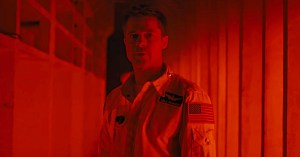 It’s pretty much a one man show and Pitt (Once Upon a Time… in Hollywood) is asked to do a lot without showing much. His character is a reserved man by nature, though that doesn’t stop him from explaining his inner thoughts through intrusive voice over narration, an addition that feels tacked-on after some test screening to better acquaint an audience that was having difficulty staying on board. Pitt is an actor capable of tremendous subtleties through his movie star good looks, and he has moments here where his eyes are telling the story that the movie doesn’t seem interested or committed to tell. If you were going to spend two hours in space with one actor, you could do far worse than someone like Pitt.
Ad Astra is more art film than thriller, more father-son reclamation than sci-fi, and more a drifting homage to Apocalypse Now in Space than something that can stand on its own merits. The expansive cosmic visuals are luxurious on the big screen, the level of detail toward the realities of space travel are appreciated, and Pitt is a sturdy anchor for the project, but what does it all come to? Everything is kept at such a generalized level that the movie feels like it’s skirting the surface and ignoring larger depth. It has a surfeit of directions and choices it can make for greater depth, but we have to keep on trucking, like a ticking clock, entirely constructed to serve one purpose, barreling toward the father/son confrontation and resolution. Except I didn’t care about Roy’s dad because I didn’t feel the impact he had on his son, I didn’t feel the need for some form of closure, the driving force of the movie’s big little universe. And yet we drift onward, like the boat in Apocalypse Now, heading for our destination because we’re told to do so. Ad Astra is an acceptable matinee with some well applied technical craft and a bleak sense of realism but it’s ultimately too empty of an experience to warrant any return trips of value.
Nate’s Grade: C+
Share this:

Once Upon a Time… in Hollywood (2019)

Quentin Tarantino has been playing in the realm of genre filmmaking for much of the last twenty years. He’s made highly artful, Oscar-winning variations on B-movies and grindhouse exploitation pictures. There are some film fans that wished he would return to the time of the 90s where he was telling more personal, grounded stories. His ninth movie, Once Upon a Time… in Hollywood, is Tarantino returning to the landscape of his youth, the Hollywood back lots and television serials that gave birth to his budding imagination. Tarantino has said this is his most personal film and it’s easy to see as a love letter to his influences. It’s going to be a divisive movie with likely as many moviegoers finding it boring as others find it spellbinding.
In February 1969, actor Rick Dalton (Leonardo DiCaprio) is struggling to recapture his past glory as a popular TV star from a decade prior. Cliff Booth (Brad Pitt) is Rick’s longtime stuntman, personal driver, and possibly only real friend. Rick’s next-door neighbor happens to be Sharon Tate (Margot Robbie), a rising star and the wife to famed director Roman Polanski. All three are on a collision course with the Manson family.
 The thing you must know before embarking into a theater to see all of the 160 minutes of Tarantino’s latest opus is that it’s the least plot-driven of all his movies, and it’s also in the least hurry. This feels like a hang-out movie through Tarantino’s memories of an older Hollywood that he grew up relishing. It’s very much a loving homage to the people who filled his head with dreams, with specific affection given to the life of an actor. Tarantino is exploring three different points of an actor’s journey through fame; Sharon Tate is the in-bloom star highly in demand, Rick Dalton is the one who has tasted fame but is hanging on as tightly as he can to his past image and wondering if he’s hit has-been status, and then there’s Cliff Booth who was a never-was, a replaceable man happy to be behind the scenes and who has met his lot in life with a Zen-like acceptance. Each character is at a different stage of the rise-and-fall trajectory of Hollywood fame and yet they remain there. This isn’t a movie where Rick starts in the dumps and turns his life around, or even where it goes from worse to worse. Each character kind of remains in a stasis, which will likely drive many people mad. It will feel like nothing of import is happening and that Once Upon a Time… in Hollywood is more a collection of scenes than a whole.
What elevated the film was how much I enjoyed hanging out with these characters. Tarantino is such a strong storyteller that even when he’s just noodling around there are pleasures to be had. Tarantino movies have always favored a vignette approach, unwieldy scenes that serve as little mini movies with their own beginnings, middles, and often violently climactic ends. An excellent example of this is 2009’s Inglourious Basterds where the moments are brilliantly staged and developed while also serving to push the larger narrative forward. That’s missing with Hollywood, the sense of momentum with the characters. We’re spending time and getting to know them, watching them through various tasks and adventures over the course of two days on sets, at home, and on a former film set-turned-ranch for a strange commune. If you’re not enjoying the characters, there won’t be as much for you as a viewer, and I accept that. None of the central trio will crack Tarantino’s list for top characters, but each provides a different viewpoint in a different facet of the industry, though Sharon Tate is underutilized (more on that below). It’s a bit of glorified navel-gazing for Tarantino’s ode to Hollywood nostalgia. There are several inserts that simply exist to serve as silly inclusions that seem to be scratching a personal itch for the director, less the story. I was smiling at most and enjoyed the time because it felt like Tarantino’s affection translated from the screen. I enjoyed hanging out with these people as they explored the Hollywood of yesteryear.
 DiCaprio hasn’t been in a movie since winning an Oscar for 2015’s The Revenant and he has been missed. His character is in a very vulnerable place as he’s slipping from the radars of producers and casting agents, filling a string of TV guest appearances as heavies to be bested by the new hero. He’s self-loathing, insecure, boastful, and struggling to reconcile what he may have permanently lost. Has he missed his moment? Is his time in the spotlight eclipsed? There’s a new breed of actors emerging, typified by a little girl who chooses to stay in character in between filming. Everything is about status, gaining it or losing it, and Rick is desperate. There’s a terrific stretch where he’s playing another heavy on another TV Western and you get the highs and lows, from him struggling to remember his lines and being ashamed by the embarrassment of his shaky professionalism, to showing off the talent he still has, if only given the right opportunity. DiCaprio is highly entertaining as he sputters and soars.
The real star of the film is Pitt (The Big Short) playing a man who seems at supernatural ease no matter the circumstance. He’s got that unforced swagger of a man content with his life. He enjoys driving Rick around and providing support to his longtime friend and collaborator. He has a shady past where he may or may not have killed his wife on purpose, but regardless apparently he “got away with it.” This sinister back-story doesn’t seem to jibe with the persona we see onscreen, and maybe that’s the point, or maybe it’s merely a means to rouse suspicion whether he may become persuaded by the Manson family he visits later in the movie dropping off a hitchhiker he’s encountered all day long. The role of Cliff seems to coast on movie star cool. There is supreme enjoyment just watching Pitt be. Watch him feed his dog to a trained routine, watch him fix a broken TV antenna and show off his ageless abs, and watch him navigate trepidatious new territory even as others are trying to intimidate him. It’s Pitt’s movie as far as I’m concerned. He was the only character I felt nervous about when minimal danger presented itself. There’s something to be said that the best character is the unsung one meant to take the falls for others, the kind of back-breaking work that often goes unnoticed and unheralded to keep the movie illusion alive.
There aren’t that many surprises with Once Upon a Time… in Hollywood as it moseys at its own loping pace. It reminded me of a Robert Altman movie or even a Richard Linklater film. It’s definitely different from Tarantino’s more genre-fed excursions of the twenty-first century. It’s a softer movie without the undercurrent of malice and looming violence. There is the Manson family and Tarantino knows our knowledge of the Manson family so we’re waiting for their return and that fateful night in August, 1969 like a ticking clock. It wouldn’t be a Tarantino movie without an explosion of bloody violence as its climax, and he delivers again, but I was shocked how uproariously funny I found the ending. I laughed throughout but as the movie reached its conclusion I was doubled over with laughter and clapping along. There’s a flashback where Cliff and a young Bruce Lee challenge each other to a fight, and it’s so richly entertaining. The phony film clips are also a consistent hoot, especially when Rick goes to Italy. It’s a funnier movie than advertised and, despite its ending, a far less violent movie than his reputation.
 As Tarantino’s memory collection, the level of loving homage can start to eat the narrative, and this is most noticeable with the handling of Sharon Tate. The initial worries that Tarantino would exploit the horrendous Manson murders for his own neo-pop pulp was unfounded. Tate is portrayed with empathy and compassion, and as played by Robbie she nearly glides through the film as if she were an angel gracing the rest of us unfortunate specimens. She has a great moment where she enters a movie theater playing a comedy she is a supporting player in. The camera focuses on Robbie’s (I,Tonya) face as an array of micro expressions flash as she takes in the approving laughter of the crowd. It’s a heartwarming moment. But all of that doesn’t make Tate a character. She’s more a symbol of promise, a young starlet with the world at her fingertips, the beginning phase of fame. Even the Manson clan doesn’t play much significance until the final act. Charles Manson is only witnessed in one fleeting scene. I thought Tarantino was including Tate in order to right a historical wrong and empower a victim into a champion, and that doesn’t quite happen. I won’t say further than that though her narrative significance is anticlimactic. You could have easily cut Sharon Tate completely out of this movie and not affected it much at all. In fact, given the 160-minute running time, that might have been a good idea. The movie never really comes to much of something, whether it’s a statement, whether it’s a definitive end, it just feels like we’ve run out of stories rather than crafted an ending that was fated to arrive given the preceding events.
The Tarantino foot fetish joke has long been an obvious and hacky criticism that I find too many people reach for to seem edgy or clever, so I haven’t mentioned it in other reviews. He does feature feet in his films but they’ve had purpose before, from arguing over the exact implications of a foot rub in Pulp Fiction to Uma Thurman commanding her big toe to wiggle and break years of entropy in Kill Bill. However, with Hollywood, it feels like Tarantino is now trolling his detractors. There are three separate sequences featuring women’s feet, two of which just casually place them right in the camera lens. At this point in his career, I know he knows this lame critique, and I feel like this is his response. It’s facetious feet displays.
 When it comes to Once Upon a Time… in Hollywood, if you’re not digging the vibe, man, then there’s less to latch onto as an audience member. It’s a definite hang-out movie reminiscent of Altman or Linklater where we watch characters go about their lives, providing peaks into a different world. It’s a movie about meandering but I always found it interesting or had faith that was rewarded by Tarantino. It doesn’t just feel like empty nostalgia masquerading as a movie. It’s funnier and more appealing than I thought it would be, and even though it’s 160 minutes it didn’t feel long. The acting by DiCaprio and Pitt is great, as is the general large ensemble featuring lots of familiar faces from Tarantino’s catalogue. I do think the inclusion of Sharon Tate serves more of a symbolic purpose than a narrative purpose and wish the movie had given her more to do or even illuminated her more as a character. However, the buddy film we get between DiCaprio and Pitt is plenty entertaining. It might not be as narratively ambitious or intricate or even as satisfying as Tarantino’s other works, but Once Upon a Time… in Hollywood is a fable for a Hollywood that may have only existed in Tarantino’s mind, but he’s recreated it with uncompromising affection.
Nate’s Grade: B+
Share this:

Deadpool 2 (2018)

It took the leaked release of the Deadpool test footage, and the ensuing enthusiastic fan response, before Fox finally decided to invest in a big screen, R-rated superhero movie. The result was 2016’s Deadpool, a huge smash and proof that a lucrative audience will turn out for more adult-oriented, outrageous, grisly versions of comic book movies. Because of Deadpool, we finally got an R-rated Logan that proved to be an outstanding swan song for Hugh Jackman’s iconic hero. Now Deadpool is getting the spotlight he has earned with a big, splashy summer release, but with success come expectations. Can it live up to the ever-increasing hype? In short: if you were a fan of the original, you’ll be happy enough, because Deadpool 2 isn’t much more than the sum of its zany parts.
Wade Wilson a.k.a. Deadpool (Ryan Reynolds) is killing bad guys for hire and considering starting a family with the love of his life, Vanessa (Morena Baccarin). Trouble emerges when Cable (Josh Brolin) travels from the future to kill a rebellious, troubled young mutant teenager, Russell (Julian Dennison), who will one day grow up to be a monstrous villain. Deadpool reaches out for help and forms an elite squad of determined heroes, notably the luck-assisted Domino (Zazie Beetz). Can Deadpool save the kid, save the day, save the future, and save himself from incessant fourth wall breaks?
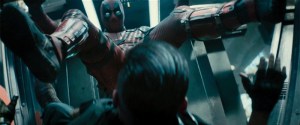
I was worried that a Deadpool sequel would fall into some of the same detractions that a Guardians of the Galaxy sequel did, and this is still applicable. Deadpool, much like the original 2014 Guardians film, was a breath of fresh air and a far looser, weirder, funkier super hero movie with a nose-thumbing, prankish attitude. We didn’t know what to expect from a Deadpool movie and now we do, and with that knowledge comes an anticipated formula of checklists to adhere to, and so any resulting sequel will invariably feel less fresh. It happened with Guardians of the Galaxy vol. 2 so to compensate James Gunn concentrated on fleshing out secondary characters into people you might shed a tear over. Deadpool 2 doesn’t bother because Deadpool 2 doesn’t take anything really seriously. That’s one of the hallmarks of the series and also one of the aspects that holds it back. There can never be a sense of stakes with a gleeful, fourth wall-breaking cartoon of a character who bounces back like Wile E. Coyote. The sequel introduces a sense of stakes with a startling turn in the first ten minutes of the movie, but by the end, even that will be corrected so that the Deadpool universe returns to stasis. The limitation of the Deadpool universe is that nothing feels meaningful or even ambitious. The movie wants to be a cheeky, transgressive good time and it achieves this single goal.
The appeal of Deadpool 2 is still its comedic voice and unpredictability. The laughs will be frequent and there are some subversive and unexpected directions that fully take advantage of the R-rating and the anarchic, nasty comic spirit of the franchise. The formation of the X-Force team and how their first big mission plays out had me howling with laughter. The meta humor commenting on the nature of super hero movies, as well as the film industry in general, begins with the very opening image (a nod to another successful R-rated super hero movie of last year) until the very last moment where Deadpool goes back in time to prevent some stinging cinematic grievances (there is no post-end credit scene, so you can skedaddle early). This is clearly the role Reynolds feels a spiritual kinship with, and his caddish, charming, persistent persona makes the perfect conduit for the film’s vulgar insanity. Whether it’s spitting insults, splashing in over-the-top violence, or making odd observations about the similarities between the songs from Frozen and Yentl, Deadpool 2 is first and foremost a bloody, depraved meta comedy.

Director David Leitch (Atomic Blonde) steps in for the departing original film’s director, Tim Miller, and continues his hot streak of stylish, action thrillers. Leitch has shown a propensity for staging intense action sequences to best showcase intricate choreography. With Deadpool 2, the most exciting moments are when the camera and editing allows the audience to fully appreciate the creativity of the choreography and stunt team. A shot of Cable leaping over the speeding caravan about to smash into him brings on a well-earned wow. Coming from that bruising world, I’m continually impressed with how Leitch approaches his action and finds organic points to develop and complicate matters. The prison caravan attack is the action peak with well-constructed, parallel lines of activity to follow and collaborate upon. It’s our first taste of Deadpool and X-Force versus the might of Cable. The characters enter the fray at different points and get separated from the runaway caravan, which keeps the momentum going. While the comedy is prioritized, Deadpool 2 can still unleash enough exciting, silly, and satisfying action.
The biggest additions to the sequel are an adversary and an ally, and both leave a favorable impression while still making you wish that Deadpool 2 had done more with them. Brolin (Avengers: Infinity War) bulked up considerably to play the gruff cyborg from the future, and his super serious, macho straight man provides a terrific comic foil for Deadpool, much like the stuffy Colossus in the first film. Brolin’s character is a capable fighter with a pretty streamlined back-story (shades of Looper abound) but it’s hard not to feel a little disappointment with how he’s ultimately utilized. He’s a great asset that feels put away for too long. Zazie Beetz (TV’s Atlanta) has a fun introduction especially as it relates to her mutant power, great luck. Deadpool scoffs at this as a power, and “being deeply un-cinematic,” but Domino proves otherwise as she’s able to dodge split-second danger in grand, complicated, Final Destination-like circumstances. Every time she’s onscreen, Domino brings a curiosity quality to the movie, and it’s usually something imaginative and fun. Beetz has an innate spunky energy, which makes it sad when the movie often asks her to be dour and dismissive. It’s taking such a lively character and constricting what makes her amusing and unique.

The biggest thing holding back the film, besides a general sense of “more of the same” or its inherent lack of stakes, is that the entire storyline is built around saving a mutant teen…. and I kind of hated the kid. My first impression was not good and it didn’t get much better from there. Part of it may be that Russell is meant to be an angry, obnoxious teenager, and maybe part of it is the generally grating performance from Dennison (Hunt for the Wilder People), but I could not care about this kid. Unfortunately, a lot of thematic emphasis is placed on saving the soul of this one annoying, wayward teenager. He’s supposed to be a point of redemption for Deadpool and a promise to be fulfilled, but my pal Ben Bailey came up with an instantly better revision. Instead of introducing this new teen character who will one day grow up into a super villain that slaughters Cable’s future family, why not have it be Negasonic Teenage Warhead (Brianna Hildebrand)? We already have an investment in her character and it would provide a better, more personal sense of stakes for the story. Plus, Hildebrand (Tragedy Girls) is actually a good actress.
If you were one of the many fans who enjoyed the irreverent antics of the first Deadpool, then you’ll enjoy Deadpool 2 as it’s more or less the same movie with a slightly limited freshness date. These movies are fun, funny, and ridiculous, but they’re also good for little else than a wicked good time, and that’s okay. There isn’t much ambition to be anything more than an irreverent satire on super heroes with edgy humor and explosive violence. The running theme of the sequel questions what Deadpool has to keep on going, and he’s told it’s one very specific F-word: “family.” I think it’s a different F-word, namely “franchise.” Fox (Disney?) will need the services of the merc with the mouth for an extended engagement as long as audiences do not tire of the same studio brand of naughtiness reheated with a few different ingredients added per revisit.
Nate’s Grade: B
Share this:

Allied (2016)
 Forgive me the indulgence but please hear me out on this peculiar observation. In 2005, Brad Pitt stars in a movie where his onscreen wife may be a spy and he may need to kill her, and his marriage to Jennifer Aniston ended shortly thereafter. Flash forward over ten years and Pitt is starring in another movie where his onscreen wife may be a spy and he may need to kill her, and his marriage to Angelina Jolie is now coming to a reported end. Obviously there are extenuating circumstances in something so personal as relationships, but if I was Pitt’s agent, I think I might advise against all future projects that even come too close to this cursed storyline. Allied wasn’t worth it, pal.
In 1942, Max (Pitt) and Marianne (Marion Cotillard) are husband and wife and also spies for the British government. They’re enjoying life back home with their infant daughter Anna when Max gets some startling news. His superior officers are investigating whether Marianne is secretly a German spy. He is to learn for himself what is real and if she is indeed a spy Max is ordered to kill her or he himself will be executed for treason.
 Allied already starts dangerously when the majority of its opening act is set during WWII Casablanca, setting up an unwinnable comparison. We’re meant to watch these two secret agents go about their clandestine operation and fall in love. One of those things happens. Oh sure, for the purposes of the plot, Max and Marianne fall in love, but no member of the audience is going to believe what they see. Pitt and Cotillard have anemic chemistry together and their characters are too stilted to draw us in (rumors of an onset romance between the stars seem unfounded by the results on screen). They achieve their first act mission, get their kill, but they don’t really encounter complications. It all proceeds just a little too easily and we fail to get a sense of their capabilities as spies. They practice the cover of husband and wife but only in superficial appearances that come across more like Marianne chiding Max (“A real husband would offer his wife a cigarette first”). I recognize that these people are spies and thrown into danger but we need to invest in them as characters if the rest of the movie is supposed to matter, let alone their relationship together. There are no supporting characters of importance. Lizzy Caplan (Masters of Sex) pops up as Max’s lesbian sister and you’d swear she’d have some significance, but nope. When Max is investigating Marianne, it never feels like the pieces are coming together. Rather it feels like we’re just getting new pieces, some lucky and some less so. The plotting feels too disjointed and arbitrary. Screenwriter Steven Knight (Eastern Promises, Peaky Blinders) is one of the best working in the industry, especially when it comes to crime thrillers and naturally drawing out tension. I expected more from him with Allied, but then that will be a trend with several aspects of this mediocre movie.
Here’s the problem with this premise: it’s too limiting. Either Marianne is a spy or she isn’t, and if she isn’t that makes for boring drama. You’re stuck so more and more obstacles have to be put in place to merely delay the inevitable reveal because that’s all the movie had. A solution could have been an Act Two break that revealed Pitt’s character to be the real spy, allowing the audience to reflect back on his action with a new lens of understanding. The crux of Act Three would then be Max’s moral dilemma of whether he turns himself or whether he frames his wife and in doing so erases evidence against himself. It would be a far more challenging and ethically murky scenario than a rather rote finale where the characters follow their predestined paths. I also think summary execution of a spy is a waste considering the value of covert information or even posing as a triple agent. I think the entire story should be told from a different perspective (okay, now spoilers). Little Anna is far too young to know what happened to her mother and I imagine there will need to be a cover story even for the official cover story. My pitch would be tell this story in the mid 1960s when Anna is now in her early twenties and discovering the larger world. She starts to come across testimony or nagging pieces of evidence that contradict her father’s story of what happened to Marianne, and her death now seems very mysterious. As she uncovers the old evidence she learns that her own parents were spies, a truth that had been kept from her, and all the evidence points to dad being the killer. The Act Three confrontation between harried father and daughter would then reveal the actual truth and that Marianne took her own life out of guilt and a desire to spare her husband punishment from his remorseless superiors. The lie was meant to comfort but now it discombobulates a family and a woman’s understanding of her parents and her relationship to them (end spoilers). Doesn’t that sound like a better version of Allied, dear reader? I certainly think so.
Director Robert Zemeckis (Flight, The Walk) is such a skilled craftsmen but this movie just gets away from him. You sense his urge to insert effects sequences into what should be an ordinary period thriller, and so we get distracting sequences that either rip you from the reality of the movie or might make you titter unintentionally. Max and Marianne’s coupling scene involves having sex in the front seat of their stranded car in the middle of a sandstorm. It would have been far more effective and possibly erotic if the camera had merely stayed in that confined space and let the building passion bubble over, all while the light becomes more and more faint from the sand storm, adding all sorts of sensual lighting opportunities with obfuscation and shadows. Instead, Zemeckis has a rotating camera shot that goes on for about a minute steady without cuts and zooms in and out of the car, inside and outside the dusty sand storm. It stops any sensuality from building. Another example if that Anna is born during the Blitz, and yet again instead of being in a small space and leaving more up to the imagination, Zemeckis and his special effects team have to recreate the air assault which increases the melodrama in a bad direction. Zemeckis has never really done a straight thriller and I can feel his flagging interest as he searches for special effects sequences to hold onto as some sort of anchor. I don’t think his skillset was the right balance for this story and the execution it needed to prosper.
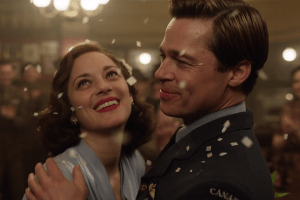 It really doesn’t feel like Pitt (The Big Short) wants to be in this movie at all. Rarely have I seen this lethargic a performance from usually one of the most reliable actors in Hollywood. Part of it is the withdrawn and conspicuous nature of his spy character but it’s more than that. I don’t know if he feels like he understands his character or is that committed to the script, and so it feels like he’s just coasting and waiting for the end. It reminded me of the disastrous Oscar hosting duties from a sleepy James Franco and an overcompensating Anne Hathaway. Cotilard’s character is the gregarious and charming one, and so it feels like she has to do all the heavy lifting to compensate for the dearth of Pitt’s performance. Cotillard can be a brilliant actress with powerful instincts down to her very marrow, as last evidenced in 2014’s devastating and humane drama of personal desperation and dignity, Two Days, One Night. She has to play the more active role, first as the charmer and then as the mystery. She works much better as the charmer. I don’t think either actor knew fully who their characters were and stumbled forward.
Allied is a strange movie where the director, the star, and the screenwriter each didn’t seem to know what movie they wanted to make. Each major participant, short of a game Cotillard, doesn’t even seem like they want to be here, as if this was a school assignment that they’re doing the minimal amount of work to fulfill a requirement. Allied just feels like one of those big studio misfires where nobody was on the same page. The story lacks characters to connect with and complications that feel connected to them and their circumstances. The plot follows the path of least resistance and arrives at its predetermined destination right on time, to the monotony of its audience. Pitt’s somnambulist acting makes the movie and his lead character harder to enjoy. There’s a definite lack of intrigue with this premise and its ultimate execution. I expect better from Zemeckis, Pitt, and Knight, and I’m sure they’ll deliver with their next projects. In the meantime, skip Allied since it certainly feels like the cast and crew weren’t in alliance.
Nate’s Grade: C
Share this:

The Big Short (2015)
 Adam McKay is not exactly the kind of name you associate with a prestige picture that’s building serious Oscar heat. McKay is best known as the director and co-writer of Will Ferrell’s best movies, from Anchorman and its sequel to Talladega Nights and the underrated 2010 buddy cop movie, The Other Guys. If you stuck through the closing credits for Guys, you were treated to an animated education lesson on the size of Wall Street’s greed and accountability in regards to the 2008 financial crisis. It was impassioned, angry, and an interesting note to end an otherwise goofy comedy. The Big Short is based upon Michael Lewis’ (Moneyball) best-selling book and it’s a disaster movie where the biggest disaster is the world economy. The movie McKay co-adapted and directed is bristling with intelligence, indignation, and a clear purpose. He wants to make you very angry, and by the end if you’re not, you haven’t been paying enough attention.
In the wake of the financial collapse in 2008, the fallout was so tremendous that many people felt nobody could have seen this coming. There were a few and they made out like bandits while trying to warn others about the impending doom. In the early 2000s, Michael Burry (Christian Bale) is a hedgefund manager who sees warning signs that the housing market is a bubble ready to burst. He sees the toxicity of the majority sub-prime mortgages wrapped together and sold as a seemingly safe security, a CDO (collateralized debt obligation). His bosses think he’s mad and they’re furious when they discover Burry has gone from bank to bank making big bets against the housing market. The banks are eager to take what they believe to be easy money from a sucker. How could the housing market burst? Other Wall Street investors take notice of Burry, notably Jared Vennett (Ryan Gosling) who pitches the plan to “short” the housing market. Nobody takes him seriously except Mark Baum (Steve Carell) and his small team who works for Goldman Sachs. Baum is curious how something so large could go unnoticed, so he and his team fly to Florida and Vegas to investigate the realities of the market and what they find does not match the rosy cheerleading from Wall Street. A pair of wannabe traders (Finn Witrock, John Magaro) stumbles across Burry’s analysis and try to make their own bets, except they need a bigger name to make the trades. They reach out to an ex-Wall Street trader (Brad Pitt) who agrees to shepherd them on this quixotic quest. Are these men righteous defenders of fraud or just people trying to get their own cut of the pie?
 The brilliance of The Big Short lies in its accessibility and the virulent passion that McKay has for the subject matter. The movie is structured like a heist and an underdog story, suckering in the audience to root for the upstarts trying to fleece the big banks and profit off their greed and stupidity. For the first 90 minutes or so, the film comes across like a caper and we follow our group of misfits as they fight against the conventional wisdom that the housing market could never topple. These guys see the signs and the risks that others could not or would not see, especially since the flow of money was rich and the good times could be shared, which lead to collusion from the very same agencies designed to regulate and enforce the financial laws. For those 90 minutes the movie flies by on its sense of whimsy and are-we-getting-away-with-this good fortune, putting our band of misfits in position to win big on the losses of the ignorant and fraudulent. And then, in one swift move, it all comes down and you’re reminded, rather indignantly by Pitt’s character, that what they are benefiting from is the meltdown of the U.S. housing market and by extension the American economy. What once felt like a celebratory caper now starts to feel queasy, and it’s in the last act that The Big Short reminds you just how awful the events of the 2008 financial crisis were and how these guys did nothing more than benefit from mass misery. These are not heroes, though Mark Baum is given plenty of moral grandstanding moments that present him as the closest thing we have in the picture. These were a bunch of guys who got rich betting on a lot of other people’s bad bets, bets that almost destroyed the world’s economic systems. The concluding half hour feels like a sudden stop after a sugar rush, where you’re left to question your decision-making but also come to terms with the reality of what seemed like a fun time. McKay lures his audience in with the guise of a heist/underdog story, appealing and accessible avenues of cinema, and then serves the cold hard medicine in the concluding moments.
McKay is admirably trying to educate and advocate while he entertains, but he truly wants the audience to understand why they should be sharpening their pitchforks. At several points, characters will break the fourth wall and talk directly into the camera, admitting that certain events didn’t happen exactly as we saw, or occasionally they’ll remind us that what we watched was exactly how it happened. It’s a measure that isn’t overplayed and helps juice the spirits of the movie, becoming something of a confidant in the schemes with the onscreen participants. When things gets a little hard to understand with the mountain of Wall Street lingo, McKay will cut to celebrity cameos to help explain the more arcane instruments of the financial system. Margot Robbie luxuriates in a bubble bath and explains sub-prime mortgages, Anthony Bourdain explains CDOs, and Selena Gomez, in a rather cogent analogy, explains synthetic CDOs as an endless chain of side bets being made off one hand of blackjack. The movie goes pretty fast and a viewer might experience information overload but McKay knows when to slow things down and provide a well-timed assist so that his learned audience will see the true extent of the corruption and greed rampant in how Wall Street handled its business.
 Of the three storylines, I found Mark Baum and his team easily the most interesting and I think McKay and co-screenwriter Charles Randolph (The Interpreter) agreed, which is why he’s the biggest part of the movie. Burry gets things started but he recedes into the background after the first act, and that’s where Baum and his financial team step into the spotlight to further explore how unstable the housing market just might be. I think this is Carell’s best dramatic performance to date (I wasn’t wowed by Foxcatcher). He’s playing perhaps one of the angriest people seen on screen but that’s because he has a moral center and the bad business practices, let alone the sociopathic greed of his “peers,” constantly enrage him. He’s something like a flabbergasted crusading journalist who keeps shaking his head in stupefying revulsion at just how deep this whole thing goes. Having Baum as our entry into the moral morass of Wall Street allows the audience to feel a sense of ethical superiority, and then like Pitt’s character, it can all go away with one perfectly articulated retort. There’s a moment where Baum is lambasting a mortgage ratings officer (Melissa Leo, her only scene too) after she admits that if they don’t rate bad mortgages as good, the banks will just go to their competitor, and then she accuses Baum of being a hypocrite. His reason for the office visit is not his outrage at the fraud but the fact that this fraud is holding up his winnings. He’s not the crusader he may wish to be. Bale (American Hustle) and Gosling (Only God Forgives) are perfectly cast and provide strong supporting work in small doses spread throughout. Pitt is in 12 Years a Slave producer mode where he knows he needs to appear in the movie to better sell it to audiences, and so he’s here and rather unremarkable. There is a bevy of familiar faces (Marisa Tomei, Rafe Spall, Max Greenfield, Karen Gillan) appearing in small moments as if everybody in Hollywood wanted to get in on McKay’s party.
There is one annoying misstep in the movie and it occurs about halfway and it’s made to stretch out the stakes in a haphazard manner. The Big Short is a disaster movie where the audience knows exactly when the disaster is coming, and yet there’s a section in the middle where the characters are all left in doubt whether their big bets will pay off because of the ratings fraud. Burry is threatened with losing his job. It’s silly because we know the economy is going to crash in 2008, but the movie throws out a weak obstacle that, hey, maybe it won’t crash. It reminds me of the Hinderberg movie from the 1970s. There were several moments where it looked like that zeppelin full of hydrogen was going to go up in flames… except students of history know that moment is fated in New Jersey, so all the close calls were foolish fake-outs for a major event that was well anticipated. We all know the economy is going down so there’s no need for the manufactured doubts.
McKay and company want to wake up a fairly apathetic general public about the crimes and negligence of the Wall Street robber barons that risked the world’s economy and then managed to skip out on the tab. The tones can juggle wildly, and I’d credit McKay’s background in comedy for his ability to maintain a reliable and firm comic footing for the film without losing the significance of his message. It’s hard to nail down a genre for the movie; it’s a dark comedy, a drama, a true crime picture, and a wake-up call. You have moments that feel like a heist flick and moments that feel like a sickening journalistic expose. It’s got highs, lows, laughs, groans, and plenty of human emotions, though the most prominent would be disgust and disbelief. The Big Short is advocacy populism as pop-entertainment, and it succeeds ably. It’s an economics lesson for the public. At the end of the movie, the closing text informs us about “bespoke tranches,” which are investment opportunities that banks are flocking to ($5 billion in 2013 to $20 billion in 2014). It’s just another name for CDOs. Unless an informed public demands action from the system, it seems that Wall Street is doomed to repeat its same high-risk mistakes and that same vulnerable public is doomed to clean up the mess.
Nate’s Grade: A-
Share this:

Fury (2014)
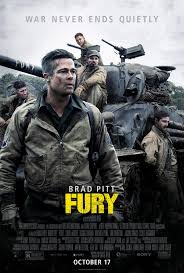 Why haven’t there been more tank movies? We have a slew of war films in all shapes and sizes and yet there are hardly any movies from the unique point of view of the battle-tested tank crew. Perhaps it’s the claustrophobic shooting conditions and limited breathing room, but then both of those are usually assets to the submarine sub-genre, and we got plenty of movies set primarily in less-than-spacious submarine quarters. Maybe it’s the sheer cost, since a submarine can be replicated with a model and a tank requires its own onset crew just to get exterior shots. Then there’s the issue of just watching close-ups of people looking through telescopes, squinting, and pulling triggers. I don’t really have a working hypothesis to explain the paucity of tank movies from Hollywood but now there’s at least one mainstream effort on the big board.
Fury follows the brave men of the titular tank that’s traveled from Northern Africa to France and now Germany in the dwindling days of World War II. Norman (Logan Lerman) is the new guy, replacing a fallen comrade on Don “Wardaddy” Collier’s (Brad Pitt) crew. The average life expectancy on a tank was only a handful of missions, but under Collier’s leadership his squad has defied the odds. Now the presence of a rookie puts all their lives in danger especially so close to the end of the war.
Writer/director David Ayer (End of Watch, Sabotage) delivers a meat-and-potatoes kind of war film, a movie that knows what it’s doing and how to satisfy its audience but rarely steps outside of this mission to resonate further. There’s a requisite pathos and air of contemplation to the proceedings, especially with the conflict of Norman’s innate goodness getting in the way of killing soldiers, armed and unarmed, in the line of duty. What does it take to be a soldier? Can you still recover as a man or does one have to shut off those elements of concern, the quibbles over moral actions that would otherwise haunt. In one sense, it’s a little contrived that the new recruit has to be so green to the battlefield that everything needs to be taught to him including the us vs. them mentality of war. On the other hand, it provides an ongoing source of conflict that leads to some striking moments, like when Collier literally forces Norman’s hand to get him his first kill. Much like Saving Private Ryan once it settles down, the movie progresses as a series of vignettes that showcase a variety of consequences and realities of the war. Naturally some are more engaging than others, but for the majority Fury holds your attention nicely. Ayer’s direction of action is astute and a tank-on-tank battle is wondrously taut thanks to the stubborn and fascinating tactics of tank warfare. I just don’t know how all these guys can make out whose order is for whom with all the other noise going on.
 It’s during the concluding act where the movie abandons most of its sense of realism to completely double down on exaggerated action movie heroics, and it’s unnecessary. Beforehand, we’ve been treated to this crew and their town-by-town escapades, watching them come together but also watching them deal with the vagaries and lasting traumas of war. And then it suddenly shifts gears and becomes a last stand movie where our small crew in one immobile tank has to take on, literally, 300 Nazi soldiers. Ayer makes a specific point of clarifying them as Nazi S.S. men and not your casual German soldier. Pitt and company all decide to stay and fight valiantly rather than hide, and so we’re treated to their preparations for what is sure to be an Alamo in a tank. It then just becomes a rote action movie where they fire into the smoke, more Germans keep coming, and we just patiently watch them run through their last remaining desperate options for defense. Ayer doesn’t falter with his depiction of the action or the logical nature of his plot beats, though I don’t know why they didn’t keep more of the gun ammo in the tank. There’s a repetition and expectation of casualties with this section, perhaps intended to magnify their sacrifice and heroism but it feels too forced. The movie was working perfectly fine prior to this new shift in tone. Now we have Germans that are plainly idiotic, with poor marksmanship, and who can’t just wait out the tank. They have rocket-propelled weapons and the tank only shoots in one direction. The ending action assault still works as an entertaining barrage of blood and violence, but if you were liking Fury for what it was then be prepared to be a little disappointed.
What really hooked me with the film was an extended sequence that doesn’t even involve the tank at all. Stopping to regroup with their company in a small, bombed-out German town, Collier and Norman enter the home of two women, Irma and Emma. Initially the scene plays out like they’re scouting for any hiding soldiers, so there’s an initial carryover of tension. Then the gentlemen stay and the scene transforms organically into something more interesting. The scene is allowed to linger, and we see a different side of Pitt’s tank captain. The women set up a dinner and there’s a moment of reserved calm. Norman and the youngest German woman get some privacy, much to the knowing approval of the other two older adults in the room. Then just as their little scene has reached serving time, the other members of the tank storm the room, drunk and confused. They came seeking to deflower Norman with an ugly prostitute they each had a turn with. Their eyes settle on the young, much prettier women, the food about to be served, and you can feel the resentment starting to build, the old conflicts and tensions sneaking back into the scene, particularly a sneering Jon Bernthal (Wolf of Wall Street), who relishes being hostile. You don’t know where this is going to go. Are they going to make a fuss? Will they mistreat the German civilians, maybe even assault them, and if so how will Collier and Norman respond? What will they say about the appearance of preference with these civilians than with their tank company? How far will this go? I am not kidding when I say that for a movie with plenty of war violence, this was the tensest scene in all of Fury. It plays out so naturally, leisurely, but every moment pushing forward and building in tension. It’s a shame then how Ayer decides to conclude this entire episode, glibly turning these women from characters into a cheap plot device. Until then, though, it’s a 12-minute oasis from the genre machinery of war movies.
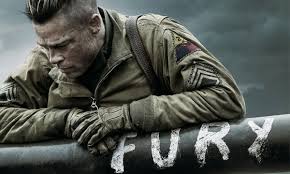 The other aspect where Fury falters is when it comes to fleshing out the characters in that dangerous tin can. With war movies the characterization can often get lost in the shuffle of violence and messages, so there’s something of a sliding scale; if you can get one good sequence, perhaps one solid insight into a character that opens them up as more than “Hispanic Gunner” or “Vaguely Southern Religious Marksman” then you call yourself fortunate. The characters don’t stray far from their archetypical orbits: the rookie, the hotheaded one, the Bible-quoting philosopher, the commander who hides his fear and… the Hispanic Gunner (sorry Michael Pena). The assembled actors do fine work with what they’re given, but so much of the part is reactionary to off-screen, out-of-the-tank action. Pitt (World War Z) has a stolid clam that commands leadership but boy does his character lack a personality. He’s just settled into that authority figure role. Shia LaBeouf (Nymphomaniac) gives a performance with enough edge, the emotions just peaking through during key moments, to leave you wanting more, both from the character and the actor. Lerman (Perks of Being a Wallflower) is suitably wide-eyed and out of his element early, finding his requisite spine and becoming a “man” over the course of the film. It works as a point of view entry into this world though his character can come across as naive and then later also unjustly criticized. After two hours with this crew, you won’t be fighting back too many emotions as they make their last stand and their numbers dwindle.
Fury is a fairly gritty, bloody, and sturdily entertaining World War II action thriller that is unwaveringly serious for a solid two acts until an all-out assault into over-the-top action movie land for its final, admittedly enjoyable, conclusion. It decides to just skimp out on the characterization so as to spend more time pumping up the virtues of tone and action. The film never bored me, and during stretches it was riveting with suspense and a gritty realism, all before retreating back to archetypes and Hollywood standoffs. For long stretches it’s a series of vignettes but there are moments that rise above, which cut through the carnage and stay with you. Ayer’s direction of action is rather impressive and this is easily the finest work behind the camera for the famous screenwriter. In many ways, Fury is a no-nonsense throwback to World War II war movies, with a similar no-nonsense pack of characters. An older audience will definitely find the movie appealing. It does more than enough well to recommend but just don’t expect the next Saving Private Ryan in terms of lasting impact. Still, give me more tank movies, Hollywood.
Nate’s Grade: B


 nathanzoebl
You must be logged in to post a comment.