Blog Archives
Promising Young Woman (2020)
 “I’m a gentleman,” says a man at his bachelor party, trying to bashfully turn down any sexual antics with the women paid to entertain him and his friends for one boozy night. He’s also trying to indicate he’s “not like those other guys” and genuinely respects women. He gets it. “Well,” says the woman in the shiny fetish outfit, “I’ll have you know in my experiences that ‘gentlemen’ can often be the worst.” This line summarizes Promising Young Woman, a revenge thriller in a post-Me Too era that is unsparing to all those who would proudly say, “Well, I support women.”
Cassandra (Carey Mulligan) was the top of her class at med school. Then her best friend was sexually assaulted at a party while she was inebriated, which allows the university to paint her as guilty and the accused as blameless (“What do you expect when you get drunk?” kind of victim-shaming). Years later, Cassandra has never been the same. She poses as a drunk at clubs and waits for her knight in shining armor to take her home, and often these modern men of chivalry prove to be creeps looking to take advantage of women and in needing of some harsh medicine.
 This is a movie that walks a fine line to stay out of the shadow of becoming just another exploitation film with a higher gloss. I was yelling at the screen early about the choices men were making with susceptible women in their care. Admittedly, it plays upon that icky genre and taps into our inherent feelings associated with it as well as vengeance thrillers, and writer/director Emerald Fennell (TV’s Killing Eve) smartly subverts our expectations and loyalties. We want Cassandra to achieve her righteous vengeance regardless of the moral or psychological effect it has upon her because vengeance is satisfying. We want to see bad people who have escaped punishment suffer, but Fennell challenges the audience to see how far we’re willing to go for this goal. There are moments where it appears that Cassandra is going to go the extra step to antagonize her targets, and this might involve facilitating other innocent women into potential danger. It’s a sharp turn that asks the audience how badly they want to hold onto that righteous sense of indignation. Do all ends justify the means? Now I won’t confirm whether or not Cassandra follows through for the sake of spoilers but this is one very knowing movie about how to make its audience uncomfortable. Obviously, dealing with the subject of sexual assault and predatory men, it should be uncomfortable because of the nature of the subject, but Fennell has a wicked sense of when to twist her audience into knots. She doesn’t let anyone off the hook easily and that includes her heroine and those close to her. Nobody looks clean here. It makes for a truly surprising experience. When I say that Promising Young Woman makes some bold choices, it really makes some bold choices. There were points I was sighing heavily and others where I was stunned silent. It brought to mind No Country for Old Men. The commitment that Fennell has to her excoriating artistic vision is startlingly provocative and effective.
One early scene stood out to me and let me know that Promising Young Woman was going to have more on its mind than bloodshed. Cassandra is walking home from a night out in her same soiled clothing and eating a sloppy hotdog with ketchup running down her body. A group of construction workers watch her and begin yelling from across the street, harassing her with unwanted sexual advances while they yuk it up. Cassandra stops, turns her head, and simply stares them down. She doesn’t glare at them or shout at them; all she does is look in silence. The workers get quiet very fast and then after several seconds they become angry and defensive, uncomfortable from her attention, and they walk away insulting her. Didn’t they want her attention? Weren’t they boasting? By merely drawing her focus onto these men and making them mildly reflective of their behavior they became uncomfortable and elected to leave. This scene only plays out for like twenty seconds and yet it serves as a symbol for what Fennell has planned with the rest of her thriller. She is going to take what you want and make you re-examine it with a fresh perspective that might just make you rather uneasy and disgusted with yourself.
The first half of the movie establishes a routine that explains what Cassandra has been doing since dropping out of med school. She’s never been able to move on from the trauma of her past and so she seeks out new potential perpetrators to inflict pain upon or scare straight through tests. By the second incident, we adjust to her formula and lie in wait for Cassandra to strike back. She’s the smartest person in the room and it’s deliciously enjoyable to watch her enact her plans. This avenging angel routine runs into a roadblock when she reunites with a friend from med school, Ryan (Bo Burnham), a pediatric surgeon. They share a meet cute that involves Ryan drinking a coffee that Cassandra has spit into as a declarative sign of his interest (trust me, I’m making it sound far creepier than it plays onscreen). They go on several dates and have a palpable romantic chemistry together. This is aided by Fennell’s excellent dialogue, which can be cutting when it needs to and also supremely charming when it wants to be. It’s a peculiar rom-com but on its own terms, including unashamedly reclaiming a forgettable Paris Hilton pop song with full sincerity. At this point, Promising Young Woman is sizing up a choice between following vengeance and following romance. It’s a formulaic fork in the road and Fennell completely understands this, as she’s also testing the audience how much they are willing to sacrifice to see Cassandra check off her guilty names. This storyline doesn’t feel like a cheap alternative either. I liked Ryan and Cassandra together. However, Fennell stays true to her poison-tipped plans and this storyline becomes another chapter in her larger thesis on the condemnation of “boys will be boys” rationalization.
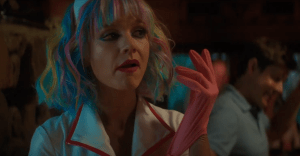 There is another scene worthy of being hailed because it goes against your and the character’s expectations (some spoilers). Cassandra tracks down the lawyer responsible for defending the university and discrediting her friend once she came forward with her rape accusation. Alfred Molina (Spider-Man 2) is this man and he’s quite antsy because he has been waiting for months for a visitor he anticipated would inevitably arrive. He’s been let go from his firm after having what they refer to as a “psychotic break” and what he refers to as a crisis of conscience. He’s made a career over sliming victims’ reputations, a fact he confesses has been made infinitely easier by modern technology. “We used to have to go digging through the trash,” he says, “But now all we need is one picture on Facebook of the girl at a party and you’ve got jury doubt.” Cassandra is taken aback by how eager this man is, not for absolution which he believes he will never earn, but to be punished. It’s not like a weird fetish but a genuine accounting of what he feels he deserves. It’s a short scene but it challenges Cassandra and the audience about the potential of redemption and forgiveness. This is what she wants after all, people to account for their part in the injustice that happened to her friend and to make amends for their guilt.
Mulligan is ferocious and on another level with this performance. She’s listed as a producer so I assume she had a personal connection with the material because she feels so aligned with the character that she can make you shudder. Mulligan has been an enchanting and empathetic actress since her breakout in 2009’s An Education, the source of her lone Oscar nomination. I’ve never seen her quite like this before. She has a natural sad-eyed expression, which made her perfect for Daisy Buchannan in the new Great Gatsby. With this role, she’s taken those natural sad-cute instincts and carved them out and replaced it with bile. Mulligan gets to play multiple false versions of Cassandra as she adopts disguises and personas to dupe her prey. This also makes the viewer subconsciously question which version they see is the real Cassandra. Is it a distortion upon a distortion? How well can we ever get to know this woman? I think Mulligan is most deserving of her second Academy Award nomination for this bracing, incendiary turn.
This is Fennell’s directorial debut and it will not be her last time in the director’s chair. Her command of pace and visuals can be sneaky good, framing figures to squeeze in potent symbolism as well as ratchet up tension and discomfort. The visuals can also be comedic poetry, like the opening images of men in khakis gyrating and thrusting on a dance floor. She also demonstrates supreme restraint where needed. The sexual assaults of past and present are never visualized but they are not mitigated either. She also has a tremendous ear for music. This soundtrack is sensational from the club bangers to the old timey country ditties. It feels as exceptionally selected as any Wes Anderson or Quentin Tarantino movie soundtrack. The score by Anthony Willis is deeply emotive with its use of strings and cello. They deliver a cello cover of Britney Spears’ “Toxic” and it’s as if the filmmakers made this choice specifically for me.
 If there is one slight downside, I’d have to say many of the supporting characters are under developed. There are plenty of famous faces in this enterprise, like Adam Brody, Laverne Cox, Clancy Brown, Connie Britton, Max Greenfield, Chris Lowell, Jennifer Coolidge, Christopher Mintz-Plasse, but most of them are deposed for a scene and then vanish. It starts to feel like a series of guest appearances from actors as they’re passing through town. Alison Brie (Happiest Season) has a longer and slightly more nuanced part as a former college friend who betrayed Cassandra when she needed her most. This character, along with Birtton’s school dean, illustrate that just because you happen to be a woman does not automatically mean you will be a helpful ally. I view it less as a snide “girls can be bad too” equivalency and more an indication just how insidious and prevalent rape culture can be and condition people into gross excuse-making complacency. I will say that it was nice to have Clancy Brown play a normal dad role and he was sweet too.
Beware, men of the world, the next time you size up a pretty young thing who looks meek and helpless. Promising Young Woman wears the skin of an exploitation movie but it’s so much more. Fennell has created a tart, twisted, and powerful film that is coursing with righteous fury. It’s a female revenge vehicle but with far, far more ambition than simply providing tingles to baser instincts. The artistry here is special and transforms the iconography of exploitation movies into a contemplative and jolting experience. Promising Young Woman is a definite conversation-starter and the first thing you might say upon its conclusion is a breathless exclamation of, “Wow.”
Nate’s Grade: A-
Share this:

Eighth Grade (2018)
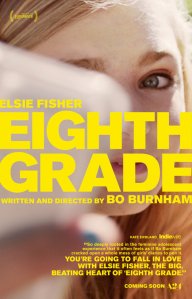 Disarmingly and impressively empathetic, writer/director Bo Burnham’s Eighth Grade is brimming with heart and authenticity in every frame. It’s a simple story of Kayla (the wonderful Elsie Fisher) who is weeks away from completing her middle school years and entering the summer before high school. She’s terribly introverted and awkward, only able to find her voice when recording her YouTube pep talk videos. Because of the protagonist’s shy nature, Burnham smartly uses the YouTube videos often as voice over to offer better insight into the kind of person Kayla would like to present herself, sometimes contrasting with the real-life version struggling to find her place and sense of self. This is an observant film that rings with authenticity with the trials and tribulations of modern teenagers in the information age, where small screens are an escape, a crutch, but also a gateway to self-discovery. Fisher is a terrific lead, perfectly capturing the understated sense of a real average teenager (acne included). Because of the introverted and ordinary nature of her, it does take a while to fully embrace her as a character. This is the one real aspect that holds back Burnham’s film. You’ll feel for Kayla, oh you’ll feel a lot of things, but it isn’t until later that you’ll engage with her. Like its heroine, this is a powerfully awkward movie with several cringe-inducing moments both comic and scary. It’s hard to watch at times but it feels completely relatable even with the new-fangled gadgets of the kids these days. I’m just glad I didn’t grow up in the age of ever-present recording devices. It’s a generous movie without an excess of quirk. In fact the movie is pretty restrained with its vision of teenage uncertainty. I did enjoy the synth wave leitmotif that would pound whenever Kayla caught sight of the boy she was crushing on, communicating the beating of her heart in a cool, modern style. The climax involves a heart-to-heart with Kayla’s dad (Josh Hamilton), a man struggling to navigate the changes in his daughter and respect her privacy and curiosity. It brought tears to my eyes and, in my opinion, wipes the floor with the much-ballyhooed paternal advice from Call Me By Your Name. Burnham acquits himself nicely as a director. His choices are determined by his story, and he draws out completely natural performances from his troupe of talented actors. I never would have thought this would be the kind of story a comic drenched in irony would tackle. Eighth Grade is a sincere, deeply heartfelt, and awkward movie about an awkward time most of us would like to skip. Don’t skip Eighth Grade.
Nate’s Grade: B+
Share this:

The Big Sick (2017)
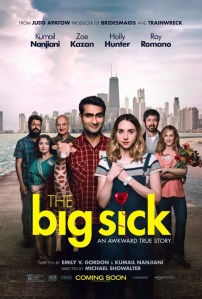 Kumail Nanjiani is a very funny guy but he also might just break your heart and then mend it. He and his real-life wife Emily Gordon met in Chicago and weeks into their courtship she was placed into a medically induced coma to combat a mysterious unknown infection. She could have died (spoiler alert: she didn’t), and months after she and Kumail married. It’s a very unconventional relationship story (boy gets girl, girl gets coma, boy and girl get together) and the basis of The Big Sick. This romantic comedy, written by Nanjiani and Gordon, was a smash hit at the Sundance Film Festival and is now expanding across the nation. This is a born crowd-pleaser, one of the funniest films in years, and a heart-warming reminder of the pleasures of rom-coms done well.
Kumail (Nanjiani) is a Chicago stand-up comedian trying to catch his big break. He falls for Emily (Zoe Kazan), a grad student in psychology. They try and keep things casual but cannot help growing closer to one another. Kumail’s traditional Pakistani family is adamant he marry a Pakistani girl, enough that there’s always one unexpectedly “in the neighborhood” during family dinners with their son. They would never approve Kumail marrying an American woman, and this stops him from introducing Emily to his parents. Kumail and Emily fight, break up, and it’s shortly thereafter that Emily is put into a medically induced coma. Enter Emily’s parents, Beth (Holly Hunter) and Terry (Ray Romano), who are thankful but wary of Kumail at first, feeling his attention is no longer required on the matter. As the days turn into weeks, Kumail finds himself growing closer to Emily and her parents in the process.
 The Big Sick succeeds wildly because it gets the most fundamental principal of storytelling right: we care about the characters. Over the course of the film, you grow attached to Kumail and Emily and their very unorthodox situation. We want them to find happiness and, more importantly in a rom-com genre, we want them to find it with each other. The characters in the movie are beautifully rendered and relatable. Their faults and relationship troubles aren’t the stuff of contrived drama but recognizable differences and cross-cultural pressures of acceptance and disappointment. He may be a stand-up comedian, and she may have fallen into a coma for an unknown medical reason, but you will relate to both of these people. They don’t feel like archetypes. Even as Kumail is making amends for his mistakes the movie doesn’t paint him as a saint worth automatic forgiveness. Considering this was written by the real-life Emily, it should be no spoiler to state that she does eventually come out of that coma. Her life is automatically better and while Kumail has only grown more steadfast in his feelings for her, Emily was asleep. For her, it’s like moments after they broke up due to an incompatible future. She’s thankful for what Kumail has done but she doesn’t want to be with him. That’s the second act break, folks. A lesser movie would have Emily’s awakening serve as its climax and everything would be hunky-dory while an earnest pop-rock song would play over. With The Big Sick, the last act is dealing with the consequences of her coma, and Emily is allowed her agency once more to make decisions all her own. It’s easy to project a progression of romance onto a static being, but she needs to travel at her own speed and on her own terms. I won’t lie; the final act produced some meaty tears from me.
Another hallmark of Judd Apatow productions that I don’t think gets enough acclaim is the sheer generosity of the screenwriting. These movies spread out the love to a wide ensemble of characters that deserve consideration. There are stock comedy types that pop in for the occasional easy laugh, like David Alan Grier’s coked-out club owner or Kurt Braunohler as the painfully inept comedian, but as a whole The Big Sick offers a welcomed kindness to its larger cast. Even Kumail’s arranged dates are given the opportunity to come across like people, particularly Khadija (Crazy Ex-Girlfriend’s Vella Lovell) who is tired of not being able to enjoy what seems so easy for others. The fussy Pakistani family is played to be stern and uncompromising but they too have their moments. They are worried about losing their sense of culture through full assimilation, and they have an alternate view of family, one that involves self-sacrifice for the whole. The best additions to the movie are Emily’s parents. They don’t initially know what to make of Kumail but they eventually bond to him in different ways. Beth is fighting to control something out of her control and Terry is trying to keep everything calm. There is still lingering discomfort buried in their marriage from past indiscretions, and during times of crises it can reappear, forcing Kumail into an unexpected position. The movie’s sense of people is so warm-hearted and open, you just want to spend more time with them all, and it’s a simple yet beautiful pleasure to watch them connect.
 Oh my lord is this movie funny too, which shouldn’t be a surprise for anyone who has seen Nanjiani’s standup routines before (extra points for not overly relying upon standup in the film for easy jokes). I was laughing from start to finish and there’s a consistent placement of jokes doled out in regular intervals. And when I was laughing it was the room-clearing guffaws. I can’t remember a movie in recent years that had me laughing as hard. Nanjiani’s deadpan is a thing of beauty and his comic timing is razor-sharp, and yet his sense of humor doesn’t detract from the weightier moments. Because the movie has such a heavy life-and-death backdrop, it’s important to have release valves for the audience, and that’s what the diligent comedy allows. It’s a bittersweet sense of comedy that doesn’t sacrifice the depth of character and the weight of the drama. In fact the least funny parts in the film are likely the standup comedy friends, though no fault to Aidy Bryant and Bo Burnham, both generally very funny people.
Nanjiani (TV’s Silicon Valley) is a pleasant surprise as a dramatic actor. There are some very dramatic moments when his character is unburdening himself of regrets, fears, and frustrations, and Nanjiani is terrific, pooling emotions you didn’t think were so readily available in his acting toolkit. He makes Kumail a likeable and charming man. There’s also an undercurrent of conflict avoidance, not wanting to upset his conservative family, which leads to holding onto secrets. It’s a flaw that provides an instant direction for character growth, going from avoidant to assertive. Kazan (Ruby Sparks) has the tougher job considering she’s sidelined for half of the movie. Her portrayal of Emily is winsome without falling into a dangerously quirky territory (no Manic Pixie Dream Girl). Thankfully, she’s allowed her agency after waking from the coma, and her scenes with Kumail afterward walk that delicate line of emotions that leave us hanging. Hunter (Batman vs. Superman) and Romano (TV’s Everybody Loves Raymond) are both wonderful. They serve as a form of Emily proxies and when Kumail grows closer to them, and they grow closer to him, it feels like this small support group is becoming an appealing team.
The Big Sick is a big crowd-pleaser, lifted to great heights by terrific acting, writing, and direction from Michael Showalter (Hello My Name is Doris). The director actually lampooned rom-com clichés in the hilarious satire, They Came Together, so having someone as instinctively skilled like Showalter guide the production helps steer away from the more expected genre moments. There are a handful of moments that feel pulled in from the Hollywood version of this story (Kumail’s big break timed with a very personal crossroads) but it mostly works on its own terms. These people are layered, allowed to be flawed and interesting human beings. It’s an unsentimental movie that finds ways to big emotions that feel completely earned. If you’re ailing for an enjoyable, funny, and heart-warming movie that respects your intelligence, try The Big Sick.
Nate’s Grade: A-


 nathanzoebl
You must be logged in to post a comment.