Blog Archives
Salt (2010)
 Congrats to the Columbia marketing team for what is by far the most imaginative advertising campaign ever. Weeks before Salt was going to open nationwide, the most bizarre story broke this summer. A dozen American citizens were revealed to be deep cover Russian agents. Apparently, their purpose, as given in the mid-to-late 1980s, was to infiltrate American society and get cozy with policy makers (and yet not one became a lobbyist). Instead they mostly raised families and lived in the suburbs of New Jersey. It’s unclear exactly what they accomplished. This hearkens back to a simpler age where we had clearly identifiable “enemies” that existed as nation states. Things are just too complicated in the post-9/11 age of the War on Terrorism. The dozen Russian spies were deported to Russian in an exchange for three American spies. I feel somewhat sad for these dozen Russian spies, especially Anna Chapman, the red-haired femme fatale that became the face of the scandal. These people grew up in the United States and for many that’s all that they know, and now they have to live in picturesque Russia. I wonder how long before they themselves defect back to the States.
Evelyn Salt (Angelina Jolie) is a CIA agent who?s just about to go home after a long night of CIA stuff. An old Russian agent has defected, and Salt is the best interrogator they have to separate the real from the nutso. As she?s about to leave, the Russian talks about a plot to assassinate the Russian president, and the killer will be a Russian spy posing as an American, Evelyn Salt. Her superior (Liev Schreiber) wants to clear things up with nervous government officials, but Salt bails. She’s concerned that her German national husband (August Diehl from Inglorious Basterds) has been abducted. She races to find her husband, outrun U.S. agencies on her trail, and maybe assassinate the Russian president as foretold.
 Believability is a fluid reality. When it comes to action thrillers, if they’re hitting the right numbers hen you give them a bit of a pass. What might normally kill a mortal can merely incur a flesh wound. Salt is packed with thriller absurdities, especially toward the end, but I posit that this movie is no less believable than most of what we see in the Bourne trilogy. The trick with Salt is that the pacing doesn’t ever let up; as soon as she?s slotted as a potential Ruskie spy, she goes on the run and the movie doesn’t slow down. It hops from action sequence to chase sequence to real-life Frogger sequence on a busy highway, all the while Evelyn performs miraculous feats of derring-do, impervious to normal rigors that would severely injure the rest of humanity. But you see, she’s a trained spy, and therefore can handle it all with aplomb. She can create her own missile thanks to an office desk and a fire extinguisher and some ordinary household chemicals (don’t try this at home, kids). In the opening seconds of the movie, Evelyn is being harshly tortured and interrogated in a North Korean prison (in her bra and panties for extra exploitation value). If she can survive that, surely this Superwoman Spy could survive escaping a batch of really lousy guards and National Security agents who seem bewildered by such art of deception like the masterful Putting on a Hat, or the more dangerous Dying One’s Hair a Darker Color (that can stain, you know).
Let?s briefly talk about the entire premise of Salt. Before this summer, naturally, this Cold War holdover plot device would seem ludicrous. Such deep cover Manchurian Candidate-like operations that take decades upon decades of time seem like a crapshoot. As proven by this summer’s most bizarre story, people who go deep under cover for extended periods of time are rarely able to snake their way into the corridors of power. It’s not like these people are planted to marry ambassadors or up-and-coming politicians. It’s essentially like a horse race, except you have to bet on which pony 25 years down the line will be the winner or spawn the winner. The odds of success seem remote at best and a waste of resources. This Cold War program also stipulates that these sleeper agents would still hold allegiance to Mother Russia nearly 20 years after the dissolution of the U.S.S.R. It’s this same mistaken idea of delayed national allegiance that surfaces when Chinese politicians try and justify how they will solve the guy/girl population disparity in their country. The Chinese politicians feel that the men of their country will come to America and find all those Chinese orphans that were adopted by American parents. Somehow these former Chinese orphans who have grown up in a different culture, in a different family, and with different gender rights and freedoms, will suddenly say, “Of course I will go back to the country that gave me up as valueless!” It’s this same basis at work for the Russian sleeper agent plan. But yet these super sleeper agents have miraculously found their ways in high positions of power. Maybe that’s the secret to educational reform. Students are more likely to be self-starters when they’re determined to bring down the infrastructure of another country.
What saves Salt is that the action sequences are good. Director Phillip Noyce has extensive experience in Hollywood and working with large stars. Noyce directed the stellar Jack Ryan thrillers Patriot Games and Clear and Present Danger; he even has experience with Jolie, having helmed 1999?s boring Bone Collector. Noyce has a great presence of mind and knows how to fill the frame up to please the senses. He knows how to compose a nice action sequence and, here?s the shocker given modern action cinema, allows the audience to fully understand what is going on. The chases have genuine excitement and the escapes come across as organic instead of contrived, which is something of a compliment for a spy film. Evelyn Salt hopping from car to car across a highway is cut together into one smooth sequence to rattle the nerves. There are some spectacular car crash images in the film, particularly when Salt escapes from police custody by driving off an overpass. Noyce finds a way to make the screen both frenetic and oddly pretty, without being self-conscious about its popcorn purposes.
 Jolie has proven herself to be more than capable when it comes to handling action. She doesn’t look as spookily thin as she did in 2008’s Wanted, which is good when you want to believe that she can be a world-class brawler. She’s tough as nails and plenty easy on the eyes. The role doesn’t require much of Jolie’s exceptional sex appeal. In fact, she’s rather maternal and her driving motivation is to rescue her husband. There are all sorts of needless flashbacks to her wedding day, little snippets to remind you that she loves her husband, in case you forgot. Jolie’s character is a bit of an enigma by design. Obviously given the star power and the fact that it?s a summer movie, you expect Jolie and her character to be in the right by the time the end credits roll. And yet the movie and screenwriter Kurt Wimmer (Thomas Crown Affair, Equilibrium) spends about half of its running time letting you fully believe that Evelyn is a turncoat (though if she was originally Russian, would she be a turncoat?). The most interesting aspect for me regarding Salt’s character was when we flashed back to the 11-year-old version (Cassidy Hinkle) of her after a car accident. Her head is bandaged, and because the girl is the younger version of Jolie, her lips look like those wax novelty lips to match Jolie’s signature pillowy pout.
Salt is a rather nuts-and-bolts thriller that balances absurdities with efficient action. With pacing so swift, you don?t have time to start nit-picking the small things, and the big things you just swallow as part of the overall package. Salt needs you to be caught up in the moment, in the chase, and not second-guessing all the plot fallacies. The film pretty much follows Jolie’s lead and is straight-faced nerve. It provides the thrills you’d want in a summer popcorn blockbuster without getting too serious. As a spy thriller it goes down like a shamelessly entertaining beach read. After all, what are the odds that your friends and neighbors of twenty years could actually be decades-in-the-making Russian sleeper agents? Well, do they look like Anna Chapman?
Nate’s Grade: B
Share this:

Inglourious Basterds (2009)
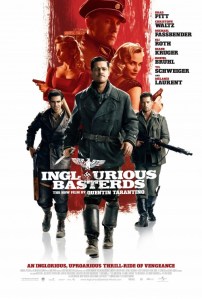 Quentin Tarantino has always been an artist that thumbs his nose at convention. Just as critics accused his last film, Death Proof, as wallowing in exploitation muck, here comes Inglourious Basterds, very loosely based on the correctly spelled 1978 Italian movie. War movies seem like a natural fit for the QT mold with their staunch violence, tough guy bravado, and vengeance-filled storylines. Tarantino has been working on the script for this film for over ten years, taking a break to produce the Kill Bill features. The finished product is a bloody alternative history wish-fulfillment fantasy with little conscience. This isn’t any sentimental, well-meaning, reflective war movie. This is war Tarantino-style and a celebration of war movies in general. Cinema becomes the weapon we win the war with.
In 1944, Lt. Aldo Raine (Brad Pitt) is given a unique mission. He is to assemble and lead a crew of Jewish-American soldiers for one purpose — to kill Nazis. They will be dropped into German-occupied France and will use guerilla tactics to dismember Nazis and strike fear into the higher ranks. Aldo personally assigns each soldier with the task of collecting 100 Nazi scalps. “And I want my scalps,” he commands. The “basterds,” as they’re called, face steep opposition. S.S. Colonel Hans Landa (Christoph Waltz) has earned the nickname “Jew hunter” for his terrifying precision at sniffing out Jews hiding along the French countryside. In the film?s terrific opening sequence, he systematically interrogates a French farmer into giving up the Jews he is hiding. Shoshanna (Melanie Laurent) is a Jewish teenager who manages to miraculously escape this bloodbath.
Years later, she owns and operates a movie theater in Paris. The German high command wants to screen their newest propaganda masterpiece, Nation’s Pride about the exploits of sniper Fredrick Zoller (Daniel Brühl), in Shoshanna’s theater. Finally she can plot her vengeance, except that Landa will be providing security for the special screening. Meanwhile, Aldo and the basterds scheme to meet up with German actress Bridget von Hammersmark (Diane Kruger), who is secretly working with the British as a spy for Operation Kino. The top-secret mission involves attending the movie premier at Shoshanna’s theater and then killing all the high-ranking brass in attendance, thus ending the war.
 Those looking for a rip-roaring good time of watching Pitt prance through the countryside dispatching evil Nazis will be disappointed to learn that Inglourious Basterds is, after all, a Tarantino movie. That means there is talking. Lots of talking, but it’s great, glourious talking with deep undercurrents of menace. The movie boils down to about six set pieces and most of that time involves long, drawn out conversations where the tension percolates underneath the surface. The characters play a cat-and-mouse game of deception, and the conversation transforms into a slow fuse waiting to go off. The characters engage in an “I know, and you know I know” bout of play acting, going about their business as if all is calm, when each is waiting for the next move. Tarantino turns dialogue scenes into slow-burning combat, and eventually those lit fuses do finally go off and the scene will erupt in a great splash of violence. Then we are left to assess the situation and collect our bearings, much like the characters if they are fortunate enough to be alive. This is a talky war movie, and Tarantino does fall in love with his dialogue rhythms and allow his characters to overindulge and circle the same plot points more than is needed, like the sequence with von Hammersmark in the bar, but the naysayers looking for an action romp that complain nothing goes on are missing the point. A tremendous amount is going on, you just have to look beneath the surface, lie in wait, and luxuriate in the simmering tension that Tarantino plays like a pro.
Tarantino has an encyclopedic knowledge of film that allows him to blend and deconstruct genres, and Inglourious Basterds feels like an homage not to World War II but war movies in general, with a dash of spaghetti westerns. When the French farmer watches Landa drive up to his home, linked with the great Enrico Morricone’s score, you definitely feel like you’re in a western transported into mid-twentieth century Europe. The conversations feel like high-noon showdowns. Tarantino’s direction feels less stylized and idiosyncratic this time. He still plays around with time and back-story, even recruiting Samuel L. Jackson to be a God-like narrator, but Ingloruious Basterds is mostly a literal and linear pop deconstruction of war movies. When Tarantino deviates sharply from the known historical timeline, it feels within reason given the cracked mirror world he?s created. Tarantino can turn World War II into a campy Warner Brothers cartoon, replete with goofy over-the-top caricatures of Hitler and Goebbles. He can also takes digressions and hard right turns with his story, allowing characters to chew over the finer intricacies of German silent cinema. It’s bloody, messy, but boy is it entertaining as hell.
 Any conversation over Inglourious Basterds is inevitably going to gravitate to its fascinating central villain, Hans Landa. German actor Waltz plays the infamous “Jew Hunter” and he is astounding to watch; he enlivens every moment onscreen and won a Best Actor award at the Cannes Film Festival. Landa is an extremely intelligent and polite inquisitor. He comes across almost like a diabolical S.S. version of Colombo: he’s three steps ahead, feigns ignorance, circles his prey, and finally strikes after mentally tearing down the suspect. Waltz is practically giddy in some sequences, enthusiastic for such sick endeavors. He likes to screw with people and make them nervous. And yet, thanks to the wily brilliance and magnetism of Waltz, you develop a perverse appreciation for the man. Despite the horrors he is responsible for, you may actually find yourself liking Landa. He has moments of great cunning, like his deliberate reasons for switching to English with the French farmer or his off-the-cuff destruction of von Hammersmark’s alibi. When he suddenly and fluently launches into his fourth language, it is one of the film’s finest “oh crap” moments. This is a truly memorable character that dominates every scene, and Waltz gives an astounding star-making performance destined to be remembered when it comes time to draw Oscar nominees.
The rest of the actors do well but no one approaches the planet that Waltz resides on. Pitt seems to knowingly be shooting for parody with his performance. His accent is twangy and coats every word in a honeyed glaze; you almost expect him to wink at the camera after each line. He’s still amusing to behold in the rather few instances that Aldo graces the movie. Laurent (The Beat That My Heart Skipped) and Kruger (National Treasure) both have intriguing albeit underwritten roles, and both actresses give the best performances in the film after Waltz. Eli Roth (writer/director of Cabin Fever, one of my favorite movie indulgences) looks the part as the commanding “Bear Jew” with his lean physique and Louisville slugger, but I couldn’t tell what he was doing with his accent. Is he supposed to be from New York or Boston? In war movies, there was usually a colorful collection of characters but Inglourious Basterds doesn’t really do much to accentuate its second tier players. The only basterd that leaves an impression is Til Schweiger (Driven, Far Cry), all humorless resolve and flinty stares. And what happened to the basterds in the final act? Where did everybody go? Yes, that really is Mike Myers doing one of his Austin Powers-esque British impressions.
 What is truly surprising is that Basterds unflinchingly looks at all the ugly aspects of war. The movie doesn’t neatly categorize the villains and the heroes. Zoller is a German sniper that killed 300 Allied troops and yet he is portrayed as grounded and romantic, a film lover able to chip away at Shoshanna?s steely reserve. To the basterds, they refuse to see past the uniform and armband; there is no difference between a Nazi and a German soldier. They will mutilate both on principal. Tarantino also gives time to examining the collateral damage of war, watching innocents gunned down in the name of duty. Shoshanna’s plot for vengeance involves the horrific deaths of scads of people whose only sin may have been being German in Paris. Operation Kino is described by Landa as a “terrorist plot” and isn’t it, really? But then Aldo disputes that a “Nazi ain’t got no humanity” and that collaborators and bystanders are just as culpable. Aldo and his basterds march through France committing what could sensibly be described as war crimes, and these are the good guys! Even with all the camp and stylized violence, there may be moments where you want to cringe and ask yourself, “Am I supposed to be enjoying this??
There are those that bemoan that Tarantino is wasting away his remarkable talents on such low-rent enterprises. He is too caught up in genre filmmaking, they claim. He needs to go back to his earlier audacious works, like Reservoir Dogs and Pulp Fiction, films of startling intelligence and playfulness. He needs to stop making collages of movies and go back to making real movies, they cry. Ingloruious Basterds will not please these critics. This is a verbose deconstruction of war movies that runs over 150 minutes and mostly involves characters seated and chatting. It will clearly not be for everyone, especially those sold into thinking Basterds was going to be a more graphic version of The Dirty Dozen. This movie is more Cinema Paradiso than The Dirty Dozen. If Tarantino wants to keep making high-gloss genre goofs, that’s fine with me as long as the end results are as creative and entertaining as this movie. Who else is going to make a World War II fantasy with excellent use of David Bowie’s song “Cat People”? No one makes movies like Tarantino. I rest my case.
Nate’s Grade: A


 nathanzoebl
You must be logged in to post a comment.