Blog Archives
The Brutalist (2024)

The indie sensation of the season is an ambitious throwback to meaty movie-going of the auteur 1970s, telling an immigrant’s expansive tale, and at an epic length of 3 hours and 30 minutes, and an attempt to tell The Immigrant Story, and by that we mean The American Story. It’s a lot for any movie to do, and while The Brutalist didn’t quite rise to the capital-M “masterpiece” experience so many of my critical brethren have been singing, it’s still a very handsomely made, thoughtfully reflective, and extremely well-acted movie following one man trying to start his life over. Adrien Brody plays Laszlo Toth, A Jewish-Hungarian survivor of the Holocaust who relocates to Pennsylvania in 1947. He starts work delivering furniture before getting a big break redesigning a rich man’s library as a surprise birthday gift that doesn’t go over well. Years later, that same rich man, Harrison Lee (Guy Pearce), wants to seek out Laszlo because his library has become a celebrated example of modern architecture. He proposes Laszlo design a grandiose assembly that will serve as a community center, chapel, library, gymnasium, and everything to everyone, standing atop a hill like a beacon of twentieth-century civilization. Everything I’ve just written is merely the first half of this massive movie, complete with an old-fashioned fifteen-minute intermission.
The second half is about crises professional and personal for Laszlo; the meddling and compromises and shortfalls of his big architectural project under the thumb of Harrison, and finding and bringing his estranged wife (Felicity Jones) to America and dealing with the aftermath of their mutual trauma. I was never bored with writer/director Brady Crobett’s (Vox Lux) movie, which is saying something considering its significant length. The scenes just breathe at a relaxed pace that feels more like real life captured on film. The confidence and vision of the movie becomes very clear, as Corbett painstakingly takes his time to tell his sprawling story on his terms. I can appreciate that go-for-broke spirit, and The Brutalist has an equal number of moments that are despairing as they are enlightening. I was more interested in Laszlo’s relationship with his wife, now confined to a wheelchair. There are clear emotional chasms between them to work through, having been separated at a concentration camp, but there is a real desire to reconnect, to heal, and to confront one another’s challenges. It’s touching and the real heart of the movie, and it easily could have been the whole movie. The rest, with Laszlo butting heads against moneymen to secure the integrity of his vision, is an obvious allegory for filmmaking or really any artist attempt to realize a dream amidst the naysayers. The acting is terrific across the board, with Brody returning to a form he hasn’t met in decades. Maybe his career struggles since winning the Best Actor Oscar in 2003 have only helped imbue this performance with a lived-in quality of a soul-searching artist. Pearce is commanding and infuriating as the symbol of America’s ego and sense of superiority. The musical score is unorthodox but picks up a real sense of momentum like a locomotive, thrumming along at a building pace of progress. The only real misstep is an unnecessary epilogue that spells out exactly how you should feel about the movie rather than continuing the same respect and trust for its patient audience. The Brutalist is an intimidating movie and one best to chew over or debate its portrayal of the American Dream, and while not all of its artistic swings connect, the sheer ambition, fortitude, and confident execution of the personal and the grandiose is worth celebrating and elevating.
Nate’s Grade: B
Share this:

Hillbilly Elegy (2020)/ Feels Good Man (2020)
 Hillbilly Elegy is based upon the memoir by JD Vance and in 2016 it became a hot commodity in the wake of Trump’s surprising electoral ascent, with liberals seeing it as a Rosetta Stone to understanding just how so many working-class white people could vote for a billionaire with a gold toilet. The movie, directed by Ron Howard (Apollo 13) and currently available on Netflix, follows an adult JD (Gabriel Basso). He’s a Yale law candidate forced to go back home to Middletown, Ohio after his mother Bev (Amy Adams) lands in the hospital for a heroin overdose. It’s 2011, and Bev has been fighting a losing battle with opioids for over a decade, costing her a string of boyfriends and jobs. JD’s homecoming isn’t quite so rosy. While he can take comfort in fried bologna sandwiches and his sister (Haley Bennett), the town is not what it once was. The factory has closed, poverty is generational, and his mother is one of many struggling to stay clean. In flashback, we watch MeeMaw (Glenn Close) take in the young JD (Owen Asztalos) and raise him on the right path. JD must decide how far the bonds of family go and how much he may be willing to forgive his mother even if she can never ask for help.
The subtitle of Vance’s novel was “A Memoir of a Family and a Culture in Crisis,” and it’s that latter part that got the most attention for the book and critical examination. Many a think piece was born from Vance’s best-selling expose on the hardscrabble beginnings of his personal story along the hills of Kentucky and the Ohio River Valley and his recipe for success. Given his libertarian political leanings, it’s not a surprise that his solutions don’t involve a more interventionist government and social safety nets. According to Vance’s book, he saw poverty as self-perpetuating and conquerable. It was the “learned helplessness” of his fellow Rust Belt inhabitants that Vance saw as their downfall. For me, this seems quite lacking in basic empathy. You see these people aren’t poor because they’ve been betrayed by greedy corporations, indifferent politicians, a gutted infrastructure and educational system in rural America, pill mills flooding Appalachia with cheap opioids, and a prison system that incentivizes incarceration over rehabilitation. For Vance and his like-minded fellows, upward mobility is a matter of mind over matter, and these working-class folks have just given up or won’t work as hard as before.
 Now, as should be evident, I strongly disagree with this cultural diagnosis, but at least Vance is trying to use his own story as a launching point to address larger points about a portion of America that feels forgotten. The movie strips all of this away. Screenwriter Vanessa Taylor (The Shape of Water) juggles multiple timelines and flashbacks within flashbacks as Vance follows the formula of prodigal son returning back to his home. The entire draw of the book, its purported insights into a culture too removed from the coastal elites, is replaced with a standard formula about a boy rediscovering his roots and assessing his dysfunctional family. At this rate, I’m surprised they didn’t even time it so that Vance was returning home for Thanksgiving.
Removed of relevant social commentary, Hillbilly Elegy becomes little more than a gauzy, awards-bait entry meant to uplift but instead can’t help itself from being overwrought poverty porn. If we’re not looking at the bigger picture of how Appalachia got to be this way, then Vance becomes less our entry point into a world and more just an escaped prisoner. Except the movie doesn’t raise Vance up as exceptional and instead just a regular guy who pulled himself up by his bootstraps through will and family support. I’m not saying he is exceptional, I don’t know the man, but this approach then ignores the reality of why so many others just aren’t following his footsteps of simply trying harder. Without granting a more empathetic and careful understanding of the circumstances of poverty, Howard has made his movie the equivalent of a higher-caliber Running with Scissors, a memoir about a young man persevering through his “quirky, messed up family” to make something of himself on the outside. This reductive approach is meant to avoid the trappings of social commentary, and yet in trying to make his film studiously apolitical to be safer and more appealing, Howard has stumbled into making Hillbilly Elegy more insulting to its Appalachia roots. Systemic poverty is seen as a choice, as people that just aren’t trying as hard, that have given up and accepted their diminished fates. Never mind mitigating economic, psychotropic, and educational circumstances. I imagine Howard wanted to deliver something along the lines of Winter’s Bone, unsparing but deeply aware of its culture, but instead the movie is far more akin to a sloppy compilation of Hallmark movies and catchy self-deprecating bumper sticker slogans. Seriously, about every other line of dialogue feels like it was meant to be on a T-shirt, from “Where we come from is who we are, but we choose every day who we become,” to, “There are three types of people in this world: good Terminators, bad Terminators, and neutral.” Well, maybe not that last one. The insights are fleeting and surface-level, with vague patronizing along the fringes.
The personal story of J.D. Vance takes the center stage and yet he’s the biggest blank of characters, and what we do get isn’t exactly that encouraging. I think we’re meant to engage with his triumph over adversity, but he has such disdain for his background while clinging to it as an identity, and this intriguing dichotomy is never explored. Vance as a character is merely there. His awkward experiences relating to the rich elites are just silly. He calls his girlfriend (Freida Pinto) in a panic over what fork to use at a fancy dinner table, as if this perceived social faux pau would be the difference between getting a law firm gig. He’s supposed to feel like an outsider, both at home and away, unable to escape his past that defines him, but the movie doesn’t even make Vance feel alive in the present. Most of the movie he is just there while big acting takes place around him. He listens to the life lessons bestowed upon him, good and bad, and it makes him the kind of man that when he grows up will join Peter Thiel’s venture capital firm, so hooray? I sighed when the movie established the stakes as he needs to get back in time for his big lawyer job interview, a literal family vs. future crossroads. The movie treats its frustrating main character as a witness to history rather than an active participant, and his personal growth is what? Coming to terms with the limitations of his mother? Accepting himself? Leaving them all behind to survive? I don’t know. There is literally a montage where he gets his life back on track, starts getting better grades, ditches his no-good friends, and heads out into the world. This could have been a better articulated character study but instead Vance comes across as much a tourist to this downtrodden world and eager to return to safer confines as any morbidly curious viewer at home.
 I simply felt bad for the actors. This is the kind of movie where subtlety isn’t exactly on the agenda, so I expected big showcases of big acting with all capitals and exclamation marks, and even that didn’t prepare me. I watched as Amy Adams (Vice) worked her mouth around an accent that always seemed elusive, with a character that veered wildly depending upon the timing of a scene. Almost every moment with Bev ends in some alarming escalation or outburst, like when a new puppy ends with Bev declaring she will “kill that dog in front of you,” or a ride back home descends into a high-speed promise of killing herself and child out of spite. This woman is troubled, to say the least, and her addictions and mental illness are what defines the character. With that guiding her, Adams is left unrestrained and usually screaming. There’s just so much screaming and wailing and crying and shouting. It’s an off-the-mark performance that reminded me of Julianne Moore in 2006’s Freedomland, where a usually bulletproof actress is left on her own in the deep end, and the resulting struggle leans upon histrionics. Was I supposed to feel sympathy for Bev at some point? Does the movie ever feel sympathy for this woman who terrorizes and beats her child? The broad portrayal lacks humanizing nuance, so Bev feels less like a symbolic victim of a larger rot of a society abandoned and betrayed and more a TV movie villain.
Close (The Wife) disappears into the heavy prosthetics and baggy T-shirts of MeeMaw, but you could have convinced me the character was a pile of coats come to life. Truthfully, MeeMaw is, by far, the most interesting character and the story would have greatly benefited from being re-calibrated from her painful perspective. She’s the one who bears witness to just how far Middletown has fallen since her and PawPaw ventured as young adults with the promise of a secure new life thanks to the thriving factory. She’s the one symbolizing the past and its grip as the present withers. She’s the one who has a history of abuse only to watch her daughter fall into similar patterns. Think of the guilt and torment and desire to rescue her grandson for a better life and save her family. That’s an inherently interesting perspective, but with JD Vance as our mundane lead, MeeMaw is more a slow-walking curmudgeon taken to doling out profane one-liners and grumpy life lessons. Close is easily the best part of Hillbilly Elegy and deserved more attention and consideration. A moment where she clings to JD’s high-scoring math test like a life raft is heartfelt and earned, more so than anything with JD.
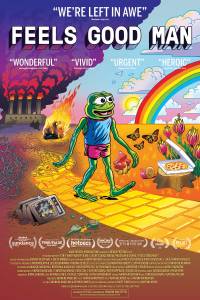 Another slice of America that feels forgotten and angry is on display with the documentary Feels Good Man, a.k.a. the Pepe the Frog documentary. Who is Pepe? He’s a cartoon frog created by Matt Furie as part of a comic series of post-college ennui between four friends. The character was adopted by the commenters on the message board 4Chan as their own symbol, and as their memes spread and became more popular with mainstream suers, and that’s when the 4Chan warriors had to do something drastic to save their favorite frog. They began transforming Pepe into a symbol of hate in order to make him toxic for outside use, and then the irony of their attempts at reclamation faded away and Pepe became a real symbol for Neo-Nazis and white supremacists. The character is currently listed on the Anti-Defamation League’s list of symbols of hate. The movie explores this evolution and de-evolution of Matt Furie’s creation and serves as a cautionary tale about the scary shadows of Internet culture and the nature of reclaiming meaning and intent with art.
Firstly, is there enough material here for a full-fledged documentary? We’re talking about a cartoon frog filling up the memes of Internet trolls. Is that enough? I think so, though I wish the movie shed even more critical scrutiny upon the 4Chan fringes of the Internet that have become a toxic cesspool of alienation and recrimination. These are people that self-identify and celebrate their social isolationism. The acronym N.E.E.T. stands for NOT Employed, Educated, or Trained and is adopted by many as an odd badge of honor. We even see home video footage of people sharing their personal lives in cluttered, trash-strewn basements. These are people electing not to engage with a larger functioning society and yet also feeling hostile to those that choose otherwise. Maybe it’s all a big joke to them, so why even bother; maybe it’s a defeatist mentality that plays upon social anxiety and learned helplessness. Maybe it’s just a noisy, nihilistic club that doesn’t want anything for themselves other than to disrupt others. The interview subjects from the 4Chan community are few but offer chilling peeks into this subculture. They see the world in terms of a very high school-level of social hierarchy, and the people who are pretty, successful, and having sexual relationships are the “popular kids” keeping them down. I think in terms of a Venn diagram, that incels and these NEET freaks are a flat circle. It almost feels like Vance’s cultural critiques of his poor Appalachia roots syncs up with the disenchanted 4Chan kids. This self-imposed isolation and self-persecution stews into a hateful mess of resentment. It’s not a surprise that several mass shooters have partaken in 4Chan and 8Chan communities.
 This scary subsection of Internet culture has been left to fester and it went next level for the 2016 presidential election. The trolls recognized their own sensibilities in Donald Trump, a candidate whose entire presidency seemed on the precipice of being a bad joke. The alt-right celebrated the man and used Pepe as a symbol for Trump’s trolling of norms and decorum, and the 4Chan message boards became an army of meme makers to steer Internet chatter. It’s hard to say what exactly the cumulative effect of these memes and trolling efforts achieved, in addition to the successful efforts of Russian hackers and a media environment that gave Trump billions of dollars in free airtime, but the 4Chan crowd celebrated their victory. “We memed him to the White House,” they declared. From there, Pepe became a synonymous symbol of a newly emboldened white supremacist coalition and any pretenses of ironic detachment dissolved away.
The rise and mutation of Pepe makes up most of the movie, and it’s certainly the most fascinating and scary part of Feels Good Man. However, there is a larger question about the ownership of art and interpretation that the movie presents without conclusive answers. Symbols are a tricky thing. They’re not permanent. The swastika wasn’t always associated with Hitler and Nazis. A pentagram has significantly different meanings depending upon a Wiccan and conservative Christian audience. Feels Good Man examines Furie as a humble albeit slightly naïve creator. He’s a nice guy who just can’t get his head around what has happened to his creation. How far does the artist’s intent go when it comes to credible meaning? At one point, Furie tried stemming the negativity by killing off Pepe in a limited comic, but it didn’t matter. The 4Chan followers simply remade him as they desired because at that point Pepe was their own. He has been built and rebuilt over and over again, that no one person can claim interpretative supremacy. Furie’s version of Pepe might be gone but there are millions of others alive and well. This gets into the nature of art and how every creator in some regard must make amends with letting go of their creation. Once it enters the larger world for consumption, they can steer conversations but art can take on its own life. The last third of the movie follows Furie taking action to enforce his copyright law to push back against the more outlandish uses of Pepe the frog, including from InfoWars’ Alex Jones, the same man who told us the government was making frogs gay for some unexplained conspiracy. Jones makes for a pretty easy villain to enjoy seeing defeated, and the conclusion of the movie involves dueling taped depositions between Furie and Jones over intellectual trademarks and free speech. It makes for an easy to navigate victory for Furie to end the movie upon, but is this larger war winnable? I have my doubts and I don’t think the trolls of the darker reaches of the Internet are going away.
I also want to single out the beautiful animation that appears throughout Feels Good Man, giving a visual representation to Pepe in a manner that’s like trying to give him a say in his own intent.
 So, dear reader, why did I pair both of these movies for a joint review? I found both of them as investigations into a sliver of America that feels forgotten, left behind, stuck in ruts outside their control, and resentful of a changing culture they see as exclusive to their hard-hit communities. I thought both Hillbilly Elegy and Feels Good Man could provide me, and others, greater insight into these subcultures and perhaps solutions that can make them feel more seen and heard. The problem is that Elegy doesn’t provide solutions other than “pull up your bootstraps” and Feels Good Man involves a destructive coalition that I don’t want better seen and heard. Both movies in their own ways deal with the nature of how very human it can be to retreat to their safe confines of people who too feel ostracized, hurt, and overwhelmed. I have pity for the people of the Rust Belt, the hillbillies experiencing generational poverty and hardships, though “economic anxiety” is not simply a regional or whites-only worry. I have less pity for the basement trolls of 4Chan trying to celebrate school shooters because it’s somehow funny. I’m amazed that so many talented people were part of Hillbilly Elegy and had such high hopes. For all of its full-tilt screaming, the movie is thoroughly boring and formulaic. Given the nature of an elegy, I was expecting Howard’s movie would be more considerate of its people, but their humanity is lost in this pared-down characterization, and the tragedy of society failing its own becomes an inauthentic Horatio Alger story of the plucky kid who went to Yale and became a real somebody. Feels Good Man might not be the best documentary but it feels more authentic and owns up to its inability to answer larger questions about human behavior, art, and interpretation. Both of these movies will prove horrifying to watch but only one is intentionally so.
Nate’s Grades:
Hillbilly Elegy: C-
Feels Good Man: B
Share this:

Never Look Away (2018)
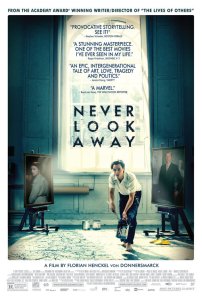 This is only the second film for writer/director Florian Henckel von Donnersmarck since his 2006 Oscar-winning masterpiece, The Lives of Others. Seeing his name attached to any movie was enough to secure my ticket. Going back to his native language, the director traces the life of a young, daring Dresden artist, loosely based on Gerhard Richter, trying to find his sense of self and truth from the reign of the Nazis to the GDR under Soviet influence. It’s a sprawling yet intimate human drama that has a full range of emotions, from the swooping romance to the heartbreak. It balances many emotions and tones as it presents a rich portrait of a young man’s life set across a fascinating backdrop. His free-spirited aunt, an inspirational figure, is abducted due to her schizophrenia and ultimately sentenced to death by an SS-enabling doctor (Sebastian Koch). This gets even more complicated when he goes to college and starts secretly dating the daughter… of that very same doctor, now being protected by a high-ranking Soviet official he aided. The simple strokes of a love story, or the disapproving father trying to destroy their love story, or the efforts of the family post-war to find some foothold in a new East Germany, it all adds up to a deeply felt and deeply alluring human drama with plenty of breathing room. The length (3 hours 8 minutes) gets to be unwieldy, especially during the third hour when we visit our second art school education. It’s just less generally captivating to watch a guy try and find his artistic voice when his life has all this other potent drama afoot, and that’s even after the lingering fallout from a forced abortion and hidden Nazi searches. Never Look Away is compelling, compassionate, thoughtful, and a tad too long for its own good. Hopefully the director doesn’t take another long eight years for a follow-up (please!).
Nate’s Grade: B+
Share this:

Welcome to Marwen (2018)
 When I saw the trailer for Welcome to Marwen my first response was pained wincing. Robert Zemeckis is one of the most daring, inventive, and imaginative filmmakers working today, but this movie just looked misguided with its approach. Welcome to Marwen is so fascinating, so tonally off, that I might almost recommend people watch it.
Mark Hogancamp (Steve Carell) was a war illustrator until the day he was attacked by a gang of neo Nazis. In the ensuring months, Mark has lost portions of his memory, is unable to use his hands to illustrate any longer, and has become something of a shut-in. He has gained notoriety through his new artistic outlet. Mark has created a WWII era Belgian town called Marwen with a group of dolls fighting evil Nazis. We escape into fantasy sequences where Mark imagines himself as Cap’N Hogie and his gang of supportive ladies. Nicol (Leslie Mann) moves in next door to Mark and he takes an immediate interest in her (she even appears in Marwen in doll form). Mark must grapple with his feelings and work up the courage to attend the court hearing to make sure the men who hurt him stay in prison.
 I was amazed at how miscalculated Welcome to Marwen plays out. It feels like Steve Carell’s Patch Adams, a sentimental movie where every step seems strange, mistaken, maudlin, and false. Firstly, this is the second documentary that Zemeckis has taken and adapted into a live-action film, as if the man is spending the wee hours of his nights pouring over award-winning documentaries of the past and determining which he can add a little razzle dazzle to with visual whimsy. Look out The Cove because maybe an undersea realm of talking dolphins will open up that horrifying Oscar-winner to a whole new mainstream audience. I’d have less of an issue with Zemeckis remaking the documentary if it didn’t seem like his entire rationale was the fantasy interludes.
The original documentary is about one man and his unique brand of healing through art. He is becoming further whole by building an intricate world through his imagination. By visualizing the fantasy worlds, Zemeckis is turning the doll segments into literal escapism that becomes tedious, obvious, and often redundant. The doll segments are about his gang of girls supporting him, expressing his interest in his kind new neighbor, and tackling the Nazis in a safe space where he can win. Every time we cut to the doll sequences it feels like the movie is spinning its wheels with these ill advised fantasy cut scenes. It gets boring watching the doll segments without any sense of stakes. The special effects are creepy and there are aspects that amplify this, like one doll’s penchant for having her top ripped off in combat, revealing her stout, rounded chest. Keep in mind that the female dolls, with the exception of one, are all analogues for people in his life, so then Mark is consistently indulging in stripping one woman of her clothes. Even though the movie sets this character up to be a potential love interest, it’s still not a good choice. Zemeckis intends to literalize Mark’s struggles and fears so that he can triumph over them, but it feels like it’s minimizing the complexity of trauma into digestible whimsy. With every trip to Marwen, I was eager to return back to the land of human beings where they might still be over-the-top but at least I wouldn’t have to watch creepy doll CGI.
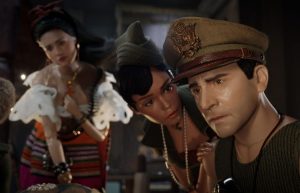 The most significant doll is the blue-haired Deja Thoris (Diane Kruger) who is meant to represent Mark’s suicidal impulses. He keeps her atop his wall so that she can watch over him, and in his sleep he dreams about her whispering in his ear, “Nobody will ever love you like I do. You should just end it now.” Oh man, that’s heavy, but when applied through the prism of a talking Barbie doll it loses its sense of seriousness. If you don’t lose yourself in the central conceit and take the dolls seriously, the movie will fall flat. Take for instance the cross-dressing aspect of Mark, which is what lead to his brutal beating. It’s a delicate subject and something easy to get muddled, and that’s exactly what happens in the presentation of this movie. The shoe fetish is initially portrayed as wacky and then becomes serious and then becomes like an artifact of horror. It’s another sign that the tone for this movie is mismatched. These things require a delicate touch with some ambiguity and sensitivity. Welcome to Marwen turns these into a loud, noisy cartoon that bumbles into its messages. Things that are meant to be charming or endearing or emotional can come across as goofy or campy or even uncomfortable.
I felt bad for so many of the actors. Carell (Vice) is trying to maintain his character’s sense of dignity throughout, but the story often goes into contrived contortions to force him into dramatic confrontations. It turns out the court appearance is rescheduled to be the same day of Mark’s photographic exhibit. Will he be able to triumph over these forces to stand up for himself? Carell is a capable dramatic actor but he’s struggling here to find stable footing because of the mish mashing tones. The development of Mark makes him come across as a creep in some moments, like his one-sided advances for Nicol, and a simpleton at other moments, where he might have sustained brain damage. Mann (Blockers) is sweet and gentle but strangely the movie hides her most interesting character aspects, like the prospect of a deceased child. You would think overcoming tragedy would be a tool for Nicol and Mark to bond. Merritt Wever (Godless) is another sweet and gentle woman in a world that seems overstocked with them. It feels like everyone in this small town exists just to be nice to Mark. She’s clearly romantically interested in Mark but he doesn’t care until the very end. She deserves better than being someone’s runner-up choice, especially only after he was turned down.
 A movie that deals with delicate issues through fantasy escapism can work, but it requires a precise hand with tone and with its storytelling detours. Guillermo del Toro has been able to prove he can tell rich, adult stories with the assistance of whimsical, weird fantasy elements. Charlie Kaufman has been able to weird the mundane and the fantastic. It can be done and Zemeckis has done it himself before, best evidenced by the masterpiece, Who Framed Roger Rabbit?. However, Welcome to Marwen is a sizeable tonal misfire. The serious elements don’t blend well with the fantasy elements, and even worse, they are made less serious and approach the realm of camp. The fun, fantasy elements are given bizarre and unsettling contexts that make them creepy and inappropriate. Escaping into Mark’s imagination winds up stripping him of much of his agency, and literalizing his psychological push-and-pull feels like a misguided examination on depression. I left my theater in a daze, trying to make sense of what I had just witnessed. The filmmakers and cast certainly mean well and want the film to be a triumph of the human spirit. I found it to be two meandering hours of watching somebody play with their disused toys.
Nate’s Grade: C-
Share this:

Exit Through the Gift Shop (2010)
 This twisty documentary begins as a chronicle of guerilla street art and then flips the script. Its star subject, mysterious British artist Bansky, becomes the director, cutting down Thierry Guetta’s massive amount of footage into a workable frame. The subject becomes the filmmaker and the filmmaker becomes the subject. Exit Through the Gift Shop is a canny film that questions the nature of art, good and bad, the documentary format, and even our perspectives on reality (what is real when seen through a lens?), all with prankish humor and an anarchist’s eye. The film starts as an introduction to street art and famous underground street artists. Initially wary, they come to trust Guetta’s ever-present camera and then wish they hadn’t. At the end, when Guetta becomes a multi-million dollar street artist under the guise Mr. Brainwash, you’re not quite certain whether everything you’ve just witnessed is one elaborate put-on, a master practical joke on the commercialization of art and style. This is far more than a look at ordinary graffiti artists. These cultural satirists question the very idea of what constitutes art, who owns it or deserves to, and the overwhelming power of self-manufactured hype to hoodwink. You get to watch the birth of an underground art form and then watch its commercialization. We’re probably only minutes away from knock-off Bansky-like tote purses. See Exit Through the Gift Shop and watch the stylistic birth and near death of an art form you never knew existed.
Nate’s Grade: B+
Share this:

My Kid Could Paint That (2007)
 Prodigy, fraud, normal preschooler? This incisive and captivating documentary looks at a four-year-old who has made thousands of dollars on her modern art paintings. If she is the real deal, what does that say about modern art when a child can compete with serious artists? This intensely interesting story is given as objective a viewpoint as possible even as the filmmaker is forced into his own movie when the family he’s been documenting is looking at his film as a favorable retort to a very critical 60 Minutes segment casting doubt that the paintings are genuine. The filmmaker has his own doubts and explores the nature of journalism and storytelling and objectivity and what is art, and that’s when the documentary transcends its story and becomes about much more. I have no doubt that the child is involved in painting (the question registers with how involved her failed artist father is), but the people that are buying her paintings are buying them because they are also purchasing the story. My Kid Could Paint That, as one interview subject states, is really a story about adults seeking the limelight, because otherwise it would just be a kid having fun painting in the confines of her home. Is she exploited? Is she a genuine talent in a world of paint splashes and squiggly lines? Will she ever just be allowed to be a kid? These are just a few of the tantalizing questions this mature and insightful movie raises.
Nate’s Grade: B+
Share this:

The Da Vinci Code (2006)
 Dan Brown’s The Da Vinci Code has been a best selling novel for three years running. Continents of trees have been felled to produce the 50 million published copies worldwide. Brown’s novel details a centuries long cover-up of some crucial background on Jesus Christ, as well as certain omissions about the role of women in Jesus’ discipleship. The book has been condemned by Christian watchdog groups as heresy, never mind that it is clearly labeled “Fiction.” Debunking fiction is simply redundant. Now Hollywood has adapted The Da Vinci Code into a massive movie, directed by Ron Howard. I must be one of eight who have not read the book, so I entered the theater with little expectation and no idea where the story would take me. Is this a great threat to the Christian church, as some argue, or is it just another dime-store thriller that lucked into becoming a national phenomenon?
Robert Langdon (Tom Hanks) is a Harvard professor of symbolism lecturing in Paris. He’s called in by a police captain (Jean Reno) about a local murder. The curator for the famous Louvre museum has been killed and his death leads to a series of coded clues about a deeper conspiracy involving Leonardo Da Vinci. Sophie (Audrey Tautou) is an investigator, and the granddaughter of the museum curator. She helps Robert escape and the two of them set off on an adventure through France and England, finding clues that lead them closer to the location of the Holy Grail. They get help from Leigh Teabing (Ian McKellen), an old friend of Roberts that has his own theories about what the Catholic Church may be so desperate to keep hush-hush. All the while Silas (Paul Bettany), an albino monk, is on the warpath to dispatch all who know too much, including Robert and Sophie.
There are just so many harebrained, hokey moments in The Da Vinci Code that can rip you right from the movie. Why does Sophie have to pay someone to leave a park bench when she and Robert can just walk out of earshot? Why does a bank teller, with his own devious intentions, drive Sophie and Robert to safety and then threaten them at gunpoint? Surely letting them be captured by the police would have served his needs better. Oh, the bank also has a payable escape clause, like it was a Scooby-Doo mansion. But the hokiest moment comes in the opening minutes. The museum curator, an old man who couldn’t hobble away from his attacker, gets shot in the gut, a quite painful place for a bullet to lodge itself. So he’s fatally shot in the stomach, but the man still has time to scribble coded messages on three separate paintings at different points in the museum, strip down, pose, write a message on the floor and a symbol on his chest. And remember, he’s an old man on top of all this. It’s like he had a checklist he pulled out in case he was ever mortally wounded at the Louvre.
 The characters aren’t any better. There’s little to any depth to these people and most of them are irrational stock roles. The Jean Reno cop character is laughable in how doggedly he’s convinced Robert is his man. Apparently, a priest told the cop Robert confessed. Case closed? Perhaps the cop, in his furtive rush to judgment, should do some outside research. The museum curator?s time of death, something any crime scene tech could denote, would prove that Robert would be ruled out, given that the man was giving a lecture in front of hundreds of alibis. That’s verifiable science, but no matter. Would not a place as heavily trafficked as the Louvre, with so many priceless pieces of art, have security cameras? I think that alone would tell you who murdered the museum curator. These details make the Reno character stupid and unbelievable. The police work hasn’t been this sloppy since the Police Academy saga.
There’s a late scene where a character addresses another and more or less says, “No one will suspect us, my partner. Let us split our winnings together. I will take your identity to my grave. What? Yes I will take a drink from your flask you’re offering me but not drinking from yourself.” The film could not hit you over the head harder with what is to come. I’d expect these kinds of half-hearted character turns from a rote made-for-TV thriller, but The Da Vinci Code has too much intended intellectual prestige to wallow in this manner.
This is not a good film adaptation. This isn’t structured like a thriller, let alone a movie. There?s no sense of momentum and the story is really an ongoing series of mini-climaxes, sputtering out to no payoff. Puzzle-solving and word games can work on the page, with the reader feeling like they’re right along, but onscreen it cannot work in a story of images. Howard highlights certain letters a la A Beautiful Mind, but then it simply becomes less a puzzle and more just witnessing how a character’s mind breaks down the code, nothing more. As a thriller, Brown seems to do just enough to push his narrative further, but he frequently writes himself into a corner and relies on plot contrivances to save his ass. There’s a scene at Leigh Teabing’s mansion involving a gun standoff, and how does Brown get his characters out of it? By conveniently having a bird fly and distract the evil gun-bearing monk. Talk about a cheat. The Da Vinci Code‘s lame behavioral explanations and short cuts are expected in a rote thriller, but Da Vinci doesn’t want to be seen as one.
But that’s the fundamental error of The Da Vinci Code: it wants to have it both ways. The film, and I’d judge that the novel as well, wants you to shut your brain off and swallow these trite lapses in judgment and reality, forgiving the movie for zero character development and polluting the narrative with stupid genre stock roles, but then it also wants you to pay close attention and activate your brain to untangle the origins of symbols, conspiracies, and church doctrine. This flick was destined to fail at birth. You can’t be a brainy thriller and fill the story with hokey moments and lapses in thought, and likewise you can’t be an enjoyably straight forward thriller if you bookend all your action sequences with talky sit-downs to explain the minutia of your story. The Da Vinci Code is thusly pulled in two directions and grinds its gears to the very end.
 This is not a very entertaining flick, in fact is nearly put me to sleep a half dozen times. The Da Vinci Code has tiny bursts of action, and most are easily swept away before the viewer can get a grip. These moments are then succeeded by lengthy, ponderous sessions of heavy exposition. It’s like characters will breathe a sigh of relief at another ludicrous escape and then say, “Well, now let’s discuss in detail some more convoluted theories.” The dialogue reeks, and characters spout plot points whenever they’re needed. The conspiracy doesn’t even make sense. Why would the Church protect a secret that could supposedly destroy its hierarchy? If Jesus was not divine then what difference does it make to go after relatives 2000 years removed? And if Jesus did have heirs would there not be thousands in 2000 years time, not one convenient individual? Even The Da Vinci Code‘s ending seems to soft peddle its “dangerous” message, where Robert, after learning all he has, says it’s all about what you believe.
If it wasn’t for Bettany and McKellen I really would have nodded off. Silas is by far the most interesting character in the whole film, and the only one with a penetrable personality. A deeply religious albino killer monk is a great character, and Bettany makes him scary but also frightfully sympathetic. I was rooting for Silas to knock off the film’s heroes and go on a better adventure of his own. McKellen is handed most of the monologues and he gives his character all the gravitas needed. Thank God for these two actors, because Hanks is miscast and Tautou isn’t nearly as endearing as her work with Jean-Pierre Jeunet. There’s a really good international cast assembled for The Da Vinci Code and the movie manages to mishandle most of them.
The Da Vinci Code played out on the big screen is ponderous, talky, boring, poorly adapted and poorly written. Some things work better on a page than onscreen, and I guess if this is the final product than the whole damn things works better on the page. The story is brimming with lame, hokey moments you’d see in a lazy TV thriller, but then the story also wants to talk you to death with its convoluted storyline. The action sequences are brief, the dialogue is smothered by lengthy exposition, and the plot just isn’t that entertaining. The cast is mostly wasted in thankless stock roles. So let me get this straight. After seeing The Da Vinci Code, the biggest threat the Christian church is facing is … bad movies? I think they’ll be alright.
Nate’s Grade: C-


 nathanzoebl
You must be logged in to post a comment.