Blog Archives
Angels & Demons (2009)
 Angels & Demons works better as a movie. It is a better movie than The Da Vinci Code, but since I found that film to be one of the worst of 2006 you should know this is not high praise.
Professor Robert Langdon (Tom Hanks, with a better haircut) is the world?s foremost expert on ancient symbols and texts, which is why the Vatican recruits him for a very important mission. The Pope has recently died and Vatican City is in the middle of the cardinals deliberating who will be the newest leader of the Roman Catholic Church. Four of the cardinals, top candidates for the Pope position, have been kidnapped. The Illuminati, a centuries-old secret society, says that a cardinal will die every hour, from 8 PM to 11 PM, and then at midnight Vatican City will be destroyed. The Illuminati was made up of followers who felt the church was rejecting science, and so we?re told that in the 16th century the Catholic Church responded reasonably by branding the Illuminati followers and executing them. 400 years is a long time to wait for revenge. To make matters worse, antimatter was stolen from the CERN facility in Switzerland and placed somewhere within Vatican City. The battery holding the antimatter is scheduled to die about, conveniently, midnight, and the antimatter will result in a huge explosion (science note: antimatter is real but it is entirely harmless and not combustible). With the help of Carmenlengo Patrick McKenna (Ewan McGreggor), acting church leader until there’s a new Pope, and particle physicist Vittoria Vetra (Ayelet Zurer), Langdon must race against time to save the Catholic Church.
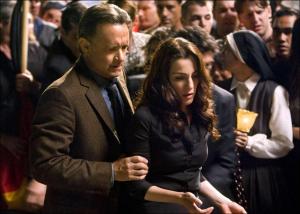 The time element gives the movie a sense of urgency that was missing before, and a kidnapping plot provides a firm structure and supplies more chances for action than unraveling a 2000-year old church conspiracy on the divinity of Jesus. The plot of Angels & Demons works out like a high-stakes scavenger hunt, shuttling Langdon across the many sights of Rome to find the next clue. However, the narrow timeline of killing a cardinal on the hour every hour makes for some tight squeezes, both for Langdon and the cardinal-killing man. I never understand why the villains give themselves such a small window to work with. I know the whole “dead cardinal every hour” thing has a nice ring to it, but is it wholly practical? There’s all that driving around Rome and the Vatican, which has got to be crowded since millions are awaiting news about a new Pope. Beyond this, why must Langdon and crew always show up to a site with like five minutes before the cardinals will be murdered? Are they stopping to get subway sandwiches in between? The timeline and plot setup provide more action sequences that make the movie fleetingly entertaining in spurts.
What doomed the Da Vinci Code movie was not the endless blather, though that certainly bored me to tears, but the fact that the film wanted to have its cake and eat it too — it wants to be a brainy thriller but get away with hokey thriller shortcomings. Angels & Demons suffers more or less the same killing blow. The flick wants you to shut your brain off and swallow these trite lapses in judgment and reality, forgiving the movie for zero character development and polluting the narrative with stupid genre stock roles, but then it also wants you to pay close attention and activate your brain to untangle the origins of symbols, conspiracies, and church doctrine. Angels & Demons introduces the idea of a ticking clock so it’s a far better paced affair than the previous film, but the movie still finds ways to get bogged down. Once again, Dan Brown’s novel has been adapted to a series of chases and sit-down chats, although this time Langdon does a lot of speed walking while he dishes out the minute history of church doctrine and architecture. To borrow from my own review of The Da Vinci Code: “You can?t be a brainy thriller and fill the story with hokey moments and lapses in thought, and likewise you can?t be an enjoyably straight forward thriller if you bookend all your action sequences with talky sit-downs to explain the minutia of your story.”
These stories are just meant to work better on the page than on screen. Puzzles and word games work when the audience can take a moment to pause but film is a medium of images and cannot simply go dead waiting for the audience to posit a guess. Movies don’t have time for you to chew things over. So then the puzzles just devolve into waiting for Langdon to explain everything, which he will do at great length. This can get tedious at a rapid rate. Langdon is less a character in this movie and more a walking, talking encyclopedia of exposition. He is robbed of anything that could be charitably described as characterization. Symbol decoding just does not work on the big screen, and Langdon is an expert whose profession is limited in application. I can’t foresee too many instances where a top-notch symbologist will be needed at a moment’s notice. Sure, it’s nice to get a history lesson and see plenty of those swell ancient churches, even if the filmmakers had to recreate them as sets because the Vatican refused them entry to film, but what point do these Dan Brown thrillers serve as movies? There is an intriguing discussion between science and the role of the church somewhere in this movie, but good luck finding much to stir your intellect. I confess never having read one of Brown’s tomes, including the super colossal mega-selling do-it-all Da Vinci Code, but surely the man deserves a better fate than to have his works die on the big screen as lamentably lame thrillers.
 There are no characters in Angels & Demons, only stock roles and suspects. Langdon’s female sidekick (Zurer,Vantage Point) serves no other purpose but to translate Latin and Italian. Really, if Langdon is a scholar on the conspiracies revolving around the Catholic Church then perhaps he should put in the time and money to learn the language. The Vatican police are there as escorts and little else. Stellen Skarsgård (Mamma Mia!) serves as the chief of the Swiss Guard, the Pope’s security team, and Armin-Mueller Stahl (Shine, Eastern Promises) is a German cardinal running the ongoing recounts for a new pontiff. Both men are presented as sly, untrustworthy suspects. Stahl’s character routinely dresses down McKenna as well, saying the young pup in the collar is not fit for church hierarchy. It?s not much to go on but the “characters” are just figures that occasionally get in the way of the film’s long-winded art history tour.
I think a lifetime of watching movies has just made my mind too analytical to be surprised by the twists in these kinds of dead weight thrillers. I?m already thinking ahead from the first minute and I don’t think I’m alone. When we are introduced to two characters, one gruff and unhelpful and one kindly and overly helpful, it is rather obvious which character will be revealed as being treacherous to provide the biggest jolt. Does anyone still suspect that Hollywood would produce a pointedly obvious evil suspect and then have it actually be that person? Not in today’s class of Hollywood thriller. You see kids, today’s Hollywood thriller is more concerned with piling on the twists than constructing a story that sticks together upon reflection, which is why many a Hollywood thriller simply falls apart as a jumbled mess by the time the end credits roll. Sometimes the endings sabotage everything logically that happened before. For an example of a textbook modern thriller, go rent the French film Tell No One and marvel at how the movie manages to be mysterious without being ludicrous. Angels & Demons doesn’t quite suffer from this screenwriting malady, but the essential evil plot by the eventually revealed evildoer is the most convoluted, ridiculously complicated scheme I have seen since that terminal 2005 thriller, Flightplan.
Director Ron Howard is able keep the film moving, almost distracting the audience away from the plot holes, but Angels & Demons is an adaptation that was doomed to fail from the start. The film plays like a lecture on tape with the fast forward button stuck. I might find more of the blitzkrieg of acts and anecdotes more intriguing if I could verify that they were all accurate. This is a thriller that wants to be seen as smart, so it empties exposition without haste, but it also wants to get away with narrative cheats common in your direct-to-DVD idiotic thrillers. You cannot simultaneously tell me to engage my brain and then a second later tell me to shut it off, sorry. Angels & Demons would have been better served without the Illuminati conspiracy and just plunged fully into the debate about bringing religion into the modern age, the friction between science and religion. Any substance the movie does present ends up being window dressing to an average potboiler mystery. This isn’t an awful movie but it never rises above “acceptable waste of time.” Hanks and Howard will probably be back in due time with the movie version of Brown’s upcoming new novel, The Lost Symbol, which will be released in September 2009. I just hope the duo, and screenwriter Akiva Goldsmith, have learned enough from their mistakes. I myself have little faith.
Nate’s Grade: C
Share this:

Eastern Promises (2007)
 Director David Cronenberg is an idiosyncratic director who explores Big Ideas through the context of creepy horror movies where the body is violated. He’s covered everything from evil gnome-like children, ravenous monsters in Marilyn Chambers’ armpit, and Jeff Goldblum’s face unfortunately peeling away. But then Cronenberg struck it big with 2005’s A History of Violence, giving him the highest profile of his long Canadian career. The auteur of ick is now back in a similarly themed tale of the true impacts of bloodshed with Eastern Promises, a gripping and thoughtful work.
Anna (Naomi Watts) is a midwife working in London and come across a young Russian girl who dies in childbirth. She leaves behind a diary that Anna seeks to have translated so that she can find family members to contact about the newborn. This brings her unknowingly to the doorstep of Senyon (Armin Mueller-Stahl) who runs a restaurant in London’s Russian district. She inquires if Senyon or any of the employees knew the dead girl, and as soon as Senyon hears about the reality of a diary he becomes more concerned. And he should be since he is the head of one of London’s most notorious organized crime families. His loose canon of a son, Kirill (Vincent Cassel), has authorized a hit behind his father’s back and repercussions may soon be approaching. Nikolai (Viggo Mortensen) serves as the family’s chauffeur but takes an interest in Anna and is willing to assist her as she stumbles into impending danger the more she translates from the diary.
 Much like writer Steven Knight’s excellent previous film Dirty Pretty Things, this is a film that shines a light on the underbelly of London and focuses on the immigrant experience and how apt they are to be exploited. Eastern Promises is both a straightforward crime thriller with an intriguing, albeit simple central mystery, but then as it moves along it transforms into something far richer. Through the diary, we uncover the hidden inner workings of the Russian mafia, which is a truly global enterprise. Women are promised with great riches and freedoms in their Slavic homeland, and then once transported will spend the rest of their lives behind the bars of a whorehouse, kept dependent thanks to a drug habit forced upon them. We’re immersed in the culture of this crime family. Eastern Promises takes its noirsh sensibilities and then gives us the foreboding and enigmatic Nikolai, a mysterious figure that the audience, like Anna, is drawn to. He spent time in a Siberian prison and is covered in telling tattoos that serve as a resume for the mafia. Nikolai is such a dominating presence and proves to be more intriguing than the central diary mystery, and it’s here where the film performs a balancing act and transfers our attentions fully to this brooding brute.
Cronenberg subverts his usual irony and weirdness to stay true to his tale, and this may well be, even more so than A History of Violence, the most accessible Cronenberg movie yet. We’re a long way from flesh-eating-monster-in-Marilyn-Chambers’-armpit. He still works with such compact efficiency so that no scene feels wasted, and Eastern Promises is a brisk 1 hour 40 minutes. Where Eastern Promises really succeeds is by layering in strong characters within a relatively genre movie. People are not exactly who they seem and the actors do their best to give remarkable depth to their roles.
Cronenberg seems to have found an actor that shares his artistic sensibilities. Scorsese has Leonardo DiCaprio, Wes Anderson has Bill Murray, Kevin Smith has Ben Affleck, and now Cronenberg has Viggo Mortensen. I never thought much of Mortensen as an actor until Cronenberg unlocked something deep and mesmerizing in their first pairing. With Eastern Promises, Mortensen establishes himself as an extremely capable actor. Nikolai is a complex figure and he Mortensen displays a mastery of understatement; his stony silences and piercing stares speak volumes, but you can practically watch the decision-making of the character pass through the face of Mortensen. He skillfully displays the good inside a man bred for evil.
 Watts is an actress with few equals and she dazzles once more in a role that requires her to do a lot of legwork. And yet, there’s a sad, haunting quality to her thanks to the back-story where she lost a child due to miscarriage. Cassel is also impressive in a complicated role that requires a lot of internal languishing. He’s at one an impudent child willing to live high off the power of his family name, and at other times he comes across as a severely wounded man who cannot thrive in his hostile family (both little and big F) environment. There are interesting revelations that make Kirill a much more complex and captivating figure, and Cassel plays the many dimensions very well. Personally, I’m happy to see Armin Mueller-Stahl in another high profile movie. There was a time shortly after his 1996 Oscar nomination for Shine where if you needed an old guy for a movie, you got the Armin. Lately, it seems James Cromwell has taken his place as go-to old guy. In Eastern Promises, he has such a sly menace to him from the moment his ears prick up at the notion of a diary. He insists upon inserting himself into Anna’s life and casually makes remarks like, “You know where I work, now I know where you work,” with just the right amount of finesse to sound intimidating and yet potentially harmless.
One scene I will never forget is when Nikolai is ambushed in a bathhouse by two revenge-hungry thugs. He sits there naked and exposed and these two unhappy gentlemen descend upon him (fully clothed) with knives. Nikolai fights like a wounded animal and manages to successfully take down both men even though he is unarmed and un-clothed. Up to this point the character has been something of a gentle giant, knowing the vicious ways of the Russian mob but seemingly at distance from them for whatever ethical decision. But it’s at this moment that we bare witness, no pun intended, to the cagey survival instincts of a man who must live his life looking over his shoulder. It’s a bravura scene that is played out in agonizing detail. Nikolai is slashed and thrown against tiled walls (much penis-related mayhem is glimpsed), but he keeps coming back and knows precisely when to strike. It really is the actors doing all the hard knocks and brawling, which heightens the tension. Cronenberg stages the violence in his realistic drawn-out style, which horrifies an audience while simultaneously fascinating them. This is by far one of the most indelible film moments of the entire year.
 Eastern Promises is an engaging character-based thriller, and yet I wish it finished as strongly as it began. This is the kind of movie where much is implied or said in silence, which works great at respecting the intelligence of an audience as well as staying consistent with a believable reality where everyone in such dangerous positions is not explaining everything aloud. However, one of the drawbacks of a film where much is implied is that when it’s over you may wish that they implied less and showed more. The climax to Eastern Promises is a little weak, especially when it comes shortly after the incredible bathhouse attack. There’s a very hazy sense of a resolution. From an artistic standpoint, I suppose I can appreciate a thriller that doesn’t feel the need to end with a pile of dead bodies and much blood being spilt, but at the same time, from an audience point of view, I was really left wanting for more when the film finally comes to a halt.
Thanks to a smart, twisty script, Cronenberg’s sharp yet quirk-free direction, and some stirring performances, Eastern Promises is a first-rate thriller with the added benefit of strong characterization to add richer depth to this tale of mobsters, retribution, and sex slavery. Mortensen is the real deal when it comes to acting, folks. Cronenberg may have found a true match with Mortensen, and the added cache may give the director greater financial opportunities to tell more intriguing tales that may or may not feature ravenous armpits.
Nate’s Grade: B+
Share this:

Jakob the Liar (1999)
 In the fickle entertainment industry, little can be as detrimental to a film’s success as bad timing. And the latest Robin Williams’ weepy not only suffers from poor timing, it cuts its own throat with the careless mistake. Coming hot on the heels of another World War II comedy/drama known affectionately as Life is Beautiful would have proved much better if the foreign film had stayed in the art house screens and quickly come and gone. Instead Roberto Benigni’s touching film made its way to big screens, broke the record for best receipts of a foreign film in America, and went on to steal the nation’s hearts and pick up three Oscar statuettes. The Hollywood version of Benigni’s Holocaust fable proves what happens when people take something that was a miracle it worked once before, and so well, and try catching lightening in a bottle again.
Jakob the Liar is never truly any form of comedy, unless you thought Hogans Heroes was in dire need of a big screen adaption because all the other Holocaust movies did not accurately portray the wackiness that was Nazi Germany. Most of the jokes are so grim and morbid that you’ll be gritting your teeth more than smiling.
The story can be very hamfisted and forceful at times, interesting considering there’s not much driving any story. And the end is scene-for-scene exact with Benigni’s flick. Most of the performances are marginal, with many appearing to be weary that they’re even in the movie. The story’s addition of a little girl that Williams’ takes under his wing for guidance is more of a distracting subplot taking attention away from the common thread of one man giving hope to the hopeless. Minus one charming scene with Williams’ improvising a radio broadcast with kitchen utensils she’s mainly a pointless addition.
The splinter in the paw of this movie is Robin Williams himself. Anyone out there remember when he used to do comedy, not schmaltzy bittersweet tug-from-the-heart-strings melodrama? Though his mugging is restrained for the most part, the sentimentality burns thin rather quickly. The movie tries to manipulate you and letting the floodgates loose with those tear ducts, but it’s so clear it’s not going to make you feel but manipulate that you can very easily see the strings as they’re being pulled.
Jakob the Liar does have a good director at its helm to show the Holocaust as the grim reality it was and not sugarcoat anything. A great deal of gratitude should go to the director for at least partially saving Jakob from being worse than it could be. Though I’m of the mind that I’m positive audiences will love it and most likely bash me, I just want everyone to know that Roberto Benigni did it earlier and better and I’d stress seeing that movie instead.
Nate’s Grade: C


 nathanzoebl
You must be logged in to post a comment.