Blog Archives
Mass (2021)
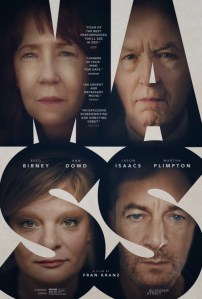 I can completely understand if anyone chooses to ignore the indie movie Mass for its subject matter alone. It’s heavy. I get it. It’s about two sets of parents, one pair (Jason Isaacs, Martha Plimpton) whose child was murdered in a school shooting, and the other pair (Reed Birney, Ann Dowd) whose child was the school shooter. It took me weeks to even work up the courage and proper mood to sit down and watch the movie. I’m glad I eventually watched Mass because it was so emotionally engaging and ultimately cathartic. That’s what I want more people to understand so that they give this hard-hitting indie gem a chance. It’s not all doom and gloom. It’s not all angry finger-pointing and gnashing of teeth. Mass is much more than you expect while being exactly what it sets out to be. It’s a small film brimming with big emotions and an even bigger wealth of empathy, allowing every participant to be a multi-dimensional human being struggling to make sense of the unimaginable that has dominated their life. Mass is one of the best written and acted movies of 2021 and deserves your time and consideration.
As you would expect given this set-up, it’s a lot of powerful conversations and grueling personal details. If you were unfamiliar with the premise, the movie teases out is main scenario like the key info are valuable kernels, and slowly and surely, we get a fuller idea of what has transpired years in the past and what the connection between these two groups of people is. It’s also a terrific setup to build anticipation and dread, so those first few moments face-to-face have the awkward niceties but we’re really waiting for the big subjects to be get their due, and they will, oh boy will they ever. However, if you’re going in looking for blood and easy answers, then this isn’t going to be the witch hunt you crave. I’m reminded of a Ted Talk I watched recently from Sue Klebold, the mother of Dylan Klebold, who was responsible for the Columbine school massacre in 1999. She talks about not recognizing signs, not of homicidal tendencies, but of suicidal tendencies, of depression manifesting as something else. It’s easy to cast blame and formulate our own assessment of parenting failures and ignored warnings, but what if the situation is far more complicated than that? What if the parents of the shooter are just another set of victims, except they never get to be honored as such by the public? They’re often looked at with suspicion, doubt, and culpability, defined by tragedy but transformed to social pariahs (the perspective illustrated so exquisitely and humanely by 2011’s We Need to Talk About Kevin). Where Mass excels is with its mighty empathy. Everyone in this story is a victim. Full stop.
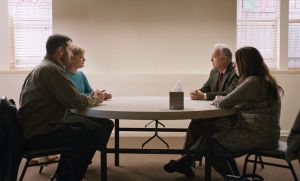 You’d be forgiven thinking Mass is based upon a stage play given its dialogue-driven story and single location setting, but it’s an original screenplay by director Fran Kraz, an actor best known for his comic relief parts in Joss Whedon projects (TV’s Dollhouse, The Cabin in the Woods). I was blown away by the immersive writing and empathy. For the first half of the movie, the parents of the shooter dominate the discussion, as they’re delivering us needed exposition on the day in question but really all the steps beforehand, the red flags that didn’t appear to be so permanent until they were. For every school shooting we read about in the news, the next question is where the parents were or why didn’t they act sooner if they had their suspicions. This is the period of the movie that answers those pertinent questions. The second half is more about the response to this news, culminating in a catharsis of tears and grace, facilitated first through anger. It’s a script structure that feels fully without manipulation, meaning the bend of the conversation occurs in a natural drift and pace. Nobody just blurts out what they want to talk about because the script is in a rush to leap to this next topical area of conflict. Franz is also very generous as a writer, able to make sure each character has their opportunity to shine and making sure we understand each character’s perspective. By the end of it, you should hopefully understand that there are no bad guys here, just victims on different sides of trauma suffering to make sense of tragedy. The monologues in this, beautifully written and performed, broke me each and every time.
Every actor holds their own but Issacs (Star Trek: Discovery) and Plimpton (TV’s Raising Hope) each get their big Oscar moment. It’s always peculiar to watch Isaacs play “normal roles” as we’re so accustomed to seeing him portray snide villains because he’s so damn good at them. Here he’s a grieving father who gets his fiery meltdown moment, and Franz has the great sense to never let his camera off the actor, allowing the full take to just derive from the live-wire emotions of the scene. It leaves the actor shaking and you just might do the same while watching. Isaacs is more the force of anger, while Plimpton is more the force of resolution, seeking an ending for all the heartache that has transformed her marriage. Her plea toward the end of the movie is an attempt at reconciliation that ends a heavy movie on uplift.
 I want to also credit Dowd (Handmaid’s Tale) and Birney (House of Cards) for their performances. They’re the more subdued ones, castigated for their position, afraid to show too much emotion because of the guilt they feel that they should have done more. Both are great, and Dowd’s final monologue, a story about her son she wants to share for better understanding, also had me in tears and especially what it results in. It’s worth it, folks, so stick around through several minutes of dithering discussion over where to find a box.
Mass is a hard movie to watch by design. It’s a delicate subject matter that will prove triggering for some and simply emotionally unpleasant and crushing for most. It’s ultimately a powerful movie about understanding, about shared grief, about empathy and relationships and similarities. It’s brilliantly written, brilliantly acted, and confidently directed. It’s little more than four people in a room hashing out their grief and conflicts, but when the drama is this potent and the characters are this complex, then it’s worth the prolonged discomfort and knots in your stomach.
Nate’s Grade: A-
Share this:

American Animals (2018)
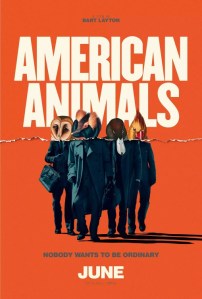 This review is weeks late after having sat down and watched American Animals, and it’s stuck with me in a powerful way. It’s a movie that pulls back the disparity between crime in the movies, so stylized and slick and carefree, and crime in real life, often traumatic, dehumanizing, and with lifelong complications for both victim and perpetrator. It’s a movie that examines a youthful sense of ennui that their lives are missing out on something extraordinary, and a step too far over a very clear moral line thanks to a fantasy given shape by escapist movies and other media. It’s also a slippery I, Tonya-style look at memory and contradiction but this time from the real-life people involved. It’s an entertaining dark comedy, an unexpected true-crime caper, and most resonating of all, a nerve-wracking thriller that left me morally queasy and unwell, but in a good way. In short, American Animals is one of the best films I have seen so far in 2018.
In 2004, at a small Kentucky liberal arts university, four young men are planning their own version of the “perfect crime.” The school has a rare books section including an original copy of Darwin’s Origin of Species and a large and valuable edition of John James Audobon’s The Birds of America. The books are appraised at $12 million dollars. Spencer (Barry Keoghan), an art student, teams up with Warren (Evan Peters), Erik (Jared Abrahamson), and Chas (Blake Jenner) to plot a daring heist. The men feel like their lives are missing something exciting and a heist is just the ticket. They just have to break in, steal the books, and subdue a librarian (Ann Dowd). Easy stuff, right?
 For the first half of the movie, American Animals plays out like a dark comedy. I had no prior knowledge that we were going to get the real-life subjects appearing as themselves in interviews cut throughout the film (their family members are still actors though). The film even plays around with this narrative hook for a few laughs, making quick cuts for punchlines and trying to square conflicting accounts, like having one scene alternate between two locations in dispute of its telling. It also helps set one of the major themes going forward in a nimble fashion, namely the difference between the reality of events and the whimsical, fantasy movie version of what an excursion into crime would be like. Having been bred on cinema’s glorified depictions of heists, the guys come to assume that a heist is sexy and fun and something that doesn’t end up hurting anyone. There’s a charming quality to the fact that Spencer uses his art skills to create models of the rare books room. There’s a laughable ingenuity to the fact that they’re planning on holding the heist in the middle of their class exams, since who would suspect students during that important time? There’s a bemused naiveté about the power of their disguises when they dress as a shuffling group of old men in powdered faces. We’re set up for a funny story about bumbling students falling all over themselves at attempted criminal shenanigans.
I was expecting a relatively light movie just from the plot particulars. It’s a heist film and the goal is to steal a bunch of books. It seemed small-scale in scope and anodyne. What trouble could a group of students get into attempting to steal books? Writer/director Bart Layton (The Imposter) seems to know this, lulling the audience into a false sense of security. He even teases the movie version of what the heist might be like, with our characters suavely stepping into their parts with practiced precision, all while music reminiscent of the Ocean’s Eleven franchise hums in the background. This is the cool-movie version, the version the characters have fantasized over in their minds, and the version that the audience is more attuned to expect. What we actually get is something very different. The heist itself plays out in excruciating detail and it runs counter to their planning. The reality of subduing the librarian is upsetting. It’s supposed to be so simple, after all, but the reality is anything but. The characters almost avoid this whole scenario, aborting their heist only to return back to it the next day. You feel the anguish of how close they were to turning away at several steps, the moments this ordeal could have been avoided, and yet fate barrels onward, energized by a misplaced sense of purpose. American Animals doesn’t let you or its characters off the hook either. I was fidgeting and sweating nervously throughout the heist and its subsequent fallout. Again, this is all about a bunch of stolen books, and I was beside myself with anxiety.
 It’s only afterwards and looking back that you realize how masterfully Layton has built up his scenes and the necessary information to make you squirm. With every heist, the particulars of the setting, the challenges and tight window need to be established, and once that occurs, we’re hoping for unexpected complications. But in order for those unexpected consequences to really hit hard, we have to be trained with what Plan A was going to be, and American Animals does this superbly. People have their designated roles and areas they refuse to partake in, like Eric makes it clearly known he will not be responsible for subduing the librarian in any way. Of course, you can expect what will eventually happen, pushing his character to an even more uncomfortable place. I was very appreciative that there’s an extended resolution after the heist, where the guys try to unload the books to a seller, and the further complications. You really feel the screws being tightened and the overwhelming feeling of dread. It’s another confirmation for me that I’m just not cut out for a life of crime. The day-to-day anxiety is just too much.
I left this movie feeling a strange mixture of jubilation and sadness, still reeling from the expertly developed and executed moral tension. The technical skills are just as strong, each working in succinct harmonious sequence to bring about Layton’s vision to startling effect. The editing is extremely tightly constructed. The smooth cinematography by Ole Bratt Birkeland frames the tension and comedy expertly, and the ominous music by Anne Nikitin kept me on the edge of my seat. It’s almost like a full-blown David Fincher film by the end. The acting is another strong point, with each actor initially relegated into a stock role (“The Muscle,” “The Wheelman,” etc.) we’ve come to associate with these kinds of movies. The film nicely pushes the characters beyond a casual, cursory understanding, blurring the lines of who they are as they blur lines of their own. A surprise standout is Blake Jenner (unrelated to the Kardashians/Jenner clan) who joins the team the latest, seems like a stereotypical rich jock lunkhead, but when he breaks down and articulates why the team is as screwed as they are, his clarity can catch you off guard. He’s the first to realize they’ve trashed their lives and are doomed and for nothing. Also deserving of praise is the always-wonderful Ann Dowd (The Handmaid’s Tale); your heart hurts for this poor woman who is confused, scared, and undeserving of her harrowing ordeal.
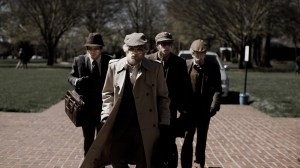 American Animals hasn’t been able to leave my thoughts for weeks, which is usually the sign of a pretty good movie. It upset me. It rattled me. It entertained me. Most of all, it made me think, about the lines people cross in the name of missing out on some vague sense of grand experience, of the differences between the reality of crime and our appealing fantasy versions of crime, and why those stories appeal to us in general. I kept thinking about the pain these four men had caused themselves and others and their regrets. I kept thinking about how smartly Layton utilizes documentary storytelling techniques to enhance his film as well as better examine the disconnect of reality-versus-movies. It’s a movie that could have been told as a documentary but excels best as a hybrid of the two, one that challenges our conception. I’m shocked it wasn’t credited to a book or news article as its source material, meaning Layton compiled all of this impressively on his own. This is a movie that got under my skin, that made me uncomfortable, but also thrilled me and entertained me from its first minute until its very last. I highly advise looking for American Animals once it becomes readily available.
Nate’s Grade: A
Share this:

Hereditary (2018)

Hereditary has built up a great roaring buzz from film festivals and its oblique marketing. Numerous critics are hailing writer/director Ari Aster’s debut film as one of the scariest movies of a generation. The studio, A24, which has built up a fine reputation for art movies and genre fare, is releasing it. Except A24 has some trouble when it comes to its horror thrillers. Last year’s It Comes at Night was similarly beloved by critics yet audiences generally disliked it, angered by the misleading marketing that framed it as a supernatural horror (there was none, no titular “it” to come at night). I wonder if A24 learned their lesson and that’s why the trailers and ads for Hereditary have been intentionally hard to follow. After watching Hereditary and feeling let down, I wonder if A24 is in for another disparity between critics and audiences. This is a sloppy, unfocused film with little sense of structure, pacing, or payoffs. It’s a movie of moments and from there your mileage will vary.
Annie (Toni Collette) and Steve (Gabriel Byrne) are ordinary middle-class parents living with two teenage children, the older Peter (Alex Wolff) and the younger Charlie (Millie Shapiro), a girl given to peculiar habits. Following a tragic accident, the family is struggling to come to terms with their loss and their new lives. Annie seeks out comfort from a group meeting, and that’s where she meets Joan (the great Ann Dowd) who shows her how to contact the spirits of the dead via a handy incantation. From there, Annie tries to establish a connection to the realm beyond and possibly unleashes a spirit targeting her family.

With the rapturous critical acclaim that Hereditary has garnered, I was expecting something far more engrossing and far less sloppy. Structurally, this movie is a mess. It feels very directionless from a story standpoint, like the movie is wading around and blindly looking for an escape route into the next scene. Rarely will scenes have lasting impact or connect to the following scene; you could literally rearrange the majority of the scenes in this movie and not affect the understanding whatsoever. That’s, simply put, poor screenwriting when your scenes lack a more pertinent purpose other than contributing to an ongoing atmosphere of paranoia (more on that later). I’m struggling to make broader connections or add lasting thematic relevance to much of the plotting, and that’s because it feels so convoluted and repetitious for so long, until Aster decides it’s time to throw the audience the most minimal of lifelines. There is a moment late in the second act where a character finds a convenient exposition dump by looking through a photo album and a book that is literally highlighted. That at least explains the intent of the final act, but even as that plays out, by the end it’s still mostly confounding. The film ends with another exposition dump, this time as voice over, and I got to thinking that if it wasn’t for these two offhand moments you would have no idea why anything is happening. I had a friend whose girlfriend had been bugging him for Hereditary spoilers for months, so I carefully explained the movie to them as precisely as I could. By the end, he told me, “I still don’t get it.” Yeah, I didn’t get it either and I was actively trying.
There is a type of horror fan that will lap up Hereditary, namely the kind that places the creation of dread and atmosphere and memorable moments above all else. If you’re a gushing fan of David Lynch movies or Dario Argento and their sense of strange dream logic, you’ll be more ready to prize the sum rather than the whole of Hereditary. The aesthetics are pleasurable thanks to crafty production designer Grace Yun (First Reformed) and the moody photography from Pawel Pogorzelski (Tragedy Girls) that maximizes the space and draws out the anticipatory dread. There are effective moments where I gasped or squirmed, but there were also moments where I wanted to laugh. The key term is “moments.” Without a structure, sense of development, and attachment to the characters and their lives, Hereditary left me chasing fleeting entertainment.

Now when it comes to horror moments, I’ll again admit that everyone’s mileage will vary. Some people will watch Hereditary and be scared stupid. Others will shrug. That’s a deeply personal response. I can look at a movie like A Quiet Place and point to its intricate structure and execution to explain why its suspense was so affecting and satisfying. With Hereditary, because all it supplies is moments, I can’t explain why something will work or won’t for a person. Maybe you have a thing against headless corpses. Maybe you have a thing for jump scares (there are more than a few). Maybe you have a thing for invisible girls making clicking noises with their tongues. Then again maybe you’d enjoy a narrative that gave you a better reason to care and that organically built meaningful scares through tangible circumstances.
If you can hang onto the final nightmarish act, that’s when Hereditary is at its best, finally picking up a sense of momentum and finality. The first forty-five minutes of this movie more closely resemble something like Manchester by the Sea, a family unit becoming undone through grief and guilt, simmering grievances just under the surface. It’s well acted, especially by Toni Collette (Krampus) as a mother barely escaping the pull of her boiling anger at her son and the universe as a whole. She gets a few quality moments to blow up and it feels like years of painful buildup coming out. The awkward family interaction is chilly but missing greater nuance. It has marked elements that should bring nuance and engagement (Personal Tragedy, Mental Instability, Blame, Guilt, Obsession), but with Aster’s undercooked screenplay those elements never coalesce. This is a movie experience that is never more than the sum of its spooky parts. Byrne (The 33) is essentially just there, and the fact that the 68-year-old actor has two teenage children is a little hard to swallow. Wolff (Jumanji: Welcome to the Jungle) does a fine job of showing his deteriorating mind late in the movie. The problem is that these characters just aren’t that interesting, so when the supernatural acceleration creeps in, there’s already a ceiling as far as how much we, the audience, will care about what befalls them. What are the stakes if you don’t understand what’s happening and don’t genuinely care about the central characters?
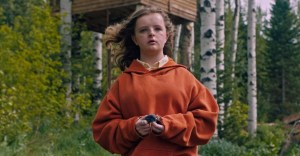
My pal Ben Bailey chided me after seeing Hereditary that I was trying to do the movie’s work for it by looking for deeper connections and foreshadowing clues. Is there some greater meaning for the headless women motif? Is there a larger reason why the dollhouse God imagery is prevalent? Is there a reason, after finding out about the haunting, that the family still leaves their beleaguered son alone? Is there a mental illness connection or is it all a manifestation of hysterical grief? The English teacher discusses the Greek tragedy of Iphigenia (see: a better movie following this model, 2017’s Killing of a Sacred Deer) and whether being predestined for sacrifice is more tragic than choosing your own self-destruction, and is that a glimpse at thematic relevance in a way that seems almost half-hearted? The problem with a long, incoherent story built upon a heaping helping of creepy imagery and atmosphere is that it can often fall into the lazy trap where the filmmaker will just throw up their hands as if to say, “Well, it’s up for interpretation.” I don’t mind a challenging movie experience (I was on the side that enjoyed, if that’s the correct term, Darren Aronofsky’s mother!). I can appreciate a movie that’s trying to be ambiguous and ambitious. However, the pieces have to be there to form a larger, more meaningful picture to analyze and discuss, and Hereditary just doesn’t offer those pieces. It’s an eerie horror movie with its moments of intrigue and dread but it’s also poorly developed, too convoluted, and prone to lazy writing and characterization. I’ll highlight it for you, Hereditary-style: if you’re looking for more than atmosphere and tricks, seek another horror movie.
Nate’s Grade: C


 nathanzoebl
You must be logged in to post a comment.