Blog Archives
Zootopia 2 (2025)
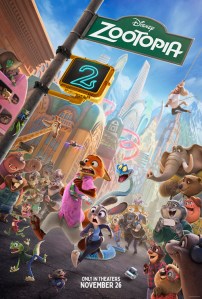 I’m genuinely shocked it took nine years for Disney to drum up a sequel to their billion-dollar “woke” allegorical hit, Zootopia. It used anthropomorphic animals living in a modern metropolis to analyze prejudice, racism, and segregation through the dichotomy of predators (untrustworthy animals beholden to vicious nature) and prey (docile animals). Specifically, it was about plucky police officer Judy Hopps (voiced by Ginnifer Goodwin) learning to work with con artist-turned-ally Nick Wilde (voiced by Justin Bateman). Now the partners are back and on another wild case uncovering yet another long-standing mystery of the city’s history entrenched in blame and suspicion of a “kind of people,” namely serpents/reptiles, who were driven out of town generations ago. There is a slight repetition in the message about looking beyond staid stereotypes and accepting other animals as equals (will Zootopia 3 be about finally accepting insects?), but when the tolerance message is essential to what made the 2016 original movie so much more thoughtful and relevant and satisfying, then keep it. The movie rises on the bickering but engaging buddy dynamic between Judy and Nick, who obviously love one another but don’t know how to admit it (consider me a shipper). The mystery tackles themes of gentrification, forced relocation, on top of its anti-prejudice and pro-tolerance foundation, so there’s plenty to unpack thematically while also taking in the visual whimsy and action slapstick. I laughed heartily at several points, including a very unexpected but transparent reference to a classic horror film complete with heavy music cues. It’s not as fresh or as finely developed as its predecessor but Zootopia 2 is further proof that this universe and its creativity can house many adventures, even if some of those plots and themes get repetitive.
Nate’s Grade: B
Share this:

KPop Demon Hunters (2025)
 I’ve watched KPop Demon Hunters four times in the last week on Netflix, so I may be a bit partial to it. Sony Animation’s newest genre-bending stunner is an action musical with surprising heart to ground the supernatural multi-dimensional battles between the forces of good and evil. Our main characters are the three young women who form the Korean pop group Huntrix; they play sold-out arenas by day and slay demons by night, working toward sealing a barrier that will protect mankind from soul-sucking demons. They meet their match when the demons form their own boy band, the Saja Boys. Handsome, charming, and media savvy, the Saja Boys begin pushing Huntrix out of the top spot and stealing their fans and their souls. It’s a cute premise buoyed by spry and colorful animation with terrifically designed and pleasing action sequences. It also helps that every song is an absolute banger, with some exceptional melodies and anthemic choruses. It may prove impossible to resist the songs, making those dastardly yet dreamy demons all the more likeable. What works just as well is the character work put into establishing the friendship between Huntrix, whose lead singer, Rumi, is keeping a secret that she is herself part demon. She finds herself drawn to Jinu, the leader of the Saja Boys, who seems more complicated than simply being a remorseless creature. He has plenty of real remorse and feeling, as Rumi has plenty of self-repression and shame, and they find the other more complex and mysteriously appealing as they feel out a possible romance. There’s a lesson here about self-acceptance and being open with the ones you love, and it’s effectively developed to the point that, during the grand climax, with the crowd chanting in unison with our ladies, affirming that solidarity, you too might get a little misty of the eye. That’s the amazing part of a movie literally titled KPop Demon Hunters: it can have you bopping your head one minute and drying your eyes the next. The animation can get exaggerated into cartoon comic absurdity (eyes literally pouring popcorn another person gobbles down), but it’s the sincerity and messages about acceptance and tolerance that rise highest. Plus there’s that music. It’s all such a vibrant blast, and it’s got the infectious jams of the summer all in a tight yet playful and poignant 90 minutes.
Nate’s Grade: B+
Share this:

Moana 2 (2024)
 It’s hard not to see the DNA of its original incarnations as a TV series for Disney Plus, as well as the awkward adjustments to slap this together into a feature film. Unless you’re a super fan of the original Moana who needs any additional content, you’ll likely have a less than impressive response to Moana 2. It feels quite episodic from villains and storylines popping up for small increments of time only to go away and be replaced by a new storyline, to a new batch of characters meant to hold our attention while other main characters, in particular Maui (Dwayne Johnson), sit out for long stretches. The animation is a notable step down as well, and while it’s still pleasing to watch and far from bad, it’s lacking the detail and refinement of the feature team, especially with lighting, as everything in this world lacks shadows with such high key lighting washing everything out. Without Lin-Manuel Miranda returning, it’s obvious the songs will not be nearly as catchy and enchanting, and the tunes for Moana 2 are pretty instantly forgettable. I’m struggling to rethink any melody right now as I write this. It’s hard not to feel like everything is so slight, from the storytelling to the visuals to the songs to the inclusion of the beloved characters from the original. I loved Moana and consider it the best of modern-day Disney, and I’m clearly not alone from the box-office dominance that the sequel was able to achieve. I actually think I would have preferred future Moana adventures as a TV series because the mythology and world has more to explore. But that version of new Moana has been transformed, Frankenstein-style, into a releasable feature film, one that suffers in the transformation into something it’s not suited for. Disney made a billion dollars from this gamut, but the rest of us are left with a Moana 2 that had much further to go.
Nate’s Grade: C
Share this:

Dog Man (2025)
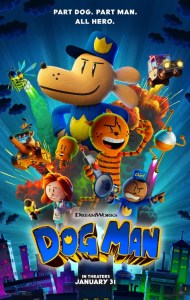 I probably wouldn’t have as much familiarity, and good feelings for the Dog Man series of books had I not become a father to a Dog Man-obsessed kiddo. The silly and imaginative comic books by Dav Pilkey, creator of Captain Underpants, are easy to enjoy with their upbeat tone, sly satire, and whimsical child-like art style. The movie is essentially all that you would want in a Dog Man movie, replaying some of the more famous stories and images and characters from some of the books. Dog Man is born when a police officer and his trusty canine sidekick get into an explosion and have their bodies surgically attached to one another becoming the ultimate crime fighter/man’s best friend. Dog Man has to battle villains like Petey (voiced by Pete Davidson), an evil cat genius, and Flippy (Ricky Gervais), a super intelligent fish with telekinetic powers as well as impress the always harried Chief (Lil Rel Howery). It’s a movie aimed squarely a children without any larger themes beyond life lessons about basic responsibility and empathy, important lessons but ones simplified and aimed at is target audience. The pacing and jokes are swift and the vocal cast is each well suited to the task, with Davidson being an inspired choice for the easily flummoxed and dastardly Petey. The material where Petey makes a child clone of himself and basically learns about parenthood is the best part of the books and could have been explored further in the movie. Still, it’s a low-stakes and goofy movie that mostly succeeds at channeling the appeal of the books. If you’re a Dog Man fan, or the parent to one, then the movie may be everything they wanted, though even at 80 minutes much longer than most bedtime reads.
Nate’s Grade: B-
Share this:

The Wild Robot (2024)
 There must be something personally appealing when it concerns movies about hopeful robots that serve as change agents to new communities. WALL-E and The Iron Giant are two of my favorite films of all time, and while The Wild Robot won’t quite enter that all-hallowed echelon, it’s still a heartfelt and lovely movie that can appeal to anyone. We follow Roz (voiced by Lupita Nyong’o), a discarded robot looking for tasks to complete on an island. Fortunately, the robot learns how to communicate with the local wildlife, including a baby goose that our robot feels responsible to train how exactly to be a goose, including how to fly before the advent of winter and the larger flock migrates. The characters are kept pretty simple but that doesn’t mean their emotions are. The movie, based upon a popular children’s book series by Peter Brown, is refreshingly mature about nature’s life cycle, not treating death like a taboo subject too dark for children. The themes of parenting, being different, and finding an accepting home through compassion and courage are all resonant no matter your age, and I’m happy to report that I teared up at several points. The parent-child relationship between the damaged robot and orphaned gosling extends beyond them, inspiring other members of the island’s food chain to work together for common goals and sustainability. There’s a late antagonist thrown in to up the stakes and provide a bit more explosive action, including a magnetic magenta-colored forest fire. The movie doesn’t quite close as strongly as it opens, but writer/director Chris Sanders (Lilo & Stitch, How to Train Your Dragon) knows innately how to execute at such a high level where even simple characters and familiar themes have fully developed stories with soaring emotions that arrive fully earned.
Nate’s Grade: B+
Share this:

IF (2024)/ The Imaginary (2024)/ Imaginary (2024)
Every so often, I find myself drawn to reviewing movies in pairs, whether it’s because of the same source material (the 2022 Pinoochios), similar perspectives (2018’s BlackkKlansman and Sorry to Bother You), or even diametrically opposed artistic responses to a similar theme (2016’s Manchester by the Sea and Collateral Beauty). However, in my twenty-five years as a fledgling film critic, I don’t think I’ve ever reviewed three movies at the same time for whatever relevancy, yet that is what I find most appropriate for this trio of exceedingly similar films about imaginary friends. Earlier in the year, Blumhouse released Imaginary, their horror-thriller take on an imaginary friend refusing to go away. At the start of the summer, writer/director John Krasinski gave us IF, a live-action fantasy/comedy about imaginary friends finding their former children as adults. And recently, Netflix released an anime movie The Imaginary, a Studio Ghibli-esque fantasy about forgotten imaginary friends trying to find new kids and new homes. I’ve elected to review all three at once and, much like the Pinnochios, declare a winner through different categories.
Begin the critical gauntlet! Bring on the (imaginary) bloodshed!
- PREMISE

Two of these movies went in a sweetly sentimental direction and the other went in the horror direction, so let’s tackle that one first. Imaginary gets at a rarely spoken truth: children can be super creepy. Watch a child hold an involved conversation with some entity that isn’t there, or just stare into the dark and say, so plainly, “That’s where the eyes are watching me,” or any number of personal anecdotes to make you shudder, and you’ll understand the significant horror potential with a malevolent creature that the child can communicate with that adults cannot see. This also lends itself to a low-budget film production as so much of the wicked entity is implicit and unseen. It’s a cost-saving genius when you can just use your, wait for it, imagination. Now Imaginary isn’t the first horror version of this premise, but it deserves points for taking a childhood concept and thinking of an effective way to transform it into a diseased and malignant antagonist, haunting its adult child Jessica (DeWanda Wise) and seeking a new child, likely her youngest step-daughter Alice (Pyper Braun). It then presents its conflict like a curse that the past generation is trying to spare the next generation from suffering through. Of course this also includes getting adults to recognize the threat as they are often dismissing it. Nobody wants to believe that Chauncey the teddy bear is the one urging you to self-harm.
The other two movies take a far more family-friendly approach to their imaginary premises. There’s a lot of shared real estate between The Imaginary and IF. Both are about outdated imaginary friends finding refuge together in a sort of halfway house, a… foster home for imaginary friends (someone should make a cartoon series about that). Both of the movies follow imaginary friends trying to find new children who will accept them and give them a new life. IF briefly follows the possibility of reuniting the forgotten imaginary friends (a.k.a. IFs) with their former owners now grown up into adulthood. This is actually the movie at its best, as the creatures find a renewed sense of purpose and reconnect with a person they cherished but had to let go. For a strange reason, Krasinski only dabbles with this poignant story direction, switching gears to find them new homes with new kids, which serves as another story direction that is also quickly ditched. IF seems to be trying on so many different versions of its premise and then discarding them like the IFs themselves. The Imaginary has more focus on its central predicament, finding new homes before these characters fade away, or worse, get eaten by a cannibalistic imaginary fiend looking to gain more years of his own existence by consuming the life force of his imaginary peers. It also has the urgency of its main character, an imaginary boy named Rudger, hoping that his child wakes up from a car accident, and if so, that she’ll still need him. The other characters are trying to set Rudger up for a life after his child, since they’ve all experienced the same fate and are trying to help him adjust to not just letting go but also being open to a new child. It’s simplified but has plenty to still explore, plus a creepy super villain.
Winner: The Imaginary
2. WORLD-BUILDING

This is what really separates IF from The Imaginary. The world of imaginary figures populated in Kransinski’s movie are cute but their larger world context is unfortunately underdeveloped. This is likely because much of the movie is connected to the personal journey of one twelve-year-old girl, Bea (Cailley Fleming), trying to keep herself busy while her father (Krasinski) undergoes vague “heart surgery.” The IF Coney Island respite feels like a secret nursing home where the discarded friends just kind of hang out. There’s even swimming and painting lessons. There’s no further examination on whether these are only the IFs from this zip code, though Bradley Cooper voices a talking glass of ice water whose child originated in Arizona, so that’s undetermined. I was also hoping for an imaginary friend from decades back, like Franklin Roosevelt or Alexander Hamilton’s imaginary friend, or from other countries. Each character design can say something inherently about their past child creator, what they regarded as fulfilling or lacking from their present. Alas, the world-building is mostly one little girl’s discovery of her new friends and then how they ultimately support her with her family predicament looming over every scene. Seriously, for a father going through major surgery, the family in IF is pretty blase about Bea’s whereabouts. Her grandmother (Fiona Shaw) doesn’t seem too pressed about letting an unattended adolescent run around New York City for hours. Bea’s experience with helping the IFs are reflections of her optimism and hope. It all comes back to her, so the movie chooses to ignore the larger possibilities of its magical unseen world.
The Imaginary feels modeled after the Studio Ghibli movies that have delighted children and adults for generations. Its main character is Rudger, an imaginary friend, and not the child who birthed the imaginary friend, Amanda. That creates a different sense of discovery, as Rudger also learns about the hidden library housing other imaginary friends and the rules. He’s to stare at a bulletin board and await a prospective child he feels a connection to, then holds onto a picture of them to transport into the child’s imaginative play where they can contribute to the creative adventure. However, there are dangers like if you die in the imaginary world, you can die for real, which is never fully explored as a real threat. The imaginary characters are told to stay indoors at night, as they don’t want to run into Mr. Bunting, the cannibalistic antagonist. I got a little lost with the different rules, some of which seemed to be emphasized more or canceling out previous rules, but I appreciated the level of thought given to making its world alive.

This is also where Imaginary begins to get lost in its own hazy imagination. Imagine the bedroom door-hopping mechanic from Monsters Inc. but with the narrative formula of Insidious, and there you have Imaginary. The world of imagination is treated very similarly to a hellish dimensional getaway, much like what happens in Insidious where dad had to retrieve his son in the demon’s phantasmagorical realm. Because the spooky imaginary world relates back to the main character’s childhood, we have a few other characters that have history with this trauma. Jessica’s father Ben has been committed to a hospital and seemed mentally ill, until you realize he rescued his little girl from evil Chauncey and lost his mind in the process. He’s not some lost cause, he’s a hero. Also, there’s a former neighbor and babysitter (Betty Buckely, always welcomed) who is obsessed with childhood psychology and willing to do some extreme things to continue her obsession with Chauncey. It’s at least widening the scope to look at how these traumatic events have impacted other people, not just the little girl bottling up those nightmares. However, beyond the simple explanation of Chauncey existing as a parasite feasting on the imaginative power of children, little else is established about the creature or its own world. At one point, a character relishes the possibility of imagination as a wish-fulfillment service, but why would this evil creature delegate its power? It reminds me of all sorts of other movies where characters side with some apocalyptic power thinking they’ll somehow be the lucky exception.
Winner: The Imaginary
3. CHARACTERS

This is where IF shined the brightest. The little girl is cute and optimistic, a fitting tonal foil to Ryan Reynolds being such a loquaciously sardonic naysayer. She wants to be so helpful, though keeping herself so busy might just be her coping mechanism to try and stop her dreadful encroaching thoughts about the possibility of losing her second parent. Her taking the lead to help the IFs then allows for little episodic asides for the different characters to share their stories and their former creators. Having a protagonist be so driven at being empathetic is a natural conduit for championing the feelings and triumphs of others. It works. Reynolds is still doing his fast-talking cynical schtick, so your mileage will vary how well it continues to appeal. Curiously, I don’t think the character of Blue (voiced by Steve Carell) is fully utilized. He’s a more childlike exaggeration of the character features already provided by Bea’s involvement. Blue resembles the McDonalds’ Grimace, and is outwardly friendly, unafraid of big emotions, and a bit silly, but his elevation in the script as being the primary IF sidekick is arbitrary. The same story could have afforded tapping, say, the excitable unicorn (voiced by Emily Blunt) as the primary sidekick and produce similar results. Again, I think there’s so much that could have been further explored as to the existential requirement of the different imaginary characters, how they represented what their former kids felt they needed. Their exact existence was what a child yearned for (the strong IF to protect the child who is afraid, the squishy lovable IF to comfort a lonely child, etc.).
The characters from The Imaginary fall into general archetypes that any Miyazaki fan will be familiar with. There’s the bossy know-it-all, the excitable goof, the silent contemplative, the wise and warm-hearted authority figure, the dangerous rogue. They all work but it’s the larger themes that resonate more than any specific individual character. Mostly, the conflict is whether Rudger decides to move on from his creator and find a new child/home. He has loyalty and emotional attachment to little Amanda but the reality is that, at some point, she will grow up and he’ll be left behind. Whether that happens now, because she passes away, or years later through becoming an adult, there will be a parting and he will need to consider a new life. The loneliness and melancholy of this existence is ignored through the kooky characters, strange worlds, and pressing points of danger, so the reality of Rudger’s eventual loss is thematically sidelined.

With the Blumhouse Imaginary, the characters are relatively stock types for a supernatural horror mystery. There’s some effort to make it about Jessica trying to ingratiate herself with her new step-children, the oldest who looks at the new mom with great suspicion and resentment. At one point, the old mom serves as a jump scare, hiding in the house; the old mom is mentally ill but the stepdaughter thought, erroneously, that mom was “getting better.” Jessica is trying her best to rise to the challenges of being a parent, but it’s hard when there’s a sneaky ghost trying to emotionally manipulate your youngest to hurt herself. I don’t know why Jessica decided to move her new family back into her childhood home, the source of her trauma, except if you looked at the real estate market, it might have been by far the best deal she could swing. What’s some reawakened childhood trauma when it comes to skipping ballooning mortgage payments? Have you seen interest rates and the price of houses post-pandemic? That’s the real terror for adults.
Winner: IF
4. EMOTIONAL INVOLVEMENT/CONCLUSIONS
Despite what Pixar may have set in stone, it’s not a requirement for a children’s movie to make you cry. I did end up tearing up from two of these movies, and it should likely be obvious which of the three was the outlier. Krasinski’s movie is designed as a big warm hug, complete with soothing, milky light pouring in from every setting. I thought it looked very similar to how Steven Spielberg’s preferred cinematographer, Janusz Kaminski, shoots natural light, and lo and behold Kaminski was the cinematographer for IF (excuse my pat on the back here). Bea’s big emotional moment where she tells her story of adventure to her unconscious father in his hospital bed pulled some heartstrings, but what I felt even more emotionally cathartic were the asides where Bea helps the IFs reunite with their former kids. When an IF is being thought about, they start to glow from within, like happiness radiating out. It was these little moments, like Blossom (voiced by Phoebe Waller-Bridge) getting to dance with Bea’s grandmother like they used to, or the simple act of Blue wishing good feelings to his nervous former-child with a silent shoulder touch and world-clarifying exhale. It was the acknowledgement that these friends, while gone, are still fondly remembered, and that they will always have that connection even if their exact relationship has changed through the years. The Imaginary operates on a similar emotional wave of adults reuniting with their former childhood friends, and it’s that sweet acknowledgement of appreciation and love that hits hardest. It reminded me a little bit of 2001’s Amelie where she’s on a mission to help strangers remember beloved items from the past. The overarching worry about losing her father seems unnecessary as a complication, especially how “heart surgery” is kept so purposely vague and seemingly uneventful until that bedside chat. There is a difference between wanting to protect your kid from the possible trauma and downplaying it to the point where it becomes a strangely superfluous plot device.
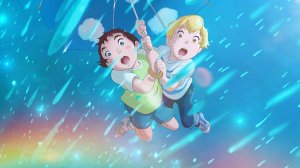
I won’t pretend there’s much to get emotional over with the Blumhouse Imaginary, though there is one Act Two twist I thought was simply astounding, but in order to explain I will need to go into spoilers, so you have been warned, dear reader. For a solid hour, we watch Alice play with a teddy bear that she calls Chauncey, the embodiment of her imaginary friend. So far so good. Then after a disturbing session with a child psychologist, the professional shows Jessica her recorded session. This is where we discover that Chauncey the bear… has never been there. Alice has been talking to the unseen entity of Chauncey and Jessica has been the only person who was seeing a teddy bear. That’s right, the twist is that the bear was never there. Bam.
Winner: IF
Three imaginary friend movies and the exploration of the meaning these figures have to children and adults after years removed. I had my quibbles with each movie, but with adjusted expectations, each movie can supply a degree of entertainment. The animation in The Imaginary is gorgeously fluid, so that alone will prove a draw to hand-drawn animation fans such as myself. Krasinski’s family film is gooey at its well-meaning core though it has underdeveloped avenues I wish had been given more articulation and exploration. The Blumhouse Imaginary movie is fairly formulaic but has a couple enjoyable twists and turns, even if they’re ridiculous. There is a potent storytelling reservoir with imaginary friends, both benevolent and malevolent, so I imagine (no pun intended) this won’t be the end of these stories making their way to the big screen.
Nate’s Grades:
Imaginary: C
IF: B
The Imaginary: B
Share this:

Robot Dreams (2023)
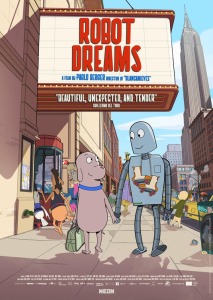 What a delightfully tender little movie Robot Dreams proves to be. It’s based on a picture book and its story is mostly about a lonely Dog who orders a build-your-own-robot for companionship and their friendship. Much of the movie hinges on the Robot being trapped on a Long Island beach closed for the season, so our intrepid Dog must go on living in his New York City apartment through the seasons while he waits to rescue his friend. The movie is wordless and based upon a picture book, but that doesn’t mean this is chiefly kid’s stuff. It touches upon the profound with such elegance and efficiency, brilliantly relatable and recognizably human. It’s all about our need for connections, and even when they are separated, both the Dog and Robot find other connections with other characters, and then it comes back to our worry that they won’t actually reunite after being apart for the majority of the movie. I was reading some gay coding between the two as well but maybe that was my own projection. My nine-year-old son was quite taken with the movie and could easily follow along, though he was also very much not a fan of the bittersweet ending, his first taste of providing the whole “what you need, not what you want” conclusion. Robot Dreams is lovingly realized, its animation so clean and crisp with wonderful characters populating an alternative 1980s NYC. It’s simple and sweet and irresistible.
Nate’s Grade: A-
Share this:

The Boy and the Heron (2023)
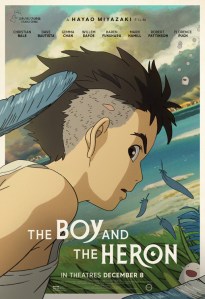 It’s been over ten years since renowned animation legend Hiyao Miyazaki graced the silver screen with what was believed to be his last film yet the retirement didn’t kick, for the benefit of all of us. I’ve resisted watching 2013’s The Wind Rises simply because of the melancholy of it supposedly being his final film. The man is in his 80s and still hand draws much of his storyboards, so if indeed this is the last Miyazaki movie we ever get, it ties thematically with many of the concepts and interests of this man’s storied career that it feels like a fitting capper. It’s his most autobiographical, following 12-year-old Mahito as he relocates to the country after surviving the firebombing of Tokyo during World War II. Unfortunately, he lost his mother in the bombing, and now his father is remarrying his mother’s younger sister, who looks near identical to Mahito’s mother. On the grounds of his new home, the boy discovers a strange overgrown tower with a door that leads to another world, and it’s within this world that a creepy scary bird promises Mohito can find his mother again. The Boy and the Heron is an imaginative and transporting fantasy with some major themes around the edges about grief and acceptance and environmental disaster, but it’s the haphazard structure and poor pacing that hold it back for me. Simply, it’s too long to get going and then too short to conclude. We don’t exit to the hidden fantasy world until almost halfway through, and the time in the regular world is stretched out, especially without going into further detail about our protagonist, who is kept very opaque. The discovery of the new world and learning its strange mostly bird creatures and rules and conflicts is where the movie really gets interesting, especially once the menacing heron becomes a squat man serving as our reluctant guide. It feels like there’s going to be some heavy revelations forthcoming, especially with the supposed duplicate nature of Mohito’s mothers, but it all comes down to an aged Man Behind the Curtain with a reveal straight out of Willy Wonka and the Chocolate Factory. We take too long to get to that intriguing fantasy world, and then once we’re there it feels a little too surface-level in design for a world on the cusp of dying. Then it’s a mad scramble to leave, and while the culminating decision feels earned in its wisdom, it also feels like the movie has simply run out of ideas. The Boy and the Heron is beautifully animated; the world feels like it’s undulating before your eyes, and there are numerous moments that allow it to breathe. However, it feels like maybe we could have gotten started sooner and finished a little later. Even mid-level Miyazaki is better than most, so The Boy and the Heron is still a worthwhile animated fantasy even if it doesn’t reach masterpiece status from a master storyteller. At least now I can finally watch The Wind Rises, so there’s that too.
Nate’s Grade: B
Share this:

Teenage Mutant Ninja Turtles: Mutant Mayhem (2023)
 As an elder millennial, the Teenage Mutant Ninja Turtles have been a formative franchise for me. I grew up on the cartoon, got the toys for Christmas, died endlessly during the shockingly hard underwater stage of their Nintendo video game, and generally have a soft spot in my 80s nostalgia for the likes of Leonardo, Donatello, Raphael, and Michelangelo, plus their surrogate father, Master Splinter. Apparently Seth Rogen felt the same way, and he and his writing partner Evan Goldberg have spearheaded a new animated variation of TMNT that just so happens to also be co-written and directed by the man behind my favorite film of 2021, The Mitchells vs. The Machines. It was a recipe to guarantee my personal enjoyment, and Mutant Mayhem thusly delivered. The biggest selling point for me was how lovingly realized the “teenage” part of the title was, getting a foursome of actual adolescents to portray our heroes, and using high school experience about acceptance and fitting in as effective and even poignant parallels. I loved just hanging out with these characters, who view their surrogate dad (voied by Jackie Chan) with a mixture of love and embarrassment, and who want to be accepted by a world predisposed to finding them monstrous. Naturally, becoming crime-fighting heroes is their best method for winning over the public, with a young and aspiring journalist April O’Neil (The Bear‘s Ayo Edebiri) hoping to improve her own social standing at school by breaking the existence of these unknown mutants. The comedy is robust and layered while allowing for nice character details and moments, giving each turtle their own satisfying arc. The action is fun and inventively staged while still being thematically relevant. The vocal cast is great, and the young actors are tremendous together, sparking an enviable improvisational energy that made me smile constantly. The art style has an intentional messiness to it, like smeared colored pencil drawings, and the imperfections are themselves part of the vast visual appeal. It’s a family movie that will succeed with old fans and new, and Mutant Mayhem is the best film depiction yet of the famous heroes in a half-shell.
Nate’s Grade: B+
Share this:

Nimona (2023)
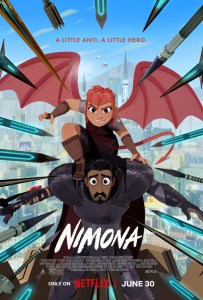
Based on the graphic novel by ND Stevenson (She-Ra), itself a web comic from 2012-2014, Nimona was developed by Blue Sky Animation Studios and originally scheduled to be released in 2020, and then Disney bought Fox, shut down Blue Sky, and pushed back against the gay content of Nimona before just canceling it altogether in 2021, and then Netflix came in and saved the project and released it, gay and all, during the last day of Pride Month. It’s been a long, protracted journey for Nimona to get to your screen and, reader, it was worth it. The movie is a rambunctious and revisionist fairy tale that is both subversive and deeply sincere, enough so that an emotional confrontation of accepting someone on their own terms elicited genuine tears on my part (for those keeping record, that’s three straight animated movies in the month of June that caused me to cry). Nimona (voiced superbly by Chloe Grace Moretz) is a high-energy prankster in a fantasy world melding Medieval culture with future technology. She befriends a fellow outsider, Ballister (voiced by Riz Ahmed), after the kingdom views him as a wanted villain. Together, they try and clear Ballister’s name by finding the real killer, and maybe they can wreck some stuff too just for fun. The cell-shaded style, a familiar aesthetic in the realm of video games, adds a bright and slickly appealing quality to the animation, and the frenetic pace and anarchic humor keep the movie bristling with entertainment, while the emotional core (vulnerable outcasts finding community) sneaks up on you and delivers a more resonating climactic finish than simply vanquishing a baddie. The ending even has rich thematic notes of The Iron Giant, which is never a bad influence. The queer content is also treated without sensationalism and treated as any other aspect of human compassion. The heart and message are just as impressive as the visuals and the humor. Nimona is a funny all-ages adventure that deserves its big screen moment after its long gestation.
Nate’s Grade: B


 nathanzoebl
You must be logged in to post a comment.