Blog Archives
The Butterfly Effect (2004) [Review Re-View]
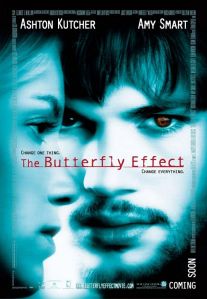 Originally released January 23, 2004:
Notice: I found Ashton Kutcher, star of The Butterfly Effect, on a trip to buy dog food, and cordially asked him to write a review. This is what he sent me. It’’s totally him. I wouldn’’t make this stuff up. That would be dumb.
“So, like, this Nate guy asked me to do a review of my new awesomest movie, The Butterfly Effect. Dude, like anyone needs a review for the most awesomest movie ever. I mean, like, the term ‘awesomest movie ever’ should say, like, everything. The only thing possibly more awesome than The Butterfly Effect would be trucker hats …… or two chicks totally making out. And I only said ‘possibly more awesome,’ which doesn’’t mean it is more awesome, because, dude, like I said before, The Butterfly Effect is the most awesomest thing ever. You can’t dispute that. Don’t even try. I’m awesome!
Like, the story goes like this, man. I play this guy, like I know big stretch there, but he’s not the most awesome guy ever, which is what you’d be thinking since it’s the most awesomest movie ever. But no, he’s like this kid who blacks out and has this wickedly twisted childhood where he stars in his neighbor’s kiddie porn, has his dog set on fire, and, like, his dad is all crazy, or, like I like to say, insane in the ole’ membrane. Ha, I totally made that up right now. I’m awesome!
So, you’re like saying, ‘Dude, that movie sounds less than awesome. Yes, sir, I am having definite doubts about the awesomeness of this movie. Like, do I need to go to the movies to, like, feel bad? I got my parents to do that for me. That and school.’ Hey man, I’m there, I know what you feel. ‘Cause right when you are like, ‘Dude, when is Demi gonna’ show up playing his mom?’ I find these old journals of mine and, dude, use them to travel back in time. I know, the awesomeness has returned. And I use the journals to go back and try and punk time, man. I try and make things better and change the future but I like totally just make it worse. I know, double punk’d, man! I try and fix the life of this hot girl in the movie (she showed her boobs in that Road Trip movie, did you see that? That part where she shows her boobs, oh man … It is awesome) but things don’’t work out. Like she becomes a crack ho at one point. Dude, total punk’d. I’m awesome!
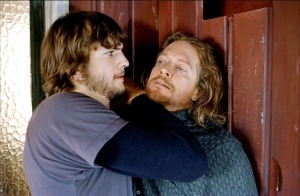 I should be taken as a serious actor. I didn’t hit my head on something and I grew a beard, what more do people need to know I got the goods? I mean, I don’t want to keep saying it but …… beard. C’mon! When actors want to be taken seriously they, like, grow beards. That’s why all those people in movies before 1970 (I know, it surprised me too that there were older movies) got awards and stuff. Beards, dude. Beards. When Billy Dee Shakespeare, like, invented acting, he totally imagined dudes, and chicks too, with beards. That’s why girls can’t be taken as serious actors, ‘cause they can’t grow beards. Ha. I’m awesome!
So, like, if you ever wondered what it would be like to see me, Ashton Kutcher, the most awesome man alive …who ever lived, no… the most awesome human being …-the most awesome thing …- ever, as a frat boy, or like, some poor dude with no arms, then you should see my new movie, The Butterfly Effect. After all, it is the most awesomest thing ever. That’s awesome. So, like, you people reading (is that what school is for?) should go see my movie. I’ll tell you why in two words: beard.”
Nate’s Grade: C+
——————————————————
WRITER REFLECTIONS 20 YEARS LATER
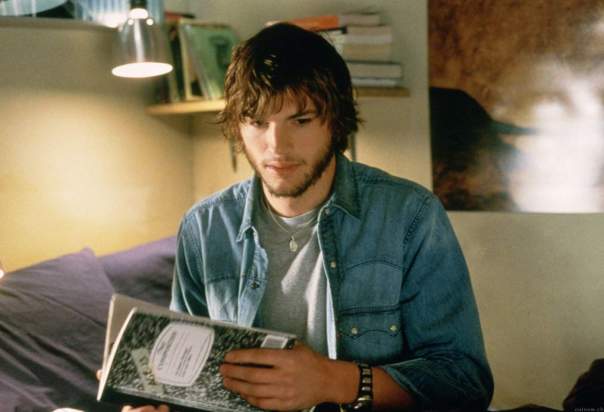
It’s hard to remember but there was a time where Ashton Kutcher was the king of the early 2000s universe. He had parlayed his excitable supporting character on a late 90s network sitcom into a successful movie career top-lining wild comedies, and he had also found success as a producer, bringing new life to the hidden camera prank TV show with his eponymous Punk’d where many of his celebrity friends would be victimized for the lols. The man even single handedly made goofy trucker hats a fashion mainstay. I know we haven’t seen much of the Kutch in a while, as he’s settled into his non-profit charities and being a family man, ceding the spotlight to his wife and former sitcom girlfriend, Mila Kunis. The Kutcher brand was stronger than ever at the time of The Butterfly Effect, enough so that Kutcher signing on as an executive producer was what finally got this widely read industry script to finally get made. You must view The Butterfly Effect as a point not just in Kutcher’s career but also in millennial edge-lord culture, the concept that anything dark is therefore compelling, and the more twisted the better. Re-watching the movie twenty years later, I wanted to laugh out loud at so many points because The Butterfly Effect is so serious while being so silly as it plumbs every depth of misery, both for its characters as well as any potential audience members still keeping track of the messy metaphysics.
Kutcher plays the adult version of Evan, a kid who has had quite a challenging upbringing to put it mildly. Mom (Melora Walters) is doing her best while Evan’s father is locked away in a mental asylum, and she’s worried her child might have inherited dad’s instability. He blacks out for extended periods and is found holding a knife or having drawn a horrible massacre at school, and even worse neighborhood tragedies (oh, I’ll get to all of them). A psychiatrist advises him to start journaling as a therapeutic means, and so he does, and when adult Evan reads his childhood journals, the words become blurry and he’s able to travel back in time to those exact moments. With this great power, adult Evan tries to right the wrongs of his life and those around him, but as all time travel stories are destined to discover, there are cruel unintended consequences to endure.
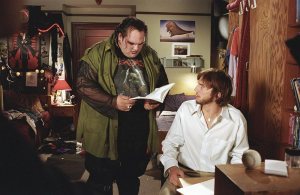 Watching this movie is like watching a checklist of events that producers thought would be dark and grisly and So Messed Up, but this movie is so self-serious that it could be a parody of what a moody teenager would think of as a “mature movie.” Let me just list some of the content the movie covers: the drunken dad next door (Eric Stoltz) is a pedophile who records his daughter and son and Evan in child porn, the kids put a firecracker in a mailbox that blows up killing a mother and her baby, an angry kid kidnaps Evan’s dog and ties him in a bag and literally sets the bag on fire killing the animal, lots of violence against young children including murder, attempted suicide, disturbing behavior in children including traumatic self-harm at school, prison rape, multiple mental asylums, disfigurement and disability, prostitution and addiction, and in the original ending, the one I re-watched, a fetus literally strangling itself with its own umbilical cord rather than being born. Wow. Just… wow. This movie is only two hours and it crams enough sundry melodrama and grimdark grist to fill out a month of the grimiest soap opera ever. Because of the sheer amount of disturbing content, every new provocative addition makes the movie’s tone teeter further and further into unintended self-parody. Once you’re starting to process the homegrown child pornographer, the movie throws animal cruelty at you, and so on. It’s not enough that Evan had a bad childhood of trauma, but does he have to experience all the traumas?
Much of the movie follows Evan’s morose quest to improve the life of his unrequited love, Kayleigh (Amy Smart as the adult version). He runs into her after several years apart and merely bringing up the past with her pedophile father filming the two of them propels her to kill herself off-screen. She’s literally introduced in one scene and then in the next she’s dead, and it’s all Evan’s fault, so says her angry brother via the answering machine clunkily informing us. Evan goes back and stops her dad from molesting her, so now dad only molests her brother Tommy instead, who Evan kills as an adult defending himself. He travels back in time and now her brother is dead and she’s become a heroin-addicted hooker and that won’t do. He travels back again and manages to improve the lives of Kayleigh, Tommy, and their friend Lenny, except in this timeline Lenny and Kayeligh are the romantic couple and Evan has no arms, having lost them in the childhood mailbox explosion. He travels back again and this time Kayleigh gets blown up as a child. Ultimately Evan concludes he cannot save her and have everything he wants, so he makes some form of sacrifice by the end; in the theatrical cut, young Evan upsets her so she chooses to live with her mother rather than her pedophile father, and in the director’s cut, he ensures Kayleigh will never meet him by killing himself in the womb (his mother reveals she’s had multiple miscarriages, leaving the impression other future siblings have done the same). I appreciate how the filmmakers have streamlined their convoluted time travel tale into a simple task of trying to get the girl, but it also becomes so overwrought that I wanted to shake my head and sigh.
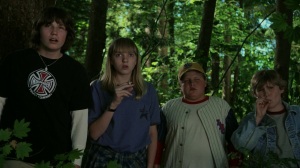
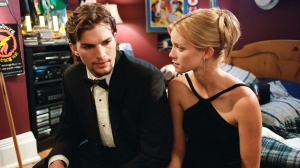 These characters are put through an emotional and often physical grinder, so it’s hard not to feel sorry for them. I long felt the film’s contempt for Kayleigh ever since young Evan (a young Logan Lerman) tells her, “You don’t even know how beautiful you are,” like she’s so stupid to see the obviousness of his compliment. I think dark comedy is the best way to read the movie, laughing along the way as Evan fails time and again to improve the lives of everyone through his space-time interventions. He can save this kid but doom his mother to lung cancer. He can save this person but is locked away in prison. It’s a no-win scenario for Evan, so he decides it’s better if he was never born, negating all the possible good he’s done in his life, including maybe being a force that could keep Kayleight from living with her dad. Maybe not having that friend and an advocate push her into that decision doomed her to a life of molestation, so way to go Evan.
I kind of loathe the time travel method in this movie but at least it provides a limitation that works within the universe of The Butterfly Effect. He can only travel reading his journals, which means he’s stuck in whatever nightmare timeline he’s responsible for unless he can recapture some part of his childhood scribblings. Reading them aloud is also an unexpected source of dark comedy because it makes me question how forthcoming a child of trauma would be about writing down his experiences in simplistic shorthand (“So today Kaleigh wasn’t feeling so good. Her face blew up. I was sad”). I did like that this inherited disorder provides more mystery to his family line, a source of material not covered in either of the Butterfly Effect direct-to-DVD sequels unrelated to Evan’s troubled story. This is perhaps the second worst method of time travel I’ve found in the movies after 1980’s Somewhere in Time where Christopher Reeve uses the power of positive thinking to convince himself he’s in 1912, and lo and behold he shall be.
 Watching this movie is like revisiting a Goth phase you had as a brooding teenager but have since considered a point of embarrassment (not that being Gothic is something to be ashamed of, simply that it was an overzealous step in asserting a misguided sense of what being a mature adult meant, generally disaffected and cynical and edgy for its own attention). The Butterfly Effect is an endless improv game of “yes and” where the proceedings only get worse. My original review in 2004 was one of my more unconventional reviews, and I just wanted to adopt my perception of the “Kutcher brand” persona of the era and make a bunch of dumb jokes, several of which I’m not too ashamed to admit still made me chuckle (“two words: beard.”). I’d lower my grade a tad but there is still a car-crash fascination of watching a movie try so transparently hard to be so twisted.
Re-View Grade: C
Share this:

The Butterfly Effect (2004)
Notice: I found Ashton Kutcher, star of The Butterfly Effect, on a trip to buy dog food, and cordially asked him to write a review. This is what he sent me. It’s totally him. I wouldn’t make this stuff up. That would be dumb.
“So, like, this Nate guy asked me to do a review of my new awesomest movie, The Butterfly Effect. Dude, like anyone needs a review for the most awesomest movie ever. I mean, like, the term awesomest movie ever should say, like, everything. The only thing possibly more awesome than The Butterfly Effect would be trucker hats … or two chicks totally making out. And I only said possibly more awesome, which doesn’t mean it is more awesome, because, dude, like I said before, The Butterfly Effect is the most awesomest thing ever. You cant dispute that. Dont even try. Im awesome!
Like, the story goes like this, man. I play this guy, like I know big stretch there, but he’s not the most awesome guy ever, which is what you’d be thinking since its the most awesomest movie ever. But no, he’s like this kid who blacks out and has this wickedly twisted childhood where he stars in his neighbors kiddie porn, has his dog set on fire, and, like, his dad is all crazy, or, like I like to say, insane in the ole membrane. Ha, I totally made that up right now. I’m awesome!
So, you’re like saying, ’Dude, that movie sounds less than awesome. Yes, sir, I am having definite doubts about the awesomeness of this movie. Like, do I need to go to the movies to, like, feel bad? I got my parents to do that for me. That and school.’ Hey man, I’m there, I know what you feel. Cause right when you are like, “‘Dude, when is Demi gonna show up playing his mom?’ I find these old journals of mine and, dude, use them to travel back in time. I know, the awesomeness has returned. And I use the journals to go back and try and punk time, man. I try and make things better and change the future but I like totally just make it worse. I know, double punkd, man! I try and fix the life of this hot girl in the movie (she showed her boobs in that Road Trip movie, did you see that? That part where she shows her boobs, oh man … It is awesome) but things don’t work out. Like she becomes a crack ho at one point. Dude, total punkd. I’m awesome!
I should be taken as a serious actor. I didn’t hit my head on something and I grew a beard, what more do people need to know I got the goods? I mean, I don’t want to keep saying it but …
beard. C’mon! When actors want to be taken seriously they, like, grow beards. That’s why all those people in movies before 1970 (I know, it surprised me too that there were older movies) got awards and stuff. Beards, dude. Beards. When Billy Dee Shakespeare, like, invented acting, he totally imagined dudes, and chicks too, with beards. Thats why girls cant be taken as serious actors, cause they cant grow beards. But dude, don’t tell that to Demi, because she totally has one wicked ferocious beard, if you know what I mean. Ha. I’m awesome!
So, like, if you ever wondered what it would be like to see me, Ashton Kutcher, the most awesome man alive who ever lived, no the most awesome human being -the most awesome thing - ever, as a frat boy, or like, some poor dude with no arms, then you should see my new movie, The Butterfly Effect. After all, it is the most awesomest thing ever. That’s awesome. So, like, you people reading (is that what school is for?) should go see my movie. Ill tell you why in two words: beard.”
Nate’s Grade: C+
Share this:

The Battle of Shaker Heights (2003)
 Ben Affleck and Matt Damon, being the egalitarian champions we all know celebrities to be, started a contest called Project Greenlight that allowed aspiring screenwriters to enter for a chance to have the winning script made into a movie by Miramax and the process documented for a behind the scenes reality show to run on HBO. Project Greenlight‘s first winner was the hapless Pete Jones. His winning screenplay gave birth to Stolen Summer, a maudlin coming-of-age story about a Catholic boy trying to get his ailing Jewish friend into heaven. You can feel the grating precociousness already. While Stolen Summer was an artistic yawn the HBO series was a hit as we the viewers saw every stupid mistake, naïve decision, and screaming matches during the production. Pete Jones’ pain was our gain.
Unlike the first contest, this one had a separate entry for directors and the tag-team of Efram Potelle and Kyle Rankin were picked to direct the winning screenplay The Battle of Shaker Heights, by Columbus, Ohio (represent) grad student Erica Beeny. Project Greenlight on HBO showcased the tension created by these butting heads. Beeny seemed ready to meltdown at a moments notice, probably because she let her good nature be taken advantage of by the egotistical, passive-aggressive, non-communicative, hilariously self-absorbed directors. This raises the question; did Affleck and Damon pick the best people or the people most likely to create the best television?
 Once again, the winning screenplay involved a coming-of-age story, this time revolving around the life of Kelly (Shia LeBeouf), a glib teenage war re-enactor. Kelly befriends Bart (Elden Henson) during a battle reenactment. Bart is from a wealthy Wasp-y household where his college is already predetermined. Kelly, on the other hand, must sullenly deal with his father (William Sadler), a former junkie who wasted away his college fund, and his flighty mother (Kathleen Quinlan). Bart and Kelly scheme to teach a schoolyard bully a lesson, and in the process Kelly starts falling for Bart’s attractive older sister Tabby (Amy Smart).
The character of Kelly doesn”t seem to have any deep reflections of life or anything of substance, just wicked one-liners. The fact that Kelly comes off as a sympathetic hero goes fully to the charming LeBeouf, who displays a laid back sense of humor and allure that is reminiscent of a young John Cusack. LeBeouf gives a star-making performance that keeps the audience engaged, even if the story is turning them off.
One of several problems Shaker Heights suffers from is that the finished product is a one-man show. Kelly is such a dominating character, a whirlwind of misplaced rage that everyone that gets in his path suffers. His relationship with Tabby seems like nothing more than unrequited puppy love that doesn’t need so much screen time being spent on a tired will they or wont they diversion. Kelly’s parents come off like theyre invisible. If you blink you may miss their entire time on screen. The father is more an absent force to drive Kellys angst, while his mother doesn’t seem to have any purpose or influence whatsoever.
 Shaker Heights feels like a film made by committee because as Project Greenlight astutely documented it was made by a committee. Miramax executives decided they could sell the film better as a pure comedy so they removed most of the winning screenplays drama. So now, with this new incarnation of Shaker Heights, the comedy never really emerges from more than a handful of superficially cute lines, and whenever a bit of drama does emerge it seems alien and disorienting. The heavy-handed direction by Potelle and Rankin paints in broad strokes, so the dramatic efforts come off as forced and overblown when they sneak up on an audience.
This incarnation of the movie may be entertaining to some, but with these cuts and directorial choices Shaker Heights seems horribly ordinary. Kelly is a disaffected teen with smart-ass comments; he lusts after the older girl who, of course, is with a supposed loser; his parents just don’t know what to do with him. The story is dulled down and all the edges seem polished off, and what an audience is left with is scenes, characters, and a story we’re already well familiar with. Does Project Greenlight seem to have a desire to select coming-of-age stories and then water them down to the point of distilling any original voice? The only interesting diversion in Shaker Heights is the war reenactment section, which is tragically too short.
The Battle of Shaker Heights is another theatrical dud from the Project Greenlight crew. Fans of teen melodrama might get some moderate enjoyment from it, but realistically, the only people who are going to pay any sort of money to see Shaker Heights are the people who avidly followed the Project Greenlight TV series. And in the end, one cant shake the feeling that The Battle of Shaker Heights ultimately feels like a disappointing season finale to Project Greenlight.
Nate’s Grade: C+


 nathanzoebl
You must be logged in to post a comment.