Blog Archives
Roma (2018)
 Alfonso Cuaron won a bushel of Oscars for his last groundbreaking project, 2013’s lost in space epic, Gravity, and one of the most daring and innovative filmmakers working in cinema had what every artist craves — cache. He could do whatever he wanted with his earned credits. And so Cuaron told a personal story about growing up in Mexico City, a love letter to his own nanny. Roma follows the life of Cleo (Yalitza Aparicio) for most of the year 1971, through her ups and downs and the loping rhythms of domestic life. This review is going to come across sounding far more critical than I intend. It’s mostly because I’m trying to deduce why my own experience with Roma was not the rapturous, transformative experience that my fellow film critics have sang. It’s a good movie but I’m trying to pinpoint why it kept me from fully engaging, or what within me stopped from engaging further. I think it stems from the central intent of the film and its overall perspective that proves too limiting for my tastes.
But first the good and the exquisite. Roma is a lusciously photographed and composed movie that brilliantly recreates the time and place of Cuaron’s childhood with stunning black and white photography (Cuaron serves as his own cinematographer for the first time). There are moments that are stupendously put together, pulled directly from Cuaron’s impeccable memory. Sometimes these even stem into the surreal, like a forest fire that features a man in holiday costume singing to himself while life and the flames rage on behind him, the chaos of the moment centered on a beautiful focal point. There’s an extended sequence of a car trying to park down a narrow driveway that becomes a symbol of unchecked manhood. There’s a riot that feels like it is being captured live, even though your brain tells you it’s the work of hundreds of people all coordinated to bring about Cuaron’s vision. There’s even a subtle (maybe not so subtle) nod to Gravity at the local movie theater. There is one family relative who garishly hangs the heads of dearly beloved dogs from the past as if they were hunting trophies. It’s a peculiar and striking detail and something that carefully tells you more about a side character. Then Cuaron cleverly cuts to the current canine being pet, establishing the connection of present and future as well as past and present, an achingly affecting theme throughout the film, trying to better understand our beginnings and the people who impact us.
 You can tell he has great affection for the women often responsible for the upbringing of children in rich homes. Cleo is the main character of Roma and given humble life by first-time actress Yalitza Aparicio. She’s very passive and selfless to a fault, but her actions demonstrate the care she has for the family she works for, especially the younger children. The emotional thrust of the film is Cleo’s unexpected pregnancy. She’s single, young, and worried it might cost her employment. It’s a difficult decision and the would-be father, a friend of a cousin, seems to want nothing to do with this new responsibility. There’s a moment late in the film, filmed in Cauron’s signature long takes, that breaks your heart, forcing the audience into Cleo’s position where she is struggling for meaning as an agonizing reality sinks in. Aparicio shows that she is more than capable of communicating larger emotions when given the opportunity.
And yet, I kept waiting to be truly transfixed, and waited, and ultimately I found myself enjoying Roma but more as a lyrical long form memory piece from someone else’s life than as a functioning drama. This is a love letter to Cuaron’s childhood nanny (it’s dedicated to her by name) and it’s a recreation of his childhood memories, which makes it deeply personal and lovingly realized from the basis of plucking fully formed moments and bringing them to startling life. The visual arrangements, movements, and bustling activity of life feel beautifully reconstructed. The problem starts to be that the movie feels like a series of moments rather than a larger story, and the argument for many will be that this is by grand design, that Cuaron is intending to comment upon the nature of life and memory through the smaller details, the kind that find their sticking places in our senses, and I do not dispute this intention. However, the end result can approach feeling like watching someone else’s dream of their past, a collection of home movies. The entry point for an audience member is going to be narrower because we didn’t live these memories.
Roger Ebert said that cinema was an empathy machine and with the right storyteller an audience should have no problem being able to experience a plethora of emotions and experiences from a wealth of characters in an array of circumstances and settings. The added problem with Roma is that Cuaron purposely chooses an outsider perspective but also choosees to film it as an outsider. Cleo is an outsider presence, which is a good starting point for drama and contrasts. She’s an indigenous Mexican, working poor, and the family member who isn’t really family. She floats through different communities feeling like she doesn’t fully belong, reminded of what sets her apart and unable to fully immerse herself in her surroundings. She’s left her family, her old way of life to move into the city and be a surrogate parent, and when she becomes pregnant she has to question her commitment to having her own child. The character of Cleo has great potential for human drama, though Cuaron seems to idealize her and hold her as a romantic symbol of his childhood, like he’s trying to do right by her legacy and memory. She’s a little too simplified, a little too selfless, and a little too opaque for the lead of a movie.
 Being an outsider is a good starting point for a story, allowing insight and criticism. This perspective is nullified by Cuaron’s storytelling and filmmaking choices to make the audience feel like a passive observer. Cuaron favors long wide shots that keep the viewer at a relative distance, both literally and figuratively. We’re soaking in all the details of the scene but those details are set dressing and visual compositions (Cuaron even imported his family’s old furniture). We don’t delve deeper into this realm because we are observing it from afar, from the added distance of time. It’s like a museum piece of a middle-class Mexican family’s life, safe for consumption and minor consideration before an audience is free to move onto the next exhibit. There’s a compassion that almost feels clinical, like the artist too afraid to spoil their art. I have no doubt how meaningful the movie is personally for Cuaron but he curiously forgoes the tools to make it more accessible, more open to others to empathize, and more meaningful for people who unfortunately didn’t have a Cleo.
Roma is a gorgeous movie that is handsomely made and lovingly dedicated to the people who often go unseen and undervalued in a lifetime. It’s elegantly photographed and often has the feel of a living dream built from Cuaron’s childhood memories. It’s well intentioned and with obvious artistic flair. However, when it was all done, all 135 minutes, I felt surprisingly unaffected. It’s a movie of moments, some of them vivid and others lyrical, but the outsider perspective and filmmaking choices made it hard to find an entry point and to fully engage in Cleo’s plight and the characters as a whole. So much more attention seems to be placed upon recreations of time, place, and people that were meaningful to Cuaron, but that doesn’t make them meaningful to me without added efforts. Roma is a quality movie with quality production and an okay story that holds back the intended reach.
Nate’s Grade: B
Share this:

Gravity (2013)
 Director Alfonso Cuaron spent over four and a half years developing his latest film, Gravity. The tale of two stranded astronauts had to invent technology to fully realize Cuaron’s zero gravity vision, carefully programming precise camera movements into a room full of LED flat screens to orient the harnessed actors and light them properly. It could have gone stupendously wrong in so many ways. Instead it’s the biggest leap forward in movie technology since 2009’s Avatar and surely one of the best science fiction films since 2006’s Children of Men, Cuaron’s last movie. It is a thrilling, awe-inspiring, astonishing, illuminating, and altogether brilliant film. Films like Gravity are the reason we go to the movies.
High above planet Earth, astronauts Mike Kowalski (George Clooney) and Ryan Stone (Sandra Bullock) are repairing the Hubble telescope when a field of satellite debris crashes into their shuttle. Both of the astronauts are adrift in space and have to maneuver to the safety of a space station. The debris storm circling the Earth is gathering size and force, and these two are running out of oxygen and safe places to hide.
 Gravity is one of those movies that you feel like ordinary English adjectives do it a disservice. I can refer to it and visually resplendent, awe-inspiring, and borderline transcendent, but my words will ultimately prove fruitless, because the experience of Gravity is beyond description. This is the reason we go to the movies, to be amazed, to feel something new, and Cuaron has taken the next great leap forward in technical moviemaking while also retaining the artistic soul of an engaging thriller. You could simply view Gravity as a visual feast and be content, or you could view it as a harrowing survival thriller and be content, or you could view it as Cuaron’s spiritual exploration on the perseverance of life against all odds (more on this later). Any way you shake it, it’s hard to come away from Gravity being disappointed, though I know with every lofty word of praise I inject that the bar is set even higher in audience expectations.
From a visual standpoint, Cuaron has crafted a truly immersive film going experience that puts you in the center of the action. The signature long takes amaze just as much as the visuals, both of which give you the sensation of what it’s like to be in space, weightless, free-floating, and oh so vulnerable at a moment’s notice. It’s been almost 45 years since Stanley Kubrick’s 2001 showed the visual poetry of zero-gravity acrobatics, and the sheer visual still has plenty of potency left. But coupled with Cuaron’s blinkless long takes, the illusion is rarely broken, especially in the first twenty minutes, which establishes the stakes and the reality of survival in space. Ignoring all aspects of the plot and acting, you could sit through the entirety of Gravity and find it a sumptuous, invigorating experience purely from the cutting edge special effects. There is a real sense of majesty to the views from space, overlooking our blue orb, the vastness of it all. It would be overwhelmingly beautiful if it weren’t also simultaneously terrifying. Space, much like nature itself, has an indifferent cruelty to it, and Cuaron does an exceptional job of presenting both the grandeur and the inherent dangers of space.
My nerves were racked throughout those tense 90 minutes of intense orbital activity. As a thriller, Gravity is a very well constructed setup with pristine execution. Each problem is dealt with in the immediacy, the unique particular of space allowing us a new perspective on the survival/disaster thriller model. First she has to stop floating. Then she has to get more oxygen. Then she has to get to a more safe location. Then she has to get back home. It may sound like not enough little plot pit stops but each one is pivotal and a remote respite from jeopardy. The wholeness of space is so complete that it feels like the odds are forever stacked against Stone. I was breathless through many of the suspense sequences, nervously tapping my feet, urging the onscreen characters onward. Cuaron and his son, co-writer Jonas, make it clear early the steps of her journey, and each feel like a natural result of the dire changing circumstances. The accumulative debris is given a 90-minute countdown for return, so we’re always wary that Stone will be caught back in the orbiting mass of projectiles. The sense of peril is kept on high and doesn’t relent, leaving you feeling like every nerve is spent by the conclusion. It’s a top-notch thriller that doesn’t involve the use of a single gun or car chase.
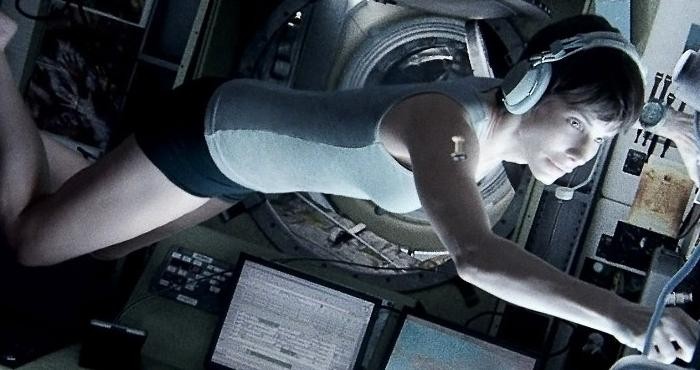 If there is one complaint, I suppose it could be over the somewhat thin back-story and characterization of Stone. I don’t know what a medical officer is exactly doing in space fixing the Hubble telescope but oh well. Cuaron keeps the audience firmly stuck in Stone’s predicament; we do not cut away to any flashbacks of life on Earth, and so it makes fleshing out a central character notable difficult. People don’t usually open up into revealing monologues while they’re trying to fight for immediate survival. She’s got the standard tragic back-story, losing a daughter, but for me this was enough to work with. I don’t necessarily need Stone to be a thriving, complex, emotionally nuanced character because my empathy was already there as soon as the peril began. I wanted her to survive because she was a person; I didn’t have to relate to her on a deeper fundamental level to root for her survival. There are some nice late scenes where Stone reflects on the existential crisis, on knowing her imminent death, on the fog she’s been trapped within since her daughter’s accidental death. Bullock (The Heat), in her best performance to date, is able to pull you in. If faced with your imminent end, how would you attempt to make peace of things, let alone stranded away from all human contact? It’s a strong awards-caliber performance and while her character isn’t given much development, she still has an arc, and I think there’s a greater thematic link with her crossing.
I’m no fan of Terrence Malick (Tree of Life, To the Wonder) but I understand people’s assertion that the man is a film theologian, making the theater a borderline religious experience for his faithful fans. In my eyes, Gravity has an unmistakable spiritual subtext that it can be viewed in different directions. Firstly, it’s hard not to feel an overpowering sense of awe when taking in the sheer magnitude and beauty of the incalculable universe. But then there’s Cuaron’s opening text that prefaces how outrageously impossible life in space is, contemplating all the harsh realities. And yet, here we are. Whether you chalk that up to something religious like God or just the fortune of the cosmos, it’s still a remarkable journey. The evolution of Stone is also reminiscent of that of life on Earth. When she finds refuge in the space station, she removes her suit, curling up in a fetal ball, while the camera centers her and she slowly rotates. The womb imagery is obvious but still effective. There’s also a third act assist that seems like direct divine intervention by most accounts. Then, spoilers, as she lands on a hospitable planet, she emerges from the sea, triumphant, taking her first steps onto land. Triumphant against all odds, against the cruel vacuum of space, life proves to be the winner. Again, whether you ascribe this to a creator God or a wonder of lucky evolutionary forces, it’s hard to escape Cuaron’s spiritual subtext tugging away at you, making the personal survival of Stone a greater analogue for the genesis of mankind and the emergence of humanity.
This is one of the few films I would recommend seeing in 3D. Cuaron has spent four and a half years translating his vision to the big screen and you’ll do yourself a disservice if you don’t see Gravity on the biggest screen possible. It is a film experience to be savored that will not measure up when you are forced to watch such outsized splendor on your puny home TV. This is an expertly made thriller, a visually transcendent, cutting-edge trip to space, and a revitalizing time at the movies. It’s as awe-inspiring as it is terrifying. It’s bursting with stimulation for the senses as well as a reawakened sense of spirituality, of something greater to be thankful for. I am in awe of Curaron as a filmmaker and I am in awe of his finished product. It was worth the wait. Now I hope I never have to wait another seven long years again before I see the words “directed by Alfonso Cuaron” again.
Nate’s Grade: A
Share this:

Children of Men (2006)
 Alfonso Cuaron is a master filmmaker and a gifted storyteller. He excels at telling entertaining stories whether they be about kids or adults. His Harry Potter film is still the most watchable and imaginative, and his earlier children’s movie, 1995’s A Little Princess, has enough power to still get me misty. Even when Cuaron sets his sights on a sex comedy (Y Tu Mama Tambien) he can’t help but turn it into an affecting art movie. This man just knows how to tell a good story. Children of Men, a bleak science fiction thriller, is just the latest example of how effortless Cuaron makes it all blissfully appear.
In the year 2027, and the world is on the brink of annihilation. It’s not plague or rampant warfare that are the obvious culprits. The reason for mankind’s end is something more natural and depressing — women have stopped being able to make babies. England seems to be the lone country with some fraction of stability. Illegal immigrants are rounded up and housed in refugee camps for deportation. Cages full of crying and pleading foreigners are on many street corners. In a world of danger and hopelessness, always count on the kindness of xenophobia.
Theo (Clive Owen) is a bureaucrat that combats the future with cynicism. He can barely escape getting blown up for his morning coffee. Theo used to be an activist and married to Julian (Julianne Moore), the current leader of the Fishies, deemed a terrorist group by those in power. She finds him and asks for one last favor. Her people need transit papers to get Kee (Claire-Hope Ashitey), a refugee, and Miriam (Pam Ferris), a former mid-wife, to safety. Then Theo discovers the importance of his assistance. Kee is eight months pregnant. The government would never admit that that the first baby in 18 years belongs to a refugee, and political groups would like to use Kee and her baby as a rallying point for an uprising. But first Theo must get her out of harm’s way.
 The idea of a world of infertile women is fascinating and full of big questions. This dystopian future must confront its own mortality in a very real way. Theo asks a friend hoarding classic art why he bothers. There will be no one alive in 100 years to even see them. Miriam says strange and heartbreaking things happen to a world that forgets the sound of children’s voices. Plenty of heady discussion is generated from a premise that affects every person on the planet. Why can’t women have babies? No explanation is given and none would seem credible. A religious faction believes this is the punishment of a vengeful God. People forget what babies even look like and what is commonly done for their care. The film also has a stark and timely portrait about the treatment of illegal immigrants. Children of Men is an intellectually stimulating movie that never rubs your nose in it. It trusts the intellect of the audience enough to leave many unanswered questions left to chew over and debate long after the movie ends.
The answers Children of Men finds seem reasonable and appropriate. Home suicide products exist for people that want to take back some control over their life, or at the least, are sick of waiting for the even more inevitable. It also seems entirely likely that this future world would turn the youngest living person (“Baby Diego” at 18-years-old) into a celebrity worthy of incredible mourning upon his untimely demise. These coping elements feel dead-on and only enhance the realistic tone of the film.
The film is a beguiling think piece but it also succeeds magnificently as a straightforward thriller. The majority of the second half is built around chase scenes and navigating to perilous outposts of safety that eventual crumble. Cuaron has a dizzying sense of believability as he puts together his world, and his roving camera feels like an embedded reporter on the front lines of chaos. The gorgeous cinematography and realistic set design contribute to the visceral sensation Cuaron sets alive with his visuals. There are long stretches where the camera continues rolling for nine minutes uninterrupted. I was left spellbound and felt trapped in this world just like the people onscreen. I was also wondering how much planning it took to coordinate and choreograph these long takes.
There are two very memorable scenes to quicken the pulse and both of them involve Cuaron’s mobile unblinking camera. The first involves a car chase perhaps unlike any I’ve ever seen before. Theo is leading an escape at dawn and robs the other cars of their keys. However, his own escape car refuses to start and the bad guys take notice. The sequence seems to last forever as Theo is forced to literally roll the car down a hill to outrun his pursuers who continually catch up with him. The second sequence follows Theo making his way through a refuge camp in the midst of a violent uprising being put down by heavily armored government troops. We watch every excruciating second of his survival as he navigates past gunfire, tanks outside a hotel, and then climbs through the different levels of the hotel being bombarded until we see, at a distance, where Theo’s trek all began. Exhilarating might just be the best word to describe Children of Men.
 But nothing feels cheap or too sentimental in this world. This is a harsh and dark world where anything can happen, so the audience is left in constant peril worrying about the fates of every person onscreen. Like Casablanca, it strips away idealized notions of bravery and duty and just shows humanity for what it is and what it can be. That is gutsy but then that’s Cuaron as a filmmaker.
Speaking of Casablanca, Owen seems like a modern-day Bogart in this role. He’s ruggedly good looking but also a sly charmer. I’ve stated before my undying man-crush on Owen and Children of Men has only added to it. Owen has a remarkable way of playing detached but still noble and conflicted. He has the best slow burn in movies. The moments of wonder for him become our moments of wonder and worry. The rest of the actors appear in limited functions but provide good work. Michael Caine practically steals the movie as a crude yet philosophical hippie.
This is science fiction at its best. Children of Men is stark and realistic and truly immersive; you really feel like a member of this tumultuous future. It works simultaneously as a thought-provoking what-if scenario and as an exciting thriller. Simply put, this is a highly engrossing movie that separates itself from the pack. Cuaron has created a disquieting and entertaining sci-fi think piece that succeeds on its numerous merits. I knew half way into the movie that the newly minted wife, Mrs. Me, was only going to want a baby more from what we were watching. At least she now has a new argument: “It’s for the good of humanity.”
Nate’s Grade: A
Share this:

Harry Potter and the Prisoner of Azkaban (2004)
 The first two film adaptations were huge hits, but were derided by some as being too loyal to the books that it stifled the creativity. Now, Harry Potter and the Prisoner of Azkaban is out and its the first film to deviate from the books. How will Potter nation take the news?
Harry Potter (Daniel Radcliffe) is entering his third year at Hogwart’s School of Witchcraft and Wizardry. Harry is also getting older, getting angrier, and learning more and more about his parents. Hes on alert that the murderer, Sirius Black (played the fabulous Gary Oldman), has escaped from Azkaban prison and is out to get Harry. Black had a hand in the deaths of Harrys parents, and now it seems hes looking to finish what he started as a follower of Lord Voldemort. Harry relies on his friends, Ron (Rupert Grint), Hermione (Emma Watson), and a kindly new Defense Against the Dark Arts teacher named Lupin (David Thewlis) to conquer his fears, his burgeoning hormones, and to face Black when the time comes.
The best decision the Harry Potter producers made for this chapter of the series was in getting a new director. Alfonso Cuaron finally infuses the Potter series with a sense of visual life. Instead of Chris Columbus’ stubborn admiration of his fake opulent world, Cuaron keeps things fluid with a constantly roving camera and long takes. For the first time in the series, you can argue that this Harry Potter film looks and feels like its own actual movie. Gone is Columbus annoying penchant for displaying everything in close-ups. The film also benefits from some new realistic exteriors and dressed-down attire, ditching the school uniforms. Theres also a new cinematographer, so instead of Columbus dull amber glow, the series takes a gratifying turn toward the menacing, with an emphasis on dreary blacks and silvers.
 The best improvement of all, however, was in getting away from the apparent slavish loyalty to the books. The third book is the longest of the three but the third film is the shortest; 15 minutes shorter than Sorcerer’s Stone, and 25 minutes shorter than Chamber of Secrets. Thank God. At the rate they were going I thought the next book, Goblet of Fire (700-some pages), was going to be like 9 hours.
So, under Cuaron’s guidance, Prisoner of Azkaban eschews the unnecessary plot elements and details fans will grumble over but moviegoers couldnt care less over (Quidditch?). Cuaron’s film may be heavy with exposition, but it never talks down to its audience. The result is a movie trying to be a movie and not trying to cram in as many details of the world as possible so fans wont have their feathers ruffled.
The young actors of Hogwarts have definitely been struck by puberty, and it has done their acting a world of good. Radcliffe will never be an exceptional actor but here he presents new and interesting dimensions to Harry demonstrating his arrogance and tempestuous anger. Tom Felton, who plays the snarky blonde-haired Draco Malfoy, appears to be maturing into a ganglier Macaulay Culkin. The one actor that truly seems to have a bright future, though, is Emma Watson. You cannot help but love her whenever she’s on screen and she seems to be developing into a fine actress.
The most notable addition to the adult staff in the film is Michael Gambon, replacing the late Richard Harris as Hogwarts headmaster, Dumbledore. Gambon turns the character from a kind-hearted grandfather type to more of an aging hippie but it works. Emma Thomson also appears as some sort of psychic professor, teaching students to read tea leaves; however, her entire role seems superfluous unless it impacts future installments (I have not read a single book). Once again, Alan Rickman rules all and needs to get more time in these movies. I don’t know how, but it needs to happen. Thewlis is the most welcomed addition in his pivotal role as Professor Lupin and delivers some of the more dramatic scenes of the film with radiance and ease. He creates a lovely father-son relationship with Harry that supplies Azkaban with a nice sense of compassion. Oldman is similarly great but unfortunately he shows up so late into the film that he seems terribly underused. There is a scene late into the film, where Thewlis, Oldman, Rickman, and the great character actor Timothy Spall share a scene. I never thought it would be a children’s fantasy series that would finally unite all these talented British stage actors but I’m thankful for it nonetheless.
 Prisoner of Azkaban is the darkest tale yet, and Harry Potter works best when things get scary. The nightmarish element design creates a wonderful sense of dread, and Cuaron deftly handles his young characters dealing with rage and death and, scariest of all, budding hormones. Theres even a sly nod to Cuaron’s steamy coming-of-age film, Y Tu Mama Tambien (it involves a three-way hug between our trio of kids).
he effects of the film are beautiful and greatly add to the entertainment value of the film. The Dementors, cloaked flying guards of Azkaban prison, are terrifying to look at, and their leitmotif of chilling the air when they are near makes for some great visuals and ominous moments. I got actual goosebumps the first time they arrived on-screen, and then when I saw this film a second time, fully knowing the story, my skin still crawled when they arrived. Perhaps the greatest addition to Harry Potter‘s special effects bestiary is the Hippogriff, which resembles a combination between an eagle and a horse. It is a gorgeous creation and worlds better looking than the three-headed dog from the original film. It also provides one of the more breath-taking moments of the film, when Harry goes soaring across a lake on the back of the Hippogriff.
Having said all this, yes Prisoner of Azkaban is the most exciting and visually alluring film of the series, also its darkest, but I couldn’t help feeling disappointed with the central storyline. Most people will love it, especially fans of the books, but after walking out of the theater I could not help but wonder if the film had a climax at all? It really kind of didn’t. There was no sense of real story momentum and the middle had some definite moments of drag. The last act of Prisoner of Azkaban is exactly like Back to the Future Part 2: time-travel, correcting the future, not running into your past selves. This is not a good comparison. So while the characters are getting more interesting as they get older, this plot doesn’t really hold up very well. It almost feels like a preface of whatever events will come in the fourth film.
Prisoner of Azkaban is an interesting watch. I am told it deviates the most from the book and it manages to generate a considerably darker and scarier atmosphere than its predecessors. For my money, any changes are good, as films are about ADAPTATION and not copying, so dispensing with subplots and details is A-Ok with me. But how will the die-hards react? Im sure youll hear plenty of grumbling all over, but Cuaron has injected needed life into this series and presented an idea of what it can grow to be. So, while I think Prisoner of Azkaban has a superior visual sense, pacing, and adaptation; I also feel the story may be the weakest we have been told. I can only imagine what the outcry will be among the fan base when Goblet of Fire is released November 2005 as one film.
Nate’s Grade: B+


 nathanzoebl
You must be logged in to post a comment.