Blog Archives
Violet & Daisy (2013)
 It’s not often that I say this but… what the hell did I just watch? I know it’s a movie called Violet & Daisy, written and directed by Geoffrey Fletcher, the man who won a screenwriting Oscar for adapting Precious. But what is this? It is some meta commentary on film violence? A twisted fairy tale? A dark comedy? Whatever it is, I know for certain that it was not very good or entertaining.
Violet (Alexis Bledel) and Daisy (Saoirse Ronan) are teenagers who also work as hired assassins by their boss, Russ (Danny Trejo). Their next assignment has a personal angle: Michael (James Gandolfini) stole a large sum of money from Russ. The gals hide out in Michael’s apartment only to fall asleep. When they wake up, Michael is sitting there, accepting his fate, begging the girls to complete their job. He’s dying from terminal cancer, estranged from his daughter, and hoping to exit this world on his own terms. Over the course of one long afternoon, the gals run into rival gangs, a trained sniper, police, neighbors, and all sorts of other plot contrivances to delay the death of Michael.
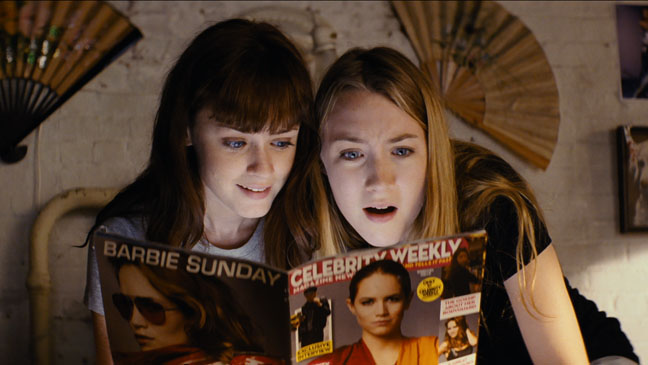 If you’re like me, with similar expectations when it comes to your moviegoing experiences, you’ll be left scratching your head and fumbling for some kind of rationale why people decided to make a film like Violet & Daisy. It feels instantly dated, relying upon the hook of young teen girls with big guns, you know, the same model that has translated to many a successful video game. More so than that, the aspiration, or at least direct inspiration, appears to be a Tarantino-knock-off. Not ripping off Tarantino, as many did in the mid-to-late 90s, but ripping off a poor Tarantino knock-off, like Two Days in the Valley or, the more adept comparison, The Big Hit. There is so much crap in this movie that exists merely because somebody thought it would look cool. Violet and Daisy open the movie dressed as pizza-delivering nuns (is this a fetish I am unaware of?) and open fire on a gang of criminals. But before their fateful gunfight, you better believe it, they have an innocuous conversation about something small, you know, like Jules and Vincent. Why are they dressed as nuns, let alone nuns delivering pizza? It doesn’t matter. This is a movie that doesn’t exist in a universe minutely close to our own. Everything about this film feels painfully and artificial. You know what previous job Violet and Daisy had? They worked at the “doll hospital,” a literal ward for dolls. The decisions of this movie are driven purely by a stylized self-indulgent whimsy. Once you realize this, and you will, the movie becomes even more of a chore to finish.
Then there’s the bizarre and sometimes uncomfortable infantilization of the female lead characters. These ladies do not act like adults; they don’t even act like teenagers. Even though they’re both over 18 years old, their behavior more closely resembles that of a flighty seven-year-old. Their speaking patterns are often in an annoying and partially creepy baby coo. They play paddy cake after successful hits. They ride tricycles. They chew bubblegum and blow bubbles during hits. They get excited about new Barbie Sunday dresses, and this is their real motivation for taking assassination jobs. Yes, to buy dresses. Then there’s their game, the Internal Bleeding Dance, where they hop up and down on the chests of their dying victims, blood spurting out of their mouths, the girls giggling, as if they were bouncing on a bed at a slumber party. These women aren’t remotely actual characters; they are masturbatory quirky hipster fodder, the ironically detached, sexy baby doll killer approximation. Except there is never any commentary at work. The depiction of Violet and Daisy as petite killers never approaches anything meaningful. They are killers because it’s cool. They talk like lobotomized film noir archetypes because it’s cool. This is quirk run amok, quirk with a gun and no purpose. I’m trying hard to ignore the obvious sexual kink undercurrents of the whole enterprise.
 Even with all these flaws, perhaps Violet & Daisy could have been morbidly interesting, except that the circuitous plot twiddles its thumbs, padding out a half-baked story. This is a movie that takes its time and seems to go nowhere. Once the girls meet Michael, the plot has to come up with numerously lame excuses to delay Michael’s execution. I kid you not, there are THREE instances where the girls run out of bullets and have to stop and walk back to the hardware store to go buy ammo. This happens. This is a thing that keeps the plot moving. It’s like as soon as the main characters get into a room together, Fletcher has to struggle to come up with reasons why his narrative should still exist. So we get a second group that Michael stole from because this guy has an even bigger death wish. This second group of spurned bad guys is on their way. If Fletcher was going this route, he might as well gone whole-hog imitating Smokin’ Aces and just had numerous crews all fighting over taking out this schlub first. It feels like Fletcher is making up the story as he goes, taking us on relatively pointless nonlinear interludes to pad the running time. The film, like Tarantino, breaks up the story into a series on onscreen chapters, though one of these only lasts like a minute. Then there’s a loopy dream sequence. The narrative is so stagnant that whatever interest you may have had will long be gone. By the time the movie actually does end, at about 80 minutes, it has long felt creatively exhausted, totally gassed. Fletcher throws out all the stops to get across that finish line.
Even though it was filmed way back in 2010, it’s hard to escape the morbid irony of Gandolfini (Enough Said) playing a character discussing his own inevitable death. He’s the best actor in the film, offering a paternal warmth that goes wasted amidst all the stylistic nonsense. Our other two featured players, Bledel (TV’s Gilmore Girls) and Ronan (The Host), have a sprightly chemistry together that works. I just wish all three actors had something to do rather than strike artificial poses and quip.
After enduring The Paperboy, and “enduring” is indeed the correct term, I was certain that the messy, tonally uneven, sometimes garish flights of fancy in Precious were due to director Lee Daniels. After enduring, and again “enduring” is the correct term, Violet & Daisy, I’m starting to think that Fletcher is deserves equal credit. Violet & Daisy is a curious exercise in twee indie hipness, suffused with quirk standing in place for characters, story, meaning, etc. It feels like the development stopped once the core concept of teen girl assassins was concocted. The off-putting childish nature of the adult girls, juxtaposed with the baby doll sexuality of the film, makes for an uncomfortable watch. To call the film bad taste is too easy. Whether this is a bizarre dark comedy, a whacko modern fairy tale, or whatever term you want to apply to justify the artificial excesses and emptiness, Violet & Daisy is a contrived mess that labors to fill out a basic feature running time, often doubling back and delaying. There isn’t a story here, more just an incongruent, irregular style. If you’re content with a knockoff of a Tarantino knockoff, with an extra dose of whimsy, then enjoy Violet & Daisy and you can dance your cares away atop bleeding bodies.
Nate’s Grade: D+
Share this:

The Sisterhood of the Traveling Pants 2 (2008)
 The ladies that inhabit The Sisterhood of the Traveling Pants 2 are not the same group of gals that charmed the pants off of me in the 2005 original film. This time the foursome is feeling some strain because they’ve all graduated and moved onto insanely ludicrous positions. Tibby (Amber Tamblyn) is making movies at NYU; Lena (Alexis Bledel) is studying art at the Rhode Island School of Design; Bridget (Blake Lively) is assisting with an archeological dig in Turkey; and Carmen (America Ferrera) is at the Brown theater department where she gets the lead in a summer production. Let’s face it, these are not the down-to-earth girls that were presented before. Was it too much to ask that one of the girls have a modestly plausible scenario? The drama is again split into two camps, the petty and comedic (Lena must choose between boyfriends, Carmen has to practice her lines) and the melodramatic (Bridget still has to deal with her mom’s suicide, Tibby has a pregnancy scare). The movie doesn’t work this go-round because every beat of the plot is wholly predictable (of course the guy Lena flirts with in art class will end up being the nude model), and much of the conflict is just inane. The characters act in stupid and contrived ways because the plot demands it. Sure the condom broke but can’t Tibby get the morning after pill at least? Sisterhood 2 also packs a baby birth, reunion between granddaughter and the grandmother she never knew existed, and a climactic trip to Greece for some serious girl power. It’s drama overload and lacks the notable sincerity of the first film.
Nate’s Grade: C
Share this:

The Sisterhood of the Traveling Pants (2005)
 I had no real intention of ever seeing The Sisterhood of the Traveling Pants. It looked to be a competent movie, horrifically clunky title aside, but I really didn’t have any interest in seeing another movie where four young girls become four young women. Then my then-girlfriend says she wants to see it. I think we all know what happens next. Even though I was the only male in my theater (I kind of expected this), I found Sisterhood to be a sweet and heartfelt film I was glad I experienced. It had far more emotional truth to it than I ever would have expected.
Four very close friends are about to depart for the summer. Bridget (Blake Lively) is the confidant sports star and going off to soccer camp in Mexico. Lana (Alexis Bledel) is the demure artist and is going to visit her grandparents in Greece. Carmen (America Ferrera), a bigger girl with big ambitions, is traveling to South Carolina to spend time with her long-absent father (Bradley Whitford). It seems the only one staying put is Tibby (Amber Tamblyn), an angsty nonconformist stuck stocking shelves at a Wal-Mart-esque store and working on her documentary, which she has deemed a “suckumentary.”
Before they set off on their adventures the girls discover a magical pair of pants. It seems that this one pair of jeans fits each to a T, even the curvier Carmen. The girls form a sisterhood around these magically one-size-fits-all pants. They promise to send them back and forth to each other all summer and write down any luck the jeans have imbued them with.
 In Mexico, Bridget sets her sights on a hunky soccer coach (Mike Vogel). She’s brimming with confidence and flirts like a champ. Overseas in Greece, Lana meets Kostas (Michael Rady), a hunky fisherman attending university in Greece. Sparks fly but Lana’s grandmother forbids her to see Kostas. Carmen is shocked to discover that her father is planning on getting remarried to Wasp-y Lydia (Nancy Travis). It seems dear old dad has not told her everything. And Tibby is befriended by a dogged and precocious 12-year-old, Bailey (Jenna Boyd), who wants to be her assistant on the “suckumentary.”
The best part of Sisterhood is the excellence of the lead actresses. All four give well-rounded, warm, enlightened, and exquisitely affecting performances. They each get a good weepy scene and each actress nails it. Bledel has mastered the nervous stammer. She’s adorable as we witness her wallflower character coming out of her shell. Tamblyn mopes and sneers but grows the most thanks to the intervention of Bailey (Boyd is a scene-stealer if ever there were one). Ferrera was a terrific find in Real Women Have Curves, yet another intelligent and charming teen movie. In Sisterhood she gets to display tremendous anger and heartache and she sells every second of it. She is going to be a lovely actress to watch in the future. Lively is a newcomer to film even though she looks like Kate Hudson’s lankier cousin. She’s a girl that knows what she wants but doesn’t necessarily know why she wants it.
One of the smartest things director Ken Kwapis does is to keep the different story threads together. I first thought that Sisterhood would become a vignette movie, meaning that we’d get like a half hour of each girl’s adventure and then we’d travel to the next. It would have worked. But by keeping the girls’ stories intertwined we’re reminded of their bond and we can connect with them all. Kwapis even fits in some nifty scene transitions in his mostly unobtrusive direction. He lets the film’s focus rest on the characters and the performances, which are the strengths of Sisterhood.
The film seems to diverge into two storylines: the summer romances (Bridget and Lana) and the more dramatic (Carmen and Tibby). The summer romances are fun but the real meat of the movie is in Carmen and Tibby’s teary adventures. Carmen is devastated to feel that she’s been replaced and forgotten by her father. It all comes to head in a marvelous scene where Carmen cannot fit into a bridesmaid dress that fits Lydia’s rail thin daughter. She explodes in anger and pain against her father’s new family and runs off. Tibby, on the other hand, is your typical dour and rebellious teen (though in PG-land that means nose ring, colored hair, and thrift store attire). Her relationship with Bailey opens her up and the audience falls in love with both of them. The last half hour of Sisterhood hits an emotional crescendo with both storylines that will leave plenty reaching for the Kleenex.
 Sisterhood sure doesn’t lack melodrama but the film is played so earnestly that you really won’t mind. In other teen girl films, the inclusion of dramatic elements like suicide, abandonment, and even leukemia might cause the casual rolling of eyes. The difference is that Sisterhood respects both its characters and its audience. This is a sincere, unpretentious movie that has a genuine sweetness that won?t give you a toothache. In fact, the most unbelievable moment of the movie is that a pair of pants would fit them all. Again, pretty good for a flick rife with melodrama.
Sisterhood is unabashedly sentimental but it walks a fine line without ever getting truly sappy like some Nicholas Sparks tale (A Walk to Remember). Usually movies of this ilk whitewash over reality and oversimplify complex issues and emotions. Not so with Sisterhood, which deals with tough issues in an admittedly soap operish way but also forces its characters to endure tough resolutions. I am clearly not the intended audience for The Sisterhood of the Traveling Pants (I do by all accounts have a Y chromosome) but I enjoyed it all the same.
The Sisterhood of the Traveling Pants is an old fashioned, good-hearted family film that won?t make you cringe. It’s respectful of its audience and doesn’t take easy shortcuts with its story. It’s also respectful of teenagers and their experiences. The acting by our four leading ladies is uniformly outstanding. In a summer fueled by male-driven high-octane action flicks, something a little low key and sweet is always appealing when done right. This won’t exactly be a movie that will appeal to everyone, but Sisterhood is an above average and earnest take at all-too-familiar territory. Despite the clunky title, this teen-targeted weepie is a good fit for any audience wanting to feel good.
Nate’s Grade: B
Share this:

Sin City (2005)
 Like film noir on steroids. Director Robert Rodriguez has made the most faithful comics adaptation ever; giving life to Frank Miller’s striking black and white art. The visuals are sumptuous but the storytelling is just as involving, a perfect mix of noir/detective elements and subversive, highly memorable characters. Sin City may be the most violent studio film … ever, but the over-the-top tone keeps the proceedings from becoming too nauseating, even after limbs are lost, heads roll (and talk), and dogs pick away at living bodies. This is a very ball-unfriendly movie; lots of castrations. The blood even looks like fluorescent bird crap. The stories become somewhat repetitious (anti-hero saves distressed woman), but Miller and Rodriguez keep their tales tight, pulpy, comic, and unpredictable. My friend turned to me after it was done and said, “That was a great movie.” I could not argue.
Nate’s Grade: B+


 nathanzoebl
You must be logged in to post a comment.