Blog Archives
Big Fish (2003) [Review Re-View]

Originally released December 25, 2003:
Premise: Estranged son Will (Billy Crudup) travels back home in an effort to know his ailing father Edward Bloom (Albert Finney; Ewan McGregor as the younger version). Will hopes to learn the truth behind a man who spent a lifetime spinning extravagant tall tales.
Results: Despite a shaky first half, Big Fish becomes a surprisingly elegant romance matched by director Tim Burtion’’s visual whimsy. McGregor’’s shining big-grinned optimism is charming. Not to be confused with the similar but too mawkish Forrest Gump, Burton’’s father-son meditation will have you quite choked up at its moving climax. Fair warning to those with father issues, you may want to steer clear from Big Fish. You know who you are.
Nate’’s Grade: B+
——————————————————
WRITER REFLECTIONS 20 YEARS LATER

Tim Burton has never really made a movie like Big Fish before or in the twenty years since. He’s made movies that are aimed at children, like the Disney live-action remakes for Dumbo and Alice in Wonderland, and he’s made animated movies that are more wholesome while still holding to the man’s creepy-cute aesthetic, but he’s never made a movie so unabashedly sentimental as 2003’s Big Fish. Many of his stories involve alienation and outcasts and outsiders and characters accepting themselves, their unique oddities, and their unconventional families. This movie was different. It was based on the 1998 novel by Daniel Wallace and primarily concerns the relationship between fathers and sons as the paterfamilias is nearing his end, a not unfamiliar plot structure for treacle and tears. It’s about a smooth-talking man of legendary tall tales about his life and his exasperated son trying to find real answers. That’s the movie. It’s purposely small even though the tales are tall. There’s nothing larger than simply resolving the strained relationship between father (Albert Finney) and son (Billy Crudup). It’s the most intimate movie of Burton’s career while still finding a place for his fantastical visual whimsy, as the outlet for Edward Bloom’s (Finney as the dying version, Ewan McGregor as the younger version) fantastical tales of adventure. It’s a movie elevated by Burton’s signature style and it’s one that still, in 2023, had me choking up and tears streaming down my face by the conclusion.
This is an episodic movie by design and it does hamper some of the emotional investment, until that whammy of a culmination. Because we know the younger Edward Bloom is exaggerating his life’s travails for entertainment, and perhaps a dash of pride to heighten his deeds, it makes the many sequences of young Edward and his escapades feel a bit fleeting, as if we’re trying to find the larger meaning hidden within the fables and the fabulous. The ultimate point is that the entertaining diversions and exaggerations are who Edward Bloom is, and ultimately trying to discern truth from legend loses sight of the appeal of this charming man and his wild tales. I can understand this while also slightly disagreeing with the conclusion. It’s a little pat to say, well, the point of all these extravagant stories is simply that they were entertaining, never mind about finding a buried meaning or truth. It’s like saying, “Hey, just enjoy the ride.” The point is to fall in love with the storyteller and see the storytelling itself as its own act of love, which I don’t think works until the very end of the movie. Until then, it’s a transitory series of adventures, from wartime to the circus to aggressively persistent courtships and hidden magical towns, each reflective of the indomitable spirit and cheery optimism of our chief yarn-spinner.

In that way, it’s easy for the viewer to adopt the same perspective as Will (Crudup), and that may be the hidden genius of screenwriter John August (Go), or I may be projecting. Our plight is the same as the son: we’re trying to discover what is actually real about the real man. It’s easy to feel his exasperation as he wants something genuine from this man and only keeps getting the same old tales and stories, and everyone else is smiling broadly and happy to just accept the man on his own terms. That’s where Will’s character arc goes, finally accepting his father on his terms, which means playing along with his rules. It’s a level of empathy and acceptance rolled together, but it’s also like two hours of a character going, “My dad might be a liar and I’m curious who he is,” and then in the end going, “My dad might be a liar but I guess that’s who he is.” It doesn’t feel like the grand epiphany that the movie thinks it is, even with Danny Elfman’s Oscar-nominated score trying to stir every doldrum of your heart (Elfman has only been nominated four times in his storied career, also for Good Will Hunting, Milk, Men in Black). So for much of the movie’s running time I’m pleasantly entertained but a little frustrated that the movie doesn’t seem to be digging closer into the man garnering all this unwavering attention.
However, it’s at the very end where Big Fish really transcends its limitations to become something deeply moving and powerful. As I re-watched, I’m twenty years older, and likewise my own father is twenty years older, and moments like this have more potency to me. It’s about the son accepting his father on the same terms he fought so hard to circumvent, and so the ending becomes a beautiful exchange of the storyteller inviting someone else to finish his story’s ending. It’s surprisingly profound when you boil it down to its essentials, and that may be why I had tears dripping down my face as the adult son narrates one last fantastic tale of helping his father escape from the hospital, dart through traffic in his classic car, and arrive for a farewell with all the many friends he’s made through his many decades of laughter and camaraderie. Edward then transforms into the fish, becoming the very symbol of his “fish tales,” and lives on through the stories and memories of others, simply but effectively communicated with the mourners engaged in retelling Edward Bloom’s escapades through engaged pantomime. It’s one of the most clear-cut examples for me of a perfectly good movie really hitting another level in the end.
Big Fish began a long collaboration between Burton and August, who has become such a prolific Hollywood scribe that he’s likely had his hand on just about every script in town. August would later be trusted to write Charlie and the Chocolate Factory, Corpse Bride, Frankenweenie, and Dark Shadows; that’s five Burton projects in nine years. For those keeping track, this was only the second Helena Bonham Carter appearance in a Burton movie, the first being the misbegotten 2001 Planet of the Apes remake. It’s also fun to watch Marion Cotillard (Inception) in her first American movie as Will’s pregnant wife.

Big Fish also has a strange unintended legacy regarding someone else who connected with it. It was the last film seen by the famous playwright and monologist Spalding Gray, an enormously compelling storyteller who, much like Edward Bloom, favored the oral tradition. He suffered through depression most of his life, which was amplified after a severe car accident and multiple surgeries to recuperate in the early 2000s. On January 10, 2004, he took his children to see Big Fish and the next day was declared missing. His body was found in the East River in New York City and it’s believed Gray took his own life leaping from the Staten Island Ferry. His wife, Kathleen Russo, told New York Magazine in 2008 that Gray had cried throughout the movie and she concluded, “I think it gave him permission to die.” It’s unfair to blame the movie for a suicidal man’s decision-making, but I think it’s interesting that the emotional closure onscreen was so powerfully felt that Gray may have felt a personal level of closure as well.
My original 2003 review was so minimal, one of five or six short capsule reviews I wrote together as end-of-the-year awards contenders (same with the upcoming Cold Mountain re-watch), so I wanted to add more thoughts to the subject. My opinion feels relatively the same twenty years later though the ending had even more power as a 41-year-old than at twenty-one. I’ll keep my review the same for relatively the same reasons, though I hope Burton returns back to telling another Big Fish kind of detour (2014’s Big Eyes was not that).
Re-View Grade: B+
Share this:

Traffic (2000) [Review Re-View]
 Originally released December 27, 2000:
The war on drugs may be one worth fighting but it’s a battle that every day seems more and more impossible. Traffic is a mirror that communicates the fruition of our current procedures to stop the illegal flow of drugs.
Traffic is told through three distinct and different narratives. One involves an Ohio Supreme Court justice (Michael Douglas) newly appointed as the nation’s next Drug Czar. While he accepts his position and promises to fight for our nation’s children, back at home, unbeknownst to him, his daughter is free-basing with her bad influence boyfriend. Another story involves a wealthy bourgeois wife (Catherine Zeta-Jones) awakened to her husband’s arrest. Her shock continues when family lawyer Dennis Quaid informs her of her husband’s true source of income. He’s to be prosecuted by two DEA agents (Don Cheadle and Luis Guzman) unless she can do something. The final and most compelling narrative involves Benicio Del Toro as an honest cop in Tijuana battling frustration with the mass corruption surrounding the city. Each story weaves in and out at various points in the film.
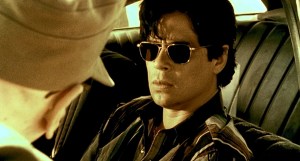 Traffic was photographed and directed by the man with the hottest hand in Hollywood, Steven Soderbergh. He uses a documentary feel to his filming that adds to the realism. Different color tones are assigned toward the three narratives as reflections of the emotional background. Soderbergh expertly handles the many facets of the drug industry and pulls out his typical “career best” performances from his onslaught of actors.
Benicio Del Toro is the emotional center of Traffic. His solemn demeanor and hound dog exterior reflect a good man trying to fight the good fight in a corrupt environment. He effortlessly encompasses determination, courage, and compassion that you’ll easily forget the majority of his lines are in Espanol. Benicio is an incredibly talented actor and one with such vibrant energy whenever he flashes on screen. It’ll be wonderful watching him collect all his awards.
Catherine Zeta-Jones also shows strong signs there may well indeed be an actress under her features. Her role is one of almost terror as you watch her so easily slip into her imprisoned hubby’s shoes. The ease of transformation is startling, but in an “evil begets evil” kind of fashion. The fact that she’s pregnant through the entire movie only makes the shift from loving house wife to drug smuggler more chilling.
 The entire cast does credible acting performances with particular attention paid toward the younger actors deservingly. Don Cheadle throws in another terrific performance showing he’s sublimely one of the best actors around today.
Traffic oversteps its ambitions and aims for a scope far too large. It is based on a 6 hour BBC mini-series, so trying to cram that material into a two hour plus format is taxing. As a result we get an assembly of characters, but too many with too little time in between to do any justice. Screenwriter Stephen Gaghan (Rules of Engagement) condenses the towering impact and influence drugs have well enough, but he intercuts the stories too sporadically that attachment never builds for either of the three narratives. He does balance the Douglas Drug Czar one carefully as not to fall into the cliched vigilante metamorphosis. But the mini-series had more characterization and depth to its tale.
Traffic is a good film but it has edges of greatness never fully visioned. Soderbergh shines bright yet again and all accolades will be deserved. Traffic is undeniably a good film, but it’s one you may not want to watch a second time.
Nate’s Grade: B
——————————————————
WRITER REFLECTIONS 20 YEARS LATER

So twenty years later, how is that war on drugs going? Considering the billions of dollars and countless lives that have gone into trying to stop the intricate infrastructure of supply and demand for the drug trade, the United States has little to show for its efforts. If anything, there has been a dawning realization of the futility of playing cartel whack-a-mole, removing one leader just for another to take their place in the supply chain. There have also been movements toward treating addicts rather than incarcerating them. The country has stubbornly become more accommodating and understanding of the ravages of addiction; it only seemed to take the spread of the opioid crisis where affluent families in the suburbs were affected personally. Tragically, it seems too many Americans have to have an “it could happen to me!” moment before their empathy for another person’s struggles kicks in. These relaxing attitudes have translated into recreational marijuana being legal in 15 states as of this review. Many other states have decriminalized marijuana, and Oregon has recently voted to decriminalize all drugs. It seems that in 2020, our concept of the war on drugs has dramatically changed. Some may find these developments an admission of giving up, of retreating from some moral duty, but others have concluded that maybe we’ve been fighting all wrong for 50 years and the only thing we have to show for our blood-soaked efforts is that multiple criminal elements got much richer.
 It’s an interesting social and cultural landscape for going back and re-watching 2000’s Traffic, the last film on my re-watch of 2000 cinema. Times have changed and this is felt in Steven Soderbergh’s Oscar-winning ensemble covering the globe-trotting scope of the war on drugs. Traffic won four Oscars, including for Soderbergh for Director, Benicio Del Toro for Best Supporting Actor, and for editing and adapted screenplay. The only Oscar it was nominated for that it didn’t win was Best Picture, losing to Ridley Scott’s sword-and-sandals epic, Gladiator. It was an ambitious movie and had over 100 speaking roles. Soderbergh served as his own cinematographer and cameraman, bringing a docu-drama versatility to the movie that added its own sense of realism. 2000 was the year Soderbergh hit his critical peak. He was an indie darling from 1989’s influential sex, lies, and videotape and puttered throughout the 90s with small, personal, weird movies (I loved Schizopolis as a teenager), and then in 1998 he gained a new level of credibility providing sheen and heat to Out of Sight, the movie that cemented George Clooney as a major movie star. The one-two punch of Traffic and Erin Brockovich in 2000 earned Soderbergh two Oscar nominations for director, a feat not accomplished since 1938, and after 2001’s highly successful Ocean’s 11 remake, Soderbergh had jumped to the top of the industry while maintaining his indie artistic credentials. He’s been dabbling and experimenting since (A movie shot on an iPhone!) with mixed results, but the man’s track record is hard to digest into simple categorization. He can jump from an action showcase for an MMA fighter, to a gleeful male stripper romp, to a four-hour epic covering the life of Che Guevera. With Traffic, Soderbergh was working with his biggest budget and cast yet. The decision to use different color tones is smart to easily distinguish the various storyline locations so that an audience can be immediately oriented when jumping around from place to place. It’s also extremely hard on the eyes at times. The Mexican storyline is so washed out in bleached colors that it looks like an atomic bomb just went off in the distance and is filtering the world with an excess of bright light to make you squint. Soderbergh also has a penchant for natural light coming through windows to be seen as giant blocks of white. Again, it achieves its artistic purpose but it also makes you want to avert your gaze.
The 150-minute movie is based on a sprawling 1989 BBC miniseries that totaled six hours. Stephen Gaghan (Syriana) adapted the screenplay and he does a fine job of condensing the major plot points of the mini-series into a manageable feature length. He also does a fine job of articulating the many intertwined players and motivations and contradictions of the drug trade. However, I can’t help but feel like some of the nuance and character development is lost by condensing everything into the body of a manageable American feature production. Take for example the character Catherine Zeta-Jones (Chicago) plays, Helena Ayala. She’s a rich southern California housewife who has her life upturned when she discovers her husband, recently arrested by the DEA, is one of the chief distributors for a Mexican cartel. Her character is in disbelief and shock at first, then she tries to make due with legal bills and mortgage payments. Things get considerably worse when the cartel threatens her children if Helena can’t pay her husband’s outstanding debts that have now fallen onto her. Her character arc goes from an ignorant, privileged housewife into a ruthless co-conspirator willing to do whatever it takes to protect her family and maintain the cushy lifestyle they have become accustomed to. Over the course of the BBC miniseries, you watch that version of the character undergo significant changes in six hours. In the 2000 film, the character undergoes significant changes in a matter of scenes. Helena goes from desperate to duplicitous in literally minutes, and the jump feels too unearned. The rushed storytelling caps some naturalism. A character can go from not trusting the DEA to providing damning evidence to the DEA in three scenes. A character can go from bored, privileged teenager to junkie prostitute in three scenes. For a movie about gritty realism, these character leaps can feel overly forced and inauthentic. There are so many characters and storylines and political points to make that the overall narrative can feel crowded, so while it’s always interesting, it can inadvertently fashion its own ceiling for emotional engagement because the many characters feel like impressions hitting their marks rather than as fully developed portrayals of people.
 The storyline that has aged the worst is Michael Douglas (Ant-Man) playing Robert Wakefield, a newly installed Drug Czar learning the ropes. For the majority, he’s akin to a 60 Minutes journalist just sitting in rooms and asking various professionals about their experiences and advice from their unique positions. From there, the storyline takes up the “it could happen to me!” trapping with Robert’s private school daughter (Erika Christensen) becoming an addict. It may have been surprising for a high-profile politician to have a child as an addict, but now this kind of irony feels passe. We’re used to politicians having ironic skeletons in their closet. The ongoing plot of her descent doesn’t really humanize her even as she makes some drastic decisions to chase that next high. She’s more an ironic counterpoint to shake her father, and the audience, of their preconceived mental imagery of what an addict might look like. It feels slightly retrograde and pearl-clutching, not simply that she goes through hell but that it’s set up to register that, oh my, WHITE PEOPLE, even RICH WHITE PEOPLE, can also be junkies. In 2000, this story might have been jolting and scared some older adults into wondering if this drug menace could find its way into their hallowed gated homes too. Nowadays, it seems obvious. If the storyline of a father dealing with his addict daughter had reveled more about one another as characters it would be worth the attention, but the daughter is kept as an example, a symbol, and Robert just has to take his lumps before the inevitable conclusion that his job is a lot harder than he would have imagined. His speech at his introduction at the White House has the hallmarks of drama ready and waiting, as he chokes over the political boilerplate he no longer believes in, but he simply walks out rather than sharing what he’s learned.
The best storyline in Traffic is, no surprise, the one closest to the action with Benicio Del Toro (Sicario) playing what feels like the only honest cop left in Mexico. Obviously that’s an over simplification, but the police force and political class are heavily corrupted by the cartels and their money. The character Javier Rodriguez has to navigate this tricky world without making himself as a target for those corrupt officials who think he’s an impediment. He’s trying to do good in a deeply flawed system and maybe even he knows he’s fighting a losing battle but he’s decided to keep his integrity while trying to fight what he considers is a worthy cause. A high-ranking general seeking his services reminds him of his lowly pay as a police officer, yet Javier Rodriguez is unmoved. Del Toro made a career of playing oddballs and sleazes, so it’s interesting to watch him play a fairly noble, straight forward role and in a language he didn’t speak before production (while born in Puerto Rico, he moved early and grew up in the U.S. and knew little Spanish). I don’t know if I would have awarded him the Oscar (my favorite for 2000 was Willem Dafoe as a vampire) but it’s certainly an understated performance with real gravitas. Del Toro is the quiet, churning contemplation of this movie and I would have been happy if the whole enterprise had been devoted to his south of the border exploits. I appreciated that the moves in this storyline would have larger effects on others, like a crackdown on a cartel being a reason why they need more money and the reason they now step up the pressure on Helena to pay up or else. It best encapsulates the knotty, interconnected framework that Gaghan and Soderbergh are going for.
 Traffic is one of those movies you know are good. It’s well written, well acted, and has a definite vision it’s going for that it mostly achieves. It’s also a movie that engages more intellectually than emotionally. There are some deaths and downturns but I doubt you’ll feel much regret or catharsis. The movie unfolds like an in-depth journalistic article, and the leaps in rushed characterization feel like a result of a looming deadline and a hard cap with its word count. It’s unfair for me to continue comparing the movie to its miniseries when that project had almost three times the length to fill out its tale (about poppy trafficking and heroin manufacturing in tribal Afghanistan) but it’s a clear-cut case of crammed plotting. My initial review back in 2000 keeps mostly to the plot and the many actors, though I think I overstated Zeta-Jones being “chilling” and I think my love of Del Toro in Way of the Gun that year transferred some extra praise for his performance here. It’s hard to remember but I was really anticipating this film my freshmen year of college. Traffic is a good movie but it’s not exactly one people get excited over. Every aspect is professional, proficient, but there isn’t exactly a lingering takeaway that changes your perception of the war on drugs. I’ll hold to the same grade and say it’s an admirable accomplishment but one better suited for a mini-series (it was adapted back into a TV miniseries in 2004).
Re-View Grade: B
Share this:

Before the Devil Knows You’re Dead (2007)
 Sidney Lumet is 83 years old and still directing movies, God love him. The man is behind cinematic milestones and classics like The Pawnbroker, Serpico, Dog Day Afternoon, Network, and 12 Angry Men, which goes back all the way to 1957 – 50 freaking years ago! The longevity of this man is admirable. He hasn’t pulled together a compelling film in some time, but Before the Devil Knows You’re Dead is a stirring, character-driven crime drama that reveals itself to be a first-rate melodrama.
The film is anchored by two huge performances by Philip Seymour Hoffman and Ethan Hawke, playing a pair of brothers both on hard times. Hoffman’s character, Andy, has been living well outside his means to keep up appearances and to sate his taste for a local heroin den. He’s in charge of company payroll and an internal review just discovered a pair of terminated employees still drawing checks, the source of Andy’s cash to pay for his lavish lifestyle. Hawke’s character, Hank, is behind on child support and belittled by his ex-wife. He’s having a hard time even finding the dough to pay the 100 bucks for his daughter to go see The Lion King in New York City. Andy hatches a scheme to solve both their money woes: they’re going to knock over a mom-and-pop jewelry store. It just so happens that the store belongs to Andy and Hank’s mom (Rosemary Harris) and pop (Albert Finney). The plan goes hopelessly awry and both brothers feel intense pressure in the aftermath.
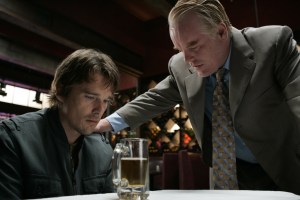 Lumet and debut screenwriter Kelly Masterson really know how to ratchet up the suspense. The nonlinear timeframe keeps the audience on its toes and continuously rewriting what we think we know. Unlike movies like Babel and 21 Grams, the plot is actually assisted by skipping around time and telling the story out of order. We get the basics and then the details begin to take shape, but because of the prior knowledge the film packs an increasing sense of dread that builds in intensity. As the brothers sink lower trying to cover their misdeeds, Lumet and Masterson crank up the tension to a peak. The knotted and twisty narrative exposes the fragile dynamic of this family and keeps the audience alert and hungry for more.
Hoffman is at his sleazy, duplicitous best with this performance. His character is a man accustomed to getting what he wants and he knows all the manipulative tricks to get there, be it bullying or cajoling. He’s a pusher with so much anger and desperation just below the surface. Andy never feels respected or loved by his father, and he has a great scene where he breaks down in a fit of rage and tears in response to his father apologizing for the bad upbringing. Hoffman imbues great emotional complexity to a man whose world is crashing down. It is enthralling to watch.
Not to be outdone, Hawke puts forth his finest effort of his career. He’s the baby of one very corrosive family; he misplaces trust and admiration in his big brother. Hank isn’t the sharpest tool in the shed but he has a distinct weariness to his worries, living day-to-day with the knowledge that the world sees him as a loser or a screw-up, losing the respect of his own daughter. When things go bad he unravels rapidly while still holding to his secrets. It’s a performance brimming with nervous anxiety, mounting regret, and self-effacement.
 The secondary characters don’t get nearly the attention and consideration. Marisa Tomei is more a plot device than a character; she’s Andy’s wife but has been having an ongoing affair with the more nurturing Hank. She spends most of her scenes in some form of undress and feels more like another notch in the complicated relationship between the brothers.
Finney is fine with a rather small role that merely requires him to be aghast or incredulous with the slow police work. I don’t know if a suitable Finney performance can compensate for a staggering leap of character late in the movie, but I suppose I’d rather have any Albert Finney performance in a movie than none at all. Before the Devil places Finney’s character on a perch and just doesn’t give him much outside of his own dawning realization of who was responsible for the botched robbery.
Before the Devil Knows You’re Dead is a gripping family tragedy that takes on a Shakespearean quality as it comes to a somber, chilling close. The wordy titles comes from an Irish drinking toast that states, “May you have food and raiment, a soft pillow for your head; may you be 40 years in heaven, before the devil knows you’re dead.” The message declares the inescapable consequences of our actions. This is a film about the disfiguration of one family; it’s bleak, tragic, but whole-heartedly entertaining and extremely focused in its aims. Lumet has returned to smashing form and reminds an audience that there’s still plenty of vigor left in this 83-year-old director.
Nate’s Grade: B+
Share this:

The Bourne Ultimatum (2007)
 I think the best aspect of the The Bourne Ultimatum, the third in the memory-troubled spy series, is how kinetically improvised it feels. Jason Bourne (Matt Damon) is a human weapon and he thinks constantly with his body, feeling the situation and his environment, and he comes up with improbable weapons, be them pens, magazines, or kicking ass with just a book (knowledge is power). Bourne doesn’t rely on fancy gadgets or a caustic wit; he just outsmarts the competition by reading his world and reacting instinctively, and that is thrilling to watch. The Bourne films have separated themselves from other spy series like James Bond and standout because of how viscerally realistic they play out. That said, Bourne still survives scrapes that would kill any mortal. At this point, we know just about all we need to know with most of the characters, so Ultimatum is one long, fantastic, and gripping series of chases between Bourne and the CIA operatives that want to rub him out. Ultimatum is Paul Greengrass’ (United 93) second film in the series and he enhances the excitement through his docu-drama style of shooting. The editing is constantly roving and perfectly channels the nervous wariness of a spy that is constantly looking over his shoulder. The action sequences are stellar and raft with suspense and top notch stunt work amongst exotic locales. Ultimatum tacks on some awkward political commentary (black hoods, secret CIA torture, breaking the law to “win” the battle against terror) and tries squeezing its story into a fight between Bourne and the dangerous and lawless elements of the American government that have flourished under President Bush’s watch. It doesn’t quite work in the context of a summer action movie, but thanks for trying. The Bourne Ultimatum is a spry and refreshing action movie that serves to cleanse the summer palate of huge special effects blockbusters.
Nate’s Grade: A-
Share this:

Corpse Bride (2005)
 Not as good as Nightmare Before Christmas, but really, what can be? Tim Burton second stop-motion animated film is beautifully crafted and emotionally involving. It’s interesting because all three characters in the movie’s love triangle have really done nothing wrong, and our sympathies are stretched to all three. The contrast of the world of the living (drab, formal) and the dead (colorful, lively) is stark, and death in Corpse Bride is presented as simply another stage of living. Therefore, you don’t have to worry about scaring the kids with this one. The ending is a bit too conventional and the songs are all lackluster, nothing ever as remotely hum-able as Danny Elfman’s masterpieces in Nightmare Before Christmas. Despite the unfair comparisons, Corpse Bride is easy on the eyes, amusing, and nicely romantic.
Nate’s Grade: B
Share this:

Big Fish (2003)
Big Fish (2003)
Premise: Estranged son Will (Billy Crudup) travels back home in an effort to know his ailing father Edward Bloom (Albert Finney; Ewan McGregor as the younger version). Will hopes to learn the truth behind a man who spent a lifetime spinning extravagant tall tales.
Results: Despite a shaky first half, Big Fish becomes a surprisingly elegant romance matched by director Tim Burtion’s visual whimsy. McGregor’s shining big-grinned optimism is charming. Not to be confused with the similar but too mawkish Forrest Gump, Burton’s father-son meditation will have you quite choked up at its moving climax. Fair warning to those with father issues, you may want to steer clear from Big Fish. You know who you are.
Nate’s Grade: B+
Share this:

Erin Brockovich (2000)
 Julia Roberts is the female equivalent of John Travolta in last year’s A Civil Action — little guy/gal taking on the big/evil corporations that pollute our water. This is hands down what is likely her best performance of her long career. It’s a one-sided take and displays the title character’s ruthless tactics and intimidation in order to reach whatever goal she wishes to strive for. The story though, isn’t much for most to work with as it is essentially sap and predictability: the hero will win, justice will prevail, the bad guys who were alluding in the beginning will be punished… etc. etc. Julia’s “woman in a man’s world” business gruff will either prove sadistically humorous or simply wickedly mean-spirited to each viewer. You’ll either love this character or hate this character but either way it will keep you watching.
Nate’s Grade: B


 nathanzoebl
You must be logged in to post a comment.