Blog Archives
V for Vendetta (2006)
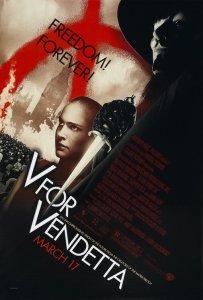 Legendary comics author Alan Moore has a particular disdain for Hollywood adaptations. They just haven’t gone so well for this scribble scribe. There was 2001’s From Hell (I may be the only one in the world that actually likes it, Heather Graham’s atrocious cockney accent aside) and 2003’s The League of Extraordinary Gentleman. Moore is even responsible for the creation of the John Constantine character, who had his own 2005 big screen venture. I suppose you could see why he has certain contempt for the movie versions of his much-heralded stories. Now comes V for Vendetta, based on Moore’s 1988 comic and adapted into a screenplay by the Wachoswki brothers. While I may have no idea how close V for Vendetta is to Moore’s graphic novel, I can say that the movie is a smart, superb thriller that dares you to think while you?re stuffing popcorn into your mouth.
“Remember, remember, the fifth of November, gunpowder treason and plot. I see no reason why the gunpowder treason should ever be forgot”
In the future, America has lost its super power status after overextending itself in war. Britain has turned into a hostile totalitarian government, led by chancellor Sutler (John Hurt). Evey (Natalie Portman) works for the state-controlled TV station. One night, while walking out past curfew, Evey is attacked by some undercover cops looking for a good time. A mysterious masked man named V (Hugo Weaving) comes to her rescue. His grinning, bearded mask resembles Guy Fawkes, a revolutionary that tried to blow up the British Parliament 400 years ago on November 5th. V starts taking out high profile government figures and then infiltrates the government airwaves, asking others to rise up against the corruption they see around them. He promises to blow up parliament one year to the day of this message. Finch (Stephen Rea, so expressive with his hangdog demeanor) is assigned to find out who this V is and how to deal with him. In reality, Finch discovers a lot more troubling information about his own government. Evey is linked with V and tracked down for interrogation and potential execution. As the date approaches, Evey must battle her own loyalties and strike out against what she feels is right and just.
 What makes V for Vendetta so exciting is its playground of ideas. This is a dynamically intelligent, complex movie but it never lets the smarts get in the way of a rousing good time. This is a very political movie that’s very relevant today, like the exchange of freedom for security and the use of fear mongering to serve an agenda. I love that the government’s leaders were a rogue?s gallery of corruptible figures; the Bill O’Riley-like TV pundit blowhard, the church leader who just happens to be a pedophile, the scientist whose good intentions justify the worst in human experimentation. V for Vendetta is a thinking man?s comic book movie, one that actually has actual respect for its audience and refuses to dumb down its message. The movie starts at a gallop and never lets up intellectually, and that’s so wonderfully refreshing from a film of any stripes. While I would not classify myself in the camp that views V for Vendetta as an anti-Bush administration screed, I’d have to say the movie does stir people out of a sense of apathy. I was even moved by the film’s hopeful conclusion, which is more than I can say about any other comic book movie (yes, even Elektra).
Director James McTeigue has previously served as the Wachoswki brothers’ assistant director. V for Vendetta is his debut as a director and what an auspicious debut it is. The movie is visually lush thanks to Aliens cinematographer Adrian Biddle (sadly, he died December 2005), but the smartest notion McTeigue accomplishes is putting story above special effects (ahem, George Lucas?). The command McTeigue has as a first-time director is impressive; how many people would be this restrained with all the fancy tools Hollywood has to offer? It’s his restraint and priorities that allow V for Vendetta to excel. And when the film does call for action, McTeigue judiciously uses visual trickery to enhance the scene. A late scene involving slow-mo V taking out a cadre of soldiers while they reload is amazing both in its “hey, look at this!” visual acuity and that it fits perfectly within the narrative. Nothing is self-consciously showy for the sake of wowing an audience, and every beat of action feels organic to the storyline. V for Vendetta is a terrific debut with some great set pieces.
Weaving is awesome as our hero. Since at no point does V ever take off his mask, it wouldn’t have been unheard of to simply hire a stunt guy to play the part and dub Weaving’s voice in later. But no, Weaving decided to be the part and adds so much to the character. He knows when to turn his head, nod, lean to a side, just like a silent film star interpreting the moment through action; it sounds ridiculous but it definitely helps paint a clearer picture of V. Then there’s Weaving’s incredible voice, making V sound like the world’s craziest, coolest Shakespearean lit professor.
Portman has finally made me appreciate her as an actress. She had a long winter between 1994’s The Professional and her 2004 one-two punch of Garden State and Closer, but I now finally see that Portman is a fine actress and not just a promising talent. She’s the heart of the film, the focal point for the audience to journey along, and she’s excellent at every point. I also give her props for having her head shaved on camera (I can only imagine what the eventual porn version will do with this scene).
 I’m left in the cold by this over inflated discussion on how “daring” V for Vendetta is by having the hero of a major Hollywood movie be a terrorist, one that says things like, “Violence can be used for good,” and, “Sometimes blowing up buildings can change the world.” Yeah, sure, but it’s a well-mannered, well-read, cultured terrorist versus a giant evil totalitarian government that kidnaps people, strips them of their rights, and enforces cruelty and prejudice. So exactly how daring is that? Of course audience sympathy is going to fall to the little guy, in this case a terrorist, which is the only hope of shaking things up and righting wrongs in the system. That doesn’t exactly strike me as subversive. This movie isn’t promoting terrorism any more than Munich was when Spielberg allowed the Palestinians to have a voice. The movie is anti-oppression if anything.
My only complaints are minor. The movie gets a bit repetitious in its windup to the climax (oh look, we’ve cut again to the Big Brother round table), and that somewhere along the middle V for Vendetta gets log-jammed with subplots. Everyone has a story to tell in V for Vendetta and we see every personal tale, and after a while it kind of grinds the flow of the story down. However, this problem is sidestepped after awhile and V for Vendetta gets back on track, driving full-force toward its conclusion like a runaway train.
What sounds on paper as something incredibly silly, including a kissing scene involving a motionless clay mask, V for Vendetta plays out with such excitement, visual prowess, and vibrant intelligence; this is a very political movie that?s very relevant today and I loved it all the more for it, but V never forgets to be entertaining at the same time. McTeigue has fashioned together a stirring and fascinating directorial debut, and even though the Wachowski brothers have their fingerprints all over this film, the pretension is kept to a minimum. V for Vendetta is exactly what the Matrix sequels should have been: a pulpy mix of brains and action, not a snore-fest that beats you down before putting on a show. It’s a shame Moore didn’t want his name attached to the finished product, because V for Vendetta is 2006’s first great movie of the year.
Nate’s Grade: A-
Share this:

Constantine (2005)
 I’ll admit it; I’m a sucker for Christian mythology played against thriller and action settings. I may be the only person to have watched all of The Prophecy flicks, and probably the only person that eagerly chows down on the cheesy sequels to The Substitute, yet shy away from seeing the first film. I’m captivated by the imagery, the discussion of Heaven and Hell and its mythical logistics, and just the psychology of supernatural biblical beings. With this in mind, I was strongly anticipating the release of Constantine. What I got wasn’t exactly what I expected but I’d be lying if I said I wasn’t entertained.
John Constantine (Keanu Reeves) is a very troubled man. Since his youth he’s had to live with his gift that allows him to see through earthy disguises and witness angels and monstrous demons walking among us. He’s parlayed this ability into a modest side job of exorcising demons and sending them back to Hell. Constantine figures his loyal service should grant him passage into the pearly gates, but Archangel Gabriel (Tilda Swinton) reminds him that that’s not how it works. Constantine is doomed to go to Hell because he tried taking his own life, and if that’s not enough he also has terminal lung cancer from smoking like a chimney. “In other words, you’re f***ed,” Gabriel confides to Constantine.
 Police detective Angela Dodson (Rachel Weisz) is investigating the suicide of her twin sister (also Weisz). She swears her mentally disturbed sis wouldn’t do such a thing, and she seeks out the help of Constantine. He challenges her beliefs, stating that God and the Devil (Peter Stormare) have a wager over the souls of mankind but cannot directly interfere. But now something is breaking this rule and it looks like demons may be getting closer to entering our plane, and it looks like Angela’s dead sister may have known more than people would have thought.
The plot of Constantine is rife with contrivances, aborted subplots, underwritten and nearly forgotten supporting characters, and sketchy logic (staring at a cat can transport you to Hell? No wonder I’m a dog person). Often the film feels overwhelmed by good special effects, as they seem to be the crux of the film?s purpose of being and not, on the other hand, a theological playground of ideas. Constantine gives veiled glimpses of something smart, but routinely shuts that door to focus more on annoying jump scares.
In fact, Constantine seems rather old-fashioned with its theology, still clinging to the Roman Catholic belief that suicide is a one-way ticket to the fiery abyss. I understand its use as motivation for our lead, but will progressive audiences accept something they may find archaic? I suppose it could be worse. Constantine could have briefly gone to Hell for eating meat on a Friday.
It’s interesting that after spending two years making The Matrix sequels, Reeves would choose to attach himself to another big-budget theological action flick. His acting never really rises beyond morose loner but somehow he does make for a satisfying, brooding hero. Reeves? low-key monotone speaking voice allows him to spout cheesy dialogue with a straight face and mercifully keeps the audience grounded.
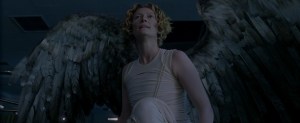 The true stars of Constantine are the memorable supporting players in this celestial smack down. Swinton uses her androgynous looks to forge what David Bowie might be like as an angel: angular, mysterious, waif, and somewhat creepy. Stormare delivers a performance so kooky and tic-heavy, that it could only be compared to the weirder moments of Christopher Walken. Both actors liven up the film and seem to be having the most fun by far with their cheeky roles.
The genius of Constantine is in its one-upsmanship game it holds with the audience. Granted, suspension of disbelief is needed to even go along for the ride, but when we start learning that Hell has its own line of bibles (and they’re longer) we’ve gone beyond suspension of disbelief and into wacky Anne-Heche-speaks-to-aliens land. While sitting through Constantine, we the audience think, “There’s no way this movie could get any sillier.” And then it does! We think, “Alright, that was crazy. Now there’s no way after that this film could get any sillier.” And then it does! Constantine is an amazing ascent into movie madness. After a while, I became drunk from the film’s insanity and wanted it to get even crazier, if possible. It almost seems like there’s a drinking contest between the movie and the audience, and Constantine isn’t afraid to piss its pants to win.
By the time Lucifer shows up, clad in all white like Tom Wolfe, and the Dark Lord appears to have Tourette’s Syndrome and/or a speech impediment, Constantine has hit the bottom of its Kool-Aid cup. Sure the film’s cinematography is slick, and the premise is intriguing, but the real draw of Constantine and the real enjoyment of the flick is how bat-shit crazy it is. I cannot even think of comparable films. I hope David Lynch was taking notes if he saw this.
For a while there, it seems director Francis Lawrence wanted Constantine to be a companion to Wesley Snipe’s Blade character. Maybe the two of them can set up a play date and go destroy otherworldly creatures. There’s a visually striking sequence late in the film involving Constantine in a room full of demons. He’s “contaminated” the water system by placing a giant cross inside, thus holy-fying the water before he can bottle it and sell it to the masses. He holds a lighter to the sprinkler system, demons growling all around him ready for their kill, and then water sprays down across the room. “Holy water?” one female demon says in a stunned voice, watching her flesh sizzle away. Then Constantine marches through the wet room blowing away demons into splashes of ash with his comically unwieldy cross-shotgun. It’s filmed wonderfully with dark hues and is a great idea; however, it’s a bit of a rip-off of the opening sequence in the first Blade.
 This seems to be a repeated sentiment in Lawrence’s direction. He has a sharp visual eye and several camera angles come from odd yet exotic places, but his film is borrowing so heavily from so many other films. What you’re left with is the impression of a stylish if very derivative looking action film. One exception is when Lawrence shows us glimpses of the blistering burnt orange world of Hell. It seems Hell is an exact model resemblance of Earth, only with the fire, brimstone, and crawling demons with their heads sliced open (there is a scary level beneath the surface where we witness a sea of people being tortured). The second or third time we traveled to Hell, I began to wonder what my house would look like and the logistics of upkeep for the homeowner in Hell. Surely the heating bills wouldn’t be the same.
Constantine is funny, frustrating, confusing, gorgeous, and just plain insane in the ole membrane. The film exhibits a rare and engaging form of insanity that may glue audience eyeballs to the screen to see what happens next. I’ve seen Constantine twice (don’t ask why) and even though I knew all the weird plot turns I still found myself getting an enjoyable contact buzz from the film. Who knows how long such a novelty can sustain itself, though. Comic book fans, especially those with a spiritual bent, should get a kick out of Constantine as will anyone else searching for a pristine example of how wonderfully out of control Hollywood moviemaking can be. Sometimes in a good way.
Nate’s Grade: B-
Share this:

The League of Extraordinary Gentlemen (2003)
 This movie is certifiably insane. While a very literary X-Men seems like a great idea, what exactly does Tom Sawyer bring to the table? What, is he going to convince the bad guys to white wash a fence? And yet, this highly operatic bombast almost succeeds on its sheer level of lunacy, like when you realize you’re watching Sawyer get a crush on a vampire on a giant underwater submarine that’s so big it has end tables and vases in its hallways. Still, the handling of Jekyll/Hyde here is what Hulk should have been like. League of Extraordinary Gentlemen almost works, but its falls apart amidst shabby special effects, outlandish plotting, and very wooden dialogue. The director doesn’t make it any easier to follow, trumping his action sequences with rapid fire edits. Ah well, my bafflement was more entertaining.
Nate’s Grade: C


 nathanzoebl
You must be logged in to post a comment.