Blog Archives
Midnight in Paris (2011)
 Woody Allen hasn’t been this light-footed in a long time. Midnight in Paris is an effervescently charming film that flirts with overt sentimentality. But before you think Allen goes all gooey, the fatalist in him pulls back for some wisdom about the folly of nostalgia. Allen’s nebbish stand-in this time is Owen Wilson, assuredly better looking but on the same neurotic wavelength of his director. Wilson is a disgruntled Hollywood screenwriter visiting the City of Lights with his shrewish fiancé (Rachel McAdams) and her upper-class parents. One night a mysterious taxicab picks him up shortly after midnight. Wilson is transported back in time to his favorite era, 1920s Paris. He gets to rub elbows with literary and artistic giants, like Gertrude Stein (Kathy Bates), Ernest Hemmingway (Corey Stoll), Scott and Zelda Fitzgerald (Tom Hiddleston and Alison Pill), Salvador Dali (Adrien Brody), and others. He even falls for a lovely lady (Marion Cotillard) from that time period who served as a muse for several artists. Midnight in Paris is a far more enjoyable experience if you have a modicum of education in the humanities. Identifying the artists of old, albeit exaggerated cartoon versions of themselves, is part of the fun, fantasizing about interacting with the greats. But Allen is also playful with his storytelling, and for a while Midnight in Paris becomes a highly refined cross-time romance (think The Lake House written by Tom Stoppard). Midnight in Paris has been catching on with audiences, becoming Allen’s biggest hit in 25 years, and it’s easy to see why. It’s whimsical while being literate and romantic without being corny.
Nate’s Grade: B+
Share this:

Predators (2010)
 For a solid 45 minutes, Predators is a fairly good genre movie. No, it’s a very good genre movie. We snap awake in freefall with a ripped Adrien Brody. A group of deadly warriors from all cultures find themselves stranded in some strange jungle. For that 45-minutes of goodness, the assembled killers (and Topher Grace as a doctor?) try and piece together their circumstances while exploring the foreign terrain. It’s a setup straight out of the Twilight Zone catalogue. And then, at minute 46, they find out they’re on a game preserve planet for the notorious alien bounty hunters, the Predators. The characters get picked off one-by-one and the patient buildup unwinds in a familiar and depressing bloodbath. Predators will work as a quick fix of junk food, but it teased a promising alternative that never came to fruition. The action is bloody but listless. The plot twists are seen from miles away (Topher Grace as a doctor?) and after all that badass macho posturing, the end credits blast the song… “Long Tall Sally” by Little Richard? It’s the most bizarre element in a movie with killer space monsters in dreadlocks.
Nate’s Grade: C+
Share this:

Splice (2010)

Splice is a slice of freaky-deaky sci-fi horror done with enough style and weirdness to keep your eyes glued to the screen. Director Vincenzo Natali (Cube) takes a few notes from David Cronenberg in staging his creature feature. A scientific couple (Adrien Brody, Sarah Polley) are about to have their gene-splicing lab shut down, so they make a radical decision to start an experimental personal project. Utilizing human genes, they combine other DNA to create a new species. The moral ambiguity and scientific danger is thoughtfully addressed, with the couple quickly finding how easy it is to make moral compromises. Soon they become attached to the creature they name “Dren” and view her as a daughter. Things get even crazier when Dren starts exhibiting some Oedipal desires (I believe the reverse is more fitting, an Elektra complex). Slick cinematography and seamless practical and digital effects help ensure that Splice is never dull. The movie seems two steps away from achieving true greatness. In the end, after all the intrigue and surprising amount of emotional subtlety given the premise, Splice devolves into a by-the-numbers slasher film. The final act is all about character poking around in the dark for the big scary monster. It’s not nearly as intellectually stimulating. In this regard, Splice reminds me of 2007’s Sunshine, another sci-fi film that started strong, had some style and brains, and then blew it by devolving into a clichéd horror movie where characters outrun a super-powerful slasher villain. As a fan of intelligent sci-fi, it’s frustrating to get teased with greatness and have to settle with pretty good, but I’ll gladly take the gonzo pleasures of Splice over any rote action thriller.
Nate’s Grade: B
Share this:

The Brothers Bloom (2009)
 Con movies work thanks to P.T. Barnum’s belief that the audience wants to be fooled. We all enjoy being conned to some degree. The excitement of con movies is being outsmarted and figuring out how it was accomplished. The Brothers Bloom, by writer/director Rian Johnson, one of the more exciting new filmmakers in Hollywood, is a con artist caper that understands the rules of the game and then aspires to transcend the game. Whether or not it succeeds depends on how much whimsy you can stomach in a two-hour duration.
Stephen (Mark Ruffalo) and Bloom (Adrien Brody) are a pair of con artist brothers. Stephen has been drawing up elaborate schemes ever since childhood, and he always uses his brother as the face of the operations. The brothers have a third member to their team, the mysterious and mute Bang Bang (Rinko Kikuchi), who, we’re told, just appeared out of thin air one day and they expect she’ll leave in the same style. Bloom is tired of playing characters and roles and wants out, but his big bro comes back with one last con in the works. Penelope Stamp (Rachel Weisz) is rich, peculiar, and lonely, ripe for the taking. Bloom snares her with the exciting prospect of being apart of an adventure. There’s a globetrotting plot to profit from selling a book to some shady characters (Robbie Coltrane, Maximilian Schell), and it’s just what Penelope needs to feel alive and leave the confines of her large cage-like home. Naturally, Bloom falls for the “mark” and feels conflicted, but was this part of Stephen’s plan all along? Is he setting up some form of a happy ending for his little brother? Is Penelope in on the con? Who’s conning whom?
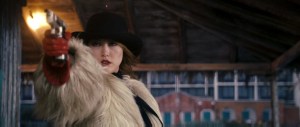 The Brothers Bloom is steeped in whimsy and at times runs dangerously close to falling into the inescapable gravitational pull of “cutsey.” Some have compared the film’s quirky, precocious style to Wes Anderson, but the movie reminds me more of the style of Barry Sonnenfeld, a filmmaker who made outsized whimsy seem like everyday reality; Anderson’s movies seem to exist in their own impeccably handcrafted worlds. I loved the opening 10-minute prologue which explores the childhood history of Stephen and Bloom, examining their first con on local rich kids. It’s quick-witted, snappy, and even has Ricky Jay provide narration, reminiscent of Magnolia or the David Mamet con movies. The Brothers Bloom has a sunny disposition that doesn’t come across as smug. Stylistically, the movie never crosses the line into feeling overly mannered. The Brothers Bloom exists in some unknown time period. The cars are modern, the clothes are from the 1930s (everyone wears a bowler hat with such flourish), and the sets look like they’re from the 1960s. There is no dependence on technology, just good old-fashioned brains and charm.
And yet this is more than an exercise in style. Just as he did with the adroit, neo-noir movie Brick, Johnson takes a genre and subverts its expectations. The Brothers Bloom treats cons more as storytelling, and it positions the film and its characters in an interesting new light. Bloom yearns for an “unwritten life” because all he’s known have been roles in his older brother’s games and cons, and the poor sap doesn’t even know if he has an identity beyond fabrication. Stephen has also begun to blur the lines between reality and his cons, and his life’s ambition is to stage the perfect con where “everybody gets what they want.” Get that? The Brothers Bloom aims for deception that gives everyone, including the deceived, a happy ending. It almost sounds like a charitable goal. Johnson has injected the con artist genre with some pathos and self-reflection. Too many con artist movies are only good for one viewing; once you know the particulars of the con, do you feel invested in watching it play out again? Johnson puts some melancholy into the mix and it gives the film more weight than being the sum of its many quirky parts.
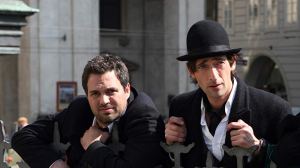 The acting across the board is superb. Ruffalo is his typically low-key yet engaging self, and he seems sincere even when you know he isn’t. His love and concern for his little brother is touching. His schemes are all for his brother to get out of his shell and experience some level of happiness. Brody embraces the weariness of his character. He is confused and tired and feels like he cannot trust human connections; he’s paranoid that all roads lead back to some machination from his brother. His affection for Penelope is like an awakening for his character, and yet he cannot fully give into it because is it genuine? This incredible level of uncertainty with every aspect of life casts a heavy toll, and Brody convinces you of that toll. Kikuchi (Babel) makes great use of physical comedy and has a lot of fun with her mysterious character. She’s mute for practically the entire film yet manages to communicate plenty. But it is Weisz (The Fountain) that steals the movie and steals your heart. Her screwy eccentric is deeply lonely but radiates a ditzy glow. She fully embraces the prospects of adventure and bounces in glee. This woman is powerfully adorable.
There are a handful of missteps in the narrative. The movie likely lasts twenty minutes longer than it needs to, with false endings and even a false third act. Audiences are used to con movies revealing the larger scope by the end after a bevy of last-minute twists. This is not the case with Bloom. The movie gets more muddled and introduces new conflict that isn’t ever really resolved. Audiences expect clarity by the end of the third act, not confusion. I feel like I’m missing something with the duplicitous Diamond Dog character (Schell), and maybe that’s the point; perhaps I’m supposed to be in the dark about his connection to the brothers Bloom. I won’t get into spoilers, but I was expecting more reveals at the end of the movie, perhaps Stephen showing one last final box, and the movie gives you nothing. I suppose the purpose is to play against con movie conventions and the surprise is that there is no real surprise by the end, no “I was in on it” or “It was all part of the plan” a-ha moments of ironic revelation. That’s nice but it doesn’t always make a movie more satisfying. The ending would be more moving if the audience didn’t already feel spent by the time they have to process something more emotional.
Johnson’s follow-up to his immensely entertaining debut is a solid winner, though it leaves you hanging and wanting at the end. The movie is quirky and heavy on the whimsy, and yet it also squeezes in some pathos. Yet the movie falls short of its ambitions and the talent of Johnson. The Brothers Bloom will seem enchanting to some and insufferable to others; it defies expectations and genre conventions, and sometimes would be better off adhering to them. It’s an amusing caper comedy but it could have been something even more special. It just needed a little less narrative sleight-of-hand.
Nate’s Grade: B+
Share this:

The Darjeeling Limited (2007)
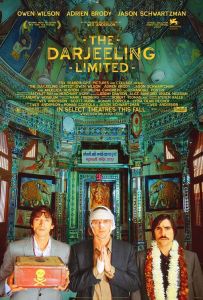 I’m starting to think Wes Anderson may become his own worst enemy. The man seems trapped in his precious, idiosyncratic style that revolves around intricate, dollhouse-style production design, slow-motion and simple pan shots, clever-to-smug characters, family dysfunction that coalesces somewhat by the end, and a soundtrack full of hip, retro songs. I like Wes Anderson; I loved his first three films, was rather lukewarm on 2004’s Life Aquatic, but The Darjeeling Limited is pretty much a bland rehash of the same. Instead of a father reconnecting with his long-forgotten son it’s three brothers reconnecting in the wake of their father’s death and mother’s abandonment. The humor is fairly subdued and while the movie is brief it seems to run out of gas early on and get repetitive. I think Anderson is more interested in showing off his highly elaborate production design than crafting interesting things for his characters to do inside those complex sets. I didn’t feel a blip of emotion for any of the character, all of who have some lasting fear of women ever since their mother ran out to become a nun. There’s kind of an unsettling misogynistic vibe in the movie against women, which is an unfortunate surprise. There’s a spiritual quest that some may relate to but I found it superficial at best, intended to gloss over the plot holes and character miscues. I wish Anderson well, but his next venture behind the camera might work better if he threw out his fraying filmmaker playbook.
Nate’s Grade: C+
Share this:

King Kong (2005)
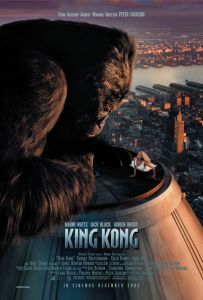 Has there been any movie this year that’s had a bigger hype machine than Peter Jackson’s King Kong? Coming after his Lord of the Rings trilogy, about two billion in revenue and a slew of Oscars in tow, Jackson decided to recreate the movie that captured his imagination as a child. It was King Kong that made Jackson want to become a filmmaker, so now he is returning the favor. Universal ponied up a staggering 200 million dollars for a budget and paid Jackson a record 20 million to sit in the director’s chair. Like his Rings series, this Kong clocks in at a gargantuan 3-hour running time. Will audiences share Jackson’s adoration with the story of a woman, a big ape, and a bigger building?
Carl Denham (Jack Black) is a filmmaker feeling studio pressure. The suits want to reel him in before he even starts shooting his next picture. Carl scrambles to get his crew and equipment onto a boat before the studio can shut him down. He?s on the prowl for a new lead actress and spots Ann Darrow (Naomi Watts), a hungry out of work vaudeville actress. He quickly convinces her to be apart of his movie and hurries her aboard, the selling point being that Jack Driscoll (Adrien Brody) has written the story. Carl practically kidnaps Jack and they all set a course for the mysterious Skull Island, a place only rumored to exist. The ship’s captain and crew are wary but sure enough their vessel washes ashore on an exotic island. But this is no sunny getaway, as the crew is immediately besieged by hostile natives and Ann is taken prisoner and offered as a sacrifice to Kong, a 25-foot gorilla. Jack leads an expedition to retrieve Ann, who begins to bond with her hairy captor (Stockholm syndrome, anybody?). Kong rescues Ann from dangers, be it bug or dinosaur, but flies into a vicious rage when she’s plucked away from him. Carl realizes an even bigger attraction: a giant ape to headline Broadway and line his own pockets. His schemes come true as Kong is knocked out and transported back to New York City. However, no stage is too great for Kong, as he busts free and looks all over for the love of his life, Ann.
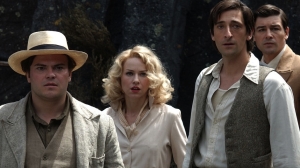 The sweet love story gives Jackson’s update a surprising emotional richness. In the 1933 original, Fay Wray never stopped shrieking until the big guy toppled off the Empire State building. She had no emotional connection to her furry captor and his unrequited love. In the 2005 King Kong, the strength of the movie is the relationship between Ann and Kong. Jackson of course stacks the deck of his story to all but guarantee an audience will fall in love with the big brute (he appreciates sunsets, how romantic!). There?s not much choice whether or not to sympathize with Kong, especially those moments where we stare into his soulful eyes welling up with emotion. King Kong has always been a tale of exploitation with man as the true monster. By administering time to fully develop a convincing relationship between beauty and beast, it makes the later scenes of exploitation have a larger sense of tragedy. Immense credit goes to Watts for selling this relationship and spurring our sympathy for Kong, instead of making their bond something for snickers and eye-rolling. Poor Adrien Brody though. It’s pretty bad in a romantic triangle when you’d rather pick a giant primate than Brody.
The performances go a long way to adding to the enjoyment of King Kong. Watts is a luminous actress and a natural beauty. It’s because of her that the second half of the movie has a beating heart and some kicks to the gut. Brody is ho-hum but given little to work with as a, wait for it, second banana. Black works wonders to make his villainous role so charismatic. Denham is a huckster that would step over his dying mother to make a buck, and yet Black’s charming and funny even at his most dastardly and cowardly. I don’t think King Kong would have worked the same with different actors; few could bring the heart and emotion Watts emotes, and few could bring Black’s comic virtuosity that makes it plausible why others would follow his showman character. Colin Hanks (also along side Black in Orange County), as Denham’s assistant, imparts a favorable impression. I’d like to see him paired up with Topher Grace sometime. Give it some consideration, Hollywood.
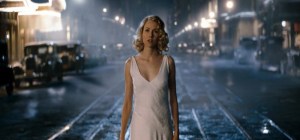 King Kong is a spectacular vision by one of cinema’s greatest visionaries. Jackson has lavishly recreated the excitement of his youth, bringing the story of Kong into the modern age with studly panache. The film is marvelously beautiful to take in and has plenty of moments that will reawaken the child within you, transporting you to an age when movies truly seemed larger than life. During the epic battle between Kong and the T. Rexes, I knew the exact curiosity and excitement Jackson felt when he saw the 1933 original. The action is intense and rarely lets up once our adventurers reach Skull Island. The special effects are some of the best movies have ever seen. Kong moves with expressive accuracy that goes a long way toward expressing his humanity, whether it is in a sigh or a tantrum. Andy Serkis has yet again brought life to another entirely CGI character. King Kong is well worth the price of admission just to sneak a peek at the Jackson’s limitless imagination.
With Jackson’s beefed-up recreation, he has also brought with him a terrible amount of bloat. This King Kong runs a frightful 3-hours plus, and most viewers will just feel exhausted by the time the lights go back up in their theater. Jackson’s love affair with his material is indisputable but it also seems to cloud his judgment as far as pacing is concerned. Numerous scenes seem to stretch longer than necessary and lose their point of interest, the first hour seems too drawn out and prosaic, and the movie haphazardly mixes in the serious with the soapy (Kong on ice?). Some scenes lose their sense of believability the longer they stretch on, even in a movie filled with giant monsters. Certain subplots have set-up but no follow-through, like all the added attention to Jimmy (Jamie Bell), the ship’s teen that wants to experience danger too. Jackson even makes sure we catch that he’s reading Heart of Darkness. So where does this character go? Nowhere and very slowly at that. The character has no bearing on anything that happens with the plot and is dropped entirely once they leave the island. There’s no point. Did something get cut from the inevitable 8-hour extended edition DVD that will prove how pivotal Jimmy really was? I doubt it.
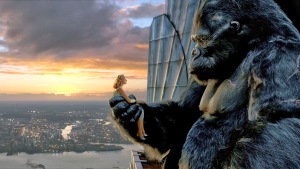 Some nipping and tucking and a comprehensive editing overhaul would certainly make King Kong a better movie, but it would lose its sense of spectacle. I can’t complain about length too much since Jackson packs such a wallop of entertainment like few others, so while King Kong certainly is a bloated and exhaustive film, it’s also an artistically bloated, exhaustive film. Jackson sure does have reverence for his source material (some lines and scenes are directly lifted), though he may have overlooked the 1933 King Kong‘s 100-minute running time.
Peter Jackson’s King Kong is an epic, epically grandiose, epically imaginative, epically action-packed, and epically bloated. The update is a bit exhausting but Jackson packs more entertainment per minute than few others in the film business, even if he has too many minutes to work with. Watts really sells her tender relationship with Kong and gives the film a surprising emotional heft absent from the 1933 original. Because of our emotional investment the film has a greater sense of sadness and tragedy as it plays out. King Kong was the 800-pound gorilla of the movie year and Jackson knows how to deliver a visual epic, even if he tiptoes into self-indulgence. While I can protest the length, pacing, and some subplots that go nowhere or strain credibility, it’s hard to argue that King Kong is the popcorn spectacle of the year. Your bladder may hate you by the end of it but you won’t want to miss a second.
Nate’s Grade: B
Share this:

The Jacket (2005)
 In The Jacket, Adrien Brody plays a mentally disturbed soldier sentenced to spend his days in a treatment facility. He gets strapped into a straight jacket and locked inside a morgue drawer as part of his “therapy.” Inside these closed quarters, for whatever unexplained reason, Brody has the ability to travel through time. This got me thinking about some other weird/lame ways people travel through time in films. In 2004’s The Butterfly Effect a bearded Ashton Kutcher is able to jump through time by reading his childhood journals. Sure this is weird, and may give false hope to a nation of gloomy journal-scribbling teenagers, but when it comes to incompetent time travel techniques, 1980’s Somewhere in Time is number one with a bullet. Christopher Reeve’s character desperately wants to travel back to 1912. So he removed all modern furniture, clothing, and anything post-1912. Then he lies down on his hotel bed and keeps repeating to himself that he’s living in 1912. Somehow this works and Reeve gets to embark on romance, 1912-style y’all.
Jack Starks (Brody) is a helpful and well-meaning guy that just can’t catch a break. As a soldier in the 1991 Gulf War, an Iraqi kid he was trying to befriend shoots him in the head. When he returns home he starts a long trek through the Northeast. Starks helps out a mother and daughter whose car has stalled. He befriends the non-gun wielding little girl, Jackie, but her drunken mom nearly accosts Starks and they drive away. Then he gets a ride with a drifter (Brad Renfro). They get pulled over by a cop. The drifter kills the cop; Starks gets knocked out and framed for the murder. He’s sentenced to spend the rest of his days in a clinic for the mentally disturbed. And you thought you were having a bad day.
 The operator of the clinic (Kris Kristofferson) has some unconventional methods of therapy, like locking Starks in a straight jacket and sliding him into a morgue drawer. Inside this confined space Starks can zip through time to 2007. In the future he goes home with an angsty young woman (Keira Knightley) who, surprise, ends up being an adult Jackie, the girl he helped at the side of the road. They’re both confused and freaked out, but what spooks Starks even more is the knowledge that he dies on New Year’s Day, 1993. Starks must now get into that jacket so he can visit 2007 some more, fall in love with Jackie, and piece together clues to prevent his soon-to-be death.
Brody seems to be having as much bad luck post-Oscar as Halle Berry and Nicole Kidman. He’s in some funk playing glum character after glum character. Brody and his gaunt figure do have a natural haunted quality and he does excel at emoting grief and horror (hence the 2002 Best Actor Oscar for The Pianist). Brody gives the film more intensity than it deserves.
Knightley is a decent actress but has little to work with. Her role is wrapped in a slab of Gothic traits posing as characterization. When she talks it sounds like she has a cold. I don’t know if this is because of her attempted American accent, the glum character, or maybe she just had a cold from all that outdoor shooting in the snow.
Director John Maybury has the irritating habit of filming scenes entirely in jagged close-ups. Two people will be talking and then -WAM!- huge close-up of an eyeball. Then -POW!- giant mouth filling up the screen. Then -WAM! (again)- more of the same. This editing decision is a distraction but it also lacks purpose. It doesn’t effectively communicate character emotion or scene tension; it just annoys the crap out of you.
 The Jacket is fairly interesting for a good while. The premise is almost ingenious: a man must travel to the future to collect information to prevent his mysterious death in the past. The Jacket adds further intrigue with the question of whether Starks really is traveling through time. Maybe he truly is disturbed and this is all in his head. Sadly, but as expected, The Jacket disproves this tantalizing possibility after an hour of tease.
When the film does transition into its final half, the possibility it showcased seems to go slack. The answers seem either overly tidy or simply anticlimactic, like the truth behind Starks’ death. The Jacket opens strong and strings us along with some intriguing prospects but the end results merely peter out the film’s potential until The Jacket seems completely drained of blood.
Their relationship also has some unexpected creepy moments. Starks, in 1992, visits the little girl he will eventually have sex with in 2007. Yes she’s an adult when they take their tussle in the sheets, but having him later visit her when she’s a child is just plain cre-eeeee-py.
For a while, The Jacket aims to be an intelligent mind-bender but the film squanders its potential. The answers don’t seem nearly as thought-out as the film’s initially intriguing questions. Brody gives the movie more brooding intensity than it deserves. The Jacket is irritatingly directed, alternating between pale shots of white wilderness, extreme close-ups, and overkill on style. The Jacket seems like a nice fit for a while but becomes too frayed to be memorable.
Nate’s Grade: C+
Share this:

The Village (2004)
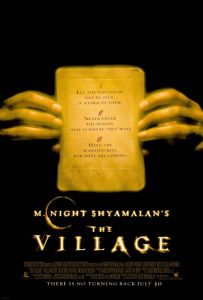 When saying director names you can play a fun little game of word association. Someone says, “George Lucas,” and things like big-budget effects, empty storytelling, and wooden dialogue come to mind. Someone says, “David Lynch,” and weird, abstract, therapy sessions dance in your head. The behemoth of word association is M. Night Shyamalan. He burst onto the scene with 1999’s blockbuster, The Sixth Sense, a crafty, moody, intelligent thriller with a knock-out final twist. Now, though, it seems more and more evident that while The Sixth Sense was the making of M. Night Shyamalan, it also appears to be his undoing. His follow-up films, Unbreakable and Signs, have suffered by comparison, but what seems to be hampering Shyamalan’s growth as a writer is the tightening noose of audience expectation that he kowtows to.
With this in mind, we have Shyamalan’s newest cinematic offering, The Village. Set in 1897, we follow the simple, agrarian lives of the people that inhabit a small secluded hamlet. The town is isolated because of a surrounding dense forest. Mythical creatures referred to as Those We Dont Speak Of populate the woods. An uneasy truce has been agreed upon between the creatures and the villagers, as long as neither camp ventures over into the others territory. When someone does enter the woods, foreboding signs arise. Animals are found skinned, red marks are found on doors, and people worry that the truce may be over. Within this setting, we follow the ordinary lives of the townsfolk. Ivy Walker (Bryce Dallas Howard) is the daughter of the towns self-appointed mayor (William Hurt), and doesnt let a little thing like being blind get in the way of her happiness. She is smitten with Lucius (Joaquin Phoenix), a soft-spoken loner. Noah (Adrien Brody), a mentally challenged man, also has feelings for Ivy, which cause greater conflict.
 Arguably, the best thing about The Village is the discovery of Howard. She proves herself to be an acting revelation that will have future success long after The Village is forgotten. Her winsome presence, wide radiant smile, and uncanny ability to quickly emote endear the character of Ivy to the audience. She is the only one onscreen with genuine personality and charisma, and when shes flirting and being cute about it you cannot help but fall in love with her. And when she is being torn up inside, the audience feels the same emotional turmoil. I am convinced that this is more so from Howard’s acting than from the writing of Shyamalan. She reminds me of a young Cate Blanchett, both in features and talent.
It seems to me that Shyamalan’s directing is getting better with every movie while his writing is getting proportionately worse. He has a masterful sense of pacing and mood, creating long takes that give the viewer a sense of unease. The first arrival of the creatures is an expertly handled scene that delivers plenty of suspense, and a slow-motion capper, with music swelling, that caused me to pump my fist. The cinematography by Roger Deakins is beautifully elegant. Even the violin-heavy score by James Newton Howard is a great asset to the film’s disposition.
So where does the film go wrong and the entertainment get sucked out?
What kills The Village is its incongruous ending. Beforehand, Shyamalan has built a somewhat unsettling tale, but when he finally lays out all his cards, the whole is most certainly not more than the sum of its parts. In fact, the ending is so illogical and stupid, and raises infinitely more questions than feeble answers, that it undermines the rest of the film. Unlike The Sixth Sense, the twist of The Village does not get better with increased thought.
Shyamalan’s sense of timing with his story revelations is maddening. He drops one twist with 30 minutes left in the film, but whats even more frustrating is he situates a character into supposed danger that the audience knows doesn’t exist anymore with this new knowledge. The audience has already been told the truth, and it deflates nearly all the tension. Its as if Shyamalan reveals a twist and then tells the audience to immediately forget about it. Only the naïve will fall for it.
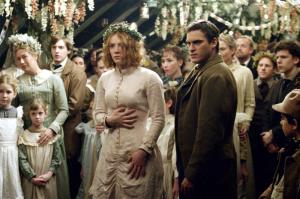 Shyamalan also exhibits a problem fully rendering his characters. They are so understated that they dont ever really jump from the screen. The dialogue is very stilted and flat, as Shyamalan tries to stubbornly fit his message to ye olde English vernacular (which brings about a whole other question when the film’s final shoe is dropped). Shyamalan also seems to strand his characters into soap opera-ish subplots involving forbidden or unrequited love. For a good hour or so, minus one sequence, The Village is really a Jane Austin story with the occasional monster.
The rest of the villagers don’t come away looking as good as Howard. Phoenix’s taciturn delivery seems to suit the brooding Lucius, but at other times he can give the impression of dead space. Hurt is a sturdy actor but can’t find a good balance between his solemn village leader and caring if sneaky father. Sigourney Weaver just seems adrift like shes looking for butter to churn. Brody is given the worst to work with. His mentally-challenged character is a terrible one-note plot device. He seems to inexplicably become clever when its needed.
The Village is a vast disappointment when the weight of the talent involved is accounted for. Shyamalan crafts an interesting premise, a portent sense of dread, and about two thirds of a decent-to-good movie, but as Brian Cox said in Adaptation, ”The last act makes the film. Wow them in the end, and you’ve got a hit. You can have flaws and problems, but wow them in the end, and you’ve got a hit.” It’s not that the final twists and revelations are bad; its that they paint everything that came before them in a worse light. An audience going into The Village wanting to be scared will likely not be pleased, and only Shyamalan’s core followers will walk away fully appreciating the movie. In the end, it may take a village to get Shyamalan to break his writing rut.
Nate’s Grade: C+


 nathanzoebl
You must be logged in to post a comment.