Blog Archives
Selma (2014)/ Black or White (2014)
 There’s a reason that race is regarded as the “third rail” when it comes to American politics. A half-century after the marches and protests, chief among them the influence of Martin Luther King Jr., the world feels just as fractious as ever when it comes to race relations. The inauguration of America’s first black president was seen as a significant touchstone, but optimism has faded and recent headline-grabbing criminal cases, and the absence of indictments, have prompted thousands to voice their protest from assembly to street corner. Race relations are one of the thorniest issues today and will be for some time. Two recent films take two very different approaches to discussing race relations, and they’re clearly made for two very different audiences. Selma is an invigorating, moving, and exceptional film showcasing bravery and dignity. Where Selma is complex, Black or White is a simplified and misguided sitcom writ large.
In 1965, Alabama was the epicenter for the Civil Rights movement. Martin Luther King Jr. (David Oyelowo) has his sights set on organizing a march from Selma to the sate capital in Montgomery. His wife, Coretta (Carmen Ejogo), is worried about the safety of their children, as death threats are sadly common for MLK. He needs to turn the tide of public perception to light a fire under President Lyndon Johnson (Tom Wilkinson) to get him to prioritize legislation that would protect every citizen’s right to vote.
 Without question, Selma is one of the finest films of 2014. It is powerful, resonant, nuanced, political, immediate, and generally excellent on all fronts. It’s a rarity in Hollywood, namely a movie about the Civil Rights movement without a prominent white savior. This is a film about the ordinary and famous black faces on the ground fighting in the trenches for their freedoms. There are compassionate white people who heed the call, don’t get me wrong, but this is a movie told from the black perspective. I suspect the portrayal of President Johnson had something to do with Selma’s poor showing with the Oscars, though I can’t fully comprehend why. Yes, Johnson is portrayed as a man who has to be won over, but he’s on MLK’s side from the beginning. He is not opposed to legislation to protect voting rights; he’s just hesitant about the timing. Johnson says, “You got one issue, I got 100,” and the pragmatic reality of pushing forward legislation through a divided Congress was real. Johnson was not opposed to MLK’s wishes; he just wanted him to wait until the political process would be easier. In fact, in my eyes, Johnson comes across as compassionate, politically savvy, and he clearly makes his stakes on which side of history he’s going to be associated when he has a sit-down with the obstinate Alabama governor, George Wallace (Tim Roth). Like the rest of the varied characters in Selma, it’s a nuanced portrayal of a man in the moment.
The march in Selma is a moment that seems like an afterthought in the narrative of the Civil Rights movement, dwarfed by the Montgomery bus boycott and the March on Washington. The movie does a great job of re-examining why this moment in history is as significant, an eye-opening moment for the nation to the brutal reality of oppression. The opposition is entrenched, thanks to a stagnant system that wants to hold onto its “way of life.” It just so happens that way of life meant very different things for black people. The movie is politically sharp, with dissenting perspectives arguing over the next course of action in Selma and the national stage. Selma is another in the current crop of biopics eschewing the standard cradle-to-grave approach to highlight a significant moment that highlights exactly who their central figure is (Lincoln, Invictus). With Selma, we get a battleground that allows us to explore in both micro and macro MLK, the man. The courage of ordinary citizens in the face of violent beatdowns and police bullying is effortlessly moving and often heartbreaking. There is a moment when an elderly man, reflecting upon a recent family tragedy, cannot find words to express his grief, and my heart just ached right then and there. I teared up at several points, I don’t mind saying.
 There isn’t a moment where I didn’t feel that director Anna DuVernay (Middle of Nowhere) was taking the easy road or pulling her punches. The screenplay respects the intelligence of the audience to sift through the politics and the arguments, to recognize when MLK is igniting a spark, and just how complicated and fragile the Selma situation was back then. Here’s a movie ostensibly about MLK but spends much of its time on the lesser known individuals like James Bevel and Congressman John Lewis, who walked alongside the man, taking time to flesh them out as people rather than plot points. MLK’s wife is also given an important part to play and she’s much more than just being the Wife of Great Man. DuVernay’s direction is impeccable; you feel like she has command over every frame. The sun-dappled cinematography by Bradford Young (A Most Violent Year) makes great use of shadows, often bathing its subjects in low-light settings. The score is rousing without being overpowering, just like every other technical aspect. This is a prime example of Hollywood filmmaking with vision and drive.
With respect to the Academy, it’s hard for me to imagine there being five better performances than the one Oyelowo (Lee Daniels’ The Butler) delivers as the indomitable Martin Luther King Jr. It is rare to see an actor inhabit his or her character so completely, and Oyelowo just sinks into the skin of this man. You never feel like you’re watching an actor but the living embodiment of history made flesh. This is a complex performance that shows refreshing degrees of humanity for a figure sanctified. He was a man first and foremost, and one prone to doubts and weaknesses as well. An excellent scene with top-notch tension and peak emotion involves MLK and Coretta listening to a supposed tape of Martin’s infidelity. In the ensuing tense conversation, both parties acknowledge the reality of his affairs. It’s a scene that’s underplayed, letting the audience know she knows, and he knows she knows, but not having to rely upon large histrionics and confrontations. It’s the behind-the-scenes moments with King that brought him to life for me, watching him coordinate and plan where to go with the movement. Oyelowo perfectly captures his fiery inspirational side, knocking out every single speech with ease. It’s a performance of great nuance and grace, where you see the fear in the man’s eyes as he steps forward, hoping he’s making the best decision possible for those in desperation.
There isn’t one bad performance in the entire film, and this is a deep supporting cast including Wendell Pierce (HBO’s The Wire), Tessa Thompson (Dear White People), Common, Giovanni Ribisi, Dylan Baker, Lorraine Toussaint (Netflix’s Orange is the New Black), Stephen Root, Cuba Gooding Jr, Jeremy Strong, and Oprah Winfrey.
It’s been weeks now since I watched Selma but there are still many moments that I can recall that still have a tremendous power on me even in mere recollection. The opening sequence of the Birmingham bombing, a moment of horror frozen in chaos and debris, is a gut punch of a way to begin a movie about human beings fighting for equality. The sheer brutality of the response from the Selma police force and associates is horrifying, and a true pivot point for the movement in the eyes of the public. More so than anything else, Selma brilliantly and beautifully recreates the suffocating reality of injustice that was so prevalent for many African-American citizens, especially in the South. This is an era where people are being lynched with impunity just for being “uppity.” There was a supreme danger in simply standing up for equal rights, and many suffered as a result. The movie recreates this mood, this permeating feeling of dread and outrage and sorrow, so expertly and so artfully. From an early scene with a middle-aged black woman jumping through hoop after arbitrary hoop just to register to vote, you quickly realize that this vehemently hostile environment was never going to settle things on their “own time,” as apologists are prone to citing in lieu of federal intervention. Selma makes it abundantly clear why MLK felt the movement just could not wait, as Johnson requested. People are senselessly dying and being beaten all for the right to fairly vote. You feel the same sense of urgency with every scene, whether it’s cold-blooded murder, noxious intimidation, or reciprocation that goes above and beyond any sense of responsibility, you understand exactly the terror it was to be black in the South during this time period.
 Another potent point of acclaim for Selma is how relevant it is to our own world today. While 12 Years a Slave was an often stirring and very professionally made biopic that exposed the ugly reality of slavery, it was not a film that screamed “immediacy.” Slavery ended in this country over 150 years ago, and while we’re still dealing with the repercussions of treating other human beings as property, it’s an easy film to dismiss in a backhanded, “Well, that was so long ago, and we’ve come so far” manner. The actions of Selma and MLK are still being felt to this day. We live in a world where many feel the justice system has its own separate-but-equal division, and the recent controversial grand jury decisions in the cases of Michael Brown and Eric Garner cannot be ignored. The reality for many black men in this country is statistically far more dangerous than others, fueled by a culture of entrenched racial bias that assumes the worst at first. The transit officer who executed Oscar Grant (detailed in the harrowing 2013 film Fruitvale Station) served eleven months in prison for a crime that had scads of witnesses. Garner’s death is captured on video, and yet even the Staten Island coroner’s report of “homicide” wasn’t enough to convince a grand jury that there was sufficient cause to at least go to trial. It’s been noted that prosecutors could get a grand jury to “indict a ham sandwich.” According to the U.S. Bureau of Justice Statistics, of the 30,000 cases that were not prosecuted in this country, only 11 were because a grand jury did not return an indictment (.0004%). However, grand juries rarely indict when a police officer is accused (In Dallas between 2008 and 2012, there were 81 grand jury investigations of officer shootings and only one actual indictment). It’s hard not to feel like these things don’t add up.
Then there’s the all-important struggle of voting, central to Selma and the plight of African-Americans in the South. You would think with Johnson’s passage of the Voting Rights Act that we wouldn’t be litigating the same issues of the past, but the Supreme Court determined that this country is far different then it was in the 1960s and there was no need for the Voting Rights Act today. Within hours of striking it down, scads of new legislation appeared in the (primarily Southern) states that had been limited beforehand because of their past history of discrimination. The right to vote is just as relevant as it was during MLK’s time and there are forces trying to stifle that right, to throw up new obstacles, new hoops, new challenges, all in the name of “polling security,” never mind that the cases of in-person voter fraud are so rare as to be one in every 15 million voters. It’s a solution without a cause, and it’s why many see it as a disingenuous political ploy. It’s the twentieth-century, and yet the struggle for equality frustratingly repeats too many of the same battles. It’s this historical and contemporary context that gives Selma its extra surge of relevancy, reminding how far we still have to go, reminding the world that MLK’s work is by no means complete and that it is up to the rest of the populace to fight for the kind of country that he spoke of in his “I Have a Dream” speech.
 It is this complex, complicated, and dire reality that hobbles another movie that tackles modern-day race relations, Mike Binder’s imprudent Black or White. The plot of the film, inspired by a true story reportedly, centers on Kevin Costner as Elliot Anderson, a rich lawyer who has custody over his biracial granddaughter Eloise (the angelically adorable Jillian Estell). Now that Elliot has lost his wife, Eloise’s other grandmother, Rowena Jeffers (Octavia Spencer), wants joint custody so Eloise can spend time around “her own people.” The two of them push and pull and lock horns over what’s best for their grandchild, which gets more complicated when her biological father (Andre Holland, who is actually in Selma as well) comes back into the picture.
Right away you can tell very early on that there will not be anything approaching subtlety in the world of Black or White, its own title serving as the first clue. The characters are sketched broad and the premise feels like a weird mishmash of Archie Bunker appearing in a court drama. It’s a preachy movie that doesn’t have a deft hand when it comes to crafting a message that rises above easy observations disguised as something deeper. Eloise’s father, Reggie, is so poorly underwritten that he feels like he stepped off the set of some after school special. He’s addicted to crack, a lifelong screw-up, and a general disappointment that has never been present for his daughter’s life. He even smokes crack out in the open on the front porch across the street from where his mother lives. At one point, Anthony Mackie’s character berates Reggie for being a walking stereotype. Just because Binder calls attention to it doesn’t excuse it. But he’s not alone, because Spencer’s sassy black matriarch character and Costner’s gruff and frequently soused character are right there with him. The frequent arguments feel like they should be punctuated by studio audience hoots and applause, that is, if you could hear them over Terrence Blanchard’s relentlessly overpowering musical score instructing the audience exactly how to feel with every clunky moment.
 In a way, the overbearing musical score gets at the major problem of Black or White, which is that a complicated case is being told from the safest point of view. Elliot is more akin to Clint Eastwood’s character from Gran Torino then, say, Archie Bunker. He’s irritable and prejudiced and old-fashioned and wary but balks if you call him a bigot. I mean he’s polite to his Hispanic housekeeper. The more you examine the character the more you realize this is a movie designed to coddle an older generation (my tiny theater was packed with patrons over 60). The movie doesn’t challenge anybody and actually rewards Costner’s character and his outdated viewpoints. The opening conflict over his refusal to share custody with Rowena makes no sense. She’s an excellent grandmother, caring, nurturing, a fine role model as well for her perseverance and starting several small businesses out of her home. Not only that but Rowena is surrounded by a large family of relatives that adore Eloise. It’s contrived that these two could not agree on shared custody when they both have much to offer the girl. The only way any of this works is if Reggie is somehow responsible for the death of Eloise’s mom. Perhaps he introduced her to crack and she overdosed. Unfortunately, it’s never explained in the slightest, and so Elliot’s hostility for the entire Jeffers clan seems petulant, especially with the happiness of his granddaughter in the balance. Without better context, his rampant anger seems to be guilt-by-association overkill. To his credit, Rowena has a major and annoying blind spot when it comes to Reggie’s stability as a parent. In fact he’s so obviously still on drugs that her ongoing refusal to accept reality harms her character irreparably.
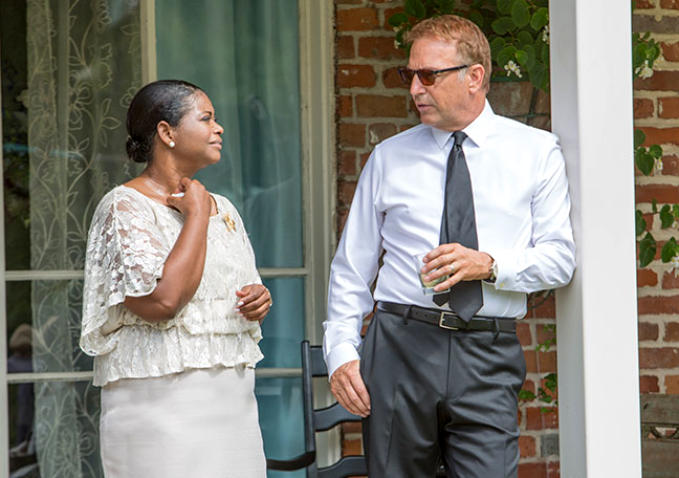 In the end, Black or White isn’t so much a film that about race relations as it is about privilege. Costner’s would-be bigot doesn’t have a problem with black people, just as long as those black people abide by his rules of conduct and expectation. It’s the same kind of qualification he’s never had to consider for himself, and one the intended audience will likewise miss. He comes from a wealthy position and Rowena and her family are likely lower middle class at best. He has a world of class privilege at his disposal that the loving Jeffers family does not, and because of that he feels they are less suited to raising little Eloise. Perhaps he’s worried about Reggie re-entering her life, but what animates Elliot Anderson is spite. He’s consumed with the overriding assumption that he must be right in all things. While the film draws many heavy-handed parallels between Reggie’s drug abuse and Elliot’s alcoholism, it clearly presents the both of them on completely different planes of judgment. One of them is ultimately redeemable and the other less so. Elliot’s perspective is essentially he can provide more and therefore more has to be better, but his definition of more is a private school, a housekeeper, a tutor who is treated as a caricature of initiative. Rowena provides a large and loving support system, but apparently they are less valued in the eyes of Elliot. And if you needed any more of a clue that Elliot and his sense of privilege are the unbeknownst star of the movie, he gets to deliver the big speech at the end that Says Something Meaningful. It feels a bit odd that the one character that uses the N-word in the film (albeit there is context) is the one telling lower-class black families how to live.
I don’t doubt the sincerity of writer/director Mike Binder (The Upside of Anger); I don’t think he purposely made a film to make older, primarily white Americans feel better about thinking what they do about these troublesome times. It’s not a nefarious movie but it is misguided and will provide cover for a certain selection of audience members who wonder why nobody is asking the old white guys their opinions on modern race relations. Even overlooking this charge, Black or White is just overblown melodrama that has to constantly explain everything to you at all times and guide you through every strained point. Selma and Black or White are both aiming at hearts and minds, looking to add to the conversation on contemporary race relations, but only one of them works as both an eye-opening message of empathy and as an exceptionally made film itself.
Nate’s Grades:
Selma: A
Black or White: C
Share this:

Nymphomaniac volumes I & II (2014)
 When Danish film director Lars von Trier said he wanted his next movie to be “porn” he wasn’t kidding. The controversial filmmaker wanted to explore the world of a woman addicted to sex, following her history of varied experiences over the course of two movies/volumes. Actors lined up for the notoriously demanding filmmaker. During the sex scenes, computer effects magic married the actors’ faces and upper bodies with the lower parts of porn stars. Upper half, Charlotte Gainsbourg, lower half, some pornographic double, all spliced together into one onscreen human being. Think about that little special effects ground-breaker, putting Hollywood faces into hardcore sex scenes. Knowing von Trier’s pessimistic tendencies, and his penchant for heaping abuse upon his female leads to the point of uncomfortable exploitation, you may rightly cringe about the prospect of a von Trier “erotic” movie. That’s the funny thing about Nymphomaniac; it’s all about sex, sometimes graphically so, but it’s never erotic. It’s an intriguing, sometimes maddening look at human sexuality and our inhibitions and frailties, until a horrible ending spoils it. In the end, von Trier just couldn’t help himself.
The story boils down to this: Joe (Gainsbourg as an adult, Stacy Martin as the younger version) is found beaten and unconscious in an alley. The kindly, monk-like Seligman (Stellan Skarsgard) finds her, brings her back to his home, and tends to her wounds. Joe says she brought all of her pain upon herself. Seligman finds this hard to believe. She uncorks a lengthy series of tales about her sexual awakening and desires.
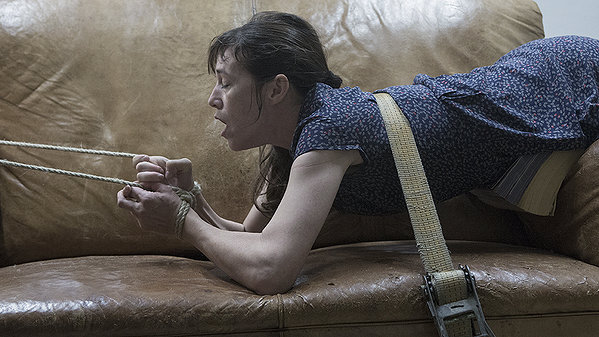 In many ways, Lars von Trier is the best and worst candidate to present a four-hour opus on the life and times of an avowed nymphomaniac. The man approaches the idea of sex addiction in practically the most clinical way possible while still being cinematic. You can practically envision Seligman as a stand-in for von Trier, countering Joe’s sense of shame with a broader, scientific perspective. Really, this is the tale of a woman spilling her guts about all her dirty little secrets and a man nodding along, asking questions, and dismissing her self-loathing with his reason and empathy. It’s sort of like being inside a therapist’s office. I can’t say whether or not I find all the analogous asides to be interesting or simply insufferable pretension. While Joe is detailing her behavior, Seligman will stop her and provide further context, often bringing in such subjects as fly fishing, the mating habits of fish, the Fibonacci sequence, Eastern Orthodoxy, and classical music. It’s almost absurd how encouraging Seligman is, dismissing every action of Joe’s sordid past through an example. After a while, it almost becomes a humorous game all its own, as we know Seligman will use every story as a stepping off point to some weird outside connection. Every item in Seligman’s bare bedroom inspires a story from Joe, which leads to a suspicion that she is something of a salacious Keyser Soze, piecing together her story on the spot; some of the coincidences with Jerome (Shia LaBeouf) seems just a bit too much. Seligman’s enlightened and intellectual asides force the audience to consider deeper meaning with Joe’s actions. Is she irredeemable, does she have control over what she’s doing, is she doing anything even bad? Over the four hours of psychological examination, the doctor is out. Nymphomaniac, especially in Volume Two, is the best film yet on sex addiction. It doesn’t demonize the behavior, it doesn’t treat it as sensationalistic, and it doesn’t overtly judge its lead characters and the choices they make, nor does it spare them the devastating consequences.
The graphic nature of the film is getting all the headlines but Nymphomaniac treats its heroine as an addict trying to get a hold of herself. We begin with young Joe innocently discovering her sexuality, especially discovering the pull she can have over an almost endless parade of weak-willed men who will follow her every whim. If that was the only plot, then there would be little separating von Trier’s film from any late-night cable erotic series (“Oh, let me tell you the time I met this man and we did this…” –Repeat). Over the two movies, we get a stronger sense of how utterly trapped she is by her urges, by her addiction. When she’s dealing with the undignified death of her father, Joe finds whatever solace she can with a willing bedmate. She places herself in precarious situations chasing after that orgiastic high, which disappears at the conclusion of Volume One. The cliffhanger separating the two volumes is that Joe loses her ability to feel sexual pleasure, which is rather problematic for a nymphomaniac. And so in Volume Two, Joe desperately searches for a means to get her groove back, at one point abandoning her own child so that she can pursue her kink. Joe goes to counseling, joins a sex addict group (she bristles at the term and prefers “nymphomaniac”), and tries to detox, at one point removing everything vaguely sexual from her apartment, including anything knob-shaped.
 The film is structured as a series of vignettes and anecdotes, broken up with von Trier’s tried-and-true onscreen chapter system. As expected for a film based around anecdotes, some stories are more interesting or revealing or simply entertaining than others. The stories are a little more whimsical in Volume One but by the time we get to Volume Two, they become more punishing and sad. It’s one thing to bet your promiscuous gal pal who will have sex with the most people on one train ride home, or on a prank to stick a restaurants dining utensil up your vagina, but it’s another when an adult woman, night after night, leaves her toddler at home so she MAY have the opportunity to have her behind whipped. The young Joe stories are easier to shake off as youthful experimentation and thrill seeking, which Seligman rationalizes as well. However, they set up just exactly the path that the adult Joe was destined for. The tales in Volume Two have to ratchet up the stakes, given Joe’s absent mojo, so what was once titillating can become downright disturbing. von Trier’s four hours offer plenty of feel-bad feel-good opportunities along the human sexuality sphere. Adult Joe thinks introducing a language barrier could be enticing, so she asks an African immigrant if he’ll have sex with her. He agrees, but brings his brother along. The two men bicker in a different language, while Joe sits there, head slumped against her hand, comically waiting for these two naked men, their penises wagging in the foreground of the camera, to get to business. It’s quite a funny and ludicrous turn of events.
One story in Volume One stands out for its raw emotional power. Joe has a whole schedule of lovers visiting her door. Well one such older man wanted to have Joe all to himself but her price was high: he had to leave his wife, “Mrs. H.” Surprise, he does, and Joe is already uncertain if this new arrangement is what she wanted; her offer was better in the theoretical sense that he would never cross that line. Well the misses (played with chomping disgust by Uma Thurman) comes for a visit and she brings her kids along. She wants her children to see what their daddy traded them away for. At first, the wife acts civil with some stinging passive-aggression, but the uncomfortable incident is dragged out, and the emotions reach a fever pitch, with crying all around. It’s so uncomfortable, so potent, and so memorable, forcing Joe, and the audience, to think of the ripples of consequences from simple sexual dalliances. While Joe is having her fun, unbeknownst to her, there are far-ranging consequences that she, and by extension the audience, choose to ignore because all those pesky details would get in the way of our fun.
The most troublesome storyline is also one of the longest, with Joe having her backside swatted by a no-nonsense sadist played by Jamie Bell (Man on a Ledge). This guy insists there will be no penetration and his rules are to be followed strictly. It starts out intriguing to get a sense of who this guy is and what his practices will be. Joe has to sit with other women between the hours of 2-4 AM, and maybe she’ll get picked. Night after night, she goes through this setup, so desperate to feel the spark of desire again. This situation feels like it goes on forever. There is no easy climax. Rather it sets up the darker turn for Joe’s character, as she gives up being a mother and a wife. To make ends meet she becomes a debt collector, using her knowledge of men, particularly heir weaknesses, to coax them back into paying. There’s one disarming moment when she takes great pity on a pedophile that will surprise you, and it’s the only incident that causes Seligman to disapprove. Her boss (Willem Dafoe) advises her to think of an eventual replacement she can groom, and his method is singling out a young girl with no support, becoming her world, and slowly manipulating her to do your every wish. In a von Trier film, that is what a retirement 401k package looks like. This whole storyline, including her young mark (Mia Goth) romantically falling for her would-be maternal figure, just feels misplaced, like von Trier doesn’t know how to bring his four-hour opus to a close.
 That’s because he doesn’t! This paragraph is going to delve into the conclusion of Nymphomaniac, so be warned that there will be major spoilers being discussed. If you wish to remain pure, skip to the next paragraph. During Volume One, I had the unmistakable feeling that all of this had to be leading somewhere. It wasn’t just going to be one woman distilling her life stories over the course of one night. I also figured there had to be a reason for why Seligman would rationalize every one of Joe’s actions, shifting blame away from herself. And there’s truth to what he says, namely that the world judges Joe far more harshly for her actions because she happens to be a woman committing them. If a man was performing the same stunts, or left his family, he would not be seen as damningly. Then early on in Volume Two, Seligman reveals himself as asexual, a man born without any sexual desire. He argues he’s the perfect person to hear out Joe’s tales of woe, as he can objectively analyze them free from lust and desire and titillation. Then, by the end of volume Two, Joe as decided to change her ways. She wants to be someone different, someone better. She’s turned the corner. What, a glimmer of well earned hope emerging at the end of a von Trier film? That’s impossible. This natural ending is destroyed thanks to von Trier’s nihilistic perspective; he just can’t help himself. And so, though it makes no narrative sense and seems completely out of character, Seligman comes back to Joe, tries to rape her, and is then shot dead. That’s the end. Every man is a deviant. It just completely undoes Seligman’s entire perspective, as von Trier abandons whatever gains he’s made over four hours for what amounts to a groan-worthy joke. It is without question one of the worst, most misguided endings I’ve seen in a film. It makes the previous four hours feel like a lousy setup for a lousier joke.
It’s a shame because Gainsbourg gives a terrific performance as the older Joe. The actress is no stranger to von Trier and his sadomasochist ways, having also starred in Antichrist and Melancholia. You get a sense of her character’s desperation, the thrills of her youth now gone. She’s also grappling with her own fallibility, the anger that comes from that, her antipathy with others, and the regrets and jealousy that penetrate her hard exterior (no pun intended). She’s trying to act above society, an operator who plays by a different set of rules, but it’s fascinating when the emotions reveal themselves from the sensations. And Gainsbourg puts all of herself into this role, submitting to her character’s many mental and physical tortures. Even if she has a body double pasted in, it’s still representational of her and Joe. Gainsbourg manages to draw us in, not wanting our sympathy but eventually earning it. Martin, as young Joe, gets just as much screen time as Gainsbourg, but there’s a vacancy there to her acting, a certain passivity that makes young Joe feel more like a spectator than a participant in her life. Skarsgard (Thor: the Dark World) is an appealing foil for Joe, almost comical in how accepting he is and how excited he can get with his digressive connections. The only other actor of note in the large ensemble is LaBeouf (Transformers) who affects a strange accent but sticks with it. We’ll see if his self-imposed exile from Hollywood and acting sticks as well.
 I’ve spent this entire review talking about everything else rather than detailing the nature of the graphic sex, the point that earned Nymphomaniac much of its curiosity with the general public. That’s because the explicit nature of the sex is inconsequential. I understand that that may sound odd for a movie literally called Nymphomaniac, but that’s because von Trier’s movie is less interested in the salacious and tawdry acts and more about deconstructing a life lived and the increasingly fraught rationale for her choices. Much like Blue is the Warmest Color, the graphic sex is the headliner, and it is occasionally graphic and unsimulated, with more than a few vaginal close-ups. The sex is incidental, a symptom of the human condition, and von Trier’s less-than-sensational look at such a sensational topic grounds the movie intellectually. With Nymphomaniac, von Trier is posing questions, pushing his audience to question our own views on sexuality and concepts of normalcy and what is and isn’t in good taste. We’re prurient creatures lapping up all the dirty details and copious amounts of nudity, but the introspection is what sticks, and it’s an incisive character study that opens up in many beguiling, illuminating, and surprisingly relatable ways…. Until the end. There’s no way to account for Nymphomaniac and just forget the ending. Four hours and for what? I cannot fathom what von Trier was going for rather than a return to his M.O. of humanity resorting to casual cruelty. If you can bear it, Nymphomaniac is a fitfully entertaining film, provocative to the end, and then it all slips away thanks to cinema’s worst practical joker.
Volume 1: B-
Volume 2: C+
The Ending: F
Nate’s Grade Overall: B
Share this:

Saving Mr. Banks (2013)
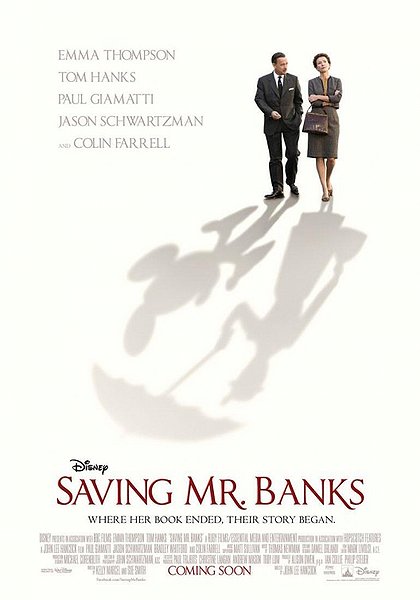 Seemingly sure-fire Oscar bait, Saving Mr. Banks left enough Academy voters cold and it’s easy to see why. First off, the behind-the-scenes sparring to adapt Mary Poppins is the movie we want to see, watching crotchety author P.L. Travers (Emma Thompson) butt heads with head honcho Walt Disney (Tom Hanks). The movie is at its best when these two share the screen, with Walt’s genial strong-arming finding little traction with Travers stern refusals (no Dick van Dyke, no animation, no mustaches). What I wasn’t expecting was a parallel storyline detailing Travers childhood in Australia dealing with an unstable home life thanks to a drunken father (Colin Farrell). It literally takes up half the movie, and while there are a few interesting juxtapositions, the screenplay just trades off scenes; one in 1961, then one in 1906, then back again, etc. The issue is that the flashbacks are never very revelatory and have no business dominating the running time. All of the information gleaned from these flashbacks could have been corralled into one late flashback, or even mentioned in a speech. Saving Mr. Banks gives you two movies running parallel, but most people will only be interested in the one. It’s a pleasant film, benefiting from strong performances by Thompson and Hanks (perfectly cast), but one can’t shake the feeling of Disney P.R. pervading the film’s retelling. It comes from the perspective that Disney is always right and that Travers was always wrong, having to work through her personal issues before relenting, even tearing up at the final product. In real life, Travers never forgave Disney and never allowed another of her Poppins books to be adapted into a film, though not for want of trying by the studios. It feels unfair to portray an author’s artistic integrity as an obstacle that needs to be defeated, but there it is, and Disney’s Mary Poppins, while beloved, resembles much of what Travers feared. Who defends the cranky authors of the world when they have a point? Saving Mr. Banks is an entertaining film, charming and likeable, until you begin to look beyond the fairy dust and realize the revisionism before your eyes.
Nate’s Grade: B-
Share this:

Thanks for Sharing (2013)
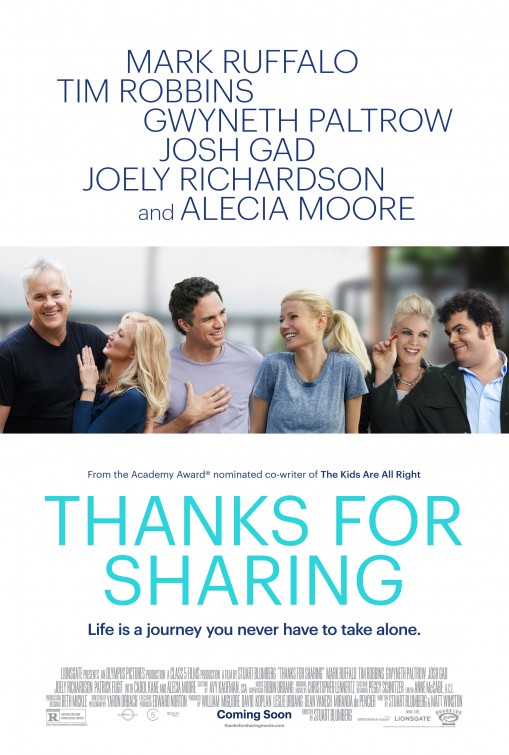 “Isn’t sex addiction one of those things guys make up when they’re caught cheating?” asks a character in Thanks for Sharing. This movie treats the topic of sex addiction very seriously, rattling off plenty of adverse side effects rather than just a wandering eye. Director and co-writer Stuart Blumberg (The Kids Are All Right) is certainly empathetic to his characters on screen. I just wish the movie knew what it wanted to be.
We follow three sex addicts in one therapy group, all at different points of recovery. Mike (Tim Robbins) is the paternal figure of the group. He’s long been married to his high school sweetheart. Adam (Mark Ruffalo) is five years sober and being prodded by Mike to start seriously dating again. He meets Phoebe (Gwyneth Paltrow), a cancer survivor, and hides his addiction from her. Worst of all is Neil (Josh Gad), a doctor who has been mandated to attend sex addict group therapy after “bumping” into people on the subway and recording an upskirt video of his boss. He doesn’t believe he has a problem, but, under the guidance of Adam and Mike, comes to the conclusion that the only person who can fix his impulses is himself.
 Thanks for Sharing is an admittedly entertaining movie, at turns, but it’s a movie with one debilitating identity crises. What kind of movie does it want to be tonally? We get raunchy sex gags, and then the film transitions into rom-com fluff, and then the film transitions into hard-hitting addict drama, and then it’s all back again. All of these elements could have been carefully threaded into one movie, but Blumberg and co-writer Matt Winston cannot nail down a consistent tone. In fact many of the changes can be quite jarring. One minute people are engaged in wacky sex hijinks, and the next they’re lamenting all the horrible life choices they’ve made in tears. When there isn’t a clear tone, or clear transitions, then the comedy undercuts the drama and vice versa. Therefore, certain elements can be appreciated or be found engaging, but the movie cannot become more than the sum of its parts. And let me get into whether sex addiction is really a topic that can work in the realm of romantic comedy. With the right finesse anything can be presented in a comedic light that still maintains the humanity and dignity of its flawed characters. However, is something as easily misunderstood as sex addiction, whose particulars can be quite appalling to many, the right fit for a genre that is predicated on whimsical coupling? I don’t think so. Thanks for Sharing doesn’t change my mind.
About that rom-com part, notably the relationship between Adam and Phoebe, it’s easily the least interesting part of the film. Both of these characters are fairly bland. Adam’s the sober guy trying to keep things going, except that we never really feel like he’s challenged. We don’t feel the threat that he’s going to relapse. And we don’t really get to know much else about the guy. He vaguely works for some sort of environmental firm. As a character, he is defined by Phoebe, herself a collection of quirks that doesn’t coalesce to form a human being. The film weirdly keeps harping on the fact that Phoebe likes her food to not touch, as if this minor peculiarity is some harbinger of a greater OCD complex (she’s into physical fitness!). The fact that other characters have to jump in on this makes it even more transparently reaching. Worse than all this, the couple’s interactions, and much of their budding relationship, feels overwhelmingly artificial. The dialogue should be sparking, charming, but you get no real sense of why either of these people would fall for the other, excluding the obvious physical attributes of each. The rom-com convention of the Big Secret (Adam’s addiction) is left dangling until, surprise, it’s defused early. I’d expect the movie to push further since there is a wealth of drama to be had about the trust levels of dating a sex addict, but instead it just forces them apart all too easy. Then there’s the fact that the movie covers perhaps a month of time and their relationship seems to move ridiculously fast, mostly because Blumberg is impatient for his couple to get to a more physically intimate stage.
Thanks for Sharing works far better as a darker drama, and as a movie, when it focuses on the roles of Mike and Neil. The film smartly connects sex addiction with other impulse control issues; for Mike he’s been sober from booze for 15 years, and for Neill he has weight control issues. These are the characters we see struggle, these are the characters at the more interesting points. Neill especially is a doctor whose hit rock bottom and can’t get away from the felonious things his addiction tempts him to do. Mike has a surrogate family with his support group. Now that his prodigal son (Patrick Fugit) returns, that adds tension to his family dynamic, both at home and in group. I would have preferred Thanks for Sharing to be told chiefly from the perspective of these characters, eliminating Adam and Phoebe altogether. But even these good storylines find themselves wading into all-too familiar plot devices. Mike’s arc involves reconnecting with his son, which will lead to a misunderstanding, a conflict, and ultimately forgiveness, and you see every step coming. Neill’s journey gets an unexpected boost when he takes initiative to help Dede (Pink a.k.a. Alecia Moore), one of the only ladies in group. Of course it takes a pretty girl to push Neill out of his selfishness and self-loathing, but he does progress, and it’s the most emotionally rewarding moment in the film. The problem is that Neill’s storyline is tied up in a platonic head-scratcher. Dede takes Neill to a dance hall where they are just there to… dance, but the kind of dancing that hipsters do. It all seems like something for people on drugs, but whatever reason, Neill shaking his groove thing, and coming to an understanding that he will not be touching Dede, makes his character better. I was surprised that Blumberg was able to end the movie on something of a downbeat, falling back to the central message of one day at a time, vigilance.
 There is one standout scene that really gets to the scariness of sex addiction succinctly. Once Adam falls off the wagon, which shouldn’t be much of a spoiler people, he regroups with Becky (Emily Meade) a gal he had a one-night stand with. Their flirtation is quick, settling into their attraction, and then she engages in behavior that, meant to be alluring, is rather insightful. She has a daddy fixation and wants to be punished as a “bad girl” with Adam pretending to be her stern father. That could be a red flag, but Adam carries on. Then she asks him to slap her. Adam refuses. So she does it herself, beating herself, eventually descending into a mess of tears, screaming. Adam tries to console her, stupidly deciding to try and make contact with her after she keeps screaming, “Don’t touch me!” She locks herself in the bathroom and threatens to harm herself. This one moment in the film gets at the damage of sex addiction like nothing else. It points to possible abuse, but really it all falls apart so rapidly that your head is spinning. The conclusion is pat and anticlimactic, but the lead-up is fantastic. If the rest of the movie had been thematically closer to this scene, Thanks for Sharing would be worth sharing.
From an acting standpoint, the cast does a fine job portraying their characters and his or her respective foibles. Ruffalo (The Avengers) is a bit too even keeled for his character. Gad (Jobs, The Internship) is the film’s comedic spark but also its greatest source of internal drama, which Gad handles well, showcasing the desperation of Neill. The real surprise is actually pop singer Pink in her first real acting performance (Charlie’s Angels: Full Throttle counts under no circumstances). Her introductory monologue, which she nails, makes you take notice that Pink has some genuine acting muscles.
Thanks for Sharing is an uneven mishmash of genres and ideas, rarely settling down into something worthy of the talent at work here. The comedy works against the drama, the drama works against the comedy, the clichéd character developments don’t serve anyone, and the overall artificial nature of the central rom-com coupling drags the enjoyment level further down. There is good work here, good acting and some memorable scenes and offhand laughs, but all Thanks for Sharing can amount to is a series of scant moments, passing encounters of entertainment. I didn’t find many of the characters to be as nearly compelling as the filmmakers did, and some of their hasty resolutions and developments feel far too simple for an addiction this complicated. The potential of the film is never fully realized. While I’m doubtful rom-com is a good fit for a serious exploration on sex addiction (wasn’t Shame hilarious?), it does lend itself to a bevy of juicy setups and possibilities. We get little of these. It’s as if the film wanted to present a case for the legitimacy of sex addiction, front-loaded with stats and horror stories and characters to open our eyes, and the notion of telling a laudable story was secondary to the educational efforts. Congrats. Now give me a story to care about.
Nate’s Grade: C+
Share this:

The Spectacular Now (2013)
 I say this as a fan but John Hughes was probably the best and worst thing that happened to the modern teen movie. He certainly brought an extra level of pathos and relatability to the genre, but then again he also dealt in stereotypes, often languishing his characters to stock archetype ghettos (the Jock, the Prep, the Nerd, etc.). In the ensuing decades, it’s been hard to break as many teen films, of those aimed at teenagers, have casually dealt in these easy labels. That’s why something like The Spectacular Now is such a welcomed respite. Here is a teen movie that aims to tell a story about people and their problems, not simply a regurgitation of high school cliques and clichés. This isn’t a film where all the pieces magically come together; this is a high school movie that more closely approximates real life. This is more Cameron Crowe than John Hughes material.
Sutter (Miles Teller) is the most popular guy in school, or so he’d tell you. He’s the life of every party, the kind of guy who everyone enjoyed, and the guy who could charm the pants off any girl. He’s recently broken up with his girlfriend Cassidy (Brie Larson), though still harboring serious feelings for her. Of course the best way to get over the old girl is with a new one, and Sutter sets his sights on Aimee (Shailene Woodley). She’s a smart, somewhat quiet gal that immediately takes a shine to the spotlight that is Sutter’s affections and attention. He’s not entirely over his old girlfriend, still angling to get back together, but also Sutter’s whole perspective could be summed up as an extreme case of carpe diem. The kid is partying like there’s no tomorrow because he’s convinced he has no real future, so he’s going to live it up while he can.
 You’ve easily seen this movie before but it’s rare to see it given so much depth, maturity, and care. At heart, this is the story of Sutter learning he’s a screw-up and getting his life back in order, learning some self-control and responsibility, and winning over the good girl. But The Spectacular Now is so much more than that, and it’s especially sadder than you may have expected with its wise-talking, charming protagonist. This is the story of a teen coming to grips with parental abandonment, gaining insight into his own delusional detours to avoid pain, and the horrible realization that he is, in his present reckless condition, a bad influence dragging down the future of the girl he genuinely cares for. That’s a lot of heavy emotional drama and none of it revolves around the clichéd staples of teen movies, like those checkpoints such as prom and the Big Test. This is the story about one damaged man coming to terms with the state of his damage and gaining the courage to change his direction. He’s an alcoholic but the movie doesn’t ever put the narrative on hold for soapbox preaching. If anything, Sutter’s alcoholism is handled so subtlety, with most character silently acknowledging but unsure or indifferent to act, that it may strike a few chords with audience members. Then there’s the fact that none of this is heavy-handed; the filmmakers have done a fabulous job of giving each character credibility. They behave like real human beings. Even the easily slotted antagonists, namely Cassidy and Sutter’s deadbeat dad, are given shades of recognizable humanity and depth. Even though Cassidy waffles in her feelings for her ex, I cannot dislike her because her character portrayal is so honest. She’s struggling with her feelings for a screw-up with redeeming qualities. That’s fairly relatable, even if she’s not our winsome romantic lead. The filmmakers drag a typical teen movie story into our real world setting, adding depth and telling observance. You will recognize many of these characters.
There are few superlatives to describe the cuteness of the blossoming relationship between Sutter and Aimee. It’s so smooth and relaxed yet completely believable, and the two actors have such a warm and natural chemistry with one another, enough that I seriously contemplated if they dated outside the film (rumored but nothing conclusive). You feel their budding affections, the sweet swoon of young love, and the hiccups along the way. Woodley (The Descendants) does an outstanding job with her mannerisms and affectations; her awkwardness around her feelings is adorable, but not in that prefabricated cutesy way often ascribed to the oft-mentioned Manic Pixie Dream Girl roles. She’s a fairly normal teenager on the fringes of high school, keeping her nose down and looking ahead. In movie terms, you couldn’t readily classify a gal like Aimee, and that’s because she’s a real character fully fleshed out by the screenwriters and the actress. Woodley’s performance is near invisible of acting tropes and constraints. She just dissolves into the character as all exceptional actors do.
But this is Sutter’s movie and, in accordance, Teller’s (Rabbit Hole) film. The young man puts on an acting camp in this film, shedding the various layers of armor from his sad clown of a character. As I said, we’ve seen this character before, but Teller and the screenplay are able to give Sutter such extraordinary depth. The carefree life-of-the-party character is turned into an introspective character study, essentially examining the darker side of Ferris Bueller. He’s using alcohol and his blithe attitude to blunt the pain that he fears he’ll end up like his old man, that his life has already peaked and he’s not even out of high school. Teller is such a successful charmer that he already wins you over to his side despite some boorish behavior because we see that the guy has a good heart. In the film’s opening, he’s propping up his friend to finally get the guy a girl, and the ensuing mess ends Sutter’s own relationship. The last act involves Sutter coming to grips with the negative impact of his actions, notably on Aimee. Teller is so effective at giving you glimpses of the sadness eating him whole. His concluding scenes when he finally breaks down feel like a hard-fought victory for the character as he confronts his doomed fate. At every turn, Teller impresses, and compounded with Woodley, they form an unbeatable team of sterling young acting talent.
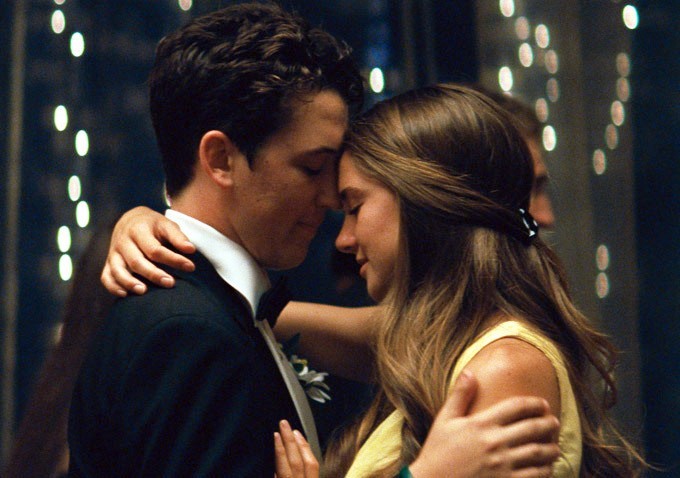 Special mention to Kyle Chandler (Super 8) for his pivotal walk-on roll as Sutter’s bad dad. He’s so pathetic and so desperate and so wonderfully realized by Chandler. He doesn’t get a Big Scene, he doesn’t get a Big Speech, he doesn’t even do anything out of the ordinary for a shifty, unreliable, selfish drunk, but those few minutes he’s onscreen, it all becomes so deeply sad and clear where Sutter’s life is headed without intervention.
The only depiction that I had trouble believing was Sutter’s almost consistent drinking and driving. Throughout the film, he has his trusty Styrofoam Big Gulp cup with him, spiked with booze. The man hasn’t graduated high school yet and is already a high-functioning alcoholic. Because of this I can believe that people would not be alarmed seeing him drive after imbibing a few drinks. However, the man is constantly drinking while behind the wheel of an auto and several times he appears completely trashed. I find it alarming as well as a bit far-fetched that not one character, not even Aimee, would raise objection to Sutter’s continued dangerous behavior. We also witness several scenes of Sutter drinking in bars. It’s conceivable he has a fake ID at his disposal, and it’s even more conceivable that he could talk his way into any establishment, but it’s more food for thought. Then again maybe this is just one of those towns where nobody cares about innocent lives being snuffed out by drunk drivers.
The Spectacular Now is an earnest film that doesn’t overdo it, providing challenging life lessons to fully formed, complex, believable characters. It doesn’t sugarcoat the heartache and harsh reality out there for vulnerable teens. It’s a charming romance tied up with an insightful character study of one young man hiding his sadness and anxiety of life’s disappointments with humor and booze. Thanks to the tremendous acting of its onscreen pair, you root for Sutter to turn his life around because you see value in him as a person, even if he doubts it himself. You’re on his side from the start, and you know how nicely he matches up with Aimee. You want this movie to pull off the spectacular, and for long stretches it feels just as if that will happen. The ending aims for ambiguity but is far more hopeful than its source material. I was charmed thoroughly by this film and its lead characters but even more I was thoroughly engaged in their dilemmas, moved by their struggles, and encouraged by their perseverance and growth. The Spectacular Now (extra points for never even having a character spout the title) is a funny, warmhearted, measurable restrained, knowing film that could open eyes. It may not be spectacular to some, but it’s surely a great film.
Nate’s Grade: A-
Share this:

Flight (2012)
 The advertising for Flight has highlighted the sexier elements, the star wattage of Denzel Washington and director Robert Zemeckis, and the thrills of the air disaster. What you get is a different matter. The first thirty minutes prepares you for one movie, and then Flight takes off in a different direction, a path that fails to capitalize on the potential of the subject matter.
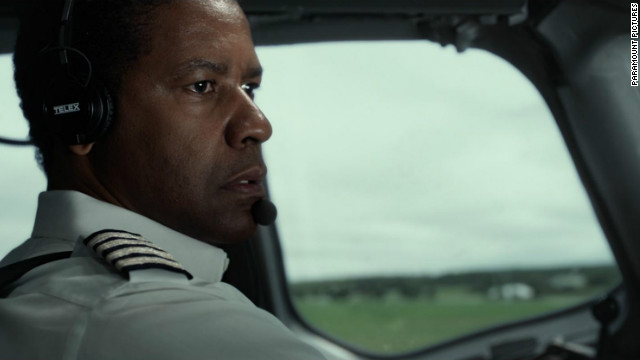
Whip Whitaker (Washington) is one hell of a pilot. He miraculously lands a downed airplane, limiting the loss of life to six. He is also a hell of a drunk. Whip also happened to be drunk and high on cocaine at the time of the crash. As the airline investigation searches for the causes that lead to the crash, Whip and his team, longtime friend and union ally (Bruce Greenwood) and high-priced ethically sketchy defense lawyer (Don Cheadle) try and protect their own. The media is agog in hero worship with Whip, but they don’t know about what awaits in his blood test drawn at the scene of the crash. As Whip prepares for possible criminal charges, he meets a recovering addict Nicole (Kelly Reilly) and the two form a connection. He hides out at his father’s old estate, invites her along, and they struggle to stay clean and fly right. But temptation is too powerful a beast for Whip, and he will continue to make poor decisions.
 It’s really a modern-age version of The Lost Weekend or The Days of Wine and Roses. It is an alcoholism story. We’re all familiar with them at this point in the movies. A part of me thinks addiction stories are some of the easiest ones to write; you take a flawed character, introduce the addiction, have them determined to get sober, and then provide temptation after temptation. And that’s kind of what Flight feels like. The compelling elements of the movie, notably the legal ramifications of the crash and the political maneuvering, get too often sidelined by a repetitious mélange of Whip getting drunk or thinking about getting drunk or trying not to get drunk. There are many ups and downs, but the cycle of addiction and abuse starts to grow weary, especially when the movie offers more interesting and unique story avenues worth exploring. The airplane sequence is a taut, horrifying, intense sequence. The legal wrangling resulting from it seems like the stuff of good drama. The airline is trying to limit its monetary damage, the lawyers are trying to cover for their clients including having the dead crew stripped from the fatality numbers, and all the while the investigation is getting closer to uncovering Whip’s secret. That’s the movie I wanted to see with Flight. The majority of what I got was a by-the-books addiction parable with some good actors. The movie seems to be going in too many different directions.
Zemeckis’ return to live-action is welcomed and long overdue, and it’s great seeing him direct real people in real environments again, even if the finished film is flawed. His interests seem more with the special effects-laden crash, a harrowing sequence for the ages. When it gets to the addict stuff, it seems like Zemeckis goes on autopilot himself, bowing to the strength of his charismatic star sucking everything into his orbit. The movie becomes an acting showcase for Washington’s abilities at the expense of a completely coherent plot or tone. At times the film seems cavalierly comic, particularly with John Goodman’s character that gets treated like an endearing figure. He’s Whip’s chief source of drugs and his chief enabler and his casual nature with hardcore drugs, and the film’s noncommittal stance, gives the movie a strange, unsettling quality. Then there’s the religious aspect that feels like it flew in from a whole other screenplay (I can’t tell whether the film is dismissive of religion or just flippant). Plus Zemeckis just can’t help himself when it comes to on-the-nose literal music selections (after Whip gets high due to his compatriots, the elevator plays the Muzak version of the Beatles’ “Some Help from My Friends.”). It’s at this point I’m so happy for Zemeckis to be back making live-action movies, I’m probably giving Flight an even bigger pass than it may deserve.
I’m not sure the Nicole character provides anything substantial to this movie, let alone the movie treating her as a co-lead for the first thirty minutes. In between our moments of watching Whip on the plane, we have scenes of Nicole going about her sad day. I’m wondering how in the world these storylines are going to connect and why we have to leave the drama of the plane for the mundane life of an addict eeking out a desperate life. These should not be parallel storylines; the audience interest is not divided here. Nobody is complaining about spending too much time with Whip and the plane crash. No one is saying, “I wish I could see that woman’s sad life some more.” Why did we even need to see Nicole before she meets Whip in the hospital? Were all of those early scenes just too essential to lose in a movie over two hours? Thematically, I can understand that Nicole presents a romantic possibility but also a reward for Whip if he stays clean and sober. Seeing him screw up this pseudo-relationship is another example to convey the self-destructive nature of Whip. I get that. But if this woman were really integral to the plot, she wouldn’t vanish for the entire final act.
It’s easy to see why actors are always attracted to addict roles. They’re usually showy parts that allow for many opportunities to bottom out. Rest assured, Washington (Safe House) is uniformly excellent, portraying a deeply flawed individual prone to grandiose self-delusion and justification for his behavior. We’re so used to seeing Washington play the calm, cool, collected men of dignity, men who seem preternaturally gifted at leading others. With Flight, he becomes far more vulnerable, a self-destructive character that pushes others away and betrays the trust and faith of others. He’s not fighting some larger external force; he’s battling his internal demons that continually lead him astray. He can be petty, mean, weak, delusional, and downright unlikable at turns. It’s a strong performance that anchors the film. The other actors all provide admirable backup duties, from Cheadle to Greenwood to a brief appearance from Melissa Leo (The Fighter) as an airline investigator. I want to single out James Badge Dale (HBO’s The Pacific) for the impression he makes with a part that amounts to one single scene in the movie. He plays a gaunt cancer patient sneaking away for a stairwell smoke (“Wouldn’t want to give my cancer cancer”), joined by Whip and Nicole. He’s so good with the gallows humor and surprisingly poignancy that I wanted the camera to just start following him.
 I want to point out one quirk during my movie going experience with Flight. I was easily the youngest person in my theater by 20 years minimum. I don’t enjoy seeing movies with a predominantly elderly crowd because they do not follow the agreed-upon rules of movie decorum. They often engage in conversations or provide a running commentary. A man two rows behind me had his watch beep for a solid minute to inform him, and the theater, it was now seven o’clock. Either he didn’t hear it beeping (which defeats the purpose) or couldn’t figure out this new-fangled 1980s watch technology to turn it off (which also defeats the purpose). Anyway, what I really enjoyed then was the audible reactions when Flight’s beginning, its very opening images, was a pair of naked breasts. The first scene features Whip and flight attendant Katerina (My Name is Earl’s Nadine Velaquez) getting dressed after a wild night of booze, cocaine, and sex. Whip talks to his ex-wife on the phone, and in one ongoing camera shot, we watch Velaquez walk around completely naked. Then she leaves off screen… and comes back still completely naked. Now I mention this because it delighted me to no end to listen to the grumbling of the older audience members. And yeah, the nudity is fairly gratuitous but I’m happy Zemeckis was able to rankle my elder audience before the second second of film.
Flight is also unique in the sense that it may be the only film I know of to posit that drugs and alcohol could save lives. Will is drunk and high while flying, but he saves the day because of his impairment. Ordinarily in the event of a crash or a dive he would revert to his training; every pilot in a flight simulator recreating the events crashed and killed all passengers. Instead, Will goes by instinct, thinking outside the box, and saving the day. And what enables him to do this? Booze, sweet life-saving booze! He’s so calm and relaxed in the moment that he’s able to think straight and discover unorthodox solutions in limited time. Flight never makes this fact explicit but I think it would have made a more interesting film if this debate had been given more airtime. Yeah Whip was drunk, but not every drunk is impaired the same. I’m not excusing driving while intoxicated, but the movie presents a strange situation, fictional yes, where drugs and alcohol saved lives. Then in the end, and our lead is in trouble, what does it look like will save the day? Cocaine! Seriously, the white knight in the final act is the white powder.
I think audience might be in for a rude awakening while they sit through Flight, advertised as an airline thriller. It’s still a competent, occasionally compelling movie with strong acting from Washington and others, but are audiences really interested in another alcoholism drama even if it has Big Stars? The most frustrating part of Flight is that it has so much potential, so many intriguing storylines or angles to choose from, and it settles on the most mainstream one, the familiar arc of an alcoholic coming to terms with their addiction. How is that more dramatic than an airline crash or the later investigation and legal witch-hunt to find a culprit to blame? The movie prefers to focus on the minor rather than the major, following the familiar formula to the very end when our lead has to make a grave moral decision. It’s a character study but the character and his path are the familiar. All the stuff that makes Flight different (the airline disaster, the investigation, the politics of blame) is the stuff that gets relegated so we can watch Whip screw up time and again. There’s an interesting study on hero worship buried somewhere in all this. I enjoyed Flight more in the moment but it has been crumbling under further reflection and analysis. I’m dearly glad Zemeckis has stepped back to the land of the living but Flight has too much baggage to go anywhere new and exciting.
Nate’s Grade: B-
Share this:

Shame (2011)
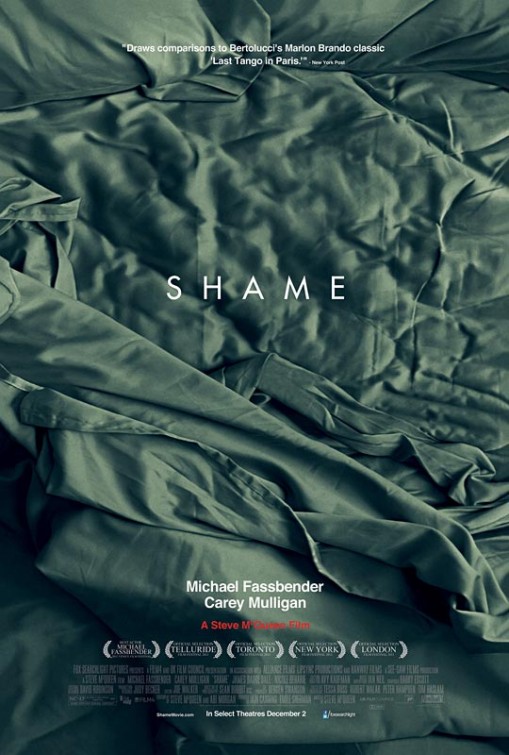 Most of the press about the seedy drama Shame has centered on the exhibition of star Michael Fassbender’s manhood, hence the NC-17 rating shackled to the film. Director/co-writer Steve McQueen, who teamed with Fassbender on the riveting Irish hunger-strike drama Hunger, decided against recutting his film for a more audience-inclusive R-rating. The Fassbender penis cannot be cut (draw your own circumcision conclusions). All of this fuss over seeing a penis onscreen seems a little ridiculous and immature. It just seems silly to censor a story about sex addiction by being coy with the appearance of the male anatomy. If they gave awards for onscreen penis performances, Harvey Keitel would have gotten a lifetime achievement award years ago. For all the physical nakedness on screen, when it comes to compelling characters and a story, that’s where Shame goes limp.
Brandon Sullivan (Michael Fassbender) is a high-powered New York City businessman working in a high-powered office doing important business stuff. At least, that’s about the impression the movie gives. What makes Brandon tick, though, is the biological highs of giving in to his carnal desires. He is a sex addict. He has sex daily, some with women he picks up, some with prostitutes. He has a mighty stash of pornography and his work computer is filled to the brim with smut. Brandon’s world of empty physical pleasure is interrupted when his sister, Sissy (Carey Mulligan), drops by to stay a while. She’s a needy, emotionally troubled woman, the kind of girl that gets into bed with her sex addict brother to feel some kind of warmth. Sissy drives Brandon mad, a madness that not even meaningless sex can cure. When sissy sleeps with Brandon’s married boss, his life becomes even more hectic. Perhaps brother and sister aren’t far off in their dysfunction.
 What’s most shocking about Shame is not the explicit sex scenes or the full-frontal nudity (sigh, another reason to hate Fassbender) but what a shallow move this is. From beginning to end, everything in this movie is surface level. We don’t get to know anything about Brandon except for his expensive interior decorating. Ooo, he has a fine collection of vinyl, it makes perfect sense that he would be a sex addict now. The movie is filled with joyless sex, but just because there’s a lot of it, and the camera takes time to show Fassbender’s remorseful expressions mid-coitus, does not mean we have approached anything introspective or revealing. The most we learn about Brandon is that his longest relationship lasted four months. When Sissy comes to crash with her big bro it seems to unnerve the man. Why? Is it because her emotional neediness holds a mirror up to Brandon about his own broken behavior? Is it because she’s the only person in his life he has some relationship with and he wants to sever this, to cut him off completely from feeling anything? What has caused both of these people to become so dysfunctional? What about their parents? Your guess is as good as mine. McQueen and co-writer Abi Morgan (The Iron Lady) cannot be bothered to shed light on their characters. This must have been the easiest movie in the world to write, as well as one that almost fulfills some sort of filmmaking exploitation dream (“No no, we’re doing a serious art movie. Now ladies in this scene you’ll be engaged in a threesome for an exhausting amount of screen time. Make sure to lick those nipples like you mean it”).
Because of the narrative shortcomings, the film can grow rather tedious. You never get a real sense of sexual addiction. Just because we watch a guy have sex with strangers, prostitutes, and watch a lot of porn does not mean we are any closer to understanding his urges and compulsions. There’s one brief moment where McQueen seems to communicate Brandon’s thinking, as the camera cuts between sensuous close-ups of a female officemate (Nicole Beharie). This technique is used too sparingly, though, and we’re left to just assume, “Oh, this guy has just gotta have it.” I would have greatly appreciated McQueen taking a more assertive role in communicating the mindset of his main character. Let’s get into his head, let’s see the world the way he does, let’s through the power of editing feel the gnawing craving for physical release. There is one terrific scene during the opening where Brandon and a woman on the subway seem to be communicating a shared desire simply through careful expressions and body configuration. It’s the one scene in Shame that feels like we’ve gotten a peak into Brandon’s world. Instead, the majority of Shame is far too cold and clinical, watching Brandon’s self-destructive behavior from a safe distance like we’re afraid of catching something. I get that all of the onscreen sex is supposed to be seen as unsexy, but that doesn’t mean we couldn’t have followed Brandon’s point of view deeper. Just following a character’s POV is not the same as consent of their lifestyle. McQueen’s camera favors pretty long takes that voyeuristically eavesdrop on his characters, creating a sense of reality that can become ensnaring. I wanted to break free from a near five-minute take filmed from the back of Brandon and Sissy’s heads while they sit on a couch watching, in a strange moment of public domain access, a cartoon from the 1930s. McQueen’s film almost feels like a bait-and-switch bauble, promising the audience the seedy perversions of a man dominated by his uncontrollable desires, and then just delivering a guy who speaks little and jerks off at work a lot.
 From an acting point of view, the lone saving grace of Shame, both Fassbender and Mulligan give captivating performances. Fassbender has had an incredibly varied year performance-wise, posing as Rochester, Magneto, and Carl Jung (one wonders what Freud would make of Brandon). The steely actor has a commanding presence and he’s able to reflect a burning intensity with the power of his eyes. Brandon, on the page, has about maybe 100 words of dialogue, so much is left to the actor’s fluid imagination, and Fassbender makes his character compelling to watch, at least for a while, despite the fact that the screenplay does not give him a compelling character to play. Mulligan (Drive, Never Let Me Go) is becoming rather adept at playing sad-eyed Kewpie doll women. Her character has a bit more to say in Shame, a girl trying to connect to the only family she has left, a brother who wishes to cut himself off from all feelings. The movie is at its best when these two are onscreen together. And for the horndogs out there, Mulligan matches Fassbender’s “I’ll show you mine” dare and delivers the full-frontal goods as well.
Shame is a sexually frank movie that seems curiously tight-lipped when it comes to character and plot. It’s filled with body parts but rarely do those parts assemble into a character. The movie is all surface, shallow and repetitive, and if that’s meant to communicate the self-loathing nature of its main character then what a strange mission that McQueen has achieved. The movie is flat, tedious, and distant, too timid to go deeper with its characters and their compulsions. I want to see Brandon’s personal and/or professional life suffer because of his addiction. I want to see the struggle to keep the urges at bay. I want to see Brandon hit rock bottom. I want to feel his desire to change. But we get none of this. Shame ruefully takes its narrative cue from Brandon, which means it’s a whole lot of nothing in between bouts of meaningless, empty sex.
Nate’s Grade: C
Share this:

The Fighter (2010)
 Somewhere along the line, the boxing film became the perfect metaphor for the underdog story. Two men at battle with only their fists and iron wills. Somehow this match up has come to symbolize man’s eternal struggle against himself and society. From Body and Soul to Rocky and Raging Bull, it’s hard to imagine the filmic landscape without the tropes of boxing. It’s also a pretty staid and tired genre, where filmmakers often rely on those tropes to fill in the gaps for lazy storytelling. The Fighter is a true story that star Mark Wahlberg has been nursing for years trying to get it off the ground. It’s the knockout acting and attention to character that separates The Fighter from the competition. Rarely has such a sedate formula felt so freshly presented.
In the mid 1990s, Mickey Ward (Wahlberg) is a man trying to come to grips with his life. His welterweight boxing career has stalled thanks primarily to his trainer, his unreliable half-brother Dicky Eklund (Christian Bale). Big brother used to be the pride of Lowell, Massachusetts, once fighting Sugar Ray Leonard and boasting about knocking the giant down (this claim is in dispute as replays show that Leonard may have simply tripped). Dicky’s boxing career went away about the same time that Dicky became addicted to crack cocaine, spending long hours inside Lowell’s many crack houses. An HBO documentary crew is following around Dicky, which he mistakenly believes is a ticket to his comeback. Mickey’s mother, Alice (Melissa Leo), also serves as manager to both her boys. Dicky is clearly the apple of her eye and Alice enables his destructive behavior. Mickey is pushed into fights to feed his extended family (eight siblings), and the thrill is gone. Then one day he’s approached by a promoter who will give Mickey one more chance. The only catch is that Mickey has to cut his family loose.
 Truth be told, The Fighter isn’t really much of a boxing movie. Sure that’s the selling point and it allows for a rousing, crowd-pleasing finish, but Mickey could just as easily be striving to open a deli or striving to go back to school. The real story is the family. The boxing is only a backdrop, and if it weren’t for the true-story basis I would say it serves as little more than a metaphor for the punishment Mickey has taken in life. The Fighter is about a man working up the courage not to step into the boxing ring but to break away from his self-destructive family weighing him down in misery. This is a dysfunctional family drama disguised as a Rocky-style boxing redemption picture. The boxing aspects are small, mostly contained to the final act as Mickey’s career finally begins to gain some traction. For some, this will be disappointing news. But for me, I loved the family drama stuff. This is a fractured family with deep lines of division, nursing grudges, resentment waiting to boil over, all the marks of meaty drama. The focus is on Mickey trying to break away from the pull of his harmful older half-brother and his boorish mother. His mother enables Dicky, her favorite child, to the detriment of the rest of her brood. Her relationship with Dicky is fascinating and complicated, like a mother sacrificing the rest of her clan to help her most damaged child. You can catch some of the invisible ripples from these decisions, like the seven sisters all forming one unified hive-mind to survive. They’re like a block of cheerleaders for mother, only able to get attention and some form of affection by doing so. The extensive family unit revolves around Leo’s matriarch, fiercely protective and fiercely myopic. She refuses to remove herself from Mickey’s management team, and thus Mickey and his career suffer. It’s downright Oedipal. If only he can escape the clutches of his family, perhaps Mickey can taste success that has eluded him so long. The family drama makes up a good majority of The Fighter, and that’s just fine with me when I get characters this damaged and complicated.
And all of this is blissfully entertaining. Director David O. Russell is miles away from his other films like Three Kings and I Heart Huckabees. This is different kind of redemption story where the main guy winning a title is nice, and we can all celebrate, but it’s really his separation from a harsh family dragging him down. The film also produces an engaging romance for Mickey, which gives him a renewed sense of purpose to finally break free of his family. Amy Adams (Enchanted, Doubt) is a bartender at a local hangout with some college under her belt, a point that irritates Mickey’s family. The Eklund sisters lash out at Mickey’s squeeze in childish ways. Adams, playing Charlene, shies away from the daffy or genteel roles of her past. She gets to spit profanities with glee. Her relationship with Mickey serves as a foil to his family, showing what strength a positive, healthy relationship can achieve. But while the family is presented in an antagonistic sense, they are not blithely demonized. Russell and his team of writers and actors use humor to find surprising pockets of warmth amidst all the darkness and shattered dreams. This isn’t an addiction story that plumbs the depths of human weakness. The production feels bathed in authenticity and the city of Lowell, Massachusetts and its lived-in, blue-collar culture feels like another vital character. When the HBO documentary finally airs, you feel the cloud of hurt that covers the entire town in shame. Nobody wants to be known as a town famous for crack addiction (you can watch the 1995 doc online for free).
 The acting is also some of the best you’ll see all year. Wahlberg is a sturdy center, used to the abuse and underplaying his character’s transformation from punching bag to assertive human being. This is Wahlberg’s home turf, and he’s been shopping the story for years in Hollywood, so it’s no surprise that everything comes so natural for the Beantown kid. But his understated work is going to get obscured with the flamboyant performances from both Bale and Leo. Bale (The Dark Knight, Rescue Dawn) has long been considered one of the finest actors of his generation, his Method devotion and versatility a godsend. In The Fighter, he’s a live wire, a bundle of energy in a haunting skeletal frame. He’s a figure of lost promise, of tragedy and bruised ego, trying to live vicariously through his younger brother. He’s deluded himself into thinking that this HBO documentary will launch a comeback at 40. Bale excels with the bombastic bits, practically bouncing off the walls, but then he nails the quieter, smaller moments of his character, where Dicky realizes that he’s wasted his gifts. Leo (Frozen River) could easily fall into an outsized monster of large hair and nicotine-stained fingers, but the Oscar-nominated actress finds exciting ways to tap into her character’s humanity. She fully knows that her beloved child is a crack addict, but watching her rationalize and justify her actions is exciting.
The Fighter is a meaty family drama, stirring tale of redemption, and a showcase of superior acting. In an awards season where it feels like many films are missing some secret ingredient, The Fighter has it all together. It’s an underdog story of a different flavor that manages to be authentic, entertaining, charitable, and engrossing even while staying within the boundaries of a predictable framework. We all know that Mickey will triumph in the ring; otherwise his tale would never have caught the notice of Hollywood producers. This is a fresh take on old material. The focus is on the fractured family dynamic and the many characters, not on a simplistic rising through the rankings of sport. It’s because of the tremendous acting and character work that the first half of the film easily outshines the second. Once the family is sidelined, and Mickey’s boxing career takes off, The Fighter turns into a more conventional genre picture, though still engaging. The movie ends on a satisfying note of uplift that feels fully earned without a twinge of naiveté. This Oscar season, expect audiences and voters alike to find something to cheer about in this return to the ring.
Nate’s Grade: A-
Share this:

I’m Still Here (2010)
 Joaquin Phoenix may not be the most stable of actors, but anyone could have successfully guessed that his public meltdown and entry into rap, complete with a scraggly mountain man beard, was a hoax. Phoenix and his brother-in-law Casey Affleck worked out a two-year piece of performance art, with Phoenix completely committing to his egotistical, self-destructive send-up of actors. Affleck directed the exploits, which is another clue that everything is a hoax. Do you think his brother-in-law, and a respected actor, would film Phoenix going overboard, snorting coke, lying with hookers, having an assistant literally defecate on his face, and then try and turn a buck? I’m Still Here is like a Saturday Night Live sketch, or an improv game, that stretches on forever. Whatever points Phoenix and Affleck may have had in mind get utterly lost at a plodding 108 minutes. Phoenix’s Andy Kaufman-esque practical joke is admirable but that doesn’t mean anybody needs to see this ramshackle, artless mess. It all comes across like a self-indulgent jape between friends, a personal project that loses all meaning outside a limited circle of friends.
Nate’s Grade: C
Share this:

Get Him to the Greek (2010)
 How many scene-stealers get spin-offs? That sounds like something you’d more likely find in the realm of TV, but it does happen occasionally in cinema. In 2008’s Forgetting Sarah Marshall, comedian Russell Brand played British rock star Aldous Snow. He stole Sarah Marshall and he also stole the movie. Now the stringy Brit with the crazy hair gets is own movie, Get Him to the Greek, a semi-sequel to Sarah Marshall.
Aldous Snow (Brand) has had his career hit a bit of a snag. His latest album, and lead single, “African Child” has been met with a tidal wave of bad press. Critics are calling it the worst thing to strike Africa after famine, war, and apartheid. His longtime girlfriend and fellow recording artist, Jackie Q (Rose Byrne), has dumped him and gotten full custody of their son. His life, and he, has gone off the wagon. Music exec Sergio (Sean “Puff Daddy” Combs) is desperate for ideas to help make money for his company. Aaron Green (Jonah Hill) suggests to the boss man that it will be the 10-year anniversary of Snow rocking out at the Greek Theater in Los Angeles, a seminal concert event. The boss tasks Hill with traveling to London, retrieving Snow, getting him to a Today Show performance in New York and then to the Greek in L.A. for an anniversary concert. Of course babysitting a drug-addled rock star and getting him places on time is easier said than done.
 Get Him to the Greek is ultimately a buddy movie. Brand and Hill play off each other so well. In fact, I might say that Hill’s character is a tad too dull when he’s not around the hyperactive and impulsive Snow. You sort of feel for the guy and you’d like life to turn out well for him and his girlfriend, but you’re not completely committed to the character. However, when he’s bouncing off Brand, the movie transforms into a wild comedy with many funny moments and a few that miss the mark. Green has been entrusted to handle his high-maintenance rock star and this presents a few stellar comic setups. Green has to make sure that his star is not impaired when he performs on the Today Show, so he steals Snow’s flask of booze and joint and downs them both to protect his star. The resulting appearance on the Today Show then flips the script, having the flaky star be the straight man to the highly impaired handler. The funniest sequence for my taste involves a drawn-out drug trip in a Vegas hotel. Things spiral out of control and involve furry wall groping, mass amounts of property destruction, and Snow stabbing Green in the chest with an adrenaline needle, then being chased by an incensed Sergio who will not be stopped even after being hit by a car. It’s an exhilarating, madcap sequence that picks up comedy momentum and plows ahead. You may not be able to relate to either character, but when you put them together the movie comes alive with comic mischief and misfortune.
Being a Judd Apatow (Knocked Up, Superbad) production, Get Him to the Greek has got to bring the heart with the raunch. Even though we spend the majority of the running time with two characters, the film is less character-based than other Apatow-produced products. The sentiment slips in at the end. Obviously, given the setup, you expect Green to become more aggressive motivated, Snow to become more mellow and conscientious, and we’re all better for it in the end. The two characters do begin to bond in their unusual way, which elicits much of the film’s enjoyment. I enjoyed spending time with these two guys, especially when they were together. That likeability factor got the film through some of its rough patches. As far as supporting casts, a hallmark of an Apatow-produced film, Sean “P. Diddy” Combs is the movie’s scene-stealer, mostly through sheer force of will. He’s not the funniest guy but man does he chew scenery with gusto. He’s so loud and crazed that he practically scares you into laughing as a defensive impulse.
 Brand is a terrific comedy discovery. He has such an electric energy and his wild-eyed hijinks and deadpan delivery had me in stitches. I was worried that a full movie for Aldous Snow would wear thin, but Stoller and Brand have deepened the character. It would be extremely easy, and almost understandable, for Snow to just be this caricature of the rock and roll lifestyle, an easy send-up for easy jokes. But just like with Sarah Marshall, the more time you spend with Snow the more you start to like him. He’s genuinely charming. His onstage persona evokes memories of Mick Jagger, Led Zeppelin, and Freddie Mercury. He’s self-destructive and egotistical but he’s not as shallow as he may appear to be (his vocabulary is a notch above, too). He’s unpredictable but he’s not stupid. He’s fairly vulnerable with some real feelings, lamenting his failed relationship with Jackie Q and yearning to be the father for a son that may not even be his. His life is filled with hangers-on and leeches, including his own parents. Brand can be good at being ridiculous but he can also be very good at being miserable. His vulnerability and attempts to be something more than the sum of his lifestyle allows for some tender moments between the babes and booze.
Hill has graduated from supporting player to “regular dude” lead in the Apatow Academy. He’s presented almost as a brazenly average everyman, albeit one who appears to be dangerously overweight (seriously, Hill has ballooned like a blowfish and I worry for the guy). This role allows Hill to showcase the most range he ever has yet. He believes in the power of music and has a personal stake in what goes down at the Greek. He sells his dramatic parts better than expected. He and his girlfriend, Daphne (Elizabeth Moss from TV’s Mad Men), make for an unconventional couple via Hollywood’s superficial standards. It’s an interesting match and somewhat refreshing that Hill isn’t dating some knock-out (Moss is quite fetching, don’t get me wrong).
Greek doesn’t measure up to Sarah Marshall and part of that is because the story is a bit too shaggy, housing gags but lacking a stronger driving plot. Many of the scenes don’t connect so much as independently exist. Also, writer/director Nicholas Stoller (who also directed Sarah Marshall) sometimes doesn’t know when to leave well enough alone. The drug-addled sequences tend to get a little tedious after the third or fourth time. Granted, drugs and alcohol are all apart of the modern rock and roll experience, but watching people act weird on drugs can get tiresome unless given a different context to work with. Some of the comic setups are a tad lazy but are saved by the efforts of Brand and Hill. When Aldous orders his lackey to smuggle heroin in his rectum, it feels strained even by the standards of wacky comedies. It feels like one episode that doesn’t lead to anything other than a quick, almost absurd, comedy dead-end. And for a movie with a ticking clock constantly running down the hours before Snow needs to be at the Today Show and then the Greek Theater, there sure is a strong lack of urgency. When they run late or miss planes, you don’t really care because you know it’s a matter that will be easily solved.
 A fact I really enjoyed with Sarah Marshall was that the girls were given something to do — they were allowed to be more than the joke, they could be in on the joke. Mila Kunis and Kristen Bell’s characters were allowed to be nuanced, mature yet able to make mistakes, and both were funny while being central to the story. With Greek, the female characters are mostly one-note and then given a little polish. Jackie Q is all brash sexuality and Daphne is prim and constantly exhausted. They’re extremes made for easy laughs. When Jackie Q tries to get serious, we don’t really buy it because she seemed rather pleased to soak up the unhealthy riches of fame. Her behavior is inconsistent. With Daphne, her wet blanket personality is supposed to be the joke, and then when she cuts loose toward the end, requesting a three-way between her, Green, and rock star Aldous Snow, it feels wrong for her character and weirdly reminiscent of Chasing Amy. I know Get Him to the Greek is primarily a boys movie, but it lacks the same generosity of character that aided Forgetting Sarah Marshall.
Get Him to the Greek is a solid comedy helped by two strong lead performances. It’s a nice addition to Apatow’s family of character-based comedies even if it doesn’t live up to its ambitions. The movie is consistently funny throughout, which is integral to being a comedy. The character dynamics lead to some entertaining comic set-ups and sometimes some lazy ones, but the troupe of actors makes it all work. Brand and Hill are a fine team and the movie has plenty of surprises and cameos to keep things fresh when a gag misfires. I wouldn’t mind seeing the further exploits of Aldous Snow, or even listening to some of his recordings (his Sarah Marshall tune “Inside You” was criminally left off the Oscar nominees in 2008). But this movie just made me realize how much more I appreciate Sarah Marshall, and how that movie has grown on me over time. I suppose like Hill’s character, it took an extended detour with Aldous Snow to make me realize what I truly appreciate in life.
Nate’s Grade: B


 nathanzoebl
You must be logged in to post a comment.