Category Archives: 2021 Movies
Judas and the Black Messiah (2021)

Fred Hampton was the deputy chairman of the Black Panthers in Chicago and was only 21 years old when he was murdered in 1969 by federal agents. Judas and the Black Messiah is about Hampton and his life in political activism cut short, but it’s also another tragedy, one far less known. Bill O’Neal was a federal informant who was manipulated into betraying Hampton to the FBI and ultimately setting up the man’s execution. Both men are given consideration and brought to life by great actors, Laketih Stanfield as O’Neal and Daniel Kaluuya as Hampton. O’Neal is tasked with getting into the trusted inner circle of Hampton and the Black Panthers without blowing his cover, or else he’ll be going to jail for years on potentially pending charges. The FBI agent in charge (Jesse Plemons) is under pressure by J. Edgar Hoover (Martin Sheen), and this all provides even more pressure onto O’Neal, who is a pawn of the higher-ups who only care about neutralizing the growing power of the Black Panthers. The film plays out similar to an undercover mob movie, like The Departed, and much of the drama follows whether O’Neal will get caught, how he will navigate the tenuous territory he is in, and the paranoia of being in danger at all times and from multiple sides if he succeeds or fails. I appreciated the attention given to O’Neal and the consideration that he too is another victim. He is eager to succeed and thinks he might use his service as an introduction into the Bureau for legit work, but he also very much wants to be accepted by the Panthers because he agrees with their philosophies and is looking for a community that welcomes him and provides a sense of direction. If I had a complaint, it is simply that we get a lot more Judas here than we do the Black Messiah. It feels like we’re getting a rather simplified summation of Hampton and scrubbing clean some of his personal leanings (having him identity as a socialist rather than a Marxist) that would make him more controversial. By all definitions, Hampton was executed by agents of the state to pacify institutionally racist fears about powerful and gun-owning black Americans, but putting so much emphasis of the story on the man who betrayed him creates an imbalance in presentation and risks mitigating the depth of Hampton. After Hampton returns from prison, the movement he’s been so heavily involved with seems to dissolve onscreen, focusing solely on setting up our deadly climax. He is seen as a martyr first and foremost. There are two extended shootouts in the second half that don’t feel at all in keeping with the first half of the movie. Kaluuya (Get Out) is electric in public and awkward and sweet in private with his beloved girlfriend. It hints at much more that could have been explored away from his fiery public persona. Stanfield (Knives Out) has the more multi-dimensional role and yet even given the grand Shakespearean tragic proportions of his position, I can’t help but feel like O’Neal feels a tad underdeveloped. There’s a subtle ambiguity that follows his character’s motivations but many of his moments revolve around whether he will be accepted, fool someone, or get caught. There are greater questions of whether the mask he wears is real. The characterization gets a little lost because of the nature of the subterfuge. This movie is over two hours but has the potential to be an epic tragedy and could have sustained a limited series of storytelling. As it is, it’s a tense and powerful movie with great acting and an ending that will rightfully outrage and disquiet. Judas and the Black Messiah is stirring but I feel like it had lost potential by transposing its story and conflicts into two hours and with two central underwritten figures of tragedy. It’s quite good but man this could have been amazing.
Nate’s Grade: B+
Share this:

Psycho Goreman (2021)

The Canadian quintet Astron-6 is a production company that specializes in practical horror effects to delight the eyes and churn the stomachs. In 2011, they decided to make their own films and released Manborg, a hilarious if sketchy and stretched-out horror-comedy replete with loving references to 1980s culture and movies. Their crazy, low-budget schlocky efforts have developed a following, and they earned extra credibility when they played things gravely serious and terrifying in 2016’s The Void. Now writer/director Steven Kostanski (one-fifth of Astron-6) has delivered Psycho Goreman, and this is what happens when gonzo, genre filmmakers are working at the top of their chintzy, delightfully deranged capability. The results are highly entertaining with equal parts great, good, and bad-good, and lovers of silly, schlock cinema will be in high heaven.
Mimi (Nita-Josee Hanna) is a little girl used to bullying her big brother Luke (Owen Myre) and generally getting her way. She and her brother discover a gem hidden in their backyard and it just so happens to connect to a powerful and murderous alien monster, the self-described “Archduke of Nightmares,” named by Mimi as Psycho Goreman (Matthew Ninaber), or PG for short. The creature was imprisoned by a galactic council who feared that unleashed he might conquer the universe in fire and blood. Unfortunately for PG, he’s at the mercy of Mimi, who can command him thanks to her ownership of that magic gem. For her, PG is her greatest new friend and play partner and woe unto thee anyone who tries to take PG away from her.
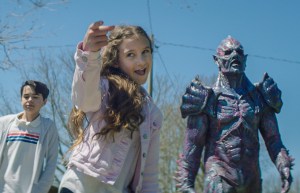
The movie feels like a cleverly constructed episode of Rick and Morty where a crazy idea is given unusual consideration and development and layers of humor and ridiculousness are uncovered so that the whole enterprise impresses. The basic premise is what if a brat had the power to control a monster, and while the movie pretends like life lessons will be learned or earned (“humans are the real monsters” is so trite that it’s an obvious put-upon), the movie also never downplays how much of a terror the little girl can be. It might be an easy joke but it’s still a good one, the fact that the universe shouldn’t fear this hideous monster but really this mean little girl is a fact that many parents will nod along with. The movie does some effort to redeem her, if that’s really important to you, but it also doesn’t soften her rough edges and her impudence. She is a brat, and she will inflict pain on others, and the fact that she has awesome power makes her a scary being the entire universe should really be quaking over.
The enjoyable fish-out-of-water dynamic elevates the comedy and payoffs of Psycho Goreman. This powerful monster is beholden to the childish whims and forced to do the bidding of a child, and he hates being out of control and every moment he is forced to play with her. The begrudging acclimation makes for several fun scenarios where he learns from her and also learns how far she’s willing to go. I enjoyed PG trying to make sense of Mimi’s made-up game and its nonsensical rules, and I enjoyed the levels of bizarre family domestic drama as PG integrates himself with this terrified clan. Having a normal dinner between humans and a blood-thirsty alien marauder is rife with comedic potential, and that’s even before the additional side story of the strife between the put-upon mother and the father who is just a gigantic loser. Their ongoing relationship troubles relate to some hilarious motivational turnarounds, like the father (Adam Brooks, another Astron-6 member) resenting the mother for thinking he’s a loser, so he’ll prove her wrong by being a supportive parent, which just happens to include helping his daughter’s involvement with a killer alien. He has an inspirational speech to his daughter late in the movie that had me cackling. The movie is more than its crazy, schlocky moments of gore and rubber costumes. It’s a fun but cleverly constructed comedy that understands the tenets of what makes crazy so genuinely funny.

But along the lines of gore and rubber costumes, Psycho Goreman is like a gloriously inappropriate Power Rangers episode for adults. The elaborate care and design of these monster and alien costumes is outstanding, especially for a relatively low-budget movie. It might look cheap from time to time, though I would argue this is also part of its unassailable charm, but the filmmakers show their real priorities with their monster designs. They are so varied and weird and good looking and have levels of detail to them as well. There’s one design that is simply a living cauldron of corpses (I think voiced by Rich Evans from Red Letter Media). Every new character is a new joy to behold, and when the clashes begin, as they inevitably do, you discover the extra care put into the creature designs with how they viciously come apart. There is a simple pleasure watching the great production design of the costumes and outfits as well as the outrageous gore. I loved that a kid is turned into a giant living brain monster and nobody seems to really care and it becomes a running joke of how callously everyone has viewed this child, including his own indifferent parents. If you’re a fan of goofy monster costumes and extravagant gore, this film is a twisted treat.
Mimi is going to be a love-her-or-hate-her character because she is exactly what Angela Pickles (Rugrats) would be like if given ultimate, unchecked authority over human life. She wields her power flippantly and will joke about siccing PG on her brother to kill him. She also hoots and hollers for PG’s violence against innocents because to her it’s all a big show of amusement. I found the high level of energy of Hanna’s performance to be the difference maker for me. Her character is an unrepentant brat but she’s so entertaining to watch because she holds to this very specific vision. Hanna is downright brilliant in her smarty-pants, mean girl articulation and has great physical expression. Watching her dance in discombobulated movements like the queen of the world made me laugh every time. I thought Hanna was terrific and her comedic timing was so well-honed for being so young. I understand many will find Mimi grating or overbearing or simply too much to handle. I get it, and I don’t think Psycho Goreman will be nearly as enjoyable for anyone who dislikes Mimi. You’re not meant to approve of her actions and warpath of destruction, but you can still enjoy the mayhem all the same.

If you’re a fan of low-rent, cheesy midnight movies, the deranged and demented, and giant silly costumes and bloody excess, Psycho Goreman will be everything you hope it to be. I will admit it peters out a little right before its big showdown, but otherwise the movie is consistently entertaining, consistently strange, and consistently funny. The comedy is better than you think as the filmmakers refuse to rest on the appeal of easy jokes and easy sentiment. They know why you’re watching and deliver, but the work under the surface is impressive and admirable. The filmmakers know they have a very specific, tailored audience that will celebrate their unique retro pastiche sensibilities, and if you happen to live on that same wavelength as I do, then you too will find Psycho Goreman to be an insane near masterpiece of low-budget, high-concept schlock. Give your 2021 a boost by checking out this Canadian splatter comedy and give in to the madness.
Nate’s Grade: A-
Share this:

Our Friend (2021)
 A sweet and heartfelt true story to friendship that also doesn’t sugarcoat the hardships of illness and the elongating circle of grief. Our Friend is based on the life of journalist Matthew Teague (Casey Affleck) whose life is thrown into turmoil after his wife, Nicole (Dakota Johnson), is diagnosed with terminal cancer. They rely upon their devoted friend, Dane (Jason Segel), for help during the months and years after the diagnosis. The movie jumps around in time, for minimal effect, but does a fine job of laying out the three central characters and their core relationship of love and compassion. Dane is scoffed at by Matt’s friends as a loser who hasn’t gotten his life together, and Dane even contemplates some drastic personal decisions, but he finds a purpose and definition with his servitude, even as it impacts his own outside relationships. I was expecting more attention to the titular “friend” of the title, and it is a slight detriment, but the dramatic core of this movie is solid. The topic of terminal illness can easily veer into soapy, maudlin territory, but the movie is on firm grounding early during a scene where Matt and Nicole discuss how to tell their two young girls that mommy isn’t getting better. Her angry outbursts later and final moments are also unvarnished yet still in character. The acting is quite good overall and there are plenty of one-scene players that leave a favorable and empathetic impression, like Gwendoline Christie and Cherry Jones. The non-linear jumps feel like an attempt to create more meaning than a simple story about friendship will afford and an invitation to sift out connections and parallels. It’s a movie that doesn’t necessarily break away from your expectations as a cancer weepie. You know what you’re headed for. Our Friend is an enjoyable and heartfelt drama with better-than-average performances and overly disjointed editing. If you’re in for a decent tearjerker, give it a try.
Nate’s Grade: B
Share this:

The Little Things (2021)
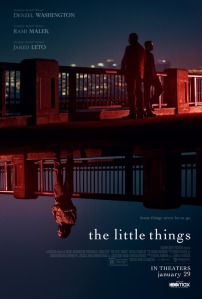 The Little Things wants to be Seven but it’s not even half of Seven (three-point-five?). It’s a meandering movie that doesn’t quite commit to being a prestige character study or a grisly, pulpy serial killer thriller, and so it operates in a middle-ground that achieves little more than prolonged boredom. It’s far too long, far too slow, and with not nearly enough excitement or intrigue or depth.
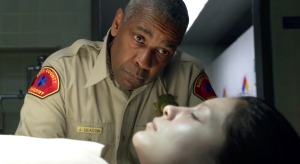
In 1990, Joe “Deke” Deacon (Denzel Washington) is a LASD deputy and living out his final days on the force in the relative anonymity of the unincorporated parts of Los Angeles. He used to be a big time L.A. cop but got far too involved in series of murders, and his obsession lead him to a heart attack, a divorce, and being removed from his office. Deacon delivers evidence to Jim Baxter (Rami Malek), the new chief detective on a series of murders that may be a continuation from Deacon’s days. The two men work together to untangle the details and target their primary suspect, Albert Sparma (Jared Leto), a bow-legged, greasy-haired creep who maybe confessed eight years ago.
 The Little Things was originally written in the 90s by writer/director John Lee Hancock (The Blind Side, Saving Mr. Banks) and it’s easy to see why. The 1990s was a heyday of serial killer thrillers; it felt like any studio would greenlight a project as long as the crazed killer had a gimmick to their murders (”This guy only kills people on Friday… because you can’t eat meat on Friday?”). While the preponderance of these kinds of movies has shifted to the ever-flowing world of direct-to-video (look for The Hangman, where Al Pacino chases a killer literally playing the game hangman with victims), there is still a perverse fascination with true crime culture and serial killers to be exploited by a canny writer. We still love these kinds of stories when done well. HBO’s True Detective has also taken the serial killer formula and transformed it into a contemplative, long-form character study that looks just as much at the flawed detectives as it does the killers. Over the course of eight elegiac episodes, True Detective can take the time to immerse you in the sordid and portentous details of these people, their cases, the lingering questions, and their demons and doubts made flesh. The depth of the tortured, flawed characters and the complexities of the cases are what sustain the multiple-episode investment (exception: season two). With a movie, you must be more judicious with your precious two hours of time for storytelling. This preamble was a long way of saying The Little Things doesn’t fit as either. Its cases and characters lack the depth to justify the time dwelt, and the thrills are decidedly dimmer, denying a serial killer audience a compelling case, compelling characters, and a unique killer.
I’m going to summarize the two-hour-plus plot for you now: two cops investigate a series of serial murders. They think they have a culprit. They tail the suspect. A slightly surprising ending that lacks the shock and contemplation I think Hancock is looking for. The end. I’ll keep it vaguer to preserve spoilers but suffice to say that is not enough plot for an investigation. I recently re-watched Seven, one of my favorite films of all time and a masterpiece in its genre, and it has a natural propulsion to it where each clue leads to the next by design from its grandly clever psychopath. You know there are seven deadly sins and each new victim is another step closer to achieving that mad goal. The story engine keeps the plot driving forward. With The Little Things, there are some bodies and a whole lot of waiting. And waiting. And waiting. Paired with the placid pacing, it sure makes The Little Things feel like it’s missing a big picture.
 There are also some moments that ripped me out of the movie, mostly involving a disconnect between what is intended on the page and what is delivered on the screen. We’re told that these characters are so obsessed, yet they don’t come across that way. Sure, they follow Sparma because he’s so obviously a guilty-looking suspect, but we don’t witness the lengths they’ll go and the people they’ll push away in order to close their case. In the end, Hancock approaches this territory, but it feels like a stab at subversion and relevance the rest of the movie has been missing. It feels like Hancock had two hours of one kind of thriller and then in the final five minutes said, “Eh, who cares?” This climax also involves a professional detective making so many bad decisions about his own personal safety that I felt my eyes rolling out of my head. It’s like Hancock is using the character’s dumb choices to declare how obsessed he is with finding the truth, and yet we didn’t witness this obsession earlier when he was making good decisions. Baxter is supposed to be a family man and a religious man, yet Malek is playing him so devoid of emotion and the script doesn’t present anything meaningful for his domestic life, that he feels more like a robot with a flimsy back-story provided as a default setting. Then there’s Deacon’s monologuing to the corpses of the dead women. He also sees ghosts of the victims. If the movie was presenting this as a sign of his tortured psyche, it should have gone all-in. Have him converse with them all the time, have them reappear and whisper in his ear, have the new crime scenes trigger the appearances of victims from the old crime scenes, take this unique angle and take ownership of it, really separate from the glut of other serial killer thrillers. Alas, it’s just an awkward personality motif that occurs from time to time to provoke an eyebrow raise.
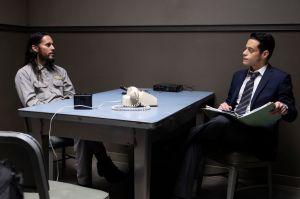
All three central actors have won Oscars for their acting, and while nobody is outright bad, they all seem to be delivering wrongly attuned performances. Washington (Fences) dials down that natural charisma to go full quiet intensity, and there are few actors who can be as intimidating with looks and hushed words as this man. Except he’s supposed to be haunted and the wear and tear of the man’s past lacks weight because of the performance choice. The pain and struggle seem to be suffocated in that steady steely Washington glower. Malek (Bohemian Rhapsody) is too detached to convincingly play his young family man coming unglued thanks to the case. He’s playing the role like he’s secretly going to revealed as the real killer in a hasty last-second twist. Leto (Blade Runner 2049) is inherently drawn to off-putting oddballs and his appearance halfway through provides a necessary jolt for the movie. The problem is that he’s so creepy, he’s so weird, he’s so desirous of attention, that it makes the character overwhelmingly obvious. He’s not interesting so much as he’s just a neon sign flashing “Guilty,” and there are only two ways to go with this, neither exactly fulfilling given what has preceded. The best scene in the whole dirge of a movie, by far, is the interrogation with all three actors feeding off one another.
 The Little Things feels like a dated copy of 1990s serial killer thrillers without anything new to offer besides the star wattage of its cast. It’s even set in the 90s for no real reason than to deny its characters access to cell phones and the Internet. The look of the movie is awash in the cool, moody style of David Fincher’s signature look, like Hancock and his technical artists were reviewing Seven and Zodiac and aiming for a fawning homage to a modern master of crime cinema. I would advise people to just watch Seven again, or even any of the many junky serial killer thrillers from the 1990s (Copycat, anyone?). The Little Things just isn’t that interesting. The main characters are threadbare, the women are either colleagues, wives, or corpses, the plot meanders for far too long, the pacing is turgid, and it lacks memorable set pieces and reveals that linger. It needed to be better, or worse, but instead it’s just imitation David Fincher visual wallpaper.
Nate’s Grade: C
Share this:

Locked Down (2021)
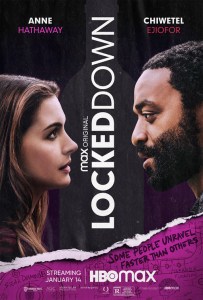 I’m already starting to dread the inevitable onslaught of movies and fictional narratives tackling the COVID crisis, and I don’t know if that’s ever going to be truly inviting for me. After the near year of pandemic fatigue, I can’t see myself wanting to relive the experience through my media. Naturally, this is partially because of how fresh everything is. Years down the road I may hold a different opinion and find COVID-19 stories more engaging. I’m sure there will be worthy ones to explore with the best storytellers that movies and television can afford. Right now, I’m not looking forward to the rom-coms about couples being forced together, or forced apart, and I’m not looking forward to the zombie movies that seem all too obvious in commentary. It is with this context that I watched the new 2021 movie Locked Down with wary curiosity. It was filmed during the quarantine in London over 18 days. It stars big actors, has a director and writer who have worked on highly esteemed projects, and it’s the first big project to feature the pandemic while we’re still in the middle of a worldwide pandemic. It has temporary notoriety but is it any good?
Linda (Anne Hathaway) and her husband Paxton (Chiwetel Ejiofor) are stuck at home like everyone else in London thanks to COVID-19. He’s struggling for work and she’s struggling with the mental weight of her job and the impending knowledge her friends and co-workers will soon be laid off by Linda herself. The couple is also heading for a divorce, though they’re keeping that quiet from concerned family members checking in. Paxton’s sense of self is falling apart, and the rebellious biker who got into one unfortunate bar fight long ago seems to be fading. Now he doesn’t know what he’ll be and he’s forced to sell his prized motorcycle. Linda gets the idea to pull off a jewelry heist that she and Paxton have an unique opportunity for. Could it be the thing that makes them feel excited again? Could it bring them back together?
 Locked Down has some significant tonal shifts but more so in ambition than execution, because at its core its really a talky, mumblecore relationship drama, but one that I found a little too lax and shapeless and ponderous to jibe with. Screenwriter Steven Knight can be a tremendous writer. He’s written Eastern Promises, Locke, Dirty Pretty Things, and created Peaky Blinders. He knows plot, he knows character, he knows structure. This, though, doesn’t feel so much like it was a script needing to be told as it was an experiment in could they make a movie about the pandemic and film it during the pandemic. The heist elements are rather haphazard and ultimately mean little to the overall storyline, merely serving as an instrument to reconcile our couple and force them to rely upon one another for a shared triumph (this shouldn’t be a spoiler). I think your overall view of Locked Down will depend upon your opinion of how the heist elements are handled. If it seemed like the start of something more exciting, more engaging, then you’ll be disappointed. If you didn’t care about the particulars of a heist during COVID times, and you didn’t want a more purely genre plot device to take over from the character-driven relationship drama,then you might be more charitable. For me, I love heist movies and the formula is ready-made for payoffs and entertainment. However, I also enjoy character-driven relationship dramas but I just wasn’t connecting with this one.
The characters of Paxton and Linda felt too overly written for me and lacking the more intriguing nuances that I find in the best of observational mumblecore cinema. To be fair, being overly written is not an indictment in itself. Quentin Tarantino characters are overly written and we love them. Viewers love big characters that demand your attention and equipped with monologues that we wish we could recite when life’s challenges afforded us the opportunity to wax poetic. The central agreement we have with characters, whether they’re realistically drawn or idiosyncratic or cartoonish, is that they need to at least be interesting. You need to want to spend time with the characters.
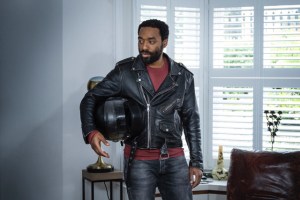 With Locked Down, I was getting as restless as the onscreen couple. I didn’t find them interesting because the same character notes were being hit over and over with little variation. The monologues, while having moments of life and personality, didn’t provide me greater insight at minute 80 than they did at minute 40. The experience felt like watching actors workshop characters and looking for extra meanings that seemed to be elusive. Listening to these characters talk more should make them more interesting, make them more personable, and make them more complex, right? While they uncork some well written asides, they’re each just rubbing the same nub of an identity crisis. The pacing also made the repetitive portions feel even longer. The metaphor of what Paxton’s motorcycle represents is so overblown and simplified. After spending so much time listening to these two bicker and argue in the same rooms, I was hoping for the heist as a needed escape, something that could finally serve to motivate the characters out of their pity parties and force them into a new conflict. I needed something, anything more to hold my waning attention. Alas, I finished Locked Down in the same patient, pursed-lip stupor as it began. These characters did not deserve this much extra breathing room.
I like Hathaway (Colossal) and Ejiofar (12 Years a Slave). Watching them leap into what is essentially a two-hander filmed play sounds like a good bet for entertainment, especially with a writer with the credentials of Knight (we’ll ignore the outlandishly bonkers 2019 Serenity). Hathaway and Ejiofor are good together too. They have a spark that works, her anxiousness melding well with his dismissive pessimism. Again, the characters they’re portraying aren’t poorly written. There just isn’t enough polished material for them. That’s why each feels like they’re grasping to discover the character like it’s being formed in the moment. The entire movie feels like an overextended improv workshop everyone involved is developing in the moment. Good mumblecore movies can make you feel like a fly-on-the-wall with real people, but these characters are so overly written that an improv feeling doesn’t so much replicate the recognizable rhythms of life as it does an ungainly acting class in search of more direction and discretion. There are some other celebrity appearances in the form of Zoom cameos, and that’s something I’m not looking forward to with the incoming COVID movies, the ugly selfie aesthetic prevalence.
 Locked Down feels more like an experiment to see if the filmmakers could make a movie under such unique and trying circumstances. It feels more like an acting exercise in need of more development and a little more vitality. There are fleeting moments that seem to tap into a universal despair and uncertainty many of us have wrestled with during our COVID isolation, but then the movie will just as likely throw in a hidden patch of poppies in a garden and a joke about nobody seeming to recognize the name Edgar Allen Poe. I watched Locked Down over the course of two nights, and mt girlfriend and I literally had forgotten we watched the first hour until coming across it again and going, “Oh yeah, we need to finish that after all.” I feel like that sums up the movie well. Within a day, I had already forgotten it, and that was before I even finished the full movie. They made a movie during COVID. Now make better ones in the future.
Nate’s Grade: C


 nathanzoebl
You must be logged in to post a comment.