Category Archives: 2017 Movies
All the Money in the World (2017)
 All the Money is the World used to star Kevin Spacey as the prolific oil billionaire John Paul Getty, that is until director Ridley Scott elected to reshoot the part, replacing Spacey with Christopher Plummer after Spacey’s unsavory history of sexual assault came to light. In only ten days, Scott changed his movie with only a month to spare before its release. It’s an amazing feat, especially when you consider Plummer is in the film for at least a solid half hour. He’s also the best part as the mercurial, cruel, penny-pinching magnate who refuses to pay his grandson’s ransom even though he’s the richest man who ever lived. In 1973, John Getty III (Charlie Plummer, no relation) was kidnapped by Italian criminals. With the miserly grandfather offering no help, Gail (Michelle Williams) tries to negotiate with the criminals and her father-in-law to secure the release of her son. I didn’t know anything coming into this film, but afterwards I felt like it focused on the wrong characters. The mother stuck in the middle is not the most interesting protagonist here and seems like a go-between for the two more immediate and intriguing stories, the elder Getty and the youngest Getty. Williams (Manchester by the Sea) is acceptable as the strong-willed, put-upon mother, though her mid Atlantic accent made me think I was watching Katherine Hepburn. Mark Wahlberg (Daddy’s Home 2) is completely miscast as a former CIA agent that helps Gail. He succeeds in converting oxygen to carbon dioxide and that’s about it. The central story is interesting enough, though there are points that scream being fictional invented additions, like a last act chase and a kindly mobster who undergoes reverse Stockholm syndrome. John Paul Getty is an interesting character, and Plummer is terrific, though I am quite curious what Spacey’s performance would have been like under octogenarian makeup (Plummer already happens to be in his 80s). All the Money in the World is an interesting enough story with decent acting but I can’t help but entertain my nagging sense that it should have been better even minus Spacey.
Nate’s Grade: B-
Share this:

The Post (2017)
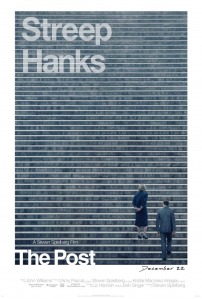 Even with the added timely benefit of championing a free press in the era of Trump, Steven Spielberg’s The Post is a movie held together by big speeches and Meryl Streep. It’s the story of the Pentagon Papers but it’s told from the wrong perspective. It’s told through the reference of whether the owner of the Washington Post (Streep) will or will not publish and how this endangers her family’s financial control over the newspaper. Plenty of dismissive men doubt her because she’s a woman. It’s simply one of the least interesting versions of an important story. Streep is her standard excellent self and has a few standout moments where you can actively see her character thinking. I just don’t understand why all these talented people put so much effort into telling this version of this story. I missed the active investigation of Spotlight, how one piece lead to another and the bigger picture emerged. There was an urgency there that is strangely lacking with The Post. The question of whether she will publish is already answered. It feels like the screenplay is designed for Big Important Speeches from Important People. Tom Hanks plays the gruff editor of the newspaper and Streep’s chief scene partner. They’re enjoyable to watch, as is the large collection of great supporting actors (Bradley Whitford, Carrie Coon, Sarah Paulson, Tracy Letts, Matthew Rhys, Jesse Plemons, Bruce Greenwood, and a Mr. Show reunion with David Cross and Bob Odenkirk). This is a movie that is easier to admire than like, but I don’t even know if I admire it that much. The film has to call attention to Streep’s big decision and the stakes involved by underlining just what she has to lose and reminding you how brave she’s being. When Streep leaves the U.S. Supreme Court, there’s a bevy of supportive women lined up to bask in her accomplishment. It’s a bit much and another reminder that The Post doesn’t think you’ll understand its major themes. It’s a perfectly acceptable Oscar-bait drama but it sells its subject short and its audience.
Nate’s Grade: B
Share this:

Bright (2017)
 Netflix has been fighting to get into the world of theatrical features. While its original series have met remarkable acclaim, Netflix still wants to draw filmmakers. There have been a few high-profile film buys like Brad Pitt’s War Machine, the live-action American Death Note, and it’s become Adam Sandler’s new home. Bright is a $90 million dollar fantasy film directed by David Ayer (Suicide Squad, End of Watch) and written by Max Landis (American Ultra, Dirk Gently). The big buzzy movie has been met with big derision from critics, some even referring to it as the worst film of 2017. After watching Bright, I think my friend Drew Brigner sums it up pretty well: “It’s not terrible, but it’s not great.” Slap that onto the poster, Netlfix.
In an alternate Los Angeles, humans exist side-by-side with fantasy creatures like fairies, elves, and orcs. Daryl Ward (Will Smith) is assigned a “diversity hire,” Jakoby (Joel Edgerton), the first orc on the force. Nobody wants to work with him. The humans are looking for whatever means they can of getting rid of the orc, and Ward’s superiors are looking for his assistance. Then one night on patrol, Ward and Jakoby come across a nightmarish crime scene. Bodies are burned in place. A woman is stuck in a wall. There’s one survivor, Tikka (Lucy Fry), an elf who has gotten hold of a magic wand. It so happens that magic wands are powerful weapons and only Brights can hold them. Word gets out about their discovery and every group in L.A. is after this powerful item. Ward and Jakoby have to escape gangs, orcs, corrupt cops, and an elf cult leader, Leilah (Noomi Rapace), who needs the wand to summon her Dark Lord back to dominate Earth.
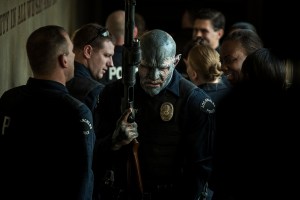 For the first 48 minutes or so of Bright I was willing to give it a welcomed chance. The world building from Landis presented enough interesting wrinkles to keep me intrigued. The banter felt believable enough to fit into its desired genre. Edgerton (It Comes at Night) is engaging and charming as a good-hearted orc whose life’s dream is to be a police officer. He is viewed as a traitor by his own kind, so that makes us like him even more for what he’s willing to sacrifice for this precarious position. There’s a personal source of conflict between Ward and Jakoby that is introduced early for them to work through. There are magic police, which is kind of cool. The world feels lived-in with clever details even though it could have used more of that sense of living. Too often it feels like the only difference in this new L.A. are scattered creatures in different locales. Elves are the rich elite. Orcs are the poor and disadvantaged. I could have used more magical creatures in the mix. What about dwarves, wizards, dragons, anything? Still, Landis’ script was providing enough breadcrumbs to carry me along, building up to the wallop of finding the magic wand. It forces Ward to make a startling personal choice that will define the rest of the film. It took a while to get going, but I was still willing to give Bright the benefit of the doubt.
However, it’s after the 48-minute mark that Bright begins its disjointed descent and never truly recovers, disassembling at an alarming rate. What follows is a series of poorly developed, poorly shot action sequences as the characters bump into one violent group after another. The interesting plot development gets put on hold and the weaker elements begin taking greater significance. It wouldn’t be a fantasy film without a great prophecy, which comes into bearing in the most contrived of ways. Speaking of contrived, there is a coincidental rescue late in the second act that made me loudly groan. Then there’s redoubling back to previous locations presumably to save money on set design. Once the movie sets things in motion for the mad scramble for the wand, it just feels like one unrelated sequence after another to keep our characters on the run. Even with the fantastical world building, you’ll be hard-pressed to muster genuine surprise. That’s because all of the later plot turns are readily telegraphed, like the coincidental save. We’re told that only a Bright can handle a magic wand and anybody else that touches it will explode. First off, why doesn’t this make the magic wand a defensive weapon if you know how rare Brights are? If you know idiots are going to have grabby hands, why not slide it toward your enemies? Regardless, knowing that dichotomy, you know one of the two main character will be revealed to be a Bright during a climactic moment, because why else have it? Anticipating payoffs isn’t necessarily a bad thing, but when you can anticipate all of them, then you’re in trouble. The most surprising aspect of Bright is how ultimately it’s still a formulaic buddy copy movie dressed up with some extra fantasy spectacle.
Another weakness that becomes more apparent as the film continues is the characters. Ward and Jokoby are pretty thinly sketched out with a few clarifying details. Ward is the lightly racist archetype who learns to accept his partner’s differences over the course of one long night. He’s pretty indistinguishable from the character Smith plays in the Bad Boys films. I suppose his prejudice and desire to better support his family is enough setup to question whether he’ll follow in the corrupt patterns of his colleagues. But after he makes his choice at that 48-minute mark, it’s like his character growth just stops. He still barks orders, he still quips one-liners, and he makes the big sacrificial gesture, but his character development is iced for a solid hour. Jakoby has more ground to cover and fairs somewhat better as the Jackie Robinson of the orc community. Except this guy seems way too inexperienced, clumsy, naïve, and simply not good at his job. In order to be the first diversity hire, I’m expecting this guy to have to go above-and-beyond to even be considered for a position. It reminds me of Shonda Rhimes quote where she says, as a black woman, “you have to be twice as good as them to get half of what they have.” I didn’t believe Jakoby was the best candidate for shattering that orc-sized glass ceiling. The harassment from the other cops can be painfully juvenile as well, like tacking on a stupid middle school-esque “kick me” sign to his back. He wants to make more of himself and because of that dream he’s shunned by his fellow orcs and distrusted by humans. That perspective should be far more interesting than what we get with Bright.
 The supporting characters fare even worse as bodies given momentary activity. Tikka is merely a plot device and not a character. She doesn’t even speak until close to 85 minutes into the movie, and it wasn’t really worth the wait. A toaster could have replaced her and the plot would remain relatively the same. She is the definition of a prop. She has no personality, no agency, and no goal beyond keep the powerful thing away from the villain. Because she’s a Bright she’s one of the few who can wield the magic wand, but even those rare occurrences are underwhelming. If this thing is as advertised, a “nuclear bomb that grants wishes,” then why doesn’t Tikka just utilize it to destroy the villains once and for all or at least help Ward and Jakoby? Poor Fry (The Darkness) just gets yanked around from scene to scene, shivering and generally looking frail. She’s got some killer eyebrows though.
Noomi Rapace (Prometheus) doesn’t have much to work with as the chief villain, Leilah. She’s an acrobatic murder machine who wants to summon the Big Evil Thing of Old, and that’s about it. Rapace does have a naturally elfin-looking face, so it’s solid casting. The other characters, especially the various antagonists, are just slight variations on heavies. No real personalities. No dimension. They’re just a video game stage of slightly different looking goons to be cleared before the next stage. Maybe there’s a larger point about the similar darker impulses all races are tempted by, but I think that’s giving the movie more credit than it deserves.
On that front, the racial commentary of this alternate L.A. is muddled, to say the least. The orcs are obviously meant to take the place of lower-class African-Americans in this newfangled City of Angels. However, what does the movie do with this? The orcs are judged to be troublemakers, prone to violence, and generally subhuman, with several people holding a thousand-year-old grudge over the mistakes of previous orcs. Under Ayer’s murky direction, the orcs easily resemble the black and Latino gangs we’ve seen in many of his police dramas. They’re meant to be an underclass. What does that make black people? There’s a tone-deaf joke in the opening where Ward yells, “fairy lives don’t matter” before swatting the winged nuisance to its death. I guess racism against orcs has replaced all other forms of intra-human racism. Landis’ script takes a hot button issue and drops the ball on making the commentary meaningful. Just think about what Zootopia did with its racial allegory on predators and prey. They took a serious topic and had something to say about it. Landis takes a serious topic and ignores the greater potential. By the end of the film, it feels oddly like Landis just took an old buddy cop story concept and grafted some incidental fantasy elements onto it and called it a full day.
 Ayer doesn’t help matters by filming in his Suicide Squad-vision of drizzly grays, cool blues, lens flares, and lots of dim shadows. The very look of the movie is so downcast and the action sequences are too poorly developed and choreographed. The combat is very often close-quartered and the jumpy edits and slippery sense of geography make the brawls practically incomprehensible. The sequences don’t develop organic complications. It’s just the same concept over and over, get to that place, shoot the bad guys before they shoot you, repeat. The action also misses opportunities to connect with the character motivations and to derive mini-goals that can help spice things up. Bright has none of that. Even with the inclusion of magic and magical creatures! The best scene is an attack in a convenience store that gets closest to involving parallel lines of action with some organic consequences related to its specific setting. Otherwise it’s a lot of shootouts in locations you’ve seen in other grimy cop movies (alleys, warehouses, strip bars, etc).
Bright is the most expensive movie in Netflix’s history and they’re already reportedly developing a potential sequel. The world Landis has created has enormous potential. It’s unfortunate that it’s not realized in this first edition. It’s not as bad as some film critics have been harping about but Bright should have been much better. The characters are lacking, the world building feels unfulfilled, the narrative is predictable, the social commentary is simplistic, and the action sequences are dreary and unexciting. I think something like Bright might in the end be intended as a loss leader for Netflix, something they initially lose money on but ultimately draws in new subscribers. It’s almost the same cost for that canceled Baz Luhrmann series, The Get Down (at least got eleven episodes from that). Bright is an underdeveloped genre mash-up that might make you reach for a magic wand of your own, your remote.
Nate’s Grade: C
Share this:

Downsizing (2017)
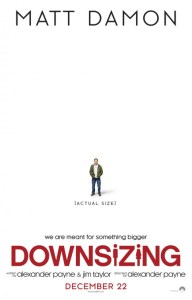 Alexander Payne is not exactly the first name you would think of when it comes to science fiction. The man has a history of road trip comedies, average Midwestern men, mid-life crises, and the colorful miscreants of society. The fact that the director of Sideways and The Descendants is tackling The Incredible Shrinking Man is a bold move. Payne is outside his comfort zone with Downsizing, and it shows at points. While never quite satisfying the possibilities of its premise, Downsizing is still worth watching for its memorable moments and for the sheer brilliance of one outstanding performance.
In the not-too-distant future, science has developed the technology to shrink human beings to five inches tall, approximately 1/100th of their size. A middle-income couple can live like the top one percent because their money goes further. Paul Safranek (Matt Damon) is a schlubby, regular guy suffering from the ennui of a job he hates and a life that feels unfulfilled. He and his wife, Audrey (Kristen Wiig), decide to undergo the downsizing procedure, which is irreversible. Paul’s wife backs out at the last minute but he doesn’t find out until after he’s gone small. Now with a McMansion all to himself, Paul has to readjust to what he thought his new life would be like. He moves into a condo and shirks the offers to join the parties of his hedonist neighbor, Dusan (Christoph Waltz). Paul finally decides to live life and embraces new experiences, the biggest befriending Ngoc Lan Tran (Hong Chau), a one-legged Vietnamese cleaning lady who was downsized against her will for being an overseas political activist. Paul feels drawn to this woman and she opens his eyes to the larger world around him.
 The strangest part of Payne’s movie is that the main thrust of the story could have been told without all of the science fiction dross. This is very much a romantic comedy/drama that follows the formula of a man jilted at the altar who has to get his life back together, finds someone new who changes his perspective on life, and then they get together by the end. You could have plucked this story and set it in an ordinary world and it still would have worked, which begs the question whether the world of Downsizing is properly applied. The consumer commentary seems muddled, with the rationale for downsizing being helping the planet, reducing the population so to speak, but really it’s an escape into a fantasy of wealth. People are downsizing so they can live in luxury and leisure. This should set up Payne for his incisive brand of satire as he skewers the selfish and self-righteous foibles of mankind, except that doesn’t really happen. Sure, eventually in the second half the movie opens up its tiny world a little wider, revealing the not-so-hidden subculture of immigrant labor toiling away to keep everything stable and pretty. It’s obvious social commentary and rarely does it go a step further than just recognition. And so the film becomes another in a long line of movies about a man who must be shaken from his malaise and enjoy the possibilities of life he never knew existed. Downsizing eventually ignores its sci-fi conceit to tell a relatively ordinary tale of self-actualization.
Payne’s premise would have best been explored through the more open parameters of a television series. Downsizing is an interesting concept that leads to other natural questions over how this tiny world operates and also how it interacts with the larger community. There’s a small scene where a drunk overhears Paul’s plan to shrink and argues that little people shouldn’t be granted the same voting rights as “normal-sized” citizens. The normies contribute more to society and should be given more credit, he argues, before being shooed away. This political division could have made for an interesting topic of reflection itself, but like many of Payne’s pit stops, it comes and goes after whetting your appetite for further examination. What about a story where downsizing is a punishment to do away with the “undesirables” of a nation? A TV series would have allowed more room to explore, with finer nuance, the details and possibilities of this fanciful world. Payne allows his movie to breathe, taking extended jaunts on different ideas but rarely enough to satisfy your sense of curiosity. The last act takes place at the original downsized colony in Norway, though at their diminutive size I wonder if it took them months to travel in Dusan’s yacht. It’s meant to think about what will come after humankind has passed the point of no return when it comes to climate change. Paul has to rethink what he wants his legacy to be and what meaning his life will have, which then pushes him into a rather simplistic choice of go with the girl or the cause. Given the rest of the movie’s focus, you shouldn’t be surprised what decision he ultimately makes.
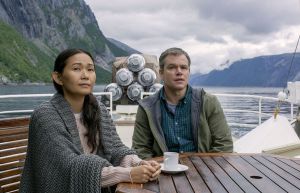 However, the real reason you should legitimately see Downsizing is for the astounding, star-making, can’t-take-your-eyes-off-her performance by Hong Chau (Inherent Vice, Big Little Lies). I cannot recall another movie where a character comes in at the halfway mark and just takes over completely, single-handedly lifting the movie up. Every moment she is onscreen is made better. You’ve never seen a character in a mainstream movie quite like Ngoc Lan Tran. She’s a political dissident, amputee, and lower-class cleaning woman who teaches Paul about the class divides. Tran is tragic, comic, caustic, lovable, and Chau is an acting revelation. I’ve read several reviews that found her to be a cringe-worthy, borderline racist depiction of an Asian woman meant to be laughed at, and I strongly disagree. At no point was I laughing at Tran because of her status, her ethnicity, or her broken English cadences. I was laughing because she was a force of nature that blew away the pretensions of others, that cut to the chase, and spoke her mind in a carefree and honest manner. Her matter-of-fact affectations are so perfectly delivered in accordance with the character’s personality. There are moments where her character is being set up for one thing and Tran goes entirely in another direction, and whereas you might have laughed at the start she surprisingly earns other emotions. Take for instance a scene where Dusan tries to ditch her by making an excuse about a sudden travel commitment. Tran takes this moment and turns it into a genuinely poignant monologue about the unexpected nature of fate. By the end she’s crying out of sheer elation, and those tears are not meant for ridicule. Downsizing realizes what an asset it has and makes her the deserved focal point of the second half. You’ll fall in love with her too. Chau doesn’t just deserve an Oscar nomination; she deserves to win everything.
Downsizing is an episodic high-concept comedy where the shrinking is irrelevant to the main storyline that evolves over two plus hours. This is an adult movie that explores some mature topics with surprising time and scrutiny, and then it can also be a simplistic rom-com that misses the mark on larger, Swiftian social satire. It’s another story in a long line of disaffected, middle-aged men finding their groove again, except then it becomes the story of a Vietnamese activist and her unique persona. Hong Chau is the reason you should see Downsizing above all. She doesn’t so much steal her scenes as just take full ownership over the back half of the movie. Her performance is so uniformly excellent that you wish the rest of Payne’s uneven movie could meet her commitment. There are a lot of ideas here that seem to get brushed aside for the conventional formula of a romantic union, even if the pairing is rather unconventional. Downsizing is an entertaining movie that doesn’t quite amount to more than the sum of its little parts.
Nate’s Grade: B
Share this:

Wonder Wheel (2017)
 It feels like Woody Allen is trying to recapture his magic from 2013’s Blue Jasmine, a character study of a tragic modern Blanche DuBois coming undone by her bad decisions. Whereas that film rightfully garnered Cate Blanchett an Oscar, Wonder Wheel is not going to do much for its own tragic heroine, Kate Winslet. She plays Ginny, and she’s stuck in a dull marriage, a dull life as a waitress at a Coney Island diner, and she keeps thinking of the life she could have and should have had as an aspiring actress. She has a summer affair with Mickey (Justin Timberlake), a lifeguard who wants to be a writer with experiences. Ginny’s affair is jeopardized when Mickey starts seeing her stepdaughter, Carolina (Juno Temple), who is on the run from her own mobster husband. All of this melodrama is kept at a fever pitch, and the film feels far too stagy, with characters careening in limited locations and having long, combative conversations. The cinematography is gorgeous as sets and people are draped with glowing, amber waves. Winslet’s character is not nearly as compelling as Allen intends as a tragic heroine being laid low by her flaws. She’s not exactly likeable but she’s also not exactly interesting, not like Blanchett. Losing her fling to a younger woman makes her even more desperate and self-destructive, which amplifies Winslet’s fussy and broad acting. Timberlake is strangely the narrator of this story and has several fourth wall breaking moments, and it doesn’t work, especially since his character is more a cobbled together cipher. There’s an odd subplot where Ginny’s young son is a pyromaniac and it adds nothing but stress. The story doesn’t add up to much and the characters just aren’t that interesting; they’re loud and abrasive but they don’t tap into anything larger about the human condition. It’s Allen’s half-baked homage to Eugene O’Neill. In a most unexpected move, I think the best actor in this movie is Jim Belushi as Ginny’s dimwitted husband. I think that says everything you need to know about Wonder Wheel, an up-and-down melodrama that has its mind set as a theatrical production and never leaves that space.
Nate’s Grade: C+
Share this:

Star Wars: The Last Jedi (2017)
 As I stated in my review of Star Wars: The Force Awakens, “The first mission for Episode VII is to reset the course, to wash away the bad taste of the prequels that haunt many.” Mission accomplished, mostly, though the biggest criticism for J.J. Abrams’ resurgent sequel was how all too closely it hewed to the original plot beats of its own past. It was an overcorrection, a swing too far in the other direction and turned a reboot into “a loving homage that approaches facsimile.” I enjoyed the new characters, the next generation of Star Wars heroes, and wanted to see what would happen to them next. I just hoped the franchise could steer a course of its own. Having a talent as unique as Rian Johnson (Brick, Looper) as the writer/director of Episode VIII certainly portends to that. The Last Jedi is a better movie, structurally and even emotionally than Force Awakens, but it’s flawed and definitely less fun and is driving so many fans to the dark side.
The First Order is crushing the last vestiges of the puny Resistance. General Hux (Domhnall Gleeson) is chasing the last ships of General Leia (Carrie Fisher) through the galaxy. Finn (John Boyega) is looking for Rey (Daisy Ridley) who is missing. He is teamed up with Rose (Kelly Marie Tran), a plucky mechanic, to find a master code breaker to thwart the First Order’s tracking system so everyone can safely escape. Meanwhile, Rey has sought out the last Jedi, Luke Skywalker (Mark Hamil), who agrees to train her just to teach her why the Jedi are wrong and he will not help the Resistance. She’s also been psychically linked to Kylo Ren (Adam Driver), who is still struggling with his own identity as a pupil of the dark side. Supreme Leader Snoke (Andy Serkis) has lost his faith in Kylo, who he feels is too weak to embrace his darkest impulses. Kylo believes he can convince Rey to join him, and Rey believes that Kylo can be saved and turned into an ally. The Resistance is looking to survive another day and rebuild their rebellion in the hearts and minds of the downtrodden.
 I was hopeful Johnson would be able to tread safely away from the undertow that is the pull of Star Wars nostalgia, and he did so, both to the movie’s great benefit and oddly to its peril at different points. Episode VIII is not a repeat of the plot beats of Empire Strikes Back, though there are some thematic similarities that go along with a middle chapter in a trilogy, like separating the heroes, experiencing losses, etc. Clearly, once Johnson received the handover from Abrams, there were certain Star Wars storylines setup in Force Awakens that he had no interest in continuing. I won’t specify what they are for the sake of spoilers but Johnson definitely undercuts the expectations of extraordinary developments with ordinary, mildly indifferent responses. Certain characters fans may have thought would be more important are gone. It’s as if Johnson is saying to the audience, “Did that thing really matter to you? Who cares?” It’s not Johnson’s fault the fanbase spun off intense theories. He undercuts your expectations throughout. The characters are allowed to fail. The reported saviors don’t want the responsibility. By upsetting the balance of the force, if you will, Johnson has injected a sense of uncertainty into the Star Wars mix, a badly missing element ever since the original trilogy. When a major character looks ready to sacrifice his or herself, you start to believe that this genuinely may happen. When the characters finally fulfill their mission and track down their special contact, they’re denied their goal. You can tell Johnson is having fun with misdirection and, as one character says, “letting the past die.”
However, that same sense can also get Johnson into trouble. From a narrative standpoint, we’re not much further by the end then where we began. From an emotional standpoint, I don’t know if we’re that much farther either. There are elements you can clearly tell that excited Johnson, namely the Rey/Luke/Kylo moments. That relationship, dynamic, and hidden history is easily the best part of The Last Jedi. The decision to psychically link Rey and Kylo seems cheesy at first but works out beautifully, synching up the two force wunderkinds forces them closer and each one looks at the other as a potential kindred spirit. They each think they can save the other, and so it becomes a far more concrete battle over the soul of our characters rather than just a philosophical exercise. It opens up more of a literal dialogue between these opposites and deepens their chemistry. Luke might be following a typical hero’s journey/acceptance of the call, but it’s still an interesting path because he’s bitter and lost his faith in the moral primacy of the Jedi.
 On the flip side, there are also elements where you can clearly tell Johnson had less excitement. The middle section involves a side mission onto an alien casino, and it feels like filler, especially with where it eventually goes and what it opens up about the world. I think it’s meant to showcase the exploitation of the underclass, the rich getting richer off war profiteering and the subjugation of civilizations. It doesn’t land and detracts from the other, more interesting storylines. The cutsey comic relief characters inserted to sell toys are not overpowering but they clearly feel like a studio requirement. At least I’m giving Johnson the benefit of the doubt that he didn’t decide that his Star Wars movie needed winged, big-eyed guinea pig creatures. The concluding half hour also could have been eliminated considering the second act break feels like a more climactic ending. The premise of an elongated chase through space that exhausts fuel supplies and where an enemy ship can track light speed jumps is oddly reminiscent of the first episode in the Battlestar Galactica reboot series (maybe Johnson was a fan). There are things the Force is able to do that we’ve never seen before. It begs questions over what exactly are the parameters of this invisible made-up zen power. Also, if you just solve things by saying “new Force powers” then it becomes a Star Wars cheat. There are also nobodies that could have been, and should have been, replaced by other higher-profile characters. There’s a moment of pure unchecked badassery that should have been someone else taking the sacrifice. By cramming in all of this other material, Johnson is trying to find things for his various characters and storylines to do, and not everything is on the same plane. Finn and Poe (Oscar Isaac) recede into the background all too easily. This is the longest Star Wars movie in franchise history and it could have easily been cut down by 20 minutes.
Fortunately for us, Johnson’s eye for striking visuals and strong, punctuated character moments is still alive and well, and The Last Jedi has moments that left me awed. There are a handful of visuals that are burned into my memory. A multi-dimensional shot of action that pans over to a frantic eyeball. A blast of light that cuts through space like a razor, with the sound dropping out for that extra degree of awe. Speeding ships kicking up red plumes. A slow-motion team-up that all but dares you not to pump your fist. Johnson’s unique sense of visual composition is still present an accounted for. He also reveals a strong handle over the coordination of action sequences, an unknown quantity for him until he landed on this biggest stage. The opening sequence is a great showcase for Johnson with multiple points of action both macro and micro. The X-wing fights are snazzy but the simple struggle of pilot trying to reach a detonator is terrific tension. Abrams, and now Johnson, have brought the feel of Star Wars back, where the alien settings are real and not just a green screen warehouse like the prequels. The light saber battles (all two of them) are given personal stakes. The fights matter. Unlike the prequels, we have people that behave and fight like human beings and not cartoons that leap off walls, do thirty flips in the air, and take leaps off 100-foot canopies. The characters and their conflicts don’t get lost among all the special effects wizardry and explosions.
 The characters with the best material are also the ones who give the best performances. Hamil (Sushi Girl) is fantastic as the old curmudgeon, the bitter man who’s lost his faith. There are later moments where all of his acting is performed through his eyes and little twitches over his face, and he communicates so many emotions. Ridley (Murder on the Orient Express) continues her flinty determination while being somebody who isn’t as instantly adept at every new challenge. Her one-on-one sessions with Luke and Kylo are made better from her charisma. She’s a star. Driver (Logan Lucky) is still compelling as a villain struggling with being a villain. I enjoy having a bad guy who is sloppy, tempestuous, and not fully immersed in the dark side. It makes scene-to-scene more interesting and it plays better to the film’s theme of trying to save one’s soul from the power of influence. Driver has less “woe is me” moments than Force Awakens and feels more committed to his character’s ultimate journey. Kelly Marie Tran (XOXO) is the newest edition and makes quite a favorable impression as the crafty, thoughtful Rose. She’s got some key emotional moments and Tran nails them. She’s also an eager fan of the heroes of the Resistance, namely Finn, and when the reality doesn’t quite match her fantasy, she mimics the Star Wars fandom in her dejection. While the movie doesn’t find the most useful places for her inclusion, I was happy to watch Rose make her case as a new and valuable addition to the franchise. The actor I felt worst for is Gleeson (Goodbye, Christopher Robin). His character is simply an officious weasel we’re not really meant to take seriously, and this is further accomplished by Gleeson’s screeching voice. I worried the man was going to give himself an aneurysm.
This is also the last time we’ll see Carrie Fisher in the Star Wars universe, barring the misbegotten CGI version of her that resembled a chalky blow-up doll in Rogue One. Fisher died almost a year ago and that knowledge hangs over every one of her scenes. You wonder if there will be any sense of closure with her character in this universe. Johnson provides a scene between Luke and Leia that is so poignant and shot so tenderly that it feels like the perfect sendoff for Fisher. He even kisses her forehead before slowly departing, feeling the urge to stay, while a burst of light halos her face. If you were going to cry at any point in The Last Jedi it will probably be this moment to remind you of Fisher’s passing. Leia does have a couple other appearances after this moment but it’s really this scene that serves as her effective curtain call from this massive franchise.
 Star Wars: The Last Jedi is an exciting transitional chapter, and this movement seems to be chaffing many fans, bringing forth the question of whether the fanbase will allow there to be a different Star Wars. This is a movie that discards storylines and characters with the wave of a hand, that subverts expectations and plays with misdirection. This is Rian Johnson’s response to nostalgia in place of genuine emotional responses. As Kylo Ren says, “Let the past die.” It’s not the movie’s fault that people devoted countess hours to speculating about possible film theories that were deemed relatively inconsequential. Johnson refocuses on the characters that matter most, Rey and Kylo, by pairing them up as twin forces. While The Force Awakens definitely has more of a brash sense of fun, I find Last Jedi to be the better movie. It’s not quite up to par with the original trilogy. Johnson gets a little overburdened by trying to add too many things, including a casino subplot that feels like a unsatisfactory side mission in a video game. The new Star Wars films have lacked the bold unpredictability of the original trilogy. There’s nothing quite as seismic as Darth Vader being revealed as Luke’s father or even Han Solo captured and locked in carbonite. Even the major deaths in the new films feel anticipated, like in Episode VII, or less momentous, like in Episode VIII. There are some fake-outs with major deaths that many will deem cheap gambits, and I won’t disagree. I was entertained throughout The Last Jedi. I enjoyed the new characters. I enjoyed the action sequences. I even enjoyed the porgs. This is a movie that is looking for balance between the light and dark, and Johnson establishes a Star Wars that resets the table in exciting and frustrating ways. With J.J. Abrams now onboard of Episode IX, we’ll see how he brings home the characters that he brought into the universe a long time ago in a galaxy far, far away. I imagine the fans grousing this new direction might be more forgiving of nostalgia.
Nate’s Grade: B+
Share this:

Roman J. Israel, Esq. (2017)
 It was halfway through Roman J. Israel, Esq., a soggy legal thriller and morality play, that I got up and took an extended bathroom break and felt no guilt. At that point I had just sat through a solid hour of set up, establishing Denzel Washington as a frumpy, super autistic, super awkward, out-of-time civil rights lawyer but I kept waiting for the plot to engage. And I kept waiting, and waiting, and finally writer/director Dan Gilroy’s (Nightcrawler) movie seemed to connect some relevant plot events, Roman doing something unethical to profit personally and suffering the consequences. It was here I thought now things will start to ramp up, now there will be a stronger sense of urgency with what was already a loping, ungainly film that felt more like a collection of scenes with little cohesion. Whatever it’s meant to be, Roman J. Israel, Esq. is a tedious process, a movie fumbling for an identity. It’s hard for me to believe this is from the same creative voice that gave us the entrancing Nightcrawler. Washington is agreeably playing against type and always worth watching. There are ideas here that could have worked had they been refined and reworked. It just all feels like anything rarely matters or adds up to anything significant. Take for instance Roman’s brief he plans to file that will, by his admission, change the very criminal justice system. He mentions this mission when it appears that his new boss (Colin Farrell) may fire him. It looks like this brilliantly composed legal brief will seem like a pretty big deal. Well Roman doesn’t do anything with it for the rest of the movie, though it does serve as his legacy anyway. Farrell’s character can wildly fluctuate between a lawyer hungry for exposure and high-paying clients and a guy who wants to be like Roman, helping the little guy and advancing civil rights causes. This is a movie that just feels listless, bumping around from one disjointed plot point to another, and the only thing keeping me in my seat was Washington’s acting prowess. But even that couldn’t hold me forever.
Nate’s Grade: C
Share this:

I, Tonya (2017)
 Back in 1994, popular culture was rabidly obsessed with figure skating thanks to Tonya Harding (Margot Robbie), the “bad girl” who was accused of coordinating an attack on her skating rival, Nancy Kerrigan. Tonya’s skuzzy husband, Jeff Gillooly (Sebastian Stan), had hired a friend to “intimidate” Kerrigan, and the end result was a broken knee and the world-famous outcry of, “Why?!” I, Tonya takes a look at the players of this media circus and lets them tell their own stories in their own words.
I,Tonya feels brazenly like a Scorsese movie populated with kooky Coen brothers characters. Director Craig Gillespie (Lars and the Real Girl) cribs from the best and uses all those propulsive camera moves, voice over leading to fourth-wall-breaking, and music needle drops to draw an audience into this crackling crime story. The biggest decision made by screenwriter Steven Rogers (P.S. I Love You) is the dueling perspectives of Tonya and Jeff being given equal treatment. They both sit for a series of on-camera interviews and will even interrupt the flashbacks to object. Jeff will recount a time Tonya chased him around with a loaded shotgun, and then Tonya will turn to the camera and argue that this moment never happened. I, Tonya doesn’t tell you who to believe and who to doubt. The account will purposely contradict one another, often demonizing the other party and painting themselves as a larger victim of fate. The movie is steadily entertaining as it mixes moments of light and dark. Tonya breaking the fourth wall to talk about her domestic abuse is another way of showing just his disassociated she’s become to a life of abuse. It turns fourth wall break into coping mechanism. I was laughing at the buffoonery of Jeff’s goons and moved by the relentless torment of Tonya. It’s a story that’s worth revisiting and is given an invigorating sheen of inept crime thriller. Gillespie goes a little too hard with the Scorsese speed ramp zooms and quantity of literal song selections, but it doesn’t detract from the film’s overall entertainment impact.
 This is a film about reassessing preconceived notions about who the characters are, what the story exactly is, and where the truth lies amidst all the madness. Tonya scoffs, “There is no such thing as truth,” as if she were channeling the forty-fifth president of the United States of America. This becomes a foundational thesis of the movie as we’re presented with conflicting personal accounts where characters will break the fourth wall to criticize the validity of what they are doing or saying. All of these conflicting accounts force the audience to constantly reconsider what we are seeing and being told. We have to consistently think about the source and how there might be bias at play. As expected, Tonya and Jeff’s differing versions of events paint the other as more knowingly duplicitous. Tonya flat-out accuses Jeff of years of physical abuse, the kind of relationship Tonya’s vicious mother had primed her for. LaVona Golden (Allison Janney) would say all of her cruel hostility was valuable in an ends-justify-the-means crucible. Through fighting to earn the approval of an abusive authority figure, Tonya became one of the greatest figure skaters in the world, the first to achieve the vaulted triple axle. LaVona shouts that “nice” doesn’t get you anything in this world (her own mother was nice and LaVona became a waitress). People throughout I, Tonya are reshaping worldviews, angling for sympathy, and spinning history for personal advantage. Everyone wants to be a victim, a martyr, or at least the person who was right in the end. By the end, you don’t know what exactly to believe and whose truth is closest.
This was a media scandal that the public gladly gobbled up every new morsel, bringing out the knives to carve up a villain served up on the Olympic stage, but I, Tonya is a very empathetic portrayal that still doesn’t take the edge off of its title heroine. She grew up poor and scrappy and had to make her own costumes for her skating performances. From a technical standpoint, Tonya Harding could out skate anyone, but she didn’t fit into the cookie cutter beauty pageant image of what a wholesome girl should represent. The same bias against her, the trailer trash girl who couldn’t catch a break, was still dragging her down even when her skating was superior to her competitors. It definitely helps to paint a sympathetic portrayal for the woman, and that’s even before the years of abusive relationships, and a husband she may have returned to in order to appear more “wholesome family.” It’s easy to castigate Tonya Harding as a villain, but it’s even harder to see the person inside the caricature that was sold for mass media consumption.
The use of humor has to be very delicate because of all the controversial material. We have naturally offbeat characters doing incredibly stupid things, and then we have a husband repeatedly hitting his wife. This seesaw of tone means that the comedy needs to be precise or else it will undercut the drama or, worse, cross into gross mitigation of abuse. LaVona is a popular source for verbal abuse, and it’s meant to be shocking, but at no point do I think the film trivializes the conditions of Tonya’s childhood for ironic comic fodder. It’s presenting an abnormal treatment of an abnormal upbringing, and the later detours with “The Incident” are highlighting the naturally cracked criminals. These people were not good at what they were doing and were easily caught. The nimwits-try-their-hands-at-crime subgenre is ripe for laughter, in particular Shawn Eckhardt (Paul Walter Hauser) and his self-professed masterful skills at counter terrorism planning. The Tonya Harding scandal is so inherently sensational and with so many bizarre, colorful characters that to treat it without its penchant of natural humor would be a disservice. Crazy people doing dumb things are going to tend to have some humor value. Where the film falls short is in the realm of media satire. There are a few tasty morsels sprinkled throughout, like LaVona forcing reporters to stand behind a rope line if they wanted to snap her picture, but overall the media satire feels flat. Bobby Cannavale (Spy) feels completely wasted as a Hard Copy reporter/exposition device. He offers few insights and fewer colorful anecdotes. The most pointed the film gets with media commentary is when Tonya looks directly into the camera and accuses each person of being her abuser. It’s a stark turn that stops the action cold, and the audience has to think about their own tacit approval through media consumption. By rewarding this coverage and the easily packaged version of events, have we all played a part in Tonya’s suffering and shame?
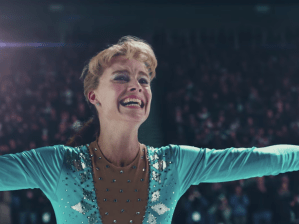 Robbie (Suicide Squad) is sensational in the role, eliciting so much emotion that it can instill whiplash. One moment you’re impressed by the depth of her vulnerability and the next you’re whistling at her hard-as-nails persona and sheer tenacity. It’s an unapologetic performance that goes dark places and serious places, but Robbie doesn’t stoop to pander. Tonya wants your empathy but she doesn’t want your pity, and she sure as hell isn’t going to pretend to be somebody she’s not. The tricky part is the question over who is Tonya Harding. With Robbie, she’s a profane firebrand who is impatient with a world that refuses to accept her and her talents. The scene where Tonya is stripped of ever competing again in professional figure skating is a dazzling piece of acting on Robbie’s part. Tonya has sacrificed much of her own life for this sport, and by her own admission she doesn’t know how to do anything else. To see it all go away with the pound of a gavel, she pleads for jail instead as a more humane punishment. This feels like Robbie marking her grand entrance into the next acting echelon in Hollywood.
The supporting roles nicely serve their purpose, with Janney (The Girl on the Train) being the obvious standout. Her hellish mother is overpowering in every sense. Janney is abrasive and fierce and a crutch for the screenplay when it needs something shocking. I do not doubt the voracity of what the Tonya and other participants have said about LaVona, but the filmmakers don’t know when to leave enough alone. There are insights to be had through LaVona’s relationship with her daughter but it’s too often one-note. She’s the angry older woman berating people for shock, comedy, or a transition.
I, Tonya might change your mind about Tonya Harding. She’s definitely unrepentant in the movie while at the same time asking you to view her with an empathy that was lacking during the parade of 1990s tabloids. She’s an abuse survivor who had to claw for every advantage she could earn. You might not like her, or maybe you’ll grow to appreciate her, but you will understand her better. Robbie is outstanding, Janney is highly memorable and perfectly cast, and the direction provides plenty of jolts, from electric camerawork to the energetic propulsion through its diverging viewpoints. The dark comedy works, the serious drama works, and the domestic violence is not trivialized with so many ironic winks. I, Tonya is an unflinching expose that forces you to question the validity of everything. It’s a movie that dares you to question your perceptions while you’re keenly watching. Perhaps twenty years later, Tonya Harding will get whatever she is due.
Nate’s Grade: B+
Share this:

The Shape of Water (2017)
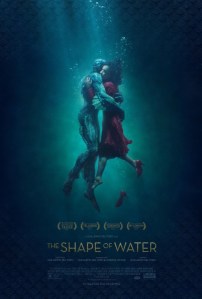 You haven’t seen a romance like director Guillermo del Toro’s latest monster mash (monster smash?), The Shape of Water. del Toro, an aficionado of cinematic creepy crawlies, has swerved from big-budget studio fare into a smaller, stranger period romance between a woman and an amphibious creature who already arrives pre-lubricated (I apologize already for that joke). I was compelled to watch The Shape of Water twice to better formulate my thoughts, mostly because I was not expecting the movie to be so enthusiastically whimsical, adult, and romantic, and the best beauty and the beast tale of this year.
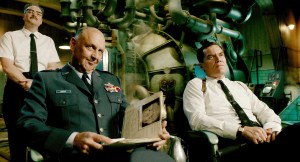
Elisa (Sally Hawkins) is a lonely mute woman working on the cleaning staff at a classified government laboratory. Her neighbor, Giles (Richard Jenkins), is a hopeless romantic trying to find his place in the world as a gay man. Her best friend, Zelda (Octavia Spencer), is supportive but thinks they should mind their own business. An Amphibian Man (Doug Jones) from the Amazon is confined to a cell and repeatedly beaten by Richard Strickland (Michael Shannon), the vile head of security at the station. They believe the creature’s ability to breathe underwater and on land will be the key to winning the space race. The scientist in charge, Dr. Hoffstetler (Michael Stuhlbarg), is secretly a Russian spy, though his allegiances are more to the fragile creature than any country. Elisa teaches the creature sign language, the joys of hard boiled eggs, and lots of cheery music. She also falls in love with the creature and grows determined to save the Amphibian Man by breaking him loose.
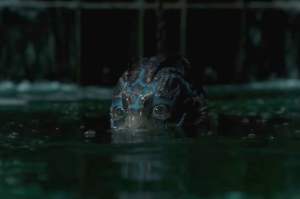 From the get go, del Toro drops us into a world that is not our own, as he’s so skilled at doing. This version of 1960s Baltimore feels as though it’s the twentieth century equivalent of a fairy tale village, and our monster is also the princess in need of rescue. Our heroine has a strange scar that foreshadows her place of belonging. The entire film bristles with a sense of expertly curated magic realism even though there isn’t anything explicitly magical. The supernatural and fantastical are met with a casual acceptance, as they would be in any storybook legend of old. When Elisa discovers the Amphibian Man in his tank, it’s literally at the ten-minute mark or even earlier, and she is unfazed. She immediately accepts the existence of this scaly mere-man, establishes a line of communication, and befriends the creature. It’s as if del Toro is trying to prime the audience for what’s to come and hoping to skip over the intermediate waiting period of incredulity. For del Toro, the real fun is once the characters connect, and belaboring that necessary connection is not in the audience’s best interests or time.
The movie glides by on effusive outpouring of charm, given such vibrant, sweeping life thanks to del Toro’s repertoire of pop-culture influences and his passionate love of cinema. The Shape of Water feels like del Toro and co-writer Vanessa Taylor (Hope Springs) took one of the old Universal horror B-movies and decided to make it into one of the most personal, delightful, and curious filmgoing experiences of the year. It’s film as escape for society’s outsiders. The sense of whimsy is ever-present without being overpowering or diluting the drama. It never feels quirky for its own sake of satisfaction. You’ll recognize several of del Toro’s artistic references, the re-purposing of cultural artifacts, but the magic suffused within every frame is thanks to del Toro and his team of filmmaking artists. If Amelie was going to fall in love with a sea creature, it might look something like this The Shape of Water.
The movie is also surprisingly, refreshingly adult in its depiction of human beings. Again the opening minutes set a standard of what to expect. We get a sense of Elisa’s daily routine before leaving for work, and one crucial component involves furious masturbation in her bathtub (set to an egg timer for sport?). This is a far more sensual movie than I was ever anticipating. There are multiple sequences of Hawkins disrobed and offering herself to the Amphibian Man. We never see any underwater action but we do hear about some of the mechanics of how the coupling is even remotely possible physically (“Never trust a man,” Zelda chuckles upon hearing those dirty details). It’s not all sexy time indulgences. There’s a sharp undercurrent of very real and very upsetting violence, typified by Strickland’s ruthless determination to break the creature. He’s a Bible-thumping sadist generally dismissive of those he finds different and lesser and yet he’s drawn to Elisa. Why is that? Because she’s a diminutive woman who cannot talk, and this sexually excites him like nothing else. He even comes on to her, thinking his interest is a form of masculine charity. There are some shocking moments of very real violence and its lingering effects. Strickland’s on-the-job injury becomes a metaphorical moral gauge for the putrid character’s state of being. The Shape of Water is a movie that does not blunt anything, whether it’s the sexuality or violence of its story (beware pet lovers: this is the second 2017 entry where an amphibian being hidden from the government eats somebody’s house cat). This is a fable for adults, a grimy Grimm’s tale with a sprinkle of Old Hollywood sparkle.
 The Shape of Water is also a deeply romantic and earnest love story about two outsiders finding a connection in the most unlikely of places. Engineering a story that pushes two oddball characters together, each finally finding a kindred spirit, is an easy recipe for a satisfying conclusion; however, their romantic connection has to feel rightly earned. If we don’t believe the characters have fallen for one another, that this potential relationship elevates their existence, that the colors of the world seem brighter when around this person, then it doesn’t work. You have to buy the love story and it must be earned. Amazingly, del Toro is able to craft a love story with a mute woman and an Amphibian Man that checks most of the boxes of Hollywood romantic escapism. Elisa has an openhearted way of looking at the world, and her acceptance provides her with a bravery few others have. The creature presents somebody who views her not as a woman with a disability, as something lesser, but as something whole and wholly fulfilling. Everyone wants to be truly seen by someone for who they are rather than what they’re not.
While del Toro is supremely skillful at making Elisa’s romantic yearnings felt, there is one inherent weakness in this girl-meets-fish dude tale of love. The Amphibian Man isn’t really much of a character and far more of a symbol to the other characters. To Elisa, he’s her hope. To Giles, he’s a wild animal. To Strickland, he’s a defiant challenge to be tamed. To Zelda, he’s the questionable new boyfriend for her pal. To Hoffstetler, he’s a beautiful creature. To the U.S. government, he’s a potential scientific breakthrough. To the Soviets, he’s a liability and a potential future weapon. We’re told the indigenous people of the Amazon worshiped the Amphibian Man as a god but ultimately he remains a cipher others project onto. The love story feels a little too one-sided from an audience investment perspective. Still, the romance works and that fact alone is incredible considering the unique pairing.
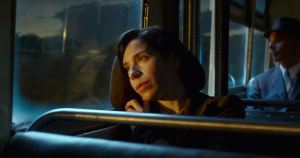 Hawkins (Maudie) is the beating heart of the movie and delivers a wonderfully expressive portrait of a woman finding her voice, so to speak. She’s relatively upbeat and that fits the whimsical tone of the picture. Hawkins plays a woman excited by the possibilities of the world. She reminded me of Bjork’s tragic heroine from 2000’s Dancer in the Dark, a woman who saw the extraordinary in ordinary life, who could perceive a symphony of music just on the outer edges of everyone else’s hearing. Going completely wordless for the movie, save for one very memorable fantasy sequence, requires a lot of daunting physical acting from Hawkins, and she’s more than up to the task. I guarantee a scene where she tearfully forces Giles to say out loud her signing will be her Oscar nomination clip.
When we talk about the weird and wild promise of cinema, it takes a controlled, assured vision and precise execution to bring together the dispirit elements and allow them to coalesce into something that feels like a satisfying, mesmerizing whole. The Shape of Water is del Toro’s gooey love letter to monster movies while stepping outside of homage and into the realm of something daring and different. I could talk about the Busby Berkley musical number as declaration of love, or that the story is told from socially marginalized voices finding an affinity together, or the small character moments that give generous life to supporting figures like Zelda and Hoffstetler, or that it leaves implied stories to be chewed over for extra richness like Giles likely being outed at his work to the dismay of his closeted superior, or the perfect casting for secondary antagonists, or the exquisite cinematography that seems to utilize every shade of green the human eye is capable of seeing, or the stunning production design, or the sweetly eccentric whistling musical score by Alexadre Desplat, or the grace of Doug Jones’ performance in the amphibian suit, or just how funny this movie can be, even the sadistic villain. I could talk about all that stuff but I’ll simply condense it all to a plea to give The Shape of Water a chance. It’s rare to see a storytelling vision this precise that’s also executed at such a high degree of difficulty. In other hands, this could have been an unholy mess. With del Toro, it’s a lovely mess.
Nate’s Grade: A-
Share this:

The Disaster Artist (2017)
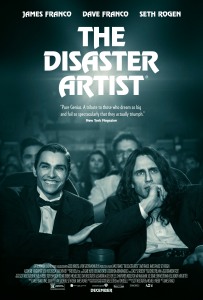 As an avid devotee of The Room, and a connoisseur of crappy cinema, I have been looking forward to this movie for literal years. I’ve been fascinated by Tommy Wiseau’s movie ever since I first saw it in 2009, and I’ve since watched it over 40 times. In my review for the movie, I said if I had to pick only five DVDs to take with me on a desert island, I might just select five copies of The Room. It’s that rare form of bad movie that is a thousand brushstrokes of bad, where you can discover something new with every viewing, and you desperately want to have your friends discover this miracle of filmmaking. It’s become a modern-day cult classic and theaters have been playing rowdy spoon-tossing midnight screenings of Wiseau’s film since its initial 2003 release (humble brag: I’m responsible for it playing on a monthly basis in Columbus, Ohio since 2009, the only regular public screening in all of Ohio). From its successful re-branding as a “quirky new black comedy,” fans had burning questions that needed answering, and that’s where Room actor Greg Sestero co-wrote a behind-the-scenes book, The Disaster Artist. One fan was multi-hyphenate James Franco, who purchased the adaptation rights, attached himself as director and star, transforming into Wiseau and tapping his younger brother to play Sestero. Who would have guessed all those years ago that these beleaguered actors would soon have Hollywood celebrities portraying their astonishment? The Disaster Artist might be one of the best films of the year by chronicling one of the worst films ever made.
Greg Sestero (Dave Franco) is a struggling actor in San Francisco when he meets the Teutonic acting force that is Tommy Wiseau (James Franco). Tommy doesn’t behave like anyone else, for good or ill, and it inspires Greg to become friends with him. Tommy says he’s the same age as Greg, though is clearly double, and that he’s from New Orleans, though he definitely sounds more vaguely Eastern European. Tommy also has a lot of money and elects to move to L.A. to make it in the film industry, and he wants his best friend Greg to join him. Greg finds some beginning levels of success but Tommy is rejected at every turn, determined as too weird and off-putting by casting directors. He doesn’t want to play a villain; he sees himself as the hero. Tommy won’t wait for Hollywood and decides to make his own movie. He’ll write it, direct it, and be the star, and Greg can be his onscreen best friend. The Room, Wiseau’s magnum opus, was a stunning document of filmmaking ineptitude that had to be seen to be believed, and many of the people involved were certain it would never be seen at all.
 I was worried that the film version would simply be many painstaking recreations of scenes from The Room and watching characters snicker. Thankfully, the recreations are kept to a minimum and The Disaster Artist personalizes the story in the friendship between Tommy and Greg. If anyone has read the book, you’ll know there is a wealth of juicy anecdotes about the bizarre onset antics and about the human enigma himself, Wiseau. The film could have been three hours long and just thoroughly focused on all of the crazier aspects of the behind-the-scenes and I would have been satisfied. However, the ace screenwriters, Scott Neustadter and Michael H. Weber (The Fault in Our Stars), have elided all of those crazy details into a story about a personal relationship. The most memorable tidbits are still there, like the 60 plus takes needed for Tommy to say one line, but the sharper focus allows the film to resonate as something where you can genuinely feel invested in these people as characters rather than easily mocked send-ups. Greg feels greatly put upon by Tommy but he admires his fearlessness, and deeper down he feels indebted to Tommy for getting him onto the road to his dream. Thanks to Tommy, Greg was able to move to L.A., find a place, become an actor with representation, and book commercial spots. Tommy is also an anchor weighing him down. Greg will routinely have to place his rising career opportunities at the mercy of Tommy’s capricious sense of loyalty. It’s a movie that explores the value of friendship and the lengths people will go.
This is also an extremely funny movie. Part of the allure of The Room is how it feels like a movie made by space aliens who didn’t quite understand human interactions. The head-scratching choices and dropped subplots and redundant, nonsensical plotting are all given examination, allowing the audience to be in on the joke even if they have never seen Wiseau’s actual movie. This is a film completely accessible to people who have never seen The Room; however, if you have seen The Room, this movie is going to be 100 times more fascinating and enjoyable. The sheer bafflement of what transpired is enough to keep you chuckling from start to finish. The Disaster Artist is wonderful fun, and the actors involved are here because they love Wiseau’s movie. The celebrity cameos are another aspect that helps to add to the film’s sense of frivolity, spotting familiar faces in roles such as Casting Agent #2 (Casey Wilson), Actor Friend (Jerrod Carmichael) and Hollywood Producer (Judd Apatow). Watching everyone have a good time can be rather infectious, but The Disaster Artist succeeds beyond the good vibes of its cast.
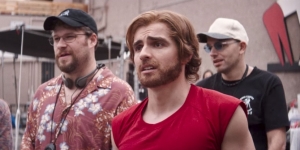 Rather than lap up the easy, mean-spirited yuks, The Disaster Artist goes further, following a similar point of view with 1994’s terrific Ed Wood by portraying these men as deeply incompetent filmmakers but also as sincere dreamers. Wiseau is clearly overwhelmed by the demands of being, let’s be generous, a traditional filmmaker, but he is also a person who set off to achieve a dream of his own. He was denied other avenues so he took it upon himself, and a mysterious influx of money he doesn’t like to discuss, and this self-made-movie star built a vehicle to shine brightest. Sure, ego is definitely a factor, though one could argue it plays some degree in all creative expression needing an audience. Wiseau didn’t let a little thing like ignorance of storytelling, film production, or how to handle cast and crew as human beings with needs stop him from plowing ahead to prove his doubters wrong. The filmmakers definitely find a certain nobility in this artistic tenacity, as did Tim Burton with Ed Wood. It’s natural to pull for the underdog, even an underdog that is so naïve it might be worrisome. You can laugh freely at Wiseau, and you will, but you may also start to admire his gumption. As the opening barrage of celebrity interviews posits, you could not make something like The Room even if you were the greatest filmmaker on the planet. It is nothing short of an accidental masterpiece. It is a movie that has entertained millions of people and one they feel compelled to share with friends and family, compelled to bring others into this strange, beguiling cult of fandom. While Wiseau may not have made a “good movie,” he has made one for the ages.
James Franco (11.23.63) deserves an Oscar nomination for playing Tommy Wiseau. I’m serious. He is channeling some Val-Kilmer-as-Jim-Morrison lightning when it comes to simply inhabiting the spirit of another person onscreen. It’s crazy that a movie so bad could inspire another movie that might legitimately compete for legitimate awards. James Franco is entrancing with his performance as he fully channels Wiseau, an almost mythic figure that we have never seen the likes of before. The accent is pitch perfect and impossible not to imitate after leaving the theater. Wiseau can be manipulative and cruel but he can also be generous and selfless. He takes great ownership over his friendship with Greg, so he believes all of his actions are to help their unique bond, even when he’s pushing that same person away. He so desperately wants acceptance but seems incapable of achieving it on anybody’s terms but his own. Wiseau is a fascinating film figure, and the movie does a fine job of neither overly romanticizing him nor vilifying him. Even despite his missteps, you may find yourself feeling sympathy for Wiseau, and that’s a major credit to the screenwriters and James Franco’s magnetic performance.
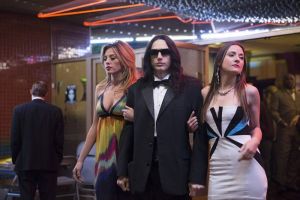 The other actors, a.k.a. everyone in Franco’s sphere of friends, are committed, enjoyable, and plugged into why exactly audiences have grown to love The Room for years. Dave Franco (Now You See Me 2) is effectively the perspective of the audience, deliberating how much of Tommy to put up with and when to walk away. Seth Rogen (Sausage Party) gets the most sustained comedic run as a script supervisor who is bewildered by Wsieau’s methods. Alison Brie (Netflix’s GLOW) is our chief source of confused expressions as Greg’s girlfriend. Ari Graynor (I’m Dying Up Here) wrings great laughs from her awkwardness with Wiseau as filmmaker and onscreen anatomically-challenged lover. Megan Mullally (Will & Grace) is Greg’s disapproving mother who worries about what kind of relationship her son has with a much older man. Zac Efron (Baywatch) is hilariously excitable as the inexplicable drug dealer, Chris R. Speaking of excitable, Jason Manzoukas (The House) and Hannibal Buress (Spider-Man: Homecoming) are a great team as the film equipment rental guys who can’t believe their luck with Wiseau. Even two-time Oscar nominee Jacki Weaver (Silver Linings Playbook) gets some nice moments as an older actress who justifies in a heartfelt message why exactly everybody on set would go out of their way to work on such an awful movie.
If you’re a fan of The Room, then you’ll absolutely adore The Disaster Artist, and if you’ve never seen The Room, you’ll still find plenty of entertainment in Franco’s film. Wiseau’s 2003 film has to be experienced to be fully believed. The film-about-his-film provides the added extension of a coterie of characters to share in our bemusement and bafflement, providing a chorus of commentary. However, the movie isn’t all jokes at Wiseau’s expense. It evolves into a love letter for the power of art to bring distaff people together with a shared dream. Like Ed Wood, Wiseau might be incompetent by traditional measures of filmmaking but he ignored the naysayers and followed his artistic vision. Under Franco’s direction, he’s a modern-day Don Quixote, or just a really weird guy who lucked into a miraculous alchemy that gave birth to a cult classic. At the end of the movie, Tommy thinks he’s a failure. Greg reminds him to listen to the audience reaction. They are hooting, hollering, applauding, and having the time of their lives. He’s responsible for that and he should be proud of his accomplishment. I unabashedly love The Room. I introduce the theatrical screenings in Columbus. I loved The Disaster Artist book. This movie is everything I was hoping for, and it just so happens to be one of the funniest, most genuinely pleasurable films of the year.
Nate’s Grade: A-


 nathanzoebl
You must be logged in to post a comment.