Category Archives: 2017 Movies
The Great Wall (2017)
 The Great Wall is the most expensive film in Chinese history and the first major co-production between an American film studio and a Chinese-owned studio. While Matt Damon is the name above the title, it’s filled with recognizable Chinese stars, like Andy Lau, Eddie Peng, and pop star Lu Han. China’s most renowned action filmmaker, Zhang Yimou, serves as the director. It has the look and feel of a Hollywood special effects epic but it’s very much a Chinese film in ownership and execution, perhaps marking a new synergy of East meets West blockbusters. With a whopping budget of $150 million, the same as the last Star Trek movie, it looks like a typical Hollywood big-budget epic with visual spectacle and sweeping vistas. It’s up to the viewer whether a majority-Chinese production successfully imitating Hollywood middlebrow action spectacle is a brave step forward or just another source for mediocrity.
In the 11th centruy, traveling European mercenaries William (Damon) and Tovar (Game of Thrones’ Pedro Pascal) are looking for black powder, an explosive substance that’s worth serious money back home. A mysterious feral creature attacks them and William cuts off the beast’s hand, taking it as a trophy. The Nameless Order, Chinese military officials stationed at the titular great wall, capture them and want to know exactly how these foreigners were able to defeat this beast. Legend states that long ago a meteor crashed to Earth, and with it came a horde of green monsters with big teeth lead by a queen that psychically controls her thousands of attack drones. Every 60 years the creatures emerge searching for food for their ravenous appetites. The Imperial City must be protected at all costs and that is why the wall was constructed. Lin Mae (Tian Jing) is thrown into command when her male superiors are killed, and she relies upon her unexpected Western allies to throw back the evolving horde of monsters.
 As the first major big-budget collaboration between studios in China and the United States, The Great Wall feels like something that would have escaped from the 1990s era of tentpole filmmaking, and it’s clearly a paycheck film for all involved. Now that doesn’t condemn in either regard. There’s a certain charm to the relatively dumb sci-fi action movies that started being prepped with steady regularity in the 1990s when advancing special effects made it possible for hordes of CGI monsters to thwart. There’s an obvious point of engagement that crosses all translations: man versus monsters. The film even somewhat admirably knows its own ridiculousness and embraces it. I was reminded of the go-for-broke silliness of Jerry Bruckheimer’s movies like National Treasure’s positing that maybe, just maybe, there’s a treasure map on the back of the Declaration of Independence. This feels like the biggest budget Asylum movie you can imagine, and that in itself is not necessarily a problem. However, because of the mechanical nature of so much of its storytelling and the safe territory it resolutely occupies, The Great Wall is a mediocre monster movie that aims right down the middle for cross-continental mass appeal and nothing more. I’m almost certain that Damon had to have been paid $20 million dollars to justify his participation. The actors and the director go about their business in a professional manner but you feel the lack of passion. It’s a film looking to appeal to the most people and losing any sense of distinction.
Credit director Yimou (Hero, House of Flying Daggers) for keeping the film on life support, providing just enough action variety and pleasing visuals to stir an audience awake. The monsters are introduced very early into the film, around the twenty-minute mark, and their CGI horde definitely presents a worthy challenge. In fact they feel too overwhelming in their numbers. Early on we see that the ferocious creatures, which closely resemble the Ghostbusters demon dog painted green, are hard to kill outside of a straight shot to their shoulder-eyes (they have eyes on their shoulders… because…). The first creature that successfully scales the wall takes out a slew of Chinese warriors. If one of these things is that hard to kill, how in the world can a limited number of people, even with high ground, defend against a sea of a hundred thousand? The mismatched numbers deflate the stakes and lessen the tension, which isn’t helped from subpar characterization. The world building is certainly hazy (Why do they come out once every 60 years? Why do magnets affect them? Why all the effort for small food supplies?) and some of the elements feel inserted just for their “cool” factor. A group of female warriors bungee jump off platforms to spear the monsters, but why is this necessary when we’ve already seen that China has fiery projectiles that are far more effective? It is cool though.
Thankfully a movie with little going for it other than spectacle at least knows to vary up its action sequences. Each encounter with one of the monsters is structured differently. The best sequence may be William and Tovar navigating through a blinding fog and relying upon the sounds of whizzing arrows to alert them to approaching hungry monsters. It provides some fun tension and pop-out moments. There’s a beautiful sequence commemorating a fallen friend with the launching of hundreds of floating lanterns. The concluding sequence involves our remaining characters climbing to the top of a pagoda lined with stained glass. As the characters rush up flights of stairs, the screen is lovingly diluted with colored shafts of light, which also add extra visual flourishes when the monsters begin to leap through the glass level by level. Yimou’s use of color has always been a hallmark of his career and it translates even into the color-coded amour of the different divisions of the Nameless Order. They look like ancient Power Rangers. While lacking a great deal of overall tension due to its predictable nature and dull characters, there are fleeting moments of suspense drawn out in individual action set-pieces. The overall movie is generally unremarkable CGI carnage reminiscent of a too-late Lord of the Rings rip-off, and yet there’s at least a general professionalism to its unremarkable CGI carnage.
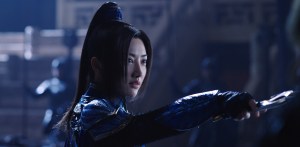 Early on the movie was hit with accusations of whitewashing, and given Hollywood’s recent track record with the likes of Exodus, Aloha, and Gods of Egypt, it would be entirely conceivable that producers felt Damon needed to be a white savior role. That’s not the case at all and in fact the Chinese forces are shown to be flawless specimens. Damon’s character is the out-of-place European (complete with hard to place accent) who represents selfish and arrogant Western attitudes. He’s routinely awed by the ability and precision of the Chinese warriors, who dutifully sacrifice for the greater good and safety of others they will never know. They are symbols of power, teamwork, courage, strength, and dignity. The lessons can be rather blunt (a woman… in charge?!). The portrayal of the Chinese forces is so honorable and so empowered that they come across as boring moral paragons without an ounce of traceably human nuance. They don’t come across like characters so much as interchangeable warriors, and so when they start dying one-by-one their sacrifices ultimately leave little impact. It turns out that the non-Chinese actors, Damon and Pascal, supply the most interesting characters because their roles are allowed personality, basic moral ambiguity, and inner conflict beyond a sense of duty and the requirements of achieving that duty. The Great Wall drafts off Damon’s worldwide star power to teach him a lesson about Eastern values. It certainly presents China and Chinese characters in a very positive perspective, but being so broad sanitizes their humanity and transforms people into boring paragons.
Given the pedigree of those involved, it’s completely expected to be underwhelmed by the end results of such an expensive East meets West collaboration. The Great Wall is ultimately too safe and stately to satisfy beyond generic genre thrills; lowering one’s expectations is highly advised in order to properly appreciate the goofy action spectacle. The Great Wall of China being constructed to protect from a horde of ravenous, possibly extraterrestrial monsters is certainly a silly premise, but the movie doesn’t pretend it’s anything than what it is, a large-scale monster movie with a sense of fun. It’s not soaked in deconstructive irony or meta commentary. Instead, The Great Wall is a straight-laced action spectacle that treats its absurdity with conviction. It’s not much better or worse than other empty-headed big-budget action cinema from the Hollywood assembly line, but is that progress? Is making an indistinguishable mediocre B-movie a success story?
Nate’s Grade: C
Share this:

The Lego Batman Movie (2017)
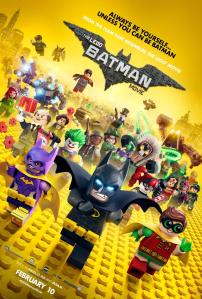 The Lego Batman Movie intends to expand the world of a movie that was designed to sell toys and was far better than anyone ever imagined. It’s frenetic, silly, and paced at spoof level speed with genial gags flying fast every ten seconds or so. It’s also flat, and while intermittently amusing I only chuckled, at best, a handful of times. Will Arnett’s self-involved Batman was a fun side character in the original Lego Movie but there’s not exactly enough there for his own starring vehicle (Jack Sparrow Syndrome). He’s saddled with a weak plot about letting others get closer and not having to be a loner. Besides a brief comedy bit about a cataclysm, the movie could have just been a broad Batman movie. It doesn’t really utilize the landscape of a Lego universe in any way. While many of the jokes didn’t work for me, I knew another one was mere seconds later, so I shrugged off the misfires. The final act of the movie involves a separate league of villains, all conveniently connected to other Warner Brothers properties. Lego Batman wore me down after the opening sequence where Batman battles his entire rogues gallery. It was high-energy but its aim was just too low for my tastes, and the results made me appreciate even more the cleverness and plain comedic accomplishments of the original Lego movie. There aren’t any memorable moments or jokes and there’s far too much Batman rapping. It’s colorful, it’s wacky, it’s filled with fine vocal actors with very little to do other than Arnett and an amusingly awed Michael Cera as The Boy Wonder himself, adopted sidekick Robin. It’s an acceptable albeit numbing experience that I wanted to enjoy more. I don’t know if this is the start of Lego spin-off movies but if it is I hope others do better with their own building blocks.
Nate’s Grade: C+
Share this:

50 Shades Darker (2017)
 I’ll admit not understanding the appeal of the 50 Shades of Grey phenomenon. The introduction into BDSM was a worldwide sensation and the 2015 first film made half a billion dollars, the kind of money usually reserved for movies featuring muscular men in rubber costumes that use whips and chains for different purposes. I happily watched the first film to get a sense of what the big deal was and was unmoved. For a film designed to be titillating and provocative, I came away wishing it had more action (of any sort). With great success, author E.L. James asserted more authority in the film series. Out went original director Sam Taylor-Johnson, who at least provided a sleek sheen to the final product and sexual tension where able, and in came new director, James Foley (Glengarry Glen Ross). Out went the original screenwriter Kelly Marcel and in came a new screenwriter, James own husband Niall Leonard, which could only mean the threat of the film hewing closer to the book was a guarantee. James is giving fans of her popular though critically savaged romance novels more of what they want, and I guess what they think they want are relatively bad movies, limp sex scenes, and an inert romance.
Anastasia Steele (Dakota Johnson) is trying to get back on her feet after leaving her ex, billionaire and bondage enthusiast Christian Grey (Jamie Dornan). He’s got serious issues but won’t stay out of her life. He has to have her back, and rather easily the on-again off-again couple is back on and back getting it on. However, their sex life is threatened with women from Christian’s past and the question of whether he can settle down for good with such a plain Jane submissive like Ana.
 There is a mystifying lack of conflict in the movie that makes 50 Shades Darker feel aimless. There are occasional bumps in the road in the form of old girlfriends still looking for their turn, and Ana’s aggressively inappropriate boss (Eric Johnson), but they’re dealt with almost immediately and without larger consequence. One of these antagonists is foiled by nothing more than a stiff drink to the face like a full-on Dynasty parody. Dealing with Christian’s past seems like natural territory for a sequel. A character as cold and self-serving as Christian could very likely attract a host of dangerous women. Stalkers who cannot let go would present an organic threat to their relationship and Ana’s literal life. A deranged former lover would provide a substantive question for Ana to deliberate. Is she doomed to the same fate? Bella Heathcote’s troubled character is begging for attention but she is so unceremoniously sidelined to the point of hilarity, and then she’s never seen again. Why should the story provide any question that these star-crossed lovers might not magically work out in the end? None of the mini-conflicts last longer than fifteen minutes before being effortlessly overcome, including a helicopter death scare. The shapeless plot structure is tediously airy, leaving too much space for characters and a world that doesn’t warrant the consideration. You would think the extra time would be spent with lengthy, over-the-top sex scenes stripping away all inhibitions and pushing the boundaries of cinematic good taste, but that’s not so much the case (more below). I knew we were in trouble when a sequence of Ana sailing Christian’s yacht was as long as one of the so-called outrageous sex scenes.
Here’s a prime example of just how poorly 50 Shades Darker is plotted. While dressing up for the masquerade, Christian admires Ana in lingerie. “You just going to stand there gawking?” she asks. “Yes,” he replies. Later, she walks in on him exercising shirtless and getting all sweaty while practicing for the Olympics on a pommel horse. It’s a flip of the male gaze, for once in the movie’s two hours. This is obviously a prime spot to repeat the dialogue exchange for a clever payoff, have Christian ask if she is going to just stand there gawking and her answer be in the affirmative. This movie cannot even do that! 50 Shades Darker doesn’t just fumble the big things, like plot and character and tone, it fails to even achieve modest, easily reachable payoffs that can be as ludicrously obvious.
Devoting more time with Ana and Christian outside of the bedroom is also best not advised. These one-dimensional characters are also barely removed archetypes from late night soft-core porn. Ana is an audience cipher but she’s also one incredibly dense human being. Forget the annoyingly mousey acting tics that Johnson (How to Be Single) is instructed to never abandon, this is a lady who just doesn’t get it. She’s had sex with her dude like minimum a dozen times and she’s never noticed the array of scars across his chest? After her boss tries to force himself on her, she fights back and runs into Christian’s arms, and he gets the guy fired (because a woman reporting a sexual assault on her own is not convincing enough?). Hearing the news, Ana acts deeply confused, as if she cannot understand why her boss is now not her boss. Did she just forget the upsetting assault? Every man in this universe seems to find Ana uncontrollably irresistible. She’s the ultimate prize to be owned. Even her own friend, who clearly has a crush on her, creepily makes her the centerpiece of his photography gallery show without her consent. She can huff and puff all she wants about agency but Ana is still a woman looking for her prince to sweep her away to a land of exotic privilege. Her reason for accepting a dinner date with Christian: she’s hungry. That’s fine, not every romance needs to be progressive or healthy, but when that guy is as controlling and worrisome as Christian Grey, then the romance starts to sour and become an exhibit of toxic misogyny. And that’s before Christian reveals that Ana, as well as his previous subs, looks like his dead mother.
 Christian is your dark, brooding, oh so attractive as the bad boy but he’s defanged, turned into proper boyfriend material, the kind of guy who would drop down for an old-fashioned proposal of a girl’s dreams. In other words, the movie makes him boring. He’s still problematic as a romantic partner. While he swears this time will be different and no finely worded legal contracts are necessary, he’s still a controlling jerk and a boor. Even during his “please take me back” dinner he’s attempting to order for Ana. He deposits money in her account despite her protests, he buys the publishing company she works for to become her ultimate boss even outside their relationship, and he’s constantly insisting she is his and his alone in the creepiest of declarations. The movie seems to think it’s found a palatable excuse to explain away his warning signs. His mother, depicted in a hilariously sad picture that looks like a Wal-Mart family photo from a refugee camp, died of a drug overdose at a young age and he was physically abused by his father. It’s a slapdash, simplistic cover for his bad behavior. Another strange discovery: the childhood bedroom of Christian Grey has a framed poster of 2004’s The Chronicles of Riddick. I know Universal is trying to play some studio synergy here, but come on. How old is Christian supposed to be? Also, HE HAS A FRAMED POSTER OF THE CHRONICLES OF RIDDICK.
All of this can be moderately forgivable if the movie more than makes up for where it counts with fans, namely steamy and scorching sex scenes that were the hallmark of the lurid book series. While the first film was far from perfect, or even adequate, let it be said it still could constitute an erotic charge when it desired. With the sequel, the sex is shockingly lackluster. There are only four full sex scenes and they start to become weirdly routine. You anticipate that Christian will spend a little time here doing this, and little time there doing that, and then as soon as would-be penetration comes into being they oddly jump forward and spare the audience the sight of sexual congress. It’s different minor tracks of foreplay and then the movie seems to shy away from the sex itself. For something this supposedly kinky it becomes strangely mechanical, predictable, and boring. Another irritating feature is that every sex scene is accompanied by a blaring rock or pop song. It announces itself with what I call “sex guitar music.” It blares over the scene and makes it difficult for the viewer to better immerse in the scene. Some of the music is downright nails-on-chalkboard awful from a tonal standpoint, creating its own source of comedy. The absolute most hilarious musical pairing is Van Morrison’s “Moondance” while Christian is fooling around surreptitiously with Ana in a crowded elevator. Go ahead and look up the song and come back to this review, I can wait. The jazz flute playing over the scene is certainly… different. It might be the worst sex scene song pairing since Leonard Cohen’s “Hallelujah” in Watchmen. I stayed until the end credits and counted 27 songs used in a 118-minute movie. Reportedly there’s a score by Danny Elfman in the film but I challenge you to find it (easiest paycheck of his career).
 If you’d like to be spared the turgid two-hour experience, I’ll spoil the specifics of the sex scenes in this paragraph so you can see how truly tame the movie is for something so reportedly transgressive and kinky. The first sex scene is their reunion as a couple and he undresses her, goes down on her, then climbs atop, then it’s over. The second involves him spanking her, upon her request, then he goes down on her, climbs atop her, then it’s over. The third sex scene involved Ben Wa balls as foreplay reminiscent of the superior and far more erotic Handmaiden (seriously see that Korean movie like 1,000 times before this), or was that the second sex scene? As I type this, it’s only been mere hours since I left my screening and I can’t recall the general details of the third sex scene, that’s how boring it was. The fourth is more montage but it’s an unleashed exuberance of sexual id. Christian dumps an entire bottle of massage oil onto Ana’s breasts, which seemed impatient and wasteful to me, but I’m not a billionaire. I cannot overstate just how dull and lazily staged the sex scenes are in the film, extinguishing any kind of titillation and strangely demurring once things get passionate. The nubile bodies are on display, Johnson’s in semi-permanent arched back, though Dornan is often coquettishly obscured (sorry again, ladies). The word that seems most appropriate for the sex scenes is “anticlimactic.” Ana jokes that she’s a vanilla girl and trapping Christian into a plain relationship, and their big screen sex life typifies this (anyone remember Ana’s question about what a butt plug was?). It’s a world of kink where nipple clamps are giggle-worthy accessories to the participants and the go-to sexual position is missionary. This movie is not the daring dip into untapped sensuality it’s been made out to be. It’s much more conservative at heart.
Ironically, 50 Shades Darker is a curiously reserved romance that lacks serious heat. The actors have very little chemistry and are fighting losing effort to convince you just how sexy they find one another. Dornan still seems like a dead-eyed shark to me. I know people aren’t going to this movie for the story, but some better effort could have been afforded rather than false conflicts that are arbitrarily resolved one after another. It’s an empty fantasy with boring characters and timid sex scenes that register as sub-soft-core eroticism. I wrote of the original film: “Surprisingly boring and rather tepid, 50 Shades of Grey feels too callow to be the provocative film experience it wants to be. It needs more of just about everything; more characterization, more organic coupling, more story, more romance, more kink. It is lacking in too many areas, though the production values are sleek, like it’s the most technically accomplished episode of Red Shoe Diaries.” Every criticism is still valid and even more so. Whereas the first film was about the flirtation and exploration of the coupling, the sequel inevitably treads the same ground, watching pretty dull people get dressed in pretty clothes and then take them off. For a book series so infamous for its tawdry smut, I was expecting more smut or at least better smut.
Nate’s Grade: C-
Share this:

Split (2017)
 It’s hard to even remember a time when writer/director M. Night Shyamalan wasn’t a cinematic punching bag. He flashed onto the scene with the triumviri of Sixth Sense, Unbreakabale, and Signs, what I’ll call the Early Period Shyamalan. He was deemed the next Spielberg, the next Hitchcock, and the Next Big Thing. Then he entered what I’ll call the Middle Period Shyamalan and it was one creative and commercial catastrophe after another. The Village. Oof. Lady in the Water. Ouch. The Happening. Yeesh. The Last Airbender. Ick. After Earth. Sigh. That’s a rogue’s gallery of stinkers that would bury most directors. The promise of his early works seemed snuffed out and retrospectives wondered if the man was really as talented as the hype had once so fervently suggested. Then in 2015 he wrote and directed a small found footage thriller called The Visit and it was a surprise hit. Had the downward spiral been corrected? With a low-budget and simple concept, had Shyamalan staked out a course correction for a mid-career resurgence. More evidence was needed. Split is the confirmation movie fans have been hoping for. An M. Night Shyamalan movie is no longer something to fear (for the wrong reasons), folks.
Split is all about Kevin (James McAvoy), a man living with twenty-three different personalities in his head. One of them, Dennis, kidnaps three young ladies, two popular and well-adjusted friends (Haley Lu Richardson, Jessica Sula) and the introverted, troubled teen, Cassie (Anna Taylor-Joy). The girls wake up locked in a basement and with no idea where they are and whom they’re dealing with. Kevin takes on several different personas: Barry, a fashion designer, Hedwig, an impish child, Patricia, a steely woman devoted to order, Dennis, an imposing threat undone by germs. The altered personalities, or “alters” as they’re called, are preparing for the arrival of a new persona, one they refer to as simply The Beast. And sacrifices are needed for his coming.
Right away you sense that Split is already an above average thriller. This is clever entertainment, a fine and fun return to form for a man that seemed to lose his sense of amusement with film. The areas where Split is able to shine that would have normally doomed the Middle Period Shyamalan are in the realms of tone, execution, and ambition.
 Very early on, Shyamalan establishes what kind of feeling he wishes to imbue with his audience, and he keeps skillfully churning those sensations, adding new elements without necessary breaking away from the overall intended experience. You’re meant to be afraid but not too afraid. It’s more thriller than outright horror. There is a level of camp inherent into the ridiculous premise and in watching a grown man act out a slew of wildly different personas populating his brain. Shyamalan swerves into this rather than try and take great pains to make his thriller a more serious, high-minded affair. His camera lingers on the oddities, allowing the audience to nervously laugh, and he allows McAvoy extra time to sell those oddities. It’s especially evident in the introduction of the Patricia alter ego, where McAvoy uses a lot of faux grave facial expressions to great comic effect. Shyamalan no longer seems to fear being seen as a bit silly. Shyamalan even knows in some ways that he’s making a genre picture and an audience expects genre elements or the reversal of those elements. At one point, Dennis insists that two of our girls strip to their underwear because they’re dirty. I shook my head a bit, believing Shyamalan to sneak in some PG-13 T&A. Except it’s just enough for some trailer clips. Shyamalan’s camera doesn’t objectify the teen girls even after they run around in their skivvies. He doesn’t have to indulge genre elements that will break the film’s tone. He also doesn’t have to overly commit to being serious. He can be serious enough, which is the best way to describe Split. It treats its premise and the danger the girls are in with great seriousness, but the movie still allows measures of fun and intended camp. The cosmos themselves don’t have to be responsible for all of time’s events to click together to form his climax. It can just be a young woman trying to escape a psycho thanks to her wits and her grit.
Execution has also been a nagging problem of the Middle Period Shyamalan (affectionately his Blue Period?). I may be one of the few people that thought 2008’s Happening had some potential even as is if another director with a better feel for the material and less timidity embracing the full possibilities of an R-rating had been aboard. With Last Airbender and After Earth, both movies were exceptionally bad from a number of standpoints, but Shyamalan’s botched execution of them made the anguish all the more realized. You walked away from both disasters and openly wondered why Shyamalan was given such large-scale creative freedom and at what point the producers knew they were sunk. With Split, Shyamalan has pared down his story into a very lean and mean survival thriller anchored by a mesmerizing performance from McAvoy. The story engine kicks in very early, mere minutes into the movie. The man doesn’t even wait the usual ten minutes or so before introducing the inciting incident. This Shyamalan has no time to dawdle, and the rest of the movie lives up to this pacing edict. It’s efficiently plotted with the girls in a position of discovery and learning their surroundings, the different alters, and how to play them against one another. Each piece of info builds upon the last. It’s a survival thriller where you think along with the characters, and their decisions make sense within the internal logic and story that Shyamalan commands. There are scattered interruptions from our subterranean terror, mainly exposition from Kevin’s shrink and some hunting flashbacks from Casey’s childhood with her father. I figured they would show Casey to be similar to the feisty heroine from You’re Next, revealing her as a fiendishly clever and capable survivalist that the villain underestimates to his great peril. It’s not quite that but the flashbacks do serve a purpose, a very dark purpose, and a purpose that could lead to some very uncomfortable personal implications others may interpret.
 Shyamalan’s ambition has often exceeded his reach when it came to his post-Signs oeuvre. The man never seemed like a great fit for the fantasy and sci-fi blockbusters that Hollywood was hoping he’d sprinkle his “Spielberg scion” magic all over. The number of moving parts seemed to overwhelm and his worst instincts took over. To be fair, Shyalamlan is also to blame as his ego became inflated and he started chasing after his cinematic windmills convinced he was creating great works of art. In Lady in the Water, he inserted himself as the writer that will eventually save all of mankind. That’s a step above arrogant. And he reserved time in that fishy-woman-out-of-water misfire to literally eviscerate a crotchety film critic because the man obviously held no grudges. My point is that when Shyamalan’s stories got too big so did his sense of himself. He lost limitations and people reeling in his excesses and wayward plotting. Even Shyamalan’s early successes are smart examples of how to get the most bang for your buck. Unbreakable is his “comic book movie” and that has like one fight scene. Signs left most to the imagination. Shyamalan has always been a better filmmaker when he holds back and embraces the limitations of his situations, finding more resonant creative solutions. Shyamalan has blossomed under the Blumhouse model, a factory for cheap high-concept thrillers in the $1-10 million range. With that kind of minimal budget, it forces Shyamalan to be very economical with his filmmaking and very meticulous with his storytelling. It worked for The Visit and it especially works with Split. This is a movie that emphasizes its strengths, storytelling and performance, and a large-scale budget is not essential for those elements to flourish. You want to know Shyamalan’s cameo this time? It’s a computer tech literally billed as “Jai, Hooters lover.” We’ve certainly come down from savior of the human race, and it’s a welcomed sign (no pun intended).
The movie would be so much less without the intensely captivating performance from McAvoy (X-Men: Apocalypse). A character with multiple personalities totaling twenty-three, with twenty-four on its spooky way, must be an actor’s dream. McAvoy loses himself in the sheer playfulness of the part. The characters are distinct down to his poise, posture, the way he carries his body, subtle facial expressions or movements that he’s keyed into specific altered personalities. It’s a lot more than silly voices. It’s a shame that this kind of performance will never really get the recognition it truly deserves. This is an Oscar-worthy performance from McAvoy as he transforms himself again and again. The man finds several different ways to be creepy and menacing, never overdoing the same note. It’s an astonishing chameleon-like performance and definitely deserving of future awards consideration, and we’re in the general cinematic dumping ground of January. I would like to also call attention to Taylor-Joy (The Witch) and her resourceful and thoughtful performance. She’s playing a scared and scarred young woman but a fighter worth rooting for who rises to the many challenges. She’s a Final Girl you can love.
Split is a solid and atmospheric thriller with a killer crazy performance by James McAvoy. The movie flies by, drawing you into its clutches, and the ongoing twists and turns feel organic. There really isn’t so much a twist ending as a culmination of flashback implications. The end has an uncomfortable implication in its resolution, but that’s the worst of it. As long as his head doesn’t get too big, I could welcome Shyamalan cranking out fun mini-budget thrillers in the Blumhouse model. It could be the beginning of a, dare I say, Shyamassaince. I’m sorry (I’m not sorry).
Nate’s Grade: B+


 nathanzoebl
You must be logged in to post a comment.