Category Archives: 2013 Movies
A Madea Christmas (2013)
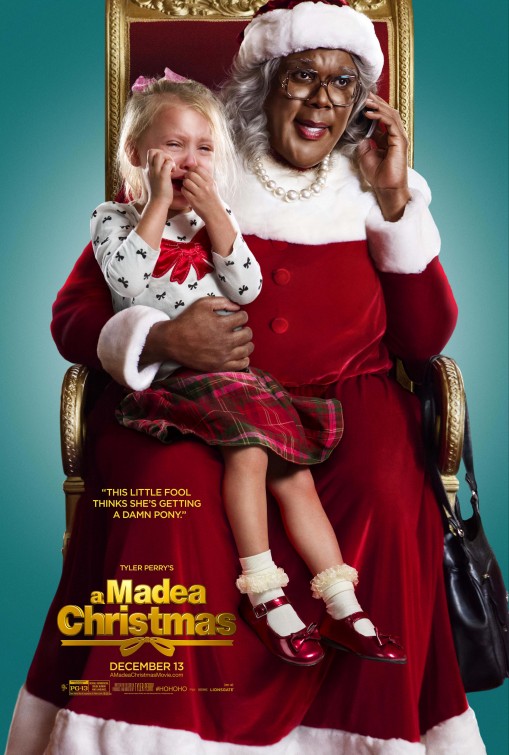 I had no plans to watch this movie, let alone in a theater and on opening night. Then one fall weekend, my pal decided to raise the stakes on our fantasy football match-up, and then Ronnie Hillman couldn’t hold on to the ball, and I lost by four points. My punishment: seeing Tyler Perry’s A Madea Christmas in the theater. My friend and critic Ben Bailey has taken it upon himself to watch and review all the Madea films, so he was ready and planning to watch the latest. I accompanied him for one magical night of holiday messages bequeathed by a large man in drag pretending to be an old woman.
Madea (Tyler Perry) is called into action to help drive her sister Eileen (Ana Maria Horsford) to Alabama. Eileen wants to surprise her daughter, Lacey (Tika Sumpter), for Christmas. Lacey is working in a small-town as a teacher. Her husband, Conner (Eric Lively), is trying to engineer a new strain of corn to help his hometown confront a water shortage. There’s just one problem. Eileen hasn’t told her mom she got married… and to a white man. Lacey is worried that the news would kill her mother since Eileen has a weak heart. So Conner has to pretend to be a farmhand while Eileen visits. Then, unexpectedly, Conner’s parents (Larry the Cable Guy, Kathy Najimy) arrive to spend Christmas with their family, but they too must get in on the act. The small town is also in trouble of losing lots of money if they cannot put together their annual Christmas Jubilee celebration. Lacey’s ex-boyfriend Oliver (JR Lemon) swoops in to offer a corporate savior, but there are strings to attached, and he’d certainly like to get closer to Lacey.
I am about to type a string of words I never thought could possibly be put together in the English language: Tyler Perry’s A Madea Christmas, also starring thespian Larry thy Cable Guy, is not altogether terrible. I feel like a weight has been lifted just admitting this. Oh, let there be no question that this is a bad movie in just about every way, but the simply bad and poorly executed outweighs the terrible. To be fair my expectations could not have been any lower, especially after suffering through my first Tyler Perry movie ever this year, the earlier 2013 film, Temptation. This was my first Madea film. Part of my other entertainment was observing my audience, the mostly full theater on opening night, and charting their reactions to Madea and my own differences in opinion. I can’t in good conscience suggest this is a reason for people to go see this movie, but there it is.
 Every actor not named Perry or Cable Guy looks like they could sure use some more direction; they’re hungry for it. Actually, Najimy (The Guilt Trip) and Larry make a good team and you’re actually pleased when they enter the story, providing an alternative to Madea’s shenanigans. I’ll credit Perry with this twist: the redneck family is tolerant from day one and compassionate human beings and the conflict focuses on a black racist against white people. Although in the year 2013, inter-racial marriage seems like a strangely dated conflict to get so worked up over. This is also the least grating Larry the Cable guy has ever been in a movie, including the Pixar Cars franchise. But these are acting professionals. The rest of the cast is filled with Pretty Bland Young People, all of who look like they’d rather be on a TV soap. Sumpter (Sparkle) in particular comes across like discount Zoe Saldana. Hey, there is a former CW star involved in this too, Chad Michael Murray (TV’s un-canceable One Tree Hill, House of Wax) and while his character is dumb, the town’s chief redneck, he’s actually fine when you can make out what he’s saying. But the best actor in the whole movie turns out to be Alicia Witt (Urban Legends, 88 Minutes) as Murray’s put-upon wife. If there’s anything approaching subtlety in this mess, it’s through Witt’s graceful performance of a woman struggling against her husband for what she believes is best for her child.
The Madea character, Perry’s most famous alter ego, can have a numbing effect that mellows your judgment of an otherwise unlikable figure. Our introduction to the matriarch is her brief stint working at a retail store. She’s unfailingly rude to customers asking ordinary questions, she’s hostile, threatens violence readily, and then, when rightly fired, creates a scene and literally steals from the store. In mere minutes, I’m left with the impression that this elderly grandmother who looks like a linebacker is just a horrible human being and should be in jail. And this impression sticks for some time, that is, until you begin to adopt a Stockholm syndrome-like appreciation for her mean-spirited bickering and retaliation. As we sit and watch Eileen act like a horrible human being, so condescending and needlessly hurtful to her unknown in-laws, the balance of most terrible shifts, and we start to root for Madea because she’s the only one who cuts through the nonsense, the only one to speak truth to Eileen’s reproachful behavior. In the end, you may come to appreciate her being there to set people straight. I still think the whole Madea character is a large miscalculation on Perry’s part, a character that’s never as funny as he thinks it is (though eight movies in, so what do I know?). The constant string of malapropisms feels like the dying riffs of a deflated improv jag. There are several scenes that involve lines given off screen as if Perry is still experimenting with the scene. In the end credits bloopers, which are also not funny, it looks like Perry’s shooting style is just to turn the camera on and say whatever. This is a character born to be a supporting player if utilized at all. Though her best asset is when here happens to be a worse character onscreen to whom she can focus her ire. So as long as Madea keeps starring in movies alongside more horrible human beings, we should be fine.
Part of my forgiveness with several of the film’s sins goes back to its inception as a Christmas fable. You see these kinds of movies all the time on TV, where the threat of not having the small town’s Christmas ceremony is going to bankrupt the whole town in an impenetrable dark cloud of holiday misery. These are the movies where plots hinge on silly things given way too much significance, and where solutions can be pulled out of nowhere and the film’s family-friendly message tied up nicely in a bow. In other words, it’s a world not meant to remotely echo our own reality. And so I ended up giving A Madea Christmas more leeway during the many, many times its onscreen actions conflicted with credulity, because it doesn’t matter. So then…
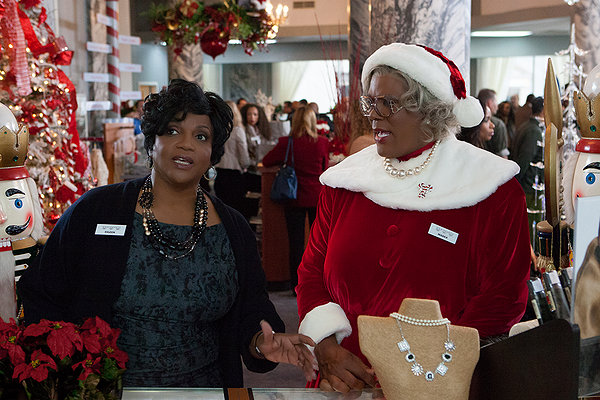 Who cares if Conner is a college-educated scientist and doesn’t know the difference between male and female cows? Who cares if Conner conducts cutting-edge bio-engineering in an open barn with, what appears to be, doing little more than pouring different liquids into different vials? Who cares that the town lawyer is so incompetent he can’t be trusted to read a contract that is all of three pages? Who cares that catching a glimpse of a husband and wife in bed, with the husband under a sheet, is immediately interpreted as Klan membership, because what other possible explanations could there be? Who cares that there is a Klan meeting that Madea accidentally walks in on, and oh yes, they all happen to be in uniform? Who cares that the town’s chief redneck bullies the mayor into firing a teacher when I’m pretty sure that duty is not under the mayor’s direct powers? Who cares that for no reason there is a Naked Gun-style tracking shot that involves passing YouTube celebrities Sweet Brown (“Ain’t nobody got time for that”) and Antoine Dodson (“Hide your children and hide your wives…”)? Who cares if a character believes saying things in public over a microphone to shame a corporation into charitable giving is tantamount to an unbreakable oral agreement? Who cares about the wanton violation of the separation of church and state throughout the film?
Let me dig into that last one for just a bit. Perry takes up the “War on Christmas” mantle and dominates his conclusion with this non-conflict conflict. Turns out the company that is saving the town’s Christmas Jubilee festivity, thus saving jobs and keeping the beleaguered town afloat, has the audacity to request a secular ceremony. First off, this entire service is coordinated and produced by the local town’s government, on government property, and already a violation of the reach of government and religion. Even their classrooms have giant wooden crosses in them. What about anyone in this town who doesn’t happen to be Christian? I suppose anybody with differing religious beliefs is just not welcomed in this part of Alabama. But the most eye-rolling part is when characters screech that some vague omnipresent corporate or bureaucratic entity is taking away Christmas or stopping them from celebrating Christmas. NO ONE IS STOPPING YOU FROM CELEBRATING CHRISTMAS. Some of us just don’t believe that it’s government’s place to advocate or do so on government property, and the courts agree. Anyway, it’s an easy target for Perry and my crowd seemed to be nodding dutifully along to the whole “keep Christ in Christmas” message. It seems like a cheap way to unify the town, and it is.
Perry has been knocking out about two movies a year since he came onto the scene in 2005, and I still don’t know if he properly knows how to adapt his skills to the screen. The tone is uneven and the comedy usually falls flat, but there are just moments that make you shake your head in befuddlement. This is the SECOND Perry movie this year where a mother has been lying to her daughter for decades about her father being dead when he really ran out on them. Perry also decides to fill his holiday film with Christmas-related wipes. One second we’ll be watching some serious drama and then a giant animated Christmas tree will fly across the screen transitioning us to another. What? I’ve never seen this many wipes in a film short of a movie that had Star Wars in its title. From an acting standpoint, I still feel like Perry’s direction is more theatrical, trying to play to the people in the cheap seats. Too many scenes feel rudderless, with assorted actors just feeding more lines to Madea so she can continue on a longer improvisation before somebody remembers to pick up the plot again. The film also ends immediately following the climax, the solution to the town’s ails, without resolution. The camera pans up above the town and cue the end credits. It’s a bit abrupt.
 Then again after directing over ten movies, many starring the Madea character, there is little incentive for Perry to change his style. His brand has made him one of the most lucrative entertainers in the industry, and he has a thriving studio of his own in Georgia, pumping out content and giving lots of African-American actors valuable experience and exposure with parts that don’t include Black Best Friend to the White Lead. Perry is a one-man industry and has legions of fans that will make any one of his movies a hit. They want what they want, and Perry is going to shovel it out to them. A Madea Christmas looks to be more of the same. It’s generally leaden in its comedy, filled with heavy-handed messages, a loose narrative built around propping up Madea improv riffs, and the character’s mean-spiritedness only really works when she’s attacking a deserving party. I’ll have to defer to Ben Bailey on where this ranks up there in the franchise (he said it may be the best), but for me, I was expecting terrible and was treated to mostly just bad. That’s a victory. Merry Christmas everyone! Hallelujer.
Nate’s Grade: C-
Share this:

Frozen (2013)
 Enough time has passed that a revival of the 1990s Broadway formula that Disney stuck so aggressively to for so long is actually a welcome treat, especially when Frozen is this good of a movie. An extremely loose retelling of Hans Christian Anderson’s The Snow Queen, we follow two sisters and princesses, one of whom, Elsa, is gifted with magic powers controlling ice. She’s lived a life of solitude out of fear and penance for endangering her sister when they were kids. Ana has no idea, having her memory wiped through magic, and so she desperately wonders why big sis gives her the cold shoulder. After another accident, Elsa lets her powers loose, refusing to try and fit into the confines of society no longer. Ana is the only one who can save her and the town. Did you read any mention of a man in that plot breakdown? While there are significant male characters, including romantic suitors, Frozen is the story of a different kind of love, a familial love between sisters. It also generously pokes fun at Disney’s admittedly spotty record of heroines giving up their dreams for the first man they meet. Even the comedic side characters work wonderfully. Josh Gad (Jobs) as a magic snowman had me cracking up throughout with his dopey line reading and enthusiastic inflections. Idina Menzel (Rent) as the voice of Elsa is enthralling, and she gets the film’s “Defying Gravity”-esque showstopper, “Let it Go.” Kristen Bell (TV’s Veronica Mars) is terrific as the voice of Ana, vulnerable, heartfelt, and a little bit goofy, and she sings great. All the actors sing great (look what happens when you hire musical theater alums). Even better, the songs are catchy, well composed, and critical to the plot, short of a silly troll tune that should have been cut. The movie also looks gorgeous, which is surprising considering I thought the color palate would be limited with the film mostly taking place in the snow. But what makes the movie truly enjoyable is how emotionally engaging it is, the somber opening twenty minutes setting up just how much tragedy and misunderstanding there is between Ana and Elsa (the melancholy end to their song killed me). Their eventual reconciliation and the selfless acts of bravery might just make you misty. Frozen is a holiday treat for families, animation aficionados, and those hoping Disney could make a film with positive messages for young girls. In a weak year for animation, this rockets to the top of 2013. Just make sure you get the Disney version for your family and not, you know, the horror movie of the same name about people stranded on a ski lift. Though that’s a pretty good survival thriller itself, so, your call.
Nate’s Grade: A-
Share this:

The Starving Games (2013)
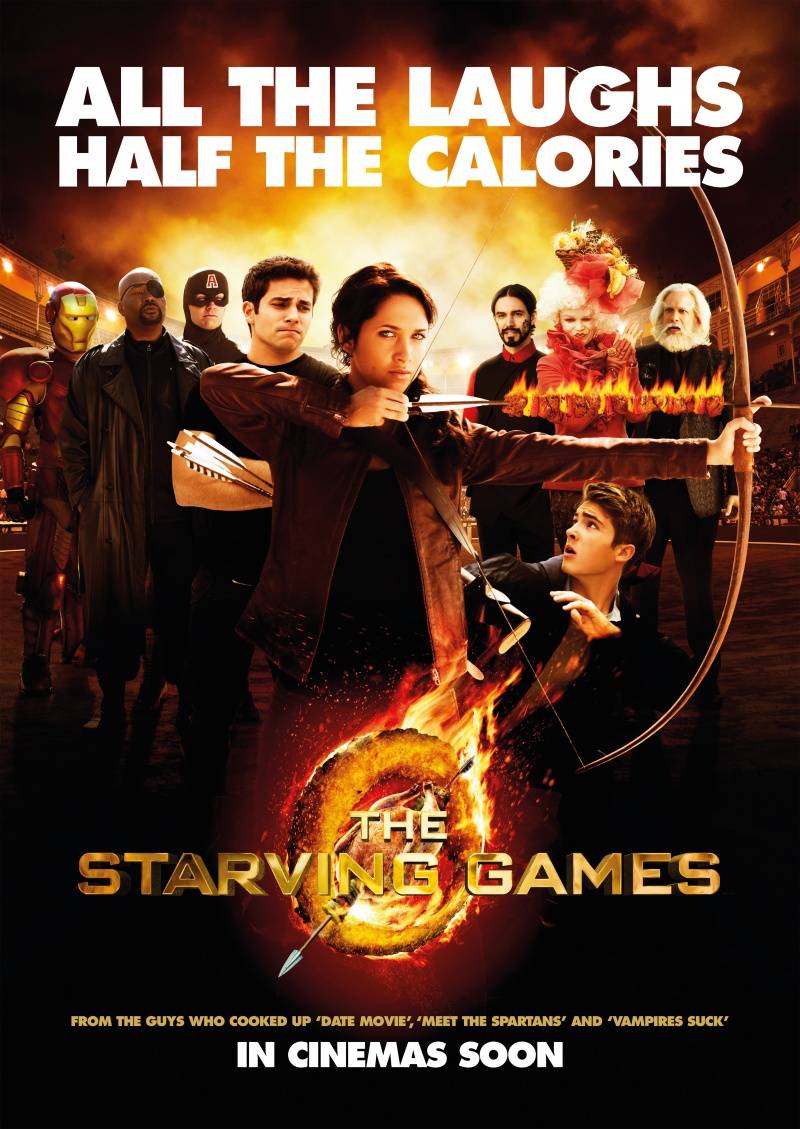 I feel like lambasting the duo of Friedberg and Seltzer has gotten to the point of beating a dead horse. I’ve been railing against their misbegotten sense of comedy (really just pointless and soon-to-be-dated pop-culture references) for years, declaring three of their terrible spoof movies as my worst film of that year. There is no love lost between me and these two men, and yet I feel the sense to restrain my ire when it comes to their latest, The Starving Games. It’s another witless comedy caper, this time using the popular Hunger Games series as its skeleton to hang its desperate jokes upon. These guys don’t know what parody is, don’t know the particulars of comedy and how to build and payoff a joke. It’s the same pattern of ineptitude that will never change. Yet while sitting through all 80 laborious minutes of Starving Games, I felt like Friedberg and Seltzer have come to the realization that the end is nigh for their spoof careers. This last movie didn’t get a theatrical release and the production values look chintzy even for them. They used to crank these lousy films out one a year; hell, in 2008 they gave us two. Now they’ve released two in the last five years. Usually they’ll pack a celebrity or, barring that, MadTV alums. Even those are absent. That’s right, even this movie couldn’t snag a MadTV alum or D-list celeb. Perhaps, as I’d long prayed, the public has grown sour on Friedberg and Seltzer’s misunderstanding of comedy and matured enough to realize that pointless references are not the same as parody. In all fairness, I did laugh two times in The Starving Games, both related to Diedrich Bader as President Snowballs. The lead actress, Maiara Walsh, displays a lot of potential. She’s a good comic actress, has a tremendous smile, a memorable face, and sturdy poise to slough through this mess. She deserves a better movie and more opportunities.
At this point, you know what you’re getting with Friedberg and Seltzer, and that’s all you’re going to get. However, I just looked online and discovered they have two movies scheduled for release next year, one a Fast and Furious parody (goody), and the other an honest to God spoof-free straight comedy. I’ll be fascinated to see what these two have to offer when it comes to non-spoof comedy, but their background fills me with equal parts dread and derisive excitement. Hey, it can’t be worse than InAPPropriate Comedy, could it?
Nate’s Grade: D
Share this:

Out of the Furnace (2013)
 The last time writer/director Scott Cooper looked at a rural, low-income, hand-to-mouth existence, he helped lead Jeff Bridges to Oscar gold with Crazy Heart. It would make sense then for Cooper’s follow-up, Out of the Furnace, to populate those same hills. It also makes sense why actors would flock to Cooper’s next project. It’s a film that strives to be a little of everything, a slow burn and artful revenge thriller, but ultimately will please few, the actors wasted here included.
In rural Pennsylvania, Russell Baze (Christian Bale) is a diligent steelworker who always has to be on the lookout for his younger brother, Rodney (Casey Affleck). Prone to impulsive decisions, Rodney routinely finds himself in debt to bad people. The situation magnifies when Russell is sent to prison for a few years due to a fatal car accident he was responsible for. When he leaves the penitentiary, life has only gotten worse. Russell’s ailing father passed away while he was locked up. His girlfriend, Lena (Zoe Saldana), has moved on with police chief Wesley Barnes (Forest Whitaker). Most distressing, Rodney has gone through four tours of Iraq and is deeply troubled. He’s fallen into old habits and gotten involved in an underground bare-knuckle fighting ring run by the ferocious Harlan DeGroat (Woody Harrelson). Rodney runs afoul of Harlan and disappears, and Russell goes on the warpath for vengeance.
 The problem is that Out of the Furnace doesn’t do enough to separate itself from the pack. We get little insight into the hard lives of these men. Both brothers are haunted by guilt and trauma, squeezed by few economic opportunities, and feeling like life itself is trapping them in corners. However, their path is already predetermined. Russell is destined to stay on the narrow path of responsibility, suffering slings and arrows, but striving to do the right thing. We see this time and again. And Rodney is destined to make poor decisions, desperately getting in over his head and reaching out to all the wrong people. We see this time and again. Each part is solidly locked in, and so we wait because we know their exact trajectory. We know something bad will happen to Rodney and we know Russell will be driven to seek justice his own way. Likewise, Harlan is a scary psycho without complexity. He’s just a drug-addled, violent, scary dude, but he’s so one-note. Lena, once she briefly reunites with Russell, is completely absent in the film, as if her unrequited position is all she serves for our purposes. Cooper displayed a terrific ear for lived-in characters with Crazy Heart, and the details of this world feel honest, it’s just that there aren’t enough of them. The storyline is engraved with little variation, and Cooper doesn’t take full advantage of his great cast, relying upon familiar scenes and elements to establish his loosely drawn characters. We’ve seen these burnouts and lowlifes and dignified blue-collar workers all before. This is a film that wants to be challenging but too often seems to take the easy road.
The very plot structure also seems amiss. As stated above, the journey seems set in stone, so then when something bad does happen to Rodney, it feels overdue. Rodney doesn’t meet his ultimate bind until halfway through Act II, and then when the plot shifts to vengeance, it becomes an uncomplicated straight line. And a streamlined plot with little variation or surprise, with characters that are customary, can get boring. Once Russell is on the warpath, there is little complications or obstacles, or even moments to contemplate the full extent of his actions. And then the movie is done. Because the final act plays out exactly as you anticipate, the movie leaves you feeling anticlimactic. The payoff is unsatisfying. Plot reorganization would have benefited the Russell vs. Harlan storyline. Rather than draw out Rodney’s ultimate screw-up, which everyone is just waiting for from minute one, why not have his screw-up be the Act I break, coming around the half-hour mark rather than more than an hour into the film? That sets the story forward and provides enough space for Russell to work upwards toward Harlan as well as examine what kind of man he is becoming. As it plays out, Harlan is crazy but also easy to access despite the threats of what the rural hill people will do to visitors. If a revenge story was the method that was going to test Russell’s character and redemption, then we needed to get to this crossroads sooner, especially since everyone is waiting for it to happen.
 The power of the acting goes a decent way to compensate for the film’s unresolved investment. Bale (The Dark Knight Rises) internalizes most of his character’s emotions, always trying to hold back a swell of anger and guilt, to just keep going one day at a time. He delivers another strong performance as a man struggling to do the right thing. In this day and age, even a passable Bale performance is going to be above average. Affleck (Ain’t Them Bodies Saints) is a go-to actor when you have a desperate character that is clearly outmatched. His volatile performance is laced with sadness, as you understand how cursed Rodney feels, how the universe hands him bad break after bad break. Affleck tinges his hopelessness with a resigned weariness, as if he’s just seeking a final release. Harrelson (Now You See Me) stews villainously, erupting with extreme violence. He’s a scary guide helped by Harrelson’s flicker of madness he imbues the character with. It’s too bad he doesn’t do anything memorable outside the opening minute. Whitaker (Lee Dainels’ The Butler) probably gets the worst of it, and I think he knows it, which is why the actor adopts a gravely speaking voice that sounds like he has a frog in his throat. Beyond the fact that he’s linked with Russell’s old flame, there isn’t anything important to mention about the character, nor is there anything for Whitaker to do other than make limp threats about letting the police focus on Harlan.
Out of the Furnace is one of those movies that gets details right but loses sense of the big picture. Its blue collar, working class characters are given the right clothes, posture, look, but they’re not given enough material to breathe as characters. The people in this movie end up becoming dispensable parts of the background, serving their strict plot purposes and then dissolving again, lacking complexity and personality. The characters aren’t strong enough for this to be character-driven; the plot isn’t given sufficient structure for this to be a searching moral exploration; the pacing and direction don’t provide enough thrills for the film to work as a revenge thriller. And so Out of the Furnace, while not being a bad film, falls short of truly working as a character study, as a moral examination, as a traditional pulpy revenge thriller. It’s got a great cast and some wonderful production values that convey the weight of low income America, but the movie just lacks an engaging story to justify the talent in use. A few more revisions would have helped, but Out of the Furnace ultimately comes up short because it lacks any sort of lasting heat.
Nate’s Grade: C+
Share this:

Violet & Daisy (2013)
 It’s not often that I say this but… what the hell did I just watch? I know it’s a movie called Violet & Daisy, written and directed by Geoffrey Fletcher, the man who won a screenwriting Oscar for adapting Precious. But what is this? It is some meta commentary on film violence? A twisted fairy tale? A dark comedy? Whatever it is, I know for certain that it was not very good or entertaining.
Violet (Alexis Bledel) and Daisy (Saoirse Ronan) are teenagers who also work as hired assassins by their boss, Russ (Danny Trejo). Their next assignment has a personal angle: Michael (James Gandolfini) stole a large sum of money from Russ. The gals hide out in Michael’s apartment only to fall asleep. When they wake up, Michael is sitting there, accepting his fate, begging the girls to complete their job. He’s dying from terminal cancer, estranged from his daughter, and hoping to exit this world on his own terms. Over the course of one long afternoon, the gals run into rival gangs, a trained sniper, police, neighbors, and all sorts of other plot contrivances to delay the death of Michael.
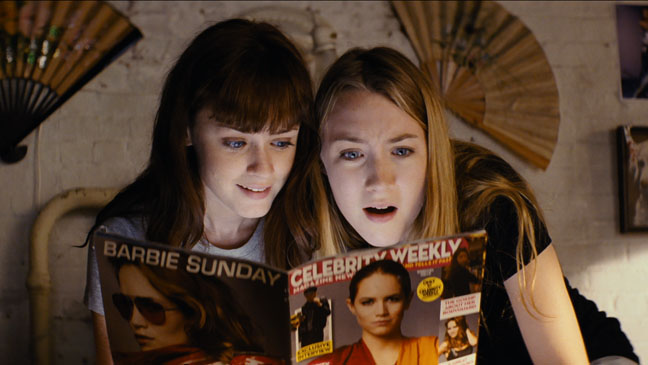 If you’re like me, with similar expectations when it comes to your moviegoing experiences, you’ll be left scratching your head and fumbling for some kind of rationale why people decided to make a film like Violet & Daisy. It feels instantly dated, relying upon the hook of young teen girls with big guns, you know, the same model that has translated to many a successful video game. More so than that, the aspiration, or at least direct inspiration, appears to be a Tarantino-knock-off. Not ripping off Tarantino, as many did in the mid-to-late 90s, but ripping off a poor Tarantino knock-off, like Two Days in the Valley or, the more adept comparison, The Big Hit. There is so much crap in this movie that exists merely because somebody thought it would look cool. Violet and Daisy open the movie dressed as pizza-delivering nuns (is this a fetish I am unaware of?) and open fire on a gang of criminals. But before their fateful gunfight, you better believe it, they have an innocuous conversation about something small, you know, like Jules and Vincent. Why are they dressed as nuns, let alone nuns delivering pizza? It doesn’t matter. This is a movie that doesn’t exist in a universe minutely close to our own. Everything about this film feels painfully and artificial. You know what previous job Violet and Daisy had? They worked at the “doll hospital,” a literal ward for dolls. The decisions of this movie are driven purely by a stylized self-indulgent whimsy. Once you realize this, and you will, the movie becomes even more of a chore to finish.
Then there’s the bizarre and sometimes uncomfortable infantilization of the female lead characters. These ladies do not act like adults; they don’t even act like teenagers. Even though they’re both over 18 years old, their behavior more closely resembles that of a flighty seven-year-old. Their speaking patterns are often in an annoying and partially creepy baby coo. They play paddy cake after successful hits. They ride tricycles. They chew bubblegum and blow bubbles during hits. They get excited about new Barbie Sunday dresses, and this is their real motivation for taking assassination jobs. Yes, to buy dresses. Then there’s their game, the Internal Bleeding Dance, where they hop up and down on the chests of their dying victims, blood spurting out of their mouths, the girls giggling, as if they were bouncing on a bed at a slumber party. These women aren’t remotely actual characters; they are masturbatory quirky hipster fodder, the ironically detached, sexy baby doll killer approximation. Except there is never any commentary at work. The depiction of Violet and Daisy as petite killers never approaches anything meaningful. They are killers because it’s cool. They talk like lobotomized film noir archetypes because it’s cool. This is quirk run amok, quirk with a gun and no purpose. I’m trying hard to ignore the obvious sexual kink undercurrents of the whole enterprise.
 Even with all these flaws, perhaps Violet & Daisy could have been morbidly interesting, except that the circuitous plot twiddles its thumbs, padding out a half-baked story. This is a movie that takes its time and seems to go nowhere. Once the girls meet Michael, the plot has to come up with numerously lame excuses to delay Michael’s execution. I kid you not, there are THREE instances where the girls run out of bullets and have to stop and walk back to the hardware store to go buy ammo. This happens. This is a thing that keeps the plot moving. It’s like as soon as the main characters get into a room together, Fletcher has to struggle to come up with reasons why his narrative should still exist. So we get a second group that Michael stole from because this guy has an even bigger death wish. This second group of spurned bad guys is on their way. If Fletcher was going this route, he might as well gone whole-hog imitating Smokin’ Aces and just had numerous crews all fighting over taking out this schlub first. It feels like Fletcher is making up the story as he goes, taking us on relatively pointless nonlinear interludes to pad the running time. The film, like Tarantino, breaks up the story into a series on onscreen chapters, though one of these only lasts like a minute. Then there’s a loopy dream sequence. The narrative is so stagnant that whatever interest you may have had will long be gone. By the time the movie actually does end, at about 80 minutes, it has long felt creatively exhausted, totally gassed. Fletcher throws out all the stops to get across that finish line.
Even though it was filmed way back in 2010, it’s hard to escape the morbid irony of Gandolfini (Enough Said) playing a character discussing his own inevitable death. He’s the best actor in the film, offering a paternal warmth that goes wasted amidst all the stylistic nonsense. Our other two featured players, Bledel (TV’s Gilmore Girls) and Ronan (The Host), have a sprightly chemistry together that works. I just wish all three actors had something to do rather than strike artificial poses and quip.
After enduring The Paperboy, and “enduring” is indeed the correct term, I was certain that the messy, tonally uneven, sometimes garish flights of fancy in Precious were due to director Lee Daniels. After enduring, and again “enduring” is the correct term, Violet & Daisy, I’m starting to think that Fletcher is deserves equal credit. Violet & Daisy is a curious exercise in twee indie hipness, suffused with quirk standing in place for characters, story, meaning, etc. It feels like the development stopped once the core concept of teen girl assassins was concocted. The off-putting childish nature of the adult girls, juxtaposed with the baby doll sexuality of the film, makes for an uncomfortable watch. To call the film bad taste is too easy. Whether this is a bizarre dark comedy, a whacko modern fairy tale, or whatever term you want to apply to justify the artificial excesses and emptiness, Violet & Daisy is a contrived mess that labors to fill out a basic feature running time, often doubling back and delaying. There isn’t a story here, more just an incongruent, irregular style. If you’re content with a knockoff of a Tarantino knockoff, with an extra dose of whimsy, then enjoy Violet & Daisy and you can dance your cares away atop bleeding bodies.
Nate’s Grade: D+
Share this:

All is Lost (2013)
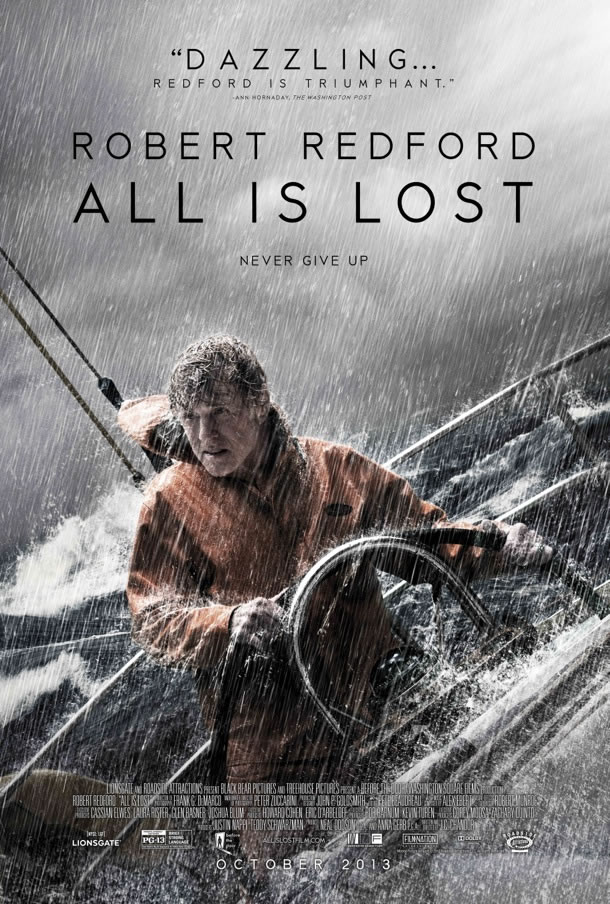 J.C. Chandor, nominated for an Oscar for writing Margin Call, chose a curious follow-up. In All is Lost, Chandor serves as writer/director and takes acting legend Robert Redford, strands him in the middle of the ocean, and watches him flounder. Considering Margin Call was heavily dialogue-driven, it’s an interesting detour to a nearly wordless film. Redford plays an older sea-faring gentleman who discovers one morning that his boat has been damaged by a floating shipping container. He has to repair the hole and take inventory of his remaining supplies. As his boat takes on more water, being battered by storms, Redford must strive to reach a shipping lane as his best bet to be rescued.
 Allow me to furor my brow at the reception All is Lost has gotten thus far. It’s not a bad movie but when you boil it down it’s a rendition of The Old Man and the Sea minus, you know, the giant fish. I knew going in that the film was going to be minimalist, but I didn’t think it would be this dull. It is literally a guy manning a boat for 90 minutes, patching things up, with the situation getting worse. Then he’s in a raft. Then he’s low on supplies. Then, well, it ends pretty much how you’d expect though with a flicker of ambiguity for the squeamish. The drama of human survival, of man against nature, can be plenty invigorating, but instead Chandor takes a more leisurely and studiously pessimistic approach, and so we watch Redford slowly fail. The filmmaking can barely keep your interest. He hoists the sale. He tends a hole in his boat. He salvages electronics. There are a couple of choppy storms that throw the ship around, but The Perfect Storm this isn’t. Nor is it Open Water. There is a certain brainy enjoyment from survival thrillers, thinking alongside the characters, but our opportunities are absent here unless you know a thing or two about sailing, otherwise I just kept thinking, “fix the hole in your boat.” It takes a good while, until the third act when Redford is forced to abandon his sinking vessel, before the perilous reality seems to settle in. Beforehand it feels like the film is dawdling, and I just found myself shrugging and growing restless. It feels callow of me to complain that not enough happens onscreen when I’m watching a man struggle to survive at sea, but that’s because the sense of urgency is nil. I watched Redford eat beans out of a can more than I saw him sweat over his predicament. I wish Redford had been paired with a tiger or a volleyball for decent screen company.
This is very much a one-man show with Redford ably holding the screen, but will you care about his character and his plight? The character is nonexistent, far more so than the similar charge against the other awards-friendly survival thriller, Gravity. I always felt like I was observing Redford from a distance, never fully emotionally engaged, and more so just studying his survival skills like there might be a test later. That’s because Redford serves as a metaphorical stand-in for all of humanity (the character’s listed name is “Our Man”); the movie feels replete with allegory, which makes the tedium all the more unbearable for me. I didn’t feel the man’s horror or nerves or despair or urgency. I didn’t feel much of anything. That’s because I believe that Redford’s acting history is meant to fill in for the absence of character. We’re not watching any man brave the dangers of the ocean, we’re watching the aging Hollywood screen idol dig into his own screen history and showcase what remains. It’s a fine performance that kept me watching but it felt too modulated, too controlled, too internalized to translate the myriad of emotions necessary. It’s 90 minutes of Redford standing in for himself standing in for humanity, named “Our Guy,” remember. That already sounds laborious.
 Chandor received notoriety for his smart, hard-hitting Mamet-esque dialogue, and deft handling of actors, but All is Lost showcases a whole other set of skills in his storyteller toolbox. Being nearly wordless, the movie is one giant exercise in visual storytelling. Chandor’s camera angles, editing, and in particular the use of sound and lighting, keep the audience oriented smoothly. While it may take a moment to gauge what Redford is doing, there is a logical connection to his actions. There’s a visual mastery here that was not even hinted at with Margin Call, which was mostly a stage play of boardroom conversations put on film. The special effects are seamlessly integrated into the film and having Redford perform many of his own stunts adds to the overall verisimilitude, the film’s calling card. I feel like Chandor the director outdid Chandor the writer.
All is Lost is a film I can better respect than support, an intellectual exercise in a deteriorating and seemingly doomed survival scenario, the anti-Cast Away. It’s probably as realistic as these things get, but does that make it interesting? The details of reality are there but the story and especially the character work is lagging. It’s nice to see Redford with such a meaty part, and obviously one he is connecting with, but I wish his talents were put to greater non-metaphorical purposes. With the plot and characterization stripped, it appears that Chandor’s film is rife for allegorical analysis, noting the struggle in the face of overwhelming odds, the futility of existence, etc. To me, that sounds like you’re doing the movie’s work for it. The overall lack of urgency just wrings out what entertainment there could have been with this tale of survival. When your main character doesn’t recognize the threat, then that transfers to the audience, and we too shrug. All is Lost is certainly well made from a technical standpoint, with Chandor showing impressive visual storytelling prowess, but it drags and offers little incentive to connect. What ends up being lost is your patience and attention.
Nate’s Grade: B-
Share this:

The Hunger Games: Catching Fire (2013)
 It’s been a year and a half since The Hunger Games broke box-office expectations, gifting Lionsgate studio with a formidable franchise. Based upon Suzanne Collins’ series of young adult novels, the first film was an agreeable adaptation that was occasionally hobbled by poor direction, rushed plotting, and budget limitations. Catching Fire, the second film, improves upon the established groundwork in almost everyway with the chief drawback being a terminal sense of dystopian déjà vu.
In the months after the events of the 74th Hunger Games, the two victors from District 12, Katniss Everdeen (Jennifer Lawrence) and Peeta Mellark (Josh Hutcherson), are traveling across the other districts of Panem as part of their victory tour. What better way to endear yourself than visiting other districts to remind people that their children are dead and you survived? On the tour, there is growing unrest throughout, and the people have turned Katniss as their symbol of defiance against the tyrannical Capitol. President Snow (Donald Sutherland) threatens Katniss to control her media image, to convince the people that she’s madly in love with Peeta and not a fledgling revolutionary. In order to check the power of the victors, Snow introduces a rule change for the 75th games, the Quarter Quell. This year the participants will be culled entirely from previous past victors, meaning that Katniss and Peeta will be plunged back into the deadly games and this time their competition aren’t children.
 What a difference a director with a sense of cinematic visual command can make. Early into pre-production, the original director Gary Ross (Seabiscuit, Pleasantville) decided to bow out for sequels, and so Francis Lawrence (Constantine, I Am Legend) was hired, and goodness does the movie benefit from this change at the helm. Lawrence has a much stronger visual authority, having cut his teeth in commercials and music videos (remember those, kids?) before feature films. The man couldn’t frame a lousy shot if he tried. With a stronger visual lens, the world of the Hunger Games is able to stretch, given a proper budget, and the visual grandeur unfolds around you, especially the largess of the Capitol. The movie doesn’t feel like they had to cut corners with their budget or special effects, and part of that is credited to the skill of Lawrence. And with this new visual stylist comes the demise of shaky cam. Dance and celebrate that Ross’ misapplied docu-drama approach has been abandoned; this time, when there is onscreen action, you can comprehend what is happening. I read the book years ago but even I was feeling twists of tension, notably the start of the Quarter Quell. The action isn’t terribly developed but it’s sufficient, though again the kill-or-be-killed extremity kept to PG-13 safety is starting to chafe. My only visual complaint is that much of the action within the games takes place at dawn/dusk and thus low-light environments. It feels like someone threw on a muddy filter, though perhaps this was just my theater’s light bulb-saving projection setting.
Now that the world of Panem is established, Catching Fire does a nice job of showing the various social conflicts coming to a head, bubbling into uprising. The pre-games victory tour opens up the world, allowing us into other districts and viewing the different strife befalling them. It’s jolting to watch the public defiance met with summary executions and yet the people will not be stopped. Now the class conflicts of the haves and have-nots get pushed to their breaking point. There’s a great contrast provided with a Capitol party so lavish, with food so sumptuous and plenty that the Capitol denizens have cocktails on hand to induce vomiting. That way you can continue eating (historical fact: vomitorium is actually not what you think but instead a passage below a tier of seats for easy exit, like in modern stadiums). The themes and the points aren’t subtle, that’s for sure, but they are effective and intriguing. Katniss, who only wanted to survive, has been thrust as the face of revolt, and now she has to walk a delicate line to again save her loved ones. The fascist politics and media manipulation hinted at in the first film are given more examination, providing a richer narrative. What works in the first Hunger Games is generally expanded upon and what faults the first film had have been, generally, nipped and tucked. There’s nothing as eye-rollingly awful as Peeta’s human rock sculpture camouflage. The burgeoning love story elements again are abbreviated the harshest, but when the world is coming apart, you have to spend more time on revolution than love triangles.
The film also benefits from a slew of new characters that have strong personalities. We’re introduced to other formers winners of Hunger Games past, and they make the most with their limited exposure. Joanna Mason (Jena Malone) is an axe-wielding woman given to speaking her mind with devil-may-care attitude. Her first scene in the film involves her stripping naked in an elevator with Peeta and Katniss. Malone (Sucker Punch) really has fun with the blithe approach of the character and manages to come across as comical while still being a credible badass. She’s a terrific character and you’ll be seeing more of her in the sequels to come. The other famous victor is Finnick (Sam Claflin) who bathes in the celebrity limelight, luxuriating in his media image as a suave playboy. Except there’s more under the surface and you’ll be given peaks throughout the film. I’m not as sold on Claflin (Snow White and the Huntsman) as I am on Malone; he’s got the requisite chiseled physique, but I don’t feel the charismatic pull the character demands. Also, when I close my eyes and listen to him speak I hear James Franco, and I don’t know what to make of that. Then there’s the new head game maker, Plutarch Heavensbee (Philip Seymour Hoffman), who is presented as an enigma. He leans on President Snow to spare Katniss rather than turning her into a martyr for the cause. However his alternatives are sinister and media savvy. Hoffman is one of our best working actors today but he seems to sleepwalk through the role, perhaps because he’s meant to be vague. However it’s played, it’s hard to get a read on Plutarch until the very end.
Strong as ever, Lawrence (Silver Linings Playbook) is the rock of this franchise. The Oscar-winning actress has been on a tear as of late and her acting and overall presence elevates the material. They struck gold when they hired her. There’s more fire to her and more devastation, as she’s going through the PTSD, plagued by nightmares. She’s haunted by the horror she’s escaped but also by the continuation of the threat from Snow, the ongoing charade that she will have to keep up for the rest of her life. There is no time out of the spotlight as a victor let alone a national celebrity like Katniss. Lawrence can convey so much wordlessly and she can convincingly play the different dimensions of her wounded warrior.
 Many of the criticisms one can hurl at Catching Fire are the same from Collins’ book. There is a repetitive plot structure, where the games themselves feel like too much of a retread. It feels forced to serve up what worked the first time. The problem with throwing Katniss and crew back into the Hunger Games is that all the real consequential action is taking place outside of them. We’ve been watching the stirrings of revolt all movie, watching the cracks take shape, and then the movie returns to its deadly TV competition when the audience just wants to leave to see if the revolution will be televised. Breaking free of Katniss’ first-person perspective from the book allows the filmmakers to add scenes fleshing out the world and the characters, with some nicely malevolent conversations between Snow and Plutarch. But that also means we don’t have to be locked into watching Katniss’ every move (I know this sounds like sacrilege). It’s not like the creatively torturous games are boring, but it’s hard to ignore an increasing sense of been-there-done-that. When there are so many larger, wider-reaching consequences happening outside throughout the various districts, you can’t help but feel a bit antsy. Another reason the film doesn’t break free from the games repeat is that it purposely keeps Katniss, and in turn the audience, in the dark about the larger outside machinations. The collective ignorance has a purpose but it also makes the plot frustrating.
Really, Catching Fire is more a setup for the series greater conflict rather than a complete film/story. Things are unraveling in the country of Panem, but if you want resolution you’ll have to wait until 2014 for the next movie, or more likely 2015 for its concluding half. What Catching Fire does is tease out the plot change and then transition to it, but only in the final minute. As my pal and colleague Ben Bailey notes, it ends in similar fashion to 2003’s Matrix Reloaded, and you’re left on a cliffhanger that doesn’t seem like a natural resting point for the story. Again, these critiques can be waged at the book as well as the film is a fairly close adaptation that will satisfy the die-hard fans.
From here on out, the Hunger Games movies are going to get more interesting. With two remaining films to cover the ground in one book, it should allow for greater development of characters, conflicts, dramatic themes, social commentary, or just larger kickass action sequences now that we’re in a larger arena, so to speak. Under the screenwriting expertise of Danny Strong (HBO’s Recount and Game Change) I’m anticipating a more politically astute and intellectual dystopian drama. Francis Lawrence has brought visual dynamism and stability to the franchise, just in time for when things are poised to get really interesting. As a film, Catching Fire is a step above the previous entry, ironing out some of the shortcomings and presenting more subtext when it comes to its social unrest. It introduces a bevy of intriguing new characters, escalates tensions throughout the realm, and promises greater suffering and strife ahead. However, the repetitive plot structure of throwing Katniss back into the games for an hour eats away at time that could be better spent watching the revolution ferment. It’s still a reliably entertaining film with a sharper visual gloss, so fans should go home happy and audiences should be suitably thrilled. The alterations from Collins’ book are all for the better. Catching Fire will slay the box-office with little trouble but I’m most thankful that we’ll be leaving the games behind for good.
Nate’s Grade: B
Share this:

42 (2013)
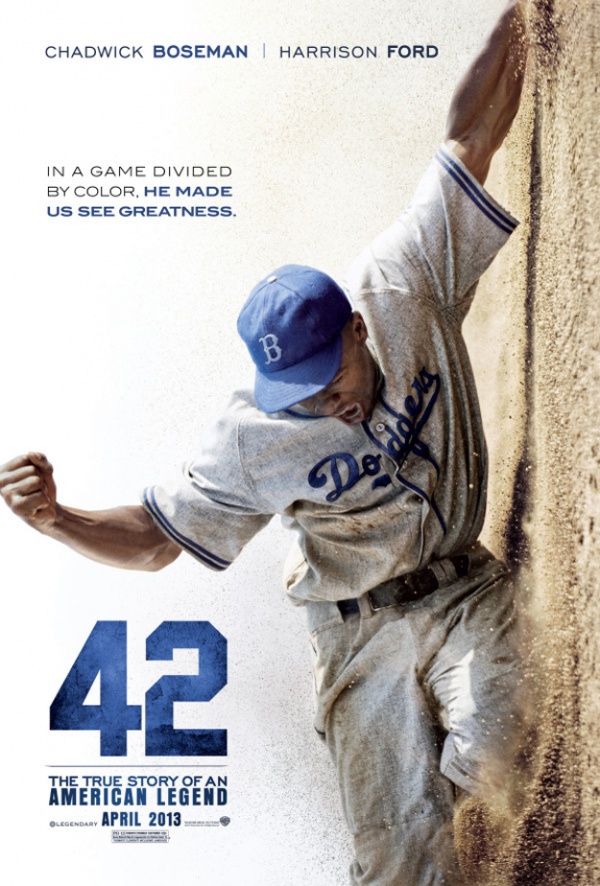 Staid and square, a bit like its lead, 42 is a biopic on Jackie Robinson breaking the color barrier in baseball, and while it’s reverential to a fault, it could have used more life. As a character, Robinson is simply not terribly interesting because he’s being trapped within a limited prism of inaction. Robinson the man could be fascinating, but Robinson the character of this movie is a bit of a bore. That’s why the film is just as much about Brooklyn Dodgers owner Branch Rickey (Harrison Ford), a far more colorful character that gets to chomp cigars and lecture people with countless speeches accompanied by heroic piano cues. 42 is crammed to the gills with messages but they’re so transparent and overdone, occasionally ham-fisted, where every important thought is spelled out and underlined and repeated for the audience. The corny sentimentality clashes with the danger and hostility Robinson bravely faced. We got stuff like a little kid praying to God that Robinson hits a homer to “show what we can do,” a white guy trots up to Robinson and he seems dangerous… only to want to wish him well, and then there’s all the white players learning lessons of tolerance, treating Robinson as if he’s some prop for their own self-actualization. The greatest acting in the movie, a bit that may take your breath away, is from Alan Tudyk who plays a competing team manager. He is like a racist Foghorn Leghorn and he just… keeps… going. This sequence is the film’s best because it feels earned, complete, and lastly emotionally resonant. 42 is an acceptable biopic, effectively triumphant where it counts, but it feels too dated, too safe, and overburdened with doling out a slew of messages rather than telling an engaging and difficult story.
Nate’s Grade: B-
Share this:

Blue is the Warmest Color (2013)
 The French drama Blue is the Warmest Color has been bathed in publicity and controversy ever since its debut at the prestigious Cannes Film Festival. It’s a three-hour lesbian romance about sexual awakening and finding a deep human connection, but all anyone wanted to talk about was the graphic sex. The drama split audiences down the middle, with people like Steven Spielberg praising its unflinching examination on the craving and heartache of young love, and others like New York Times film critic Manohla Dargis called the director/writer Abdellatif Kechiche “oblivious to real women.” It’s an impressive film, a rapturous love story for the twenty-first century that defies swift categorization. This isn’t just a gay film. This isn’t just a romance. This is a highly relatable, appealing, and heartbreaking movie of the first-order; however, both the defenders and detractors of Blue have substantial merits to their claims.
Adele (Adele Exarchopoulos) is a normal 17-year old girl trying to gather a sense of her self. Her peers are pressuring her to lose her virginity with a popular guy, but it’s another person, a mysterious blue-haired lass, that Adele can’t stop thinking about. This woman, the somewhat older Emma (Lea Seydoux) is an art student and an out lesbian. One night, Adele follows her into a lesbian bar and they strike up a friendship, one that quickly translates into something more romantic. Over the rest of the movie, we cover several years of Adele and Emma’s lives together and learn that each has left an indelible mark on the other, for good and bad.
 Let’s tackle the portion that’s gotten the most coverage in the media, the graphic sex sequences that earned the film the rare stateside NC-17 rating. You may have thought 2011’s sex addict drama, Shame, earned its NC-17 rating, but Blue trounces it. Short of unsimulated sex scenes in movies like Shortbus and 9 Songs, I doubt many audience members have experienced sex sequences this explicit and this lengthy (you may start checking your watch at some point). At its Cannes premier, the critical response breathlessly hyped a sexual encounter that went on for 18 minutes. That number may be the total onscreen copulation time; the longest sex scene is seven minutes or so, but you do feel the vigorous extension. Is there a particular reason the steamy sex scenes needed to be this long or this graphic? Kechiche likely wanted to communicate an explosion of immeasurable passion unlike anything Emma or Adele will experience in their lives. But did this need to be communicated with seven minutes of orgasmic fingers, lips, and tongues exploring every crevice of their bodies? Would six minutes of enthusiastic sex prove insufficient? I’d be a hypocrite if I said I found little entertainment in watching. I just don’t think the film demanded as much drawn out sex when the drama is this strong.
And that’s the mass appeal blurb when it comes to Blue is the Warmest Color: come for the intensity of the sex, stay for the intensity of the feelings. You will swiftly feel the nervousness and sexual tension that comes from the exploration of attraction. All those high school butterflies come fluttering back. The depth of feeling is easily relatable. The characters are searching for unparalleled human connection but also discovering more about who they are. This is a moving, absorbing, and crushing love story, but it’s just as much about two people falling out of love. That was a major surprise for me. What’s more is that the forces behind their breakup are completely understandable and you can see them coming; at heart, they are two different people that operate in different worlds, and they do change over time. That’s excellent storytelling when one can feel for both sides of a breakup, comprehend how this moment arrived, and looking back, see how inevitable a conflict like this would be. Emma’s sphere of friends is one that Adele does not feel a comfortable place within. Emma worries that Adele needs to find a sense of identity outside their relationship. Adele is still too timid to admit the truth about her relationship with a woman to her colleagues and family. These are major conflicts and they simmer and gestate in ways that feel like real life. Beyond some of the specifics in the bedroom (more on that later), there isn’t a moment that feels unbelievable in the entire three hours. This is a naturalistic love story that unfolds in small waves, allowing us to get to know the characters and their lives.
 The two actresses are outstanding and bare much more than their flesh for this film. Exarchopoulos and Seydoux disappear into their characters. These are richly developed characters, and each actress does her best to bring them to startling life. Exachopoulos (who looks like a Parisian Maggie Grace) has so much of the film riding on her 19-year-old shoulders since her character is the film’s major point of view; we often see the world through her perspective. She’s excellent as the curious, anxious, bashful young woman, and her encounters with Emma open her world up, allowing Adele to broaden as a person. She’s still not confidant, given to doubts that Emma seems to lack, but Exarchopoulos convinces you of the difference. Every step along her journey is credible, acted with poise, even the uncontrolled weeping. In a just world, this French newcomer would be up for serious acting award consideration. Seydoux is the more assured character, the one who sizes up her interest, but when hurt, the ferocity of Emma’s fury is staggering. This is not a woman to scorn, and Adele will learn this the hard way. Later in the film, as the history hangs in the air between Emma and Adele, we get a powerful sense of how conflicted both women are, having never turned off their feelings but trapped by circumstance and consequences. You feel each member cycle through the myriad of emotions, fumbling between desire and desperation. The actresses work together beautifully, raising one another’s performance, and giving one another the environment to get truly intimate, emotionally and physically.
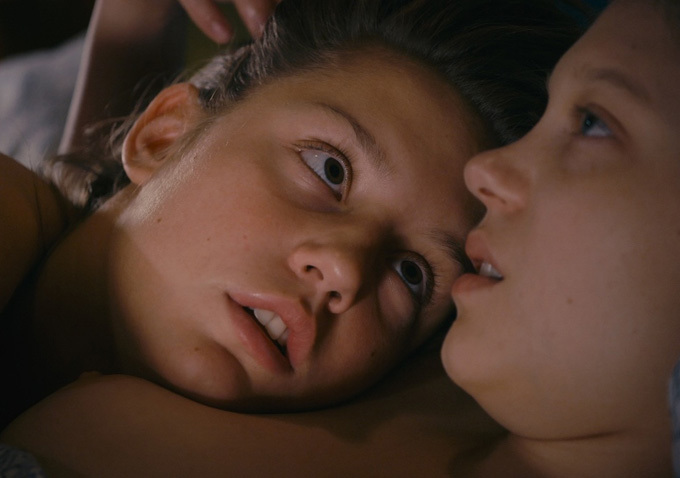
The film is more a representation of a man’s fantasy of lesbian sex. The male gaze, a term referred to often in feminist film criticism, is trenchant in this film. Kechiche’s camera doesn’t just love his two young stars; it fawns over them, lusts over them. The camera is always within inches of Adele’s face, glued to tight shots lingering over Exarchopoulos’s pouty lips. Seriously, the actress has her mouth open the entire movie, her lips forever pillowy, forever pouting. It’s a sensual movie, yes, but does every shot of young Adele need to be so tawny and voyeuristic, her hair always slightly askew in her face, her body positioned just so that her assets are featured? Critics like Dargis are correct about Kechiche’s fawning camera pushing over into the boundary of erotic fetishism. This is where my questioning of sexual positioning comes back; going ass backwards when it comes to cunnilingus (and yes, I will intend that pun) is aesthetically pleasing in a sensuous manner, and that feels like the dictum of Kechiche’s intimate camerawork. It’s heterosexual male pleasure represented on screen, at least in its depiction. Otherwise, with the camera always tethered inches away from Adele’s face, why don’t we remain focused on her face during all this physical pleasure? It can be just as erotic. However, with all that out there, why can’t lesbian sex be given the same ridiculous fantasy depictions of heterosexual sex in the movies? I can almost guarantee that pool tables are not a prime location for indulging one’s urges. And just showcasing lesbian sex onscreen between a committed couple (not just girl-on-girl flings like in Black Swan) and normalizing it, whatever intention, is a virtue.
 But it’s not just the sex scenes that could use some judicious snipping; the entire three-hour enterprise could be easily consolidated. The film is replete with loping scenes that sort of drift along, recreating the ordinary rhythms of life rather than the plot beat connect-the-dots we associate with most film narratives. That’s fine, you need time to establish characters and setting, but do we need people interpreting poetry at length and indulging in gender philosophy for minutes on end? Perhaps if I watched Blue is the Warmest Color a second time I’d be more tolerable of the narrative bloat, finding added subtext and metaphor to all those ponderous philosophical discussions over the nature of the self and gender identity. Of course seeing a three-hour movie, again, is going to take a significant time commitment.
Sensual throughout, beautifully developed, richly observed, and brought to life with bristling and audacious acting, Blue is the Warmest Color is a love story that hits hard with emotional force. By nicely realizing the characters, providing them depth and fallibility, we can empathize with them along the different stops of their romantic journey, seeing where each is coming from and understanding the yearning, frustration, and passion. When things are good, there’s a frisson on screen, a palpable sense of desire accentuated by Kechiche’s loving (and occasionally obsessive/fetishized) camerawork. The acting by Exarchopoulos and Seydoux is as raw and fevered as their onscreen lovemaking. I doubt it needed to be a full three hours long, and I doubt the notorious NC-17-earning sex scenes needed to be as graphic to communicate delight, but I’m most pleased that Blue is offering a full movegoing experience, watching the formation of two characters over time and how they change. It’s easily watchable even during its more ponderous, dare I say French-y, sidesteps. The ending is a slight misstep, calling out for greater certainty, but the French title for the film was, Adele: Chapters 1 & 2, the implication being there may be future cinematic adventures that await these people. I don’t know if this will ever come to fruition considering the original graphic novel by Julie Maroh is a mere 160 pages, rather shrift considering the medium, but I can hope. Romances this involving, observant, and intense don’t come around too often and deserve to be cherished. Just consider the sex a bonus.
Nate’s Grade: A
Share this:

Dallas Buyers Club (2013)
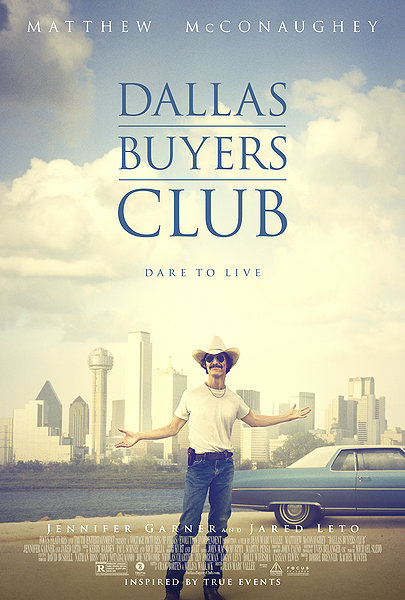 It’s been a while since Hollywood really tackled the AIDS crisis and the prejudices associated with it. Thanks to better understanding and tolerance, and a rise in life-extending drug treatments, AIDS is rarely stigmatized today as it once was, as a death sentence, as a gay disease. It’s faded into the back of most people’s minds. It’s been twenty years since Philadelphia and Tom Hanks’ Oscar-winning performance. Has it been too long? The drama Dallas Buyers Club returns to the early years of the AIDS crisis and the ignorance of the age, illuminating a lesser known true story about one of the most unlikely activists to emerge.
In 1985, Ron Woodruff (Matthew McConaughey) is a Texas electrician and part-time rodeo bull rider. He’s drinking, snorting cocaine, and sleeping with every woman he lays eyes on. Then one day he collapses and wakes up in the hospital. He’s told he has contracted HIV/AIDS and likely only has 30 days left to live. Ron is aghast, instantly defensive, declaring, “I ain’t no faggot.” Rather than wallow, he fights to live as long as he can, refusing to be part of a hospital drug treatment for AZT unless they can tell him, definitively, he’s getting the actual drug and not the placebo. Ron travels to Mexico and finds a sympathetic doctor with alternative treatments involving vitamins and other natural drugs, none of them illegal, just unapproved by the FDA. Ron returns to the States and runs into trouble trying to sell his wares to the afflicted gay community. Raylon (Jared Leto), a kindly transvestite suffering from AIDS, agrees to help Ron make inroads, for a percentage of the sales. Ron and his unlikely business partner skirt legal loopholes to sell “memberships” into the titular Dallas Buyers Club. With monthly dues, every member gets a dose of attentive medicine, and it’s having remarkable results.
 The bulk of the attention Dallas Buyers Club has received is from the transformative performances of its two lead male actors, and they are exceptional. McConaughey (Mud) begins as the sort of character we’ve seen before, the swaggering cowboy who’s a natural ladies’ man, but as his life quickly falls apart and his circle of friends turn on him in gay panic and ignorance, Ron is pushed to the brink. McConaughey’s weight loss, which garnered plenty of ink in tabloids last year, is startling and instantly echoes his character’s dire state. Likewise, when you see a late scene of Leto (Lord of War), his frame is so gaunt, so frail, and so evocative of the few remaining moments these men have left to them. It’s no stunt or gimmick because their performances, even without the weight loss, are enormously affecting and powerful. Both men project a blustery confidence they themselves occasionally buy into, but both men are, naturally, scared witless, fumbling, scrambling against the clock. McConaughey is the strong face, the wheeler-dealer who has to use his live-wire charm and bag of tricks to get the meds. As roadblock after roadblock is thrown his way, we readily watch the toll is takes on Ron, the heaviness of his burden that becomes more about people than money. Leto is the conscience of the film and as he shrinks away, you can’t help but feel the inescapable tragedy. Leto will break your heart. I fully expect both men not only to be nominated for Oscars but likely to be favorites to win.
Despite the strength of those two outstanding performances, the film itself doesn’t measure up in a disappointing number of ways. The script by Craig Borten and Melissa Walleck misses far too many opportunities to round out the characters and the central conflict. The second half of Dallas Buyers Club feels a tad rudderless, and this is mostly because of a general sense of sameness in Ron’s conflicts. He butts heads with the FDA, finds a loophole, keeps going. This pattern repeats but it never escalates until the very end. As a result, the film feels like it’s treading water when it shouldn’t be. The portrayal of the FDA and other antagonists is decidedly one-note, almost to a ghoulishly degree. The movie sets up the piñata of Big Business/Pharma to take easy whacks at a faceless, money-driven entity that put profits before human lives. I get it, but it’s too easy and a movie that gropes for emotional depth should not have to stoop to caricatures of bureaucratic evil. The truth of the matter is that there was plenty of legal intransigence and feet dragging when it came to the response to AIDS, and that’s why it feels almost callously wrong for Dallas Buyers Club to reduce this dramatic point in history, where 95% of people who contracted HIV/AIDS had a month left to live, to an us vs. them/slobs vs. snobs underdog tale. That reductive condensing is a disservice to the real people but also a greater dramatic story at heart here.
I’d also like to note that the characters themselves are lacking. They held my interest, certainly, but what can I say about them? What moments revealed nuance or progression? The character arcs are dramatic with a capital D: homophobic Texas good ole’ boy becomes unlikely AIDS activist and friend to gays. The parameters are clearly mapped out, the start and the finish, but what’s lacking is substantive growth that I can acknowledge onscreen. Beyond the ongoing presence of Raylon, the movie doesn’t provide enough evidence for me to move Ron from homophobe to activist. I think this is due to the script meeting the basic requirements of what it thinks are the big signposts along Ron’s personal journey. So we get a scenario such as Ron refusing to enter a gay bar, then cautiously entering, then feeling comfortable around gay people. I don’t need people to trip over soapboxes to blurt out their inner feelings, their changing perspectives, but there has to be more than what’s presented in the interest of time and narrative cohesion. Likewise, Raylon is portrayed as saintly, your prototypical movie gay man with flamboyance and attitude, and he is certainly charming, but much like the main character in 12 Years a Slave, Raylon is more tragic martyr than fully-realized character. His service to the script is to push Ron forward on his own humanizing arc, and I’ve already stated my problems with that. The remaining characters are underwritten, with the unfeeling Dr. Sevard (Dennis O’Hare) served up as a stooge. Except he’s trying to get a sample size to test a drug’s viability, the same process with all medicine. Yet because he’s looking at the big picture, and lacks bedside manner, he’s the enemy to harrumph. Jennifer Garner’s character is more an exposition spout than person.
 Weirdly, the movie drifts into an extended subplot, almost a secondary antagonist after the FDA, against the preliminary AZT drug treatment. This was the first major drug produced to combat HIV/AIDS. It had major backing with huge pharmaceutical industries. Opposition to the conventional norm of the time (AZT is our only medical hope) provides a snug storyline to garner our rooting interest in Ron, but this fight seems too impersonal and one-sided. We’re given reams of stats on the effects of AZT on AIDS patients, presenting a picture that AZT breaks down the patient’s immune system. Dallas Buyer’s Club becomes a sermon against AZT. The movie doesn’t have to be apolitical but it needs to mask its sermonizing or at least be more passionate about its case. Then in the end credits we’re served a short post-script saying that a low-dose AZT, in combination with other drugs, saved millions of lives. After hearing two hours of how terrible and stupid AZT is for treatment, it’s a surprising endnote. Does that justify the doctors that the film so easily vilified?
Ultimately a good film worth watching, I can’t help but continue finding problems as I reflect upon my Dallas Buyers Club experience. If it wasn’t for the excellent acting onscreen, I would have noticed the flaws of Dallas Buyers Club even earlier, but strong acting has a way of being a soothing balm with the deficiencies in a film. The narrative, with easy one-note villains and a runaround of repetitive conflicts, needs more development to match the caliber of performances of McConaughey and Leto. Both men give it their all, breaking your heart in the process, and their performances are even more commendable and impressive when you realize that the film’s characterization is wanting. I feel like the complexity of this volatile time, and Ron Woodroof as a human being and unlikely activist, have been simplified into a rah-rah mass appeal underdog vehicle. I think this does a disservice to the characters and their personal drama, and I wish the filmmakers presented them better as well-rounded individuals rather than tools for the re-education of Ron Woodroof. There’s enough good here to balance out the could-have-been-better, chiefly the power of the central male performances. However, if you want a passionate account of early AIDS activism, I suggest checking out last year’s Oscar-nominated documentary How to Survive a Plague.
Nate’s Grade: B


 nathanzoebl
You must be logged in to post a comment.