Category Archives: 2011 Movies
I Am Number Four (2011)
 Despite being based upon a young adult book series, I Am Number Four is an unfortunate title. What do you call the sequel? I Am Number Four 2? I Remain Number Four? Let’s not even mention the obvious pan that is begging to be covered by that title (“I Am Number Four? More like I Am Number Two!”).
Number Four, a.k.a. “John” (Alex Pettyfer), is your normal teenage alien hiding on Planet Earth and trying to live a regular life while eluding intergalactic mercenaries. Numero Quatro has relocated to the town of Paradise, Ohio with Henri (Timothy Olyphant), his alien guardian who poses as dear old dad. The two are trying to keep a low profile because Number Four is one of the last nine super-powered aliens from a dead planet. The aliens develop different special abilities as they mature and Number Four has begun to notice that his hands glow in the dark. Number Four catches the attention of Sarah (Dianna Agron), a pretty gal whose ex-boyfriend happens to be the super jealous quarterback. Number Four also befriends the school’s nerd (Callan McAuliffe) who thinks his father was taken by aliens. He’s not exactly keeping the desire low profile. Numbers 1-3 have been killed by a pack of alien mercenaries who intend to dominate Earth, and now Number Four is next.
While neither special nor afflicting, I Am Number Four is a pretty mundane, mediocre, special effects driven goof aimed primarily at young teen males. The plot lacks any trace of nuance and seems fantastical in what should even be ordinary. The Ohio town is one of those small towns that exist in the minds of west coast studio executives, where everyone gathers round for a carnival and the roads are mostly of the dirt variety. Sarah’s family is one of those ideal, chatty families that exist primarily in the minds of nostalgia. They don’t just sit around and chew their food; they are actively involved in dinner cutesy dinnertime games and cutesy embarrassing interactivity. But the movie never lets you think about these inauthentic tidbits for long before more explosions or colorful special effects rattle you. The plot follows an almost mechanical process, supplying some PG-13 skin (ladies in low rise jeans! Cleavage!) or some rudimentary chase scenes at a fairly brisk pace. The story borrows liberally from many sources, including a dash of super powered loner Spiderman stuff, angsty teen romance from Twilight, and a sprinkle of whatever is playing on TV right now as you sit reading this.
 The action is never really takes off beyond the general concept of Things Exploding and People Running. Director D.J. Caruso (Eagle Eye, Disturbia) can string together a series of pleasing visuals but they never amount to much. The film lacks real suspense and any risible sense of excitement. The action sequences are disposable but at least Caruso makes sure that the audience can follow along. I thought with all the sci-fi elements that the film would make more interesting choices, but alas I Am Number Four relies all too easily along commonplace action tropes like it’s an accomplishment. Number Six (Teresa Palmer) gets to walk away from an explosion in slow-motion (while she wears sunglasses). Nobody in town seems to ever pick up on the mounting collateral damage of this interstellar spat. Caruso and the screenwriters are too content to just be happy playing with the special effects toolbox, emulating the favorite moments of the sci-fi action genre. And one of those tropes is that ANIMALS CAN NEVER DIE. Number 4 has a shape-shifting guardian pet that decides to take the form of a dog. Then when things get rough, this dog mutates into a hulking CGI creature, which still looks like a dog. And when he gets wounded fighting another CGI monster, it’s not enough that we get the pained dog cry but the filmmakers decide that he also has to transform back into a regular Earth dog at this point to hammer home the image of pooch in trouble. Shameless to the very end. And then, during our resolution this space dog has to come hobbling out.
Fortunately for the audience, the actors are all rather beautiful. Pettyfer (Alex Rider) isn’t much when it comes to this thing called acting, but he’s got abs you could scrub laundry with and really that’s half the part of playing a hunk from outer space. I give the guy more credit just for having to be saddled with the lame superpower of glowy hands. It’s a long wait for those glowy hands to become instruments that launch glowy fireballs. For most of their screen time, Pettyfer’s power just looks like he’s clenching two very powerfully charged indigo-glowing cell phones. Olyphant (Deadwood, Hitman) is too young for me to be covering as the dad to a 17-year-old kid. I still remember Olyphant in 1999’s Go. Maybe that’s just my hang-up. The ladies are all gorgeous are all in the flawless skin and teeth variety, you know, the ones that populate every small town. No one truly makes much of an impression but they’re easy on the eyes. It’s like an Abercrombie and Fitch catalogue come to life with extra explosions (and more clothes).
 The only actor that stands out is Kevin Durand and he’s under pounds of makeup as the chief villain. Durand first came to serious attention as a season-long villain on TV’s Lost as Martin Keamy. He has a real distinct menace that doesn’t come across as self-satisfying or ironic. He’s got a real presence and it seems like casting directors have caught on to this former Canadian standup comedian. From there Durand has become something of a go-to guy when it comes to large intimidating men and men with some kind of mild speech impediment; his characters in X-Men Origins: Wolverine, Legion, and even Robin Hood all sounded like they had their mouths stuffed with cotton. Durand always has a good time with his bad guy roles, whether they are flinty or over-the-top. I enjoy watching this man onscreen even if he’s under some fairly lackluster creature makeup that makes him look like a tattooed shark man.
The point that caught my attention, and was scantily mentioned but once without nary a rejoinder from any character, was the fact that the big bad evil aliens are killing the alien teens in order. No reason is ever attempted. There are nine super alien teens but for some reason these interstellar killers are uncontrollably anal-retentive (“We may be vicious monsters, but we respect the value of numerology”). It makes little strategic sense to stick to the doctrine of taking out your enemy one at a time and in a predetermined order that everyone knows about. It also means that presumably Number 9 will be the hardest to vanquish since they will have the longest time to master their super power. Later on, Number 4 gets an added boost from a sexy, slinky Aussie who happens to be Number 6. My first thought: “What the hell happened to Number 5?” Then I figured that Number 5 has to be locked away somewhere in a protective safe house at an unknown location. Because that affords Number 6 to do whatever the hell she wants; the evil aliens would just have to stop and say, “Look Number 6, we’d really, truly love to vaporize you right now, but first we gotta go find and kill Number 5 first. See ya later.” If that’s the case then Number’s 7-9 need to get off the bench and team up. Number 4 can’t keep this up forever, guys.
I Am Number Four is tailor-made for a young male audience that doesn’t have the urge to see something harder or edgier. It’s got superfluous jet-ski stunts, girls with flat tummies, explosions, cool space weaponry, CGI monsters, villains in long black trench coats, failed attempts at romance, a dog, and even a reference to famous Cleveland Browns quarterback Bernie Kosar. It’s not an incoherent cacophony of light and sound like you’d find in a Michael Bay film; director D.J. Caruso is like Bay lite with more self-discipline. I Am Number Four is fairly derivative stuff but nothing worth getting upset about. After you see derivatives of derivatives, you start forgiving the final product for lacking any discernible flavor. All of the elements come together in rather harmless fashion making a rather empty but harmless sci-fi action flick.
Nate’s Grade: C
Share this:

The Mechanic (2011)
 The Mechanic is a routine remake of a 1972 Charles Bronson hitman thriller. But when did “mechanic” ever become commonplace slang for “killer”? The film treats this concept like everyday knowledge. Bishop asks, “You know what a mechanic is?” A character responds matter-of-fact: “A hitman.” And the “mechanic” services are advertised via a system that includes a Craigslist style message board. It makes me wonder what the “adult services” section on Craigslist was really all about this whole time.
Arthur Bishop (Jason Statham) is the world’s greatest hitman. He meticulously plans his hits, deciding whether to make it look like a suicide or an accident or whether to send a message. He’s the cleanest of the cleaners. Then he gets a very delicate assignment – he’s to take out his mentor, Harry McKenna (Donald Sutherland, taking a paycheck). Bishop’s boss (Tony Goldwyn) tells him that somebody is going to kill Harry. If it’s Bishop at least he can make it more humane. Bishop takes out his mentor and makes it look like a carjacking. Then Harry’s screw-up of a son, Steve (Ben Foster), appears to get vengeance for his old man. Bishop takes the hotheaded kid under his wing and trains his to be an assassin. Then, naturally, Bishop discovers he was set up and played by his employers, which brings about a larger examination on the cyclical nature of violence. Just kidding. There’s more killings.
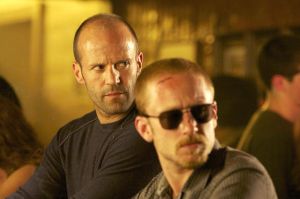 To say that The Mechanic is a well-oiled formula picture is probably the kindest thing that can be said. It follows the path of its hitman forbears fairly close. The opening pre-credit sequence is a hit that established the abilities of our deadly lead, Donald Sutherland pops up just long enough to lay down the necessary exposition for the film, and then before we even finish the first reel (20-minute mark) the movie manages to introduce a sexy female (Mini Anden) whose only purpose, in grand action movie tradition, is to have enthusiastic sex with the lead whenever his tank is low. The rest of the movie follows rather lockstep with the various beats of the genre, meaning that Bishop takes on an apprentice, shows him the ropes, they bond by taking out the bad guys, and then of course the final show drops and the truth about Bishop killing Harry is revealed. Along the way, The Mechanic does enough to satisfy genre fans looking for the goods when it comes to thrills.
The best moments are the tag-team hitman efforts of Bishop and Steve. The stuntwork is occasionally impressive like when Bishop and Steve repel down a large hotel building or when a car literally drives all the way inside a bus. There’s a brutal, visceral fight between Steve and his first kill that serves as the film’s highpoint. It was these sequences that made me actually sit back and think, “You know, I think this concept would actually play best as an ongoing TV series.” Think about it: you’d have your target of the week, the planning and execution that always make for satisfying payoffs, and then week-to-week Bishop and Steve would continue their complicated relationship with Bishop’s guilt eating away at him while he tries to keep the truth at arm’s length away from his neophyte partner. To me, that sounds much more dramatically rich while still keeping the body count consistently high.
Of course by hewing so close to the confines of genre, The Mechanic also has very little going on outside of the mini-missions of the hit jobs. Bishop obviously has been misled and setup by his sleazy employers. It’s fairly clear early on that when a guy gets out of a limo in a three-piece suit and tells you that the old man in the wheelchair is the bad guy, red flags should be waving. There doesn’t seem to be a formidable opponent in this fight mostly because Bishop is long described as the best at what he does. So how do you stop the best? You’d think you’d hire other players of comparable skill or offer an incalculable amount of money to kill the guy. But our villain doesn’t do any of this. Five minutes prior to his death, our villain fails to even once threaten Bishop (don’t even pretend like that’s a spoiler). The main conflict is really the complicated connection between Bishop and Steve; however, this relationship is kept at a slow simmer the whole film, even after Steve pieces together the ugly truth. The character development is left mostly at an inferential level. That means that there are long stretches where the characters glare, dispense with macho cool speak, glare with sunglasses, and then fall back on some unique hitman quirk they all have to relax (Bishop listens to classical music on vinyl records because he takes life yet appreciates beauty! IRONY!).
 But the ending needs to be further discussed because it leaves a terrible aftertaste. Given the dramatic dynamic at work, you pretty much know that Bishop and Steve will eventually come to a head. Bishop regrets what he’s done and is trying to make amends and find some meager form of redemption by taking Steve under his wing. He’s trying to make amends for the many sins in his life. He’s coming to terms with his life’s choices. So then you would assume (spoilers to follow) that when Steve ultimately seeks his own very deserved sense of vengeance, that the old pro would accept his doomed fate. It makes the most sense. It provides an end for the character’s journey, it provides closure to Steve, and it allows for an ending where people have to pay for their life’s mistakes. It’s not even downbeat because it feels right; it’s the correct ending for this material. It’s also the way the original Mechanic ended. But why end the movie on Statham accepting death? That would shuttle any chances for Mechanic sequels. And so, in a colossal cop-out, our hero narrowly survives and even manages to set up a bomb to take out Steve. While his young partner was emotionally unstable and looking for an outlet for his billowing anger, but the man was warranted in his vengeance. It’s entirely the wrong ending for not just this kind of movie but this movie specifically. It smacks of a pathetic attempt to leave the option open for a would-be franchise. It eliminates the entire idea of consequences mattering.
Statham gives the exact same performance he’s been giving in every movie for a decade plus. You know what you’re getting with a Statham action vehicle, for better or worse. He’s going to get shirtless, he’s going to dispatch the bad guys with relative ease, and never once will an expression flash across his stony face. He even verbalizes guilt while still being completely stone-faced. You don’t really buy any inner turmoil with this guy; he’s too “cool” to have feelings other than anger and vengeance. But then Foster practically redeems the entire movie. The young actor has been delivering intense performances for years now, whether it is an emotionally unstable guy in Alpha Dog, an emotionally unstable guy in Hostage, an emotionally unstable guy in 3:10 to Yuma, or an emotionally unstable guy in The Messenger. Notice a pattern? I’m amazed the reservoir of little tricks Foster finds to make Steve pop. Foster gives a far better performance than the movie deserves.
The Mechanic is a routine action movie that fails to rise above its genre conventions due to a lackluster plot, some vapid character development, and a horrendous ending. Statham does his thing, his shirtless chest gets due prominence, but the movie lets both he and a game Foster down. The kills are rather sloppy leaving behind mountains of evidence and dead bodies, and yet there seem to be no consequences. That makes for a long march to an inevitable conclusion with a few bursts of colorful violence to entertain. But what actually exists on the screen isn’t half bad. It’s fairly unremarkable, straightforward genre pap, but that can be suitable for the right audience and the right frame of mind. I was seeking something brainless to excite me when I caught The Mechanic, and it modestly achieved these modest goals.
Nate’s Grade: C


 nathanzoebl
You must be logged in to post a comment.