Category Archives: 2009 Movies
Where the Wild Things Are (2009)

Studio execs are always seen as the bad guys, right? They meddle in the affairs of artists, more concerned about dollar signs and marketing potential than in lasting, authentic artistic achievement. Director Spike Jonze, the most lauded video music director of all time, has gone through five years of trials to bring the adaptation of Where the Wild Things Are to the big screen. He’s had his funding cut, he’s been dropped by one studio, and the second studio contemplated starting over from scratch after seeing an early cut of the movie. The studio heads were worried that Jonze’s take was too sullen and too scary for children. They asked for something a tad more uplifting about a boy that runs away to have adventures with giant monsters. Jonze and co-screenwriter Dave Eggers (Away We Go) insisted on their vision and stuck it out, and 18 months later, that vision is what made it to theaters. Having now seen Where the Wild Things Are, it pains me to accept that maybe those studio honchos had a point all along. Jonze’s film is eclectic and visually wondrous but this is not a children’s movie; this is a movie about childhood intended for thirty-something adults and film critics. And man, it’s a downer.
Based upon Maurice Sendak’s masterful 1963 book about an unruly child “sent to bed without supper,” we follow Max (Max Records), a nine-year-old on a tear through life. His older sister is growing up and hanging out with older friends, his dad is absent, and his mother (Catherine Keener) is trying to juggle work, kids, and having a life her own. One night she has a man over (Mark Ruffalo, in cameo form) and Max gets upset. His mother isn’t giving him the attention he feels he’s owed. So he acts out, bites his mother, and when she responds with genuine terror, he runs away. He finds a small boat and sails away across the ocean to a mysterious island. It is here that he encounters the titular wild things, giant beasts that act out in very similar ways. Max declares himself the king of the beasts and they accept. Carol (voiced by James Gandolfini, a fabulously warm performance) is the happiest to have somebody new to play and listen. There’s also the small goat-creature Alexander (Paul Dano), the eagle Douglas (Chris Cooper), the elusive KW (Lauren Ambrose), and the married monster couple, the pushy Judith (Catherine O’Hara) and the subdued Ira (Forest Whitaker). Together they form an unorthodox family that still falls prey to in fighting and jealousies.

First off, Jonze does a magnificent job of creating the world of the wild things. The cinematography by Lance Acord (Lost in Translation) uses a lot of handheld cameras to trail after Max, communicating the kinetic energy of youth. The movie looks gorgeous but doesn’t resort to a self-conscious gloss. Acord makes the wilderness look inviting and dangerous. The wild things are amazing creatures to watch, brought to startling life by Jim Henson’s creature shop and seamless CGI artistry to provide facial expressions. If these creatures were purely computer generated, they would lose a sense of magic. Watching the furry suits interact with the real world brings so much more enjoyment to the movie. These giant creatures look real and intimidating. I liked the fact that there’s one character, The Bull, who just stands in the background alone, and the other wild thing monsters make a point of not noticing him. He’s the weird disaffected kid on the outside. I also appreciated that the movie doesn’t pander to make the monsters cute and cuddly. They continue to be scary. At one point Carol even chases after Max with the intent to eat him. Jonze and Eggers have made a movie about childhood that doesn’t coddle children. The production design by K.K. Barrett (Marie Antoinette) is nicely imaginative, though it only deals with a handful of stick huts. The fort that the wild things construct is fantastical, like an alien structure but made completely out of twigs.
Jonze and Eggers have made a movie all about the feelings of childhood; however, it seems that almost all of those feelings are negative. Sure Max bounces around with youthful energy, and his imagination goes to exuberant places, but the movie paints a broad picture of how painful and disappointing childhood can be. The movie doesn’t capture the wonder and excitement and possibilities of childhood; it focuses on the somber realities of what it’s like to be misunderstood, lonely, and incapable of changing anything. What about the pleasures of childhood? Even when Max engages in his fantastic creativity it usually leads to destruction and hurt feelings; everyone ends up in a worse place. A great example is in the opening sequence where Max tries to snare his older sister and her friends into a snowball fight. He gets them to play along and then everything is great, until the older kids accidentally take it too far and Max is left embarrassed, hurt, scared, and incredibly angry, which leads to lashing out, which then leads to regret and attempts to rationalize it as not his fault. This pattern is repeated throughout, where Max will get scared or confused and this triggers bouts of physical violence, like literally biting his mother. You might think his time on the island would be an escape, but really all of the monsters are manifestations of Max’s fractured psychology. KW represents his older sister’s approval so deeply longed for; Judith represents his defensiveness; Alexander represents his feelings of marginalization and helplessness; and Carol most closely resembles Max’s id, concerned that his family is falling apart, prone to jealousy and sudden violent outbursts when he doesn’t get his way. It all can make for an interesting psychoanalytical experience but it also can get tiresome. Listening to needy, whiny, morose monsters can be exasperating after awhile when there isn’t anything else resembling a plot. Where the Wild Things Are feels somewhat like Jonze and Eggers are subjecting everyone to their own therapy.

This shaggy, somewhat draggy movie has little else going on, so we watch Max boss around the monsters, commission colossal forts, run around, sleep in a big pile, and more or less try and hold a family together when they are moving in different directions. Things slow down a lot on this island. Max himself is a polarizing figure. Some people find him relatable, his pain and fears, and still others find him to be a wild brat. His behavior seems to go beyond that of a normal child acting out. I’m not going to prescribe the kid but me thinks there may be something else amiss with Max (am I alone in my diagnosis, people?). My friend thought Max was an insufferable and unsympathetic brat who learned nothing by the end of the movie. I feel that Max has to have learned something, since his entire time spent on the island was him working out his troubles to gain a little more perspective. Records is a real find as a child actor, and he’s the only human onscreen for like 90 minutes. I thought he carried the movie ably enough and finely displayed the conflicting emotions of being nine years old.
Will you like Where the Wild Things Are? That’s difficult to surmise. It may depend upon whether you can identify with Max; I couldn’t for the most part. This is a much easier movie to admire than to like. There’s very little fun to be had. The movie has an implicit sense of loss and melancholy throughout. Children’s movies don’t need to be all happy endings and feel-good lessons, but then again they don’t also have to be densely Freudian. Childhood isn’t all innocence and rainbows, but it’s also not all rain clouds and emotional meltdowns and feelings of impotence. The movie presents childhood as an unyielding hell. I know other people love Where the Wild Things Are, and I respect that artistry Jonze and his crew brought to this movie, but I doubt I’ll ever watch this movie again in my life. For once, the studio execs had it right.
Nate’s Grade: B-
Share this:

Away We Go (2009)
 Away We Go sort of came and went in the blink of an eye over the summer. Some critics dinged the indie production as being insufferable, hipster, smug, and unlikable. I agree that the plaintive guitar-strumming score grates, and the costumes have that trying-hard-not-to-be-hip coolness, which can be insufferable, but Away We Go is more than just faulty hipster packaging. There is a moving and entertaining drama inside here. The problem is, you have to sift through some of the junk to reach it.
Burt (John Krasinski) and Verona (Maya Rudolph) are in their early thirties and about to have a baby. They aren’t exactly hipsters but they have been living a somewhat fringe existence; Verona even points out that they have a cardboard window. Their existence has been mostly ramshackle and now its about to change forever. Burt and Verona decide to journey across the country and reunite with family and old friends. They’re studying widely different family units across the country to discover not just what kind of parents they will be but what kind of family they will be.
Just by the fact that nobody dies at the end, this is a big departure for director Sam Mendes (American Beauty, Revolutionary Road). This low-key road trip comedy is quite different from the meticulous prestige pictures associated with the Mendes name. Away We Go is a scruffy, small, and disarming little picture that wants to say something. I was taken aback at how affecting I found moments of Away We Go, though it is only moments. Burt and Verona are not exactly the best equipped to start a family right now, which makes them anxious and nervous, and anxious about not being more nervous. They haven’t exactly matured much since graduated college years ago. But amidst their search for the definition of a “working family” they must accept the uncertainty of life. Burt and Verona have a comfortable interaction, from his upbeat sarcasm to her grounded realism. There’s a great running gag where Burt tries to raise the baby’s heart rate, so his goofy bouts of fake agitation will be immediately followed by a stethoscope and an adorable grin of satisfaction. They are a compatible couple and it is refreshing to see a movie couple that compliments each other in personality. They actually love each other, are good for one another, and are not beset with contrived conflicts. In fact, the movie ends up pretty much exactly where it began, only with a smattering more of wisdom. The lesson learned in Away We Go is that it doesn’t matter what the bumps in life may be, it’s all about who you have as your co-pilot.
 Screenwriters and married partners, Dave Eggers and Vendela Vida, mix in small moments of weight and an overall tone of genial sweetness. The drama and the comedy are given equal share of the script, though the elements don?t mix that often. The funniest moment, by far, is when a little boy tells his mother exactly what he knows about babies (I won’t spoil the guffaw-inducing surprise). There are some quiet yet weighty moments of human observation here. There was a tender exchange between Verona and her sister Grace (Carmen Ejogo) that had me on the verge of tears. The sisters reminisce about their parents, long dead, and then Grace says that having this baby keeps their parents alive; the sisters can see parts of their mother in the baby’s face. Verona is giving back life to her dearly departed mother and keeping her parents’ legacy ongoing. This lovely thought struck me with such sudden force that I felt overcome with emotion. It could be dismissed as a common sense fact of genetic proliferation, but I had never thought of the birth of a child as a means of keeping the past alive and honored. To me, this is a simple yet wonderful and powerful statement. Another great moment is when Burt and Verona make lifelong promises to each other on a trampoline. Verona doesn’t want to marry, so the scene is the equivalent of the two lovebirds exchanging vows. It’s heartfelt and sincere and well within the bounds of the characters.
What?s frustrating to me is that the movie?s poignancy is undercut by its excisions with grotesque cartoon versions of bad parents. Burt and Verona visit different imperfect family units, but it isn’t until the end of the movie where we see anything resembling a semi-authentic brood. Alison Janney plays an obnoxiously loud parent who berates her children for laughs and accepts the brokenness of children; to her, she can’t fight against genetics and thus gives up parenting. On the flip side, Maggie Gyllenhaal plays a narcissistic earth mother who still nurses her children and condemns the very idea of strollers (“I love my babies. Why would I want to push them away?”). In each case, the depicted family is a caricature and readily ridiculed for some easy and snide laughs. Even Burt’s parents (Jeff Daniels, Catherine O’Hara) are figures set to be mocked for their self-absorbed bourgeois values. In some ways, Away We Go started to remind me of that awful movie North, where a young Elijah Wood travels the globe in search of new parents. At each stop, Wood encounters broad caricatures of different family units. In Away We Go, half of the movie is spent palling around with repulsive idiots who overstay their welcome fast. What’s even more frustrating is that the script becomes locked into a pattern, meaning that we spend the same amount of time (10-15 minutes) with each family. This is not helpful when Burt and Verona finally reach the relatable families, in Montreal and Miami, then the movie shortchanges the palpable drama. In Miami, Burt’s brother has had his wife run out on her family, abandoning their daughter. We’ve finally reached interesting and complex character, each with an aching sadness just below the surface about the hardships of parenthood, and the movie has to keep on moving because we spent too much time with the crazies for easy laughs. You’re supposed to spend more time with the good stuff, not the bad.
 The noisy, exaggerated supporting characters are balanced by the believably baffled Krasinki (TV’s The Office) and Rudolph (Idiocracy). He’s effortlessly charming and Rudolph plays her character with subdued texture, uneasily taking everything in for due consideration. Both actors are likable and we grow in empathy with them as they go from stop to stop. The couple is so charismatic that it makes the drama-free reality of functionality forgivable. The rest of the cast play their parts to the hilt, but special consideration should go out to Melanie Lynskey (The Informant!, Heavenly Creatures) who plays the mother of a large adopted clan of kids in Montreal. Her problem is that she cannot conceive and she’s endured five horrible miscarriages. Her slow and melancholy dance around a stripper’s pole is heartbreaking, and that?s something I thought I would never write in my life.
Despite some missteps, Away We Go is a sweet and affectionate little movie that fights against being overly twee and precious. It’s definitely not sentimental but at the same time it rejects cynicism and detached irony, embodied by the compatibility of a couple that truly love each other. At the same time, the movie can be annoying with its loud side characters that act as distractions. The best moments in Away We Go are the small ones centered on Burt and Verona. It’s those handful of small moments that pierce your heart. It’s strange but after writing this review, I realize that I like the good moments even more and the bad moments even less. It’s like Away We Go has become more entrenched in my mind. This is a sometimes promising, sometimes frustrating, drama that knows enough about life to not settle for easy answers. If only it didn’t settle for easy jokes with stupid characters.
Nate’s Grade: B+
Share this:

Year One (2009)
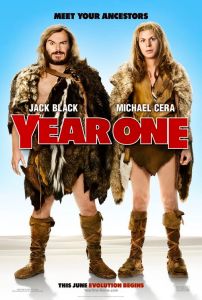 This is a slapdash comedy that?s too toothless to be satire and too dumb to be witty. Jack Black and Michael Cera play a pair of banished cavemen who stroll through various episodes from the Old Testament, like Cain and Abel and a circumcision-crazed Abraham, before settling in for a wild time at Sodom. This uninspired riff on the Bible rarely lands any laughs. The comedic aim of the film is extremely low; the scatological humor consists of farting peasants, bestiality, eating poop, urinating on your face, genital mutilation, and lots and lots of pedophilic jokes thanks to a grotesque, lispy Oliver Platt. Year One (of what exactly?) is a big step back for co-writer/director Harold Ramis and a general waste of everyone’s time and talent. Black and Cera do have an interesting and playful ying-yang chemistry but they have so little to do given the rambling, episodic nature of the plot. The characters make anachronistic pop culture references or talk in self-aware circles, the celebrity cameos do little, and the jokes lack any lasting momentum. Somewhere Ramis wants to make statements about religion and faith but the flick is too timid to do anything, so the movie limps to a finish with its lame “be your own chosen one” message. This is a prehistoric comedy with rocks in its head.
Nate’s Grade: C-
Share this:

Drag Me to Hell (2009)
 Sam Raimi returns to his spook roots in this delightfully disgusting horror flick. Drag Me to Hell has such a gleefully playful and perverse personality, alternating between being scary, being gross, being funny, and circling back for more. This is camp of the highest hokey order, and Raimi infuses every moment with inspired schlock. Poor Alison Lohman, the bank loan officer cursed to be dragged to hell in three days time. She gets a lot of fluids sprayed into her face (there’s an oral obsession to this movie; lots of mouth stuff) and she takes it like a trooper. She’s put through a physical wringer here and maintains her dignity and believability among staples to the head, grave digging, and talking goats. The ending seems to be coasting to a predictable finish and then it hits you in the head, upsetting your sensibilities. I loved it. Drag Me to Hell, ultimately, is little more than a glossy, entertaining blow-off, a reminder what an inventive director can do with the horror genre. It doesn’t all have to be nubile teenagers escaping a knife-wielding maniac. If there is one lesson I’ve learned from movies and television, you do not anger the gypsies. They have a monopoly on curses and they are not afraid to use them.
Nate’s Grade: A-
Share this:

State of Play (2009)
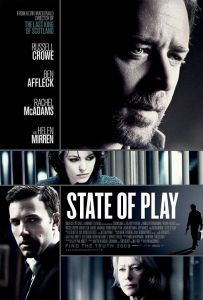 This is a solidly engaging mystery with some twists and turns that don’t come out of left field. Russell Crowe is a journalist investigating the murder of a Congressional aide, who just happened to be having an affair with Ben Affleck, his old friend. There are strong performances all around by the cast, though Rachel McAdams seems superfluous as a blogger-turned-sidekick except for allowing the movie to barely touch upon the idea of print journalism dying. The biggest issue is the pacing. The movie stays at a constant simmer, which works for grabbing your interest but then the final plot blows feel lacking because the narrative has not risen in tension. In fact, I’d say the conclusion to one of the two main mysteries is downright disappointing the way it fails to dovetail with the other, larger mystery. There is a lot more that could be said over the state of modern newspapers and the inherent biases that need be kept at bay. State of Play is an intelligent thriller but ultimately too limited by the condensed framework of its script. This movie feels like it has more ideas to share, ethics to chew over, questions to tease out, characters to ripen, and that’s probably because State of Play is based upon a 2003 BBC miniseries that gave sufficient time for these elements to flourish. Still, I can’t knock this relevant, political, old-fashioned conspiracy thriller. It’s too rare these days that Hollywood churns out smart movies like this for adults.
Nate’s Grade: B
Share this:

The Proposal (2009)
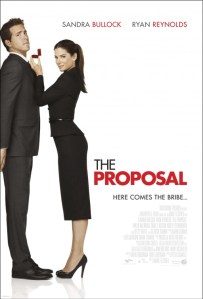 Romantic comedies can be elevated by the chemistry and comic abilities of their leads. I think the most painful modern pairing was Maid in Manhattan, which featured polar opposites Jennifer Lopez and Ralph Fiennes (could you find a more unlikely couple outside of Harold and Maude?). With The Proposal, Sandra Bullock takes a break from her usual pratfalls and finds a worthy sparring partner in the charming, self-effacing Ryan Reynolds. Bullock is a mean book editor who must get married ASAP or be deported back to Canada, and Reynolds plays her beleaguered assistant and surprise sham fiancé. The two actors have a terrific rapport and generous give-and-take, propping the other to higher achievement; they feed off each other. Their spirited, snappy, collaborative, and most significant, fun relationship is what won me over. Otherwise, The Proposal would likely have succumbed to its wealth of genre clichés, like kooky relatives (an irascible Betty White), contrived conflicts (see: premise), last-minute misunderstandings, and the collapsed window of time. These people go from hating each other to loving each other over the course of one weekend in Alaska. Yet through it all, Reynolds and Bullock kept me smiling and alert, saving me from cuteness overdoses. Hopefully Bullock and studio execs will learn from this that bickering couples work best when the actors can play nice together.
Nate’s Grade: B
Share this:

Couples Retreat (2009)
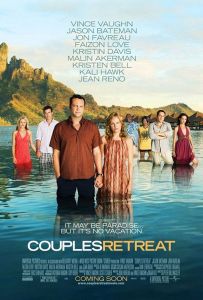 Vince Vaughn is a likable scamp. He’s generally played the same quick-witted, charming, motor-mouth lout in every movie since 2005’s smash, Wedding Crashers. He’s been working fairly nonstop since then and has, by all accounts, become something of a box office draw, which seems bizarre if you think about it long enough. So the best thing I can say about Vaughn’s new comedy Couples Retreat is, hey, at least he’s making sure his pals can pay the bills.
I think it was that famed poet Pat Benatar who said love is a battlefield. She never went through marriage counseling (note: maybe she did, I don’t care to actually research this). The movie centers around four dysfunctional couples that take a vocational to a tropical island resort. Dave (Vaughn) has trouble prioritizing his wife, Ronnie (Malin Akerman). Joey (Jon Favreau) and Lucy (Kristin Davis) have been together ever since she got pregnant in high school. They’re at each other’s throats and secretly looking to cheat on each other. Jason (Jason Bateman) and his way younger wife, Cynthia (Kristen Bell), are unable to conceive a baby. They’re very organized about their life and cannot handle life’s deviations. Finally, Shane (Faizon Love) has been dumped by his wife and is taking the loss hard. He’s found comfort in a flighty twenty-year-old girl (Kali Hawk) that he can barely keep up with. The vacation is interrupted when the couples learn that they must participate in the resort’s relationship therapy sessions or leave. The couples must stick it out to in order to save failing relationships and ride those nifty Jet skis.
 Couples Retreat sure doesn’t feel like any vacation for the audience. Directed by Peter “Ralphie” Billingsley (longtime friend and producing partner for Vaughn and Favreau), the pacing is leaden and the movie feels like its coasting without any momentum. Structurally, the plot is not your series of escalating events but more a relentless parade of tiny plot speed bumps, seemingly indistinguishable from the last. Many scenes just bump right into each other with little transition. Billingsley does not show that he comprehends the rhythms of comedy. Even at a mere 107 minutes, this movie felt twice as long to me. Like Peter Jackson’s King Kong, it just takes way too damn long for these people to get to the freaking island. I don’t need a half hour of setup for stock characters. Many scenes will go on too long and then just sort of come to an abrupt end, like Vaughn and his friends were saying, “Well, we’ve taken this as far as we can go. The scenes don’t end in climaxes or revelations or punch lines, they just end. So after a while I felt like Couples Retreat was one long draggy middle of a mediocre movie stretched out interminably. It’s the equivalent of an eternity of waiting in a doctor’s office.
The character work is haphazard at best. You would think with the premise involving introspection and communication that the screenplay might offer up some deeper characters. You would be mistaken. Each character is given one note/generalized conflict to work, and they stay exactly within that narrow field of play. The male-female dynamics are Joey and Lucy have been together since high school and now they each have wandering eyes. Of course this kind of waffling infidelity is played for such sophomoric yuk-yuks like Joey getting caught masturbating and Joey getting an erection during a massage. You see a trend there? Cynthia and Jason are too anal retentive about their lives and the fun has died out. Sounds like room for some comedy. Oh, and they are also having trouble conceiving, which is way too serious a topic for this kind of movie. It’s somewhat amusing to think of Vaughn as the most stable character in a family comedy; it’s sort of like when Christopher Walken was the voice of reason in 2004’s equally bad, Man on Fire. What is Vaughn’s problem exactly anyway? He’s a “video game seller” who spends too much time… selling video games? The particulars of his job are too nebulous; does he work at a large chain, does he work at a software production company, what does he do that he can’t bother helping out his wife for one afternoon? You could almost certainly eliminate Faizon Love’s character completely. He’s just in the movie to crank out obligatory “older guy with too young girl” jokes, and his resolution is so hackneyed and reliant upon ridiculous coincidence (surprise, his ex-wife has tracked him down to the resort!) that it hurts the brain.
The movie has the benefit of being made in one of the most gorgeous places on earth. I’m sure the cast and crew had a great time making this movie. Too bad it doesn’t translate well to the paying customers. I was surprised at how stodgy the overall film is. I expected it to look down on hedonism, and I appreciated the movie treating marriage as a serious commitment that constantly needs to be engaged, but what is up with how stuffy this message comes across? The people who aren’t in relationships are seen as little party animals looking for their next carefree fix. Sure marriage is going to look better to the masses when you make the alternative so irresponsible. However, prolonging unhappy, extremely dysfunctional couples who can no longer stand each other isn’t helping either. Can’t some dysfunctional couples just grow apart? Why must there be reprehensibly forced happy endings all around? Couples Retreat, after awhile, kind of feels like your grandmother lecturing you about your relationships.
 There’s much potential for laughs with Couples Retreat, but you’ll do no better than scattered chuckles. This is definitely a case where all the good jokes were highlighted in the trailer. Couples Retreat squanders so much talent, mostly consisting of a boy’s club and giving the actresses little to do or play off of. Akerman (The Heartbreak Kid), Bell (Forgetting Sarah Marshall), and Davis (Sex and the City) are all very capable comedic actresses; Kali Hawk quickly becomes irritating with what she’s been given. The island therapists include the hilarious John Michael Higgins (The Ugly Truth) and Ken Jeong (The Hangover), who must be contractually obligated to appear in every movie this year. I would have thought that eccentric therapists plus the natural conflicts of couples counseling would have provided a wealth of funny material. It’s a shame then that the counseling scenes are kept short. It would be a better asset for this movie if it spent more time in therapy and less time doing goofy, trust building exercises by island guru Jean Reno. Seriously, swimming with sharks is supposed to help a deteriorating marriage how? There are comic setups that look like they’re going to lead to something juicy, and then they just fizzle, like a Guitar Hero battle that goes from silly to lame all too quick. A buff and tan yoga instructor (Carlos Ponce) gets a little too in touchy-feely with his female pupils. But then it stays at a distance, hammering home the same PG-13 safe sight gags. It’s like watching people dry hump for laughs. As I expected, the funniest parts are the naturally combative interplay between Vaughn and Favreau. Part of that may be because they’ve been friends for over a decade and part of that might be that both are credited as screenwriters, along with producer Dana Fox (What Happens in Vegas).
Let’s look at how I’ve described Couples Retreat in this review. Waiting in a doctor?s office. Listening to your grandmother condemn your relationship. Doesn’t sound like much of a good time, does it? The comedy consists of mostly one-liners with a whole lot of dead space in between. The characters are so limited, the actors are shamefully wasted, and the comic set pieces are too meandering to be amusing. Somewhere there’s an edgier, R-rated version of this movie that got scrubbed clean to fit a PG-13 mandate. You see glimpses of the naughtier movie Couples Retreat might have been. This is a movie in need of some serious counseling of its own.
Nate’s Grade: C
Share this:

The Invention of Lying (2009)
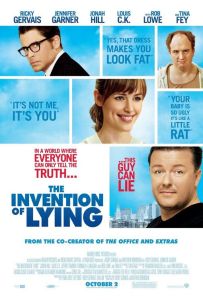 Imagine a world where people could only tell the truth. Sounds scarier than anything in horror movies today.
Mark (Gervais) is trying to romance Anna (Jennifer Garner) but even the waiter tells him she’s out of his league. She tells him upfront that she finds him unattractive and he will never have any hope of having sex with her. She’s more interested in Mark’s snide but handsome co-worker, Brad (Rob Lowe), who she feels is a better genetic match. Mark is about to be fired from his job, writing historical screenplays about the 13th century, and his secretary (Tina Fey) delights in telling him that she loathed every minute they spent together. This is a world without a filter. Until one day Mark goes to take out money from the bank, and something inside his brain switches. His balance is $300 but he asks for $800, and the bank teller apologizes for the computer error and gets Mark his full $800. He explains to his barfly friend Greg (Louis C.K.) that he said something that wasn’t. Nobody understands. “I’m a black Eskimo,” Mark says. Everybody takes him at his word. Mark is the only human on earth who has the ability to tell a lie, which he uses to his great advantage whether it be gambling, getting out of a traffic ticket, or unearthing a “lost” historical chapter about ninjas and aliens that makes for a stirring “non-fiction” film. Mark can’t even explain what he’s done, since the world lacks even a word for “lie.”
Gervais and co-writer Matthew Robinson concoct some interesting and inspired ideas of what a world bereft of lying would be like. Naturally, advertising would be completely different if people had to tell the truth, the whole truth, and nothing but the truth; imagine prescription drug ads that only said, “This is a placebo. Your penis won’t ever grow bigger.” The slogan for Coca-Cola is, “It’s very famous,” and the slogan featured for its rival, Pepsi, is, “When you can’t have Coke.” No one has any concept of fiction, of people pretending to play parts, so movies only consist of an older man sitting comfortably and reading a historical account with some minor dramatic inflection. Movies have become book reports. The sign in front of a retirement center says, “A Sad Place for Hopeless Old People,” and a motel sign reads, “A Cheap Place to Have Intercourse with a Near Stranger.” However, I’m puzzled by how forcefully open every person is. Just because you can only speak the truth doesn’t mean you have to be talking constantly. I understand Gervais’ point about the need for lies to protect people’s feelings, but just because you think someone looks fat doesn’t mean you have to blurt it out. When Mark greets Anna at the door for their date she reveals, “You’re early. I was just masturbating.” It’s funny, sure, but did she feel compelled to link the two statements? It seems in this world, everyone is incapable of keeping their mouths shut.
 The premise of the movie is terrific, and I’m honestly shocked no one has thought of it before. But the premise wears a little thin after the first 30 minutes of people speaking with no filter. You begin to expect outrageous comments that will be hurtful and blunt, and because you expect them it takes away the shock value and lessens the humor. But then The Invention of Lying takes a sharp right turn at about minute forty and becomes a radical and subversive and much funnier movie. Mark is comforting his dying mother (Fionnula Flanagan) who is afraid of leaving existence. She’s afraid of a cold nothingness. So Mark explains to her that there is an afterlife, a world beyond our own, where everybody gets to be around their loved ones in a mansion, and there’s no pain. She closes her eyes and dies in peace with this new knowledge. The doctors and nurses are amazed and beg to know more. Mark has created the idea of religion and God! He’s mobbed by people and camera crews demanding him to explain what he knows. Mark then works up the courage to establish a system of 10 rules to follow, which he tapes onto old pizza boxes. He then addresses his flock and has to explain the complicated minutia of religion, with hilarious questioning from the acolytes. Mark explains that there is a “man in the sky” who watches everything we do and is responsible for everything that happens. “Does that mean the Man in the Sky gave my sister cancer?” someone asks. Mark tries to explain the nature of a loving, all-powerful deity who willingly allows bad things to still happen. “Screw the Man in the Sky,” someone yells, “He’s going to kill us all. We need to fight back!” You try explaining the nature of the unknown to people.
It’s at this point that the movie transforms into a biting satire on belief and belief. I was cackling but I noticed that my theater seemed to get awfully quiet the longer the religious satire went on. I almost spat out my drink when I saw a spinning newspaper headline that said, “Man in the Sky Continues to Give Children AIDS.” It’s offensive but completely within the bounds of religious questioning. Gervais and Robinson aren’t ridiculing religious belief; in fact they seem to prove that it has a definite place of significance within society and can be beneficial psychologically. The satire isn’t savage and still manages to play with the amiable, fable-like nature of the story. Gervais isn’t laying out an argument that believing in an unforeseen deity is stupid. The movie isn’t condescending or hectoring, like Bill Maher’s anti-religion documentary Religulous, but it does take some slyly subversive swipes at the nature of faith and its reliance upon the unproven.
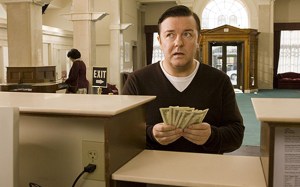 The Invention of Lying suffers from trying to be a romantic comedy. Too much of its conflict is spent on whether the chubby guy can get the pretty girl. The movie gets a tad sentimental for dealing in bitter-truths, and Gervais and Robinson steer the film to the ultimate romantic comedy setting: objecting at a wedding. I wouldn’t have minded the rom-com asides if they didn’t feel like they kept striking the same chord. Mark wants to be in a relationship with Anna. She points out that he’s fat, has a snub nose, and not a good genetic match. He persists. She points out that he?s fat, has a snub nose, and not a good genetic match. This goes on and on until the inevitable break at the end. Mark, and especially Gervais, is an appealing guy, self-effacing and witty, even downright cute at turns, but when Anna keeps repeating the same looks-first mantra, it makes her seem increasingly shallow and him seem like a glutton for punishment. Garner is a fabulous comedic actress and packs a lot more emotion into her character than I would have expected given the conceit.
Ricky Gervais is catching fire as of late, and it seems that America is finally waking up to the charms and brilliance of this squat comedian. He created The Office, the standard for squirm-based comedy, and appeared in the underrated supernatural comedy Ghost Town last fall. Gervais shows the necessity of lies in our world, from sparing hurt feelings to making mass-market entertainment. The world needs dishonesty. When The Invention of Lying is on-target, it is a hilarious, almost brilliant, comedy, with its best gags saved for taking on “the Man in the Sky.” It’s too bad then that the entire movie doesn’t live up to these flashes of comedic brilliance. Still, the movie is sweet enough and ends on a satisfying level, even if The Invention of Lying begins as one movie and ends as another. Gervais is an appealing lead, though he doesn’t prove much in the way of a director, and he has some real dramatic acting chops too, nicely put to use during his mother’s deathbed scene. I hope more Americans wake up to this man’s charms. Gervais continues to show audiences the sharp wit that has made him one of the world’s foremost funnymen.
Nate’s Grade: B+
Share this:

The Unborn (2009)
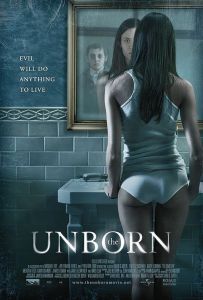 Writer/director David S. Goyer’s horror movie wants to be all things to all people and thus comes across as both conventional and sloppy. The story is about some evil presence that predates religion (all religion?), but somehow this is tied together with Nazi experiments on twins and a spooky kid that pops out. Most of the scares are cheap and silly, often giving way to vivid hallucinations that break when another character enters the room. Really, what is Holocaust material doing in such a by-the-book spook flick? It’s like a Jewish version of The Omen. The story manages to be hokey and too convoluted at the same time. Gee, for a movie that has the word “born” in the title and features a character getting sick weeks after sex, I wonder what the awesome twist ending will be? The movie is tedious from start to finish, though technically competent aside from the acting. It is unfathomable to me that Gary Oldman is a supporting actor in this tripe. It seems like the real purpose of this movie was to engineer gratuitous shots of Odette Yustman (Cloverfield) in her teeny, tiny cotton panties. In fact, I think there’s one review that only talks about her rear and its appeal, which is naturally why it is prominently displayed in the movie poster. When the malevolent spirit is going by its in-utero nickname, “Jumby,” it loses some serious scare factor. See this as a companion piece to the Oscar-winning drama, The Reader. Then tell me which has the stranger message.
Nate’s Grade: C-
Share this:

Sunshine Cleaning (2009)
 This mordant family drama has an intriguing premise, sisters who start a business cleaning up after messy crime scenes, but the film suffers from a crippling passivity. It’s nicely acted all around, especially Emily Blunt as the more troubled, wild child sister. The dysfunctional characters are established with momentary glimpses to back-stories, mostly tragic, but the narrative just sort of nudges them along. Sunshine Cleaning is a little too removed and clinical for its own good. The working-class characters are rundown but that doesn’t mean the movie has to feel the same way. Subplots and characters will be abandoned or left with no resolution. Alan Arkin’s scheming grandfather character never seems related to the plot, and he feels like he was lifted from another movie with a wackier veneer. It also makes time for cute sentimental elements that don’t jibe with the film’s tone, like using a CB radio to talk to loved ones in heaven. Sunshine Cleaning is sweet and sincere drama with some dark humor mixed in and it comes across as affable entertainment. Still, this movie had much more promise, if only it was less reserved and afraid to get its hands dirty.
Nate’s Grade: B-


 nathanzoebl
You must be logged in to post a comment.