Category Archives: 2009 Movies
Ninja Assassin (2009)
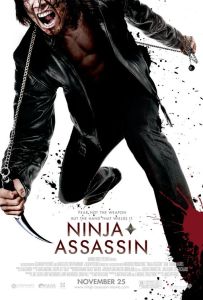 I never would have fathomed that a movie with both “ninja” and “assassin” in its title would barely hold my interest. This is a movie I got up and did the dishes through. Over-the-top never felt so boring, and perhaps it comes down to the flimsiest of stories strung together to connect the various ninja fights. It really does the bare minimum narrative-wise to get to the next opportunity for bloodletting, and oh what bloodletting! This is an extremely bloody movie but its power is undone because the violence is too stylized. Blood sprays like geysers and every slash of the flesh unleashes a balletic dance of painterly, soupy blood. The movie might work as disposable trash if only the action sequences were exciting. This isn’t a ninja movie but some half-assed video game. These aren’t Bruce Lee Ninjas, these ninjas can literally vanish into thin air before your eyes and they blend into the shadows. They are supernatural creatures that defy our traditional notions of what defines a ninja. This ain’t it. The characters all take such brutal beatings, and they spill tanker truckloads of blood, that it’s a wonder they can even stand let alone fight. There are a fee snazzy fight sequences but only thanks to choice in geography. The choppy editing only makes matters worse. I expected much more from the director of V for Vendetta. Ninja Assassin is just an un-engaging, hyper violent cartoon with a dimwitted story and little reason to care. The action isn’t even that good because the editing and lighting conspire to make sure you won’t be able to comprehend what’s going on. The best part of this entire damn stupid movie is the animated segment at the start of the closing credits. So have fun washing dishes until then, folks.
Nate’s Grade: C-
Share this:

The Informant! (2009)
 Stephen Soderbergh’s comic farce is highly amusing from start to finish. I even watched it twice and still found myself shaking my head and chuckling in bafflement. That’s the best way to describe the tone of the film — baffled laughter. Matt Damon stars as Mark Whitaker, a corporate whistleblower whose grasp on the truth is tenuous at best. Damon’s character is a cut-up and his delusions of being a spy plus his scatter-brained narration are as fascinating as they are hilarious. This guy thinks he’s James Bond. And yet the film, while deeply comic, never comes across as snide or condescending even if most of the laughs come from Whitaker’s disconnect from reality. The film has a deliberately ironic tongue-in-cheek vibe, from the silly yet undeniably jaunty kazoo-aided score by Marvin Hamlisch to even the amber-colored cinematography (like the film was shot through the prism of a honey jar), the movie is an entertaining series of blunders and revelations. Damon is charismatic and deeply funny and Whitaker makes for such an interesting main character exactly because he is so unpredictable and unreliable. He doles out the truth in pieces like a kid caught. The Informant! is light and breezy but with some well-honed psychology of rationalization and self-deception. I don’t know how true this supposed true-life tale really is, but it’s a hell of a fun tale.
Nate’s Grade: B+
Share this:

Whiteout (2009)
 I was expecting bad but this is shockingly bad, notably in its lapses in basic filmmaking fundamentals. For instance, there’s a scene where Kate Beckinsale talks with a superior, and the editing cuts back and forth in the middle of every damn line between a medium shot of the actress and a close-up. The jarring effect feels like the movie is punching you in the face. The movie can’t even get watching conversations right! This Antarctica-set murder mystery seems like a neat idea until you realize it’s just another lousy slasher movie, albeit in an exotic location. The Antarctica location is mostly used to make sure that nobody can tell what the hell’s going on. Furious white flurries of snow pretty much make the onscreen action oblique, like you’re trying to look through a dirty window and comprehend what’s happening. The plot sets up a wealth of disposable characters and patently obvious suspects (Gee, will the weird, tattooed pilot have something to do with a body dropped from a plane? Stay tuned). It’s all pretty stupid with no real room for brain-dead thrills because the technical craft is so shoddy. However, the movie did make it clear that when, not if, the CSI franchise expands, they need to set it in Antarctica.
Nate’s Grade: C-
Share this:

Ponyo (2009)
 It was hard for me to watch the initial trailers and advertisement for this movie because the animation just looked so … simple. I was forlorn that legendary director Hayao Miyazaki was taking a step backwards. He was stepping away from the complexity of his recent works. While his take on Han Christian Anderson’s Little Mermaid tale is intended for young children, I was relieved when I finally saw the finished animation. I got what he was going for: a painterly aesthetic that is seductively simple. The boy meets fish-turned-girl tale is resoundingly cute with a delightful sense of wonder; however, it really just sort of comes to an abrupt stop. The character relationships are established, the conflict of a sea princess being on land is developed, and then all the magical creatures team up and chat with the humans, and then we’re pretty much done. It’s a curiously hasty conclusion and it makes the movie feel less formalized and finished; Miyazaki is still one of the most imaginative filmmakers alive, in any medium, but Ponyo, while visually appealing and mostly adorable, suffer from shrift storytelling that ultimately makes this a cute if passing diversion.
Nate’s Grade: B
Share this:

Law Abiding Citizen (2009)
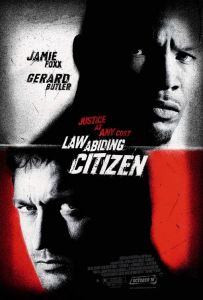 Taking a few lessons from the grisly Saw franchise, this revenge thriller follows Clyde (Gerard Butler) track and kill the men responsible for murdering his wife and child. Except that pretty gets resolved in 15 minutes. The rest of the movie is Clyde’s misguided, morally queasy assault on the justice system; the judges, lawyers, police officers that keep a dying system going, letting guilty murderers walk. Clyde is specifically targeting the prosecutor (Jaime Foxx) that made a plea bargain instead of risking his conviction percentage at a trial. This is a violent vision that wants to rewrite our very Constitution, questioning giving accused murders the same considerations as soccer moms. The movie can come across as a conservative, Death Wish-style fantasy against the judicial system and those pesky civil liberties afforded to everyone. While shrouded in the guise of being a bloody thriller, the movie’s idea of moral ambiguity is pretty thin. Its ethical arguments don’t stand a second line of questioning. Sure, director F. Gary Gray (The Italian Job) can put together an exciting and tense sequence, and the film is filled with surprise, and Butler arguably gives his best performance since 300, but while I was entertained I was also offended at being expected to cheer every time Clyde knocked off another innocent citizen.
Nate’s Grade: C
Share this:

A Prophet (2009)
 France’s entry for the Best Foreign Film Oscar is like a much more realistic version of HBO’s soapy prison drama, Oz, for better and worse. We follow a young prisoner who gets caught up in the power dynamics of the many warring factions within the pokey. This is a dense, slow-burning drama that hooks you early but then seems to stall. Early on, our lead character is given an ultimatum by a Corsican boss: murder an informant held in the jail or die himself. It’s a turbulent moral struggle with definite intrigue as he considers his dwindling options of escape and practices a routine to slit a man’s throat to save his own. After that A Prophet introduces a stream of characters inside and out of prison and it gets more complicated. The film values realism but it means that the characters aren’t as colorful, and therefore memorable or interesting, as they would be in similar crime capers. It makes it hard to remember who is who and why exactly they’re important. The story follows the steady ascent of our lead from nascent to criminal boss but it all plays out as a series of small power plays with little grand gestures. This is not Scarface at all. There’s little action, scant suspense, but mostly the movie deals with the minutia of climbing the criminal underworld. It’s like the filmmakers want to impress you with the homework they did in sociology. A bland lead and an overabundance of procedural details blunts the film’s entertainment quality. I appreciate gritty realism but after a while I’d sacrifice some of that realism for some more engaging characters.
Nate’s Grade: B+
Share this:

Bad Lieutenant: Port of Call New Orleans (2009)
 This is a crazy movie. It is not weird, it is not bizarre; it is not silly. Werner Herzog’s whacked-out movie is a remake of a 1992 movie that wasn’t that good to begin with. This certifiably crazy movie mostly involves Nicolas Cage as a corrupt cop playing all sides and snorting everything that isn’t bolted down in the Big Easy up his nose. For a stretch during the middle, he starts to sound like Jimmy Stewart with lockjaw. The central murder investigation plot is pretty much an afterthought in an environment like this. You want the crazy, and with Cage and Herzog, it is in no short supply. There’s Cage threatening an elderly woman at gunpoint, crawling reptile POV shots, a man’s “soul” break-dancing after the man lies dead, and neon iguanas that may exist only in Cage’s drugged-out mind. The film has been described as a trippy parody of standard cops-and-robbers fare, or as a seriously demented anti-drug message, but I think the best description is just “crazy-ass movie.” It has moments that make you do nothing but shake your head and laugh, like when Cage is about to hit rock bottom and EVERY case/storyline gets solved in a matter of seconds to his bemused disbelief. The comedy is straight-faced but it is definitely there. Cage harnesses his eccentricities and delivers an insanely entertaining performance that reconfirms that there is indeed an actor underneath his Hollywood veneer. He is compulsively enjoyable and the movie is compulsively watchable, every crazy freaking second of it. Iguanas!
Nate’s Grade: B
Share this:

Antichrist (2009)
 Just in time for Easter, I watched notoriously sadistic filmmaker Lars von Trier’s (Dancer in the Dark, Dogville) controversial psycho-horror film, Antichrist, and wow, is this a loathsome, powerfully unpleasant experience. There’s about five minutes of worth in this whole film. In a beautifully shot black and white prologue, we watch a couple (Charlotte Gainsbourg, Willem Dafoe) have sex and, unbeknownst to them, their baby falls out a window and dies. It’s all downhill from there and at rapid speed. The remaining movie explores Gainsbourg’s trauma and grief and her husband’s therapeutic attempts to cure his wife. There’s a somewhat intriguing premise buried underneath the mounds of psychobabble — a husband blurring the lines of professionalism to become his partner’s therapist. There are some complex ethical and emotional areas to explore there, but alas, von Trier takes his characters to a spooky cabin in the woods (named “Eden” for maximum metaphorical pretension) and the move becomes one long, incomprehensible, pompous trek into weirdness and pseudo-intellectualism. von Trier wants his movie to be disturbing, so he packs it will strange images like a dead talking fox (“Chaos reigns”) and a stillborn baby dear handing from the back of its mother, intending to convey the ruthless brutality of the natural world that his characters must navigate. Except I never cared about these characters at all. We never get to know them, so we can’t really feel for them, so when they start becoming unhinged it has no dramatic weight. Their lengthy conversations are a drag, and one psychology exercise after another doesn’t make much sense. The von Trier narrative model (woman is relentlessly tortured) is alive and well and leads to some shocking scenes of over-the-top sexual violence. von Tier’s attitude toward women, and female sexuality, has always been somewhat sketchy; is he an exploitative misogynist or a cloaked feminist arguing that the male-dominated world cannot handle feminine sexuality and independence? I feel like von Trier is an artist that could be diagnosed with Munchausen’s by proxy syndrome.
Nate’s Grade: D+
Share this:

Saw VI (2009)
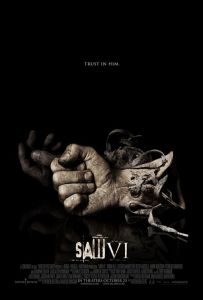 I checked out on Saw 4 and Saw 5 feeling like this horror series had grown stagnant, plus its central villain was killed off by the conclusion of the third movie. I thought the series wouldn’t go on for much longer, and oh how wrong I was. Jigsaw (Tobin Bell) has a second apprentice now fulfilling his departed master’s bidding, capturing even more people and trapping them into the franchise-favorite death traps. This means that there are yet even MORE recorded messages and vast, abandoned warehouses out there. FBI Agent Hoffman (Contas Mandyor, an amazingly horrible actor) has taken up the contrived contraption mantle. Of course it’s all preposterous and overly gory, but that never stopped the series before. Saw 6 boasts the franchise’s fourth director (the editor of all the previous movies just graduated to the big leagues). But this is mainly a franchise built around the hardened desires of its fans, indoctrinated in the gospel of gore. As I said before with Saw 3: “Just like the collapse of the Final Destination franchise, these movies started big but then bottomed out when their audiences had the rules memorized. At that point the only thing left is curiosity in what fiendishly outlandish ways people will get horribly killed.” This pretty much still holds true.
The real interesting draw for the sixth entry, and the only reason I drifted back in curiosity, is because Saw 6 is the weirdest participant yet in the current health care debate. The victims in this installment are health insurance employees. The people in charge of deciding who live and who dies are now put through morally challenging, queasy challenges. It’s a lot harder to kill somebody deliberately rather than by omission, by denying coverage or finding a loophole to get out of paying for a perfectly reasonable, and much needed, procedure. There’s a macabre enjoyment in watching health insurance officials put through Jigsaw’s battery of tests, though some of his victims seem pitiable — one guy is thrown in just because he’s a smoker (I suppose Jigsaw didn’t consider giving the guy a nicotine patch first). The main character going through the funhouse of horrors is an insurance company CEO (Peter Outerbridge) who has his mathematical equation about who earns coverage put to the test. Jigsaw is exacting vengeance after the CEO denied him coverage on an experimental treatment for cancer. It’s easy to see what side of the issue Jigsaw is on; he says that insurance companies put profits over human lives and get in the way between doctors and patients. This is a Saw movie even Michael Moore could cheer. I wish at the recent health care summit on Capitol Hill that the president had said, “Gentlemen, we’ve heard what the Democrats had to say about health care, we’ve heard what the Republicans had to say. I’d now like us all to see what Saw 6 has to say on the matter.”
 The story again is cut into two halves: the health insurance CEO going from death trap to death trap, and Agent Hoffman trying to stay ahead of the FBI investigation into the new Jigsaw killer. Guess which is more interesting? The FBI agents in this movie are those classical trained bumbling FBI goons that always come in late, take things over, and properly muck everything up. These people are lousy detectives and even worse at hiding their suspicions about Hoffman. It’s no surprise then that he manages to outsmart these idiots when Hoffman is, in fact, a dolt. This is not a smart man. Case in point, he’s using the severed thumb of a dead agent (Scott Patterson, apparently on Hoffman’s trail for the previous two films) to mark up bodies and frame the guy. Problem is that he’s framing a dead man, which means Hoffman has a really small window of plausible time to make this frame credible. It’s not going to work months later when the FBI wonders how a dead agent keeps kidnapping new people and putting them through hell. Then again, given the intelligence level of these onscreen agents, I’d assume that the FBI would blame zombies.
The apprentice aspect has always been the worst part of this series. I do not care whatsoever about the ins and outs of how Jigsaw set up his traps and who helped build the damn things. This isn’t some Discovery Channel series. I don’t need to watch the behind-the-scenes look at the grisly garage of doom. Just like the third Saw film, this is another entry that wants to play around with the bigger Saw picture. Scenes are introduced that retroactively alter the Saw timeline of events, causing characters to grow different motivations. I swear, the Saw movies all start to feel like they’ve been built from the rotting leftovers from each previous and less effective movie.
The only thing of note as far as acting goes is that the opening player (Tanedra Howard) won a VH1 reality show competition for a spot in this movie. Ladies and gentlemen, we now live in an age where people will compete for the luxury of being the first to cut open their insides in the SIXTH movie of a flagging horror franchise. You don’t want to know what they’re willing to do for a spot in the next flick.
 The draw of this franchise are its clever yet queasy death traps where the audience can place itself in the victim’s position and wonder what they would do given the life-and-death circumstances. How far would we all go to live? Well, in Saw 6 the traps aren’t that fiendish or memorable. The best one involves a group of six insurance actuaries (experts at finding loopholes to deny and cancel coverage) tied to a carousel with a shotgun pointed at them. One by one they swing by the kill zone, making it the most proverbially deadly game of musical chairs ever. Even better is the fact that the CEO is given the opportunity to “save” two on the carousel from the shotgun blast, so they each start screaming little arguments why they are worthy and their peers are not. It’s a neat little pressure-cooker of a scene, especially when one guy on the carousel realizes he’s the last to die. The thing slowly reels back around as he uses his final seconds to demand that the CEO look at him (“You look at me when you kill me!”). That defiant little moment manages to pierce through the ponderous personal growth edict the series has foolishly heralded as its purpose. The rest of the death traps are just cruel and labored and not nearly as interesting. You ca only watch people singe their skin on hot burners so many times before the body begins to involuntarily yawn.
Saw 6 is certainly no better than the other movies but neither is it worse. It’s the topical subject matter that makes this the only Saw movie worth a dubious look after the first flick. It taps into a populist rage against insurance companies that makes it vicariously satisfying and truly bizarre. It would be questionable to say that the franchise has recaptured any sort of creative juice, but I wouldn’t mind catching a future Saw film take on other big issues plaguing our country. Imagine Saw tackling predatory lending and the negligible banking industry resisting reform tooth and nail. Wait until the heads of Goldman Sachs and AIG get a load of Jigsaw.
Nate’s Grade: C
Share this:

The White Ribbon (2009)
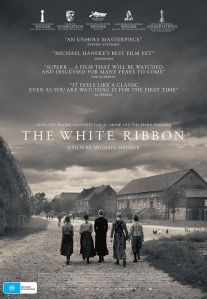 After all the awards and hype, I’m left fairly unmoved. I think I’m just not a fan of the director; I disliked Funny Games, disliked The Piano Teacher, and think Cache is vastly overrated. Michael Haneke is just not for me, and The White Ribbon is further proof of this fact. This is two and half-hours of incidents. Supposedly, since its victory at the 2009 Cannes Film Festival, this movie was dubbed as a case study examining the beginnings of antisemitism as a small German town undergoes a series of mysterious violent assaults and vandalism. I don’t know how in the world this explores any sort of psychological group think to later clarify Germany’s willingness to accept Hitler’s demands. All this movie does is show yet another example of teenagers rebelling. In typical Haneke fashion, characters can be unbelievably cruel to one another at the flick of a switch. Nothing really adds up and the pacing is so mind-numbingly deliberate to showcase the world of pre-World War I Germany. So when people leave the room we watch them walk off screen, hear their off screen noises, then they return and go off screen again and we can repeat the same jolly waiting game. I understand the artistic thought behind it, but I’d be much more forgiving if Haneke had developed a story and some characters worthy to wait for. This is a plodding and conceited exercise that reveals next to nothing about the human condition for cruelty, because, chiefly, you don’t really believe that these people exist nor do you care.
Nate’s Grade: C


 nathanzoebl
You must be logged in to post a comment.