Category Archives: 2007 Movies
Gone Baby Gone (2007)
 Ben Affleck doesn’t necessarily establish any gifted visual style with his directing debut, however, Affleck the Screenwriter and Affleck the Actor ensure that the movie succeeds swimmingly as a murky morality play. The film is an actor’s showcase and they get plenty of room to maneuver, with standout performances by Ed Harris as an embittered cop and Amy Ryan as the living embodiment of the worst white trash would-be mother on the planet. Where Affleck earns his artistic stripes is by asking hard questions with moral ambiguity and not dishing out easy answers. This is an above average crime thriller that uses its lower class Boston setting as an additional character. There are only a handful of relevant flaws, like Michelle Mongahan’s character being pointless except to cry, and a mystery that clever moviegoers will have figured it out early thanks to the economy of characters and some shifty glances. The missing child mystery allows Affleck to explore some very dark places and non darker than the human soul. Affleck may not dazzle with visual prowess, but the man sure knows how to tell a damn good story and direct actors to award-winning levels. Give this man another movie.
Nate’s Grade: A-
Share this:

In the Valley of Elah (2007)
 Is anyone more polarizing in the film world at this moment than writer/director Paul Haggis? He takes a far subtler approach to exploring difficult subject matter this time, and the lack of histrionics makes the message far more serviceable. The film begins as a mystery, with Tommy Lee Jones investigating the disappearance of his son who was supposed to return from Iraq. Then the film transforms into an examination on the hidden, psychological costs of a war that continues to backslide into incivility and chaos. Jones gives a terrific taciturn performance, expressing so much sorrow with his hangdog expressions and sad, soulful eyes. There isn’t a moment in the movie that feels trite or contrived, and its conclusion is surprising in how subdued it plays out, which makes it far more emotionally troublesome. The title is in reference to the location of the famous biblical battle between David and Goliath. Is America Goliath? Are we David? I can’t honestly decode all the metaphors in this solid slow burn anti-war flick. Haggis is bristling with things to say but effectively buries them below the surface so that the viewer is not beaten over the head but yet left with many significant questions. And what police investigation, even in a war away from home flick, would be complete without a visit to a strip club?
Nate’s Grade: B+
Share this:

Michael Clayton (2007)
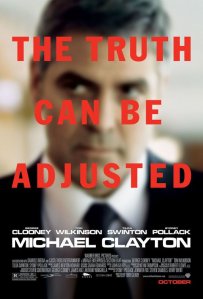 A smart, suspenseful, terrifically acted corporate thriller, this movie hums along with great precision thanks to a deeply articulate screenplay by writer/director Tony Gilroy. The acting trio (George Clooney, Tom Wilkinson, Tilda Swinton) delivers sensational performances muddled with doubt and weary, nervy complexity; each comes across a full human being in what could have come across as a dull Law and Order episode. I don’t understand why Gilroy plays around with the film’s timeframe, because he spends nearly ten minutes at the end in a suspenseful car chase where we already know the outcome. There is a murder that is played against Hollywood convention; it’s quick, grimly efficient, and scary in how soon it’s all over. Michael Clayton is a first-class movie that respects the intelligence of an audience.
Nate’s Grade: A
Share this:

Ratatouille (2007)
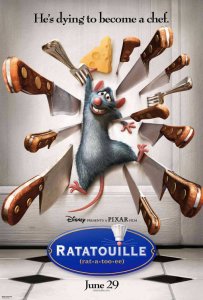 This movie continues to grow on me every day after I saw it. Writer/director Brad Bird yet again impresses with a deceptively simple story that manages to hit big themes in organic ways. The comic possibilities are fully realized with the setup of a man and a rat teaming up to be a great Parisian chef. There is a jubilant spirit alive and well throughout the film, and it’s difficult not to get swept up in the wit, the wonder, and the magnificent visual feast.
Nate’s Grade: A
Share this:

Elizabeth: The Golden Age (2007)
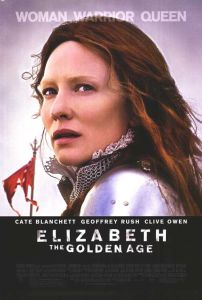 This unanticipated sequel to the 1998 film that put Cate Blanchett on the map is pretty much the same setup from the original go-round. Once again, Elizabeth is trying to assert her authority, once again Catholics are plotting an assassination to place Elizabeth’s good Catholic sister on the throne, once again Elizabeth pines for a man she cannot have, this time in the dashing form of Sir Walter Raleigh (Clive Owen). Everything is cranked into overkill, which means there are plenty of speeches and plenty of bellowing. The romantic triangle between Elizabeth, Raleigh, and Elizabeth’s most beloved assistant to the Queen (Abbie Cornish) is a waste of time and does not dignify any of the three. The camerawork ranges from awe-inspiring to maddening, with the director relying on bird-eye-view long shots and always throwing some object in the foreground to obscure the action. It gets old quickly. Blanchett gets to suit up with armor and ride a horse around, but this Elizabeth redux leaves much to be desired. If they ever kick around an Elizabeth 3 in, oh, 10 or so years, hopefully they can move on to a new story structure while I watch the aging queen through a lattice 300 feet high.
Nate’s Grade: B-
Share this:

There Will Be Blood (2007)
 Paul Thomas Anderson is one of the most gifted filmmakers working today, bar none. There Will Be Blood is only his fifth film and marks a radical departure from his intimate, inter-laced character dramas. Blood is an epic in size and scope and has been blessed with numerous awards and vehement praise. Critics say this film is one for the ages. My anticipation was fed to unhealthy proportions thanks to the hyperbolic praise and Anderson’s track record of audacious visionary cinema. There Will Be Blood is certainly audacious, and not just with its bladder-testing running length. This lethargic throwback to 1970 filmmaking exists for the purpose of a single performance and neglects other important tenets of storytelling. At 158 minutes, I can safely assume for many that there will be boredom with There Will Be Blood.
Our first glimpse of Daniel Plainview (Daniel Day-Lewis) is in the pit of a hole. It’s 1898 and Plainview is chipping away at the earth looking for scraps of silver. His meager beginnings set the stage for other mining prospects when, on the hunt for silver, he discovers even bigger riches – oil. Thanks to the advancing automobile age, the world has a thirst for oil that knows no bounds and makes Plainview a wealthy man. He’s an unscrupulous business figure that trots around his “son” HW (Dillion Freasier) as one more angle to fleece gullible townsfolk out of their property rights. HW’s father died in a drilling accident when he was a baby and Plainview has looked after him since.
One day Paul Sunday (Paul Dano) enters Plainview’s office and is willing to name a prime piece of land that oozes oil. Plainview agrees to pay Paul his sum and heads out with crew to Little Boston, California. The small town is easily enamored by Plainview’s promises of riches and prosperity. He purchases as much tracts of land as he can and begins drilling for that valuable black liquid. Eli Sunday (also Dano) is Paul’s twin brother; he wishes to build a church and become a prominent religious figure for his town. He sees the oil as his ticket to a throng of adoring congregants that will do his bidding. Oil is struck and several parties vie for dominance.
 I fear that Blood may be too languid for its own good. I’m all about allowing a film to take its time to establish a world and the people that inhabit it, and to its credit Blood spectacularly recreates turn-of-the-century America and the craze for oil. The cinematography and production design are stunning in gorgeously recreating a bygone era with such dusty detail. The film is packed with evocative imagery that will linger in your memory, like a burning oil derrick that feels like someone just drilled down to hell. The mixture of smoke, fire, and oil set amidst the hazy twilight is a remarkable sight. Visually speaking, this movie is close to flawless.
The nascent plot is what hampers Anderson’s Blood from reaching masterwork territory. The focus is on a misanthropic man who despises people and wants only to seclude himself, and yet he has genuine affection for his son until Daniel feels betrayed by his ambitions. I understand that the movie is a far-reaching character study, and Daniel Plainview is a fascinating and ferocious character, a perfect yet perplexing combination of greed and ambition, but I feel like Anderson has spent so much thought on his characters and forgotten to write a story around them. The silent, early portion of Blood gives us a quick summation of how Plainview rose to fortune and power and it’s rather compelling how much story comes across with no words of dialogue. This wordless pattern seeps into [i]Blood[/i] and there are stretches here and there where you may not hear a wisp of dialogue for, oh, 15 minutes, but by this point the movie is beyond setting up its storytelling universe. Again, I have no issues with the use of silence to convey meaning and metaphor, but it feels downright neglectful for Anderson to have concocted such intense, lively portraits of people and then to encase them in a void of speech.
Significant human interaction is kept to a minimum and I couldn’t help but feel that the movie was uncomfortably coasting without conflict for too long. Blood sets up Eli Sunday and Daniel Plainview as rivals, two men intent on grabbing power and the upper hand. The film takes a winding path to set these players in motion but I was encouraged that now, finally with two adversaries pitted together, the film would kick into another level and showcase a violent struggle worthy of a titan like Plainview. I recall every summary I read of There Will Be Blood noting that Eli is the thorn in Plainview’s side for many years and that their feud took up the bulk of the labored running time. This does not happen at all. Eli drops out for long stretches of plot and is forgotten unless Anderson feels that the character needs to be shoehorned back into the central drama at arbitrary points. This is no battle either, it’s all one-sided; Plainview handles Eli without breaking a sweat. With this in mind, I’m puzzled at how the conflict between Eli and Plainview was supposed to take center stage. Anderson had such wonderful potential to paint a doomed rivalry that eclipsed both men, but instead the external conflict only appears whenever Anderson desires some new sounding board for Plainview. That means that Blood can go for what feel like entire acts before it appears that conflict will be introduced or elaborated upon. There is a vacuum of story here and Eli Sunday, as written and performed, is far too submissive and easily beaten to present any formidable challenge.
 Why present characters at odds if you’re not going to push them further? Why write such vivid and amoral characters if you’re going to have them sit out or stay still? Plainview is the star of the show, I get that, but that isn’t an excuse for underwriting every single other character in an entire 158-minute movie. There are no intriguing character dynamics in this movie. Eli Sunday is forgotten. HW presents the closest insight into the humanity (what’s left) of Plainview, but the character is treated like a mute doll and when HW unexpectedly leaves the story so too does the only significantly interesting emotional relationship. Anderson establishes that greed comes in all shapes and sizes, be it an oil tycoon or a false prophet feasting on the coffers of his congregation. There is great thematic tension between the spiritual and the material but it never comes to a head. I kept waiting for confrontation but what Blood kept dishing out time and again was willful stagnation.
The extended ending forces a marginally contrived final reunion between Eli and Plainview but it doesn’t feel like any sort of payoff. The brutish and abrupt finale will cause many to scratch their heads and say, “That’s it?” until their scalps bleed. It’s a rather unsatisfying end for a film that boasted such grand ambitions.
The musical score by Radiohead guitarist Jonny Greenwood certainly wasn’t bad but it definitely did not mesh with the movie. Greenwood’s score consists mostly of a cacophony of violin strings buzzing about like a swarm of angry bees. The score seems to have a life of its own, intruding upon the scene at whim and upstaging character dialogue at times. The mixture of shrieking violins and some heavy percussion makes the movie feel less like a costume drama and more like a horror movie. The score seems to percolate and signify approaching danger. The score is also overly redundant and feels unnaturally paired to There Will Be Blood. It’s a marriage that doesn’t ever match.
 Day-Lewis doesn’t act often in movies and when he does it’s usually something special. His performance in Blood is outstanding, and it better be, because the film is built exclusively around his performance. He is an angry man bent on crushing opponents and making sure no one else gets sight of success. Day-Lewis is an immense talent and can dabble with multiple emotions with sheer, sightless subtlety. His distinct manner of speaking is finely attuned, though sometimes I felt like I was watching the world’s longest, and best, Jack Palence impersonation.
The other actors fall victim to the one-man show nature of the narrative. Dano comes across as miscast. He seems too youthful and ineffectual for the role. When he’s beaten and bullied his voice goes into a high-pitch squeal that is not becoming for the character. Dano’s acting takes the empty characterization one step further and removes any audience empathy.
Going by the repeated slam that Anderson is less a visionary and more a regurgitation of homage, if Boogie Nights was his Scorsese movie, Magnolia his Altman movie, Punch-Drunk Love his French New Wave movie, then There Will Be Blood is his Kubrick movie. It’s a plodding, challenging, and idiosyncratic movie that hits universal themes like family, greed, desire, and vengeance but does so in a small-scale story that feels intimate and epic simultaneously. The movie is dripping with artistic integrity and breathtaking filmmaking ability; however, it’s also a crushing disappointment. Anderson is a gifted writer/director with few contemporary peers, but he strands such vivid characters in a dessert of storytelling. There is little external conflict and the characters feel neglected or too easily forgotten. The focus is one misanthropic man but the film shortchanges him by not supplying additional substantial characters or conflict. Perhaps There Will Be Blood will stand the test of time and be the classic or landmark that critics are wetting themselves to declare it. It’s just simple economics in my mind: a character study cannot fully resonate without a strong network of supporting characters and/or lasting conflict. I have never been let down by a Paul Thomas Anderson film yet but I suppose there’s a first for everything.
Nate’s Grade: B-
Share this:

Atonement (2007)
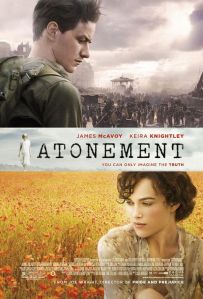 No film this awards season seems to have been kicked and beaten more than the sweeping period romance, Atonement. This poor movie has a strong stable of well-respected British thespians, a red-hot young director in Joe Wright (2005’s Pride and Prejudice), plenty of lofty, top-notch production values, and the whole enterprise is based off a highly acclaimed novel by author Ian McEwan. Where did all the hate come from? I think it has something to do with the fact that somewhere along the line Atonement became, on paper, the presumptive favorite to win Best Picture. Then reality hit and it hit hard. Atonement wasn’t even nominated by the Writer’s Guild, the Producer’s Guild, or the Director’s Guild and yet the film still managed to eek out a Best Picture nomination for 2007. I became suspicious that Atonement would turn out to be this year’s Dreamgirls, namely a presumptive front-runner that was too calculating and self-conscious and ultimately free of substance to make its mark. While Atonement is perfunctory and nothing altogether special, the film still succeeds as a worthy piece of entertainment that doesn’t deserve to be dragged through the mud.
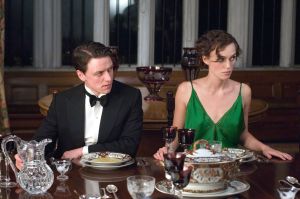 In the mid 1930s, Robbie (James McAvoy) works as a housekeeper’s son on a lovely English estate. He has his eye on Celia (Keira Knightley) and puts his burning passion to paper, typing two very different notes. The first one is blunt (and features a naughty word that rhymes with “blunt”) and the second one is more of a poetic declaration of his affections. Robbie has instructed Celia’s younger sister, Briony (Saoirse Ronan), to pass his love letter to the rightful party. He realizes too late that he sent her off with the wrong letter and Briony reads it herself, dumbfounded at the message and terminology. Briony is a bright child that fancies herself a playwright, but she’s still a child that cannot fully grasp the meaning of Robbie’s advancements. When she intrudes on Robbie and Celia having spontaneous sex against a library wall, she can only assume that Robbie is attacking her older sister (stupidly, neither says anything to clear up the awkwardness and just leaves the scene wordless). That same night Briony discovers her cousin being attacked and she’s certain that Robbie is the culprit, or is she? Her false confession sends Robbie to jail and alters lives forever.
Flash ahead to World War II, and Robbie has joined the Army to be released from jail, Celia reunites with him for the first time in years, and a now 18-year-old Briony (Romola Garai) realizes her foolishness as a child and tries expunging her overwhelming feelings of guilt by working as a nurse and tending to the ghastly numbers of wounded soldiers.
Atonement is visually ravishing to watch. The cinematography by Seamus McGarvey is lushly colorful and blends light and shadow to an extraordinarily effective degree, draping the performers in contrasting colors that pop. Wright’s camera always seems to be perfectly located to discover beautiful compositions indoors and out; the movie is just visually pleasing on all fronts, like seeing Knightley in her dark green dress bathed in the glow of police lights at night. At several points, however, the film’s look does get overly soft and glossy, like the cameraman smeared gobs of Vaseline over the lens. The period costumes and production design are agreeably period-y. The musical score has moments of great lyrical poignancy and then it shatters when the score resorts to integrating the sound of a clacking typewriter as a percussive instrument. I wanted to beat my head against a typewriter to make it stop.
 There’s a vague mechanical air over the entire two hours, like the filmmakers felt that merely assembling all the right pieces and having the right, awards-friendly pedigree would be enough. The five-minute uninterrupted tracking shot along the Dunkirk beach epitomizes this flawed belief. This superfluous shot wanders around soldiers stationed on a beach, winds around the outskirts of the bombed out city, and finally rests in a pub crawling with Brits, but nothing is added by the shot continuing uninterrupted and the staging fails to illuminate anything remarkable about the expensive set. The shot exists simply to call attention to its self and to serve as another bragging point for the filmmakers. The Dunkirk shot adds little to the atmosphere of the film because the scene barely flirts with giving a bigger picture of what is happening. Instead, that shot, like the movie, while well composed and entertaining, is an exercise in self-congratulation.
The film loses serious momentum as it transitions into war and its period of titular atoning. The movie just isn’t as compelling watching Robbie shuffle around at war. Rarely is he in any danger and he just seems to be biding time. Atonement is a tad too prim, a tad too demure to really go deep enough. The romance is intended to be of the unrequited variety but it feels malnourished even at an unrequited level, which is truly saying something. There is so much more beneath the surface but the film never wants to push too far for whatever reason. Knightley and McAvoy have a nice workable chemistry and that’s part of what makes the first half of Atonement the better half. So much of the story involves internal struggle but the movie doesn’t wish to invest the time needed to explore serious psychological wounds. Atonement never capitalizes on the intriguing if melodramatic opening of the film. This is by no means a love story, no matter what the marketers wish to convince otherwise. The romance between Celia and Robbie has little setup to seem believable or worthwhile. This is a movie about the power of words, which naturally is a topic that functions better in books.
After Kinsey and now Atonement, Vanessa Redgrave seems to have found a contemporary niche or her talents: she shows up in the final minutes to give a monologue that demands that the audience reflect from a fresh perspective. Redgrave plays an older adult Briony who has written several best selling books and is being interviewed for television. The ending is designed to be more devastating in print form, and it wants to call into question the nature of fiction and whether or not one lie and be absolved by another. But in the medium of film, the shockwaves are minimal because the language of film is visual. The stutter-step plot structure, which occasionally bends backwards to replay an event from an alternative perspective, is an extraneous annoyance that’s finally justified by Redgrave’s late appearance. What is the true cost for a “happy” ending?
 While Knightley and McAvoy get all the attention and cause teen girls to swoon uncontrollably, the real star of Atonement is 13-year-old Ronan. The young actress is a revelation as a sophisticated girl entering the earliest stages of womanhood. She’s nursing some serious puppy love on Robbie and his disinterest fuels her false confession; she means to punish him. Ronan is eloquently precocious at the start, acting wise beyond her years, but when she steels a glimpse at Robbie’s unfortunate letter, she drops her older pretensions and presents the spirited and unrestrained eagerness of a girl that’s madly curious and madly in love. Ronan effortlessly switches between the two sides of Briony, playing the astute, proper young lady or the nervy, confused girl trying to make sense of her budding sexuality. Kudos to the casting director as well for casting an older actress to play the 18-year-old Briony that genuinely looks like a grown-up Ronan.
Naysayers dismissing Atonement as outdated rubbish are diluted; it’s a well-crafted movie from considerably all angles. Then again, those that champion the film as a testament to bravura filmmaking are also diluted; the film is good, yes, but entirely unexceptional. Atonement is a fine film that takes a reportedly unfilmable novel and gives it a good attempt.
Nate’s Grade: B
Share this:

Sweeney Todd: The Demon Barber of Fleet Street (2007)
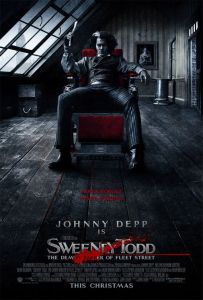 Famed musician/lyricist Stephen Sondheim’s tale of murderous barbers, cannibalism, and poisoned hearts first debuted on Broadway in 1979. Sondheim has been very protective of his material when it comes to film rights, but it wasn’t until the combination of visionary director Tim Burton and acclaimed actor Johnny Depp that Sondheim allowed his revered musical to be made into a movie. The result is faithful production that expands the scope of the musical while maintaining an intimate, chamber-music feel. Sweeney Todd flirts with being a masterwork but settles for being incredibly damn entertaining.
Benjamin Barker (Johnny Depp) returns to London after 15 years in prison on a flase charge. Judge Turpin (Alan Rickman, suitably creepy) wanted Barker’s wife for his own and conspired to have the barber sent away. Now under the auspices of Sweeney Todd, Barker has come back to seek his wife and daughter. He sadly learns that his wife is dead and his teenaged daughter, Johanna (Laura Michelle Kelly), is the ward of the Judge. Sweeney reopens his barber business above a flagging pie shop run by the eccentric Mrs. Lovett (Helena Bonham Carter). Sweeney plots his revenge against the Judge and his henchman, Beadle Bamford (Timothy Spall, suitable rat-like). Anthony (Jamie Campbell Bower), who traveled with Sweeney back to London, has set his sights on Johanna and intends to run away with her as soon as she can escape the Judge. Meanwhile, a rival barber named Pirelli (Sacha Baron Cohen) recognizes Sweeney from the old days and wants his silence paid for. It’s not too long before things get dicey, throats get cut, and people get turned into meat pies.
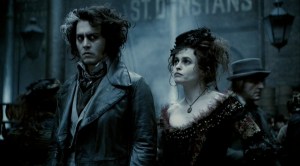 People unaware of the Sondheim musical are going to be in for a big shock. The film is about 80 percent sung, and the singing never rises to big, show-offery numbers of crescendo power vocals; the songs are more in the variety of speaking and vocals frequently overlap. The movie has greater clarity to the lyrics, and for the first time I as able to actually decipher Joanna’s words in the song “Green Finch and Linnet Bird.” Fans of traditional musicals, the kind that feature songs centered on female deer or large corn exporting states, may be aghast at how adult and violent the musical is. It’s just as much a grand horror movie as it is a musical. No doubt people are not generally accustomed to soaring medleys set to gashed throats and spurting blood. Sweeney Todd is captivating tale where almost all the characters are villains in some sense, and yet you do build sympathies even after innocents are killed and baked into flaky desserts.
Unlike other recent big screen versions of popular Broadway song-and-dance shows, Sweeney Todd is not simply the stage version transported to a bigger stage. This is a movie, through and through, and a perfect marriage. Burton is the perfect visionary to filter the twisted sensibilities of Sondheim’s masterpiece onto the silver screen. As a director, his work has been artistically backsliding since the start of this decade, but Sweeney Todd puts a firm stop to that. The technical aspects of Sweeney Todd are brought to life with great care and imagination. The Gothic sets are gorgeous and the costumes and cinematography are fitfully drab and dour, like everyone is living in a silent movie devoid of color; it takes a lot of hard work to create a near monochromatic playing field for the actors. And so when the blood does splash, and oh does it splash, the film pops with vivid color. Sondheim’s playful lyrics and rapturous music has never sounded better; it practically swoons.
The movie opens up the play in ways that a staged performance never could. Instead of keeping a distance from the bloodletting, usually something symbolic or as graphic as coloring a red line across a victim’s neck, Burton thrusts the audience right into Sweeney’s shop. The blood sprays in bright geysers and the violence is fully realized, fully felt, even if it’s never terribly realistic. The full weight of Sweeney’s vengeance and eventual destructive madness can be felt when the audience is witness to its wrath, and that includes the graphic murders. The medium of film ups the horror elements and transforms Sweeney Todd into a stronger work by amplifying the tension. The last scene with Mrs. Lovett is far more haunting than anything that could have been achieved on a stage. Burton also adds lots of dark humor thanks to his open visual palate, like during the song “By the Sea” where Mrs. Lovett fantasizes about her and Sweeney cozying up together in different scenarios. The film transports the viewer to the different pretend locales all the while Depp remains gruff and indifferent. He maintains the same curmudgeon from fantasy postcard after fantasy postcard. It’s the cheeriest segment in a grimly perverse musical that could rival Hamlet for dead bodies.
 In an effort to slice a three-hour musical to a manageable two-hour movie, screenwriter John Logan (The Aviator, Gladiator) has pruned the story down to the essentials, namely everything that impacts Sweeney’s ultimate pursuit of vengeance. Johanna and Anthony, the hopeful lovers, have been pared down the most. Their only scenes now revolve around intruding upon Sweeney or helping him meet his venomous goals. The lecherous songs the Judge sings to himself about his lust for Johanna has also been cut (my wife was severely disappointed by this cut, saying, “You’ve got the Rick, come on!”). The most notable omission is the opening medley “The Ballad of Sweeney Todd” that serves as a Greek chorus-like overview of the sordid tale ahead. The song provides a lot of back-story and exposition that can be more easily covered by Burton fashioning visual flashbacks of Sweeney’s former life. The ballad and other absent songs are still used instrumentally throughout the film. Logan has also turned Toby (Ed Sanders), Pirelli’s assistant, into a much younger character, turning him into an urchin boy with fresh memories of life in a workhouse. I’m not entirely sure Toby’s protective song to Mrs. Lovett “Not While I’m Around” becomes an ode to puppy love and loses some believability. Also, normally Toby is played as a man-child who isn’t entirely whole in his mental faculties; however, the movie version turns him into a plucky Oliver extra. It seems less devastating and tragic.
But what about the singing? Depp won’t be knocking down doors on Broadway anytime soon but he delivers a very satisfying baritone that, while lacking in power or refinement, delivers in spades with emotion. His singing is full of great texture. His song “My Friends,” an ode to being reunited with his razors, is full of brio and nuanced longing, but he really shows his talent when Sweeney loses it. He’s a man obsessed with vengeance and when it escapes his grasp he snarls with scary intensity. When he launches into “Epiphany,” where he determines the whole human race is fit to have their throats slit, he barks at strangers on the street and howls at the sky, smiling at his glistening razors in hand. What can be forgotten with musicals is that there is so much more to a performance than simply an adept ability to sing the right notes. With Sweeney, Depp spins an incredibly rich performance that plumbs the dark recesses of a man whose only purpose is vengeance. In the end, when he’s saturated in blood and the full reality of his actions is upon him, Depp goes from remorse to psychosis to horror to acceptance in, like, a minute flat. Seeing such a classic Broadway character done justice by an actor of Depp’s immense talent is thrilling and a bit of a relief to Sweeney fans.
 Carter has the weakest, thinnest voice of the cast. Mrs. Lovett is a larger than life figure that has been played on Broadway by the likes of Angela Lansbury and Patti LuPone. The role is usually played more boisterous, more comically broad. It’s a juicy part and full of brash bravado. Carter stumbles through “The Worst Pies in London” and she seems to step all over her lines, rushing through and losing the comedic flavor. But like I said before, a performance is so much more than singing, and it is here where Carter imbues great complexity to her role. Her unrequited love for Sweeney consumes her and her relationship with Toby places her in an awkward predicament. Carter flashes a wealth of emotions through the power of her eyes. It’s a battle between maternal and sexual urges. Stylistically she resembles a rag doll someone tossed in the trash but it all works.
It’s refreshing and exhilarating to see a perfect marriage of material and artistry. Burton has transported Sweeney Todd into a faithful and jubilantly dark movie that doesn’t shy away from the grotesque. It’s a stirring, wonderfully Gothic rendition of Sondheim’s masterpiece. Sweeney Todd is blissful, spirited entertainment that’s not exactly for the squeamish, but this is one musical that can simultaneously touch the heart while turning the stomach.
Nate’s Grade: A
Share this:

A Mighty Heart (2007)
 Good intentions and some proficient camerawork can only go so far to make a film worthwhile. Angelina Jolie gives the best performance of her career as kidnapped Wall Street Journal reporter Daniel Pearl’s wife (she’s French and Cuban, making for one really tricky accent). I wanted to like this movie more. The subject matter is serious and timely, the filmmaking has a sturdy docu-drama look, and the acting never comes across as phony, but alas, I think I mentally checked out because much of the film is a detective story that I already know the ending to. Daniel Pearl was infamously beheaded, so watching an hour of his wife, friends, and local police scramble to track down key figures, their allegiances and acquaintances, and the whereabouts of Daniels can come across as fruitless and somewhat cruel. This film doesn’t have the same cathartic feel that United 93 had because that moment was universal, and while I can admire the cinematography and superb acting I can’t ignore the fact that watching people search and fail gives me little emotional reward as a viewer.
Nate’s Grade: B
Share this:

Evening (2007)
 A chick flick crammed with lots of bona fide stars and A-list talent that manages to squander all talent. It slogs on and on, the back and forth nature of the plot does little to keep an audience alert, and the story it tells in the past is so pedestrian, so minuscule, and ultimately so mundane that you can’t help but wonder why an old woman on her deathbed would be flashing back and remembering it. This high profile weepy never finds the right tone and often settles for maudlin and predictable plot turns. Evening is the kind of movie that kills the chances for a large, female-driven film to get made in Hollywood.
Nate’s Grade: C-


 nathanzoebl
You must be logged in to post a comment.