Category Archives: 2003 Movies
Monster (2003) [Review Re-View]
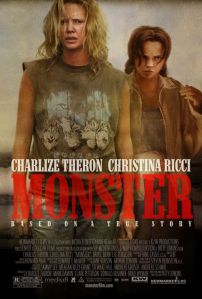 Originally released December 24, 2003:
Monster follows the life of Aileen Wuornos (Charlize Theron, now nominated for a Best Actress Oscar), Americas only known female serial killer. In the late 1980s, Wueros was a roadside prostitute flexing her muscles with Florida motorists. She describes hookin’ as the only things shes ever been good at. One day Wuornos has the full intention of taking her own life, but she meets 18-year-old Selby (Christina Ricci) at a lesbian bar and finds a companion. Driven by a growing hatred of men from sexual abuse, Wuorno’s starts killing her johns to try and establish a comfortable life for her and Selby.
Let’s not mince words; Theron gives one of the best performances I have ever seen in my life. Yes, that’s right. One of. The. Best. Performances. Ever. This is no exaggeration. I’m not just throwing out niceties. Theron is completely unrecognizable under a mass of facial prosthetics, 30 extra pounds, fake teeth and a total lack of eyebrows. But this is more than a hollow ploy to attract serious attention to the acting of a pretty face. Theron does more than simple imitation; she fully inhabits the skin of Aileen Wuornos. The closest comparison I can think of is Val Kilmer playing Jim Morrison in The Doors.
Theron is commanding, brave, distressing, ferocious, terrifying, brutal, stirring, mesmerizing and always captivating. It may be a cliché, but you really cannot take your eyes off of her. Her performance is that amazing. To say that Theron in Monster is an acting revelation is perhaps the understatement of the year.
With previous acting roles in Reindeer Games and The Cider House Rules, Theron is usually delegated to pretty girlfriend roles (who occasionally shows her breasts). Who in the world thought she had this kind of acting capability? I certainly did not. If Nicole Kidman can win an Oscar for putting on a fake nose and a so-so performance, surely Theron should win an Oscar for her absolute transformation of character and giving the performance of a lifetime.
With this being said, and most likely over said, Monster is by no means a perfect film. Minus the terrific central performance, Monster is more of an everyday profile of a grotesque personality. The film weakly tries to portray Wuornos more as a victim, but by the end of the film, and six murdered men later, sympathy is eradicated as Wuornos transforms into the titular monster. Some supporting characters, like Ricci’s narrow-minded Christian up bringers, are flat characters bordering on parody. The supporting characters are generally underwritten, especially the male roles that serve as mere cameos in a film dominated by sapphic love.
Monster is proof positive that human beings will never be phased out by advancing machinery when it comes to acting. Monster boasts one of the greatest acting achievements in recent cinematic history, but it also coasts on sharp cinematography and a moody and ambient score by BT (Go). Monster is a haunting film that you won’t want to blink for fear of taking your eyes off of Theron. She gives an unforgettable tour de force performance that will become legendary.
Nate’s Grade: B
——————————————————
WRITER REFLECTIONS 20 YEARS LATER

Monster was a revelation for Charlize Theron, an actress who until then had mostly been known for parts that asked that she be good looking and little else. Twenty years later, Theron is one of the best actresses working in Hollywood and it almost never happened without her breakthrough performance where she brought to startling life the horror of Aileen Wuornos’s tragic life and tragic desperation. When this movie came out originally in 2003, I doubt anyone but Theron’s closest friends suspected she was capable of a performance this raw and spellbinding, but that’s also a condemnation on all of us. How many other actresses out there could maybe rival the best of the best if they just had the right opportunity? How many actresses are stuck playing the same limited roles because that’s all they’re ever asked to do? How many actresses are wrongly assumed to be of limited talent simply because of their comely appearance? That isn’t to say there’s some hidden universal equation that the uglier you are the better at acting you have to be (though it sure has worked out for [insert your example of a conventionally unattractive actor here]), but this movie is a clear indication that too many actors are never given enough opportunities to shine.
Back in early 2004, I credited Theron’s performance as one of the best I’ve ever witnessed in my then-twenty-one years of moviegoing (although that number should be smaller considering I wasn’t keenly watching Scorsese as a baby). She is very good, but I’d like to claw back some of my rapturous words of praise now that we’ve seen twenty years of Theron acting excellence. Looking over her career, I might actually cite 2011’s Young Adult as her finest performance, and that one didn’t even nab an Oscar nomination (she’s since been nominated twice since, for 2005’s North Country and 2019’s Bombshell). The draw of the movie is the head-turning performance from Theron and she just disappears completely inside the skin of her subject. It’s hard to remember at times that this is Theron, thanks to the richness of her startling performance but also the accomplished makeup effects, which were not nominated. At every point, you feel the fire burning behind the stricken complexion of Theron, a fire that will eventually consume her and everything she loves. While highly compelling, this is not a performance of subtlety and restraint. This is a big performance, and the movie is often prone to making loud pronouncements about its subjects and pertinent themes. It’s loud, brash, and maybe for some it will seem a little too loud, a little too unsubtle, but it’s a movie that refuses to be ignored for good reason.
 In my original review I raised some reservations with the rest of the movie, and I’m here to recant one of them. I wrote back in 2004, “The film weakly tries to portray Wuornos more as a victim, but by the end of the film, and six murdered men later, sympathy is eradicated as Wuornos transforms into the titular monster.” I’m positive that many will still cling to this same idea but oh boy have I come around in twenty years. By the time the movie is over, you wonder why more women haven’t just snapped and gone on killing sprees. Wuornos is indeed a victim. She’s responsible for terrible deeds but that doesn’t change the fact that she started as a victim and continued as one until put to death by the state of Florida in 2002. She was a sexual assault survivor, groomed into prostitution, and then trapped by a society that saw her as little other than trash, something to be pitied but ultimately forgotten. She comes of age as an adult thinking her only value is the fleeting moments of pleasure she can provide for men, and in the narration, we hear her dreams that one of these men who repeatedly tell her how pretty she is would take her away to another life, like a princess. Alas. It’s impossible to separate her past as a victim of predatory men from her actions when she turns on predatory men. Being forced into prostitution out of desperation is one of the definitions for sex slavery and trafficking. The movie does try to make her last few johns more ambiguous over whether or not they are “good people” and thus “deserving” of their fates, like a scale is being introduced and we’re doing the calculation whether Wuornos will strike (#NotAllMen, eh felas?). There’s a clear dark path where the murders get considerably worse. She begins by defending herself against a rapist, but by the end, it’s just a kind family man who picked her up without even the intention of having sex. We’re meant to see her transform into the titular monster, but I kept wondering about Aileen Wuornos as the societal stand-in, accounting for thousands of other women who lived and died under similar tragic circumstances.
I also found myself growing increasingly contemptuous of the love interest character played by Christina Ricci (Yellowjackets). When we’re introduced to Selby, she’s a wide-eyed naif testing her boundaries of comfort but clearly tapping into repressed homosexual feelings. Their relationship is meant to serve as the emotional rock for Wuornos, the reason that she’s acting more rash is because she’s trying to earn enough money for the two of them to run away together and build a new life. She is her motivation, but Selby is absolutely the worst. You can excuse some of her hemming and hawing about striking out on her own and leaving her controlling parents, as she’s fighting against repression as well as trepidation for starting out independently, but this lady becomes fully aware of the dangers and dehumanization that Aileen goes through to earn her meager amounts of money, and Selby encourages her to do so. Not just encourages her, Selby pressures her to do so, to get back out there and “provide” for her, knowing fully well what that means, knowing fully well how these men have treated Wournos, repeatedly abusing her. What are you doing to help things out, huh Selby? She’s embarrassed hanging around Wuornos around some other lesbian friends she just met, so she’s already looking to upgrade and move past her lover. By the end, as she’s trying to coax a confession of guilt from her girlfriend to save her own skin, Selby becomes just another user, taking what they want from Wuornos and discarding her when they’ve had their fill.
 This was the directorial debut for Patty Jenkins, who also served as the sole credited screenwriter, and while the indie darling-to-franchise blockbuster pipeline has been alive and well in Hollywood, it was quite a surprising leap that her next movie after Monster was none other than 2017’s Wonder Woman. To go from this small character-driven true crime indie to leading the big screen solo outing for comics’ most famous female hero is quite a bizarre but impressive jump. Her only other feature credit is the much less heralded 2020 Wonder Woman sequel. She was attached to direct a Star Wars movie about fighter pilots but that seems to have gone into turnaround or just canceled. So is the way with Star Wars movies after 2019’s Rise of Skywalker. Just ask the Game of Thrones creators, Josh Trank, and Taika Watiti how that goes.
Monster is a phenomenal performance with a pretty okay movie wrapped around it in support. Twenty years later, Theron is still a monster you can’t take your eyes away from. It changed her career destiny and I think acts as an exemplar for two reasons: leaving the viewer with the question how many other wonderfully talented performers will never get the chance to showcase their true talents because of faulty assumptions, and how many other women are out there living in quiet degradation like Aileen Wuornos.
Re-Veiw Grade: B
Share this:

Cold Mountain (2003) [Review Re-View]

Originally released December 25, 2003:
Premise: At the end of the Civil War, Inman (Jude Law, scruffy) deserts the Confederate lines to journey back home to Ada (Nicole Kidman), the love of his life he’s spent a combined 10 minutes with.
Results: Terribly uneven, Cold Mountain‘s drama is shackled by a love story that doesn’t register the faintest of heartbeats. Kidman is wildly miscast, as she was in The Human Stain, and her beauty betrays her character. She also can’t really do a Southern accent to save her life (I’m starting to believe the only accent she can do is faux British). Law’s ever-changing beard is even more interesting than her prissy character. Renee Zellweger, as a no-nonsense Ma Clampett get-your-hands-dirty type, is a breath of fresh air in an overly stuffy film; however, her acting is quite transparent in an, “Aw sucks, give me one ‘dem Oscars, ya’ll” way.
Nate’’s Grade: C
——————————————————
WRITER REFLECTIONS 20 YEARS LATER

I kept meaning to come back to Cold Mountain, a prototypical awards bait kind of movie that never really materialized, but one woman ensured that it would be on my re-watch list for 2003. My wife’s good friend, Abby, was eager to hear my initial thoughts on the movie when I wrote my original review at the age of twenty-one. This is because Cold Mountain is a movie that has stayed with her for the very fact that her grandfather took her to see it when she was only nine years old. While watching, it dawned on nine-year-old Abby that this was not a movie for nine-year-olds, and it’s stuck with her ever since. I think many of us can relate to watching a movie with our parents or family members that unexpectedly made us uncomfortable. For me, it was Species, where I was 13 years old and the movie was about a lady alien trying to procreate. I think my father was happy that I had reached an acceptable age to go see more R-rated movies in theaters. Social media has been awash lately with videos of festive families reacting to the shock value of Saltburn with grumbles and comical discomfort (my advice: don’t watch that movie with your parents). So, Abby, this review is for you, but it’s also, in spirit, for all the Abbys out there accidentally exposed to the adult world uncomfortably in the company of one’s parents or extended family.
Cold Mountain succumbs to the adaptation process of trying to squeeze author Charles Frazier’s 1997 book of the same name into a functional movie structure, but the results, even at 150 minutes, are unwieldy and episodic, arguing for the sake of a wider canvas to do better justice to all the themes and people and minor stories that Frazier had in mind. Director Anthony Minghella’s adaptation hops from protagonist to protagonist, from Inman to Ada, like perspectives for chapters, but there are entirely too many chapters to make this movie feel more like a highly diluted miniseries scrambling to fit all its intended story beats and people into an awards-acceptable running time. This is a star-studded movie, the appeal likely being working with an Oscar-winning filmmaker (1996’s The English Patient) of sweep and scope and with such highly regarded source material, a National Book Award winner. The entire description of Cold Mountain, on paper, sounds like a surefire Oscar smash for Harvey Weisntein to crow over. Yet it was nominated for seven Academy Awards but not Best Picture, and it only eventually won a single Oscar, deservedly for Renee Zellweger. I think the rather muted response to this Oscar bait movie, and its blip in a lasting cultural legacy, is chiefly at how almost comically episodic the entire enterprise feels. This isn’t a bad movie by any means, and quite often a stirring one, but it’s also proof that Cold Mountain could have made a really great miniseries.

The leading story follows a disillusioned Confederate defector, Inman (Jude Law), desperately trying to get back home to reunite with his sworn sweetheart, Ada (Nicole Kidman), who is struggling mightily to maintain her family’s farm after the death of her father. That’s our framework, establishing Inman as a Civil War version of Odysseus fighting against the fates to return home. Along the way he surely encounters a lot of famous faces and they include, deep breath here, Phillip Seymour Hoffman, Natalie Portman, Giovanni Ribisi, Cillian Murphy, Eileen Atkins, Taryn Manning, Melora Walters, Lucas Black, and Jena Malone. Then on Ada’s side of things we have Zellweger, Donald Sutherland, a villainous Ray Winstone, Brendan Gleeson, Charlie Hunam, Kathy Baker, Ethan Suplee, musician Jack White, and Emily Descehanel, and this is the storyline that stays put in the community of Cold Mountain, North Carolina.
That is a mountain of stars, and with only 150 minutes, the uneven results can feel like one of those big shambling movies from the 1950s that have dozens of famous actors step on and as quickly step off the ride. Poor Jena Malone (Rebel Moon) appears as a ferry lady and literally within seconds of offering to prostitute herself she is shot dead and falls into the river (well, thanks for stopping by Jena Malone, please enjoy your parting gift of this handsome check from Miramax). Reducing these actors and the characters they are playing down to their essence means we get, at most, maybe 10-15 minutes with them and storylines that could have been explored in richer detail. Take Portman’s character, a widowed mother with a baby trying to eke out a living, one of many such fates when life had to continue after the men ran to war for misbegotten glory. She looks at Inman with desperate hunger, but it’s not exactly lust, it’s more human connection. When she requests that Inman share her bed, it’s just to feel another warm presence beside her, someone that can hold her while she weeps about the doomed fate of her husband and likely herself. There’s a strong character here but she’s only one stop on our expedited tour. The same with Hoffman’s hedonistic priest, a man introduced by throwing the body of a slave woman he impregnated over a ridge, which might be the darkest incidental moment of the whole movie. His character is played as comic relief, a loquacious man of God who cannot resist the pleasures of the flesh, but even he comes and goes like the rest of our litany of very special guest stars. They feel more like ideas than characters.

This is a shame because there are some fantastic scenes and moments that elevate Cold Mountain. The opening Civil War battle is an interesting and largely forgotten (sorry Civil War buffs) battle that begins with a massive surprise attack that produces a colossal explosion and crater and turns into a hellish nightmare. Granted, the movie wants us to sympathize with the Confederates who were bamboozled by the Yankee explosives buried under their lines, and no thank you. The demise of Hoffman’s character comes when he and Inman are captured and join a chain gang, and they try running up a hill to get free from approaching Union troops. The Confederates shoot at the fleeing men, eventually only with Inman left, who struggles to move forward with the weight of all these dead men attached to him. When they start rolling down the hill, it becomes a deeply macabre and symbolic struggle. The stretch with Portman (May December) is tender until it goes into histrionics, with her literal baby being threatened out in the cold by a trio of desperate and starving Union soldiers (one of which played by Cillian Murphy). It’s a harrowing scene that reminds us about the sad degradation of war that entangles many innocents and always spills over from its desired targets. However, this theme that the war and what it wrought is sheer misery is one Minghella goes to again and again, but without better characterization with more time for nuance, it feels like each character and moment is meant to serve as another supporting detail in an already well-proven thesis of “war is hell.”
Even though I had previously watched the movie back in 2003, I was hoping that after two hours of striving to reunite, that Inman and Ada would finally get together and realize, “Oh, we don’t actually like each other that much,” that their romance was more a quick infatuation before the war, that both had overly romanticized this beginning and projected much more onto it from the years apart, and now that they were back together with the actual person, not their idealized imaginative version, they realized what little they had in common or knew about each other. It would have been a well-played subversion, but it also would have been a welcomed shakeup to the Oscar-bait romantic drama of history. Surely this had to be an inconvenient reality for many, especially considering that the men returning from war, the few that did, were often not the same foolhardy young men who leapt for battle.
Zellweger (Judy) was nominated for Best Actress in the preceding two years, for 2001’s Bridget Jones Diary and 2002’s Chicago, which likely greased the runway for her Supporting Actress win from Cold Mountain. There is little subtlety about her “aw shucks” homespun performance but by the time she shows up, almost fifty minutes into the movie, she is such a brash and sassy relief that I doubt anyone would care. She’s the savior of the Cold Mountain farm, and she’s also the savior of the flagging Ada storyline. Pity Ada who was raised to be a nice dutiful wife and eventual mother but never taught practical life skills and agricultural methods. Still, watching this woman fail at farming will only hold your attention for so long. Zellweger is a hoot and the spitfire of the movie, and she even has a nicely rewarding reconciliation with her besotted old man, played by Brendan Gleeson, doing his own fiddlin’ as an accomplished violin player. As good as Zellweger is in this movie is exactly how equally bad Kidman’s performance is. Her Southern accent is woeful and she cannot help but feel adrift, but maybe that’s just her channeling Ada’s beleaguered plight.

I think there’s an extra layer of entertainment if you view Inman’s journey in league with Odysseus; there’s the dinner that ends up being a trap, the line of suitors trying to steal Ada’s home and hand in the form of the duplicitous Home League boys, Hoffman’s character feels like a lotus eater of the first order, and I suppose one reading could have Portman’s character as the lovesick Calypso. Also, apparently Cold Mountain was turned into an opera in 2015 from the Sante Fe Opera company. You can listen here but I’m not going to pretend I know the difference between good and bad opera. It’s all just forceful shouting to my clumsy ears.
Miramax spent $80 million on Cold Mountain, its most expensive movie until the very next year with 2004’s The Aviator. Miramax was sold in 2010 and had years earlier ceased to be the little studio that roared so mighty during many awards seasons. I think Cold Mountain wasn’t the nail in the coffin for the company but a sign of things to come, the chase for more Oscars and increasingly surging budgets lead the independent film distributor astray from its original mission of being an alternative to the major studio system. Around the turn of the twenty-first century, it had simply become another studio operating from the same playbook. Minghella spent three years bringing Cold Mountain to the big screen, including a full year editing, and only directed one other movie afterwards, 2006’s Breaking and Entering, a middling drama that was his third straight collaboration with Law. Minghella died in 2008 at the still too young age of 54. He never lived to fully appreciate the real legacy of Cold Mountain: making Abby and her grandfather uncomfortable in a theater. If it’s any consolation to you, Abby, I almost engineered my own moment trying to re-watch this movie and having to pause more than once during the sex scene because my two children wanted to keep intruding into the room. At least I had the luxury of a pause button.
Re-View Grade: B-
Share this:

Big Fish (2003) [Review Re-View]

Originally released December 25, 2003:
Premise: Estranged son Will (Billy Crudup) travels back home in an effort to know his ailing father Edward Bloom (Albert Finney; Ewan McGregor as the younger version). Will hopes to learn the truth behind a man who spent a lifetime spinning extravagant tall tales.
Results: Despite a shaky first half, Big Fish becomes a surprisingly elegant romance matched by director Tim Burtion’’s visual whimsy. McGregor’’s shining big-grinned optimism is charming. Not to be confused with the similar but too mawkish Forrest Gump, Burton’’s father-son meditation will have you quite choked up at its moving climax. Fair warning to those with father issues, you may want to steer clear from Big Fish. You know who you are.
Nate’’s Grade: B+
——————————————————
WRITER REFLECTIONS 20 YEARS LATER

Tim Burton has never really made a movie like Big Fish before or in the twenty years since. He’s made movies that are aimed at children, like the Disney live-action remakes for Dumbo and Alice in Wonderland, and he’s made animated movies that are more wholesome while still holding to the man’s creepy-cute aesthetic, but he’s never made a movie so unabashedly sentimental as 2003’s Big Fish. Many of his stories involve alienation and outcasts and outsiders and characters accepting themselves, their unique oddities, and their unconventional families. This movie was different. It was based on the 1998 novel by Daniel Wallace and primarily concerns the relationship between fathers and sons as the paterfamilias is nearing his end, a not unfamiliar plot structure for treacle and tears. It’s about a smooth-talking man of legendary tall tales about his life and his exasperated son trying to find real answers. That’s the movie. It’s purposely small even though the tales are tall. There’s nothing larger than simply resolving the strained relationship between father (Albert Finney) and son (Billy Crudup). It’s the most intimate movie of Burton’s career while still finding a place for his fantastical visual whimsy, as the outlet for Edward Bloom’s (Finney as the dying version, Ewan McGregor as the younger version) fantastical tales of adventure. It’s a movie elevated by Burton’s signature style and it’s one that still, in 2023, had me choking up and tears streaming down my face by the conclusion.
This is an episodic movie by design and it does hamper some of the emotional investment, until that whammy of a culmination. Because we know the younger Edward Bloom is exaggerating his life’s travails for entertainment, and perhaps a dash of pride to heighten his deeds, it makes the many sequences of young Edward and his escapades feel a bit fleeting, as if we’re trying to find the larger meaning hidden within the fables and the fabulous. The ultimate point is that the entertaining diversions and exaggerations are who Edward Bloom is, and ultimately trying to discern truth from legend loses sight of the appeal of this charming man and his wild tales. I can understand this while also slightly disagreeing with the conclusion. It’s a little pat to say, well, the point of all these extravagant stories is simply that they were entertaining, never mind about finding a buried meaning or truth. It’s like saying, “Hey, just enjoy the ride.” The point is to fall in love with the storyteller and see the storytelling itself as its own act of love, which I don’t think works until the very end of the movie. Until then, it’s a transitory series of adventures, from wartime to the circus to aggressively persistent courtships and hidden magical towns, each reflective of the indomitable spirit and cheery optimism of our chief yarn-spinner.

In that way, it’s easy for the viewer to adopt the same perspective as Will (Crudup), and that may be the hidden genius of screenwriter John August (Go), or I may be projecting. Our plight is the same as the son: we’re trying to discover what is actually real about the real man. It’s easy to feel his exasperation as he wants something genuine from this man and only keeps getting the same old tales and stories, and everyone else is smiling broadly and happy to just accept the man on his own terms. That’s where Will’s character arc goes, finally accepting his father on his terms, which means playing along with his rules. It’s a level of empathy and acceptance rolled together, but it’s also like two hours of a character going, “My dad might be a liar and I’m curious who he is,” and then in the end going, “My dad might be a liar but I guess that’s who he is.” It doesn’t feel like the grand epiphany that the movie thinks it is, even with Danny Elfman’s Oscar-nominated score trying to stir every doldrum of your heart (Elfman has only been nominated four times in his storied career, also for Good Will Hunting, Milk, Men in Black). So for much of the movie’s running time I’m pleasantly entertained but a little frustrated that the movie doesn’t seem to be digging closer into the man garnering all this unwavering attention.
However, it’s at the very end where Big Fish really transcends its limitations to become something deeply moving and powerful. As I re-watched, I’m twenty years older, and likewise my own father is twenty years older, and moments like this have more potency to me. It’s about the son accepting his father on the same terms he fought so hard to circumvent, and so the ending becomes a beautiful exchange of the storyteller inviting someone else to finish his story’s ending. It’s surprisingly profound when you boil it down to its essentials, and that may be why I had tears dripping down my face as the adult son narrates one last fantastic tale of helping his father escape from the hospital, dart through traffic in his classic car, and arrive for a farewell with all the many friends he’s made through his many decades of laughter and camaraderie. Edward then transforms into the fish, becoming the very symbol of his “fish tales,” and lives on through the stories and memories of others, simply but effectively communicated with the mourners engaged in retelling Edward Bloom’s escapades through engaged pantomime. It’s one of the most clear-cut examples for me of a perfectly good movie really hitting another level in the end.
Big Fish began a long collaboration between Burton and August, who has become such a prolific Hollywood scribe that he’s likely had his hand on just about every script in town. August would later be trusted to write Charlie and the Chocolate Factory, Corpse Bride, Frankenweenie, and Dark Shadows; that’s five Burton projects in nine years. For those keeping track, this was only the second Helena Bonham Carter appearance in a Burton movie, the first being the misbegotten 2001 Planet of the Apes remake. It’s also fun to watch Marion Cotillard (Inception) in her first American movie as Will’s pregnant wife.

Big Fish also has a strange unintended legacy regarding someone else who connected with it. It was the last film seen by the famous playwright and monologist Spalding Gray, an enormously compelling storyteller who, much like Edward Bloom, favored the oral tradition. He suffered through depression most of his life, which was amplified after a severe car accident and multiple surgeries to recuperate in the early 2000s. On January 10, 2004, he took his children to see Big Fish and the next day was declared missing. His body was found in the East River in New York City and it’s believed Gray took his own life leaping from the Staten Island Ferry. His wife, Kathleen Russo, told New York Magazine in 2008 that Gray had cried throughout the movie and she concluded, “I think it gave him permission to die.” It’s unfair to blame the movie for a suicidal man’s decision-making, but I think it’s interesting that the emotional closure onscreen was so powerfully felt that Gray may have felt a personal level of closure as well.
My original 2003 review was so minimal, one of five or six short capsule reviews I wrote together as end-of-the-year awards contenders (same with the upcoming Cold Mountain re-watch), so I wanted to add more thoughts to the subject. My opinion feels relatively the same twenty years later though the ending had even more power as a 41-year-old than at twenty-one. I’ll keep my review the same for relatively the same reasons, though I hope Burton returns back to telling another Big Fish kind of detour (2014’s Big Eyes was not that).
Re-View Grade: B+
Share this:

Master and Commander: The Far Side of the World (2003) [Review Re-View]

Originally released November 14, 2003:
Without sounding easily amused, this movie really is glorious filmmaking. With Peter Weir’’s steady and skilled direction we get to really know the life of the early 19th century. We also get to know an armada of characters and genuinely feel for them. Russell Crowe is outstanding as Captain Jack Aubrey. His physicality and emotions are expertly showcased. When he gives a motivational speech you’’d understand why people would follow him to the ends of the Earth. Paul Bettany (again buddying up to Crowe after ‘A Beautiful Mind’) is Oscar-worthy for his performance as the ship’s’ doctor and confidant to the Captain. He’’s not afraid to question the Captain’’s motives, like following a dangerous French ship all around South America. ‘Master and Commander ’hums with life, and the battle sequences are heart-stopping and beautifully filmed. It took three studios to produce and release this and every dollar spent can be seen on the screen. ‘Master and Commander’ is fantastic, compelling entertainment with thrills, humanity, and wonder. It’’s grand old school Hollywood filmmaking.
Nate’s Grade: A
——————————————————
WRITER REFLECTIONS 20 YEARS LATER

They really don’t make movies like Master and Commander anymore and that is a detriment to every facet of our society. It took three different studios to bankroll this expensive movie, made all the more expensive by being almost entirely set at sea, a very costly and volatile location. In a just world, this would have been the beginning of a cinematic universe to rival Marvel, and the dashing Captain Jack Aubrey (Russell Crowe) would be as beloved as Captain Jack Sparrow, and children would beg their parents to read the dozen naval adventure novels by Patrick O’Brian. Just imagine lines of children for Halloween eagerly dressed in little admiral outfits with long blonde ponytails. Unfortunately, we do not live in this utopian universe, and 2003’s Master and Commander was the one and only movie we ever got. It received ten Academy Award nominations including Best Picture and Best Director for Peter Weir, winning two Oscars for Cinematography and Sound Editing, two of the only categories where runaway champion Return of the King wasn’t nominated. This is a masterpiece and a prime example of Hollywood filmmaking at its best. It’s just as easy to be transported in 2023 as it was back in 2003.
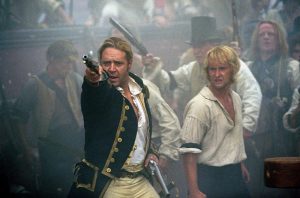
This movie is still effortlessly engaging and enthralling, dropping you onto the HMS Surprise during the Napoleonic wars. Even the opening text starts to get your blood pumping: “Oceans have become battlefields.” The opening act is a tremendous introduction to life onboard an early nineteenth-century ship, giving us a sense of the many crewmen and their responsibilities, as well as the different pieces working in tandem while under attack from a French vessel. The movie is structured as an elongated cat-and-mouse chase between the two ships, with the English trying to outsmart the faster French ship with its heavy cannons that easily outnumber the Surprise. Each stage presents a new challenge. One sequence involves them setting up a ruse with a smaller ship attached with a lantern to trick the French vessel into following the decoy at night. The constant threat of this sleeker ship getting the drop on them and attacking is always present, turning the opposition into a mythic monster breaking forth through the fog. The tests of command and camaraderie lead to important questions over duty and sacrifice. There are several children manning the decks as well, cadets eager to be the next generation of English warriors. It’s a shocking reality to process through our modern perspective, and it’s made even harder when tragedy befalls these youngest sailors just like any of the other crew. The movie is steeped in authentic details and realism that makes you feel like you’ve dropped into living history.
In 2023, Gabriella Paiella wrote a GQ article titled “Why Are Guys So Obsessed with Master and Commander?” noting its enduring popularity with a certain selection of Millennial men (yours truly included). She theorized part of its ongoing appeal is how wholesome the movie comes across, with depictions of positive and healthy male friendships. Even the dedication to service is depicted in a way forgoing jingoism. This is a deeply empathetic movie about men who deeply love one another. The most toxic depiction on screen isn’t one born of masculinity run amok during wartime but more a division in class amplified by superstition. Pity poor midshipman Hollum (Lee Inglebee), a man who cannot make friends with the crew because they disdain his privilege and will never see him as a better or an equal. He becomes a scapegoat for the bad luck of the ship, as they feel he is a “Jonah,” a curse. Poor Hollum, who sees no way out of this dilemma and literally plunges overboard with cannonball in hand, ridding the crew of their reputed curse (the wind picks up the sails the next morning). Beyond this valuable and sad storyline, the men of the Surprise seem so grateful for one another’s company. It’s a guy movie that invites men to escape to the frontier as an inclusive summer camp (no girls allowed!).

By the end of this movie, as we’re utilizing every nautical trick we’ve learned and preparing to seize the elusive French boat, my body was shaking in anticipation. We’ve gone on this journey and gotten to know a dozen faces, and we feel part of the team to the point that we’re onboard too. Seeing any of these men close their eyes permanently is awful. It’s not just keen military strategy and theory being discussed; we feel the real human cost. A small moment at the end, where a young man asks for help to sew the death shroud of his mentor, just hits you in the guts. Even watching poor Hollum processing his final fateful decision is heartbreaking. I still gasp even today watching Doctor Maturin (Paul Bettany) accidentally shot and then have to perform his own surgery. You feel the highs and lows throughout this voyage because the movie has made you care. The sheer adventure of it all is terrific, but it’s the immersive details and the strong character writing for everyone that makes this movie so special. It’s not just a rousing high-seas tale of bravery but also a stirring and empathetic character piece and absorbing drama.
It’s astounding to me that Weir isn’t still one of the hottest working directors. The Australian has earned four Best Director nominations across three decades (1985’s Witness, 1989’s Dead Poets Society, 1998’s Truman Show) and proven he can handle any genre with any style. He’s only directed a single movie since Master and Commander, 2010’s Siberian prisoner of war movie, The Way Back. In twenty years, we’ve only been given one other Peter Weir movie, and that is a travesty. In a recent interview, Weir confirmed he’s essentially retired from directing. If only time had been kinder to this great director. For comparison’s sake, other famous artists that also have four Directing nominations include Clint Eastwood, Stanley Kubrick, and Francis Ford Coppola.
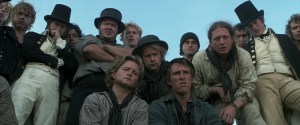
I assumed Master and Commander would still be good to re-watch in 2023, but I was amazed at how quickly I fell back under the movie’s sway so completely absorbed. It’s the kind of movie where everything just feels so natural, so authentic, and so compelling, where the hard work can be too easily undervalued because it all just feels like a documentary. This movie is so captivating and enthralling and every adjective you can devise. It earns them all. Why oh why did we never get a second of these? There were over a dozen novels as source material at the time of the first movie. According to that same 2023 GQ article, the studio head at Fox, Tom Rothman, explained that he was a lifelong fan of the O’Brian novels, having fallen in love with them as a boy. It took the studio chief using his position to get this kind of movie made in 2003, that’s the level of corporate power necessary to circumvent all the naysayers trying to kill this. I guess rather than mourn the lack of sequels I should count my blessings that we have even one. You were too good for this world, Master and Commander: The Far Side of the World.
Re-View Grade: A
Share this:

Lost in Translation (2003) [Review Re-View]
 Originally released October 3, 2023:
Sofia Coppola probably has had one of the most infamous beginnings in showbiz. Her father, Francis Ford, is one of the most famous directors of our times. He was getting ready to film Godfather Part III when Winona Ryder dropped out weeks before filming. Sophia Coppola, just at the age of 18, stepped into the role of Michael Corleone’s daughter. The level of scathing reviews Coppolas acting received is something perhaps only Tom Green and Britney Spears can relate to. Coppola never really acted again. Instead she married Spike Jonze (Being John Malkovich) and adapted and directed the acclaimed indie flick, The Virgin Suicides. So now Coppola is back again with Lost in Translation, and if this is the kind of rewards reaped by bad reviews early in your career, then I’m circling the 2008 Oscar date for Britney.
Bob Harris (Bill Murray) is a washed up actor visiting Tokyo to film some well-paying whiskey commercials. Bob’s long marriage is fading and he feels the pains of loneliness dig its claws into his soul. Bob finds a kindred spirit in Charlotte (Scarlet Johansson), a young newlywed who has followed her photographer husband (Giovanni Ribisi) to Japan and is second-guessing herself and her marriage. The two strike up a friendship of resistance as strangers in a strange land. They run around the big city and share enough adventures to leave an indelible impression on each other’s life.
 Lost in Translation is, simply put, a marvelously beautiful film. The emphasis for Coppola is less on a rigidly structured story and more on a consistently lovely mood of melancholy. There are many scenes of potent visual power, nuance of absence, that the viewer is left aching like the moments after a long, cleansing cry. There are certain images (like Johansson or Murray staring out at the impersonal glittering Tokyo) and certain scenes (like the final, tearful hug between the leads) that I will never forget. Its one thing when a film opens on the quiet image of a woman’s derriere in pink panties and just holds onto it. It’s quite another thing to do it and not draw laughs from an audience.
Murray is outstanding and heartbreaking. Had he not finally gotten the recognition he deserved with last year’s Oscar nomination I would have raged for a recounting of hanging chads. Murray has long been one of our most gifted funnymen, but later in his career he has been turning in soulful and stirring performances playing lonely men. When Murray sings Roxy Music’s “More Than This” to Johansson during a wild night out at a karaoke bar, the words penetrate you and symbolize the leads’ evolving relationship.
Johansson (Ghost World) herself is proving to be an acting revelation. It is the understatement of her words, the presence of a mature intelligence, and the totality of her wistful staring that nail the emotion of Charlotte. Never does the character falter into a Lolita-esque vibe. Shes a lonely soul and finds a beautiful match in Murray.
 Lost in Translation is an epic exploration of connection, and the quintessential film that perfectly frames those inescapable moments of life where we come into contact with people who shape our lives by their short stays. This is a reserved love story where the most tender of actions are moments like Murray carrying a sleeping Johansson to her room, tucking her in, then locking the door behind. The comedy of disconnect is delightful, like when Murray receives incomprehensible direction at a photo shoot. The score by Jean-Benoît Dunckel, front man of the French duo Air, is ambient and wraps around you like a warm blanket. The cinematography is also an amazing experience to behold, especially the many shots of the vast glittering life of Tokyo and, equally, its emptiness.
Everything works so well in Lost in Translation, from the bravura acting, to the stirring story, to the confident direction, that the viewer will be caught up in its lovely swirl. The film ends up becoming a humanistic love letter to what brings us together and what shapes how we are as people. Coppola’s film is bursting with such sharply insightful, quietly touching moments, that the viewer is overwhelmed at seeing such a remarkably mature and honest movie. The enjoyment of Lost in Translation lies in the understanding the audience can feel with the characters and their plight for connection and human warmth.
Writer/director Sofia Coppola’s come a long way from being Winona Ryder’s last-second replacement, and if Lost in Translation, arguably the best film of 2003, is any indication, hopefully well see even more brilliance yet to come. This is not going to be a film for everyone. A common argument from detractors is that Lost in Translation is a film lost without a plot. I’ve had just as many friends call this movie “boring and pointless” as I’ve had friends call it “brilliant and touching.” The right audience to enjoy Lost in Translation would be people who have some patience and are willing to immerse themselves in the nuances of character and silence.
Nate’s Grade: A
——————————————————
WRITER REFLECTIONS 20 YEARS LATER

I have never done this before in the four years of my re-reviewing movies, but I really just want to quote my introduction into Lost in Translation because I feel like this perfectly sets the scene, as well as giving my 21-year-old self some kudos: “Sofia Coppola probably has had one of the most infamous beginnings in showbiz. Her father, Francis Ford, is one of the most famous directors of our times. He was getting ready to film Godfather Part III when Winona Ryder dropped out weeks before filming. Sophia Coppola, just at the age of 18, stepped into the role of Michael Corleone’s daughter. The level of scathing reviews Coppola’s acting received is something perhaps only Tom Green and Britney Spears can relate to. Coppola never really acted again… So now Coppola is back again with Lost in Translation, and if this is the kind of rewards reaped by bad reviews early in your career, then I’m circling the 2008 Oscar date for Britney.” Besides the unnecessary broadside against Ms. Spears, who I’ve already apologized for with my re-review of 2002’s Crossroads, I think all this holds true. Within three films, Sofia Coppola went from an unfortunate punchline (not her fault!) to Oscar winner and indie darling.
Lost in Translation was my favorite American movie of 2003, so I’m always curious how my then-favorites stack up twenty years later. I’ve softened on American Beauty and Requiem for a Dream, and still consider The Iron Giant, Magnolia, and Moulin Rouge to be excellent. My feelings toward Lost in Translation, upon re-watch, remain mostly the same, though after two decades of watching other slow-burn, character-centric indies and widening my viewing, its highs aren’t quite the rhapsodic high for me in 2023 but it’s still an effective melancholy mood piece.
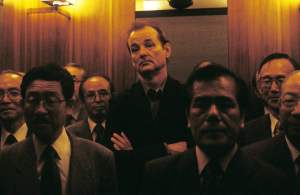 Lost in Translation taps directly into a universal feeling of yearning for connections in a time where it’s becoming easier and easier to disconnect into our own little bubbles. You don’t have to be stuck in a foreign country to feel isolated or out of sorts, and Coppola uses the external circumstances as a means of reinforcing the emotional isolation and then re-connection of her characters. This is why I brush aside some of the harsher criticisms levied against Coppola’s portrayal of Japanese culture and the locals. This is an outsider portrayal, and I don’t think there’s so much a critical judgment over Japanese culture as being inferior as just being different from what these characters are used to. They are clearly out of their element; it’s not that the culture is weird, it’s that the culture is different (that doesn’t mean there aren’t some overstayed stereotypes here as well). Trying to simply communicate with people that all speak another language is a quick and accessible dynamic to better visualize and articulate disconnect. I feel like this story could have been told from any racial or ethical perspective; it’s about two outsiders finding one another. The racial dynamics are less important. Obviously Coppola’s own personal experiences and outsider perspective in Japan are what provides the specific details with this tale, but I think what makes the movie still so effective in 2023 is because it’s so relatable on a deeper level that it eclipses any specific personal details. It’s about feeling lost and then feeling seen.
The key scene for me happens about seventy minutes into the movie, after Bob (Bill Murray) and Charlotte (Scarlett Johansson) have had an adventure with the Japanese hospital system. They’ve become one another’s insomnia buddies, teaming up to explore the city’s nightlife. As they lay side by side in bed during the wee hours, they have an intimate and poignant conversation, and it has nothing to do with sex. “I’m stuck,” she says. “Does it get any easier?” It’s about a young woman asking a middle-aged man for guidance and wisdom and him offering what he can with the caveat that he too is still struggling for his own wisdom. It’s the illusion that at some magic predetermined number of trips around the sun, the mystery of life will somehow become perfectly realized, as if now we can see the grand architectural design. There is no magic number. Everyone is trying their best and making it up as they go, and that’s what this conversation represents. She’s begging for reassurances that adult life will get easier, that she’ll find her footing, and Bob encourages her to continue pursuing her hobbies and passions even if she can’t stand her own art (which sounds like every artist I’ve ever known). Much of his actionable advice comes down to being patient including with yourself. Everybody is in their own way trying their best with what they have. He assures her that the more she gets comfortable with who she is the less things can bother her. It’s a beautiful scene and the reason it works even better is that Coppola doesn’t treat this moment with the gravity it has. It’s not even the film’s climax. Much like real life, when we look back at the exchanges that prove the most formative, we don’t have alarms ringing to better inform us that this is a moment that will have maximum import. We don’t know until it’s over.
 I have never viewed Lost in Translation as some kind of will-they-won’t-they May-December romance, and at no point was I secretly hoping that Bob and Charlotte would get together. This is because they do get together but it’s not a purely romantic connection, although once you start really analyzing romance itself, there are far more complicated and nuanced dimensions to this overly simplified concept, and one could argue this is a romance of sorts but not one about physical passion and infatuation that dominate our association. It’s about two human souls drifting along in life who find a kinship with one another when they need it the most. I never wondered at the end whether they would kiss or have some kind of affair or even run off together, because that wasn’t what was so essential to this dynamic. It wasn’t how far they would go for love, including what would they give up or who would they hurt, it was about each of them serving as a life preserver, something to hold onto during a turbulent time. I truly believe that if they had kissed and had some kind of tawdry love affair that the film would have been cheapened. When Bob carries Charlotte back into her hotel room bed, I never viewed this act as two lovers but of a father and daughter. It’s too easy to just reduce every relationship into a sexual pairing. We all have meaningful relationships with many people who occupy different spheres of our life and our experiences, and our lives could be irreversibly altered without their influence no matter how fleeting our time together may have been. To reduce everything into whether they spark something sexual or passionate is just plain boring.
This was a turning point in the careers of all three of its major figures. For Coppola, it was confirmation of her artistic voice and stepping from the long shadow of her father. She won an Oscar for Best Original Screenplay and was nominated for Best Director, only the third woman ever at that time. That’s a big deal. This was a statement film for her and she’s been making very leisurely paced, lushly photographed, somber character pieces since, very Sofia Coppola Movies (her latest promises to highlight the perspective of Priscilla Pressly). She never quite had another movie land as well as this one though 2006’s Marie Antoinette is due for a reappraisal as well. For Murray, it was confirmation that he had real dramatic acting skills that he’d shown flashes of in other movies like The Razor’s Edge and Rushmore, and it earned him his only Academy Award nomination. For Johansson, it was also the beginning of establishing her as an adult actress of serious caliber, and there was a critical stir that she had been snubbed by the Academy in 2004 not just for her role in Lost in Translation but also Girl with Pearl Earring. Johansson had been a steadily working actress since she was a child, and this was confirmation that she was ready to make the next jump. From there, she found a creative kinship with Woody Allen, and Wes Anderson, and even became an action movie star that could headline her own blockbusters. She finally got her first Oscar nominations in 2019, for both Marriage Story and Jojo Rabbit, becoming only the twelfth actor ever to be nominated twice in the same year. Murray’s star has fallen out of favor recently from his onerous onset behavior, though he did reunite with Coppola for 2020’s On the Rocks.
 One of the stranger post-scripts for this movie relates to Johansson’s singing. The karaoke scene in Lost in Translation is one of the best, and it works on a magical elemental level where the music becomes our means of expression. When Murray sings “More Than This,” it’s hard not to read more into the moment. It’s right there in the song choice. Both actors do their own singing, adding to the fun and authenticity. Johansson would later release her own album in 2008 titled Anywhere I Lay My Head. It wasn’t uncommon for young actresses to moonlight as singers for a vanity project (Paris Hilton and Lindsay Lohan did this too), but what set this album apart was that it was almost entirely comprised of Tom Waits covers. According to Yahoo, as of August 2009, it had sold only 25,000 copies, which to be fair is twenty-five thousand more than I’ve ever sold, so what do I know? She released one more music album, 2009’s Break Up.
Looking back at my original 2003 review, it’s easy to see how smitten I was discovering Lost in Translation and trying to argue its virtues in my college newspaper. I think I assumed most of my fellow collegians would rather watch raunchy comedies like Van Wilder rather than a slow-burn indie about sad people roaming a foreign city. To this day I still have an equal number of friends who deem Lost in Translation as slow navel-gazing fluff to beautiful and beguiling. As I said before, it’s a mood piece about disconnected people, and I think if you’re in the right mood, or an open mind with the patience to spare, then there’s still something appealing and rewarding about an understated movie about two lonely people finding an unexpected kinship that defies reductive romantic classification. I just experienced something on this level with 2023’s Past Lives. I’m glad that Coppola has kept the final whisper between Bob and Charlotte a secret because it doesn’t matter what he specifically says so much as the meaning of this exchange for the both of them. It’s a goodbye of sorts but also a recognition of one another’s help and compassion. It’s not for us to hear. It’s too intimate. It’s a perfect ending for a film that still proves indelible twenty years later.
Re-View Grade: A-
Share this:

Kill Bill vol. 1 (2003) [Review Re-View]

Originally released October 10, 2003:
Breathtaking and stylistically amazing. That’s all there is to it. Can’t wait for part two.
Nate’s Grade: A
——————————————————
WRITER REFLECTIONS 20 YEARS LATER
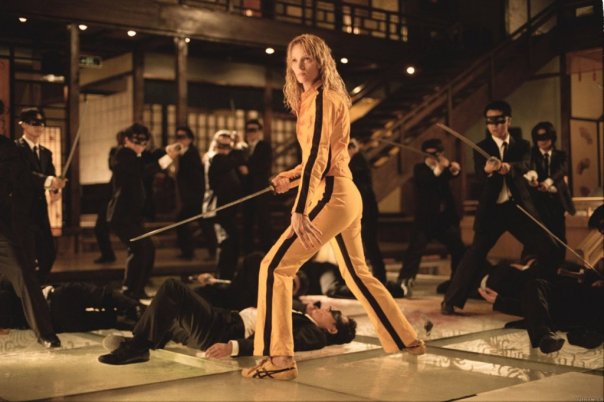
Kill Bill was a turning point in the career of one of the biggest cinematic artists of the past 30 years, and as exciting and stylish as Volume 1 proved, this is the point where Quentin Tarantino vanished within himself and became the ultimate B-movie revivalist. It only took two films for Tarantino to not just become an indie brand name but his own adjective, as Hollywood was flooded with “Tarantino-esque” imitators chasing after the man’s unique voice of snappy pop-culture soliloquies, hard-boiled dialogue, and meta-textual irony. Of course the imitators could never truly capture the full appeal of Tarantino’s movies, overvaluing the surface-level aspects (quirky characters, non-linear plots, unexpected bursts of violence) and missing the greater character depth and thematic intricacies that allow the style to accentuate the entertainment rather than solely serve as that value. 2003 was the crossroads where Tarantino switched from smaller dramas and crime thrillers about semi-recognizable and relatable people (the middle-aged romance in Jackie Brown is the most tender and sincere writing of his career) to remaking and re-packaging his favorite grindhouse exploitation movies. It was like Tarantino himself was following the path of the would-be Tarantino-esque imitators.

Kill Bill began as an idea between actress Uma Thurman and Tarantino on the set of Pulp Fiction; it even feels like a big-screen realization of the failed Fox Force Five pilot that Mia Wallace (Thurman) filmed. Thurman had the idea of the opening, a bloody and beaten woman in a wedding dress being executed only to survive her execution. The idea germinated for years and became two movies worth of material. It’s hard for me to envision Kill Bill as one whole entity because the two volumes feel so thematically distinct. The first is an homage to 1970s kung-fu movies and Eastern cultural influences whereas the second volume serves as an homage to spaghetti Westerns and Western cultural influences. I’m shocked that through the annals of numerous physical media releases at no point has someone released Kill Bill as one whole four-hour movie. It’s only ever been physically screened as such once by Tarantino, and I think the implicit admission is that, while conceived as one sprawling and gargantuan epic, the movies work better as halves that reflect and enrich one another due to that separation. As I wrote in my 2004 review of Volume 2, the first part is the “show” and the second is the “tell,” but what a show Tarantino pulls off.
There was a time where the idea of Tarantino helming an action movie felt antithetical, but he tapped every corner of his encyclopedic knowledge of genre cinema to give us one of the best action movies of all time. The centerpiece sequence pitting The Bride against the Crazy 88s, as well as the ball-and-chain-wielding schoolgirl Gogo, feels like the culmination of a lifetime of cinema geek passion. It’s viscerally exciting without getting boring over the course of twenty-something minutes because Tarantino keeps things shifting, never falling upon redundancies, as if he’s so eager to squeeze in each and every loving homage and reference point. The climax, which again feels so natural an escalation and end point for a “part one,” took eight weeks to film, and the MPAA insisted it be toned down to secure an R-rating (he turned it black and white to obscure the color of the blood, itself another indirect homage to martial arts movies of old when they played on American television). Reportedly over 450 gallons of fake blood was used during the production of both volumes, but this first edition is definitely the more gleefully over-the-top.

The revenge structure is shaped around The Bride (née Beatrix Kiddo) killing the five members of her former gang, the Deadly Viper Squad. Volume 1 only covers two members meeting their just desserts, one of which is the opening scene. That means after the first ten minutes fighting Vernita Green (Vivica A. Fox), we’re working the rest of the movie to the next boss fight. That’s where we get the character dynamics, the obstacles that The Bride must overcome (step one: wiggle your big toe), and the history of O-Ren Ishii (Lucy Lui) and her ascension to Japanese crime lord. With less careful filmmakers, this middle stretch might feel sluggish, but with Tarantino, it’s invigorating as the new world and its many faces connect together to create such an intriguing and engrossing larger picture. Volume 1 provides the structural bones of the story, as well as buckets of sticky viscera, whereas Volume 2 adds the meat and complexity and larger nuance. That doesn’t mean Volume 1 is lacking creativity, it’s just that it’s the half that has to perform more foundational lifting so that those character details and choices will have the larger impact they do. Volume 1 is a long straight line back to O-Ren Ishii, and the accelerating carnage is wonderful to behold.
Thurman has never been better than with her Quentin collabs. After her sudden rise in Pulp Fiction, it felt like her career stalled playing many “hot girl” roles in misfires like The Truth About Cats & Dogs, The Avengers, and of course Batman & Robin. After her Kill Bill revival, her star rose again only to once again falter from more reductive “hot girl” roles in misfires like Paycheck, My Super Ex-Girlfriend, and the movie musical of The Producers. She recently came into the casting orbit of Lars von Trier, a filmmaker who never met a beautiful woman he didn’t want to punish excessively onscreen for society’s ills. Her role in 2014’s Nymphomaniac volume 1 was a memorable high point as a contemptuous woman confronting her husband’s younger lover, the titular nymphomaniac. Perhaps it was the meta-textual comment of Thurman’s cinematic type-casting, the older “hot girl” replaced by the younger, newer beauty. I’m probably just grasping for greater meaning here. Thurman and Tarantino didn’t speak for years after the conclusion of the Kill Bill series, but it wasn’t until 2018 that we found out why. That’s when the public found out about the existence of a video where Thurman was driving a car and crashed. The problem was it should have been a stunt driver but Tarantino insisted and pressured Thurman into doing the stunt, she crashed, was injured, and still suffers to this day. She says she has since forgiven Tarantino even though he and Harvey Weinstein withheld footage of the incident for years.
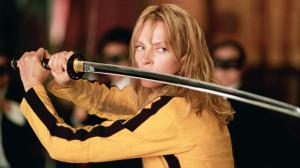
The music has taken on a life of its own. Much was repurposed from old movies and given new context, much like Tarantino’s overall creative mantra. The siren-blaring announcement of two foes facing each other has become its own pop-culture meme. The slow-motion walk to “Battle Without Honor or Humility” has also become pop-culture shorthand. “Twisted Nerve” is a great ringtone, and “Woo Hoo” by the Japanese surf rock girl group The 5,6,7,8s became so inescapably hummable that it eventually became the catchy theme of a wireless company.
This movie also holds a special place for me because the image that immediately comes to mind is watching my father uproariously laughing throughout the movie and rocking in his theater seat. A severed head leading to a geyser of endless blood had my father cackling like a child. By the end of the movie, I recall him turning to me, smiling ear-to-ear, and exclaiming, “Now that was a great movie!” Conversely, I also remember my college roommate falling asleep next to me as The House of Blue Leaves was bathed in (>450) gallons of (black and white) blood.
In the ensuing two decades, Tarantino has directed five other movies, published two books, been nominated for Best Director twice, won his second screenwriting Oscar, and essentially brought the tastes of the Academy to his own. He’s written three Best Supporting Actor winners (Christoph Waltz in 2009 and 2012, Brad Pitt in 2019) and become one of the most commercially reliable names, a director whose very name itself is a selling point for mainstream audiences. Even while some may bemoan that the indie provocateur might be “slumming” with his own highly polished version of B-movies, he’s dragged those same tastes to wide commercial appeal and industry acclaim. Kill Bill Volume 1 is the beginning of Tarantino tattooing ironic air quotes to his output, but when you’re this talented and passionate about movies of all kinds, even a kung-fu homage can become a cultural force and one of the best superhero origins ever (The Bride is pretty much a superhero and compared to Superman in Volume 2). Kill Bill Volume 1 is still a masterfully entertaining and bloody fun experience twenty years later.
Re-View Grade: A
Share this:

The Station Agent (2003) [Review Re-View]
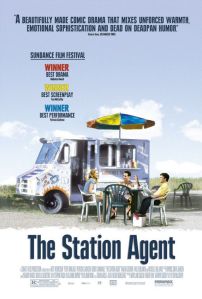 Originally released December 5, 2003:
This is the most charming film of 2003, and Im not just saying this because I had an interview with one of its stars, Michelle Williams (Dawson’s Creek). Fnin McBride (Peter Dinklage) is a man with dwarfism. With every step he takes every look he gives, you witness the years of torture hes been through with glares and comments. Hes shut himself away from people and travels to an isolated train station to live. There he meets two other oddballs, a live-wire hot dog vendor (Bobby Cannavale) and a divorced mother (Patricia Clarkson). Together the three find a wonderful companionship and deep friendship. The moments showing the evolution of the relationship between the three are the films highlights. Its a film driven by characters but well-rounded and remarkable characters. Dinklage gives perhaps one of the coolest performances as the unforgettable Fin. Cannavale is hilarious as the loudmouth best friend that wants a human connection. Clarkson is equally impressive as yet another fragile mother (a similar role in the equally good Pieces of April). The writing and acting of The Station Agent are superb. Its an unforgettable slice of Americana brought together by three oddballs and their real friendship. You;ll leave The Station Agent abuzz in good feelings. This is a film you tell your friends about afterwards. There’s likely no shot for a dwarf to be nominated for an Oscar in our prejudiced times but Dinklage is deserving. The Station Agent is everything you could want in an excellent independent movie. It tells a tale that would normally not get told. And this is one beauty of a tale.
Nate’s Grade: A
——————————————————
WRITER REFLECTIONS 20 YEARS LATER
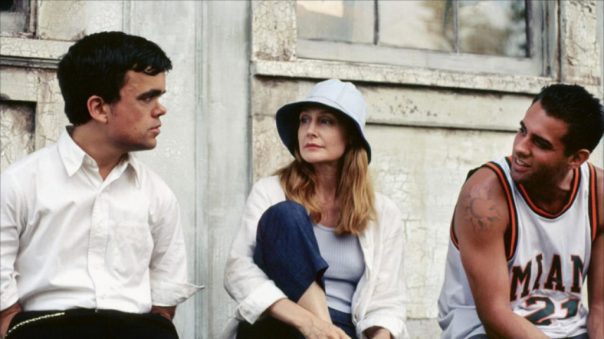
Tom McCarthy didn’t invent the quirky, found family indie but he sure seems to have nearly perfected it, starting with 2003’s The Station Agent. This little gem of a movie is so subdued, so relaxed, and so gentle that it seems to adopt the very personality of its lead character, Fin (Peter Dinklage), a dwarf who just likes trains a lot and wants to live his life in solitude. He’s an unassuming man who keeps to himself as a means of survival, because almost every time he goes into public life Fin is met with stares, snickers, and harassment (the convenience store lady gets his attention to take his unsolicited picture). Very few will get to know this man beyond his superficial physical characteristics, so he retreats within himself, perhaps purposely obsessing over an antiquated hobby as a means of escape to the past. He’s a lonely man and the movie is about him finding his clan, his place in the world, by slowly lowering his defenses. It’s a simple sort of story that is lifted by the strength of its characters and its wonderful ensemble cast.
With such a taciturn main character we need a contrasting character, a much more talkative person with high energy, and this is beautifully embodied by Bobby Cannavale. He plays Joe Oramas, a coffee truck operator who exemplifies joy de vie. He’s charming, garrulous, and relentlessly upbeat, which makes for a magnificent odd couple contrast with Fin, and it allows both characters to gradually change and grow attached to one another’s mutual friendship. Finn allows himself to become more vulnerable and form bonds and Joe starts to see the world from Fin’s point of view, allowing himself to slow down and appreciate the smaller things he might have missed in his excitable and irascible activity. Dinklage’s dry understated performance is a perfect counterpoint to the churning energy emanating from a grinning Cannavale. This is a fine showcase of both actors, who would go on to win six Emmys between them in the years ahead.
The third member of this found family is Olivia, played by Patricia Clarkson, and I actually think the movie might have worked better without her character. She does provide a point of view that our two guys lack; she’s experienced significant grief over a lost child and her life is in shambles as she tries to discover what she wants from her cratering marriage to a young-er John Slattery. Clarkson is also wryly enjoyable and gets some of the best lines in the movie, so she’s not at fault here. I think it’s because I’m confused about how this character is treated, especially compared to the natural opposites-attract dynamic of Fin and Joe’s friendship. Olivia feels like a broken thing that the boys need to try and help get better, but we were already covering this with Finn’s reserve from a lifetime of feeling ostracized. The possible romance between Fin and Olivia is also awkward because there are obvious implications that she sees Fin as a replacement son, even having him sleep in her son’s old bed. At one point, in her anger, she yells at Fin that she’s not his mother, but it feels much more like she’s the one who is looking for a surrogate son, and just because Fin is a dwarf and perhaps of similar heights makes the whole thing feel uncomfortable and ill-advsied. I’m not going to refuse an added Patricia Clarkson in my movie, but upon my re-watch twenty years later, it’s hard not to feel like McCarthy didn’t have as much envisioned for this part.
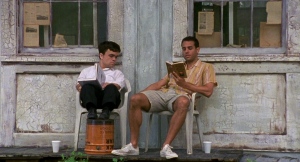 McCarthy’s movie acclimates the viewer to the simple charms of its people and the small town, getting to know the various characters and their foibles and hopes, getting used to the rhythms of this life and adjusting much like Fin. There are small victories that are payoffs, like Fin finally getting a library card, or speaking in front of a school class about his affinity for trains. It works so well. McCarthy continued his found family writing with 2007’s The Visitor and 2011’s Win Win, both anchored by the emotional enormity of sad, lonely men learning to open up to companionship. There were some dips in the road but McCarthy worked his found family magic to the biggest stage with 2015’s Best Picture winner, Spotlight, which McCarthy directed and co-wrote. His only follow-up theatrical movie was 2021’s Stillwater, where an oil rig dad (Matt Damon) tries to save his daughter overseas from a very ripped-from-the-headlines scandal (Amanda Knox was very unhappy). There is also a 2020 Disney Plus movie about a kid detective and his imaginary polar bear best friend (that actually sounds adorable). I guess I figured a Best Picture Oscar on your resume, as well as a history of working within the studio system and world of indies, would have given McCarthy more work than directing a handful of episodes for 13 Reasons Why and creating Alaska Daily. I’ll always be looking for the next McCarthy project when I can.
McCarthy’s failures can be just as intriguing as his successes. The Cobbler is just such an astounding idea that it’s hard to imagine anyone thinking it would work out, with Adam Sandler as a magic shoe-maker. However, this same pessimistic mentality probably prevailed when McCarthy was trying to raise money for The Station Agent. His indie successes proved that he could take any jumble of strange characters and turn it into a functional movie. Maybe that hubris, well-earned along with his contributions to the Oscar-nominated Up script, finally caught up with 2014’s The Cobbler. I would pay good money to one day watch that un-aired footage of the original Thrones pilot, the one the producers themselves acknowledged to be deeply troubled. After retooling the show and cast, bringing in Michelle Fairley and Emilia Clarke, McCarthy departed, though is credited for helping to secure Dinklage’s involvement, and it’s impossible to think of the zeitgeist-defining excellence of the HBO series with anyone else playing the iconic role of Tyrion Lannister.
 Re-evaluating The Station Agent twenty years hence, its many charms are still abundant and I appreciated how gentle and relaxed everything felt. When indie movies deal with heavy amounts of quirk and oddities, it can often be heavy-handed and abrasive, never letting the audience forget for a second just how special and strange and different the movie must be (here comes 2024’s look at Napoleon Dynamite). McCarthy’s movie almost feels like a writing exercise where he plucked three very different characters out of a hat and challenged himself to build a grounded movie built upon their unexpected friendships. It’s a movie confident to just let the characters speak for themselves. It’s more a slice-of-life glimpse at people who feel far more real than most Sundance indies built upon oddballs and quirk. I would slightly lower the grade from an A to an A minus simply because of the Olivia character. Clarkson is great but her role feels undeveloped, somewhat redundant, and a little sloppy. Still, the enjoyable performances, the observational detail, and the simple pleasures of a story well told with characters you genuinely care about are what shines through even twenty years later.
Author’s note: In my original review, I cite having interviewed Michelle Williams (yes, surprise, she plays the small-town librarian). While I was my college newspaper’s film critic from January 2002 to May 2004, I did have the opportunity to interview several actors and directors through phone cattle calls with other collegiate journalists. These names include Angelina Jolie (Tomb Raider 2), Billy Bob Thornton (Bad Santa), Kevin Smith (Jersey Girl), and the late Paul Walker (Timeline). However, my school schedule was not accommodating for the Williams interview, so I had my dormitory neighbor and friend Tim Knopp call in and ask my question. It wasn’t me. I’m coming clean after twenty years, folks. I also recall having him quote a line her character says in The Station Agent, saying Fin had “a nice chin,” and being told that she was baffled and blanking on the reference. I’m sorry, eventual multi-Oscar nominee Michelle Williams, for trying to be clever.
Re-View Grade: A-
Share this:

The Rundown (2003) [Review Re-View]
 Originally released September 26, 2003:
In the beginning of the new action comedy The Rundown, Beck (The Rock), a bounty hunter, is entering a club on a job. On his way in Arnold Schwarzenegger passes him by and says, ”Have fun.” Consider it a proverbial torch passing, because while Schwarzenegger is going to be busting the campaign trail, The Rundown establishes The Rock as the fresh and capable marquee name for all future action films. This man is a star.
Beck is offered a chance to square off all debts to mobster Billy Walker by agreeing to journey into the Brazilian jungle. His mission is to retrieve Travis (Seann William Scott), a hyperactive screw-up who happens to be Walker’s son. One Beck travels to the Amazon he runs into Hatcher (Christopher Walken) who claims to own the jungle and whatever contents dwell within. He asserts that Travis has stumbled upon a wealthy artifact in his jungle and therefore refuses Beck to leave with Travis. It’s at this point that the chase is on.
I don’t care what your little sister told you, Vin Diesel is not the next face of action, no, it’s The Rock. Despite only appearing in three movies (and he was only in The Mummy Returns for like three minutes), The Rock displays a razor-sharp sense of comedy. He’s also huge, likeable, and he can even emote well during smaller moments, not that The Rundown will stretch you as an actor. He’s also honed in excessive eyebrow arching.
Walken exists in a plane of brilliant weirdness that we simple human will never be able to co-exist upon. His Hatcher is one mean villain who exploits indigenous workers, wears his pants up to his armpits, and says he put the heart in the darkness. Walken’s hysterical tooth fairy monologue is worth the price of admission alone.
Director Peter Berg (Very Bad Things) adds a delectable cartoonish flavor to the film. His action sequences pop with exaggerated energy and zestful humor, like when Travis and Beck roll down a hill for a near minute. This is everything an action film should be: lively, funny, with keen action sequences that are low on CGI but filled with characters we care about. The Rundown is the best summer film not released during the summer.
The Rundown is an adrenalized punch of fabulous action and hilarious banter. When you’re not laughing and spilling your popcorn you’ll be sitting straight up to catch every lovely eyeful of spectacular action. It’s a terrifically entertaining and fun flick. The Rock has arrived.
Nate’s Grade: A
——————————————————
WRITER REFLECTIONS 20 YEARS LATER

Looking back, The Rundown really was a sea change for action cinema, and it also helps that I called it all the way back in 2003, because even a little 21-year-old me could recognize what seems almost blindingly obvious over two decades of hindsight: The Rock was a born star.
The Arnold Schwarzenegger cameo in the opening scene of the movie feels even more like a passing of the baton, as Arnie was stepping out to join the world of politics and Dwayne “The Rock” Johnson was only beginning to get started building a movie career. “Have fun,” Schwarzenegger says in passing. The wrestling phenom had built a powerful following and had begun making the leap into mainstream features with 2002’s one-two-punch of The Mummy Returns and his spinoff, The Scorpion King (did you know there are five Scorpion King movies and the 2012 edition co-starred fellow wrestler-turned-movie star Dave Bautista? Well now you do!). His appearance in the Mummy sequel was minimal, and marred by some of the worst CGI of the new century, but his solo Scorpion King adventure wasn’t quite the launching pad Johnson’s team had hoped. It wasn’t really until his fortuitous inclusion with the re-surging Fast and Furious franchise in 2010 that Johnson finally hit superstardom. However, the same magnetic appeal that would come to define Johnson as one of the biggest and more consistent movie stars in the world can be seen so evidently in 2003’s The Rundown, an action-comedy vehicle that plays to all the man’s many strengths. He’s got an immediate presence, a trained comedian’s command of timing and inflection, a gift for slapstick and lack of vanity about being goofy, and the man is just an agile and impressive physical specimen who throws himself into the rough and tumble stunt work. In short, Johnson knows how to look cool, knows how to look tough, knows how to look silly, and knows when to change gears. He’s a generational talent. My friend Ben Bailey says Johnson should play Superman because he really is Superman hiding among us pitiably frail mortals.
 The Rundown, formerly known as Helldorardo, is also an excellent launching pad for director Peter Berg, who until this time had only one other movie on his resume as a director, 1998’s relentlessly dark comedy, Very Bad Things (a film I remember “enjoying,” if that could even qualify as the correct word). This was Berg’s coming out party for the realm of bigger studio fare, and while it didn’t launch his career much like his leading man, it led to Berg’s breakout, helming 2004’s Friday Night Lights. From there, Berg has directed blockbusters (Hancock), blockbuster misfires (the unjustly maligned Battleship), and five reportedly different Mark Wahlberg action dramas from 2013-2020, though you’d be forgiven if you inadvertently confused a Spenser Confidential with a Mile 22. Berg’s docu-drama style became entrenched in 2004, though it didn’t always suit every movie equally. That’s why the movies that stand out from this default cinema verite visual style are even more remarkable for me, especially when Berg showed he can do over-the-top flashy fun violence just as good as any other big screen movie maker. His zest for the outlandish makes the movie feel like a living cartoon, but in the best way. The screen is coursing with energy but within a dedicated vision of spectacle, unlike say the mass chaos and indifference to coherency that dominates a Micheal Bay extravaganza.
Chiefly, The Rundown is just such an overwhelmingly fun experience. The actors have an infectious and combustible chemistry, bringing to mind the likes of Midnight Run and Romancing the Stone. The plot holds up well and allows for momentous action and a pleasing revolt against an exploitative villain played with panache by none other than a cranky Christopher Walken. Even while being irreverent and ridiculous, the movie still works as a story and a buddy movie, and the ending feels fulfilling and satisfying on its own terms. As I said in my 2003 review, this is everything an action movie should be. It’s exciting with engaging set pieces and outlandish stunt work but it never loses sight of its characters and their fractious screwball relationship. I love movies where the two lead characters are working against odds and constantly one-upping each other, flipping who has the upper hand. It makes for a far more unpredictable experience and ensures neither character is ever too confidently in control.
 This is an excellent movie to just put on and dash away your cares for two hours. I’ve watched The Rundown probably a dozen times, introduced friends and students to it, and everyone walks away a believer. It’s got style and banter and enjoyable characters and surprises and is just one of those movies that nobody really ever talks about but deserves to be on everyone’s DVD shelf.
Re-View Grade: A
Share this:

Gigli (2003) [Review Re-View]
 Originally released August 1, 2003:
It’s the feel-good movie of the year revolving around a lunkhead mobster (Ben Affleck) and his mentally challenged kipnapee and their attempts to covert a lesbian hitman (Jennifer Lopez) in between her yoga/horrific monologues concerning the superiority of female genitalia. Believe the hype people; Gigli is indeed as bad as they have told you. It’s not even entertainingly bad, like Bulletproof Monk, no folks; Gigli is just mundane and awful. During the entire two-hour stretch, which feels much much longer, I kept saying one thing aloud: “How could anyone making this think they were making a good movie?” Did they think audiences would find it funny that Affleck’s mother (the mother from My Big Fat Greek Wedding) shows us her big fat Greek behind? Did they really think that a mentally challenged kid (who has an affinity for gangster rap and wishes to travel to the mythical “Baywatch”) would come off as endearing? Well instead it comes across as insulting. And what else is insulting is the laugh-out-loud dialogue Lopez is forced to spit out concerning her attraction for women. I can’t think of any actress that could say the line, “I love my pussy” convincingly. And I’m sure a lot of actresses out there have true affection for it. The writing is just atrocious. And so much else fails as well. The score is a perplexing mix of upbeat jazz and inappropriate string orchestra. I don’t understand what emotions they were going for during scenes in Gigli but a full string orchestra playing music better suited for a real drama does not fit. Maybe it was for a tragedy. In that case, then it’s right on the money. You won’t see a more sloppily executed, horribly acted, painfully written, lazily directed, inept film this year. And what the hell did Christopher Walken walking in have anything to do with anything?
Nate’s Grade: F
——————————————————
WRITER REFLECTIONS 20 YEARS LATER

Gigli. It’s a word that instantly trigger shudders and shivers, a code name for fiasco, for career-destroying miscalculations. Writer/director Martin Brest was a Hollywood heavyweight with hit adult comedies like Going in Style, Beverly Hills Cop, Midnight Run, and Scent of a Woman, and since the cataclysmic disaster that was Gigli in 2003, this man hasn’t directed a single thing in these twenty years. The man is still reeling from the wafting stink from this very bad movie. I thought it might be worthwhile to revisit what I dubbed the worst film of 2003, though I was not the only critic to make this distinction, but now I’m questioning why I even bothered. It’s not like this movie was somehow going to get that much better with two decades of safe distance. The amazingly miscalculated artistic decisions will still be the same, still bad. I guess it must have been primarily my own morbid curiosity, much like revisiting 2001’s Freddy Got Figured, about whether this famous flop could still live up to its reputation. Well, dear reader, allow me to put any lingering doubts to rest you may have had about Gigli. It’s still very very very bad.
I might possibly recommend watching this once in your life (depending upon how many years you are lucky to earn) for the sheer fascination; Hollywood so easily makes mediocre and boring and familiar movies that feel like pale imitators of some prior hit, but Gigli is something different in the realm of studio stinkers, a project where just about every single creative decision warranted the incredulous Tim Robinson gif response: “You sure about that? You sure about that?” Gigli feels like two tonally dissonant movies in conflict at every moment. The plot elements feel lifted from some mid-to-late 90s indie crime comedy, the likes where they would just throw together a grab-bag of ironic provocative plot elements you wouldn’t expect together. “Mobster doofus kidnaps mentally challenged kid who is obsessed with gangster rap and wants to visit the ‘Baywatch’ which he thinks is real! Romance with a lesbian! Severed thumb ruses!” The collection of strange parts feels like it’s supposed to be a madcap, wacky comedy, and yet the tonal approach is complete treacle, with a shockingly syrupy score that rises and falls throughout, trying to convince you that what you’re watching is quixotically aiming for Oscars. It is astounding if you stop and pay attention to the film score at any moment, no matter how strange, as it attempts to provide jazzy saunter to “comedy” scenes, like an ex-girlfriend showing up into an unstable situation, and then it segues to Spielbergian emotional heft, like when that same ex-girlfriend attempts to take her own life to convince Jennifer Lopez to come back. There were so many moments where my only response possible was to avert my eyes, shake my head, and wonder whether anyone at any stage had any misgivings, tried to reach out to Brest, but then shrugged and dismissed their very legitimate worries as, “Well, he made Midnight Run after all. What do I know?” You know enough that these different tonal approaches will not work.
 Apparently, the movie was intended to be a straightforward mob comedy but the studio wanted the focus to shift toward a romance because of the actual romance between its stars, Lopez and Ben Affleck. Whenever actors begin a relationship after a movie or over the course of making one together, it provides another lens to review the movie, to gauge their chemistry and, if you’re so lucky and observant, able to “see” them falling in love with one another. That is nowhere to be found with Gigli. Maybe it was the shared experience of finding what they could to cling to while making this movie that nobody fully understood but committed to anyway (I guess love can be described the same way under some circumstances). Regardless, the romance between the two characters is, like all other plot elements, haphazard and spontaneous and foolhardy.
The characters are all awful and they never remotely come across like relatable or even remotely interesting people. Affleck’s Italian lunkhead Larry Gigli is just awash in early 2000s misogyny and bravado, dubbing himself the “sultan of slick, the rule of cool, the straight-first-foremost, pimp-mack, hustler, original gangster’s gangster.” Allow that macho boast to also exemplify another critical problem with the movie in that almost all the dialogue will make you cringe. There’s an entire monologue by Lopez, while she’s contorting her body in a plethora of lithe yoga positions, all about how superior the vagina is in appearance and function. What about when Lopez, as an indication that she wants to engage in heterosexual congress, utters the immortal phrase: “It’s turkey time. Gobble gobble.” Larry slams a kid’s computer on the ground and triumphantly says to suck an appendage of his, but then adds, “dot com” because the kid’s a nerd or something because he likes computers. Ho ho, the kidnapped young man insists that he be read to before going to bed, and what does Larry have at his disposal? Not books, oh no, so he’s forced to read him instructions on shampoo and toilet paper. Hilarious, right? What about when this same mentally challenged kid says, “When my penis sneezes, I say, ‘God bless you.’” The early 2000s weren’t an enlightened time with depiction of mental handicaps, and poor Justin Bartha (National Treasure, The Hangover) goes fully into the worst of these impulses, making the performance feel like a minstrel show for those with mental challenges. At least this aspect is not alone. Nothing ages well in this movie and its comedy only falls flatter and the drama is only more inexplicable twenty years later. It’s a special kind of bad so rarely achieved at this level of Hollywood.
Given that the majority of the movie consists of kidnapping a naïf, most of the movie is set in Gigli’s apartment keeping the man unseen and unheard from. This makes the movie feel for a long stretch like a glorified one-set play, with special appearances from traveling guest actors popping through for a brief moment in the spotlight. Here’s Christopher Walken dispensing with a monologue and then never being seen again. thanks for coming. Here’s Al Pacino, yelling so hard I’m surprised Lopez and Affleck didn’t need to wash the layers of spittle off. Here’s Lanie Kazan (My Big Fat Greek Wedding) who needs an insulin shot in her butt and let’s make sure we see her thong while we’re at it. These incursions of well-known actors re-explain the plot, not that it was hard to keep up with, and it all feels like stretching for time when the movie is already two hours long. The resolution, where our characters drive off into their sunny endings, lasts twenty minutes itself, which feels as long as the endings of 2003’s Return of the King. It’s a screenplay that feels like it’s holding itself on ice, content that the kooky characters butting heads and trading quips and monologues would be enough, and one that feels unsure of those same impulses, relying upon a revolving door of one-scene guests to remind us what we already know. It makes you feel simultaneously trapped with awful characters yet also in the hands of someone who doesn’t quite think you’re understanding the nuance and hilarity of the strained effort.
 I’m not an automatic Affleck hater. I enjoyed his rise from the films of Kevin Smith to Hollywood leading man. I can understand the draw of working with a filmmaker like Brest, and it’s probably that same appeal that lead him to also star in 2003’s Paycheck, directed by John Woo, who like Brest never worked in Hollywood again. This was the period where Affleck’s star was on the decline, and Bennifer was dominating tabloid space, and if it weren’t for the failures we might not have ever gotten Affleck as film director, so maybe we never would have gotten The Town or Argo or Gone Baby Gone had it not been for Gigli, so there’s a silver lining for you.
Look, you already know you shouldn’t even get near Gigli and with good cause. It’s a rarity to see something this colossally bad with this level of artistic freedom to be bad, not simply having too many cooks in the kitchen but having one very wayward chef nobody felt they could interfere with. This was a runaway chef, the kind of fiasco that only comes from unchecked artistic hubris. In that regard, there may be some rubbernecking appeal here for those who can endure bad characters, bad drama, bad comedy, bad acting, and horrible depictions of human beings who never at any point sound like human beings. It’s hard to watch and two hours of your precious time. 2003 began as a rough year for movies, sporting fascinating disasters like Bulletproof Monk and The League of Extraordinary Gentlemen. Watch those movies if you’re looking for a good-bad time. With Gigli, it’s only going to be a bad-bad time, whether it’s 2003, 2023, or any year until the sun explodes. Hey, if Ben Affleck and Jennifer Lopez could put this movie behind them and reunite, and even get officially married in 2022, then we can put it behind us as well.
Re-View Grade: F
Share this:

The League of Extraordinary Gentlemen (2003) [Review Re-View]
 Originally released July 11, 2003:
This movie is certifiably insane. While a very literary X-Men seems like a great idea, what exactly does Tom Sawyer bring to the table? What, is he going to convince the bad guys to white wash a fence? And yet, this highly operatic bombast almost succeeds on its sheer level of lunacy, like when you realize you’re watching Sawyer get a crush on a vampire on a giant underwater submarine that’s so big it has end tables and vases in its hallways. Still, the handling of Jekyll/Hyde here is what Hulk should have been like. League of Extraordinary Gentlemen almost works, but its falls apart amidst shabby special effects, outlandish plotting, and very wooden dialogue. The director doesn’t make it any easier to follow, trumping his action sequences with rapid fire edits. Ah well, my bafflement was more entertaining.
Nate’s Grade: C
——————————————————
WRITER REFLECTIONS 20 YEARS LATER

The League of Extraordinary Gentlemen is a fascinating film in that it cannot be good but it also cannot be bad; it exists upon an extraordinary plane where few movies ever transpire, not so-bad-it’s-good but an altogether different realm, where it would be impossible to be good while also impossible for it to be bad. It’s a bizarre yet fascinating contraption of a movie, a literary X-Men that plays to the lowest common denominator, making awe-inspiring mistakes as it careens to a bombast that approaches self-parody but lacks self-awareness to properly execute. I do not regret watching this again in 2023 but I cannot in good conscience recommend that you, dear reader, watch it, and yet I still want every one of you to.
It began as an adaptation of Alan Moore and Kevin O’Neill’s graphic novel which was itself a combination of high art (classic literature) and popular culture (super hero team-up), and from there that high-art mashup got even more… mashy… as it made its way through the Hollywood studio system to become a big, dumb summer blockbuster. You can see the appeal to the studio bigwigs, forming their own superhero team but from recognizable literary characters, and it’s fun to see these classic characters interact as well as slotted into superhero archetypes, though I’m sure there are a few academics that consider this a debasing of canonical literary figures. Jekyll and Hyde (Jason Felmyng) makes obvious sense as the Hulk of the group. Captain Nemo (Naseeruddin Shah) works as the tech-savvy Tony Stark. The immortal Dorian Gray (Stuart Townsend) is practically the group’s erudite Wolverine. I guess Mina Harker (Petra Wilson) would be this group’s Blade. There is a certain intellectual thrill watching classic characters in a new setting that relies upon them to work together and utilize their own special powers, highlighting that we’ve had superheroes long before the halcyon of the twentieth century.

Almost every artistic decision feels designed to fully baffle you if you think about it long enough, and while shattering any sense of reality, I can almost begrudgingly respect this creative license to simply go all out with the absurdity. This high/low combination makes every scene utterly ridiculous while also being fascinating. Nemo’s fantastical Nautilus sub is designed like a giant straight razor, yet the bustling interiors are so stately, including lengthy hallways with end tables and vases, a decorative motif that makes absolutely no sense on a submersible. There is a literal scene where Allen Quartermain (Sean Connery) teaches Tom Sawyer (Shane West in a terrible haircut) how to shoot better when the guy already shoots plenty good and Tom, completely oblivious, asks, “Did you teach your son to shoot like this?” But why would Tom ask that, in this moment, unless to touch upon the fact that Quartermain’s son is dead, a fact that we the audience already know? There are hidden bombs placed that will be triggered by a hidden frequency when played on a record, and somehow every corner of this floating city of a sub will hear this one record player in one room? Why even record a triggering device and have it linked to the villains explaining their plan? Why would you need to steal Da Vinci’s architectural plans for Venice when, I’m going out on a limb here, there are more accessible and modern city infrastructure plans in 1899 Venice?
So much of the character dynamics and characterization are condensed to their formula necessity. Our reluctant lead gets a surrogate son to try and mentor. Quartermain hates the British government because he blames them for his son’s death, but it’s not like he’s abandoned the luxuries of colonialism while retiring in Kenya. The invisible man (Tony Curran) gets an opportunity to prove that a criminal can reform and be counted upon. Jekyll and Hyde learn to work together rather than fighting for dominance. Mina Harker is a powerful vampire and yet her role is to be a possible love interest to the young kid on the team and to seek vengeance on her other lover, placing her entire character arcs as past romantic partner and future partner. Look at the poster art and you’ll see they had to make extra allowance to squeeze in her vampire cleavage, her real feature as far as the movie is concerned. You have a vampire on your team and the movie simply treats her as a walking set of boobs. I suppose Tom Sawyer is meant to serve as our entry point into this world as the rookie, but every character on the team is a rookie, so having an even bigger novice seems superfluous as they’re bringing the League back together, except it’s revealed later there was NEVER any League of the past, which means the bad guy literally commissioned oil paintings of past member combinations that never existed just to sell a false history that never amounted to anything (again, pick at any detail and the entire reality unravels). Even the villain’s plot is needlessly convoluted and also astonishingly simplistic: create conflict, sell arms, get money. The secondary scheme could have been accomplished by just asking each of the League members to sit for a blood test. You didn’t need to destroy Venice for this.

The colossal miscalculations extend beyond the screenplay. This movie essentially ended the career of Connery and its director, Stephen Norrington (Blade). The story goes that Connery was offered the part of Morpheus but turned it down because he didn’t understand The Matrix, and he was offered the role of Gandalf but turned it down because he didn’t understand The Lord of the Rings, and after both became cultural phenoms, Connery was determined not to let his own questions stand in the way of what could be the next sci-fi/fantasy blockbuster. Those notable “no”s lead him to regrettably saying “yes” to this silly movie, and then he was done. In the seventeen years before his death in 2020, Connery only gave a handful of vocal performances, the last one for 2012’s Sir Billie, the first CGI-animated feature from Scotland, and oh is it bad. Norrington and Connery didn’t get along during the production and at one point the director tried to goad Connery into punching him in the face. Norrington refused to make another studio movie and has gone back to his makeup and special effects background for film productions, including providing creature effects for Feast and Exorcist: The Beginning. The fact that Connery’s character dies but they end on his possible resurrection, for a possible sequel never to come, is especially hilarious knowing Connery and Norrington elected to quit their jobs after this.
At some point, you just give into the movie and try and ride its absurdist wavelength. The climax involves an assault on a giant munitions compound making… metal-cased men? Like armor? Don’t we already have that? The movie’s rules posit that the invisible man is only truly invisible when he’s fully naked, and the movie makes sure you understand this at several points, so having a climactic battle in a frigid mountain compound just makes you worry that he’s going to be blue and invisible. I love that Dorian Gray’s weakness, his infamous supernatural doppelganger painting, isn’t like locked in some impenetrable fortress but just something he carries with him, like Superman keeping kryptonite in his travel bag. I also groaned when, while fighting Mina, he stakes her to his bed and blithely says, “I always wanted to nail you one more time.” Again, simply amazing and flabbergasting. Why do we have one member of the team that shoots good when we already have another member of the team who already shoots good? I would have laughed out loud had the filmmakers actually resorted to Tom Sawyer tricking the minions of evil to white wash a fence instead of threatening the new world order. There are no standout action sequences, the special effects can be rather dodgy for its budget, and the editing is jumbled to likely mask the absence of good action choreography, but what this movie has, in rich abundance, is lunacy, a plethora of ridiculous plot elements to digest.

In 2003, I didn’t have many words to say about The League of Extraordinary Gentlemen but all of them are correct and still accurate twenty years later. This is a movie that almost works on its own level of schlocky absurdity, and yet it could never work with this approach, but it’s littered with bizarre, miscalculated ideas and plot elements that make it all the more fascinating, like a car crash of a painting. They don’t really make movies quite often on the scale of disaster that is League of Extraordinary Gentlemen, and we all benefit by examining how something like this slipped through, to remind us all of the folly of man and the strive to do better. Somebody dissect this like a case study for our benefit as a species.
Re-View Grade: C-


 nathanzoebl

You must be logged in to post a comment.